++++++++++++++++++
Sometimes I feel like this
Barely hanging on
To the main trunk of humanity
While those others blossom together
I remain attached
Because I too belong
To the spring time.
++++++++++++++++++


++++++++++++++++++

++++++++++++++++++
Sometimes I feel like this
Barely hanging on
To the main trunk of humanity
While those others blossom together
I remain attached
Because I too belong
To the spring time.
++++++++++++++++++
++++++++++++++++++
++++++++++++++++++++++
I have known that what is called Rapid Eye Movement (REM) sleep is related to dreaming. I didn’t know until now that those of us who suffer from depression HAVE TOO MUCH REM sleep and not enough Non-REM sleep (NREM). Because I woke up at 2:30 this morning and cannot go back to sleep, I thought perhaps this might be the time to take a look at this topic.
I have been thinking about this information regarding the link between depression and disturbances in dreaming from a ‘streaming’ Netflix film I watched. I found this synopsis of the program which describes another blogger’s reaction to the movie.
From ‘Radiant Recovery’, posted by By: Arwen, 3/18/2010:
“For anybody who watches Netflix, on instant view there is a documentary about sleep called “What Are Dreams?”. It’s a NOVA special. I watched it last night and heard this interesting tidbit. If you watch it the part I’m about to mention starts roughly about 12:30.
Researchers used to think that dreaming happened in REM sleep only (where your eyes are darting about under your eyelids.) It turns out that is not true, that we all also dream in non-REM sleep. They know this from waking dream study participants up during both REM and non-REM sleep and asking them if they had been dreaming, and if so, what they had been dreaming about.
Here’s the interesting part – when asked to describe their feelings coming out of both types of sleep, the words used to describe how they felt after non-REM sleep were positive. The words used to describe their feelings after REM sleep were negative.
The researcher describing this says that these results are surprisingly reliable and consistent among a variety of participants. He mentions that the amygdala, a part of the brain, is highly activated during REM sleep, and the amygdala specializes in processing negative emotions.
Now, here’s where I sort of sat up a little bit – he goes on to note that normally people fall asleep through non-REM sleep. But people with serious depression and depressive disorders – they invariably go right into REM. And “they stay in REM and they spend too much time in REM.”
I have no idea of the connections between the potato/serotonin and any sleep science. But I do know the difference between a potato-night and a non-potato night for me. On a non-potato night I feel like I fall like a heavy rock into a dark place. I feel like I’ve had a heavy sleep, but not necessarily a deep or a sound sleep. More like something has descended on me and I can’t move. But a potato night for me feels almost like I’ve been out running errands mentally, and for the first few minutes after I’m up I feel slightly, barely disoriented. Then I feel strong and vibrant.
Again, no idea if and how any of the stuff we talk about here fits together with any of this. I just thought it was a fascinating tidbit of research and wanted to share it.”
++++++++++++++++++++++
Then, of course, I wanted to take a look at some research about this interruption in the sleep cycle related to depression and located the following:
Human regional cerebral glucose metabolism during non-rapid eye movement sleep in relation to waking (2002)
“Sleep is an essential human function. Although the function of sleep has generally been regarded to be restorative, recent data indicate that it also plays an important role in cognition. The neurobiology of human sleep is most effectively analyzed with functional imaging, and PET studies have contributed substantially to our understanding of both rapid eye movement (REM) and non-rapid eye movement (NREM) sleep. In this study, PET [measures levels of brain activity] was used to determine patterns of regional glucose metabolism in NREM sleep compared with waking.
“Whole-brain glucose metabolism declined significantly from waking to NREM sleep. …The reductions in relative metabolism in NREM sleep compared with waking are consistent with prior findings from blood flow studies. The relative increases in glucose utilization in the basal forebrain, hypothalamus, ventral striatum, amygdala, hippocampus and pontine reticular formation are new observations that are in accordance with the view that NREM sleep is important to brain plasticity in homeostatic regulation and mnemonic [memory] processing.”
++++
This 2009 study used mice that were genetically modified in regard to production of a hormone that is involved in sleep cycles and dreaming states:
“Impaired sleep and enhanced stress hormone secretion are the hallmarks of stress-related disorders, including major depression. The central neuropeptide, corticotropin-releasing hormone (CRH), is a key hormone that regulates humoral and behavioral adaptation to stress. Its prolonged hypersecretion is believed to play a key role in the development and course of depressive symptoms, and is associated with sleep impairment.
“To investigate the specific effects of central CRH overexpression on sleep, we used conditional mouse mutants that overexpress CRH in the entire central nervous system … or only in the forebrain, including limbic structures ….CRH hypersecretion in the forebrain seems to drive REM sleep, supporting the notion that enhanced REM sleep may serve as biomarker for clinical conditions associated with enhanced CRH secretion.”
++++
I found this link to a Text of PowerPoint slides used by Dr. Leibowitz that includes some basic facts about sleep and dreaming.
++++
Depression deprives us of our Non-REM positive sleep stages and drops us into the highly negatively charged amygdala-driven (fear and stress response brain region) REM dream state for most of our sleeping time:
Post by Jen Robinson — “Oct 27, 2009 … Not only do most of our dreams occur in this stage, but REM dreams are also more vivid and emotionally wrought than non–REM dreams. … studies conducted during REM sleep also show increased activation of the amygdala…”
++++
Are trauma and abuse survivors continually called to TRY to process overwhelming emotional memories?
“Recent studies indicated a selective activation during rapid eye movement (REM) sleep of the amygdala known to play a decisive role in the processing of emotional stimuli.
“[Study] Results are consonant with a supportive function of REM sleep predominating late sleep for the formation of emotional memory in humans.”
++++
“Serotonin is thought to be intimately involved in the regulation of sleep and waking in humans….”
++++
“It is now well known that the visual-emotional hallucinatory aspects of dreaming occur during REM, whereas more thought-like and verbal ideational patterns are produced during NREM.”
++++
When the Brain Disrupts the Night
++++
“One night of total sleep deprivation (TSD) or partial sleep deprivation (PSD) produces temporary remission in 40–60% of patients with major depression….”
++++
{I still believe that so-called depression is an immune system response to stressors.]
Stress and Depression: Preclinical Research and Clinical Implications (2008 – Italian and Swedish authors – excellent list of references at this link, many of the cited articles are available online)
“Major depression (MD) is a severe, life-threatening, and widespread psychiatric disorder having an incidence of about 340 million cases worldwide. MD ranks fifth among leading causes of global disease burden including developing countries, and by year 2030 it is predicted to represent one of the three leading causes of burden of disease worldwide [1], [2]. MD is also a risk factor for cardiovascular and metabolic diseases, and a major risk factor for suicide [3]. Despite extensive investigations, the exact mechanisms responsible for MD have not been identified…”
“Stress is usually defined as a state of disturbed homeostasis inducing somatic and mental adaptive reactions, globally defined as “stress response,” aiming to reconstitute the initial homeostasis or a new level of homeostasis after successful adaptation, i.e., allostasis [31]–[34]. There is wide consensus and support from preclinical and clinical data that stress exposure conceivably plays a causal role in the etiology of MD and depression-like disorders [11], [27], [31], [34]. However, no specific mechanism linking stress exposure and stress response to the occurrence of MD has yet been fully elucidated. Growing evidence indicates several classical candidates, including neurotransmitters and neuropeptides, as well as conceptually novel immune and inflammatory mediators, as likely intermediate links between stress exposure, depressive symptoms, and MD [9], [21], [34]–[38]. ….
“One of the hallmarks of the stress response has long been considered the activation of the HPA axis. Hypothalamic CRH activation is a pivotal signaling molecule in the regulation of the HPA axis in particular and of the stress response in general. Therefore, comprehension of the mechanism responsible for the negative feedback regulation of CRH is of paramount importance…..”
“Knowledge on the functioning of the HPA axis under acute or chronic challenge is also a key to understanding the intimate link between stress response and the pathogenesis of depression [40]. Indeed, in all MD syndromes, a certain degree of HPA-axis disturbance is often present, visible either at the baseline or with functional tests. Despite the fact that observed changes of HPA regulation are so far not specific for the diagnosis of depression or for any of its clinical syndromes [8], altered HPA-axis parameters are considered important biomarkers, particularly in preclinical studies. Increased circulating hormones such as adrenocorticotropic hormone (ACTH) and cortisol/corticosterone or increased adrenal gland weight are considered biomarkers of stress response in preclinical models [41], including in several papers in this Collection [19], [29], [42]–[46]. Despite the bulk of data available, surprisingly current knowledge has not yet been developed to a point where HPA-axis reactivity can be rationally exploited for targeted drug treatment, as opposed to the major achievements of drugs targeting the CRH receptors [47]….”
“The link between stress and depression is not novel, and several authors have aimed at identifying new subtypes of depression based on their functional link with stress exposure (e.g., [70]–[72]).”
++++
BBC film, “Why Do We Dream?”
++++++++++++++++++++++
+++++++++++++++++++
Early attachment-relationship trauma and abuse changes us. When all is said and done, someday in the future, I believe researchers will arrive at a logical truth that I can see now — but they evidently cannot.
The research that would feed into the ‘proof’ I would need to ‘prove’ what I already know is just beginning to emerge in the fields of neuroscience, attachment, and infant-child development. Severe early attachment-related trauma, abuse, and neglect change the way the brain forms in response to PAIN. The brain changes the development of circuits that process information related to the developing-SELF-in the world.
The central processes of the brain involved in the see-saw process between rest and activity are directly tied to the nervous system process that relate to trauma-response and calm, relaxed connectedness – both to self and to others. There is — as will be shown — clearly definable trajectories of brain and nervous system changes that DID occur through early trauma within severely abusive people — including parents.
In the present moment fields of study that are beginning to define brain changes in both Borderline Personality Disorder and in schizophrenia that demonstrate these patterns. As I said in my earlier post, +IS THERE ANY OTHER WAY FOR ME TO ‘BE’ IN THE WORLD?, the concept of ‘coping mechanisms’ does not apply to infant-toddlerhood trauma and abuse survivors. The term ‘defense mechanism’ does not apply in the OLD way of understanding, either.
When early developmental trauma changes the molecular formation of the early body-brain, opportunities for CHANGE have to be considered in light of potential for conscious CHOICE. The more trauma was present during early development, the more developmental trajectories changed, the less potential there will be for consciously changing — at some magical later date — patterns of molecular operation in the body-brain. Wishful thinking does not abrogate this fact.
Researchers in the fields I mentioned are rarely interested in strictly defining the consequences of severe early infant-toddler and young childhood abuse, let alone in stopping these traumas from happening. I therefore find that reading the research that might hold the answers I am looking for is like performing delicate life-or-death surgery with a butter knife.
Defining the questions and looking for the answers about the causes and consequences of severe early trauma and abuse of infants and young children is an exercise in pandemonium. If I think in terms of the image of a triangle, I can see that research about so-called ‘mental illness’ and its so-called symptoms takes place near the point of the triangle’s top, nowhere near the ground zero supporting level of the line at the bottom where the causes and the consequences I am talking about actually take place — on the molecular level and in the very real world of unnecessary suffering that many, many people inhabit.
The further and deeper toward the supporting bottom of this triangle we look, the more cause and consequence of early abuse and trauma are connected. There is nothing glamorous about the kind of research-related thinking it will take to discover this truth.
Severe infant-toddler-young child abuse survivors currently exist within a category society considers to be ‘acceptable losses’. We are disposable and dispensable people. We were created within traumatic early environments that were themselves reflections of the kinds of circumstances those who abused us experienced in their own early lives. None of us are considered valuable enough to REALLY worry about.
We are left to survive mostly on our own, sometimes with supposed assistance from out dated, obsolete theories and treatments. There is a gross mismatch between what our needs truly are and what we are told are our solutions. Nobody is going to figure this out in my lifetime. That doesn’t stop me from trying to understand the rock-bottom truth about what happened to my mother that created the monster she was to me.
This post presents ‘pickings’ related to this topic. The stretch of thought that must happen to see how these bits of information relate to my topic takes effort. Nobody is going to do this work for us. All of us need to be encouraged to try. Again and again I have stated that from my point of view, informed compassion is the goal, not so-called forgiveness.
Our abusers were very REALLY hurt little people at one point in their lives when it mattered the most. They in turn hurt us during our developmental stages that in turn hurt us the most. This doesn’t mean that we must continue to miss the point about what these changes were and what they possibly mean.
+++++++++++++++++++
NEW CONCEPT — ‘first-person neuroscience’
How Does Our Brain Constitute Defense Mechanisms? First-Person Neuroscience and Psychoanalysis
Abstract
“Current progress in the cognitive and affective neurosciences is constantly influencing the development of psychoanalytic theory and practice. However, despite the emerging dialogue between neuroscience and psychoanalysis, the neuronal processes underlying psychoanalytic constructs such as defense mechanisms remain unclear.
One of the main problems in investigating the psychodynamic-neuronal relationship consists in systematically linking the individual contents of first-person subjective experience to third-person observation of neuronal states. We therefore introduced an appropriate methodological strategy, ‘first-person neuroscience’, which aims at developing methods for systematically linking first- and third-person data.
The utility of first-person neuroscience can be demonstrated by the example of the defense mechanism of sensorimotor regression as paradigmatically observed in catatonia. Combined psychodynamic and imaging studies suggest that sensorimotor regression might be associated with dysfunction in the neural network including the orbitofrontal, the medial prefrontal and the premotor cortices.
In general sensorimotor regression and other defense mechanisms are psychoanalytic constructs that are hypothesized to be complex emotional-cognitive constellations. In this paper we suggest that specific functional mechanisms which integrate neuronal activity across several brain regions (i.e. neuronal integration) are the physiological substrates of defense mechanisms.
We conclude that first-person neuroscience could be an appropriate methodological strategy for opening the door to a better understanding of the neuronal processes of defense mechanisms and their modulation in psychoanalytic psychotherapy.”
Copyright © 2007 S. Karger AG, Basel
++++++++++++++++++++
FROM: Deric Bownds’ MindBlog
His post — “Brain correlates of Borderline Personality Disorder”
Brownds’ article highlights the fact that the BPD brain does not process the human trust (oxytocin), cooperation and connection arm of the vagus nerve system in ordinary ways:
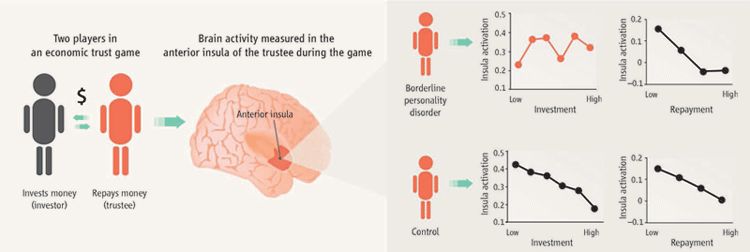 (Click to enlarge). Activation of the anterior insula is observed during an economic trust game in individuals with borderline personality disorder and healthy controls. Both groups show higher activation in response to stingy repayments they are about to make. However, only players with the disorder have no differential response to low offers from an investor (upper left graph), indicating that they lack the “gut feeling” that the relationship (cooperation) is in jeopardy.
++++++++++++++++++++
Research on trauma survivors of the Chinese Wenchuan 8.0 earthquake, demonstrated “a reduced temporal synchronization within the “default mode” of resting-state brain function.” READ ARTICLE HERE
This is the same brain area’s operation presented in this next article:
++++++++++++++++++++
January 20, 2009 by Cathryn M. Delude
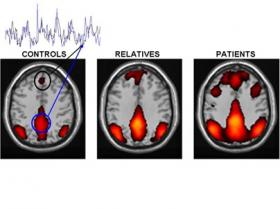
“Altered brain connectivity of default brain network in persons with schizophrenia and first-degree relatives. Colored areas represent an interconnected network of brain regions that show synchronized activity (overlapping black and blue traces) when subjects rest and allow their minds to wander. The amount of synchrony, which reflects the strength of functional connections between the different areas, is increased in patients with schizophrenia. First-degree relatives of persons with the illness also show some increase, although less than patients; this may reflect genetic effects on the brain that increase the risk of developing the disease. Black circle: medial prefrontal cortex. Blue circle: posterior cingulate/precuneus. Graphic courtesy: Susan Whitfield-Gabrieli
(PhysOrg.com) — Schizophrenia may blur the boundary between internal and external realities by over-activating a brain system that is involved in self-reflection, and thus causing an exaggerated focus on self, a new MIT and Harvard brain imaging study has found.
The traditional view of schizophrenia is that the disturbed thoughts, perceptions and emotions that characterize the disease are caused by disconnections among the brain regions that control these different functions.
But this study, appearing Jan. 19 in the advance online issue of the Proceedings of the National Academy of Sciences, found that schizophrenia also involves an excess of connectivity between the so-called default brain regions, which are involved in self-reflection and become active when we are thinking about nothing in particular, or thinking about ourselves.
“People normally suppress this default system when they perform challenging tasks, but we found that patients with schizophrenia don’t do this,” said John D. Gabrieli, a professor in the McGovern Institute for Brain Research at MIT and one of the study’s 13 authors. “We think this could help to explain the cognitive and psychological symptoms of schizophrenia.”
Gabrieli added that he hopes the research might lead to ways of predicting or monitoring individual patients’ response to treatments for this mental illness, which occurs in about 1 percent of the population.
Schizophrenia has a strong genetic component, and first-degree relatives of patients (who share half their genes) are 10 times more likely to develop the disease than the general population. The identities of these genes and how they affect the brain are largely unknown.
The researchers thus studied three carefully matched groups of 13 subjects each: schizophrenia patients, nonpsychotic first-degree relatives of patients and healthy controls. They selected patients who were recently diagnosed, so that differences in prior treatment or psychotic episodes would not bias the results.
The subjects were scanned by functional magnetic resonance imaging (fMRI) while resting and while performing easy or hard memory tasks. The behavioral and clinical testing were performed by Larry J. Seidman and colleagues at Harvard Medical School, and the imaging data were analyzed by first author Susan Whitfield-Gabrieli, a research scientist at the MIT Martinos Imaging Center at the McGovern Institute.
The researchers were especially interested in the default system, a network of brain regions whose activity is suppressed when people perform demanding mental tasks. This network includes the medial prefrontal cortex and the posterior cingulate cortex, regions that are associated with self-reflection and autobiographical memories and which become connected into a synchronously active network when the mind is allowed to wander.
Whitfield-Gabrieli found that in the schizophrenia patients, the default system was both hyperactive and hyperconnected during rest, and it remained so as they performed the memory tasks. In other words, the patients were less able than healthy control subjects to suppress the activity of this network during the task. Interestingly, the less the suppression and the greater the connectivity, the worse they performed on the hard memory task, and the more severe their clinical symptoms.
“We think this may reflect an inability of people with schizophrenia to direct mental resources away from internal thoughts and feelings and toward the external world in order to perform difficult tasks,” Whitfield-Gabrieli explained.
The hyperactive default system could also help to explain hallucinations and paranoia by making neutral external stimuli seem inappropriately self-relevant. For instance, if brain regions whose activity normally signifies self-focus are active while listening to a voice on television, the person may perceive that the voice is speaking directly to them.
The default system is also overactive, though to a lesser extent, in first-degree relatives of schizophrenia patients who did not themselves have the disease. This suggests that overactivation of the default system may be linked to the genetic cause of the disease rather than its consequences.
The default system is a hot topic in brain imaging, according to John Gabrieli, partly because it is easy to measure and because it is affected in different ways by different disorders.”
Provided by MIT
++++++++++++++++++++
Activation of Anterior Insula during Self-Reflection
This link describes yet another research study that links the brain default resting mode to self-reflection, a process that was seriously flawed in my borderline mother:
“The results provide further evidence for the specific recruitment of anterior MPFC and ACC regions for self-related processing, and highlight a role for the insula in self-reflection. As the insula is closely connected with ascending internal body signals, this may indicate that the accumulation of changes in affective states that might be implied in self-processing may contribute to our sense of self.”
++++++++++++++++++++
Processing of autobiographical memory retrieval cues in borderline personality disorder
Affective dysregulation [emotional dysregulation]in borderline personality disorder (BPD) in response to both external stimuli and memories has been shown to be associated with functional alterations of limbic and prefrontal brain areas….
Response “processing in BPD subjects were in line with previously reported changes in anterior cingulate and orbitofrontal cortices, which are known to be involved in memory retrieval. However, BPD subjects displayed hyperactivation in these areas … The deficit of selective activation of areas involved in autobiographical memory retrieval suggests a general tendency towards a self-referential mode of information processing in BPD, or a failure to switch between emotionally salient and neutral stimuli.
++++++++++++++++++++
I believe that emotional pain is as physiologically real as is physical pain. I also believe that the pain of malevolent early infant-child trauma, abuse and neglect creates changes in the developing brain that result in changes in these pain-reduction brain areas.
FULL ARTICLE FREE ONLINE:
Keeping pain out of mind: the role of the dorsolateral prefrontal cortex in pain modulation
“…the bilateral dorsolateral prefrontal (DLPFC) exerts active control on pain perception by modulating corticosubcortical and corticocortical pathways.” READ FULL ARTICLE HERE
++++++++++++++++++++
Dissociable Brain Mechanisms Underlying the Conscious and Unconscious Control of Behavior
— 2010 – Journal of Cognitive Neuroscience, MIT article
“Cognitive control allows humans to overrule and inhibit habitual responses to optimize performance in challenging situations. Contradicting traditional views, recent studies suggest that cognitive control processes can be initiated unconsciously….. [This research study presents]… patterns of differences and similarities between conscious and unconscious cognitive control processes are discussed in a framework that differentiates between feedforward and feedback connections in yielding conscious experience.”
+++++++++++++++++++++++++++++++
RESEARCH ARTICLE ABOUT CHANGES IN THE BORDERLINE BRAIN – CHANGES THAT MY MOTHER NO DOUBT HAD THAT CREATED HER ABILITY TO TORMENT, TORTURE AND TRAUMATIZE ME —
Please follow the active link for this title to read the full article including full references that I have omitted in these quotes below:
AUTHORS: Michael J. Minzenberg, Jin Fan, Antonia S. New, Cheuk Y. Tang, and Larry J. Siever
PUBLISHED: Psychiatry Res. 2007 August 15; 155(3): 231–243.
“…converging evidence suggests that the social and emotional disturbances of BPD may have a basis in the functional neuroanatomy of social/emotional information processing, supported by fronto-limbic circuitry….
“BPD patients exhibit a number of changes in the structure and function of subcortical limbic areas. This includes volume loss and lower resting metabolism in the amygdala and hippocampus … some studies have found amygdala volume to be preserved … The functional effects of this limbic pathology include elevated amygdala responses to emotional stimuli …and episodic memory deficits … which may be due to intrinsic hippocampal pathology or secondary to amygdala hyperactivity ….
“BPD patients also exhibit deficits in the structure and function of the rostral and subgenual subregions of the anterior cingulate cortex (ACC)…. The ACC may be a key neural region where altered processing of social and emotional information is expressed in some of the hallmark clinical signs of this disorder. The ACC is necessary for the maternal separation distress call of infant squirrel monkeys … and is activated in healthy adult humans both during the subjective experience of social rejection …and during effortful control of subjective emotional responses …. These experimental paradigms are related to clinical phenomena that are very characteristic of BPD, such as social attachment disturbance, rejection sensitivity and emotion dysregulation, respectively ….
+++++++++++++++++++++++++++++++
Neural paths for borderline personality disorder
People prone to stormy social lives display brain activity that may prompt oversensitivity to emotion and an inability to resolve conflicting information
By Bruce Bower
DOES THIS SOUND at all familiar?
“New brain-imaging research suggests that in people with borderline personality disorder, specific neural circuits foster extreme emotional oversensitivity and an inability to conceive of other people as having both positive and negative qualities…. Borderline personality disorder affects one in five psychiatric patients…. Most people have an important capacity for resolving conflict: the ability to perceive both favorable and negative aspects of the same person. Lacking this skill, borderline patients find it easier to veer back and forth between regarding those they know as either wonderful or awful….”
(My mother sure never ‘veered’ in her feelings toward me – no veering whatsoever! I was completely and totally ‘awful’ while the chosen good child, my sister, was the ‘wonderful’ one.)
+++++++++++++++++++++++++++++++
See also this post on the resting brain default mode:
+SOMETHING WENT TERRIBLY WRONG WITH MY MOTHER’S PRECUNEUS
++++++++++++++++++++
++++++++++++++++++++++++++++++
What is empathy? The definition given by the authors whose research article on the topic I am presenting today define empathy as “an emotional and behavioral response to another’s emotional state, which is similar in affective tone and is based on the other’s circumstances rather than one’s own.”
Because my blog is concerned with the ongoing consequences a person acquires from having experienced severe abuse, trauma and maltreatment during their infant-childhood, knowing what empathy is and is not matters because we did not grow up – obviously – within an early environment where empathy was shown to us by our earliest caregivers.
At least that’s what I have always assumed to be true until this moment as I prepare this post. My life as my mother’s victim was entirely distorted by her psychosis and mental illness. At this moment, a thought has occurred to me that seems almost too bizarre to print – but might also be close to the truth.
Given that my mother did not seem able to operate from a conscious stance in regard to me, it might be possible that she WAS practicing her version of empathy with me. What if, as an infant and very young child she suffered so much that on her unconscious level she KNEW nobody empathized with her. What if her treatment of me was (bizarrely) intended to create a human being that COULD empathize with her early feelings?
It is often suggested that a person like my mother splits off her own ‘badness’ and projects it out onto the chosen child so that this child becomes the container for the intolerable self hatred. That picture matches what I can see of my mother’s treatment of me as she hated and abused me from birth and for the next 18 years I lived in her home.
What if, as a component of this sickness, she also was directly projecting out onto me her own experience of how awful it felt to be made to feel that BAD in the beginning of HER life? How better to create another human being who could empathize with her own feelings than to reenact patterns of abuse with me that would have the end result of making me feel as BADLY as she did?
I was not human to my mother. I was the devil’s child. That much I know. I was not a separate, unique (wonderful) individual person to my mother. I was her projection of her own evil badness that somehow she internalized as a very young person herself. How better to make ME absolutely understand what this process of being bad, of being treated as a bad child could feel like than to force me to ALSO experience this reality?
Of course making someone feel as badly as we do is NOT what the process of empathy is about. I think about a story my mother used to tell from her young adulthood. She went horseback riding one summer’s day and happened to be on a misbehaved horse that she evidently lacked the skill to control. The horse wanted to be in the barn, and solved its problem by racing across a meadow directly under the low lying branch of a tree. The end result, predictably, was that mother landed on the ground and the horse returned home.
My mother used this experience as a reason that none of her children should ever ride horse. But more importantly, I want to use this event as an example of bizarre empathy potential. What if my mother needed to know that somebody else could directly empathize with what that ‘being knocked from the back of an out-of-control horse’ felt like to her? What if the only way she could guarantee that someone else could empathize with her was by reenacting the same event?
What if she had the power to place her child, say me, upon the back of a similar run-away horse and recreate the experience for me — so that I might exactly know what she felt like on the day it happened to her? When I look at my mother’s interactions with me from this perspective, I could say that she knew EXACTLY how her treatment of me made me feel.
This is twisted. There is no better word I can think of than twisted to describe how a mind could work like this. But twisted my mother’s mind was in regard to me – completely, fundamentally and absolutely. I would say the same thing about the perpetrator of maltreatment of any helpless victimized infant-child. At the same time, now that this strange perspective has entered my thinking about what my mother did to me, I understand that my thinking might be absolutely correct.
To the degree that she retained within her own unconscious the terror, pain, misery, helpless hopelessness, and feeling of being overwhelmed as a victimized child (if, in fact, she was – we will never know her true infant-childhood circumstances completely), she certainly communicated to me through her treatment of me what it was like to grow a body-brain-mind-self that included abuse experiences that created similar feelings within me. She worked very hard to make sure that I felt as terrible as was humanly possible, and she did a very good job.
My mother’s pattern of interacting with me was, of course, the opposite from the definition of empathy as “an emotional and behavioral response to another’s emotional state, which is similar in affective tone and is based on the other’s circumstances rather than one’s own.” Her only concern was for her OWN experience. She was not remotely concerned with mine as a separate ‘other’. She never recognized that I even existed as a person or had my own ‘circumstances’, let alone was separate and different from her self.
My mother’s patterns fit the extreme end of what these authors (below) describe as ‘anti-empathy’. Whether or not she intended it, my mother certainly communicated to me what it felt like to be an abused child, just as my father communicated to me what it felt like to be a dismissed and avoided child. As we continue to reenact with others the patterns of attachment that were built into us through our earliest caregiver interactions, we correspondingly ‘help’ others to know how we felt being the recipient of those same attachment experiences our self. (Be sure to take a look at the EMPATHY MATRIX below.)
NOTE: When I fell in love with a man that some people might say is like my father, what I now recognize is that they share the similar avoidant-dismissive attachment pattern/disorder that I am extremely familiar with – and that I resonate with! It is, thus, the attachment pattern that I internally and automatically recognize. Otherwise, as people, they are far different from one another. Did I unconsciously recognize this dismissive-avoidant attachment pattern because the feelings created inside myself in response to it are identical between the two relationships?
++++
Today I am presenting information from an article about how early caregiver attachment experiences intertwine with the later ability or disability to experience true empathy. This article is about ground breaking research on how empathy can be seen to operate within preschooler interactions. These empathy patterns persist over time. They do not appear out of nowhere.
For those of us who suffered from abuse, trauma and maltreatment in our infant-childhoods, this information can help us to understand the empathy process that we were prevented from benefiting from when we needed it most – as our body-brain-mind was forming patterns of attachment into our growing and developing self. (All bold type and underlining is mine, my notes are in italics)
++++++++++++++++++++++++++++++
“Individual Differences in Empathy Among Preschoolers: Relation to Attachment History” — By Roberta Kestenbaum, Ellen A. Farber, L. Alan Sroufe, in New Directions for Child Development, Vol 44, 1989, 51-64
++++
EMPATHY
“The ability to express emotions clearly,
to recognize others’ expressions of emotions,
and to react appropriately to them
are all important for accurate communication and regulation of relationships. (Kestenbaum/ID/51)”
“…what an individual comes to understand about emotions in the self and others in early relationships may have an impact on later responding to emotional reactions of others. (Kestenbaum/ID/51)”
EMPATHIC RESPONSE to “another’s emotional state”
“…recognizing and experiencing the emotion of the other. (Kestenbaum/ID/52)”
“Individuals who in the past have had their emotional needs met (for example, through a caretaker’s sensitive and consistent responding) may be better attuned to the emotional needs of others
without confusing them with their own needs,
thus allowing for a truly empathic response. (Kestenbaum/ID/52)”
++++
++
“affective perspective taking”
cognitive orientation
“empathy as the knowledge or understanding of another’s feelings. (Kestenbaum/ID/52)”
“affective perspective taking is necessary but not sufficient for empathy (Kestenbaum/ID/52)”
++
empathy defined also “in strictly affective terms, as a vicarious affective response. (Kestenbaum/ID/52)”
COMBINING THE TWO APPROACHES ABOVE:
++
“…in essence, both cognitive and affective elements are involved in this response. (Kestenbaum/ID/52)”
DEFINITION:
AUTHORS’ DEFINITION:
“…an emotional and behavioral response to another’s emotional state, which is similar in affective tone and is based on the other’s circumstances rather than one’s own. (Kestenbaum/ID/55)”
++
“…empathy is defined as
being able to discriminate the affective states of others, knowing how another feels, and vicariously experiencing the aroused emotion (Feshback, 1982; Underwood and Moore, 1982).
Similarly, Iannotti (1978) has defined empathy as an emotional response to the perspective of another. (Kestenbaum/ID/52)”
“Hoffman (1978) suggests a broad definition of empathy, with the major criterion being that the individual’s affective response is more suited to the other individual’s situation than to his or her own circumstances. (Kestenbaum/ID/52)”
++++
[author mentions “emotional contagion” without clarifying how it can “contaminate” (my word) the response of empathy]
“Another issue is whether, for a response to be empathic, an exact match of affect should be required or only a match to positive or negative tone…..Some responses, particularly those by young children, may be excluded not because of insufficient arousal, but because of immature cognitive and motoric abilities to produce an exact match. (Kestenbaum/ID/52)”
“This investigation is concerned with how the quality of early relationships predicts later responding to emotional distress….relationship experiences are internalized and carried forward to other relationships. (Kestenbaum/ID/54)”
“The present study was undertaken to look at later effects of early relationships and to compare children who had secure attachment histories with children who had avoidant and resistant attachments. Infants were tested at twelve and eighteen months of age with their mothers in the Ainsworth Strange Situation. They were classified as securely attached, anxiously attached-avoidant, or anxiously attached-resistant. (Kestenbaum/ID/54)”
“Because securely attached children presumably have had their emotional needs met as infants and have received responsive, empathic caregiving, they should have developed the capacity to readily respond empathically. (Kestenbaum/ID/54)”
“In Bowlby’s (1973) terms, in the context of early relationship experiences, infants and young children develop inner working models of self and other. This is more than the learning of roles; rather, children internalize the very nature of relationships themselves. (Kestenbaum/ID/54)”
SECURLY ATTACHED
“Thus, in experiencing sensitive caregiving, the securely attached child not only learns to expect care, but more generally learns that when a person is in need, another responds empathically. (Kestenbaum/ID/54)”
AVOIDANT ATTACHMENT
“In sharp contrast, children who show avoidant patterns of attachment are thought to have experienced repeated rejection in times of emotional need….though they may become aroused at another’s distress, they will have no framework for responding adequately. (Kestenbaum/ID/54)”
“They may defend against the feelings that are aroused. Thus, avoidant children are most likely to appear unempathic, at times displaying attacking behavior or (Kestenbaum/ID/54) inappropriate affect. (Kestenbaum/ID/55)”
ANXIOUS-RESISTANT ATTACHMENT
“…children who have anxious-resistant attachment histories are thought to have experienced inconsistent care. (Kestenbaum/ID/55)”
“In the face of strong feelings, they remain anxious, confused, and uncertain. (Kestenbaum/ID/55)”
“They may show arousal and some responsivity, but because of their disorganization and anxiety, they have difficulty acting empathically. (Kestenbaum/ID/55)”
“Due to problems in maintaining distance between themselves and others, they may be confused as to who is experiencing the distress. (Kestenbaum/ID/55)”
In this study:
“Empathy was measured in naturally occurring situations of distress during free play in a preschool setting….we chose to focus only on reactions to others’ distress….Children’s responses to others’ distress were rated for the
degree of empathic responding. To more clearly delineate differences between the groups, we also included
measures of inappropriate affective responding (anti-empathy) and
occurrences of blurring the boundaries between what is happening to another and what is happening to the self. (Kestenbaum/ID/55)”
++++
EMPATHY MATRIX
Matrix, matron and matter are all related to Latin word “matre”
Thirteen Things to Think About:
WHEN INTERACTING WITH HER INFANT
+ 1. Degree of accurate versus inaccurate perception of infant’s feelings by the mother. Projection of her feelings onto the infant is a form of inaccurate perception.
+ 2. Degree of accuracy of the mother’s perception and consciousness of her own feelings
+ 3. Degree that the mother can set her own feelings aside when interacting with infant
+ 4. Degree of accurate versus inaccurate perception of infant’s needs. Projecting her needs onto the infant is a form of inaccurate perception.
+ 5. Degree of accuracy of mother’s perception and consciousness of her own needs
+ 6. Degree that mother can set her own needs aside when interacting with infant
+ 7. Degree of genuine yet exaggerated-staged quality of emotional reaction in response to a young infant. (This playful way is what an infant needs to grow its brain correctly.)
+ 8. Degree of literal quality of emotional reaction in response to a young infant (Young infants cannot tolerate a direct and literal response to their feelings. This response overwhelms and scares them. I am not using literal to mean the same thing as genuine.)
+ 9. Degree of appropriateness of response (expectations – whose need/emotion is it?)
+ 10. Degree of intent to help – safe/benevolent
+ 11. Degree of intent to harm – threat/malevolent. Projection of an ulterior motive onto the infant that it has the intention of harassing the parent in any way is harmful.
+ 12. Degree of availability and accessibility to infant (investment – attention – two edged sword if the interactions are traumatic and threatening).
+ 13. Degree of consistency and dependability to infant (builds trust and hope or chronic fear)
++++
[Due to the condition of my mother’s mind, she never had a genuine interaction with any of her children. Everything my mother thought, did or felt was from the “pretend mode” thinking place as she never left the magical world of her early childhood.
She could not, therefore, experience empathy with anyone.
I don’t think there is anyway to “fix” this. It might be like color blindness. If we don’t have empathy, don’t have mindsight, don’t have the ability to mentalize, it’s like not being able to see the color red. And if a person is color blind, they cannot become a military pilot. They must do something else. And that something else might be “choice therapy.”]
++++
Mean age of the 24 children in the study, split equally between girls and boys, was 48.7 months. Children were part of a longitudinal study at the University of Minnesota.
[I note that they never mention insecure disorganized attachment. Did those mothers not participate in the overall study]
B – securely attached
A – anxious-avoidant
C – anxious-resistant
“When they were twelve months old and eighteen months old, they participated with their mothers in the Ainsworth Strange Situation to assess the quality of the mother-infant interaction. In this procedure, the infant has the opportunity to explore a novel situation with and without the mother present, and with and without a stranger present. Based primarily upon behaviors when the child is reunited with his or her mother after brief separations, the children are classified into one of three groups. (Kestenbaum/ID/56)”
“Securely attached (B) infants respond positively to mother’s reappearance and can use the other as a source of comfort if distressed. (Kestenbaum/ID/56)”
“Anxious-avoidant (A) infants actively avoid their mothers when they return and do not respond differentially to mother and stranger. (Kestenbaum/ID/56)”
“Anxious-resistant (C) children become very distressed during separations but on reunion are not readily calmed. They often show anger but resist efforts to comfort them. (Kestenbaum/ID/56)”
[they have a table of empathy and anti-empathy scales used to score the children on p. 57]
++++
teacher’s reports:
items that “form a coherent factor, named empathic relatedness (Kestenbaum/ID/58)”
– Is considerate and thoughtful of other children.
– Is helpful and cooperative.
– Shows concern for moral issues (for example, reciprocity, fairness, and the welfare of others)
– Uses and responds to reason
– Tends to arouse liking and acceptance in adults
– Shows a recognition of the feelings of others; is empathic
– Tends to give, lend, and share
– Can be trusted; is dependable.
++++
“There were few responses of anti-empathy, but of the twelve that were observed, nine incidents were by children with anxious-avoidant attachment histories, two incidents were by children with anxious-resistant attachment histories, and one incident was by a child with a secure attachment history. (Kestenbaum/ID/59)”
“Six instances were observed in which children appeared to blur the boundaries of who was transgressed. Of these, four involved children with anxious-resistant attachment histories, and two involved children with secure attachment histories. (Kestenbaum/ID/59)”
measured children in distress
“…behavioral responses, such as approach or vocalizations of concern, were observed much more often than emotional response…..Thus, it is still not clear what the relation is between affective and behavioral indexes of empathy. (Kestenbaum/ID/59)”
“…teachers can capture affective-behavioral dimensions of empathy in the Q sort. (Kestenbaum/ID/60)”
++
“…if prototypic models of self, other, and relationships are forged in early attachment experiences, it is expectable that children experiencing responsive care not only will be able to seek care later, but will be emotionally responsive to others as well. (Kestenbaum/ID/60)”
“…we consider this work on empathy to be strong confirmation of Bowlby’s theory. (Kestenbaum/ID/60)”
++
“It could be argued that the empathic behavior that we are seeing is a product of current parenting.
Bowlby’s theory states explicitly that development is always a product of past history and current circumstances.
Yet an infant that does not experience empathy gets a different brain.
If a child’s circumstances had changed dramatically, an early history of secure attachment would not guarantee empathic responsiveness.
And yet their brain did form secure circuits.
In this sense, early secure attachment is not seen as causing later empathy. (Kestenbaum/ID/60)”
Nonetheless, early attachment assessments are viewed as reflecting a developmental process commonly associated with individual differences in empathy. (Kestenbaum/ID/60)”
++
“The quality of the attachment relationship in infancy was indeed related to empathic responding in preschoolers. Specifically, children with secure attachment histories were more likely to have a greater empathic response (behaviorally and emotionally) to another’s distress than were children with avoidant histories. (Kestenbaum/ID/60)”
“How an individual is accustomed to interacting with early relationships, particularly with a caregiver, will be carried forward as expectations in later relationships. This creates a self-perpetuating cycle [expectations] in which an individual who expects to interact with others in the same (Kestenbaum/ID/60) way as in previous relationships creates a situation that will realize that expectation. (Kestenbaum/ID/61)”
creates a situation that will realize that expectation –[ I don’t see how they are explaining this part of things. The children here reacted to situations as they existed. They did not create them.]
“Thus, children with secure attachment histories have in the past received consistent, sensitive caregiving in times of distress. These children come to develop a sense of trust and identify with caregivers who respond empathically toward them. Because their own emotional needs are presumably satisfied, they develop the capacity to respond emotionally, sensitively, and empathically toward others in later relationships. (Kestenbaum/ID/61)”
“Children with avoidant attachment histories, on the other hand, experienced rejection from their caregivers in times of emotional need. Without an empathic model to identify with, they are less capable of responding appropriately to another’s distress. [This is more than having a model – these patterns of responding and processing information are built into the brain circuitry of these children!] As infants, they did not experience consistent emotional support, and later in life, they do not seek it. Accustomed to avoiding emotions [and this related to their bodies also. Is this a form of dissociation?] , they continue to do so in later relationships, by not responding emotionally or by responding inappropriately. Of the twelve incidents of anti-empathy observed in this study, nine were by children with avoidant histories. The differences observed between the secure group and the avoidant group are probably not due to differences in cognitive abilities such as affective perspective taking, since responding maliciously also requires the ability to realize that another person is experiencing emotional distress. (Kestenbaum/ID/61)”
“As infants, resistant children had trouble being comforted, and it was expected that as preschoolers they would continue to have difficulties controlling their own affect. Based on their past histories of inconsistent, ambivalent relationships, it was predicted that children with anxious-ambivalent [they are being inconsistent with their labels here] attachment histories would be
too preoccupied with their own discomfort to react as empathically as the secure group or as unempathically
as the avoidant group. Statistically, however, the resistant group could not be differentiated from either of the other two groups on present measures of empathy, though their average score fell between those of the other two groups, as predicted. (Kestenbaum/ID/61)”
IMPORTANT
“Although the anxious-resistant group could not be differentiated by empathy measures, the observations of children who seemed to have
trouble separating another’s distress from their own suggest a more appropriate way of beginning to distinguish this group. Although only six instances occurred of children
appearing to blur the boundaries of who was experiencing distress, four of them were by children with anxious-resistant attachment histories. If anxious-resistant children have more
difficulty differentiating between the self’s and other’s emotional states, they will experience the other’s emotional state as their own personal distress and be
less likely to respond empathically…..
Behaviors indicating boundary problems, such as seeking comfort from teachers when another is distressed, should be explored more fully. (Kestenbaum/ID/61)”
need to “look at the extent of the blurring as well as the cognitive aspects of differentiating the self from other (Kestenbaum/ID/62)” — suggestions for future research
It would seem that this is all tied to their preoccupation with their own discomfort.
This would cause them to have difficulties separating another’s distress from their own.
I would suggest that there is a direct link between their inconsistent experiences and this boundary blurring, as well as with the preoccupation.
Because of their preoccupation and blurred boundaries, they will not SEE another’s distress — so similar to the avoidant group, there would be nothing to respond TO.
– communication patterns and rhythms.
++++++++++++++++++++++++++++++++
+++++++++++++++++++++++++++++
In light of the formative nature of the mother-infant interactions that lead to the development of the human right limbic emotional-social brain as presented in my last post, +HOW DOES THE SELF GET FORMED? HERE’S A WHOLE LOT OF IMPORTANT INFO, it is perhaps one single range of related emotions that creates the most ongoing, lifelong problem: Terror.
See search: fear and infant brain development
For those of us who were maltreated as infants, it might well be that this emotional range was not only NOT regulated by our interactions with our mother as this last post describes, but our terror was also AMPLIFIED by the very person who was supposed to protect us and keep us safe and secure.
I suspect that within this emotional range related to terror we live the rest of our lives with both the inability to adequately regulate it — but also with far more terror experience built into us that most people might be able to imagine.
The terror range includes not only fear, anxiety and panic, but also dread, foreboding and uneasiness that includes the sense that we are always waiting for something bad to happen – something scary and overwhelming.
As my last post explained, these emotional reactions were created in us long, long before the reason-able abilities of our brain were formed and developed. They exist on a very physiological level within our body itself. Our body, in its feedforward and feedback information signaling loops, keeps us continually aware that danger and threat are not far away. We cannot rest, relax, or ever assume that we are safe and secure. Instead, we are always prepared to survive what we cannot see – that which we have anticipated (and often received) since the earliest times of our life = trauma.
Ours is a cellular early warning system. Ours is a continual state of warning and high alert, operating often well outside our range of conscious awareness.
Our terrorizing and terrifying experiences happened to us often way before we had words to think thoughts with. They happened while the very brain that we NOW think with was forming itself. If the mothering we received was inadequate and/or scary, the nameless fear became a fundamental part of who we are from the time of our beginning.
Most of us are thus naturally so used to the presence of this ‘structural terror’ that we cannot imagine ourselves in the world feeling any other way. This state is a ‘given’ one for us. If we can be honest with our self, the times when we have truly felt (while not under the influence of a drug) absolutely safe, secure, relaxed and calm are the exception in our life rather than the rule.
If we don’t consciously feel this state of ill-at-ease all of the time, we know it is never far away because we know we risk this terror state overwhelming us unexpectedly and often seemingly out of nowhere. Our entire body-brain-mind-self exists as a trauma alarm system that never runs out of batteries and never turns itself off.
We can experience this undercurrent of trauma-response in our body as a hypersensitivity to anxiety (e.g. anxiety, PTSD) or as a hyposensitivity (e.g. depression). If our earliest caregiver-infant interactions were not as positive as the one’s described in my last post, we need to understand and expect that our vagus nerve system and its connection to our autonomic nervous system (ANS – ‘stop’ and ‘go’ branches) have been disrupted.
I just wanted to point this out today in response to the post I just published. I KNOW what this chronic state of underlying dread feels like. I live with it nearly every single moment of my life. I have become unbelievably aware of this fact since my children have all left home. During the 35 years of my adult life I had dependent children living in my home, my caregiving system’s operation superseded my awareness of my chronic inner state of alarm. Now that they have left home and live on their own, I notice that my alarm system runs nearly all of the time.
Being able to dissipate the power my inner alarm system has over my states of being requires nearly continual conscious monitoring. I do not know how to shut it off or how to regulate this inner state of foreboding so that it will go away. I doubt that is even possible. At least by studying the kind of information I posted earlier today I at least have a much clearer understanding of where this alarm system came from and how it was formed very early into my right limbic emotional-social brain and body through traumatic early experiences with my out-of-control violent and abusive mother.
+++++++++++++++++++++++++++++++++++
++++++++++++++++++++++
In memory of my mother, and of the monster that ate her, here are some links I am behind on (catching up!) on information about Borderline Personality Disorder.
++++++++++++++++++++++
But — First This, with gratitude to the person who sent me this link:
Well-Being Is Related to Having Less Small Talk and More Substantive Conversations
++++++++++++++++++++++
+++++++++++++
From Kristalyn Salters-Pedneault, PhD
Your Guide to Borderline Personality Disorder.
It is not uncommon for people with BPD to be misdiagnosed with another disorder before getting the correct diagnosis. Many clinicians who are less familiar with BPD might assign someone a diagnosis of chronic depression, or bipolar disorder, or even an anxiety disorder. Learn more about diagnosis of BPD.
|
|
||||||||||||||
| BPD and Violence – The Facts, Not the Stigma Do men and women who have BPD commit more violent acts that the general population? Are all people with BPD violent? To what kinds of violence are people with BPD most prone?
Understanding the Cluster B Personality Disorders While BPD is associated with impulsive violence, there are other personality disorders that are associated with premeditated violence. Learn more about the Cluster B personality disorders. What is Phone Coaching and How Can It Help You? One important aspect of dialectical behavior therapy (DBT) for borderline personality disorder is phone coaching. What is phone coaching, and how can it help you cope with symptoms? Understanding Borderline Personality Disorder Learn more about the symptoms and associated features of borderline personality disorder, including emotional and relationship instability, impulsivity, suicidality, self-harm, and more. Proposed Revisions to the DSM – Are Big Changes on the Way? The American Psychiatric Association (APA) recently posted the proposed changes to the upcoming edition of the Diagnostic and Statistical Manual of Mental Disorders (fifth edition). Find links to the relevant changes and share your reaction. |
||||||||||||||
| The Current BPD Diagnostic Criteria If you want to see just how big the changes are, here are the DSM diagnostic criteria for BPD as they currently stand. | ||||||||||||||
| What’s In a Name? Many are surprised that the term “borderline” is not being replaced in the DSM-V. Learn more about the history of the name controversy here. | ||||||||||||||
| Stigma and BPD For years, in the United States and abroad, public information campaigns have tried to combat the stigma associated with mental illness. Unfortunately, these campaigns don’t seem to have been successful.
BPD versus Bipolar Disorder – How to Tell the Difference The primary reason that some clinicians confuse BPD and bipolar disorder is that they share the common feature of mood instability. Learn how to tell the difference between BPD and bipolar symptoms. How is a BPD Diagnosis Made? How is BPD diagnosed? What symptoms contribute to a BPD diagnosis? And who made up these diagnostic criteria anyway? Learn all about BPD diagnosis. What to Expect from a Good BPD Assessment Many people have been misdiagnosed after an inadequate or incomplete assessment. What should an assessment look like? How do you know you’ve been thoroughly assessed? These guidelines will help you understand how to get a good BPD assessment and what to expect. Understanding Borderline Personality Disorder Learn more about the symptoms and associated features of borderline personality disorder, including emotional and relationship instability, impulsivity, suicidality, self-harm, and more.
Must Reads
|
++++++++++++++++++++++
+++++++++++++
I am getting way behind on posting information links on child abuse prevention and Child Rights. Here’s a post for catching up!! Just click, roll and scan – follow any links that appeal to your interests.
+++++++++++++
New Site about Kids’ Health for Parents
Posted: 10 Mar 2010 08:40 AM PST on Prevent Child Abuse New York’s Blog
Many parents, upon discovering their child’s stuffy nose, rising fever or latest injury, retreat to the computer to do some research. Other parents may consult Google to find answers about developmental questions, potty training or sleeping difficulties. While this can be helpful, the sheer volume of information available on the internet can be overwhelming and at times inaccurate. Good news, parents. The search for reliable information about child health and development just got easier.
The American Academy of Pediatrics (AAP) recently launched a website that’s backed by 60,000 pediatricians. Healthychildren.org offers detailed answers to questions that parents have about their child’s well being. This website encourages parents to be proactive about their children’s health, providing reliable, up-to-date information.
Healthychildren.org is divided into multiple, easy to use sections, which include Ages and Stages, Healthy Living, Safety and Prevention, and Health Issues.
Although Healthychildren.org is an easy and convenient way to receive the up-to-date information, parents should always consult with their own pediatrician as well.
++++
Excellence in Child Abuse Prevention Awards
Posted: 15 Mar 2010 12:19 PM PDT on Prevent Child Abuse New York’s Blog
Prevent Child Abuse New York and New York’s Children and Family Trust Fund are proud to announce the 15th annual award recognition of excellence in the field of child abuse prevention in New York State.
Qualified nominees will have had an impact on any of four levels:
The awards will be presented at the 15th Annual Child Abuse Prevention Conference, Education, Inspiration & Solutions , being held at the Marriott Hotel in Albany, New York, April 26-28, 2010.
Individuals, organizations and companies are all eligible for nomination.
For more information about the NYS Child Abuse Prevention Conference and the Excellence Awards, please call 518-445-1273.
+++++++++++++
From CRIN – Child Rights Information Network
9 March 2010 – Child Rights at the Human Rights Council 58
Side event on national violence strategies [news]
A side event at the 13th Council session tackled the issue of violence against children, with delegates discussing the publication and implementation of the Council of Europe’s new Council of Europe Policy guidelines on integrated national strategies for the protection of children from violence.
Hannu Himanen, Permanent Representative of Finland to the United Nations Office, began the event by quoting the 2006 UN Study on Violence Against Children, which emphasised that action on violence requires an integrated plan. He said: “A piecemeal approach does not do the job.”
“For example”, he said, “in Finland, my country, the governement banned corporal punishment in 1984. This was an important step, but still it occurs. A recent study showed that one quarter of Finish adults accept the notion of corporal punishment.”
Mr Himanen said that a quote from Thomas Hammerberg, Commissioner for Human Rights at the Council of Europe, at the 20th CRC anniversary conference, had stayed with him. Mr Hammerberg said: “It is paradoxical and an affront to humanity that the smallest and most vulnerable people should have less protection from assault than adults.”
Lothar Friedrich Krappmann, of the Committee on the Rights of the Child, said: “The adoption of these guidelines is a significant step in the protection of violence against children.”
He went on to emphasise that: “No violence against children is acceptable. All violence against children is preventable.” Mr Krappmann said this was not limited to physical violence, but also mental abuse.
He said there had not been enough coordination between different initiatives, programmes and policies. “These guidelines affect more than 200 million children,” he added.
Marta Santos Pais, Special Representative to the Secretary General on Violence Against Children, also presented at the event. She said: “Regional organisations such as the Council of Europe can have a huge influence in regional implementation of standards, and aid cross fertilisation.”
The Council has been very influential in promoting a regional platform, she continued. In 2010, many countries have not adopted a violence strategy, even though the UN Study on Violence Against Children stated all countries should adopt a strategy by 2007. This should also include laying down markers for implementation. These European guidelines help to address some of these requirements and are relevant everywhere, she added.
She said: “I believe that promoting the dissemination of these guidelines will help us move forward on implementing the UN Study’s recommendations, and could provide a good framework in countries all over the world.”
Lioubov Samokhina, Head of the Children’s Rights Policies Division at the Council of Europe, spoke about the development of the guidelines, and the approach taken in the drafting process. “The main objective of the guideline is to promote a culture of respect for the rights of children, and to stimulate change in the attitude towards children and childhood,” she said. The main aim of the guidelines, she added, was to encourage States to develop a multi-faceted and systematic framework.
Idália Moniz, Secretary of State for Disability, Portugal, spoke of her country’s efforts to adopt an integrated and model strategy. She emphasised the importance of redefining budgets. Portuguese criminal law was changed in 2007 to outlaw all forms of corporal punishment. Cooperation is needed on all levels, from local researchers to policy and decision makers, she said.
NGO role
Peter Newell, of the NGO Advisory Council on Violence Against Children, spoke of the role of the non-governmental sector.
He said: “We are speaking about all violence, however slight. There is an adult tendency to draw a line between so-called softer forms of violence.”
He said the biggest role for NGOs was advocacy. “I think these guidelines are an advocacy tool of great value,” he added.
Mr Newell said there is still a long way to go, within the Council of Europe, and everywhere else. Mechanisms are still not being used to promote an end to all violence against children, and no country can claim to have an effective strategy against violence against children when some forms of punishment are still legally endorsed.
Twenty seven of the 47 Member States have still not prohibited all forms of violence against children, and in many countries corporal punishment is still permitted in institutions such as care homes. It is inconceivable that States would defend legalised violence towards any other groups, such as women, people with disabilities or elderly people, Mr Newell said.
Retrospective research studies interviewing young adults about their childhood show many had experienced sexual assault and other forms of violence, but they did not report it, in part because of a mistrust of social services. He said: “Proper child protection systems must involve children being systematically invited to give their views on such systems.”
Mr Newell said it was important that, while it is usually NGOs that facilitate child participation for government programmes and policy, it should really be governments themselves that are involving children directly.
“It is fine for NGOs to provide demonstration and pilot projects, but in doing so it is important we are not colluding with governments in their failure to fulfil their obligations,” he said.
A change in attitudes requries long-term campaigning. Mr Newell also mentioned how some church and faith groups were embracing an approach against violence, while evidence of abuse in such institutions is becoming more publicly acknowledged.
He said he felt conspiracy laws should be used against those groups that attempt to cover up evidence of sexual exploitation and other forms of violence towards children.
During the discussion following the presentations, a delegate asked if there had been any positive examples of the international dissemination of the guidelines. Ms Samokhina spoke of plans to organise events on the guidelines, inviting international representatives from a range of countries and organisations.
Mr Krappmann said it is “such a hard job” to eradicate violence against children, and that it is “not just the job of European States, but of all States.”
Ms Santos Pais noted that international cooperation was also essential in respect of the migration of children.
About the guidelines
In line with the recommendations of the United Nations Committee on the Rights of the Child and of the United Nations Secretary-General’s Study on Violence against Children, these guidelines were developed to promote the development and implementation of a holistic national framework to safeguard the rights of the child and to eradicate violence against children.
The guidelines are based on eight general principles (protection against violence, the right to life and maximum survival and development, non-discrimination, gender equality, child participation, a state’s obligations, other actors’ obligations and participation, best interests of the child) and four operative principles (multidimensional nature of violence, integrated approach, cross- sectoral co-operation, multi stakeholder approach). These have been mainstreamed throughout, including into sections on integrated national, regional and local action; education and awareness-raising measures; legal, policy and institutional frameworks; research and data collection.
Further information
For more information, contact:
Council of Europe
Building a Europe for and with children, DG III- Social Cohesion / Council of Europe, B Building – Office B137, F – 67075 Strasbourg Cedex
Tel: +33 3 88 41 22 62; Fax: +33 3 90 21 52 85
Email: children@coe.int
Website: www.coe.int/children
Visit: http://www.crin.org/resources/infoDetail.asp?ID=22119
++++
OMCT: Violence against children in detention
ECPAT : Children’s right to protection from sexual violence
Defence for Children International: Statement on Prosecution of children in military courts
Women’s World Summit Foundation: Statement on violence against children
Further information
++++
COUNCIL OF EUROPE: Call for papers on ending sexual violence [news]
This call for papers is addressed to legal, health, social, research and education professionals wishing to contribute to a Council of Europe study on sexual violence against children. The study will serve as a background for the Council of Europe awareness raising campaign to stop sexual violence against children.
The Council of Europe campaign
The Council of Europe Strategy on the Rights of the Child (2009-2011) has amongst its major focuses that of eradicating all forms of violence against children. In particular, it calls for launching comprehensive awareness-raising actions to prevent and combat sexual exploitation and sexual abuse of children.
In response to this mandate, in autumn 2010, the Council of Europe will launch a pan-European campaign to stop sexual violence against children. The campaign’s overall objective will be to raise European societies’ awareness of the full extent of sexual violence against children and to equip them with knowledge and tools to prevent it. The campaign will address the various forms of sexual violence including child pornography, child prostitution, online grooming, child sex tourism and child sexual abuse.
The future study
Given the complexity and sensitivity of the issue at stake, the Council of Europe wishes to prepare a study to inform and guide the campaign. The study should cover inter alia the following dimensions:
The proposed length for research articles addressing one of the aforementioned issues should be no more than 8,000 words (about 15 to 16 A4 pages, normal spacing) and should be submitted in one of the official languages of the Council of Europe, i.e. English or French.
Following the selection procedure, a limited number of experts will be invited to work with the Council of Europe on a contractual basis, during the period between April and June 2010.
Building a network of professionals
The experts who will contact us will be also invited to express their interest in cooperating with the Council of Europe in the various projects and activities to be launched during the campaign, the objective being to build a network of professionals wishing to bring their expertise and the results of their work to a community of practice at European level.
How to contact us
Please fill the document enclosed and send it, accompanied by your CV to Ms Marie-Francoise GLATZ (marie-francoise.glatz@coe.int) by 31 March 2010 at the latest.
For more information, contact:
Council of Europe
Building a Europe for and with children
DG III- Social Cohesion / Council of Europe
B Building – Office B137
F – 67075 Strasbourg Cedex, France
Tel: +33 3 88 41 22 62; Fax: +33 3 90 21 52 85
Email: children@coe.int
Website: www.coe.int/children
Visit: http://www.crin.org/resources/infoDetail.asp?ID=22165
++++
Further information
+++++++++++++
+++++++++++++++++++
I just discovered these drawings I created in pencil when I was six – what a treat!
from Age 6 – April 1958
We had lived in Alaska nine months when I drew these pictures that I just found in one of the letters my mother wrote to my grandmother in April 1958. I had turned 6 the 31st of August 1957.
It delights me to discover these pictures almost 52 years to the date later. It’s obvious to me that I was already in love with Alaska. Our family had not yet staked claim to the homestead. April 1958 is the month my father hiked back into the valley and discovered the piece of land that he then laid claim to (I had not seen the homestead when these were drawn).
When we love, we love with detail, and in the specifics of my drawings I can see that love I had and still have for the natural world.
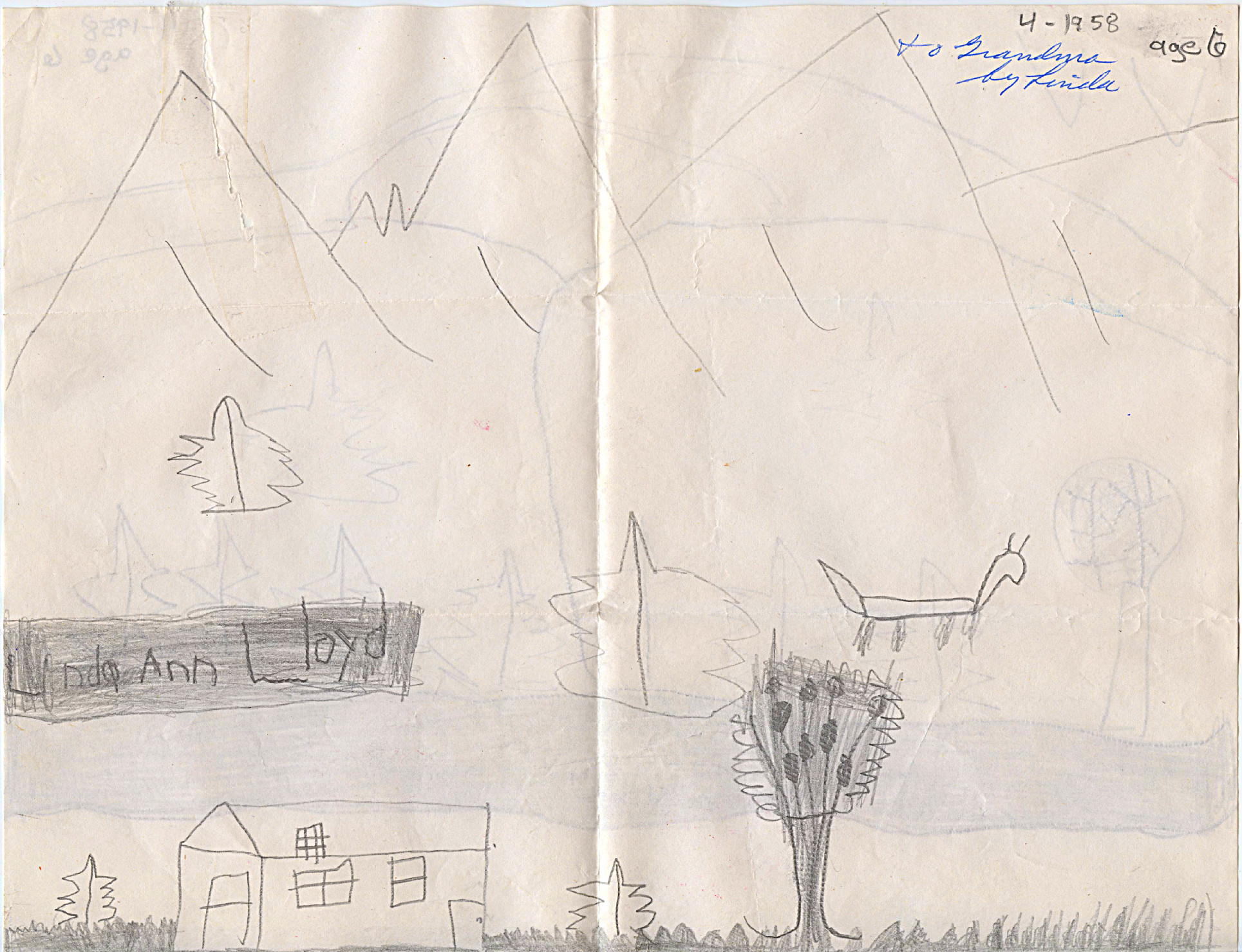

I believe this land saved me along with this love that I had for this land. I was absolutely attached to the place of Alaska – everything about the natural world made perfect sense to me. It fit within me and I fit within it. We were perfectly made for one another.
What would have happened to me if we had not moved to Alaska and the same abuse had occurred to me without this place and my love of it to sustain and nurture me? Was I able to utilize some very ancient ancestral DNA memory of being fundamentally connected to the natural world that is, in our culture, being nearly forgotten? A mother’s love for her child returned here in these 2 simple images.
NOTE: Interesting, not a flower in sight! Drawings seem very structural to me, solid, well framed, but no ‘frivolous’ flowers!
++++++++++++++++++++++++++++++++++++
++++++++++++++++++++++++++++
“…effortful control has been related to higher levels of emotion regulation, sympathy and prosocial behavior, internalized conscience, committed compliance, and social competence.”
++++
My thinking never wanders very far away from wondering about how some people react to other people in their lives. Being somewhat aware of the trauma, drama, stress, distress and duress my daughter is in the middle of right now with her premature newborn, Connor, in neonatal intensive care where she still cannot even HOLD him, kept me from being able to sleep well last night. As a result, I came into the kitchen for my first morning cup of coffee today with far more questions in my thoughts than I had answers for.
Always when I discover that someone I care about and who is (or has been) an important figure in my life acts (or did act) in ways that are beyond my ability to comprehend I have to wonder what happened ‘way back then’ in their lives that supports and in-forms how they act in their life.
Specifically this morning I was wondering about true and genuine empathy and compassion. I think again about Dr. Dacher Keltner’s writings even about the difference between a phony smile and the only true and genuine smile – the D-smile. A genuine smile cannot be physiologically faked. It corresponds to actual and very real operations within a person’s body and brain that occur in one way and in one way only.
Although we do not pause every time we see a person smile and consciously analyze whether their smile is fake or genuine, this extremely fast (in the fraction of a millisecond range) response is immediately analyzed by us within our own social-emotional body-brain response system so that we KNOW without question – automatically and correctly – how fake or genuine anyone’s smile is as we see it.
Yet all the other human behaviors that are physiologically linked into the same body-brain vagus nerve and autonomic nervous system responses most often are not as clear to us. A smile, as a single, simple human emotional-social response, is just one of many, many human responses that happen through these same response systems.
++++
I am thinking about my daughter’s heart wrenching sobs that consumed her last night in her grief of not being able to hold her newborn. As hard as it is for her, this grief is a welcome, most appropriate and necessary response. If she felt detached and blithe about the absence of her tiny infant from her arms, that baby would be in big, deep trouble.
Yet even in thinking about my daughter right now, I also think about the response of others surrounding her in her life. Watching the near pandemonium that has resulted from the unanticipated too-early birth of this baby, I can see the difference between what is a natural unfolding drama, and what is happening with others in her life that reeks of trauma drama.
How can we tell the difference?
When do we see overlapping dramas unfolding around us?
My guess is that as we learn to discern the difference between genuine responses to another’s distress from ‘fake’ ones we can at the same time let ourselves know that we are watching the effects of past unresolved traumas operating. The problem is, if the traumas happened early in a person’s development, particularly in the first year or two of life, the responses that we may be victim to or witness of are not under the conscious control of those displaying them. The behaviors are automatic and completely tied into the physiological construction of the body brain of the ‘actor’.
++++
Just as we can actually say that a fake smile is NOT a smile – because the only true smile is a genuine D-smile, we can also say that any and all displays connected in their origins to our vagus nerve and autonomic nervous system as they, in turn, connect to our brain result in EITHER a genuine and real display of empathy and compassion, or they result in FAKE empathic and compassionate actions that are not the real thing.
How can this be possible?
I suspect that people can ACT in ways that mimic empathy and compassion in the same way we can mimic a smile. People can DO things that appear to be generous and considerate, can appear to happen with another person’s interest (rather than self interest) in mind — but in fact, when we analyze the entire picture of the presence or absence of trauma drama in the expression, we can see and know the difference.
Most simply, I can think about how my mother laundered clothes, prepared meals, taught table manners, or accomplished any of the so-called mothering duties that she knew how to perform – and did for her family. And yet I cannot ever assume that she performed these actions with genuine, empathic, compassionate concern for the well-being of her family.
I do not believe my mother had the physiological body-brain capacity to experience empathy or compassion (in part as shown by her inability to experience true embarrassment or to ever admit she was wrong).
True, real and genuine consideration and caring for other people happens, in my thinking, when people can access the calm, connecting operations of their nervous system and brain. Some peoples survival and stress response are active ALL of the time. Everything they do, every action they perform, ALL OF THEIR CONCERN is really about their own survival in the world. They are constantly assessing the degree of danger and threat their SELF might be in. Everything they do and say includes on some level (rarely conscious) a consideration of their own – NOT THE OTHERS – degree of well-being.
These people’s inner resources are depleted to the extent that they cannot ever genuinely be concerned for another person’s welfare. True, they can TRY to do good, feel good, be good – but trying to do and actually doing are not the same thing. This all becomes most obvious under circumstances when another person is in great need, such as my daughter is right now.
When other people around her go through the motions of caring about her, and even as they try to help, the relative position of the helper’s self to the ‘helpee’ can be seen. When on any level the helper needs to be congratulated, appreciated and/or recognized for their ‘good deeds’ or ‘good intentions’, suspect that early developmental traumas interfered with the development of the helper’s ability to experience true empathy or compassion.
What is really happening is that the helper-giver feels continually depleted and thus continually needs replenishment from outside of their own self – from others – even the needy one they are trying to offer something good to. Sometimes the neediness of the helper-giver will show up as passive-aggressive pleas for attention and recognition. Sometimes it will show us as sarcasm, irritability, even sabotage within the giving situation.
Sometimes it happens that the person who needs assistance simply finds no response helpful forthcoming from those they might expect to help them, or even rely and depend on to help them (as with inadequate parenting of children).
According to attachment experts, when a person has an insecure attachment and their attachment needs are thus never adequately or completely met, this person’s caregiving system will never be able to be activated appropriately, either. In cases of so-called earned secure attachment, or what I call ‘borrowed attachment’, it is possible that the caregiver’s insecure attachment system (that is never actually deactivated) CAN still caregive.
But at the same time their are inner costs to be paid by both giver and receiver when this pattern exists. Most simply put, at least within these altered patterns of caregiving past unresolved trauma, and their corresponding trauma dramas are not at front and center. They simply hang around in the wings exerting less of an influence on ongoing relationships — but they are not absent completely. As a result, these caregiving patterns can be very precarious, fragile and vulnerable to easy upset should the right conditions show up in the present that threaten these kinds of secure attachment relationships (such as I had and have with my children).
++++
It is completely natural that we hope for, desire, want and at times truly NEED a caregiving response from other people in our lives. But we need to pay attention to what our gut tells us. We can tell the difference between giving presented by securely attached versus insecurely attached people in our lives – as surely as we can all, REALLY, tell the difference between a fake and a genuine smile.
When people deprive us of care we need, such as abusive and neglectful parents do to their dependent offspring, these patterns of inadequate caregiving are obvious. But as adults, these patterns can be far more difficult to detect because of both the subtleties and the complexities of the relationships with have with others.
Any time we sense something negative within our own self tied to any kind of assistance we receive from another, we need to trust this sense. It is real. As we become more clear and conscious about how we feel in relationship to how others act toward us, we can become more clear about how UNCONSCIOUS those other people probably are about their own intentions and actions.
Most often we are unaware of how it feels within our own self to have our attachment system activated. At those times WE NEED from others. At those times our own caregiving system is either off completely or on idle. When we are in a state of need ourselves, it can be extremely difficult to give to others. Yet most of the time we can be completely unaware of how all these related caregiving versus personal need transactions are happening.
++++
Because our emotional-social brain, and all the nervous system connections within our body, were formed during our earliest stages of development, we are most often not going to have the ability to notice how we are responding to those around us. These early developments within our body-brain were (and are) designed to operate automatically. We have to choose to become in-formed about how they take over our lives – including our thoughts, feelings and behaviors.
I am going to introduce a simple concept here today (click on the title of the article or go to this blog’s page +Effortful Control for the full manuscript) that is really taking a look at how and where the ability to experience true and genuine empathy and compassion for another person originates. This glimpse, however, as you will see as you take a look at the following notes from the article, is taking place ‘down the road’ from the earliest brain-nervous system development that takes place from conception to age (about) of six months to a year of age.
Already by the age of toddlerhood the fundamental experience of being a self with emotions has already been built into the body-brain. What this article is explaining is how outward behavior can already be changed from optimal due to ineffectual and inadequate early attachment patterns with early caregivers, particularly with the mother. This has to do with our progressed abilities that are built upon the ability to recognize and regulate emotions, an ability (or not) that is built into the earliest forming right limbic emotional-social brain and that affects our abilities to interact with our own self and with others for the rest of our life.
Notes from taken from the article:
Effortful Control
Some researchers have conceptualized emotion regulation in terms of children’s effortful or voluntary control as opposed to more reactive forms of control
Effortful control has been defined as “the efficiency of executive attention, including the ability to inhibit a dominant response and/or to activate a subdominant response, to plan, and to detect errors”
Effortful control is characterized by the ability to voluntarily focus and shift attention and to voluntarily inhibit or initiate behaviors, and includes behaviors such as delaying; these processes are integral to emotion regulation
For example, effortful attentional processes can be used to regulate emotions, such as turning away from something distressing
Empirical work has shown that orienting behaviors serve a regulatory function during an anger inducing task in infancy
In comparison to emotion regulation, the construct of effortful control is viewed as a broader construct that includes an array of skills that can be used to manage emotion and its expression
Whereas effortful control is seen as reflecting voluntary behavior, reactive control refers to aspects of functioning such as impulsivity and behavioral inhibition
Reactive control refers to behavior in which individuals are undercontrolled and are “pulled” toward rewarding situations (i.e., impulsivity) or behavior in which individuals are overcontrolled and are wary in response to novelty, inflexible, and overconstrained (i.e., behavioral inhibition).
Reactive control is not considered to be part of self-regulation, and reactive undercontrol and effortful control are generally negatively related
Reactive processes seem to originate primarily in subcorticol systems, whereas executive attention, the basis of effortful control, is believed to be situated primarily in the cortex (e.g., the anterior cingulated, lateral ventral, and prefrontal cortex
effortful control is thought to emerge in late infancy and to develop rapidly during the toddler years.
Improvements in inhibitory control are exhibited between 6 and 12 months of age, and it is believed that more mature effortful control is partially evident by 18 months of age and continues to improve greatly from 22 to 36 months of age
Moreover, individual differences in toddlers’ effortful control are relatively stable in the early years and from early childhood to adolescence and adulthood
On the other hand, reactive control likely develops earlier than effortful control and may be intimately related to emotional reactions, such as fear, seen in infancy
– attentional regulation (one component of effortful control)
– inhibitory control (another component of effortful control).
– internalizing problems in toddlers (separation distress)
– reactive overcontrol (inhibition to novelty).
– separation distress probably involves the inability to control negative emotions such as anxiety or sadness/depression
Children who are able to control their attention and behavior are expected to manage their emotions, plan their behavior, and develop and utilize skills needed to get along with others and to engage in socially appropriate behavior.
Indeed, effortful control has been related to higher levels of emotion regulation, sympathy and prosocial behavior, internalized conscience, committed compliance, and social competence.
The Relations of Maternal Emotion-Related Socialization to Children’s Effortful Control and Social Functioning
Although children’s effortful control reflects constitutionally based individual differences in temperament, the environment also plays a role in the development of these characteristics maternal sensitivity has been linked with infants’ and young children’s self-regulation and a reduction in negative emotion.
In toddlerhood, children with more responsive mothers have been found to display higher effortful control maternal warmth/support observed in the early years has predicted children’s ability to shift attention at 3.5 years of age, and parental warmth has been linked to children’s appropriate affect expression and regulation of positive affect.
The main goal of the current study was to examine whether toddlers’ effortful control mediates the relation between mothers’ supportive socialization strategies and four constructs reflecting the quality of toddlers’ socioemotional functioning (i.e., separation distress, inhibition to novelty, externalizing, and social competence).
In summary, in this study, we examined the relations of maternal supportive parenting to toddlers’ effortful control and social functioning at 18 months of age and 1 year later. We began the study when children were quite young because effortful control is thought to make significant improvements in the 2nd year of life, and toddlers’ problem behaviors have been found to predict maladjustment years later.
We chose to measure children’s internalizing and externalizing problem behaviors because these problems often reflect children’s deficiencies in controlling emotions and behavior. In addition, children’s effortful control likely facilitates social competence. Finally, we used multiple reporters and included observational measures of toddlers’ effortful control and maternal supportive parenting.
++++
As we begin to pay closer attention both to how we interact with others during times of needs, and to how they interact with us (and in our thinking about how our abusive early caregivers interacted with us), we can begin to see that when trauma built the body-brain, effortful control has been affected. As difficult as it might be to accept, this means to me that perhaps most behavior that harms others IS NOT INTENTIONALLY designed to harm another person.
This is NOT to say that ‘reactive control’ behaviors are not harmful. What I am seeking to better understand is how these behaviors can happen AT ALL, particularly when they occur in situations where a person is vulnerable (including infant-childhood). All the above information relates to later, adult stage enactments of trauma dramas.
When true consideration for another person’s feelings and needs cannot overcome a trauma-built person’s OWN feelings and needs, true empathy and compassion cannot exist. All attachment disorders include some component of this fact. As a consequence, everyone with an insecure attachment pattern, built into their body-brain through less than optimal early caregiver interactions, suffers from an empathy disorder.
That certainly includes me and many people that I know.
++++
CHILD’S BOOK ON COMPASSION:
 Tenzin’s Deer by Barbara Soros and Danuta Mayer
More Children’s Books about Compassionate Action
++++++++++++++++++++++++++++
+++++++++++++++++++++++
How necessary is the “Who is proud of whom for what?” game?
I feel strange. I am face-to-face with some part of my self that can do things some other parts of my self know nothing about. I was going to back for a few minutes today and write about something I introduced the other day when I mentioned feeling proud for our children (an for our self?).
From the blog post: Pride in the successes, achievements and accomplishments of one’s child is just another emotion and state of being that abusive parents are deprived of. The children of these parents are then deprived of having parents who truly appreciate them for the wonderful people that they are.
I was going to return to one of the chapters I skipped in Born to Be Good: The Science of a Meaningful Life. He included a chapter on ‘awe’ that I wanted to read this morning because I suspected that the ability to feel awe, an experience connected to the feel good-be good happiness, compassion and connection arm of our vagus nerve system is involved in the experience of pride as well as of awe.
Problem is for me at this moment, I cannot find his book anywhere in my house. True, I was having problems sorting out what I could believe, accept and understand in Keltner’s writing from what I suspected was grounded in arrogance and bias, but how did I manage to vanquish this book from my sight at the same time I have no memory of doing so?
I have many books on trauma on my book shelves. Keltner’s book is not among them. I have searched through every pile of papers, on every table top, every book shelf, in short I have looked everywhere in my house where I could have possibly placed that book once I was done reading it, and the book is nowhere to be found. I can’t believe I would have either trashed or donated the book without having some memory trace of having done so. Evidently I really DIDN’T like that book! Hum…….
So I guess I will have to wing the writing of this post about pride and the vagus nerve as I figure out what I know on my insides about this experience. Meanwhile, this me of today is very curious about where Keltner’s book is eventually going to make its reappearance in my life! It HAS to be here some place, but I sure have managed to hide it from myself.
This experience of missing this book makes me wonder how much can we and do we manage to hide from our own self in our life, not even realizing that we are doing so? I have to wonder at this moment. How much do we put away, disguise, place ‘out of sight, out of mind’ in our life because our ability to tolerate has diminished something to the point we simply cannot or will not deal with it any more? (Was I THAT sick of Keltner?)
++++
So at this point, as I continue down the pathway of “What is pride?” on my forensic autobiographical journey, I call not Keltner as my first witness, but my dear sister, Cindy. When we spoke about the topic on the telephone last night, she mentioned that from the Christian training she had in her young adult lives, she knows that the word and concept of RESPECT is directly tied in its roots to AWE.
She also affirmed that never once to her knowledge was my mother ever proud of me. Also, in her memory, she knows of only one single instance where she knew absolutely that our mother was proud of her. That happened when my sister trained our family’s dog for an obedience dog show and they won first place. Mother didn’t SAY anything to Cindy, but Cindy knew mother was proud of her.
One of my own questions about pride enters my thoughts right now, though I’ll wait for a moment to consider it. I find myself wondering, “Is the feeling of being proud of another person tied more to conditional love than it is to unconditional love? Is there a difference between the experience of feeling proud – really for the other or for one’s own self – based on a conditional valuing based on what a person DOES rather than on who a person IS irregardless of what they actually DO?”
But, first, to finish the thoughts from last night’s conversation with my sister, I have to mention that she told me that in all her 56 years, it has been her observation that the topic of pride is a VERY SENSITIVE ONE to many if not most people. She believe that all of these people suffer their entire lives from a wound that means they continually ACT in ways that they WANT to create a demonstration of pride for them from their parents.
The saddest part of this is that this lack of feeling ‘proud for’ existed in their earliest years and continues to be a part of adults’ feeling reality for their entire lives – and is rarely if ever fulfilled so that the DESIRE is gone. As a consequence, people then feel empty in a place that is never filled. It sounds to me like there’s a wound that never heals about this, a hole that’s always there, a continually unmet attachment need that then affects how a person IS in their body, in relationship with their own self and with others, for their entire life time.
My sister understands for herself that the root of ‘awe’ that is a part of ‘respect’ means that when we hear someone say to us, “That is awesome,” we are really receiving from that person a fundamental recognition of our worthiness based on fundamental respect. My sister believes that once we lose respect for another person, our relationship with them changes – often instantaneously – forever. Evidently being able to have respect for another person is somehow directly tied to our ability to feel pride for them.
++++
If this is true, I have some searching to do in order that I can understand with clarity within my own self how this respect-awe-pride pathway might actually work. Even though I cannot locate Keltner’s book anywhere in my house, I know he connected ‘awe’ to the healthy operation of the vagus nerve system just as he did embarrassment, genuine D-miles and compassion – or he would not have included a chapter on ‘awe’ in his book.
I already know that something was wrong with the operation of my mother’s feel good-be good vagus nerve system branch. I can understand that her stress response was “ON” all of the time. As a result, her “STOP” arm of her vagus nerve system and of her autonomic nervous system (ANS) could never be activated toward true peaceful calmness and connection to others. She was not safely and securely attached to her own self or to anyone else.
Now I can add her lack of ability to feel pride for me, and just barely for any of her other children, to the list of ‘symptoms’ of her infant-childhood changed growth and development from trauma, abuse and neglect.
++++
From this point forward in today’s writing I have to make it clear that I think the way I do in a particular way that gives me a bias on the topic that most people do not have – either most fortunately or most unfortunately. I evidently have some strange immunity regarding the subject of whether other people feel proud of me or not that came from my mother’s abuse of me.
I have written in previous posts that my mother’s demise that led her development down a pathway where she was incapable of experiencing either well-being for her own self or in connection to anyone else happened (I suspect) because of the very traumatic experiences she had with her earliest caregivers as they gave her so-called love that was insanely and unreasonably conditional. She grew up believing that her personal ‘badness’ caused her caregivers to hate her. If she could only be ‘good enough’ she could bask in the warmth of their love.
Hers was an environment of terrible and terrifying betrayal. This betrayal broke her. I had the benefit of having never been betrayed. I knew she hated me from the first breath I took. My mother did not vacillate. She did not wander away from her first stated course of action toward me from the time I was born. My mother never swerved off of her course. In her mind, I was not human. I was the devil’s child, bad beyond possibility of redemption.
I was never tricked into believing in any way, ever, that there was anything I could do NOT to be hated and abused. I was never fooled into believing that if I could be ‘good enough’ that she would love me. I was never given false hope either than I was loveable or that my parents could possibly love me.
True, I am painting a grim picture almost beyond belief. I can see this even though I know that the picture I am painting was absolutely real. At the same time I am saying that the absolute devastation of my infant-childhood gave me at the same time the possibility of surviving it as I grew into the person I am now.
I will give you this bizarre yet accurate image: If we could imagine an infant being born into a world where no air was ever available either that infant would die or it would find a way to endure in spite of the absence of air. If this is the reality this infant faced, and it did manage to adapt and survive anyway, the concept of ‘air’ and the experience of needing it or of being dependent upon its presence would simply never exist.
Of course we know no human can live without air. But if we substitute love for air in this image, I can assure you humans can manage to endure without it. I basically did. What little bit of love-air I found came from my 14-month-older brother, and very occasionally from contact with my grandmother and father. Eventually I became an absolute professional at being able to endure and survive on such a pitifully inadequate supply of love-air that it’s almost beyond belief. But because it was love that I was deprived of rather than of air, my body kept on enduring and growing through its developmental stages because it could adapt to these devastating conditions.
++++
As a consequence, I cannot conceive of the world the way my sister seems to, or in the way that evidently MOST people do. I have no ability to imagine ever wanting or desiring my mother or father to feel proud of me. It is not possible for me to do so. Therefore, I cannot probably empathize with all the other people who ‘have issues’ concerning their need or desire for this ‘feeling proud’ of them by their parents – or anyone else.
On some levels, having just realized this about my self is very scary. Yet at the same time the benefit of the pattern of abuse I received seems obvious to me. Nothing my mother did or did not do to me altered my ability to feel proud of or for my own children.
That’s pretty darn amazing! I could call this miracle, but I understand that in no possible way are my abilities, as they are so different from my mother’s, a miracle. My abilities, as are everyone’s, lie within me because they are physiologically possible. My mother lacked these abilities because they were physiologically impossible for her.
My body-brain-mind-self development did not ever include the possibility of my mother loving me, or with the possibility she could be correspondingly proud of me. Impossible is exactly just that – impossible. Only when the POSSIBILITY exists of something happening do we ever wish for it, desire it, hope for it, anticipate it, or expect it. I knew from the moment I was born there was no possibility my mother loved me, conditionally or unconditionally. Her love for me or her lack of it was never an issue. Things were simply the way that they were and that was that.
In other words, the issue of ‘sometimes’ or of ‘some of the time’ didn’t exist for me. Ever. My mother did not play the tug-o-war, and I mean WAR, game with me of ‘sometimes I will love you’ or of ‘some of the time I love you’ or of ‘I would and could love you if only……” She just fundamentally hated me. How strange, and looking at this from this present moment, how freeing for me this ACTUALLY was.
I did not learn how to conditionally love. I did not learn how to conditionally BE loved. At the same time, though I don’t call it a miracle, I will say the blessing of this whole pattern in combination with my own particular makeup as a person was this: I came out of my infant-childhood completely free to love, and I DO. How cool is that? Cool, I would say, beyond words or measure!
++++
Physiologically, even though I suffer from trauma and abuse in-built anxiety problems of many kinds, my vagus nerve system as it connects with my STOP and GO autonomic nervous system remained able to operate so that I am free to feel a range of emotion that includes the feel good-be good emotions and their corresponding range of options for actions. My problem lies in that RECEIVING love and affection in all its forms is difficult if not impossible for me to FEEL. But I CAN feel these feelings for others, and if I had to make a choice, this is the better one. It means I can offer to others what I never had myself.
++++
I want to go back for a moment here to the ideas contained in the words ‘respect’, ‘awe’ and ‘pride’ and to very real human experience of and with them. I suspect that my sister’s thoughts on the root of ‘respect’ might be tied to the Bible’s Hebrew translation into English text rather than to the roots in English of the word itself. I turn to Webster’s:
Etymology: Middle English, from Latin respectus, literally, act of looking back, from respicere to look back, regard, from re- + specere to look — more at spy
Date: 14th century
1 : a relation or reference to a particular thing or situation <remarks having respect to an earlier plan>
2 : an act of giving particular attention : consideration
3 a : high or special regard : esteem b : the quality or state of being esteemed c plural : expressions of respect or deference <paid our respects>
This description doesn’t go back far enough in its origins for my liking (14th century). I’ll follow ‘respect’ back to ‘spy’:
Etymology: Middle English spien, from Anglo-French espier, of Germanic origin; akin to Old High German spehōn to spy; akin to Latin specere to look, look at, Greek skeptesthai & skopein to watch, look at, consider
Date: 13th century
transitive verb 1 : to watch secretly usually for hostile purposes
2 : to catch sight of : see
3 : to search or look for intensively —usually used with out <spy out places fit for vending…goods — S. E. Morison>intransitive verb 1 : to observe or search for something : look
2 : to watch secretly as a spy
This goes back further, to the 13th century, but this still isn’t far enough for my liking. I want to find the connections as far back as the dictionary will track them (before the 12th century) because only then to I feel at rest knowing I am getting at a root image and concept. I find that both the word ‘look’ and ‘see’ originated in the English language before the 12th century:
Etymology: Middle English, from Old English lōcian; akin to Old Saxon lōcōn to look
Date: before 12th century
Etymology: Middle English seen, from Old English sēon; akin to Old High German sehan to see and perhaps to Latin sequi to follow — more at sue
Date: before 12th century
Under ‘see’ I can follow ‘sue’. I find we are now moving forward in time to the 14th century and away from older images in the word, except any reference in word origins to Sanskrit always intrigues me:
Etymology: Middle English sewen, siuen to follow, strive for, petition, from Anglo-French sivre, siure, from Vulgar Latin *sequere, from Latin sequi to follow; akin to Greek hepesthai to follow, Sanskrit sacate he accompanies
Date: 14th century
The word ‘accompany’ connects to ‘companion’:
Etymology: Middle English compainoun, from Anglo-French cumpaing, cumpaignun, from Late Latin companion-, companio, from Latin com- + panis bread, food — more at food
Date: 13th century
And here I find what makes me happy – a reference to a fundamental image – FOOD! The necessity for, the procurement, provision, consumption and sharing of this basic element of FOOD is connected to safe and secure attachment in and to the world:
Etymology: Middle English fode, from Old English fōda; akin to Old High German fuotar food, fodder, Latin panis bread, pascere to feed
Date: before 12th century
++++
OK, so I don’t see ‘awe’ in this family of word connections in relationship to ‘respect’. What do I find if I specifically follow the meanings and origins of this word, ‘awe’? This is interesting, and not what I would have expected (someday if I find Keltner’s book it will be interesting to see how he defines ‘awe’.):
Etymology: Middle English, from Old Norse agi; akin to Old English ege awe, Greek achos pain
Date: 13th century
1 : an emotion variously combining dread, veneration, and wonder that is inspired by authority or by the sacred or sublime <stood in awe of the king> <regard nature’s wonders with awe>
2 archaic a : dread, terror b : the power to inspire dread
Uh-oh! Follow that link to pain and find reference to ‘punishment’ and ‘grief’. So, what about the word ‘pride’ itself? Can this idea, with roots in our language before the 12th century, be in any way connected to a sense of amazement and awe at and for another person? The concepts of ‘pride’ and ‘proud’ are fully RELATIONSHIP oriented, contextual ideas that involve social judgment:
Etymology: Middle English, from Old English prȳde, from prūd proud — more at proud
Date: before 12th century
1 : the quality or state of being proud: as a : inordinate self-esteem : conceit b : a reasonable or justifiable self-respect c : delight or elation arising from some act, possession, or relationship <parental pride>
2 : proud or disdainful behavior or treatment : disdain
3 a : ostentatious display b : highest pitch : prime
4 : a source of pride : the best in a group or class
5 : a company of lions
6 : a showy or impressive group <a pride of dancers>
Etymology: Middle English, from Old English prūd, probably from Old French prod, prud, prou advantageous, just, wise, bold, from Late Latin prode advantage, advantageous, back-formation from Latin prodesse to be advantageous, from pro-, prod- for, in favor + esse to be — more at pro-, is
Date: before 12th century
1 : feeling or showing pride: as a : having or displaying excessive self-esteem b : much pleased : exultant c : having proper self-respect
2 a : marked by stateliness : magnificent b : giving reason for pride : glorious <the proudest moment in her life>
3 : vigorous, spirited <a proud steed>
Pause for a moment and take a look at the social judgment loading and weight related to this concept. Look at the synonyms and try to imagine how it is possible that beginning from the time of our birth, as social beings in social interactions beginning with our earliest caregivers, we might move through our childhood and into our adulthood REALLY being able to both understand these concepts let alone being able to negotiate the billions of ways human interactions involve them:
synonyms proud, arrogant, haughty, lordly, insolent, overbearing, supercilious, disdainful mean showing scorn for inferiors. proud may suggest an assumed superiority or loftiness <too proud to take charity>. arrogant implies a claiming for oneself of more consideration or importance than is warranted <a conceited and arrogant executive>. haughty suggests a consciousness of superior birth or position <a haughty aristocrat>. lordly implies pomposity or an arrogant display of power <a lordly condescension>. insolent implies contemptuous haughtiness <ignored by an insolent waiter>. overbearing suggests a tyrannical manner or an intolerable insolence <an overbearing supervisor>. supercilious implies a cool, patronizing haughtiness <an aloof and supercilious manner>. disdainful suggests a more active and openly scornful superciliousness <disdainful of their social inferiors>.
++++
We have to consider the cultural environment that creates the social context of our human interactions – including the religious underpinnings of our culture. These look to me to be anything but serene, calm, peaceful, safe and secure waters to negotiate!! How can a very young child, moving through its age 4-6 stage of developing a workable Theory of Mind, even begin to comprehend what’s what socially?
My guess is that for anyone who has a reason to think about the idea of feeling proud for self or others, or of having others feel proud of them, would benefit from taking some time to explore in the real world, in real time, and in the language of the REAL words we use to talk and think about the topic, how incredibly complex it is. We need to understand that when considering the idea of ‘proud’ we are considering what really is a war zone with mine fields of explosively emotionally dangerous, if not devastating, concepts. This idea, ‘pride’ and feeling ‘proud’ deserves a warning: DANGER ZONE! HIGH RISK HERE!
++++
While all this might look like a Pandora’s Box, if I look among the above definitions carefully, I find the words that can best assist me in my thinking about the topic. They are not the bold-typed words; they are the humble ones: ‘just, wise’, ‘reasonable’, ‘having proper self-respect’. Even the word ‘bold’ is up there, having to do with our ability to exercise our courage (within the origins of the word ‘proud’). These, to me, are the important words related to the healing possibilities of how we can learn to think about our concerns related to absence and presence of ‘pride’.
These words are connected to the center point of calm in our vagus nerve and autonomic nervous system as they connect our experience within our body and brain. They reside in the quiet, in the place of cooperation and acceptance, not of competition and judgment. These are not frenetic words. They are not restless or demanding words. At the same time, we need to realize that at whatever point in the continuum of the pride-proud spectrum we stand as we consider our potential related losses and our gains, it is our ability to reach that center point on the teeter-totter that truly matters.
THAT point is where, I believe, our hope for increased resiliency and well-being lies, not with our worrying about who has what or who gives what to whom. In the end, once a pride-proud transaction has occurred, what matters is that we feel safe, secure and attached within our own self with and to those we care most about. This is an experience of acceptance, or peaceful ‘OK-ness’ in the world. What matters is the love expressed, felt and shared.
++++
When I said the other day that abusive parents are deprived of the feeling of being proud of and for their offspring, which then deprives the offspring of the feeling that their caregiver IS proud of them, what we are talking about is actually degrees of love and of attachment as they connect to our emotional experience negotiated in our body-brain by our vagus nerve and autonomic nervous system.
The presence or absence of the positive transactions related to pride-proud happen physiologically just as the shame reaction does. Both are about ‘rupture and repair’, rejection and acceptance. Both of these are STOP and GO interactions that share their existence in the same physiological systems that our rest and stress responses do. We can pay attention to the emotions (and how they feel to us in the body) as we experience them related to both kinds of experiences.
How our earliest caregivers treated us had HUGE influence on how our physiological body-brain developed, but our body-brain-mind-self BELONGS to us, not to them. My mother’s hate-full treatment of me did not fill me with hate. Yes, there are many levels of my being that are connected to my corresponding RAGE from being traumatized by her the way I was, but rage is not the same thing as hate. But even the word ‘hate’ cannot be dissociated from its fundamental root concept in ‘care’:
Etymology: Middle English, from Old English hete; akin to Old High German haz hate, Greek kēdos care
Date: before 12th century
1 a : intense hostility and aversion usually deriving from fear, anger, or sense of injury b : extreme dislike or antipathy : loathing <had a great hate of hard work>
2 : an object of hatred <a generation whose finest hate had been big business — F. L. Paxson>
Looking carefully at what it says here I have to think about my mother’s hatred of me, and what her hatred REALLY tells me – not about me, but about her: “intense hostility and aversion usually deriving from fear, anger, or sense of injury.”
Not even a consideration of the word ‘care’ or of all the actions that are connected to it – including early caregiver interactions that we experienced from infant-childhood (and beyond) is a simple or straightforward one:
Etymology: Middle English, from Old English caru; akin to Old High German kara lament, Old Irish gairm call, cry, Latin garrire to chatter
Date: before 12th century
1 : suffering of mind : grief
2 a : a disquieted state of mixed uncertainty, apprehension, and responsibility b : a cause for such anxiety
3 a : painstaking or watchful attention b : maintenance <floor-care products>
4 : regard coming from desire or esteem
5 : charge, supervision <under a doctor’s care>
6 : a person or thing that is an object of attention, anxiety, or solicitude
++++
Over and over and over again I will say that if there is any one single simple idea I can help to introduce to people, especially to survivors who have suffered early trauma and abuse, it is the idea of what I call INFORMED COMPASSION, which is a reason-able response.
Being gentle and kind within our own self as we seek to heal and grow DEMANDS AND REQUIRES of us that we learn how to expand this gentle kindness to a consideration of those who harmed and hurt us. I don’t think we can grow gentle kindness within our own self while at the same time withholding it from the stance we take regarding others – because this stance we take comes from within our own self.
Compassion comes from the same systems in our body that create our stress and calmness responses. It is an option we can exercise with our conscious intention, will, awareness and reflective abilities. Informing ourselves by thinking about the words we use to think WITH is a critical part of this healing process. It’s a part of our continued growth and development. It’s a part of our continuing to grow up as we ‘grow out’ an expanding circle of understanding how incredibly complex it is to be a human being, let alone to be one WELL, in multiple senses of this word.
When we think in terms of pride and proud, we are really at the threshold of thinking about our truest concern: Are we accepted or isolated? Are we together-with or isolated and alone? Are we approved of? Are we deemed and proved worthy of being a part of the whole – which has to do with our very survival? Because if we follow these concepts far enough back in our language that is what we are really talking about: To be or not to be. It’s about living or dying, being built up or being destroyed.
Fortunately, I was so busy growing up with my own survival in mind that I didn’t have time to learn to worry if the same woman who was so busy trying to destroy me was at the same time feeling proud of me for avoiding her destruction. (Or proud of me for any other reason: She was not a reason-able person.) Looking at the roots of the word ‘proud’, it is my ability to recognize what is wise and just, along with my ability to be bold in pursuing what I know in my own self to be GOOD that I have, access and use my own power.
Nothing my mother did to me took these abilities away from me. Her unconditional hatred of me seems to have been better for me that would have been her conditional love. The trade-off seems to be that I have the ability to love unconditionally, which means I feel proud of and for my children because I CAN.
++++++++++++++++++++++++++++++++++++++

