
+I BEGAN TO WRITE ABOUT MY FATHER AND ENDED UP WRITING ABOUT EVIL

++++++++++++++++++++++++++++++++++++++++++++++

Whenever I try to think through my father’s role in our family, I seem to come back around, again and again, to one thing:  He did his job.  He worked as hard as any man possibly could to support us.  He was not a financial deadbeat dad, and he did not abandon us.

This is important.  When I look at these early California pictures I see that we looked like the perfect family.  Gorgeous parents, gorgeous kids, nice houses.  Our family did not fit the poverty stricken profile, even though my parents’ later decisions including homesteading, continual moving, and addition of more children to the family left us with thin resources that certainly placed us on the ‘poorer’ end of the spectrum in terms of food we ate and clothes we wore.  But we did not starve.  While we usually lived in over crowded conditions, we had a roof over our heads.  When push came to shove, somebody went to the doctor.

I think about my mother’s home of origin where past the age of 5, after my mother’s father lost everything in the stock market crash of 1929 and her mother divorced him, it was my educated, motivated and capable grandmother who consistently worked to support herself and her children.  I tie two factors together when I think about how utterly incapable my mother was throughout her lifetime of being able to financially support herself.  If our financial care had been left entirely to my mother as a single mother I know for a fact we would have been in terrible, dire trouble.

I have no way to verify any facts that lie behind the stories I heard growing up about my father’s childhood.  Supposedly my father had been a late, unwanted child.  He was ignored by his mother and raised nearly exclusively by his older sister, Olive.  My mother for some reason despised Olive, and I heard thousands of times in my childhood how much I looked and acted like her.

Right before my father’s brain surgery in the fall of 1990 he came through Albuquerque, New Mexico where I was attending graduate school and my sister had lived for many years.  He was on a mission to return to his childhood home in Holbrook, Arizona in an effort to sadly retrieve some connection to his own self and his own past that had been denied to him during his marriage to my hate filled mother who had demanded that my father disown his family of origin.

On that trip my father told me about his mother that during his childhood remained at home and never left the house except when absolutely necessary to procure goods necessary for survival.  She had no friends and she talked to no one.  My father’s father worked mostly out of town, went through three bankruptcies and died of alcoholism (as eventually did both his only brother and his sister).

My father’s description of his mother was that she might have been severely depressed.  If she had been in that state around the time of his birth and throughout his childhood, my father would have no doubt been forced to develop what is called an avoidant-dismissive attachment disorder.  Most simply put, this means that his brain was never formed to include enough of the right kinds of emotional information to develop a strong, clear healthy self, or to have a strong, clear healthy relationship with anybody else.

The avoidant-dismissive insecure attachment disorders can easily create depressed offspring.  Those same early deprivation experiences with early caregivers can also easily create Narcissistic Personality Disorder offspring.  In order for NPD to develop, I believe other malevolent factors have to exist besides emotional, psychological and mental neglect.  I don’t believe those more malevolent factors existed for my childhood father.  I think he suffered from not being wanted, and therefore from neglect.  In the end, he was anything BUT narcissistic.  I never knew my father to do a single selfish thing — unless ignoring me fit that category.

That made him a perfect fit for my mother, who intuitively would have known, unconsciously, from the first moment she met my father that he would never, ever overwhelm her emotionally.  And he didn’t.  My father’s brain-mind had been created to simply automatically know how to flip inner switches in its circuitry so that he could still function rather than being overwhelmed himself.  He could compartmentalize and dissociate from stimuli coming at him from all directions and still carry an incredibly heavy load on his back as he trudged down the road of his life while his children grew up and his wife abused him.

++++

This morning I woke up from dreams I could not remember with the image of my father carrying the load of the world upon his back like the mythological Atlas.  Atlas was one of the Classical Gods of Ancient Greece, God of Weightlifting and Heavy Burdens.  If the psychologist, Carl Jung, ever identified a human archetype related to the aspects of this god, my father lived that archetype.  When I woke this morning I saw my father in the role of being a work horse tied into the traces of trying to provide for his family.  He was more like a heavily burdened mule than a man.  And because nobody in his early life had probably ever cared about his emotional or physical well being, being able to care for his own or his childrens’ later on was probably just about impossible for him to do.

Meanwhile, my father took on the work not only of fulfilling a demanding professional profession but also took on his Alaskan lifestyle duties as described frequently in my mother’s letters.  He looks in his pictures to be gaunt and exhausted most of the time.  My father never once in his lifetime abandoned the financial care of my mother, and I don’t think she was able to ever know how fortunate she was, and I don’t think she ever appreciated what my father gave to her.  Those inabilities were simply another extension of her mental illness.

The disorganized-disoriented insecure attachment disorder my mother developed in her early childhood manifested as a severe mental illness which was, though unnamed, just another of the heavy burdens my father shouldered and lived with.  Because my mother had 6 children to ‘raise’ it seemed mostly obvious that she would not be the one to financially support the family in any way.  In that era of time, it was mostly common for men to work outside the home and mothers to remain in the home, anyway.  Those roles were rarely questioned.  But if my father had ever reneged on his own obligations that he assumed, I know for a fact our mother could have in no way filled his provider shoes.  We would have starved and frozen to death if that part of our care had been in the hands of my mother.

++++

The family stories about my father’s childhood also included reference to the ‘fact’ that he was a shy child, and by the time he was in 8th grade he was obese and had no friends.  How did the young man who was to become my father respond to the persuasive, seductive charms of the gorgeous young woman who was to be my mother when he met her?  They met through my mother’s brother, who was my father’s university roommate, and were married six months later.  Did he see all hell breaking lose from the start?  Was it a gradual process?

My parents were living in their third Los Angeles house by the time I was four.  My mother berated my father for not being motivated enough to care for the yard at the Atchinson house causing their eviction.  They bought a house in Altadena and only lived in it a brief time before they left that one and bought the one in Pasadena.  I have come to wonder because other people have questioned it, whether it was because of my mother’s rage attacks on tiny me that created a stir in the neighborhoods they lived in so that my parents simply moved out and moved on.  It’s entirely possible that is what happened.

I know that whatever happened during my mother’s labor with me created a fundamental psychotic break in her mind as she believed the devil sent me to kill her and that I was the devil’s child sent as a curse upon her life.  How did that psychosis appear to my father?  To my mother’s mother?  I believe my mother was insane enough, clever enough, and narcissistic enough to preserve her own survival by hiding her feelings about me from everyone around her.  She know how to play the perfect part of being the perfect charming wife, homemaker and mother.  She had her disguises and she chose to use them well.  She had that capacity.

I think about all the Trickster legends in old and traditional lore and legend.  My mother appeared to be an expert at switching in and out of mental and mood states depending upon what environment she was in and on who she was trying to fool.  I think my mother kept my father spinning around and around and around so that putting one foot in front of the other as he hauled his heavy burden with him was all that he could do.  Of the thousand things that were wrong with his life noticing what was wrong with me was so NOT his priority that it never happened at all.  That is what my mother intended, and my mother never missed her mark.

++++

I believe that in most cases all forms of insecure attachment disorders and their resulting so-called mental illnesses progress throughout a lifetime, and their ability to change or even identify what is wrong deteriorates accordingly.  As I grew older both my father and my mother were becoming sicker and sicker.  The more vicious, demanding and mean my mother became, the more fragmented, dissociated and compartmentalized my father’s brain-mind-self must have become to adapt to her.  I do believe that my father took the easiest route out regarding his daughter, Linda.  My mother fed him a poisoned apple regarding my innate badness, and he ate and swallowed it.  I believe that he came to believe my mother.  He ate her bait, ‘hook, line and sinker’.

It is an odd paradox to me that my father seemed to be so emotionally and mentally weak and vulnerable against the evil hatred my mother was toward me.  The more pressure she put on him the more he caved.  My mother did not want my father to love her mortal sworn enemy, Linda.  She used every power she possessed to make her wish come true.  My father, who could carry every one of the other thousand burdens in his life chose not to think or feel for himself regarding me.  I believe my father ‘learned’ not to question my mother regarding me.  Somewhere along the time-line of being my father and his wife’s husband, he gave up and gave in.

++++

The worst thing that could have happened did happen.  My father came to believe my mother’s lies about Linda.  Once that happened, I believe that my father believed that ‘if only’ Linda were not a part of his family life would be better.  He certainly had a perfected ability through his insecure attachment disorder to dismiss and avoid not only me as his child, but evidently any possible thought that my mother and he were either wrong in their thinking or their actions – and in his case, particularly his inactions.  I was doomed.  I would have been better off one or both of them had simply taken me out and shot me.

So my commenter was right that my father’s difficulties in taking the life of a moose meant nothing compared to his treatment of me.  My difficulties in seeing this and knowing this fact originated in 18 years of living under conditions controlled by my mother’s hatred of me and of my father believing her.  I was also fed my mother’s poisoned apple.  I look at these early pictures of baby me, and I can’t put the ‘1 + 1 together’ and come up with 2.  I seem to auger myself deeper and deeper in self loathing as I blame and fault myself that I cannot seem to face the truth about my childhood.

++++++++++++++++++++++++++++++++++++++++++++++

I believe I need to let my thinking wander into an area that I have only one single time seriously considered.  As I describe in +THE MOST IMPORTANT LETTER I’VE EVER WRITTEN – WHEN I DISOWNED MY MOTHER, the only way I was ever able to severe my faulty connection to my mother was when I could consider that evil was present in my childhood.  Never since that time have I allowed myself to consider that thought.

What happens if I can allow myself to add in one more factor into the equation of my childhood?  What happens if I allow myself to understand that evil is not only real, but that it permeated my entire childhood and was present in all the interactions I had with BOTH my mother and my father?  What happens if I say that I was raised in an environment filled with evil, and that both my parents participated in it?

Inside my body I can feel something happening with these thoughts.  I can feel myself separating from the group of others that were my siblings.  At can see it happening inside my body.  Like separating one dull penny from a group of five shiny ones, I am scooped away from them and left isolated and completely alone to suffer consequences that none of them – and this is my truth – cannot ever possibly imagine.

And this is the truth of what happened to me.  I was culled out of the Lloyd children flock because I was evil.  My mother believed that because I was not human, and that because I was the devil’s child, I had the innate power to take my siblings to the devil.  I had the power to contaminate and ruin them, just as I, myself, was ruined.  When I am off by myself in the family photographs, or when I am completely missing from the pictures, it was because I was being held hostage by an evil that I was told existed AS me – not IN me – but AS me.

Thousands and thousands of times that happened in my childhood.  My siblings so grew up in that environment of evil that they could not question it.  The powers of my mother’s brainwashing affected everyone.  That it affected my father is the crime.

I always want to say that I don’t know what evil is, therefore how can I believe in it?  That is a lie.  Yes, I do know what evil is.  At least the part of it that affected every part of me as a child growing up a victim of my mother’s psychosis.  Am I afraid of evil?  Yes, of course I am.  Do I think if I ignore even thinking about evil that I am somehow protected from its powers?  Yes, I think that.

++++

At this point of being willing to allow myself to think in terms of evil in my childhood, I can feel my skin and everything inside of it tighten up as if I have crashed through the ice on some vast frozen lake and fallen into icy water that I might never be able to get out of again.  I can feel my blood curdling like sour milk, and perhaps it won’t be able to flow through my heart.  I want to know, “Is there some invisible dam that does its job of keeping evil out of human lives?”  If there is, something broke through that dam in my mother’s brain-mind and evil rushed into her life and swallowed me up.  It swallowed my mother.  It swallowed my father.  But I, as their child, paid the price of suffering while they seemed oblivious.

If God is Love, which I believe He/She is, then the absence of God is not love.  In a topsy-turvy world of blurred boundaries about what is right and what is wrong, about what is love and what is hate, there I place my mother and that blurred boundary is where her Borderline was.  She crossed it with me.  She not only did not love me, she hated me, and she never wavered from that decision, whenever and wherever and however she made it.  If it happened as a result of a psychotic break while she was delivering me, it happened without her conscious thought.  But once she made her decision that I was her mortal enemy, evil consumed my mother toward me.

I could see it in her eyes when she attacked me.  I could feel it in her being toward me all the rest of the time.  She was turned, again like sour milk.  Once soured, milk cannot be returned to its sweet, good state.  Something rotten does not reverse its course and have its better life returned to it.  All that was sour and rotten within my mother was so thoroughly projected out onto me that her beliefs about me grew themselves into my brain, body and mind.

My father, whether he knew it or not, was her assistant.  He helped her.  He believed her.  He stood by her against me every time he knew what she did to me and did nothing to help me.  He took her side.  He stood by her side.  And by doing so he kept open all the flood gates that allowed evil to exist in his home and in his life as it tortured his daughter, me.

++++

I cannot find it within myself to think at this moment in any other way but to say, it was all a tragedy.  When I look at the definition and origin and relationships of words surrounding tragedy, I see that it’s about the downfall off a man – or a woman.  It’s related to ‘goat’ and to ‘ode’.  There are ancient stories contained within the human race, repeated patterns that happen within our species over and over again.  I was the sacrificial goat in my family – yes, the scapegoat.  But the bigger story, the ancient story was about the interactions between people who are ‘fallen down’ and who involve others, even their children, in this down-falling process.

Yet where does the ‘ode’ fit in?  How is it that I, the sacrificed child, be the one to sing the ode now, the “lyric poem usually marked by exaltation of feeling?”  I see at this moment an image of the Titanic going down with my parents on it.  But I escaped.  I did not go down with them.

I am the one doing this writing.  I am the one that takes a break from these words and goes outside to sit in the sun and listen to the contented chirping of the birds around me.  I just watched a cream colored butterfly with purple spots land on a cream colored pansy with purple spots that I brought into my life.  I am the one who has always, from the time of my earliest beginnings, allayed the power of the darkness that surrounded me.

The Dine people (known as Navajo) use a greeting infused with the idea of living, breathing, and walking in beauty.  I was born with that gift.  I have never lost it.  I have never laid it down and walked away from it.  Nothing has ever removed it from me.  Nothing has that power over me.  Even the name my parents gave me, Linda, is infused with the concept of ‘beauty’, though evidently in its origins it is also tied to the concept of ‘serpent’.

Whatever the role I was forced to play in the trauma drama of my parents’ lives, on my innermost levels I escaped unscathed.  I am no more tarnished by the evil present in their lives than I would be if I was that butterfly or that pansy.  It is on the equally real physiological level, however, of my brain-mind-body that my early and ongoing childhood tortures changed me.  It is with those very real changes that I must live with today no matter what I believe about my parents.

++++

I did not start off knowing I was going to end up today writing about evil.  Yet now I am thinking about another ancient story about Medusa, the snake-haired monster who could not be looked at directly because doing so would turn a person to stone.  Perhaps it is by looking into the mirror of my father as he was in relationship to her that I can better see the monster image of my mother.  Or maybe it was that he looked at my monster mother directly and was himself turned into stone.  So what is it about me that feels a twang of guilt if I think, “Better him than me?”

After all, whose ode am I singing?  If I keep on my own side of the Borderline, I know it is mine and not either one of my parents’.

++++++++++++++++++++++++++++++++++++++++++++++
+WHY I SHARE THESE PIECES OF WHO I AM NOW — BECAUSE I COULDN’T THEN?

+++++++++++++++++++++

HERE ARE SOME LINKS TO NEWLY UPLOADED PHOTOGRAPHS FROM MY CHILDHOOD:

+++++++++++++++++++++

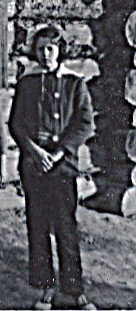
*Age 10 – Picture of my brother John and me

+++++++++++++++++++++

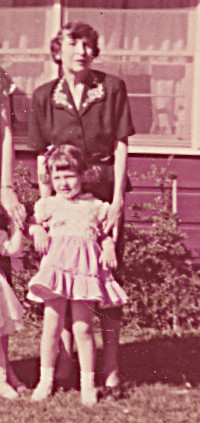
*Age 3 – 3 children with grandmother, closeup of me and grandmother

1955 Linda closeup with grandmother in front of the Glendora, (L.A.) house before Alaska - I was 3
1955 Linda closeup with grandmother in front of the Glendora, (L.A.) house before Alaska – I was 3

+++++++++++++++++++++

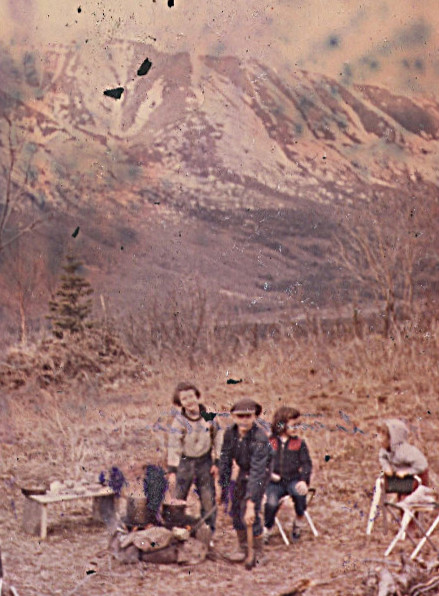
*1959 – The jeep road leading from Eagle River road into the valley

*1959 – Children in the homestead snow

+++++++++++++++++++++

*1960 – Precious picture dad, John, Cindy, Sharon and a wheelbarrow of seed for the fields

(I wish I was part of the family in this picture — where was I for this big event?)

+++++++++++++++++++++

*1960 (circa) Mom planting the fields

*1962 – Log house nursery

*1963 – June 11 – Family Portrait

+++++++++++++++++++++

*1963 5 kids and mom by cabin (possibly on trip to Santa Fe)

1963 just turned 12 -- and so sad -- I KNOW this sadness, it's rarely ever left me it was so made a part of who I am in this body.
1963 — I had just turned 12 — and so sad — I KNOW this sadness, it has rarely ever left me. Sadness was built into my body from the time of my birth. This is what it looked like when I was nearing the threshold to cross into my womanhood.

+++++++++++++++++++++

*1965 – Tucson rented house on Hawthorne St.

*1967 (circa) Dad and the red Toyota

*Adding wood ends onto the Jamesway (circa 1968?)

+++++++++++++++++++++

*Poem my father wrote to my mother

*Two pictures of Bill and Mildred together

+++++++++++++++++++++

*My Childhood Guardian Angel on the Mountain Top

It was to this mountain and to this land that I formed a secure attachment.  It was this place, this land and all that lived and moved and breathed on and around it that I loved.  This place was the heart of my heart, and this Angel on the Mountain was the heart of my heart’s heart.

My Angel on the Mountain.  She has her wings spread out to her sides, her long white gown draping over the mountain.  Her head is tipped slightly to her right.  She has a halo.  I could never as a child imagine anything or anyone more beautiful.  If my mother had imaginary friends, and me her imaginary enemy -- if she was completely mixed up on who and what was real, and could not tell her children from her dolls of play ----  WELL perhaps who am I but my mother's daughter -- because I HAD an angel, not a pretend angel, not an imaginary angel -- I HAD AN ANGEL.  She was MY angel.  Right there on that mountain top.
My Angel on the Mountain. She has her wings spread out to her sides, her long white gown draping over the mountain. Her head is tipped slightly to her right. She has a halo. I could never as a child imagine anything or anyone more beautiful. If my mother had imaginary friends, and me her imaginary enemy — if she was completely mixed up on who and what was real, and could not tell her children from her dolls of play —- WELL perhaps who am I but my mother’s daughter — because I HAD an angel, not a pretend angel, not an imaginary angel — I HAD AN ANGEL. She was MY angel. Right there on that mountain top.

+++++++++++++++++++++

This is just a picture, and a poor one at that, my mother took of some old trapper's cabin.  But I look at it, and I think, "If I could step into that place, and still have access to people I love, I would be in the closest thing to heaven I can imagine on this earth."  Yet, at the same time, I don't think heaven is more than a passing flash here on earth -- whatever it is, I think (and hope) it comes later.
This is just a picture, and a poor one at that, my mother took of some old trapper's cabin. But I look at it, and I think, "If I could step into that place, and still have access to people I love, I would be in the closest thing to heaven I can imagine on this earth." Yet, at the same time, I don't think heaven is more than a passing flash here on earth -- whatever it is, I think (and hope) it comes later.

+THINKING ABOUT THE DIFFERENCE BETWEEN CHILD ABUSE AND NEGLECT – MY REVIEW OF ‘THE GLASS CASTLE’, A BOOK I HAVE NEVER READ

++++++++++++++++++++++++++++++++++++++++++++++
Differences between Child Abuse and Neglect

++++++++++++++++++++++++++++++++++++++++++++++

I am going to pretend this morning that I am critiquing a book.  “All things are possible under the sun,” and like performing surgery on an invisible patient I am going to express my thoughts about a book I have never read.

My sister told me about this book last night in our telephone conversation.  She first heard about it while operating her used book store in Ballard (Seattle).  Customers coming up to her seeking information asked over and over again, “Where can I find the book written by that woman who was abused when she was a girl?”

“What book is that?” my sister wondered.  So she found herself a copy and eventually read it.  Perhaps you have read it, too.

++++

The Glass Castle: A Memoir by Jeannette Walls

(1,311 customer reviews)

++++

So am I writing today about the book and its story, or am I just writing about what my sister told me about the book from her ‘take’ of it?  Well, a little of both, I guess.  Will I ever read the book?  I’m truthfully not at all sure.   I make it a polished habit not to read anything while I am engrossed in my own story hunting and writing because I do not wish to contaminate my thinking.

Perhaps I have a strange attitude, but it is born from knowing some important information about myself and about how “I” and my brain-mind operate.  Because I have suffered from dissociation ever since I was a very tiny child, and because I now know this, I understand that my brain-mind can put whole batches of information places I do not know about – most, if not all of the time.

I do not want to be writing away while I am in one dissociated state or another and have whole conglomerations of thoughts pop into my sphere of consciousness when I am not aware it is happening, or aware of where the information is coming from.

My sister assures me that because my-our story is so different from Walls’, and because my writing style is so different from hers, this should never be a problem for me even if I DO read her book.  But I lack my sister’s confidence.

So I am left today with thoughts bubbling around beneath the surface of my thoughts today coming from my sister’s description of the story printed on this book’s pages.

++++

I know neither me nor my siblings have anything like a corner on the market about what it is like to grow up with a crazy parent.  Walls evidently has us beat.  She grew up with two of them.  But my siblings and I can be assured that we are also closer to belonging to the eclectic group of nutty parent survivorship than we are to being a part of the ‘close to ordinary’ or ‘ordinary’ childhood survivor group even though our story, and particularly my story, is about severe child abuse rather than mostly about the kind of child neglect Walls describes.

Yet what my sister reiterated several times last night in her conversation with me about this book is that the public does not seem to understand that there is a fundamental difference between being neglected as a child growing up and being abused.  Walls’ did not seem to suffer from abuse, no matter how neglectful and nutty her parents were.  She and her siblings were obviously seriously deprived of an ‘ordinary’ childhood experience, and suffered from severe deprivation due to neglect, but these children-people were evidently not abused as children the way my sister and I understand child abuse.  Not even close.

From my sister’s description of this book, it sounds as though at one point or another one or the other of Walls’ parents were lucid.  It also sounds like Walls’ parents were able to (1) love them and (2) not commit ‘soul murder’ on them.  Because it is the very early infant and very young childhood growth windows concerned with loving secure attachment that build the foundation of the developing brain, ANYONE who has any kind of safe and secure attachment to loving early caregivers is off to a running start from the beginning of their lives.

This running start allows fundamental brain structures, patterns, and brain circuits to form themselves in an adequate way so that they will continue to operate during all the ensuing time that little person experiences the events of their ongoing childhood.  Without these relatively dependable positive early caregiver interactions the infant-child’s brain will not be based on ‘ordinary’ benevolent world information.  This fact creates a situation where the growing child is left to play an entirely different ball game, with entirely different rules, on an entirely different playing field than any relatively safe and securely attached brain-mind child will ever know.

++++

The quality of these very early attachments determines how a young child can bond and attach to siblings as well as to parents.  Walls and her siblings were evidently attached to one another.  It sounds as though the very youngest child was left bereft of the sustenance of the attachment to her siblings, and was also left under the care of parents whose mental illnesses caused further and further deterioration of their brain-minds.  She did not turn out so well.

Walls’ story sounds entertaining, mesmerizing, fascinating, titillating, if not entrancing.  Yet while it sounds like a story of terrible neglect and madness, of starvation and deprivation, it is not the story of terrorism that my and my siblings’ story is.  I don’t think the Walls children were raised in hostile enemy territory or brutalized by acts of parental terrorism.

I believe that because the root of my mother’s mental illness was established in a childhood dissociative disorder, and because her mental illness originated in disoriented and disorganized insecure attachment conditions, and because what grew into her brain-mind and out into the way she lived her life caused her children to be projections of my mother’s fragile imaginary friendship – and in my case her imaginary enemy – needs, none of us stood any chance of developing our self as we “grew down into the world” in any ordinary fashion.  This is created for the Lloyd children a very different reality than the one the Walls children evidently grew up in.

Walls’ story sounds like it expresses living madness, but it  does not sound like her parents were terrorists.  We as a nation now clearly know what terrorist actions are like from the experience of the events from the September 11, 2001 attack on the World Trade Center and the Pentagon.  Those acts of terrorism were different than any that might be taken in a military combat situation against trained troops sent directly into a war zone.  9/11 devastated innocent civilians.

Terrorism penetrated the boundaries of our nation and overtook the boundaries of everyone who was attacked and left dead or devastated – on every level.  This attack changed us as a nation.  How much more so does terrorism change the development of infant-children?  The experience of 9/11 was a very different one than allowing our homeless to starve to death on our nation’s streets.

My sister told me that one commentator of Walls’ book portrayed her story as being told “without self pity.”  While the ongoing endurance and positive life outcome for Walls and her older siblings sounds if not heroic, at least miraculous and amazing, let us not lose sight of the differences between stories told by people who were directly abused through acts of brutality and terrorism from very early in their life from those stories told by people who did NOT suffer from soul murder, boundary violations by their caregivers, acts of violence and torture, and deprivation of vitally required early caregiver love and attachment.

It is critical that we know the difference between child neglect and abuse.  It is not helpful for the purposes of understanding, intervening, preventing, protection of children or healing the effects of severe child abuse and/or neglect to be comparing peanut butter with a light socket.  It is important that we be able to accept the ‘pain-full’ reality that belongs to the stories severe child abuse survivors tell, and know the difference between this level of overwhelming pain and so-called ‘self pity’.

In any case, we are left needing to examine the resiliency factors that allows victims of both severe childhood neglect and abuse to endure and sometimes to thrive.  Those resiliency factors are ALWAYS there if we look, and know what we are looking for (and at).  Some might call these “the wild cards.”  I do not.  I believe there is nothing imaginary or ‘wild’ about them.  They are very real factors that exist in a child’s life that allow them to “go on being” under extremely malevolent early developmental conditions.  If and when I ever choose to read Walls’ book, these resiliency factors are what I would be looking for in the story that she tells.

To not recognize and accept that powerful resiliency factors DID exist for Walls’ and her siblings, just as they existed for myself and my siblings, is to deny the fundamental construction of our human species.  Just as identifiable and definable circumstances create miserable childhoods, so also do identifiable and definable resiliency factors allow children to survive them, and sometimes to thrive in spite of them.

Reality, folks.  Do not forget reality.  None of us are super human.  Not me, not my siblings, not Walls, not her siblings.  Turning any kind of childhood tragedy into any kind of ongoing adult triumph means that we had powerful gifts provided to us in the midst of childhood traumas of any kind – or we would not be here to tell our stories.  Pretending otherwise is just that – imagining a world where reality’s rules do not apply.

We have a word for pure imagination:  Fantasy.  It is only in the world of fantasy that we can imagine that severe child abuse is the same thing as severe deprivation through neglect — and creates the same consequences.  Reality dictates otherwise.

++++++++++++++++

In my case, my mother malevolently and maliciously controlled every aspect of my growing and developing self for 18 years so far as was possible for her to do.  She accomplished this through physical, emotional, verbal, psychological, mental and spiritual abuse.  I do not make this statement with ‘self pity’.  I make it in recognition of fact.  She did everything she could imagine to make me miserable.  That she succeeded should be no surprise to anyone, not even to me.

In the Walls’ case, those children each had a self TO rescue, and a self with which to help rescue one another.  My mother’s violating abusive intentions were always intended to destroy her enemy she thought was me.  That I came out of my childhood with any semblance of a self at all is a miracle.  As a result of extreme child abuse, everything I ever do is about trying to find and rescue my damaged self.  I do not believe this would be the case if my childhood history had been of neglect instead of abuse.

That, dear readers, amounts to a waste of what should have been a perfectly good life time.

++++++++++++++++++++++++++++++++++++++++++++++

+OK – MORE LINKS TO MORE NEW PICTURES

What a gift that land was — and what a tragedy we couldn’t make a happy home there!

1959 - May - Oh, the happy homesteaders!  Oh, that our family could have happily made our home here --
1959 - May - Oh, the happy homesteaders! Oh, that our family could have happily made our home here -- Oops! Does Cindy need her pants knee patched?

*1960 Walking Up Mountain in Snow (Me and Cindy)

++++

*1960 – April 3 – Dad Stuck in Snow on Tractor

++++

*1959 – May – Walking the Mountain – Barely A Road

++++

*1959 – Children New To the Mountain – Loving IT!

++++

*1959 – Jeep Truck With Jamesway, Pollard, Tractor

++++

*1959 – Can barely see it – trailer parked at bottom of Horror Hill

++++

*1959 – January – Dad and Jeep station wagon at Pollard’s house

++++

+LINKS TO NEW PAGES ADDED TODAY INCLUDING MY CHILDHOOD ART

New links today

++++++++++++++++++++++++++++++++++++++++
*Age 9 – Happy Photo of Me and Baby David

++++++++++++++++++++++++++++++++++++++++

*Grandmother’s Notes On Analyzing Mother’s Handwriting

++++++++++++++++++++++++++++++++++++++++

*A FEW OF MY CHILDHOOD HANDMADE GREETING CARDS

++++

I included in this link (above) ‘The Reindeer Envelope’ that is considered in far more detail in this link below!

++++++++++++++++++++++++++++++++++++++++

See more - click on the link below

*Age 8 – The Reindeer Envelope – My Own Art Work Analyzed By Me – The Art Therapist

++++++++++++++++++++++++++++++++++++++++

And one of my mother’s letters:

*1963 – July 1 – Mother’s Letter About the Death of Her Father

++++++++++++++++++++++++++++++++++++++++

I will add here, because the topic of “I love Mother” greeting cards applies, that never in my childhood until I was 17 years old did I EVER feel angry at my mother.  I had no possible concept of that.  I had no concept of love, so I had no idea if she or my father loved me.  Nor did I have any concept of loving them — or anyone — except for my pet rabbits who were ‘one’s to me, as was the homestead, the mountains, the valley and all they contained.

Making ‘loving cards’ so one could ‘give loving cards’ was simply something one did — like eating, walking, sleeping.  Today I certainly don’t care one little bit about whether they loved me or whether I loved them.  It absolutely couldn’t matter then — what happened IS what happened, no matter what words they would have used themselves to explain their actions.  It doesn’t matter to me at this moment if I loved them or not.

Being able to read the images that my tragic, said and yet incredibly wise, strong and evidently directed self created is what matters to me.  That I can see my protective process in these images, especially in the reindeer one, gives me a renewed appreciation for the resiliency and resourcefulness of the human spirit.  That image shows that I was going to make it — and, by golly, I DID!  THAT’S WHAT MATTERS!

++++++++++++++++++++++++++++++++++++++++

+BEING MY MOTHER’S IMAGINARY SWORN ENEMY

Deadly Child’s Play

+++++++++++++++++++++++++++++

The consequences of some childhood imaginative play can be so destructive when carried into adulthood that we have no real choice other than to call it deadly.  My mother’s play fit this category.

For all the writings that attempt to describe and explain the behavior that some Borderline Personality Disorder parents, particularly mothers, engage in with some or all of their children, fit this category.

The reference for this post about the symptoms of dissociative disorders in children can be found below.  There is only one single aspect of the material contained in it that I wish to address right now:

4. The child’s belief in alternate selves or imaginary friends that control the child’s behavior may reflect disorganization in the development of a cohesive self.

+++++++++++++++++++++++++++++

I am also writing a reply to a comment my second to the youngest (1961) brother wrote today.  I believe that my mother suffered from a pre-Borderline Personality Disorder condition from the time she was no older than 6 years old.  I believe that what went wrong for her prior to that age had already spawned this condition so that without immediate and adequate childhood intervention, the course of the progression of her mental illness was – by today’s enlightened standards and knowledge about the disorder – entirely predictable.

She was, therefore, already mentally ill when my father married her.  The ‘up side’ of her disorder allowed my mother to appear as a vivacious, charming, stunningly gorgeous catch of a wife.  That she was too vivacious, charming, stunning and gorgeous could not have alerted anyone at that time to the terrible troubles that lay down the road of her life – and down the road of anyone’s life that she captured in the web of her illness.

My mother had a mind that could ‘think’ only in terms of the imaginary world of her early childhood.  My father fit the image of her perfect imaginary Perfect Husband – with only one fixable flaw.  As she used to tell us, he did not smoke a pipe.  That was easy.  She convinced him to start smoking one.

The birth of a son for a first child also fit her perfect imaginary world image of motherhood.  EVERYONE wanted a boy to be born first.  It amazed me that my oldest brother’s wife could hear the hysterical tone of my mother’s psychotic mind in the ‘voice’ used to comment in my brother’s baby book.  My brother and I were evidently still so captured in my mother’s web, even three years ago, that we could not detect that crazy woman’s crazy voice.  My astute objective sister-in-law sure could!

++++

So, yes, in response to my brother’s comment, my mother did become the woman she already was when my father married her – just more so.  By the time I was born, through complications of my being a breach birth that nearly killed the both of us, and due to a psychotic break that seemed to have happened to her while she birthed me, Linda, the first born daughter and second child to be born into this perfect imaginary married life of motherhood for my mother, was assigned a role all of her own.

I need to mention that according to the way my mother described all during my childhood how I tried to kill her before I was born, that the devil sent me to kill her — that part of the psychosis could easily have happened with its resulting consequences no matter which sex I had been born as.  After all, back then she had no way of knowing if I was a boy or a girl until I actually appeared.  Which brings me to the clearest way I have yet found to explain and describe what happened to me next – and through contamination, to my siblings.

My mother did not have imaginary friends from childhood that controlled her as the above number 4 symptom of childhood dissociative disorder suggests.  She formed her imaginary mental and emotional structure, I believe, while playing alone with her dolls.  They were her initial imaginary friends, and she could, of course, control them absolutely.  When she began to have children of her own she simply slid her imaginary friend structure over on top of us.  With one exception.

For whatever reasons, no doubt stimulated by the difficult circumstances of my birth, I was NEVER my mother’s imaginary friend.  I was her imaginary mortal enemy – so bad that I was assigned the status of being so evil that I was not human.   I was a demon, the spawn of the devil, the devil’s child.  I strongly suspect that her psychotic break in labor was facilitated by the use of the anesthesia used at that time for women in labor, Twilight Sleep.  This drug combination is know to have induced severe nightmarish hallucinations that were SUPPOSED to be ‘not remembered’ along with the pain of birthing.  For some women, particularly those with pre-Borderline or other psychosis-related underpinnings, administration of this drug became their demise.

In taking a short-cut here, I can clearly see the pattern my mother applied to her children as we were forced to assume the cloak of her imaginary friend/enemy projections upon us.  First born (1950) son was the Hero, second born (1951) daughter the sworn mortal Demonic Enemy Satan’s Child, third born daughter (1953) God’s Child, the Angel Saint, fourth born daughter (1955) the Fairytale Princess, fifth born son (1961) the Alaskan God Son.  I cannot yet name imaginary friend status of the sixth son (1965).

My mother had no conscious capacity to recognize these patterns.  I think my father believed her fantasies without question, as well.  I doubt he had any more of a capacity to recognize what he was dealing with than she did.  She was his wife, the mother of his children, and he evidently believed her — lies about Linda.

I see us all in a police line up.  I see us all having our mug shots taken, and instead of our actual name and identity being recorded, we each have our chosen imaginary friend – or enemy – designation attached to our existence in my mother’s – and my father’s – world.

++++

We were all simply a part of my mother’s mentally ill child’s play.  I differ from authors who might suggest the ‘imaginary’ role belonged to my mother – witch, waif, etc.  The imaginary designations with their resulting and correlating treatment we received from her, belonged to her broken mind.  The source of all of our suffering, including to a large extent the suffering of her imaginary Perfect Husband, came from whatever combination of trauma and adaptation to trauma and neglect that my mother made well before she was six years old.

Because my mother was by physiology a female, and raised a ‘traditional doll playing girl’, her psychosis centered around home and family.  Had she been a boy, who knows where her psychotic imaginary play would have taken her in adulthood.  Perhaps she would have been likely to murder us, chop us into little pieces and store us in a wall, bury us in the yard, or eat us.

Fortunately, that’s not the story being told here.  What I know of what happened to me was on the level of soul murder, and that’s bad enough.  Because the imaginary friend status assigned to my siblings was not enemy, they were able to ‘escape around the edges’ and form some self of their own.  My history with her was of her continually controlling me and abusing me as much as she possibly could.  When it comes to being able to empathize with my mother enough to truly understand her underlying unconscious motives, nobody who did not share my mother’s psychosis can ever know what it all seemed like and felt like inside of herself.  I probably come the closest because she so pervasively invaded and obsessively controlled me.

++++

Herein lays the difference between siblings that are not often apparently abused by a mentally ill parent and the Chosen One that is insanely and chronically abused.  My mother did not have the ‘benefit’ of knowing who her imaginary enemy was until I was born.  Once she KNEW, she then had a specified target upon which she could focus the full destructive intent of her psychosis.  And believe me, that’s exactly what she did.

All the moving around we did, what my mother refers to in her letters as “shifting” from place to place, simply HAD to happen as a result of the unanchored mercurial madness of her extremely disturbed mind.  It began very early in her marriage and became far more pronounced with the progression of her illness once we reached Alaska when I was five.

This “shifting” deprived all of us of any stable footing beneath our childhood feet.  Coupled with the toxic contamination of being raised by an unstable mother who was obviously capable of severe depressions and violent rage attacks, all six of her children can no doubt say that they “did not have a happy childhood.”  This does not mean that there were not positive aspects to our childhood, because there were.  Yet each of our separate, individual experiences of our childhood, even with the underlying madness, depended to the largest extent upon which one of my mother’s inescapable imaginary friends – or enemy – identities we had been assigned at our birth.

Excluding and excusing my father from responsibility for either his active or passive participation in my mother’s madness places him on the level of being a child rather than of being an adult.  He was no doubt a traumatized adult, but as one of my commenter’s wisely points out, he WAS an adult and we were his children.  At the same time that he might have been my mother’s imaginary husband, he was our very real father, as she was our very real mother.

There is no judge and jury here.  There is no real question of accountability.  It’s far too late for that.  My intention is to uncover what I can of the clues, the evidence and the seeming facts about my childhood of unimaginable suffering.  That it could have been worse is obvious.  That it never got any better is equally obvious.  I am, at best, simply a survivor of a childhood that should NOT have been allowed to happen.  And it wouldn’t have, if anyone, anywhere, had cared enough to pay adequate attention and take some appropriate action on behalf of my parents’ traumatized children.

++++++++++++++++++++++++++++++++++++++

Because the early experiences of my mother’s own childhood left her with a disorganized-disoriented insecure attachment disorder, focusing on fighting her ‘war’ against the enemy that was me allowed her to find a purpose (other than homesteading so she could have her imaginary Kingdom) that to some extent allowed her to organize and orient her inner life.  Hers was a war waged in the private confines of our home.  It was a war of terrorism.  It was a clandestine war, as most wars against innocents are, with me as the victim because my mother lacked the capacity to know I was her precious little girl, not her enemy.

Main Entry: clan·des·tine
Pronunciation: \klan-ˈdes-tən also -ˌtīn or -ˌtēn or ˈklan-dəs-\
Function: adjective
Etymology: Middle French or Latin; Middle French clandestin, from Latin clandestinus, from clam secretly; akin to Latin celare to hide — more at hell
Date: circa 1528

: marked by, held in, or conducted with secrecy

++++++++++++++++++++++++++++++++++++++

REFERENCE as presented in this October 1, 2009 post:  +CHILDHOOD DISSOCIATION, DEPERSONALIZATION, DEREALIZATION – I NEVER HAD A CHOICE TO BE OR NOT TO BE

++++

Guidelines for the Evaluation and Treatment

of Dissociative Symptoms in Children

and Adolescents

International Society for the Study of Dissociation

Journal of Trauma & Dissociation, Vol. 5(3) 2004

Digital Object Identifier: 10.1300/J229v05n03_09 119

++++++++++++++++++++++++++++++

Please follow (above) link to read this entire article and to find the exact references the authors are referring to in this section of their article (below):

“There is no consensus yet on the exact etiological pathway for the development of dissociative symptomatology, but newer theoretical models stress impaired parent-child attachment patterns (Barach, 1991; Liotti, 1999; Ogawa, Sroufe, Weinfield, Carlson, & Egeland, 1997) and trauma-based disruptions in the development of self-regulation of state transitions (Putnam, 1997; Siegel, 1999).

Newer theorizing ties maladaptive attachment patterns directly to dysfunctional brain development that may inhibit integrative connections in the developing child’s brain (Schore, 2001; Stien & Kendall, 2003).

From the vantage point of treating children and adolescents, a developmental understanding of dissociation makes the most sense.

That is, dissociation may be seen as a developmental disruption in the integration of adaptive memory, sense of identity, and the self-regulation of emotion.

According to Siegel (1999), integration is broadly defined as “how the mind creates a coherent self-assembly of information and energy flow across time and context” (p. 316).

In other words, Siegel sees the development of an integrated self as an ongoing process by which the mind continues to make increasingly organized connections that allow adaptive action.

Children and adolescents may present with a variety of dissociative symptoms that reflect a lack of coherence in the self-assembly of mental functioning:

1. Inconsistent consciousness may be reflected in symptoms of fluctuating attention, such as trance states or “black outs.”

2. Autobiographical forgetfulness and fluctuations in access to knowledge may reflect incoherence in developmental memory processes.

3. Fluctuating moods and behavior, including rage episodes and regressions, may reflect difficulties in self-regulation.

4. The child’s belief in alternate selves or imaginary friends that control the child’s behavior may reflect disorganization in the development of a cohesive self.

5. Depersonalization and derealization may reflect a subjective sense of dissociation from normal body sensation and perception or from a sense of self.

++++++++++++++++++++++++++++++++++++++

  What are the Causes of Borderline Personality Disorder?

  Conditions Related to Borderline Personality Disorder

  Treatments for Borderline Personality Disorder

  Getting Help for Borderline Personality Disorder

  Life With Borderline Personality Disorder

  Symptoms of BPD

  Diagnosis of BPD

++++++++++++++++++++++++++++++++++++++

Check out this super website!

Baby Brain Development

++++++++++++++++++++++++++++++++++++++

+SHEER DETERMINATION OF HOMESTEADING

+++++++++++++++++++++++++++++++++

This link is to a letter my mother wrote to ‘people’ who she believed were denying the fact that we were living on the homestead for our required period of time to receive title to the land in December 1959:

+++++++++++++++++++++++++++++++++

*Age 8 – Homesteading – On the Edge of Madness

+++++++++++++++++++++++++++++++++

+HUMAN AND HORSE MOTHERING – WHAT’S IN COMMON?

+++++++++++++++++

I wanted to share something from a book I’m reading, The Body Language of Horses by Tom Ledbetter, Bonnie Ainslie.  My brother gave it to me while I was visiting him in Alaska.

I’ve never really had the longed for luxury of being able to spend time with horses.  I’ve always been too poor, too involved in keeping my children clothed and fed with a roof over our heads.

I find as I read this book that I feel like the authors are talking about me.  How can that be?  I am not a horse, yet I am like them.  Because of the extreme abuse I suffered from the time I was little, and because of the overall and overriding insanity present in the home I grew up in, I did not grow up to be an ordinary person.

I have tried to fit in.  I’ve tried to learn the ‘human language’ that others speak not most importantly with their words, but with their body language and the expressions on their faces.  Because my mother was psychotic, because she could not interact with me normally, I simply did not get the same brain circuitry.  Not even the regions of my brain developed according to ‘ordinary’ experiences or patterns, as I have been explaining in my writings.

I can, therefore, more closely relate to what these authors are saying about horses than I can any book I ever read about people.  I might understand a book about all sorts of other kinds of animals if one was written like this one is, but these authors express a rare and comprehensive understanding of how it is to be a horse.  I am amazed and I am feeling calmer as I read it.

Ainslie and Ledbetter explain that every time a human overwhelms a horse with human demands and misconceptions, the horse has no choice but to act like less than what it is – less than a horse.  I understand.  I was not allowed to be a child.  The way my mother treated me did not allow me to be a child just like some humans do not allow horses to be horses.

All the many parallels I find between horses and myself create inside of me a sense that I am so much more correct in my understanding of the changed body and brain of a severely abused child compared to how a child is SUPPOSED to have been allowed to develop that I really do feel like I am a member of nearly a completely different species than are ‘ordinary’ people.

And I know I am not alone.  Therefore, as I share this single paragraph from this book (so far) I wish readers to understand that human mothers create in their offspring the kind of person their infants and children grow into.  I am aware that genetics plays a part in who we become, but researchers are becoming more and more clear that severe abuse alters how genetic potential expresses itself.

Every time an infant and a young child is not given what it needs to develop into its optimal self some life long consequence to the negative is going to appear.  Only in situations where the most important resiliency factor of the AVAILABILITY of some other adequate early caregiver’s interference in the harmful influence of the severely maltreating mother is there, in the end, hope that the effects of the mother’s severe abuse will not permanently and seriously alter the person her offspring turns out to be.

I encourage readers to FEEL the following words.  Enlarge your perspective and imagine what these words are saying if you think about them in terms of the variances in the quality of human mothering and caregiving.  In human terms mothers are not forced, for the most part, to compete with other mothers for what is needed to care for their infants and children.

And yet the end result of a human continuum of living a quality, happy and successful life is still directly connected to what our mothers (or other early caregivers) gave to us.  Harm and hatred to infants DOES NOT allow them to develop into fundamentally happy people – and I don’t care how financially well-off such an offspring turns out to be.  Look at their relationships as well as financial standing.

+++++++++++++++++

From The Body Language of Horses by Tom Ledbetter, Bonnie Ainslie:

“The lead mare wins dominance by physical and psychological means.  She rules as long as she remains vigorous.  Her powers serve twin purposes – first choice of food and space (a) for herself and (b) for her young.  By natural selection, the other mares organize in declining order of priority, with the lowest and most subservient getting the last and least for herself and her foal.  Unless the pasture is inhumanely crowded, everyone subsists.  But the psychological effects on the foals are substantially important.  As Number One in its own age group, the lead mare’s baby becomes habituated to the deference of its peers and their dams.  If well bred, soundly constructed and not too severely disoriented by premature weaning, the Number One foal emerges as Number One weanling, most likely to succeed in what humanity calls the Game of Life.”  (P. 64)

+++++++++++++++++

We are not used to thinking about human success, including psychological success, in these terms.  We do not FIRST and FOREMOST understand that it is the health and well-being of mothers (early caregivers) that MOST affects the lifelong outcome of her offspring.

In American, in particular, we want to believe that everyone is equal, and that all can “make it” if they want to and if they work for it.  We do not want to face the fact that deprivations of a serious enough nature from conception to age 2 (and then through age 7) can so set a person off course that they will never be able to completely make up the difference.

Yes, humans may be far more complicated than horses are.  That means to me that we are at an even higher risk for negative consequences from malevolent mothering – not less.  Once our culture truly understands this fact, they will be able to give us the chances we TRULY need to find a way to live well in spite of our malevolent childhoods.

In my thinking, we have to be very clear and very careful about how we assess who and how we are in the world made mostly by people who had the benevolent childhoods we all deserved – and some received the opposite of.  Most do not become members of the ‘lower hierarchy’ because we choose to be there, any more than a horse chooses to me maltreated by a human being.

+++++++++++++++++

+SOME FANTASTIC LINKS ON CHILD ABUSE AND BRAIN CHANGES!

+++++++++++++++++++++++++

Greetings to each and every person who has visited this blog during the seven weeks of absence from writing here.  I am home now after more than 10,000 miles of traveling during the past seven weeks as I visited family and friends whom I love and who love me.

The time I spent in Alaska, the home of my heart, was everything I needed it to be in order for me to move forward with the writing of my book.

I will at this point be dividing my writing clearly between my book (which will not be appearing on this blog) and other assorted writing specifically for the blog.  As my precious Alaskan baby brother (now 44) told me, if it is my desire and my intention to write a book, then I need to do it.  He explained it to me this way:

A person might pick up tools and a block of wood intending to carve an image.  Perhaps they are not quite sure what image lies within the wood so they begin carving in process until that image becomes clear and the carving can then give it form.  If, however, that point never occurs where the image within the wood is found, shaped and born, all that will result from the effort of carving is a pile of wood shavings and dust.

I heard and understand the wisdom contained in my brother’s words, and I recognize that continuing to pour words out into my blog will not accomplish the creation of my book.  I will now separate the words that belong in my book from those that do not.

+++++++++++++++++++++++++

As I continue through the process of getting my ‘home legs’ under me, I will at least post a few interesting links here for reader consideration!  Please follow some or all of these links – THEY ARE IMPORTANT!  Please also join me in my gratitude to every single person who is involved with this quality of work to further our understanding about the impact of severe child abuse on human development – and the work of everyone committed to ending child maltreatment around the globe.

Please also remember the abuse being done to the fragile web of life on our glorious planet and the suffering of so many species being caused by the thoughtless harm of all kinds caused by humans.

And, for a load of Alaskan MOOSE FUN….

+++++++++++++++++++++++++

Back to School Tips: Parents Should Get Ready, Too!

Posted: 27 Aug 2009 08:21 AM PDT

Tips for parents on helping their kids succeed in school, adapter from information provided by our friends at Prevent Child Abuse New Jersey.

Amid the shopping trips for sharpened #2 pencils, crisp notebooks and new shoes, parents should start thinking about what they can do to become the best possible support system for their child this school year. The beginning of the new academic season is often the most important, as it sets the tone for a meaningful and successful year.  Research shows that students are more equipped to thrive academically and socially when parents are actively involved in their child’s education.

+++++++++++++++++++++++++

Emotional Abuse Recovery NOW

+++++++++++++++++++++++++

Going Big: Harlem Children’s Zone on This American Life

Posted: 18 Aug 2009 02:17 AM PDT

Hats off to This American Life for shining a spotlight on the solutions to the many problems that plague our nation’s impoverished families. Going Big, this week’s episode, profiles Geoffrey Canada, a pioneer in the fields of child and family support and poverty prevention. His organization, Harlem Children’s Zone, boasts tremendous outcomes for the families and community it serves, including:

  • l00% of students in the Harlem Gems pre-K program were found to be school-ready for the sixth year in a row.
  • 81% of Baby College parents improved the frequency of reading to their children.
  • $4.8 million returned to 2,935 Harlem residents as a result of HCZ’s free tax-preparation service
  • 10,883 number of youth served by HCZ in 2008.

Listen to the This American Life podcast.

Below is a five-minute video of moms talking about the challenges of raising children in Harlem and the difference HCZ is making in their lives.

This posting includes an audio/video/photo media file: Download Now

+++++++++++++++++++++++++

Brain Development Altered by Violence

By Dale Russakoff
Washington Post Staff Writer
Saturday, May 15, 1999; Page A3

LITTLETON, Colo.—More than a week had passed since Krystie DeHoff felt bullets and bombs explode all around her, since she ran in horror past young, dead bodies to safety. Now she was inching toward normality, shopping at King Soopers grocery, when the most innocent sound–a baby crying in his mother’s arms–set the Columbine High School massacre in motion again, this time in her mind. Her heart raced, her muscles coiled. She heard not a baby, but her classmates, shrieking. “All I could think was: MAKE HIM STOP!” she said.

READ MORE……

+++++++++++++++++++++++++

Using Mental Strategies Can Alter

The Brain’s Reward Circuitry

ScienceDaily (June 30, 2008) — The cognitive strategies humans use to regulate emotions can determine both neurological and physiological responses to potential rewards, a team of New York University and Rutgers University neuroscientists has discovered. The findings, reported in the most recent issue of the journal Nature Neuroscience, shed light on how the regulation of emotions may influence decision making.

READ MORE….

+++++++++++++++++++++++++

The Neural Self: The Neurobiology of Attachment

By Phil Rich, Ed.D., LICSW

It is its basis in biology that makes attachment theory unique among theories of psychology and child development. From the biological perspective, attachment is simply an evolutionarily-evolved process to ensure species survival, and is thus as much a part our biology as that of any animal.

From this perspective, cognitive schema and the resulting mental map is not merely a psychological phenomenon, but a physical entity, hard-wired into neural circuits and reflected in neurochemical and electrical activity within the central nervous system.

The mental map into which our experiences and memories are imprinted is thus a neurobiological structure, the result of synaptic processes, out of which human cognition and behavior emerges, resulting in LeDoux’s (2002) description of our “synaptic” self.

Siegel (2001) describes the pattern and clusters of synaptic firing as “somehow creat(ing) the experience of mind” (p. 69). He writes that “integration” reflects the manner in which functionally separate neural structures and processes cluster together and interact to form a functional whole – in this case, our selves.

READ MORE…..

+++++++++++++++++++++++++

Child abuse marks genes, affects ability to cope: Study

By Margaret Munro , Canwest News Service

+++++++++++++++++++++++++

Stress

Your Three Brains

The neurologist Paul MacLean has proposed that our skull holds not one brain, but three, each representing a distinct evolutionary stratum that has formed upon the older layer before it, like an archaeological site – he calls it the “triune brain.” MacLean, now the director of the Laboratory of Brain Evolution and Behaviour in Poolesville, Maryland, says that three brains operate like “three interconnected biological computers, each with its own special intelligence, its own subjectivity, its own sense of time and space and its own memory”.

READ MORE….

+++++++++++++++++++++++++

+LEAVING NO CHAOS BEHIND – PART TWO

++++

This post follows —

+LEAVING NO CHAOS BEHIND – PART ONE

I could say that from the instant I left home I followed an invisible bread crumb trail into the future, but I would be wrong.  I began to follow that invisible pathway from the moment I was born.  Because there was never any reason, no cause and effect, no reason, no logic to consequences there was never a discernible pattern to anything that ever happened to me.

All I knew was what was told to me, as I came into a body and into this world, through actions and later by words as I came to recognize and understand them.  I was told I was so bad that I tried to kill my mother when I was born.  I was told that I was not human, that I was the devil’s child, and that I was evil.  Everything that I knew always went back to these facts.

At the same time that I was forced just by the fact that I was alive to follow this invisible bread crumb pathway into my future, I was trying at the same time to follow the faintest dim light of hope that was held repeatedly in front of me throughout my childhood by my mother.   I did not know that I was living an unsolvable paradox.

At the same time she told me that I had been created and born evil, I was also told I remained evil because I chose to do so, and that I deliberately continued to remain evil because I was so evil that was the ongoing evil decision that I chose to make — moment after moment, hour after hour, day after day, year after year, incident after incident.  I never knew that I was doomed not to ever get near to or reach the hope that was held out in front of me.

Because I was innately and essentially evil it was impossible for me to ever make the good or right decision or choice how to act BECAUSE of that fact.  Yet I was also told that the fact of my evil remained a fact because I willed it that way each time I continued to make the choice to stay evil no matter how many chances my ‘loving, caring, patient, adoring, long suffering’ mother gave me to choose otherwise.

How could I as an infant begin to learn about the exercise of free will, decision and choice when I was continually punished for a choice I had been proven to have made before I was born by my actions in trying to murder my own mother?  I was born evil.  I was evil because I chose to be evil.  I continued to choose to remain evil because I chose to be evil because I was evil.

The yet even darker blanket that grew over this entire pyschosis that my mother had was that I was born evil because of the evil I had done in some other lifetime that had condemned me to hell.  This had nothing to do with any other manifestation of a thought my mother might have had regarding something that could have been construed as a belief in reincarnation.  Her thinking along these lines ONLY related specifically to me.

Her belief in my evilness grew so that as I grew older it was not about me being born as an evil infant human.  It came to be about my having done something so evil in my earlier lifetime that I had been judged as being so evil by God that I had been condemned to everlasting damnation in hell.  I had been given up on by God and He had given me to the devil.  The devil owned me.  I was his possession, his puppet, his tool, his worker.  I was his proxy sent first to kill her, and because that didn’t work, I continued to live on as the devil’s curse upon my mother’s life.

I suspect as I write this that this dark blanket that smothered out any hope of the light coming through to me was the inevitable result of the progression of her psychosis as I continued to live as her daughter in a body that also continued to grow.  The only possible avenue of escape that could have been possible for me growing up was never provided.  It would have had to have come as a result of my being able to, in any way, understand that the further development of my mother’s psychosis, which had me at its center, was a logical consequence of her mental illness, that her mental illness was the cause of her psychosis, and her actions toward me were the effect of it.

Did anyone ever tell me that?  No.  Was I ever able to step out from under her insanity so that I could figure it out by myself?  No.  Was there any possible avenue of escape open to me from birth to age 18?  No.

My entire being from birth had to attempt to grow along with and in spite of my mother’s madness about me that she continually forced me to encounter in my ongoing experiences throughout my entire childhood.  It makes me think about how cancers devour a body’s resources until the person is killed.  I had to grow an entire being that was contaminated with the cancer of my mother’s beliefs about who I was from the time of my birth.

I was not given the choice NOT to build the cancer of my mother’s mental illness into my being.  Her cancer had taken over the ‘cell’ that was her and spilled over and grew into me.  I had to eat and swallow her poison.  I had no way to prevent this from happening.  Yet through this analogy I see that while her cancer cells were taking over space inside of who I should have been able to become as my own self, they could never invade the ‘cells’ that WERE individually my own.

I had some impermeable ‘Linda cell’ boundary abilities that prevented my mother from taking over all of me.  Somehow there were pockets of my own experience of being alive that she and her psychosis could not completely take over, contaminate or consume.  But neither was there the opportunity for these individual ‘Linda cells’ or pockets of Linda reality to form themselves into a whole entire separate person, or even into clear definable identities.  That is where the dissociation originated from.

++

When I go back and read my June 1972 writing I can see how able these individual Linda cells and pockets were to co-inhabit my own being and mind.  It strikes me that perhaps how I came to develop that far was due to the fact that I am innately a peaceful person.  Had my separate experiences of experience ever had the need to compete with one another I would not have been able to follow my invisible bread crumb pathway into the future in one body at all successfully.

I suspect that the lack of any inner need to compete for supremacy of one single perspective — or even of one tiny part of one — also stems from the bizarre yet helpful fact that nothing I EVER did as a child successfully allowed me ANY illusion of control — related to cause and effect — over my mother’s reactions to me.

I was as a child cut off at EVERY possible turn from being able to assert myself in any effective way to change what happened to me within my environment.  And no matter how strange it might be to understand this, it was because nothing worked that I never began to compete within myself so that a working model of a part of Linda ended up taking control of any part of who I was.  Hence, I basically have ended up with a dissociative identity disorder without the identities.

++

It is hard to know about the development of a human brain-mind because we need to use the brain that has already formed in order to go back and try to understand the earlier form as it formed itself.  I do believe that I have a unique situation here and something unique to offer to anyone that might wonder about the possibilities that exist within a developing brain-mind.

Brain-mind development is a process that usually proceeds through identifiable stages.  Once one or several of these developmental stages has completed itself, its patterns are locked into place and used, then, for the further developments as they come along in their own sequences and patterns.  Because of the very special circumstances I developed in, my brain did not ‘lock into place’ these individual growth and developmental stages as they normally occur.

My brain-mind was forced to go on and on and on and on as it attempted to find a place for its ongoing experiences in the world.  I received piece after piece after never-ending piece of information through my interactions with my mother without ever being given the opportunity to hook them together in any meaningful way.  I believe that some part of me knew that this was happening as it happened.

This is what makes my June 1972 writing significant.  It was a message in a bottle, written down by some part of myself and sent into the future as an intact representation of the best operation my brain-mind could accomplish right before my 21st birthday.  The writing itself was like taking a living slice of brain-mind tissue, cut out at that point of time, frozen within those words, and passed to me in the future so that I could accurately re-member who I was when I left the home of my origin.

++

Time passed.  I went on in my life.  I continued to follow that same invisible bread crumb path to get to where I am as I sit here today with my fingers upon this keyboard.    Yet even as all this time has gone by, my inner experiences of myself in my life are not much more connected to one another than they were as represented in those June 1972 words.

My brain was never allowed to develop through its stages with a single Linda at its center.   What ‘holds me together’ is more like what holds all the individual notes and patterns of silence within a song together.  The individual notes, patterns of sound and silence, tones, pitches, rhythms, movements within songs do not compete with one another any more than do my experiences or my experiences of my own experiences compete with one another.

Yet holding oneself together as the ongoing pattern of one’s life song is continually being written is an exhausting and disheartening process. I cannot, as I believe that others can, just let go and let the ‘main Linda’ go on about the business of life as if such an entity exists.  Because I have little sense that such a single Linda exists, I also cannot trust that she knows what she is up against or doing in this lifetime.  The ongoing process of living my life is therefore continually ‘up for grabs’ between all the various aspects of myself that process both my life and my experience of it.

I believe that I continue to be able and willing to ‘do life’ only because I am able to identify some very  incredible and undeniable gifts that I was born with.  Among these are my innate intelligence, creativity, indomitable will to stay alive with its accompanying determination, stubbornness and courage, my ability to have consideration for the feelings of others in my life who love me, my ability to focus intensely, my ability to tolerate changes, my ability to hope, my curiosity, my willingness and intense desire to learn, my ability to be surprised, my love for beauty including my innate desire to find something beautiful in ugliness, my loyalty to others as well as to myself, my compassion, my incredible stamina and ability to withstand pain, and the never ending peaceableness of my nature.

All of these gifts and abilities help me as I try to orient myself and organize my experience through a brain-mind that was not created in anything like a normal, benevolent world.  I imagine this to perhaps be like being deep under water all of the time, and having to follow the upward movements of the bubbles my gifts provide me with as I try to orient myself and my movements toward the water’s surface.

++

So when it comes to the question of why I never left home before I was 18 to escape the abuse, I have to say that I didn’t even know that either the abuse existed or that escape existed.  One has to know one is captured and a captive before there is anything to contrast the state of captivity to.  Otherwise, how can a person even conceive of escape in the first place?

There was also no unified Linda in existence, and therefore there was no one to make such a choice or decision ‘with’, ‘within’, ‘from’ or ‘for’.  I had all the facets of a diamond, but no diamond.  All I had was the capacity to survive in and endure being alive in a world of chaos and destruction.

When I finally did leave home, I took all the chaos as well as my ability to live with it out the door with me.  Chaos by definition means that all possibilities are contained within it.  Building patterns out of chaos is what a brain does from its beginnings.  Neither mine nor my mother’s brains were an exception to this rule.  That hers was built around a psychosis and mine was not is the difference between us.  While both options are contained within the possibilities of being human, mine allows for some access to consciousness where my mother’s did not.

Both of our child brain-minds had to develop in the midst of an unsolvable paradox — how to remain alive in a malevolent world that did not give us the resources to do so.  We each, however, had available to us different inner avenues to pursue that allowed each of us to accomplish this impossible task in a different way.  I cannot find it within myself to fault either one of us for taking the only possible route we had available to us in childhood that ensured our continued survival.

Once our individual routes to survival were taken, in our early environments that we were equally powerless to change, those routes became permanent pathways into and through our futures.  They allowed us some chance to organize and orient our inner reality within a disorganized and disoriented world.  Neither one of us could ever go back to the beginning and get to develop a different ‘better’ brain in different better circumstances.  We each were forced to live with the consequences of the ‘developmental brain damage’ that we suffered, and that could have been prevented.

That fact is what this blog is all about.