+MORE LINKS ON TEARS, CRYING AND WEEPING

++++

Why We Evolved to Cry

By JOHN TIERNEY

What’s the use of crying when you’re sad? Other animals shed tears, but humans may be unique in shedding tears of grief, and Robert Provine says that he knows why: to send a signal.

“Emotional tears are a breakthrough in the evolution of humans as a social species,” says Dr. Provine, a neuroscientist at the University of Maryland, Baltimore County. Writing in Evolutionary Psychology (pdf), he reports the first experimental demonstration of what he calls the “tear effect.” The subjects in the experiment were asked to rate the sadness of photographs of people crying, but in some of the photos the tears were digitally removed. (The experiment used actual photographs of people, not the cartoon images shown above.) When the tears were removed, the people were rated less sad, and their faces were often mistakenly interpreted as expressions of awe, puzzlement or concern. Dr. Provine concludes:

Emotional tears resolve ambiguity and add meaning to the neuromuscular instrument of facial expression, what we term the tear effect. Tears are not a benign secretory correlate of sadness or other emotional state. Emotional tears may be exclusively human and, unlike associated vocal crying, do not develop until a few months after birth. The emergence of emotional tearing during evolution and development is a significant but neglected advance in human social behavior that taps an already established secretory process involving the eye, a primary target of visual attention.

Dr. Provine says that so little is known about why adults cry that there are lots more questions to answer. “Do tears, for example, make a person appear more needy, helpless, frustrated, or powerless, as well as sadder?” he asks. “Do tears amplify a perceived emotional expression, add a unique message, or contribute a subtle nuance interpreted as sincerity or wistfulness?”

++++

Crying, Sex, and John Boehner: Not So Fast

Why the claim that women’s tears signal, ‘not tonight, dear,’ is probably wrong.

[but not by much!]

The scientists’ conclusion: “Women’s emotional tears contain a chemosignal that reduces sexual arousal in men” even though the men “did not see the women cry” or know that they were sniffing tears. Added Sobel, “This study reinforces the idea that human chemical signals—even ones we’re not conscious of—affect the behavior of others.”

The study is, predictably, getting a lot of media attention (WOMEN’S TEARS SAY, ‘NOT TONIGHT, DEAR’), but experts on tears and crying aren’t so sure the findings mean what the Weizmann scientists say they do. “I like their study very much, and I think their results are fascinating, but I have my doubts about their interpretation,” says Vingerhoets. “I suspect the sexual effect is just a side effect: testosterone, which was reduced when men sniffed the women’s tears, isn’t only about sex: it’s also about aggression. And that fits better with our current thinking about tears.”

++++

February 9, 2010

The benefits of crying

Dr. Oren Hasson, a professor at Tel Aviv University, recently conducted a study in which he studied different types of crying and the benefits of crying.  He speculated that the evolutionary advantage of crying comes from crying with your peers.  When you cry, you show vulnerability because your vision is blurred.  This allows someone who cares about you to take care of you while you are in a weakened state. According to Hasson, this is beneficial to both the caretaker and receiver because it creates a stronger relationship bond.  This means that a positive comes out of the negative situation which caused the crying in the first place.”

++++

Why Adults Cry So Easily in Animated Kids Movies – TIME Healthland

Oct 11, 2010 Why Adults Cry So Easily in Animated Kids Movies. By Belinda Luscombe Monday, The most interesting is that animated movies can be more affecting than movies with real people in them. Editors’ Picks. Research

++++

For crying out loud – Times Union

Jul 2, 2010 The most extensive research into this particular aspect of human behavior to More elucidating studies — from a parent’s perspective, was fine to reach for the tissues during moving moments in movies. And, it seems, adults cry for pretty much the same reason babies do: we want attention.

++++

Emotional Intelligence Gets Better With Age

A recent study conducted by the University of California, Berkeley (in conjunction with Arizona State University,) concludes that emotional intelligence peaks as we enter our 60s.

++++

see also:

+A START ON THE TOPIC OF TEARS, CRYING, WEEPING, THE ANS AND ATTACHMENT….

++++

+’SHAKE IT UP BABY!’ — MOVEMENT MATTERS

++++++++++++++++++++

Yesterday I spent all of the generously given birthday money I received on drip-soaker irrigation supplies.  It just struck me as I decided to write a post that my thoughts FEEL about how that collection of pieces, parts, hoses and tubes looks like in their pile on my kitchen floor:  JUMBLED.

Then I thought, “Well, if one of the key indicators of a disorganized-disoriented insecure attachment pattern-disorder is ‘incoherency’ in the narrating (and living) of one’s life, then figuring out how to put together a complicated working irrigation system for my back, side and front yard is actually a similar process to organizing BOTH jumbles — the one on my kitchen floor and the one inside of me.”

OK.  Then, “If it isn’t necessary to put together my irrigation system in a simple straight LINEAR way then it isn’t necessary to put my thoughts together in a linear straight way to make them organized, oriented and coherent, either.”

I will certainly admit that putting that watering system together so that it actually WORKS within the limitations I have both financially and expertise-wise, is intimidating.  Both involve a learning curve, and if I want to get both jobs accomplished, I have to start at one single place:  THE BEGINNING.

++++

Regarding my jumble of thoughts, I will go back and pick up a little piece of information I found on a website early in the week when my daughter and I were discussing (via email), “How important is it for an infant to crawl before it walks, and how is crawling related to the ability to read?”

From the Minnesota Learning Resource Center I found an article titled, Movement and Brain Development which states:

Fascinating research informs us that the baby’s brain develops through natural movements of nursing, tummy time, rolling, creeping and crawling. Baby’s most complex senses, vision and hearing, are also organized by doing the same movements.

Developmental movements organize and structure the brain for cognition, attention asset (vs. attention deficit) and emotional regulation, the ability to modulate between calm and excited states. The earliest learning takes place through movement explorations. Baby’s natural movements also provide a baseline of core strength and good coordination.”

(Bold type is mine)

++

I had never until the moment my eyes scanned these words heard the term ATTENTION ASSET.  “Well how cool is that?”  I thought to myself.  “Like in so many cases, what we tend to hear about is the negative side of things.”  That’s what I have finally come to understand about all the public hoopla around ‘the stress response’.  We are not likely to hear about the other part of the WHOLE that makes up our body-brain-nervous system responses to life — THE CALM AND CONNECTION SYSTEM which is exactly part of the SAME response system.

In the same way we are likely to hear of ‘attention deficit’ without hearing at the same time about ‘attention asset’.

So, I appreciated LEARNING something new just from these few simple words.  At the same time I know that ALL learning IS MOVEMENT — and also that because I have some particular prior learning, I also understand that the interactions an infant has with its earliest caregivers ALSO are also exactly building these same abilities in the infant body-brain at the same time!

++

But what I am particularly thinking about right now is about how MOVEMENT is essential throughout our entire lifespan so that we can both continue to live as we continue to GROW.  We make no significant, meaningful progress on ANYTHING (even staying alive) without movement taking place.

All the so-called ‘anxiety spectrum’ disorders that pile up inside our body-brain due to our having had to grow and develop our body-brain in the first place in horrendously inadequate, traumatic, abusive, malevolent infant-childhoods ALL involve some complication with our attention.  As our body responds continually to our environment, we are often left with a disorganized-disoriented (dissociated) condition that saps our life force and deprives us of the ability to focus our conscious, self-directed desires and will power into the channels that would allow what REALLY MATTERS MOST TO US to manifest in our lives.

I am thinking not only about dissociation, but also about ‘depression’ and ‘posttraumatic stress disorder (PTSD)’.  If I don’t build my irrigation system exactly right, water is going to leak and spill, overflow itself in its hoses and in its tubes in the wrong direction, overwater, underwater, and basically NOT end up where I want it where it is needed.

That’s very similar to how my thoughts and my energies (ALL of them) end up much of the time if I am not very careful to take care of the JUMBLE inside of me.  The ability to focus ATTENTION and to be resiliently flexible and responsive to our inner and outer environment has been DISRUPTED through the horrific experiences in our infant-childhood that we survived.

As a consequence, I believe we survivors have to build our conscious awareness and power of directed CHOICE every moment we are alive.  We cannot take for granted that either DECISION or CHOICE comes easily to us.  All severe trauma has the power to change our body, and if the stress response end becomes overtaxed — and hence takes over the utilization of our energy and life force on the AUTOMATIC AND UNCONSCIOUS LEVEL, we will have (pardon me) a HELL of a job (if not a battle) getting control of our own energy and life force back again — for our SELF.

The ONLY way I see to improve our well-being and the overall quality of our (survivorship) life is by finding as many ways as possible to NOTICE both what is happening in us that DOES NOT HAVE OUR CONSCIOUS ATTENTION (attention deficit) and to what DOES HAVE OUR CONSCIOUS ATTENTION (attention asset).

If I simply turn on my outside water spigots and let them run, the water will go wherever it wants to because I have not both paid attention to how the water is directed AND found ways to make it go where I want it to according to my conscious CHOICE and intentions.  This jumble of $147 worth of irrigation ‘stuff’ piled in my kitchen has no use or purpose whatsoever until I make the movements — ALL of them — that are required to make something out of them according to my wishes and my intention.

On a personal level, I have to ask myself, “What is your investment, Linda, in directing the flow of your own life today?”  In the same way that I have invested all of my birthday gift money in my hopes for a finished and working irrigation system, I need to FIND, KNOW, VALUE, and INVEST in my hopes for myself in my life regarding every part of it-me that I can wrestle away from my body’s automatic pilot that my trauma-built body-brain runs on — naturally.

Sure, my body has hopes, plans and ways to keep itself alive — but, “Wait a dang minute here?  Where is MY choice in all of this living?  What do I want, need, desire, hope for?”

Staying alive isn’t enough.  Building my irrigation system right isn’t enough to promise me a beautiful yard.  I need the plants.  I need to amend the soil, pull the weeds, chose the right plants, feed them, give them enough water for their needs, make sure they have the right amount of sunshine.

And — I need to enjoy them!

I am making all this yard-related effort and movement for simply THAT reason — it is a part of who I am since my earliest memories that I love flowers.  Along the way I figured out that growing food is also a good thing.  What I love CAN have a ‘lionesses’ share’ of my attention.  No matter how great this struggle, the more I learn how to organize and orient myself according to what my passions can make clear to me, the more I can direct the flow and consequence of my own energy and life force — at the same time I diminish how ‘anxiety’ rules my life.

The physical exercise that gardening (and my addition of adobe into the landscaping) gives to me benefits me in exactly the same way the author referenced above says about little tiny growing babies.  We NEVER leave behind the need to MOVE.  (Contrasted to being miserably STUCK anywhere along our life’s journey!)

And if I can’t get outside due to weather to do what I want to, I can jog, I can dance — I can do SOMETHING.  And I have to because physical movement of the body is absolutely necessary to human well-being.  I am convinced of that fact.  Movement helps cure the ‘jumbles’ — so off I go with my attention focused on my intention to make SOMETHING GOOD happen in my life today!

++++++++++++++++++++

+LIVING WITH A BODY BUILT WITH SORROW

+++++++++++++++++++++++

The day I wrote my post on attachment, +HOW DOES THE SELF GET FORMED? HERE’S A WHOLE LOT OF IMPORTANT INFO, I found myself feeling the foreboding, dread and underlying terror that I then wrote about in a second post that day, +LIVING WITH THE AFTERMATH OF INFANT-CHILDHOOD TRAUMA AND TERROR.

Today, after presenting my post on empathy, +EARLY ATTACHMENT ORIGINS OF EMPATHY, I find myself writing a second post today about the other one of the two major emotions that I chronically feel:  overwhelming sadness.

Often these two emotional states, the foreboding and the sadness coexist together at the same time.  Yet, like the other day when the dread was very noticeable, the sadness seemed to be at bay.  Today my experience is the opposite.  I don’t feel the dread, I feel the sadness.  It is this sadness that I wish to say a few words about right now.

++++

This sadness seems to fill the entire inside of my body, as if it exists in all of my cells.  I experience it as I might a loud noise, or sound that cannot be ignored, stopped or controlled.  It is overwhelming and pervasive.

After having just written about empathy, and knowing that empathy operates as we consider another person’s circumstances and feelings, not our own, I realize that at this moment it provides me with a little comfort in knowing that there are other severe infant-abuse survivors who were never loved and were chronically abused who probably know exactly what I am talking about – because they also live with the reality of these feelings on an ongoing basis.

There are times when I can be phony and pretend when I am interacting with others that I feel otherwise than they way I do.  Any reprieve I might attain by distracting myself in one way or the other (including learning my piano) is completely temporary.

I do know that during times over the past 9 years that I could look forward to seeing the man I love, and during every moment I was in his presence, these two feelings vanished completely.  This was such an unusual and foreign experience for me because I had never had it before.  Of course, I miss that reprieve – but it, too, was always temporary.

++++

I have been ‘diagnosed’ with reoccurring major depression, yet knowing that word could be assigned to how I actually feel does not give me comfort.  I continually live and act in spite of this sadness as I would have to do with any other chronic pain.  The pain of this sadness is very real.

I was thinking a few minutes ago about the feeling of being hungry, and about what it might be like to live with that feeling all of the time while nothing I could do could possibly take it away.

I always think that if I can just learn the right piece of information, it would act like a magical key that could unlock the solution that would end my experience of my chronic foreboding-dread and sorrow-sadness.  Mostly I believe it is built into my body-brain in such a way that it is a permanent part of me.  I assure anyone who does NOT experience these chronic states, they are a burden.

I absolutely believe that 18 long years of being despised, abused, hated and maltreated would be enough to engrain these emotions into the cells of anyone’s body.  Had this abuse NOT occurred during my infant-childhood growth and developmental stages, perhaps I could escape these emotions and peel away my experience of them as one can peel dried Elmer’s glue off of the palm of their hand.

I think living with this kind of chronic consequence of severe infant-child abuse requires heroic effort.  It requires courage.  It requires a commitment to those who love us to not find a way to exit the body whose cells retain feeling memories of terror, overwhelming sorrow and trauma.

+++++++++++++++++++++++

+SILENCE. TURN AROUND AND WALK AWAY?

+++++++++++++++++++++++++++++

I cannot imagine anyone WANTING to write about or talk about child abuse.  Why spoil a perfectly gorgeous day by even thinking about that so dark side of life, especially when those days lie so far back hidden in the dim and distant past?

Why no simply enjoy, if not cherish, everything that seems so good and right in one’s present moment?

If nobody wants to speak or write about those days and nights of misery, those months, those years of abuse and torture — so the silence can continue without words — can each of us forget equally?  Both those of us who have endured abuse equally with those who have not?

Who will tell those stories?  “I don’t want to,” people say.  So they don’t.  “What’s the point of it?”

Today I join those people who have to still admit we don’t know the point of it.  I don’t know the good of it.

Turn around and walk away?

+++++++++

What matters?

From service dog to SURFice dog…

turning disappointment into a joyful new direction

+++++++++++++++++++++++++++++

+EARLY TRAUMA MEMORY CHANGES ‘THE BODY’ WE DO ALL OUR REMEMBERING WITH

++++++++++++++++++++++++++++++++++++++++++++

It is not possible to talk about how we developed into the people we are today without talking about memory.  It is not possible to talk about our Trauma Altered Development without first considering how all our experiences were processed by and stored within our body as memory that built us from our beginning.

Experience forms us.  If this were not true, early infant-childhood trauma would not have the absolute power to change our development that it does.  We cannot talk about how a human being develops or how it remembers itself in the world without thinking in terms of early attachment experiences.  Memory is not only built into the body-brain, it builds the body-brain that does the remembering.

I am including information in today’s post written by Dr. Daniel J. Siegel in his book The Developing Mind: How Relationships and the Brain Interact to Shape Who We Are (The Guilford Press, 1999).  Please see the scanned image below of his chart about the types and characteristics of memory.

It is much easier to think about ‘memory’ in terms of this single, simple word.  But there is nothing simple about memory.  Memory is what our DNA is made of.  We carry genetic memory within us from the instant we are conceived.  From that instant our experiences within the environment begin to tell our DNA about the conditions of the world we find ourselves within so that we can adjust ourselves in every way possible to survive within the conditions of the world we are being made in and for.

++++

All of the terms that Siegel uses in his chart (below) describe different kinds of memory processes.  Siegel says:

From the first days of life, infants perceive the environment around them.” (page 28)

More accurately, humans “perceive the environment around them” — and within them — from the instant of their conception.  Their DNA has already begun the process of adapting within the conditions of a person’s earliest world.  What Siegel is saying here is that the postnatal infant, once it has been born and now lives independently in a body outside of its mother, continues to process experience in the form of memory.  Memory happens at the point an individual encounters the world outside of its own skin, takes information about the world and uses it to create an increasingly advanced ‘self in the world’ (which of course includes the body).

Experience and early growth and development of an infant-child’s entire body, INCLUDING the brain, are intimately, fundamentally and absolutely intertwined and interconnected.  Siegel writes:

At birth, the infant’s brain is the most undifferentiated organ in the body.  Genes and early experience shape the way neurons connect to one another and thus form the specialized circuits that give rise to mental processes.  In this way, experiences early in life have a tremendously important impact on the developing mind.  The differentiation of circuits within the brain involves a number of processes including (1) the growth of axons into local and widely distributed regions; (2) the establishment of new and more extensive synaptic connections between neurons; (3) the growth of myelin along the lengths of neurons, which increases the speed of nerve conduction and thus…enhances the linkage among synaptically connected nerve cells; (4) the modification of receptor density and sensitivity at the postsynaptic “receiving” cell making connections more efficient; and (5) the balance of all of these factors with the dying away or pruning of neurons and synapses resulting from disuse or toxic conditions such as chronic stress….Experiences lead to an increased activity of neurons, which enhances the creation of new synaptic connections.  This experience-dependent brain growth and differentiation is thus referred to as an “activity-dependent” process.”  (page 14)

The entire process described in the above paragraph is how memories make us.  This is not an arbitrary choice.  Memory makes everyone through this same interactive experience-memory-body making process.  Looked at in this way, who and what we are on every level of our existence is a result of how we interact in our biological-physiological very real body with the experiences of our life within the environments we pass through — from conception to death.

++++

MIND is not a tangible ‘thing.’  Brain is not MIND.  MIND cannot operate separately from the physiological body that gives rise to it and informs it for a person’s lifetime.  The entire foundation for our growth and development from birth happens through our earliest interactions with our attachment caregivers.  If our earliest experiences are unstable, toxic, traumatic and malevolent, the direction of our growth and development will be changed.

Siegel writes:

Interpersonal experiences continue to influence how our minds function throughout life, but the major structures – especially those that are responsible for self-regulation – appear to be formed in the early years.  It is for this reason that we will look closely at the early years of life to understand the ways in which the mind develops and comes to regulate its own processes.”  (pages 14-15)

Siegel proposes “…that the mind develops at the interface of neurophysiological processes and interpersonal relationships.  Relationship experiences have a dominant influence on the brain because the circuits responsible for social perception are the same as or tightly linked to those that integrate the important functions controlling the creation of meaning, the regulation of bodily states, the modulation of emotion, the organization of memory, and the capacity for interpersonal communication.  Interpersonal experience thus plays a special organizing role in determining the development of brain structure early in life and the ongoing emergence of brain function throughout the lifespan.”  (page 21)

++++

It is not possible to consider human growth and development without considering the kinds of early attachment experiences an infant has with its caregivers.  In my thinking, the kind of interpersonal signaling that Siegel describes here even governs our conception and all our interactive experiences from the time that conception happens.

It is here that I have to say that because I am a survivor of early and long term severe abuse trauma that caused me to change in my development, I begin to take issue with Siegel’s thinking.   I do not have the luxury of taking the kinds of liberties in my thinking that nearly all non-traumatized people can afford to take.

I have found that research-writers frequently make a giant leap between ‘infant’ and ‘child’ in their thinking and this bothers me.  That is why I use the term ‘infant-child’ most often in my own writing.  An ‘infant’ is not the same as a ‘child’.  There is a universe of critical developmental impact and room for Trauma Altered Development to occur between these two stages of being.  Siegel makes that giant leap here as he continues:

One fundamental finding relevant for developing this “interpersonal neurobiology” of the mind comes from numerous studies across a wide variety of cultures:  Attachment is based on collaborative communication.  Secure attachment involves contingent communication, in which the signals of one person are directly responded to by the other.  Sounds simple.  But why is this type of reciprocal communication so important?  Why doesn’t it happen in all families?  During early development, a parent and child “tune in” to each other’s feelings and intentions in a dance of connection that establishes the earliest form of communication.  Mary Ainsworth’s early studies suggest that healthy, secure attachment requires that the caregiver have the capacity to perceive and respond to the child’s mental state.” (page 21)

++++

“Collaborative communication” even happens inside our own bodies as our cells signal one another.  It happens on our molecular levels as our DNA interacts with the environment we live in.  Without collaborative communication life cannot continue.  Life happens on its fundamental levels through this “dance of connection” that Siegel is describing.  These signaling patterns and the information that they transmit form our entire body on all levels, not ‘just’ the brain.  Our brain, as a part of our Central Nervous System (CNS) processes all the signaling information going on within our entire body.

Siegel states that neuroscience can now describe

“…the mechanisms underlying how these early reciprocal communication experiences are remembered and how they allow a child’s brain to develop a balanced capacity to regulate emotions, to feel connected to other people, to establish an autobiographical story, and to move out into the world with a sense of vitality.  The capacity to reflect on mental states, both of the self and of others, emerges from within attachment relationships that foster such processes.  These patterns of communication literally shape the structure of the child’s developing brain.  These important early interpersonal experiences are encoded within various forms of memory.”  (pages 21-22, bolding is mine)

These earliest attachment experiences do not ‘just’ form the child’s developing brain.  They contribute to the formation of the entire body including the nervous system and the immune system because they are communicating to the growing body information in the form of memories about either the benevolent or malevolent environment the infant-child is preparing to live in for the rest of its life.

++++

My thinking continues to deviate from Siegel’s as he begins in his writing to specifically discuss the impact of memory on an infant-child’s development.  I have to read between his lines and begin to translate what he is saying through the filter of my own experiences from birth.  Siegel states:

Memory is more than what we can consciously recall about events from the past.  A broader definition is that memory is the way past events affect future function.  Memory is thus the way the brain is affected by experience and then subsequently alters its future responses.  In this view, the brain experiences the world and encodes this interaction in a manner that alters future ways of responding.  What we shall soon see is that this definition of memory allows us to understand how past events can directly shape how and what we learn, even though we may have no conscious recollections of those events.  Our earliest experiences shape our ways of behaving, including patterns of relating to others, without our ability to recall consciously when these first learning experiences occurred.”  (page 24 – I added underlining to what Siegel had italicized)

I do not disagree with Siegel’s words, but from my point of view, his thinking is too limited to apply to what I, as a Trauma Altered Development survivor, most need to understand.  DNA is memory.  DNA has recorded within it all the information needed to remember how to make a body from a single cell.  DNA contains the record of what we need to know to be built from conception into a human being rather than into a leaf, a turnip or a toad.

It is not ‘just’ the brain that “experiences the world and encodes this interaction in a manner that alters future ways of responding.”  Our brain does not pursue a course of development that is in any way separate from the ongoing development of our entire body down to its basic molecular operations.  Experience is translated by the mechanisms that tell our DNA what to do every step of the way.  I now have to consider the research discovering and describing epigenetic changes has happened since the 1999 publication of this book.

While Siegel says “this definition of memory allows us to understand how past events can directly shape how and what we learn, even though we may have no conscious recollections of those events” I must expand my thinking to include how “past events” in the form of memories build the entire body.  I have to expand my concept of “learning” to include the learning that is contained within our DNA itself, within the mechanisms that tell our DNA what to do, within the cells of our body that signal one another and receive signals from the larger environment, and within our entire body that contains a brain that eventually grows and develops an ability to inform our mind.

Because I grew and developed from birth in a malevolent environment that influenced my development on all my levels except the fundamental DNA I was conceived with, I cannot take for granted that any of my ensuing development post-birth was not affected by the influence of trauma, and therefore altered.

The only way I can begin to truly understand myself in the world is to begin to understand that trauma and the memory of trauma built my entire body in the first place, and this trauma-formed (trauma in-formed) ‘remembering body built from trauma memory’ is itself the one that I remember every memory with.  Every memory I have, conscious or not, happens within this trauma changed body.

++++

Siegel:

In a direct way, experience shapes the structure of the brain.”  (page 24)

Add to this, in a direct way experience shapes the structure of the body itself.

Siegel:

The infant brain has an overabundance of neurons with relatively few synaptic connections at birth, compared to the highly differentiated and interconnected set of connections that will be established in the first few years of life.  Experience and genetic information will determine to a large extent how those connections are established.  Memory utilizes the processes by which chemical alterations strengthen associations among neurons for short-term encoding and actually activate the genetic machinery required for the establishment of new synaptic connections for longterm memory storage.”  (page 25 – bolding is mine:  I suspect trauma interruptions in the process lead to dissociation)

Experience interacts with our genetic information.  They do not operate separately or independently.  Human beings are created to be adaptable creatures within the realm of what is possible for each of us as individual members of our species.  At its most fundamental levels, all these interactions are stored within our body as memory, and from our beginning these memories are stored as implicit memory that, according to Siegel,

“…involves parts of the brain that do not require conscious processing during encoding or retrieval.  When implicit memory is retrieved, the neural net profiles that are reactivated involve circuits in the brain that are a fundamental part of our everyday experience of life:  behaviors, emotions, and images.  These implicit elements form part of the foundation for our subjective sense of ourselves:  We act, feel, and imagine without recognition of the influence of past experience on our present reality.”  (page 29 – bolding is mine)

People who do not have a body that developed, grew and formed in a malevolent environment of trauma have a different body than does an early traumatized survivor.  The differences in the kinds of early experiences between these two groups formed different memories into the body that will then be the body that remembers everything else in their life time.  That “we act, feel, and imagine without recognition of the influence of past experience on our present reality” includes everything about our self in the world as determined through our earliest caregiving experiences in the world that built us.

People who did not experience Trauma Altered Development do not have to concern themselves with how their past experiences influenced their present reality.  They can roll on down the road of their lives having been built in a ‘good enough’ benevolent world.  Those of us who suffered severe maltreatment during our formative stages will experience the impact of those traumas within the very fiber of our body in which we live our lives.

Nearly all people who experienced Trauma Altered Development have experienced adulthoods that are less than optimal – and most of us eventually are told that we have ‘symptoms’ that place us in some ‘dysfunctional’ category or another.  NONE of us have been told the facts that I just outlined above.  NONE of us have been told that it is not only the terribly harmful things that were done to us that are our problem, not the memory of these experiences that we might or might not consciously remember that is our problem, but that it is the body we live in that was itself built BY THE EXPERIENCES OF TRAUMA we endured and changed as a consequence – through which we live our life and remember everything else with for the rest of our life – that has made us into a different kind of person than non-early-traumatized people are.

This is what Siegel is not telling me.  Severe trauma so changes us in our development that we become what Teicher’s group calls ‘evolutionarily altered’ beings.  I want to know what that means, because I know that without having had these human resiliency factors that allowed me to transform trauma memory from birth into a body that could survive, I would not be here at all.

++++++++++++++++++++++++++++++++++++++++++++

from page 33, "The Developing Mind: How relationships and the brain interact to shape who we are," by Daniel J. Siegel

++++++++++++++++++++++++++++++++++++++++++++

PLEASE NOTE:  Do not take anything I say as a reason to alter any ongoing treatment, therapy or medication you are receiving.  Consult with your provider if you find something in my writing that brings questions to your mind regarding your health and well-being.

+++++++++++++++++++++++++

Please feel free to comment directly at the end of this post or on

+++++++

Your Page – Readers’ Responses

++++++++++++++++++++++++++++++++

+THOUGHTS ON THE TRIGGER POINT OF SHAME

++++

I have the advantage of trying to work my way through trauma related information using my own experience as a basis for what I know, rather than being locked into any established patterns of thinking about either trauma or the so-called ‘mental illnesses’ that are directly connected to Trauma Altered Development (TAD).   I am writing a ‘forensic autobiography’.  That means I write from the perspective of being a ‘confessional’ rather than from being a ‘professional’.  I am free to think any way I want to about the topic of trauma as it concerns me and others like me.

I try to understand what the developmental, attachment, and neuroscience experts say about the topic of TAD, but I am certain that if I line up my conclusions on the topic against these expert findings we will not always match point by point.

I want to talk today – again – about how trauma influences our core development as infant-child abuse survivors.  If our earliest caregiver interactions were not safe and secure, our development was altered from the start.

The experience of shame, as I have written before, is a very real physiological Autonomic Nervous System response to explorations within our early environment that caused us to experience conflict – rupture either with or without repair – with our early caregivers.  If there was no serious rupture (we were in agreement with our caregivers about our self in our environment), or there were ruptures that were met with repair through the appropriate actions of our early caregivers, the “GO” and “STOP” balance within our growing Autonomic Nervous System (sympathetic arm = GO, parasympathetic arm = STOP (pair a brakes)) developed optimally and well in a balanced, ‘ordinary’ way.

These ‘shame’ interactions are always based on the experiences prior to the age of one either in a benevolent or malevolent early caregiver environment that has already by this age built our growing brain, nervous system, body and earliest experience of self in a particular direction.  If these interactions were benevolent, a different body-brain-growing mind and self is forming than would be one that is forming under malevolent conditions.

We have to begin to REALLY understand how profoundly our experiences within our earliest caregiver environment affect us – permanently.  Once we are one year old, our development has already been profoundly directed by the kinds of experiences we have had with our caregivers, primarily with our mother.  It is on this earliest foundation that all other experiences will be processed within our little growing body.

By the time we grow a body-brain that is physically developed enough to be able to experience SHAME at one year of age, the course of our development has already been determined – either within and for a safe, secure, trauma-free benevolent world, or for the opposite.

++++

I mention this today in following my post of yesterday where I described my opinion of our nation as not being completely pro the human rights of children.  The ability to optimally experience shame in a growing body already by the age of one, I believe, is directly tied to how we experience any later event that involves conflict, consciousness, conscience and choice.

I believe the earliest caregiver interactions we have, mostly benevolent or malevolent, color the development of our personality.  Experts still suspect that personality is primarily influenced by our genetics.  However, developmental, attachment and neuroscientists are rapidly uncovering the facts about how our earliest experiences actually tell our genes what to do.  Given these new and extremely important findings, we can no longer ever assume that anyone’s personality follows the same developmental pathways if everyone is not raised with the same Universal Human Rights guaranteed.  Any violation of basic human needs for development, as conveyed through our understandings about basic human rights, causes Trauma Altered Development (TAD) to occur.

Our national personality is built upon the personalities of all the individuals that are a part of the whole.  Because we are a democracy, the most obvious personality we show to the world becomes the personality of the majority of our members.  Each of our own individual personalities, in turn, were built upon a combination of our personal genetics as they manifested themselves within either a primarily safe and secure early environment or within a traumatic one.

If early attachment is not safe and secure, some degree of trauma is present because fundamental universal human rights were not guaranteed.  We are talking humans here.  Humans have basic PHYSIOLOGICAL needs for our optimal development that create us – in an interaction between our genes and the quality of our early environment – to end up being a certain way in the world.

++++

America prides itself on being a nation of individualists, choosing to consider that within the perhaps one percent of our genes that make us different from one another there is enough individual potential for differences that it outweighs the 99% of our genes that we share in common as members of our social human species.  I suspect, however, that it is only when early developmental needs are met through the application of human universal rights that the development of the foundational 99% of our shared genetic material can manifest itself optimally that the remaining 1% that provides us the buffet of individual differences can grow, develop and shine among us.

If basic human needs are not met in a safe and secure early environment primarily free of trauma (without ruptures for which there are not adequate and appropriate repair) as described within the recognition of basic human rights, the 99% of us has to take a course through Trauma Altered Development that means we have been forced to adjust to the trauma in a way that limits our ability to be far more of our unique, different self as adults.

Early traumatic, unsafe, insecure and malevolent environments seem to me to narrow the ‘channel’ through which we can pass through our early body-brain-mind-self developmental stages – and still survive.  One by one, I can think about everyone I have ever met who suffered from a malevolent early childhood and begin to see how the patterns among them-us-me become more alike in fundamental ways than they are different.

If I simply look at the so-called ‘personality disorders’ that researchers are now finding are nearly ALWAYS tied in their origins to early infant-child abuse and trauma, the end result makes these people enough alike that they can be grouped into ‘functioning categories’ according to the ‘symptoms’ that they demonstrate in their continued lives.

If I look just at three particular people, I see how Histrionic Personality Disorder, Narcissistic Personality Disorder, and Borderline Personality Disorder lie on a continuum of personality alteration that created these people to be different than I believe they would have been had their Child Rights been guaranteed so that they would have been able to grow up without Trauma Altered Development.

The very best scenario for human growth and development occurs because of development that happens without the mediating and CHANGING affects of trauma.  Only when Children’s Rights are guaranteed within safe and secure environments can a body-brain-mind-self grow up to be free – and by that I mean, free to be MOST flexible and creative throughout their lives in their actions and responses to every life experience (change) that they encounter.

Trauma Altered Development means that we have been forced to sacrifice aspects of our own autonomous development.  We are forced to be more alike than different because SURVIVAL itself has specific requirements that need to be met.  If we are exposed to overwhelming danger, threat and trauma during our early development, our specie’s resiliency factors from within our bodies will be forced into activation.  If the threat to our infant-child well-being endangers our body-brain-mind-self on the most basic levels, the Trauma Altered Development we experience will simply turn us primarily into SURVIVORS    rather into the most unique, flexible, creative original beings that we had the capacity to become.

To the degree that trauma changes a developing infant-child so that they can survive, to that degree will conscious choice and aware decision making be removed from them – unless and until these survivors can learn what the physiological trauma-changes were, how they affect us, and how we can now FORCE ourselves to become increasingly more conscious in our lives.

Non-trauma-altered people who were not forced to physiologically adapt to early traumas naturally end up with a fuller buffet of consciousness – including the ability to empathize, use a broadly built Theory of Mind to understand themselves in relationship to others in the world, and filter their experience through an aware conscience.  They simply have more choices about how to be in the world.

Of course, these non-trauma developed people can choose to be total jerks if they want to be.  Yet we know that a staggeringly high percentage of our nation’s criminal population suffered from Trauma Altered Development in malevolent childhoods.  Compared to people with Trauma Altered Development, the range of potential choices for non-trauma altered people appears to be almost infinite.

The feedback-feedforward information gathering and response loops within the body-brain-mind-self of a non-traumatized infant-child compared to a traumatized one form differently.  When I think about optimal development using the image of the infinity sign, non-trauma development creates an ever expanding, fully operational flow of life force along that “8” pathway.

The more an individual is forced to apply survival-based physiological changes during their infant-child development in the midst of trauma, the smaller the “8” pathway becomes.  In cases such as my mother’s was, the “8” simply broke so that she was left with the repetitive patterns of “0” only, living her life without the ability to allow incoming information to come in without it having to be processed entirely through the filer of the damage she suffered in her development through trauma.  My mother was not allowed to become the fully unique, thriving, creative, flexible person she COULD have become had she not been forced to physiologically adapt in order to survive during her developmental stages as an infant-child.

++++

The physiological crisis point within our human body-brain-mind-self as we interact with others of our species is at the SHAME point.  No matter how we choose to recognize this point, no matter what word we choose to apply to this very real physiological point in the operation of our Autonomic Nervous System (ANS), it is at this SHAME point that we are notified that there has been a rupture in need of repair between ourselves and others around us.  The SHAME point is where the “GO” and the “STOP” within our body-brain-mind-self happens.  It is at this point that negotiation can happen successfully – or not.

It seems entirely possible to me that this SHAME point is where the two circles of the “8” infinity sign meet one another.  In cases such as my mother’s, it is at this point that she broke and was left with “0”, unable to negotiate herself as a being in relationship not only to others, but also in relationship to her own self.  She lost the ability to consciously identify herself in a complex world of shifting realities.

My mother operated from the extremely limited survival-based point of automatic pilot only.  She could not flexibly and creatively, openly or consciously consider options to solving conflicts because everything about her centered on NOT feeling shame because she could not tolerate it.  When an infant-child’s environment is so unstable, when their basic human needs-rights are not met, when survival becomes the ONLY option, it means that the patterns of rupture without either repair or HOPE of repair have so signaled the developing little person of danger in a malevolent world that all but the most very basic, primitive options have been allowed.

++++

The problem with overwhelming trauma is that it disturbs the rupture-repair pattern of checks and balances that allows life to continue going on in anything like a normal or ordinary way.  The problem with overwhelming trauma during our infant-child developmental stages is that we are forced to find a way to survive at the same time we have the most limited resources we will have in our lifetime.  Our only option was, in effect, to steal from our own inner bank of resources in order to survive.  This causes the problem to be built right into our developing body-brain-mind-self because we are then depleted from the inside out.

The point of surviving trauma is to eliminate its effects on us.  If we have no power to eliminate its effects (think here, little tiny person) then the next best thing we can do is eliminate our awareness of the experience of being in a state of ongoing trauma that we cannot escape from.  We have no option except to escape on the inside.

Recovery from trauma post-infant-childhood means that we ‘return’ to a normal or near normal state which happens when the rupture that trauma created becomes repaired.  There must be adequate resources available to allow repair to take place so that life can “GO” on, one way or the other.  In the case of Trauma Altered Development during infant-childhood, the resources had to be found within the child itself because they were not available from the outside.

I do not believe it will be much longer before we understand completely that nearly all of what we call ‘dysfunctional behavior’ including ‘mental illness’ is a result of overwhelming trauma during infant-childhood developmental stages that causes survivors to steal from their own inner storehouse of resources at a time when having to do so – in order to stay alive – robs them of the capacity to later experience a full, healthy, flexibly adaptive, creative best-developed-self.

It is for this reason, if for no other, that a guarantee of Child Rights becomes such a critically important factor.  When a child has its fundamental human rights provided, it will not be forced to use up its own internal resources in order to survive.  Those resources HAVE TO COME from the outside of the child.  That is what human childhood is – a developmental period of growing and expanding ability to sustain oneself in the world.  In order for an infant-child to develop optimally, its needs must be attended to and met during these stages of dependency.  If those needs are not met from the outside, Trauma Altered Development will occur, or the infant-child will die.

It is the responsibility of all adults to ensure that all of a child’s rights are guaranteed and protected.  Nature has designed humans so that appropriate and adequate adult caregiving of infants and children is our specie’s primary, number one resiliency factor.  We must lift the yoke of stigma off of the survivors of infant-child neglect, abuse and trauma and place it instead on all the adults in the society surrounding our little ones that allowed this malevolent treatment and trauma to happen to them in the first place.

It is on this level that I place responsibility and accountability on our nation when I say “SHAME on you!”  Either we intend to STOP neglecting our responsibility to our nation’s children or we don’t.  Either we intend to repair the rupture in the fabric of our society that allows the basic rights of children to be violated, or we do not.

If we choose to GO on letting traumas happen to our little ones that is within our society’s power to STOP, then we must realize that the Trauma Altered Development that will happen to these maltreated and traumatized infant-children will change them on their most primary, physiological level — as they are forced to take from inside of themselves what they need in order to survive — because the adults in their world were not there to help them.  Having to do so will change the degree of well-being for these survivors for the rest of their lives.

When the trigger point of shame is touched, it is time to examine conscience and to choose a course of action.  This is true for individuals and for the societies they are a part of.  In cases such as my mother’s, these abilities were removed from her through trauma that caused her Trauma Altered Development.  Is this same kind of pattern also contained within our nation?

++++++++++++++++++++++++++++++++

Please feel free to comment directly at the end of this post or on

+++++++

Your Page – Readers’ Responses

++++++++++++++++++++++++++++++++

+WHEN OUR TEARS TAKE AWAY OUR WORDS – WHAT IS THE TRUTH ABOUT OUR TRAUMAS?

+++++++++++++++++++++++++++++++++++

By the end of this post I cannot write my way through my tears…..

+++++++++++++++++++++++++++++++++++

I decided to take a look today at this book, hoping to find within it some new information that will give me some new insights about how to ‘recover’ from the effects of the 18 years of chronic trauma I experienced from birth and throughout the survivorhood that was supposed to be my childhood.

The Trauma Spectrum: Hidden Wounds and Human Resiliency by Robert C. Scaer (Hardcover – Jul 17, 2005)

Yet, here again, in spite of Scaer’s many years of experience in treating trauma survivors, in spite of his careful writing based on meticulous research, this book does not truly address my condition.  He misses the fundamental fact that those of us who suffered overwhelming trauma while our body-brain-mind-self was passing through our early critical-window growth and developmental stages have been deprived of the most basic human right possible – the right to live our lives in a body that has not been permanently changed by having trauma built right in to it.

Because I live in a trauma formed body, I have NEVER had a body that did not include these trauma adaptation responses in it.  I do not have the luxury, therefore, to return to any pretrauma state.  Well, I do have to make an important distinction here.  Because the full development of my mother’s mental psychosis did not originate until the time she was actually birthing me, the conditions my body formed in while she was pregnant with me were benign and adequate.  Without at least having had those nine months of untraumatized development, I most certainly would not be alive today.

++++

Except for the critical 9-month reprieve from developmental trauma that I had the luxury of experiencing within my mother’s womb, all the rest of my development occurred in a malevolent environment of trauma.  I now know enough about myself and those like me to understand that everything in Scaer’s book is missing the mark about how trauma ‘facts’ apply to me.

Very few researchers are ready yet to look our situation square in the face.  They treat our reality as if they were trying to consider what a full eclipse of the sun looks like.  We cannot look unaided at an eclipse without suffering permanent visual damage.  Researchers are evidently unprepared to look at our situation without suffering damage to their own vision of what life is SUPPOSED to be like in regard to the impact that trauma truly has on the most powerless and helpless humans on earth – infants and very young children.

++++

I am sorry, but I just cannot find it within me to get too excited about or to feel too hopeful because Scaer starts his book by paying passing lip service to the reality of Trauma Altered Development (TSD) when he writes on page 12:

The nature versus nurture, genes versus experience dilemma is especially important in the field of development of the brain and behavior.  Many mental illnesses and behavioral and personality traits are considered to be primarily genetic in nature.  In fact, genes are routinely activated or “switched on” by experience, often only during a window of opportunity in early infancy.  The long-term effects of early life experience on behavior throughout the lifespan must be considered when diagnosing and treating behavioral disorders, especially when considering the perplexing tendency for victims of trauma to repeat behavior closely associated with prior life trauma.”

HOGWASH!   This is just another example of ‘sinking Titanic’ Dark Age thinking.  Yes, “genes are routinely activated or “switched on” by experience” but there’s nothing ‘often’ about this process.  It occurs on the most fundamental level in a continual process during our early infant-child growth and development – it is HOW we get made!  The experiences we have with our early caregivers, either in a safe and secure attachment relationship or not, set in motion all the physiological, biological adaptations to our benevolent or malevolent environment that determine the creation of the body we will live in and with for the rest of our lives.

Those of us forced to endure overwhelming trauma during these ‘windows of opportunity’ in early infancy (and early childhood) that Scaer mentions in passing so change us that we do not belong to the ‘ordinary’ group the rest of his book is designed to help.  I am left, again, with a mind full of ‘yes, but…..’ – WHAT ABOUT THE REST OF US?

If overwhelming traumatic experiences build us in the first place, we absolutely have no chance to EVER ‘return’ to a pretrauma state.  Very few researchers and clinicians seem to get this critical point.

(see an example of an exception: The Boy Who Was Raised as a Dog: And Other Stories from a Child Psychiatrist’s Notebook Child Psychiatrist’s Notebook–What Traumatized Children Can Teach Us About Loss, Love, and Healing by Bruce Perry and Maia Szalavitz (Paperback – Dec 24, 2007) )

How do I begin to pick my way through the rubble of thinking that is contained in books like Scaer’s so that I can learn SOMETHING useful about the impact of trauma and hoped-for so-called ‘recovery’ from its effects when I know from the start that this author has no clue about how Trauma Altered Development has changed me?  Filtering what Scaer is saying about trauma through my own body-brain-mind-self that was built through my own experiences of overwhelming trauma from the moment I was born and for the next 18 years of my life is a daunting task.  I have to translate and transform his thinking one word, one concept, one ‘lesson’ at a time.

Scaer’s book would be dense and difficult to read even if I knew ahead of time that he knew what he was talking about as his information applies to me.  Knowing ahead of time that he doesn’t have the remotest clue about who and how I am in the world leaves me ONLY with my own desire to better understand the fundamental nature of trauma as it impacts human beings.  I cannot hope or trust that this author has prepared a pathway for me to travel through this information he considers himself enough of an expert to present.

I have to rely upon my own desire for knowledge and understanding about how the trauma that happened to me changed me from the first breath I took on this earth if I am ever going to be able to achieve any healing.  I refuse to accept my assigned status of being a casualty of a war I was born into as I was forced to fight to stay alive and continue my development with every possible human resiliency factor I had in my little, tiny body.

I find myself at this moment up against my own tears that spring from the deepest levels of who I am as I seek to help all of us who were forced to change on our cellular levels in order to remain alive against all odds.  We were terribly, terribly hurt and we remained alive.  Where are the words that we can use to begin to understand what these hurts did to us?  If the trauma experts cannot even find and use these words accurately, how can I?  How can we begin to articulate what our body knows on its most profound levels about the reality of the power trauma has to impact human beings and to forever change us?

How do we begin to translate our experience and transform our tears directly into words?  I have to get back to you on that.  Right now my tears are taking my words away.  I doubt that’s a problem trauma experts like Scaer ever have to face.

++++++++++++++++++++++++++++++++++++++++

Please feel free to comment directly at the end of this post or on

+++++++

Your Page – Readers’ Responses

++++++++++++++++++++++++++++++++

+PTSD AND SEVERE ABUSE SURVIVORSHIP – PART TWO

+++++++++++++++++++

This second post about Posttraumatic Stress Disorder (PTSD) refers again to a book called Healing Trauma: Attachment, Mind, Body, and Brain – Hardcover (Jan 2003, W.W. Norton and Co.) by Daniel J. Siegel, Marion F. Solomon, and Marion Solomon, chapter 4 (pages 168-195) written by Bessel A. van der Kolk:  “Posttraumatic Stress Disorder and The Nature of Trauma.”

Today’s post follows the November 28, 2009 post

+PTSD AND SEVERE CHILD ABUSE SURVIVORSHIP – PART ONE

PLEASE NOTE:  Do not take anything I say as a reason to alter any ongoing treatment, therapy or medication you are receiving.  Consult with your provider if you find something in my writing that brings questions to your mind regarding your health and well-being.

+++++++++++++++++++

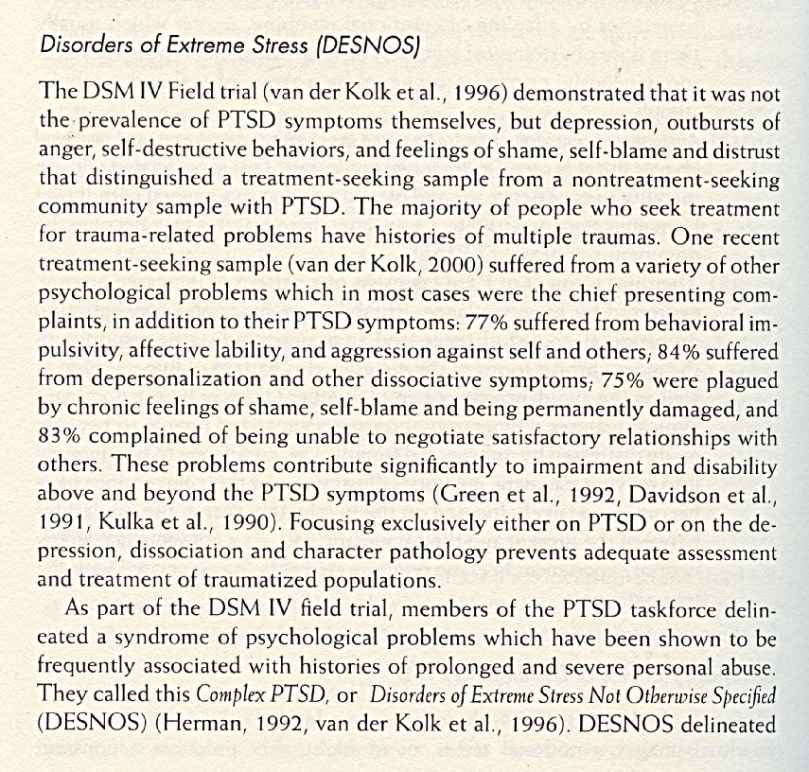
The following is taken from pages 172 of the above text.  I will consider this information in my writing below:
+++++++++++++++++++

It is now easier for me to work with this information because I have described my own version of an alternative way of thinking about the ongoing complications severe infant-child abuse and malevolent treatment survivors face as a direct result not only of the specifics of the actual horrific traumas they lived through, but also because of the very real physiological changes that surviving these traumas created in their infant-child growing and developing body.

(see yesterday’s November 29, 2009 post

+TRAUMA ALTERED DEVELOPMENT (TAD) – A NEW DESCRIPTIVE CONCEPT)

++++

An accurate primary and initial assessment of TAD for those of us who are Infant-Child Severe Maltreatment Survivors would allow us to know immediately how the changes our body-brain had to make created us to be different from ‘ordinary’ people who do not have the history of trauma that we do.

In this TAD assessment two critical resiliency factors would also need to be assessed because these two resiliency factors (one primary, the other secondary) are known to have the ability to nearly completely modify and modulate the power that early trauma has to change our developing body-brain.

The presence of safe and secure attachment to some early primary caregiver is the most basic and important resource an Infant-Child Severe Maltreatment Survivor had.  The current assessment tools available to assess adult secure and insecure attachment need to be simplified, refined and made accessible to the public.

Stemming from the degree of safety and security available through early caregiver attachment, the ability to play is a secondary but critical resiliency factor that impacts an Infant-Child Severe Maltreatment Survivor’s body-brain development.  I believe that assessment criteria and tools to measure this critical factor consistently and accurately can be developed and also made available to the public.

++++

NOTE:  In our new age of technology, the public has the right to be able to access critically important information about themselves and how their early infant and childhood experiences impacted their development.  At present this information remains ONLY available within ‘clinical’ settings, if even there.

++++

As far as I am concerned, anything and everything that is currently lumped under so-called ‘psychological’ categories belongs to the sinking Titanic of dark age medical model thinking that I referred to in yesterday’s post.

Until Trauma Altered Development (TAD) is assessed at the bedrock level of how Infant-Child Severe Maltreatment Survivors changed at their own bedrock (molecular) level, any attempt to moderate so-called ‘symptoms’ remains a crap shoot in the dark.

TAD assessment can connect the consequences of early trauma to altered physiological changes that an Infant-Child Severe Maltreatment Survivor’s body was forced to make to best ensure continued survival in early malevolent environments,

++++

Early caregiver attachment experiences from birth build the body-brain we will live with for the rest of our lives.

Van der Kolk (scanned text above) writes that it is not usually the symptoms of PTSD itself that brings those seeking help to a clinical setting.  Rather, he says that it is “depression, outbursts of anger, self-destructive behaviors, and feelings of shame, self-blame and distrust that distinguished a treatment-seeking sample from a nontreatment-seeking community sample with PTSD.”

Through an accurate TAD assessment, any ongoing difficulty an Infant-Child Severe Maltreatment Survivor has with emotions and social interactions can be traced to inadequate early caregiver interactions in a malevolent environment that built for the survivor an entirely different early-forming right-limbic-emotional-social brain.

When the foundation of the early forming right brain is altered because of maltreatment, the Infant-Child Severe Maltreatment Survivor’s later developmental stages involving shame, guilt and embarrassment will also be off course from ‘ordinary and optimal’ and will cause altered patterns of development in the body-brain.

++++

Van der Kolk states:

The majority of people who seek treatment for trauma-related problems have histories of multiple traumas.”

OK, I can certainly understand this, but here again, as I mentioned above, I do not agree with applying so-called ‘psychological’ and ‘symptom based’ medical model diagnostic thinking used in the author’s next statements.  I absolutely disagree with ever using terms such as ‘character pathology’ in reference to Infant-Child Severe Maltreatment Survivors!

One recent treatment-seeking sample…suffered from a variety of other psychological problems which in most cases were the chief presenting complaints, in addition to their PTSD symptoms:  77% suffered from behavioral impulsivity, affect lability, and aggression against self and others; 84% suffered from depersonalization and other dissociative symptoms; 75% were plagued by chronic feelings of shame, self-blame and being permanently damaged and 93% complained of being unable to negotiate satisfactory relationships with others.  These problems contribute significantly to impairment and disability above and beyond the PTSD symptoms….Focusing exclusively either on PTSD or on the depression, dissociation and character pathology prevents adequate assessment and treatment of traumatized populations.”

TAD assessments will clearly show that ‘impulsivity’, ‘affect liability’, most aggression, and dissociation are directly connected to changes in how an Infant-Child Severe Maltreatment Survivor’s nervous system, including their brain – and here, particularly their right brain – formed differently from ‘ordinary’ due to growth and development in trauma.

Chronic feelings of shame, self-blame and being permanently damaged” are also directly connected to trauma through developmental changes an Infant-Child Severe Maltreatment Survivor’s nervous system, including their brain – and here, particularly their later forming (after age one) left brain – had to make while developing in an early malevolent, trauma-filled environment.

Rather than referring to these changes as ‘character pathologies’, which in my thinking is the maltreatment, abusive stance taken by the medical model toward Infant-Child Severe Maltreatment Survivors, a TAD assessment can accurately and specifically pinpoint the origin of these changes in the body-brain and describe the consequences of them.

Receiving an accurate TAD assessment will show us exactly how our body was forced to adapt during our development through trauma so that we could survive it.   Yes, I do believe we KNOW we are different from ‘ordinary,’ but we are not ‘permanently damaged’.   We ARE permanently changed.

The changes Infant-Child Severe Maltreatment Survivors experience are fundamental and profound!  Everything about us was subject to adjustment for our trauma survival – our body, our nervous system and brain, our immune system, our mind, and our connection between our self and our self and between our self and the entire world around us.  NOT facing the truth and discovering the facts through TAD assessment will NOT resolve the difficulties we face with our continued survival into adulthood.

The only long term solution societies have is to STOP Infant-Child Severe Maltreatment!!!  Part of that solution is to provide the kind of TAD assessment Infant-Child Severe Maltreatment Survivors need, and to make available to us the resources necessary for us to live the best life we can in spite of the changes we had to make in order to stay alive because nobody STOPPED the Infant-Child Severe Maltreatment that happened to us.

It is the pathological character of the society we were born into that allowed what happened to us to happen at all, let alone allowed it to continue to the degree that trauma changed our physiological development.  If there is any self blame to be had, it is on the level far beyond OURS as the Infant-Child Severe Maltreatment Survivors.

++++

That the grand sinking Titanic of the archaic dark age’s medical model about Infant-Child Severe Maltreatment Survivors has at least THOUGHT about throwing us a life boat becomes apparent in van der Kolk’s next words:

As part of the DSM IV field trial, members of the PTSD taskforce delineated a syndrome of psychological problems which have been shown to be frequently associated with histories of prolonged and severe personal abuse.  They call this Complex PTSD, or Disorders of Extreme Stress Not Otherwise Specified (DESNOS).”

Great!  A life boat full of holes!  Gee, why are we NOT thankful for that?

A syndrome of psychological problems” be damned!  Infant-Child Severe Maltreatment Survivors do not suffer from a ‘syndrome’, and ours are not ‘psychological problems’!  For all the reasons I have repeatedly described, we simply need a TAD assessment that will tell us HOW our little body adapted down to our molecular level during our development in the midst of, and in spite of, toxic malevolent trauma.  Then we need resources that inform us how to live NOW with these profound trauma-caused changes that happened to us THEN.

The author continues:

DESNOS delineated a complex of symptoms associated with early interpersonal trauma.”

Again, we don’t have ‘symptoms’.  We have a different body-brain-mind-self that adapted to survival in a malevolent world and caused us to have Trauma Altered Development (TAD).

We don’t have symptoms, we have consequences.  Every single item in the list of so-called ‘complex symptoms’ (see them in the page scan below) that van der Kolk describes are directly connected to our TAD.  EVERY SINGLE ONE OF THESE ITEMS exist within us because of changes our body-brain was forced to make.  They are consequences of the changes our body had to make through our TAD.

The only real progress in the right direction I can see – given to us like faulty patches to a sinking life boat thrown to us from a sinking ship – is that at least an association ‘with early interpersonal trauma’ is finally being considered in the current medical model thinking.

But this tiny droplet of hoped for healing balm offered by the creation of a construct named “Complex PTSD, or Disorders of Extreme Stress Not Otherwise Specified (DESNOS)” is not what we Infant-Child Severe Maltreatment Survivors need in my book.

We need our entire society to understand and accept the truth that the Infant-Child Severe Maltreatment that happened to me and others – and continues to happen to children around us today – is nothing short of a form of parental-selected genocide that did not fulfill its intent to completely destroy us.  We are Infant-Child Severe Maltreatment Survivors because we are still alive, and we ONLY SURVIVED because we were able to adapt our body throughout our Trauma Altered Development to and within the malevolent environments that formed us.

++++

The rest of van der Kolk’s words (below) simply bring into my mind the image of the author being like a modern day Paul Revere, whose horse’s hooves pound along the streets of our nation as he screams a warning.  I am certainly not convinced, however, that even this author knows which message it is that most needs to be delivered.

The Trauma Altered Development that Infant-Child Severe Maltreatment Survivors experienced had no choice but to build itself into every part of who we are BECAUSE we live in a body, and our body had no choice but to change so that we could stay alive.

To describe any aspect of what happened to us in terms of a ‘diagnosis’ or a ‘symptom’, ‘complex’ or not, to call us ‘maladjusted’ or to tell us we suffer from any form of a ‘character pathology’ or ‘psychological problem’ is to continue to condemn us with stigmas and stereotyped prejudice which makes as much sense as applying all of the above labels to someone who is tall versus short, or who has red hair rather than blond.

If we wish as a society to remain in the dark ages about the consequences of Trauma Altered Development for Infant-Child Severe Maltreatment Survivors then at least we should have enough honor and common sense to admit it.  If we are appalled by the ignorance that is still applied to our circumstances, today is the day we can enlighten ourselves and get on with the legitimate task of figuring out how to accurately assess Trauma Altered Development so that we can begin to live well as the changed, extraordinary Infant-Child Severe Maltreatment Survivors that we are.

Our Trauma Altered Development did not affect WHO we are in the world, but it absolutely changed HOW we are in the world.  It is up to all of us to learn what that means.

+++++++++++++++++++

The following is taken from pages 173 of the above text:
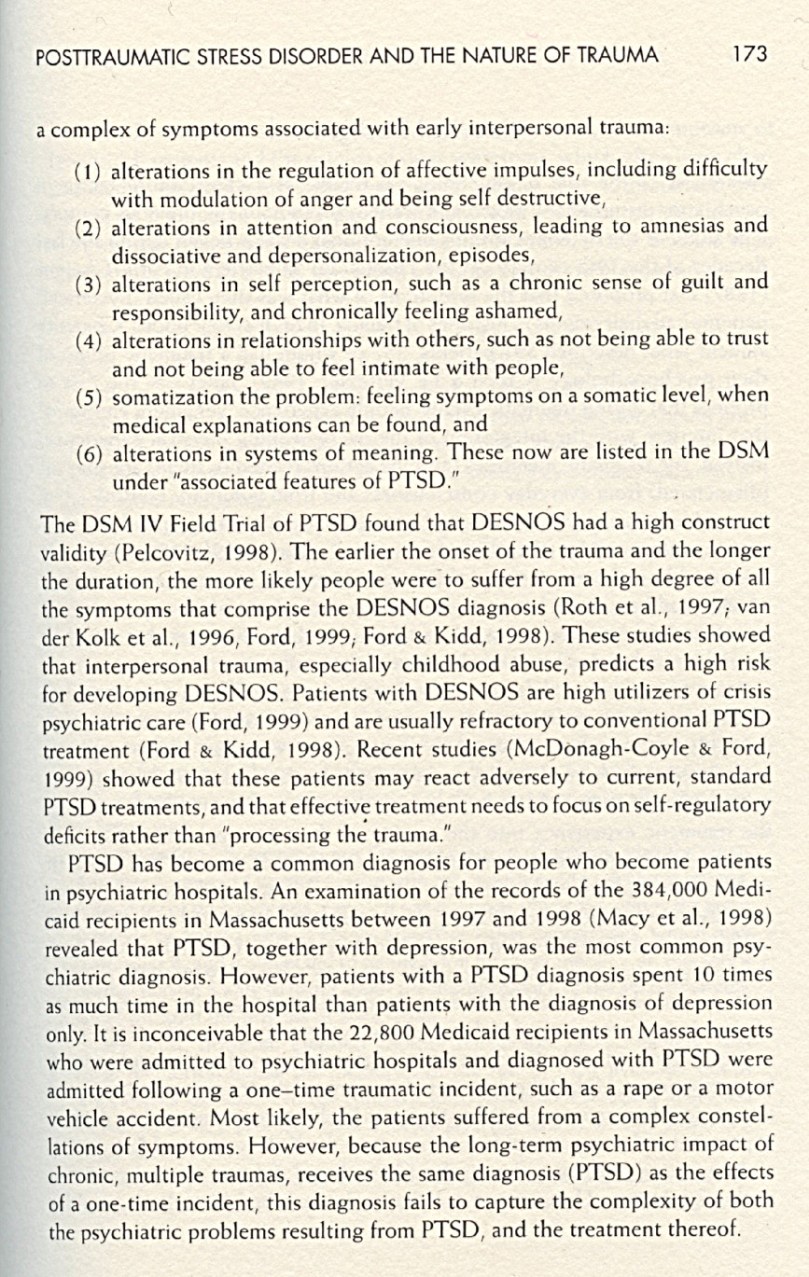
Again, it is not a picture of ‘long-term psychiatric impact’ nor a ‘diagnosis’ that Trauma Altered Development affected Infant-Child Severe Maltreatment Survivors need.  We need to understand the changes our body had to make to guarantee our survival and specifically how those changes affect us, and specifically how to improve our quality of life and well-being in the world in spite of our TAD.

+++++++++++++++++++++++++++++++++++++++++

Please feel free to comment directly at the end of this post or on

+++++++

Your Page – Readers’ Responses

++++++++++++++++++++++++++++++++

+CRIMES AGAINST CHILDREN – WHO ARE THEIR PROTECTORS?

++++++++++++++++++++++++++++++++

Something so troubles me that I cannot sleep tonight.  Could it be the sound of hurt and scared children crying, if only silently in their wounded hearts?  Who is protecting these children?

++++++++++++++++++++++++++++++++

A new page posted along the top of my blog has been added JUST FOR READERS to write any trauma-related thoughts that come to mind — either directly in response to something I have posted — or not!

Please feel free to click on the COMMENT link at the bottom of this new page that will always be at the top of the blog — and write!  Your words are important!

++++++++++++++++++++++++++++++++

Your Page – Readers’ Responses

++++++++++++++++++++++++++++++++

++++

Remembering what I wrote yesterday about the lack of playfulness and the ability to play being directly connected to the presence of trauma in a child’s environment, reading this new report about our nation’s children’s exposure to violence greatly troubles me.

++++

Please take some time to look at the report’s information, and also check out the information at the Safe Start Center website!

++++

The Office of Juvenile Justice and Delinquency Prevention published a new report that discusses findings from a survey examining children’s exposure to violence. The survey is the first to attempt to comprehensively measure exposure to violence for nationally representative sample of 4,549 children younger then 18 across major categories. Some of these categories were:

  1. Conventional crime, including robbery, theft, destruction of property, attack with an object or weapon
  2. Child maltreatment, other than spanking on the bottom
  3. Sexual victimization
  4. Witnessing and indirect victimization
  5. Exposure to family violence
  6. School violence and threat
  7. Internet violence and victimization, including Internet threats or harassment and unwanted online sexual solicitation

Results suggest that most children in the U.S. are exposed to violence in their daily lives, with more than 60 percent of the children surveyed having been exposed to violence within the past year. Nearly half of the children surveyed had been assaulted in the previous year, and nearly 1 in 10 witnessed one family member assaulting another.

Safe Start Center is dedicated to teaching about the harmful effects of the exposure of violence on children. Safe Start’s website is packed with information and resources for parents and the community to help our children stay safe. To read the full report of to learn more about the Safe Start Initiative, visit www.safestartcenter.org.

++++

About the Crimes Against Children Research Center

The mission of the Crimes against Children Research Center (CCRC) is to combat crimes against children by providing high quality research and statistics to the public, policy makers, law enforcement personnel, and other child welfare practitioners. CCRC is concerned with research about the nature of crimes including child abduction, homicide, rape, assault, and physical and sexual abuse as well as their impact.

++++

Here, also, is some more information on borderline personality disorder put together by —

In the Spotlight | More Topics |
Kristalyn Salters-Pedneault, PhD
When we talk about the impact of BPD, we’re not just talking about symptoms; BPD also has a major impact on your quality of life. From work, to relationships, to your physical health, think about the ways that BPD may be interfering for you.
In the Spotlight
Your Life with BPD
What is it like to live with BPD? It’s not easy. Intense emotional pain, and feelings of emptiness, desperation, anger, hopelessness, and loneliness are common. But life with BPD is not hopeless, and you can create a life full of quality and meaning.
More Topics
BPD and Relationships
Many of the symptoms of BPD can have direct impact on relationships, and other symptoms have an indirect (but not necessarily less disruptive) influence.
Physical Health Problems and BPD
People with BPD are more likely to report a variety of physical health problems, and are more likely to need to be hospitalized for medical reasons, than those without BPD

++++++++++++++++++++++++++++++++

+CONTINUALLY TRYING TO CREATE MYSELF IN TIME AND SPACE

+++++++++++++++++++++++++++

I tell myself to put my fingers on this keyboard and make them move.  “Speech is silver.  Silence is golden.”  I choose to go for the silver.  I was forced for the first 18 years of my life to be as silent as a child can be.  Silence will not heal me.

Writing is all tangled up today with what I choose to write about.  Having a disorganized-disoriented insecure attachment MEANS that having access to one single, integrated, cohesive, coherent Linda is extremely difficult.  I will not admit defeat and say it is impossible.  I am coming to understand, and believe, that using my words – putting them together in lines across the page – will help me become more organized, oriented, integrated, cohesive and coherent.  So here goes…..

I am thinking a jumble of thoughts, all tied into very old and continual thoughts about myself in my body in my life since my beginning.  I was not allowed to be a person.  My mother interfered with my normal, ordinary development every single step of my development.  I have paid a price for her terrible abuse of me.  The biggest one is that I didn’t so much as LOSE my self, I didn’t get one in the first place.

++++

So I have to imagine what it would be like to have one of those illusive organized, oriented, integrated, cohesive and coherent selves.  How do all these aspects of such a strong, clear, healthy self operate in time and space, which is what I guess being in a body in a life, in the world is all about?

Today, I want to know the difference between having goals, destination and purpose and having hopes, dreams and wishes.

I want to know because it seems to be I wouldn’t have to question these things the way I do now if I HAD any real idea what they mean.

My mother interfered with my development regarding everything, so why wouldn’t I expect that having a clear sense of goals, destination, purpose, hopes, dreams and wishes would be a part of what I am missing?

She never hesitated to control and abuse me in any way that she could.  Her abuse included confining me in space and time beginning when I was very, very small.  She withheld food, prevented me from even going to the bathroom when I got older.  She woke me from sound sleep to beat me, or didn’t let me sleep.  When I got older she forced me to overeat.  I could go on and on, but this isn’t what I want to say right now.  Not being free to be a growing child, not being safe or allowed to play greatly harmed my development in every single way.

What I want to say is that great sense of loss and grief I feel is tied as much to my loss of access to my inner needs, wants, desires, ability to have intentions, and the ability to find ways to know what brought me happiness as a person and what gave me pleasure.  I didn’t grow up knowing much of anything except how to survive my mother’s torture and abuse.

++++

This thinking is tied to what I believe about people like me with disorganized-disorganized insecure attachment.  I believe I organized and oriented myself around being a mother for the 35 years I had children under 18 in my care.  Today it seems that I used the goal of caring for them as well as I could, the destination I saw for them in the future as leaving home well and happy people, my purpose in life of being their mother, to organize and orient my self in the world.  My hopes, dreams and wishes were tied up in that whole process.

Having them grow up and leave was wonderful.  Yet I was left again being the disorganized-disoriented insecurely attached-to-my-own-self and the world just as I had always been for the first 18 years of my life.

Without the strange and complicated relationship I formed after they left again leaves me feeling inwardly desperate, destitute, lost and confused – again disorganized and disoriented.

I was able to obtain the goals for my education, but the process was extremely confused, and in the end I am still lost.  I can ‘make things’ with my hands, but even being able to use the ‘goal-destination-purpose’ and ‘hopes-dreams-wishes’ thinking only lasts for short periods of time and nothing about me seems connected and tied together.

I want to understand how the brain-mind changes that I have continue to cause me great difficulties in these areas.  Somehow I sense that COMMITMENT has always been a key and central piece of anything I have ever accomplished.  If I say I hope to write, that writing is tied to my dreams and wishes, how do I connect that to my goals, my destination, my purpose?

Because my right brain, left brain, corpus callosum that connects them together, and my higher executive function cortex did not form in an ordinary fashion and instead will suffer from severe trauma influence for the rest of my life, I cannot simply accept that I am going to ‘naturally’ find a solution to my dilemmas.  I have to continue to focus my will toward the goal of better understanding how all these changes – that result in what I am naturally missing – connect to my overall feelings of hopeless sadness in my life.

How does changed me find my self in time and space so that I don’t constantly know that I don’t ‘fit in’, am lost, and want to ‘leave here’?

I don’t know yet, but I wanted to say I am working on these things.  Today.  I continually have to try to learn how to create my self in time and space because this process was completely interrupted for me growing up with such abuse.  I have a trauma bond with myself that makes it hard for me to get through life feeling whole and successful.  There is a rupture between my self and myself and the world I am constantly trying to find ways to repair.

I have to start with the little things, and writing here is one of them.  Now, I will go eat breakfast as I move my self forward in the time and space that is today.

+++++++++++++++++++++++++++++++

It strikes me after putting the above words into their order that the most important word in the whole piece is PLAY.  I was not allowed to play, and as many of my childhood memories show, my mother had an uncanny ability to turn whatever childhood play thoughts or actions I had into something painful for me.

Beginning with playful interactions between infants and their early caregivers, and moving all the way through childhood, play is nature’s way of building an organized and oriented self in the world.  I suffered terribly from the lack of play and from interruption of play every step of my development because of my mother’s abuse.

My sister just gave me a simple example of how play interacts with a growing brain-mind-self regarding hopes, desires and wishes on the one hand, and goals, direction toward a destination and purpose on the other.

She took her granddaughters to a fund raiser bake sale today.  The seven year old bought muffins and a specially formed little bundt cake with a hole in its center.  On the way home she ate the muffins but carefully protected and saved the cake.  At the urging of grandma and her 10 year old sister she finally, shyly told them her PLANS for her special cake.

She wanted to take it home, fill the center with pudding, put a candle on it, and have a birthday party with her Barbie dolls.  This, of course, is what she was allowed to go home and immediately accomplish.  Even her sister, who thinks she’s too grown up to play Barbies, came to the party.  Through each step in her process she was building another healthy, happy aspect of her brain-mind-self.  Severely abused children are very often deprived SO MANY or ALL TIMES of this kind of experience — and this kind of loss is big part of what happened to change us.

I see that everything I am thinking about this morning is simply contained in that pattern of child play.  Play is how children learn to be social (after their infant brain forms through early mirroring caregiving).  Play can involve rules, or not.  Child play does allow the brain not only to build its happy-joy center, but also all the other brain patterns and circuits I am beginning to understand as they in-form our lives.

The arenas of damage my mother orchestrated against me were many and devastating, but today it is particularly the damage done to me by her abuse of my play drive and abilities that has harmed me immeasurably in my adulthood.

Today I also realize that the absence of my sadness that being with my boyfriend gave me was directly tied into play.  He was my playmate.  That is a big part of the joy and happiness I felt when I was with him.  I didn’t know this until today.  I have no built-in experience of play-joy from childhood.  I didn’t even recognize my happy feelings with him were directly connected to play.  My playmate doesn’t want to play any more.  Certainly that gives me great sadness.

What can I learn about play at 58?  How can I begin to understand that a lot of the sadness I feel stems from never having play in my childhood?  My siblings played together, and they all remember my part in their play – by my absence from all of it!

That especially the lack of play in my childhood (coupled with the rest of the terrible abuse) directly created my adult brain-mind-self’s great difficulty with the ability to dream, wish, hope or to plan, have a goal, a sense of direction, a destination for myself in my life, or a sense of purpose — in-forms my sense of grief, loss, and feeling lost like I don’t belong ‘here’ — is not a small piece of information.

+++++++++++++++++++++++++++++++