+PETER PANELLA AND ALL MY LOST GIRLS – AGE 31 JOURNALS, THE NEXT STEPS

+++++++++++++++++++++++++++++++++++

Nine months.  That’s the length of time this next of my age 31 journal entries covers.  This would be the same length of time it takes for a baby to travel from conception to birth.

It seems strange to me that over a quarter of a century later I cannot begin to be objective about myself, my story, or my process as contained in these writings.  I still distance myself from myself, and can give myself total permission to do this distancing now because THAT was a different Linda, in a different set of circumstances at a different place in a different time.  I also continue to distance myself from myself because I have no other choice:  I was made that way.

It strikes me how remote I have always been from myself in my life except for the very NEAR past and the in-the-moment experiences I have as each moment of my life unfolds into the future.  It seems that my past carries me, not that I carry it.  It is too vast, too painful and in too many pieces.

I cannot think of a story that could be more closely like the reversal of the ordinary Peter Pan and the Lost Boys story than mine is in these pages.  What would that story look like if the sexes of all the characters were reversed?  I would be Peter Panella with my Lost Girls.   My mother would be the Wicked Captainella Hook.  Marlin (name changed) in my story would be the male reversal-same character of Tinker Belle!  Leo (named changed)  would be the ever-devoted, right thinking and well-intentioned Wendy.

++++

In the nine month period of time that elapses in the pages here, I left my husband and my children in ‘their’ home and rented a ‘Room of My Own‘.  I completed my BA college degree.

It has never until this moment struck me that the trials and tribulations of a recovery-from-abuse journey happens in its own story version of a Trauma Drama.  If we had never experienced the trauma of abuse in the first place, there would never be a need for this Recovery Trauma Drama story to ever happen, either.

As Peter Panella in my story, all the Lost Girls were part of my self.  There was a dissociated me not only for every developmental stage of childhood I had missed going through ‘normally’, but also hundreds and hundreds more of them that had each experienced some horror caused by my mother along each step of the way.  Each Lost Girl holds her piece of my memory along with the experience of having her experience of her experience of trauma.  In this way each one of them holds her own consciousness about what the Main Me, Linda, cannot remember except through the emotions held within the body that all of us share.

Nobody ever told me that these unintegrated shards of my existence could not magically become part of some magical WHOLE PERSON named Linda.  Nobody ever told me that what I was really accomplishing in my recovery journey was the recognition, identification, and naming of all these separate dissociated Lost Girl pieces of my self.  Nobody ever told me that they were NEVER going to become anything else.

Nobody told me my brain-mind-self had formed from the beginning of my life under so much trauma that continued for 18 years that I will NEVER be able to obtain or create a single-self-entity that resembles the one that ordinary-childhood people are created with.  Nobody told me that as a consequence of my childhood I was made into a different sort of person.

++++

In these journal writings I am describing a catching-up-to-Linda-at-31 process that was going on at the same time I was beginning to identify the trauma and the individual pieces of me that it had created.  I tried to accomplish an exploration and solidification of self that should have automatically and naturally happened throughout my childhood and young adulthood years — and didn’t.

Every single step I took in my journey included some confrontation and encounter with my profound woundedness.  The 18 years of abuse I endured had affected — and infected — me so profoundly and pervasively that I could not find anything but a shell of Linda, packed full to overflowing with pain, confusion, and the defenses that had enabled me to survive.

By the time these journal entries end I had found my way to the only place, both internally and externally, possible for me to go to next:  Another treatment center.  This one was designed specifically to address both severe trauma and addiction.  I remained apart from both my husband and children, now 130 miles away, and walked through the next doorway of my trauma drama recovery story.  The steps that I took to get to this next doorway are described here:

+++++++++++++++++++++++++++++++++++

*Age 31 Journal – Sept. 1982 thru June 10, 1983

+++++++++++++++++++++++++++++++++++

EXCERPTS:

January 19, 1983

What do I see as my boundary problem with Leo?

My mother = my conscious

Her right and wrongs = mine

Leo’s rights and wrongs = my rights and wrongs

I use Leo:  the whole part of me that would love Linda isn’t there and Leo is that part of me that loves me

Doesn’t feel healthy

My mother is the part of Linda that hates Linda

Kathy [therapist] says:  “In some ways what you’re talking about is pretty profound.””

++

January 26, 1983

Talked to the girls tonight about my moving out for awhile.  Kathy [therapist] says it should be for at least 6 weeks.”

++

February 8, 1983 Tuesday 11 PM

Had class tonight on child abuse issues.  Sue told her story.  Makes me think about my unvisited “cave” where I’ve hidden all my childhood issues.  Wonder when I’ll get in there and poke around.”

++

February 24, 1983

From notes on Rollo May talk, “Creativity as Significant Form

“Without anxiety = heightened sensitivity, there’s no creative person.”

“Creativity:  The divine madness.  The anxiety of being lost leads to creativity.”

“The pause is not nothing.  Listen to the silence.  Technology calls pauses depressions.  PAUSING – the kind of aloneness of a creative person.”

++

March 4, 1983

Well, it’s 9:15 PM and at last I’m here in my room.  Made the move.

++

March 13, 1983

(I’m losing tears again).”

I’m creating a safe place here for myself to be with myself, and, finally, cry.”

++

March 22, 1983

I don’t want to die – I don’t want to be dead.  I want to live.”

++

March 23, 1983

I feel angry tonight.  Very lonely, too.  In that lonely place nobody else can come to.  Maybe lonely for myself.”

++

March 28, 1983

There’s a point where you go numb and you have to choose not to feel any more in order to survive.”

I used to think my mother was “just” an overly critical perfectionist.”

++

April 2, 1983

7 PM – I’m in Glyndon now [visiting].  Leo and girls are at Larry and Echo’s.  The house is very neat and clean.  It’s my home, and yet I also feel like I don’t have a home.  Alienated – That’s how I feel.  From people, my family, pets, home, even my body and myself.  I feel sad, like I want to cry, but I can’t.”

I feel hopeless like I got made wrong and I can’t get fixed.  My body is healed of the childhood wounds, bruises; but inside I haven’t healed yet – I don’t even know if I’ve started yet.  I don’t have the option of getting high to forget this all like I used to.”

2009 note: I know now, finally, that I didn’t get made ‘wrong’, I got made different.  I could not have survived my abuse if I hadn’t adapted and adjusted in every possible way that I could.  Fortunately, our human species has that ability — to adapt in order to survive.  I also know now that I could not possibly re-make myself into the same kind of person I would have been if the abuse had never happened to me.

++

June 9, 1983

There’s someone inside wanting to get out and not knowing how.”

+++++++++++++++++++++++++++++++++++

NEWS FROM:

Prevent Child Abuse New York Blog


Recent Surge in Recession RunawaysPosted: 30 Oct 2009 02:46 AM PDTThe intersection between the recession and family stress may be causing an increase in runaway kids and teens, according to a recent article in the New York Times.   Job loss, foreclosures, and poverty have added to the stresses at home which have been trickling down and effecting teens.  Reporter Ian Urbina recently spent time with teen runaways in Medford, Oregon.  He learned the desperate measures they take in order to survive everyday rather than return home.  Most runaways aren’t even reported missing by their guardians, and if they are reported to the local police, most times they don’t make it into the national database.  Without national recognition, it is very hard for police to identify and return these runaways.  Police claim that runaways are not a top priority because most of the time they do not want to be found or returned home.  Unfortunately of the 267 runaways reported nationwide 58 of them were found dead.  “These kids might as well be invisible if they aren’t in National crime information center (N.C.I.C.),” said Ernie Allen, the director of the National Center for Missing and Exploited Children.  While federal officials are expecting a rise in homelessness this year, most social programs aid homeless families, not unaccompanied youth.   At the same time, many financially troubled states have severely cut social services, leaving little to no help for homeless runaways.  This presents a significant challenge for society, as runaway children are more likely to become homeless adults who are forced to live a life of crime.For information please visit the National Association for the Education of Homeless Children and Youth, The National Coalition for the Homeless, and The National Child Traumatic Stress Network.

+++++++++++++++++++++++++++++++++++

+BEING CHEERFUL AND COURAGEOUS IN THE FACE OF A TERRIBLE REALITY

++++++++++++++++++++++++++++++++++++++++++++++

I cannot pull any punches.  Surviving child abuse is a serious matter that needs to concern both those who endured it and those who were fortunate enough not to.

Child abuse should happen to no one.  Yet it does.  Those of us who survived it are doing the best that we can to understand the changes this abuse did to us during our development, to learn, to grow and heal.  We need to be vigilant about our well-being, proactive regarding the state of our health, and informed.

We suffer from continued difficult lives for as long as we live.  At the same time, our risk for developing serious adult ailments and perhaps to die young is connected to the extremely high price we had to pay to endure and remain alive.  Sticking our heads in the sand will not help us.  We are incredibly STRONG people or we would not be here!  We have the strength to face the facts and to find ways to continue to improve ourselves, our lives, and our chances for continued survival.

++++++++++++++++++++++++++++++++++++++++++++++

It is easy to lose track of important information as time goes on that is posted in comments to writings on this blog.  One such piece of information came through today, and I think it warrants a repeat here:

Comment and reply posted to *THE ADVANTAGES OF DISCLOSURE

Comment submitted on 2009/10/30 at 1:54am

I never knew what I was experiencing was a disassociation from myself but now that I read what you wrote I go through exactly what you do. I like how you put this.
“While I have the benefit now of reorganizing and reorienting myself in relation to my brother based on our new level of connection, I have to experience aspects of this readjustment consciously in order for it to become a living useful integrated part of who I am.”

I always get in this stuck phase. Words for describing what Im going through just aren’t there. I feel like it’s because I learned from a very early age to program myself to shut off to the describing, and trying to put it into words because when I did I got hurt one way or another. So now that I am an adult I flounder. I have to work twice as hard and I fumble with thing actions, reactions that most normal adults are able to have within seconds without much thought and commit it to memory. Where as I have to actively think and then do and the evaluate and then try to commit it to memory.

Thank you for your blog

Reply submitted on 2009/10/30 at 9:58am

Hi there, and it makes me so happy to hear from you! After I had done my post yesterday about my journal, down at the bottom I went back and added something that was a (welcomed) revelation for me. For all the years of my recovery work I’ve heard people talk about how we have to learn how to feel — value of feelings, what they tell us, how to tolerate them, how to regulate them, how to learn from them. It’s true.

But yesterday was the first time it clicked with me that I never learned how to think!! My mother’s abuse interrupted me and my development every possible step of the way she could do it. Even though she could not say to me directly, “LINDA! STOP THINKING!” She really accomplished this.

This is a new realization or a new level of recovery for me to begin to understand this. Many times in my early recovery both therapists and AA people told me, “Linda, you use rationalization as a defense all of the time.” Nobody ever detected the underlying crisis of self that is connected to being smart and thinking. Nobody said to me, “By the way, Linda. Let’s look at the way you think. Let’s see where those thought patterns are connected in how your poor little growing baby brain learned to BE in a malevolent world of chaos and violence.”

We can always trust that our body, “itself” (it really IS US) remembers all our experiences and feelings because those memories are stored separately from the facts of our experience. How our left and right brain hemispheres develop and how they communicate with one another is MAJORLY affected in our early development from severe early child abuse. That means we are NOT the same as other ‘ordinary’ people are. Once we understand this, it’s a whole new world to explore, examine and learn about as we come to NAME HOW we are in the world which affects WHO we are in the world.

We cannot take for granted what ‘ordinary’ safe and secure, or even organized insecurely attached people can. We have to become far more conscious and aware. I take for granted that I have arms and hands, for example, and that I can use them and control what they do in ‘ordinary’ ways. I don’t have to consciously think about this. I just DO ordinary things with them.

Not so with the way my brain developed through abuse. So many things that psychology has simply stuck in the ‘defense’ category do not belong there. Thinking involves words, but how to connect our thinking both to our body-feelings and to our words becomes a task we can learn to practice with discipline as we try to train or retrain our brain-body-mind-self connections!

How can a growing little child ever find words when what they experience is beyond reason?

It is helping me to affirm who I am by realizing that what happened to me is shared by most people who were severely abused and neglected as children, especially to those whose mothers were ‘damaged’. It helps me to know the changes that happened to us as we grew and developed were not willy-nilly. The adaptations and adjustments our body-brain-mind-self had to make so we could survive DO follow patterns. It’s just that only now with new brain imaging techniques and new infant-child development research we are beginning to realize that we are evolutionarily altered beings. On a most profound level that is something for us to celebrate! That is a testimony to the miracle of resiliency that our species has ALWAYS had so that we could outlive at least 19 other hominid species throughout all the millions of years we have been developing — and surviving — as a species.

Having an identifiable ’self’, I believe, was a later evolutionary gift to our species that came after our life on this planet was no longer as terribly malevolent and dangerous as it was in our beginnings. We had grown enough to find ways to survive under threat, and the actual conditions of our environment eventually improved. But a tiny fetus and newborn, a little child, born into a world that is toxic and threatening still has the ancient genetic memory of how to grow a body and brain that allows it to continue to survive intolerable conditions. That those of us who were born into a bad-mothering world (especially and primarily) really are a testament to the amazing survival abilities of our species.

But the world we grow up into is filled with other people whose early lives were not all that bad, and they were able to grow and develop ‘ordinarily’ in contrast to us. It becomes, pardon the expression, like the Clash of the Titans. Only it is not supposed to be a conflict between survivors and those whose survival early on was not challenged. We just have to LEARN, and humans are very good at that. That’s why the name of our species is The Wise Ones! By golly, we are on the way.

Exactly what you are describing in your comment is how this process works for us. Think about how humans only ‘got’ verbal language ONLY 140,000 years ago. When we realize how LATE that was in our development, we realize we have vast storehouses of abilities to survive and to live BESIDES words. THOSE abilities are what kept us alive. Those abilities kept our species alive. There’s incredible powers in those non-verbal abilities. We can learn about the word part! In a way, words are frosting on the cake of life — yes, essential to who we are now in our more ‘ordinary’ world. But as I write this I realize they are not as essential to our survival as all our other abilities are (that we used or we wouldn’t be here).

++++++++++++++++++++++++++++++++++++++++++++++

I hate to have to say this, but reality IS reality.  I was thrilled – even though it is a strange thing to say, and I WISH (a part of denial, magical childhood thinking reality state) it were not so – to see yesterday’s news about research that is confirming the long term, life span consequences for an individual who has survived intolerable severe child abuse.  The research is catching up with reality.

Our survival comes with an extremely high price tag.  Survival to the child bearing years is what nature has allowed us to do.  That we survive PAST that age, as I have said before, is due to the more benevolent conditions of the world we grow up and survive into.  The cost of the adaptations and adjustments our body-brain-mind-self had to make to keep us alive DOES show up in the costly consequences of serious illnesses and premature death.

Nature does not see our early death as being unusual.  It is simply the cost of surviving in a dangerous and malevolent world.  We have to realize the facts so that we can acknowledge risk and take precautions wherever possible to alter the natural course of our continued survival in our altered and adjusted bodies.  For example, if anyone had ever told me that surviving the distress and trauma of a severely abusive childhood put me at extremely high risk for cancer, I would have made certain I had mammograms early – or at all.

That I ended up with advanced, aggressive breast cancer (in fact, two different cancers in the same breast) does not surprise me now that I understand the risks and the price my body paid for surviving my incredibly terrible childhood with my parents.  This is why I continue to work as hard as I can on this blog.  I suffer under no delusions that I have now been granted anything more than a temporary reprieve from the cancers I have been treated for and that now seem to be ‘not present’ in my body at this time.  Whatever it is that I may have learned from surviving 18 years of terrible child abuse — and what might be of use to someone else —  I better say while I am still here to say it.

Whatever happens to me down the road of my life, and whenever it happens to me, this blog will remain as my legacy in the hopes that what I have learned from my suffering will be able to help those who also suffer to live a better life.

++++

I did not fit the ‘ordinary’ breast cancer risk factor profile.  Add in the severe child abuse history, and I was on the top of the list.  Should this make us terribly sad that we continue to pay the price for the abuse we suffered for the rest of our – perhaps very short – lives!  YES!  Sad and enraged, not only as the victim-survivors, but as members of a civilization that continues to allow severe child abuse and neglect to occur.

I posted this yesterday, but as this is a repeat-of-information post, I’ll post it again (comes to us from the Prevent Child Abuse New York Blog:

Traumatic Childhood Can Reduce Life Expectancy

A difficult childhood reduces life expectancy by up to 20 years according to a study published in the American Journal of Preventive Medicine. The study found that participants who were exposed to more then five different types of adverse childhood experiences (ACEs) were over 50 percent more likely to die during the 10-year period of the study. On the other hand, people who reported fewer than six ACEs did not have a statistically increased risk of death compared with the control group.

Listen to a podcast Adversce Childhood Experiences and the Risk of Premature Mortality.

To explore the effect that childhood trauma could have on life span, Kaiser Permanente mailed questionnaires to adults who were 18 years and older, and who had visited the Kaiser clinic in San Diego from 1995 to 1997. Overall, the study subjects were middle-class and had good health coverage. Of those surveyed, 75 percent were white, 11 percent Latino, 7 percent Asian, and 5 percent African-American. They’re educated: 75 percent attended college and 40 percent have a basic or higher college education. When they filled out the questionnaire, their average age was 57. Most of them had jobs. Half were women, half were men.

The participants were asked about their exposure to eight categories of abuse or dysfunction based on previous Kaiser studies. One third of the 17,337 participants who replied to the questionnaires had an ACE score of zero, meaning they had not been exposed to any of the eight types of abuse or household dysfunction. The majority of the remaining responders registered a score of between one and four, whereas about 8 percent of the scoring participants were rated five, and roughly three percent, six to eight.

During the next decade, the study authors, kept records of which of the 17,337 participants passed away by matching identifying information such as Social Security numbers from the questionnaire with data from the National Death Index. In total 1,539 of the participants died during the follow-up period. When the increased number of deaths in those subjects with an ACE score of six or greater was compared with the control group, their mortality risk was 1.5 times higher than for people whose childhoods had been free of all eight types of abuse. They lost about 20 years from their lives, living to 60.6 years on average, whereas the average age of death for the control group was 79.1.

It is unclear why the authors saw more death ages during the 10-year period only for the group with an ACE score of six or greater. Previous studies by these authors found that the risk of chronic illnesses, such as heart disease, lung disease and cancer, was greater only for people with these high ACE scores. In contrast, the risk of substance abuse and suicide increased stepwise from low to high scores. The authors found that ACE-related health risks, namely mental illness, social problems and prescription medication use, accounted for about 30 percent of the 50 percent greater risk of death seen in this population. “As would be expected, the documented ACE-related conditions among participants appear to account for some, although not all, of the increased risk of premature death observed in the current study,” wrote David Brown, an epidemiologist at the U.S. Centers for Disease Control and Prevention (CDC), and lead author of the study.

This posting includes an audio/video/photo media file: Download Now

+’RED HIGH ALERT’ EMOTIONS AND ASSISTANCE FROM ASTROLOGY

+++++++++++++++++++++++++++++

Well, I had to cook up something entirely different today.  I found yesterday that going back to my age 29 journal was an incredibly difficult and painful experience.  There is nothing easy about any part of my life thanks to the treatment I received at the hands (and mouth) of my psychotic severe Borderline Personality Disordered mother.  So how do I live with, process, understand and begin to heal the powerful, intense and nearly overwhelming emotions I experience — frequently — as a consequence of my childhood?

My emotions reached the ‘Red High Alert’ stage yesterday.  I knew I had to find some way to ‘self sooth’ them down as many notches as I possibly could.  That meant I had to reach for some external resource for help, but which one?

I found and played a tape recording of an astrological reading I had done for me last March of 2009 specifically about the difficulties I have with my emotions by a man I consider to be a blessed and extremely talented and knowledgeable astrologer:  Zane (see Zane’s Page).

I learned a long time ago that because of the severity and extent of the child abuse I suffered, which began at my birth and lasted until I left home at 18, I have to consider and access the best of the best help I can find — anywhere I can find it — in order to live with and try to heal from the consequences of that torture.  Astrology is one of those avenues of assistance I have turned to in some of the toughest times of my adult life.

++++

I believe it takes a full lifetime of study coupled with incredible efforts at self-healing, and a whole lot of gifted talent for any individual to truly practice astrology.  I barely know enough personally to begin to understand the influences that the natural world exercise over me in this lifetime so that I can begin to gain assistance and insight from the best astrologers I can find.

Some people find it helpful to have ‘daily’ sorts of readings through which certain influences on their lives are made more clear as their lifetime progresses.  I am not interested in accessing that kind of astrological information.  I simply need to know what forces operated at my birth, throughout my childhood, and continue to operate during this very difficult lifetime I seem to have found myself in.  Zane is the most skilled and qualified astrologer I have ever found.

The internet provides a wealth of information about the basics of astrology.  There are websites that provide a free natal chart.  As with any search on the web, consumers need to pay careful attention to the information they obtain, but time spent considering the topic is, I believe, time well spent.  If you choose to consult with Zane at Zane’s Page, you can email him with specific questions or to set an appointment with him should you choose to purchase one of his readings.

++++

It is not my intention to either explain or defend astrology in this post.  Today I simply transcribed the reading I had with Zane last March.  I find the information helpful to me, and where I have differences of opinion with Zane, I note them within the text.

If you are interested, please follow this link to the whole report text:

*Age 57 – March 2009 (whole text) Astrological Reading About My Emotions

Transcribed from tape of telephone consultation

++++

Or refer to individual sections of the reading here:

MY EMOTIONS

MY DIFFERENT KIND OF LOGIC

MY FEELING DIFFERENT FROM OTHER PEOPLE

MY MARS AND JUPITER:  BEING A TEACHER

POTENTIAL AND PSYCHOLOGY

SUMMARY AND CONCLUSION

+++++++++++++++++++++++++++++++

+THE TOUGH FACTS: MY MOTHER ABUSED ME BECAUSE SHE LIVED LONG ENOUGH TO DO IT.

++++++++++++++++++++++++++++++++++++

Sometimes when I write I feel the presence of my Siamese twin.  One voice tries to speak while the other is full of silence.  One voice is bold and rushes forward, sword raised in her hand, while the other twin, so timid, hides under the bed.

One voice says, “I know what the ancient will of our species is.”  The other voice says, “Don’t mention it.  No words are meant to speak that will in this world today.”

One voice says, “My mother lived too long.  She was supposed to die much before she did.  Her time came and went and yet she endured.”  The other voice says, “That’s not for you to judge.”

One voice says, “What happened to my mother when she was a little girl ended up turning her into a monster.  It’s like what happened to Hitler.  His mother birthed him, but she should not have raised him.  My mother was not meant to raise me.  In fact, I doubt I was meant to be born at all.”

The other voice?  I don’t hear her.  She’s too far away from me now.  After all, she’s hiding underneath a very big bed and I am busy here in the other room.

++++

When times are very hard in childhood, a growing person changes.  That’s the ancient will of our species.  It only matters that any person lives long enough to produce offspring if possible, so there will be somebody left to carry us on.

It does not matter who it is that raises such children.  It is not meant to be that the changed people raise them.  It is better that unchanged people raise them.

The unchanged people were loved from the moment they were born.  Someone was there to take care of them.  They took one fork in the road that began in a good world and moved forward into the same.

The ones that have to change were born into a world where nobody was there to love and take care of them.  That told their body to follow the other fork in the road, the fork that says “The world is bad and is bound to get worse.  Make a different body now, one that can live long enough to make a baby.  You won’t live long enough to raise it.”

++++

Only somebody changed the rules our species has known for millions of years.  No longer do these changed ones expire as they once did in a world that was as bad later on as it was at their beginning.  These changed ones continue to live, past when their body was programmed to end.  These changed ones end up raising their children when they shouldn’t have to.  They were not designed for it.  They only pass on the same trauma that built them, and the dark road overflows with too many people.

++++

Our species only cares that babies be born.  It meant for the good-fork road people to raise them.  Our species has always held this hope, that someone on the good-fork road could raise the children for a better world.  Our species has always believed in a better world coming.

But we are slipping up now.  We no longer seem to believe in the good-fork-bad-fork road.  We no longer believe that our genetic memory has any wisdom, that it has the power to change us if our early beginnings are more bad than good.  We no longer believe that there are two main kinds of people – those who survived a bad beginning and changed to survive it – and those that had a good beginning who could simply just get on with the business of moving into a good future without having to change back to the ‘old way’ that our genetic memories remember.

++++

I am a child of a changed one.  Nobody from the good-fork road took me away from her and raised me in a good world like they were supposed to so I wouldn’t have to change, to adjust to a bad world.

People are confused now.  They don’t even want to admit that there is a difference between a bad world childhood and a good world childhood.  They don’t want to understand that the good of our species still governs how the bad childhood people have to turn out.  They want to join my Siamese twin sister and go hide under the bed.  Or they just want to get on with their own lives of good-fork-road play.

++++

It is an upside-down world in which parents kill their babies, but nobody ever thinks about the fact that those parents should not have been allowed to keep their babies in the first place.  In our older, more ancient and wiser days, our species knew this.  I am telling you why.  Parents who cannot provide a good-fork in the road childhood for their own children simply were never meant to keep them.  These changed parents in the old days would not have lived in a world good enough for very many to survive in at all, and the few that did survive had to take the best care possible of the little ones or none of us would be here today.

Somebody else is supposed to be raising those changed parents’ babies.  The will of our species has determined that.  It’s the same will that has kept our species alive for all these millions of years.  We are supposed to be wise, not dumb, ignorant or stupid.

++++

Conditions in the world build these two roads.  The good-fork road is not the same thing as the bad-fork road, and the people on these two roads are not the same, either, because little people raised by bad-fork changed parents have to change themselves or they will not survive long enough to have babies of their own.  One road is like Easy Street.  The other road is very, very hard and makes the people who have to be on it suffer very much.

When you are very little, if nobody takes you away to a better place and you have to suffer that much, your body and your brain have to change as you grow up or you will die.  In the olden, ancient days if you had to make these kinds of changes it was a sign that the world was very hard and you probably would not live very much longer.

At least being able to make these changes let you live a little longer, but they also meant back then that somebody else who didn’t have things quite this hard would probably be able to raise your children, if you lived long enough to have any, better in a better world.  Then your children wouldn’t have to change so much or maybe not at all.  I can see that people now have forgotten how this used to work and what it meant.  Now the changed ones don’t die so soon and their children are left to just suffer on that hard road so that they have to change, too.

What has happened to our species that we no longer know which is which?  Are there just too many of us now, and our old, ancient wisdom isn’t important any more?

It all seems very clear to me because I can write this with a 14 year old mind because my grown up Siamese twin is still in there hiding under the bed.  I know what it’s like to have a bad-fork in the road mother.  I remember.  I know somebody was supposed to take me away from her and raise me on the good-fork road.  Why didn’t anyone do that?  Did they forget what their ancient wise specie memory told them?  I guess they just choose not to pay it any attention at all.

++++++++++++++++++++++++++++++++++++

I do not wish to leave the information contained in these links behind as I continue with my posting.  Please consider them for your study:

+THE COMPLEXITIES OF SECURE AND INSECURE ATTACHMENT – DO-IT-YOURSELF STUDY LINKS

++++++++++++++++++++++++++++++

One important point to realize about insecure attachment disorders is that in effect, our on-off switch governing our human relationships is not set right, or is nearly broken completely.  We rarely, if ever, truly feel safe, secure and connected to others.  This leaves us feeling pain and anxiety much of the time (Yes, we feel that Substance P).

A securely attached person does not have their attachment system ON all of the time.  It will turn on and off appropriately.  If an attachment system cannot turn itself on and off correctly, none of the other systems will work correctly, either (exploration, caregiving, sexuality).

++++++++++++++++++++++++++++++

In our ‘modern era’ humans seem tempted to believe we are above the rules and laws of nature.  We are not, and if enough of these rules and laws are breached early enough in our development, the ensuing trajectory of all our future development will be sent off into an unhealthy, survival-only-based for the short term, direction.

Our species has evolved over millions of years in such a way that there is a narrow margin for what is most needed for our best development.  As we change how we raise our children from an extended family, tribal and community base, we are placing ourselves and our children at ever increasing risk for suffering from insecure attachment disorders with all their accompanying disruptions for the life span.

What happened to my mother and my father in their earliest beginnings set in motion a chain of predictable consequences that culminated in the 18-year torturous childhood I endured.  They both had insecure attachment early histories with resulting insecure attachment disorders.  Those disorders let the dark rather than the sunshine in to my childhood.

++++++++++++++++++++++++++++++

There is nothing easy about writing this post.  I am tempted to offer a blanket apology for the disarrayed information I am going to post links for you today.  What I WANT is polished, completed perfection.  What I WANT to present to you would look like the information contained in my October 1, 2009 post +CHILDHOOD DISSOCIATION, DEPERSONALIZATION, DEREALIZATION – I NEVER HAD A CHOICE TO BE OR NOT TO BE about the symptoms of childhood dissociation.

I was envious of those few succinct and perfectly chosen words that presented that information on Guidelines for the Evaluation and Treatment of Dissociative Symptoms in Children and Adolescents written by someone for the International Society for the Study of Dissociation.  Then I realized that these concepts were probably part of what could be called a White Paper.  They were no doubt an accumulation of multiple minds working on a problem that needed a solution, and what is presented is the result of a combined effort.

I had some friends when I lived in northern Minnesota who owned 40 acres of sugar maple trees.  Every spring when the sap began to run their entire family would participate in tapping the trees, collecting the sap, and boiling it down in huge vats until it turned into maple syrup.  It took 60 gallons of sap to create one gallon of syrup.

Thinking about secure and insecure attachment feels like a similar process to me.  I can’t begin to imagine the brilliant genius of the minds of the specialists who discover facts and write about the topic.  What I am presenting today is still — only — a collection of their words as I try to gather enough information, and go over it enough times, that I might begin to glimpse the critical significance of their work.

+++++++++++++++++++

Because the experiences of abuse and trauma I endured during the 18 years of my childhood were so extreme, my search of the ‘ordinary’ literature on ‘dysfunctional’ childhoods did not begin to answer my questions about what happened to me and why.  These links I present today contain what I KNOW is critical information about what put both of my parents at risk for turning into monsters.

In order to begin to understand the life of a tree I would not simply study the tip of the topmost and outermost branches.  To understand the bigger picture I would have to study the whole tree, down to the deepest roots that keep it standing in the sky.  I am not content to rely simply on such terms as ‘mental illness’ or ‘Borderline Personality Disorder’ to describe what I might be able to learn about my mother.  I am not content to simply label my father ‘an enabler’.  Who my parents were, why and how they operated the way that they did toward me, I will never actually know.

Attachment research gives me the clearest and most correct platform I have ever found from which I can begin to understand — and therefore begin to apply informed compassion — to the criminal actions my parents took against me.  It also helps me to understand the most important consequences caused by their actions toward me, and helps me learn how to transform them.

+++++++++++++++++++

Even a quick but dedicated quick scanning of the words contained in the following links will have the capacity to change how you look at yourself, your parents, your relationships.  These words are about how early caregiver interactions — good and bad — form the brain-mind.  It is from the foundation of these early beginnings that all future development of an individual arises, in the same way that all the future growth of a tree begins with the cracking of a fertile seed and the growth down of roots and up of its trunk and branches.

The very bare-bones layout of the information in the links covers the difference between secure attachment (about 55% of our population) and insecure attachment (the other 45%).  Most researchers use one set of words to describe the insecure attachment disorder in infants and another for adults related to the exact same patterns.  I see no reason to do this.  What exists in infancy as a disordered attachment remains for a lifetime unless some specific interventions and applied efforts are made toward trying to change the hard-wiring of the infant brain as it was built in the first place so that it becomes more ‘secure’ later in life.

There are breakdowns within the category of insecure attachment that cover what happens to the 45% of people who have less than an optimal early caregiver brain building interaction period in their infancy.  My guesstimate is that about one-third of this 45% fit into each of the following three main categories.

— There are two ‘organized’ insecure attachment disorders/patterns/systems = Avoidant-Dismissive Insecure Attachment and Preoccupied-Ambivalent Insecure Attachment.   The important word here is ORGANIZED, which is in contrast to the third insecure attachment disorder which is NOT organized.

— This is the disorganized  insecure attachment disorder/pattern/system known as the  – Disorganized-Disoriented Insecure Attachment.  Serious dissociation occurs within this group as well as many of the more serious so-called mental illnesses.

There are at least two other attachment categories that may or may not be recognized in the future as having enough merit on their own to remain distinguished from any of the above categories.  They are the ‘earned secure attachment‘ and the ‘cannot classify insecure attachment‘ groupings.

+++++++++++++++++++

I hope that readers will find something useful in these links.  I am a long, long way from coming up with my own version of a simple, clear and succinct ‘white’ paper. What appears in italics in these links are my own words as I processed these technical writings as I read them.

The main references you will find in these links are as follows as they match my codes for citation page numbers (you will also occasionally find a page number inserted in the middle of some paragraphs to note where in a sentence the page number changed):

Siegel/tdm = The Developing Mind: Toward a Neurobiology of Interpersonal Experience by Daniel J. Siegel

Schore/ad = Affect Dysregulation and Disorders of the Self by Allan N. Schore

Schore/ar = Affect Regulation and the Origin of the Self: The Neurobiology of Emotional Development by Allan N. Schore

+++++++++++++++++++

These writings contain many unfamiliar words.  If you are scanning only, skip them.  Or, do a quick Google search using “Webster define _____.”

I believe that the more traumatic a reader’s childhood was, the more they will benefit from gaining an understanding of this information.   It will improve understanding on a more profound level about what happened to their own self development and the development of their early caregivers.  (I need to specify here that I can make no assumptions about how sexual abuse fits into the picture of secure and insecure attachments.  That is not a part of my story, and I cannot and do not make any statements about it.)

++++++++++++++++++++++++++++++

++++++++++++++++++++++++++++++

+SUBSTANCE P – IT’S OUR BODY’S BIOLOGICAL LINK TO FEELING EMOTIONAL AND PHYSICAL PAIN

+++++++++++++++++

What do we know about pain?  What do we know about the connection between physical and emotional pain responses in the body and brain?

It took me many months of online research before I finally came up with what links our physical and emotional pain responses (and our pain thresholds) together.  I found it in

SUBSTANCE P — a small peptide (protein) released upon stimulation in the nervous system and involved in regulation of the pain threshold.  Substance P (P = pain) works the same in our body whether we have a broken bone or a broken heart.

I’m not sure it helps when we HURT from any pain to say to ourselves, “Oh, that pain is just me feeling Substance P.”  But it might help to realize more clearly that there is a direct and definable link between our ability to experience emotional and/or physical pain in our body-brain.  Emotional distress, including sadness, loneliness and anxiety,  is as real a pain in our body as is any physical pain we can ever experience.

And when terrible physical and emotional pain was forced upon us from early child abuse and neglect experiences, I believe the entire balance of how all these complex pain response systems in our body is altered for the rest of our lifetime.

And I also find it fascinating that Substance P is connected to our ‘puke center’.  In our early evolving brain-mind, what was toxic needed to be vomited out ASAP for our continued survival.  As we became increasingly complex beings, we eventually could not puke out mental, emotional and psychological toxins, poisons and traumas.  We had to find ways to endure in spite of them.

(Epigenetic changes are one of the ways we do this – see yesterday’s post.  These changes have a lot to do with where so-called ‘mental illness’ comes from.)

Substance P is connected to our immune system.  That doesn’t surprise me one single bit.  It is intimately involved with maintenance of our well-being – including the healing of all of our wounds.  Once we truly accept the fact that emotional wounds ARE physical wounds, I believe we can better get on with the business of healing.

+++++++++++++++++

Substance P has effects on mood, memory and sleep, and has been implicated in posttraumatic stress disorder (PTSD).

It is involved with depression and the actions of antidepressant drugs.

Substance P is involved with sadness.

Substance P is also involved with anxiety and stress responses and disorders.

+++++++++++++++++++++++++++

FULL ARTICLE (abstract below) CAN BE PURCHASED ONLINE OR ORDERED IN FROM A LIBRARY:

Psychol Bull. 2007 Nov;133(6):1007-37

Substance P at the nexus of mind and body in chronic inflammation and affective disorders.

Rosenkranz MA.

Department of Psychology, University of Wisconsin-Madison, WI 53705, USA. marosenk@wisc.edu

For decades, research has demonstrated that chronic diseases characterized by dysregulation of inflammation are particularly susceptible to exacerbation by stress and emotion. Likewise, rates of depression and anxiety are overrepresented in individuals suffering from chronic inflammatory disease. In recent years, substance P has been implicated in both the pathophysiology of inflammatory disease and the pathophysiology of depression and anxiety by 2 parallel fields of study.

This review integrates the literature from these 2 parallel fields and examines the possibility that substance P dysregulation may be a point of convergence underlying the overlap of chronic inflammatory disease and mood and anxiety disorders.

First, the involvement of substance P in peripheral inflammation and in the immune events associated with chronic inflammatory disease is discussed, with a focus on inflammatory bowel disease and asthma.

Next, the function of substance P in the communication of peripheral inflammation to the brain is considered.

Finally, to complete the bidirectional loop of brain-immune interactions, substance P expression in anxiety and depression as well as its potential role in the neural regulation of peripheral inflammation is reviewed.

PMID: 17967092 [PubMed – indexed for MEDLINE]

+++++++++++++++++++++++++++

From Wickipedia:

In the field of neuroscience, substance P (SP) is a neuropeptide….that functions as a neurotransmitter and as a neuromodulator.[1][2] It belongs to the tachykinin neuropeptide family. Substance P and its closely related neuropeptide neurokinin A (NKA) ….Substance P is released from the terminals of specific sensory nerves, it is found in the brain and spinal cord, and is associated with inflammatory processes and pain.

Function

Substance P is an important element in pain perception. The sensory function of substance P is thought to be related to the transmission of pain information into the central nervous system. Substance P coexists with the excitatory neurotransmitter glutamate in primary afferents that respond to painful stimulation.[11] SP has been associated with the regulation of mood disorders, anxiety, stress,[12] reinforcement,[13] neurogenesis,[14] respiratory rhythm,[15] neurotoxicity, nausea/emesis,[16] pain and nociception.[17] Substance P and other sensory neuropeptides can be released from the peripheral terminals of sensory nerve fibers in the skin, muscle and joints. It is proposed that this release is involved in neurogenic inflammation which is a local inflammatory response to certain types of infection or injury.[18] …. Substance P receptor antagonists may have important therapeutic applications in the treatment of a variety of stress-related illnesses, in addition to their potential as analgesics.

Vomiting

The vomiting center in the brainstem contains high concentrations of substance P and its receptor, in addition to other neurotransmitters such as choline, histamine, dopamine, serotonin, and opioids. Their activation stimulates the vomiting reflex. Different emetic pathways exist, and substance P/NK1R appears to be within the final common pathway to regulate vomiting.[19] Substance P antagonist (SPA) aprepitant is available in the market in the treatment of chemotherapy-induced nausea / emesis.

Pain

Substance P is involved in nociception, transmitting information about tissue damage from peripheral receptors to the central nervous system to be converted to the sensation of pain. It has been theorized that it plays a part in fibromyalgia.

Cell growth

Substance P has been known to stimulate cell growth in culture,[20] and it was shown that Substance P could promote wound healing of non-healing ulcers in humans.[21] It has also been shown to reverse diabetes in mice.[22][23]

Vasodilation

Substance P also has effects as a potent vasodilator. ….As is typical with many vasodilators, it also has bronchoconstrictive properties, administered through the non-adrenergic, non-cholinergic nervous system (branch of the vagal system)

+++++++++++++++++++++++++++

+WHAT HAPPENS TO US IN CHILDHOOD AFFECTS OUR BODY FOR THE REST OF OUR LIVES

+++++++++++++++++++++

I WANTED TO MENTION THIS:

++++++++++++++++++++++++++++++++++

Epigenetics is some serious stuff!  I know this information appears technical, but when we consider it we can see that this information is talking about changes in the ‘DNA control mechanisms’ rather than in the DNA itself that causes all kinds of serious disorders.

Epigenetic changes are often adaptations to toxic, threatening and malevolent conditions in our environment, particularly our early one.  Severe child abuse and neglect constitutes such a condition.  While the DNA itself is not changing in these epigenetic cases, the mechanisms that tell the DNA what to do — every single second of our lifetime — changes and THESE changes can be passed on down to future generations along with the physiological changes they cause.

This is a very new field of study.  Epigenetic changes are one of the reasons that early childhood severe stress and trauma is so dangerous.  The passing-down of these ‘directional mechanism’ changes means that we have a whole new level other than actual DNA code to consider as we look at how genetics influence development – including the development of adult-onset diseases including many so-called mental illnesses.

++++++++++++++++++++++++++++++++++

from Wickipedia:

Epigenetics

In biology, the term epigenetics refers to changes in phenotype (appearance) or gene expression caused by mechanisms other than changes in the underlying DNA sequence, hence the name epi- (Greek: over; above) –genetics. These changes may remain through cell divisions for the remainder of the cell’s life and may also last for multiple generations. However, there is no change in the underlying DNA sequence of the organism;[1] instead, non-genetic factors cause the organism’s genes to behave (or “express themselves”) differently.[2] ….

++++++++++++++++++++++++++++++++++

The following is an example of how this information looks in the research.  This is an abstract coming from research on epigenetics.  I thought about this topic today after a friend of mine whose husband has Parkinson’s disease told me today that his mother never wanted him, and that he was orphaned from birth.  I thought about the kinds of stressors on his developing body and how they probably correspond to his adult-onset Parkinson’s.  I thought about my cancer, which I will always believe was triggered by unimaginable stress during my childhood.

Epigenetic adaptations and changes are among the very real problems that originate in malevolent childhoods that are a part of what we would hope to alleviate as we work toward intervention and prevention of child abuse.

++++++++++++++++++++++++++++++++++

Lancet Neurol. 2009 Nov;8(11):1056-72.

Epigenetic mechanisms in neurological diseases: genes, syndromes, and therapies.

Urdinguio RG, Sanchez-Mut JV, Esteller M.

Cancer Epigenetics and Biology Program, Bellvitge Biomedical Research Institute, Barcelona, Catalonia, Spain.

Epigenetic mechanisms such as DNA methylation and modifications to histone proteins regulate high-order DNA structure and gene expression. Aberrant epigenetic mechanisms are involved in the development of many diseases, including cancer. …

Moreover, aberrant DNA methylation and histone modification profiles of discrete DNA sequences, and those at a genome-wide level, have just begun to be described for neurodegenerative disorders such as Alzheimer’s disease, Parkinson’s disease, and Huntington’s disease, and in other neurological disorders such as multiple sclerosis, epilepsy, and amyotrophic lateral sclerosis.

In this Review, we describe epigenetic changes present in neurological diseases and discuss the therapeutic potential of epigenetic drugs, such as histone deacetylase inhibitors.

PMID: 19833297 [PubMed – in process of publication]

++++++++++++++++++++++++++++++++++

+SO TANGLED UP IN LIES – MY AGE 20 LETTERS ‘HOME’

++++++++++++++++++++++++++++++++++

It does me no good to be embarrassed, humiliated or ashamed of the young 20 year old woman I was when I wrote these letters that my mother saved among her papers all these years.  They show me how powerfully effective dissociation is to survival.  I simply found a way to invent a ‘self’ and a life using whatever spare parts of a mind-self I found lying around once I left my home of origin.

As I comment at the end of the second letter, the left brain has amazing abilities to fabricate realities that, if never challenged by the right brain, the body memory brain, the higher cortex or a clear, strong and healthy self, simply appear to be THE reality of a person’s life.  I could not see that everything I had ever known about my life was a sham — and a shame.

I had created an entire semblance of some kind of life already by the time I was 20.  I had left home, entered the Navy (from Alaska) , gone through training (Baltimore and San Diego), gotten pregnant, out of the Navy (Rhode Island and back to San Diego) , endured a pregnancy, a terrible and traumatic delivery that nearly killed me, and the first 6 months of my daughter’s life alone, moved to San Francisco, married the father in Honolulu, moved to Sacramento and then to Ohio, spent time with my husband, done drugs, quit doing drugs, separated from my husband and was about to move to Fargo, North Dakota — all in two-and-a-half years.  I had a dissociated life — but by golly, the body that I was living in had survived all of it and kept on going.  My poor self?  Lost.  My poor mind?  Doing the best it could do to make sense of any of it.

I would say, “Don’t bother reading these letters,” but “Who am I to say?”

++++++++++++++++++++++++++++++++++

*Age 20 – My March 7, 1972 letter to my parents

*Age 20 – My May 1, 1972 letter to my mother

++++++++++++++++++++++++++++++++++

+THINKING ABOUT THE DIFFERENCE BETWEEN CHILD ABUSE AND NEGLECT – MY REVIEW OF ‘THE GLASS CASTLE’, A BOOK I HAVE NEVER READ

++++++++++++++++++++++++++++++++++++++++++++++

Differences between Child Abuse and Neglect

++++++++++++++++++++++++++++++++++++++++++++++

I am going to pretend this morning that I am critiquing a book.  “All things are possible under the sun,” and like performing surgery on an invisible patient I am going to express my thoughts about a book I have never read.

My sister told me about this book last night in our telephone conversation.  She first heard about it while operating her used book store in Ballard (Seattle).  Customers coming up to her seeking information asked over and over again, “Where can I find the book written by that woman who was abused when she was a girl?”

“What book is that?” my sister wondered.  So she found herself a copy and eventually read it.  Perhaps you have read it, too.

++++

The Glass Castle: A Memoir by Jeannette Walls

(1,311 customer reviews)

++++

So am I writing today about the book and its story, or am I just writing about what my sister told me about the book from her ‘take’ of it?  Well, a little of both, I guess.  Will I ever read the book?  I’m truthfully not at all sure.   I make it a polished habit not to read anything while I am engrossed in my own story hunting and writing because I do not wish to contaminate my thinking.

Perhaps I have a strange attitude, but it is born from knowing some important information about myself and about how “I” and my brain-mind operate.  Because I have suffered from dissociation ever since I was a very tiny child, and because I now know this, I understand that my brain-mind can put whole batches of information places I do not know about – most, if not all of the time.

I do not want to be writing away while I am in one dissociated state or another and have whole conglomerations of thoughts pop into my sphere of consciousness when I am not aware it is happening, or aware of where the information is coming from.

My sister assures me that because my-our story is so different from Walls’, and because my writing style is so different from hers, this should never be a problem for me even if I DO read her book.  But I lack my sister’s confidence.

So I am left today with thoughts bubbling around beneath the surface of my thoughts today coming from my sister’s description of the story printed on this book’s pages.

++++

I know neither me nor my siblings have anything like a corner on the market about what it is like to grow up with a crazy parent.  Walls evidently has us beat.  She grew up with two of them.  But my siblings and I can be assured that we are also closer to belonging to the eclectic group of nutty parent survivorship than we are to being a part of the ‘close to ordinary’ or ‘ordinary’ childhood survivor group even though our story, and particularly my story, is about severe child abuse rather than mostly about the kind of child neglect Walls describes.

Yet what my sister reiterated several times last night in her conversation with me about this book is that the public does not seem to understand that there is a fundamental difference between being neglected as a child growing up and being abused.  Walls’ did not seem to suffer from abuse, no matter how neglectful and nutty her parents were.  She and her siblings were obviously seriously deprived of an ‘ordinary’ childhood experience, and suffered from severe deprivation due to neglect, but these children-people were evidently not abused as children the way my sister and I understand child abuse.  Not even close.

From my sister’s description of this book, it sounds as though at one point or another one or the other of Walls’ parents were lucid.  It also sounds like Walls’ parents were able to (1) love them and (2) not commit ‘soul murder’ on them.  Because it is the very early infant and very young childhood growth windows concerned with loving secure attachment that build the foundation of the developing brain, ANYONE who has any kind of safe and secure attachment to loving early caregivers is off to a running start from the beginning of their lives.

This running start allows fundamental brain structures, patterns, and brain circuits to form themselves in an adequate way so that they will continue to operate during all the ensuing time that little person experiences the events of their ongoing childhood.  Without these relatively dependable positive early caregiver interactions the infant-child’s brain will not be based on ‘ordinary’ benevolent world information.  This fact creates a situation where the growing child is left to play an entirely different ball game, with entirely different rules, on an entirely different playing field than any relatively safe and securely attached brain-mind child will ever know.

++++

The quality of these very early attachments determines how a young child can bond and attach to siblings as well as to parents.  Walls and her siblings were evidently attached to one another.  It sounds as though the very youngest child was left bereft of the sustenance of the attachment to her siblings, and was also left under the care of parents whose mental illnesses caused further and further deterioration of their brain-minds.  She did not turn out so well.

Walls’ story sounds entertaining, mesmerizing, fascinating, titillating, if not entrancing.  Yet while it sounds like a story of terrible neglect and madness, of starvation and deprivation, it is not the story of terrorism that my and my siblings’ story is.  I don’t think the Walls children were raised in hostile enemy territory or brutalized by acts of parental terrorism.

I believe that because the root of my mother’s mental illness was established in a childhood dissociative disorder, and because her mental illness originated in disoriented and disorganized insecure attachment conditions, and because what grew into her brain-mind and out into the way she lived her life caused her children to be projections of my mother’s fragile imaginary friendship – and in my case her imaginary enemy – needs, none of us stood any chance of developing our self as we “grew down into the world” in any ordinary fashion.  This is created for the Lloyd children a very different reality than the one the Walls children evidently grew up in.

Walls’ story sounds like it expresses living madness, but it  does not sound like her parents were terrorists.  We as a nation now clearly know what terrorist actions are like from the experience of the events from the September 11, 2001 attack on the World Trade Center and the Pentagon.  Those acts of terrorism were different than any that might be taken in a military combat situation against trained troops sent directly into a war zone.  9/11 devastated innocent civilians.

Terrorism penetrated the boundaries of our nation and overtook the boundaries of everyone who was attacked and left dead or devastated – on every level.  This attack changed us as a nation.  How much more so does terrorism change the development of infant-children?  The experience of 9/11 was a very different one than allowing our homeless to starve to death on our nation’s streets.

My sister told me that one commentator of Walls’ book portrayed her story as being told “without self pity.”  While the ongoing endurance and positive life outcome for Walls and her older siblings sounds if not heroic, at least miraculous and amazing, let us not lose sight of the differences between stories told by people who were directly abused through acts of brutality and terrorism from very early in their life from those stories told by people who did NOT suffer from soul murder, boundary violations by their caregivers, acts of violence and torture, and deprivation of vitally required early caregiver love and attachment.

It is critical that we know the difference between child neglect and abuse.  It is not helpful for the purposes of understanding, intervening, preventing, protection of children or healing the effects of severe child abuse and/or neglect to be comparing peanut butter with a light socket.  It is important that we be able to accept the ‘pain-full’ reality that belongs to the stories severe child abuse survivors tell, and know the difference between this level of overwhelming pain and so-called ‘self pity’.

In any case, we are left needing to examine the resiliency factors that allows victims of both severe childhood neglect and abuse to endure and sometimes to thrive.  Those resiliency factors are ALWAYS there if we look, and know what we are looking for (and at).  Some might call these “the wild cards.”  I do not.  I believe there is nothing imaginary or ‘wild’ about them.  They are very real factors that exist in a child’s life that allow them to “go on being” under extremely malevolent early developmental conditions.  If and when I ever choose to read Walls’ book, these resiliency factors are what I would be looking for in the story that she tells.

To not recognize and accept that powerful resiliency factors DID exist for Walls’ and her siblings, just as they existed for myself and my siblings, is to deny the fundamental construction of our human species.  Just as identifiable and definable circumstances create miserable childhoods, so also do identifiable and definable resiliency factors allow children to survive them, and sometimes to thrive in spite of them.

Reality, folks.  Do not forget reality.  None of us are super human.  Not me, not my siblings, not Walls, not her siblings.  Turning any kind of childhood tragedy into any kind of ongoing adult triumph means that we had powerful gifts provided to us in the midst of childhood traumas of any kind – or we would not be here to tell our stories.  Pretending otherwise is just that – imagining a world where reality’s rules do not apply.

We have a word for pure imagination:  Fantasy.  It is only in the world of fantasy that we can imagine that severe child abuse is the same thing as severe deprivation through neglect — and creates the same consequences.  Reality dictates otherwise.

++++++++++++++++

In my case, my mother malevolently and maliciously controlled every aspect of my growing and developing self for 18 years so far as was possible for her to do.  She accomplished this through physical, emotional, verbal, psychological, mental and spiritual abuse.  I do not make this statement with ‘self pity’.  I make it in recognition of fact.  She did everything she could imagine to make me miserable.  That she succeeded should be no surprise to anyone, not even to me.

In the Walls’ case, those children each had a self TO rescue, and a self with which to help rescue one another.  My mother’s violating abusive intentions were always intended to destroy her enemy she thought was me.  That I came out of my childhood with any semblance of a self at all is a miracle.  As a result of extreme child abuse, everything I ever do is about trying to find and rescue my damaged self.  I do not believe this would be the case if my childhood history had been of neglect instead of abuse.

That, dear readers, amounts to a waste of what should have been a perfectly good life time.

++++++++++++++++++++++++++++++++++++++++++++++

+AFTER 100s OF LETTERS, THIS ONE’S GETTING CLOSER TO SHOWING THE REAL WITCH MOTHER

++++++++++++++++

(This letter also posted:  *1963 – September 4 – Letter from dad to mother)

++++++++++++++++

Hang onto your hat, the top’s down and we’re going for a ride……

1963 August 6 - Here for the first time in all my mother's letters we can begin to catch a glimpse of a glimmer of the real Mildred

++++++++++++++++

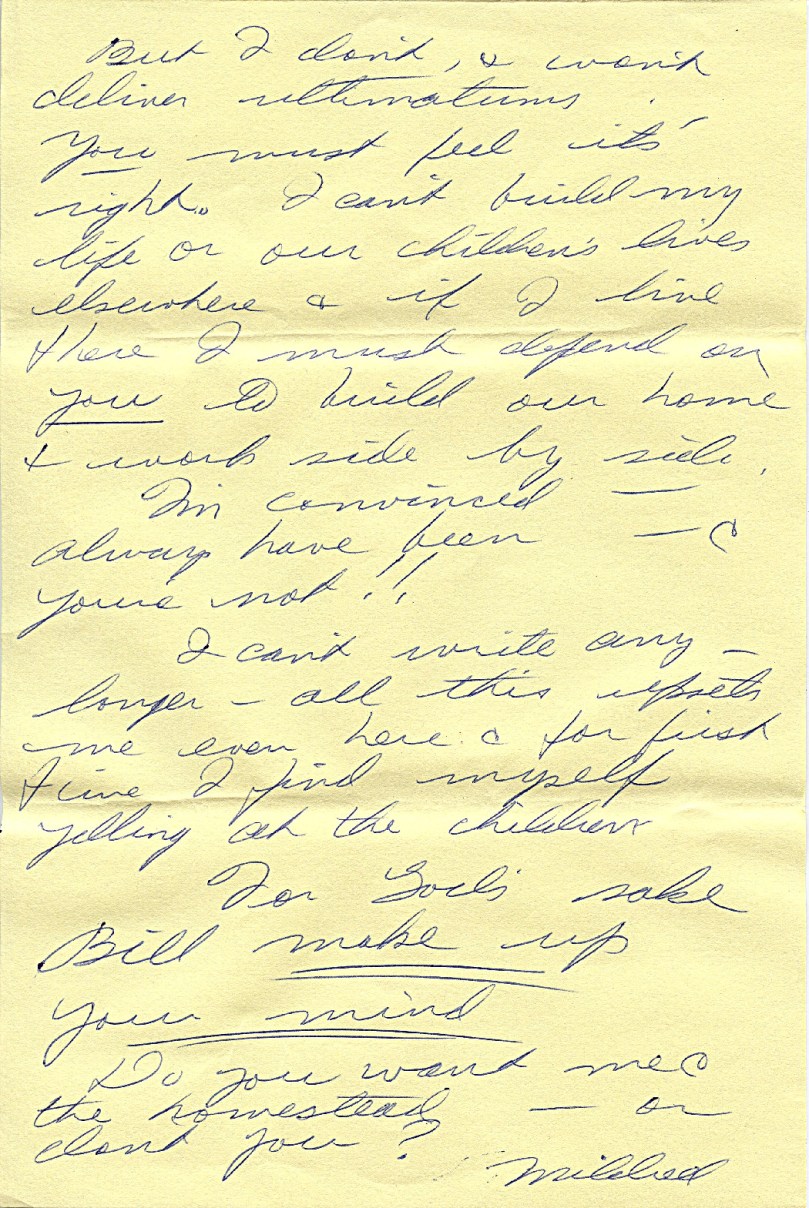
This letter is mother’s (to me, shocking) response to dad’s long (to me, thoughtful and honest) letter of —*1963 – September 3 – Dad’s Letter to Mother While the Rest of Us Are In New Mexico.   Here is an excellent opportunity to look at the pitiful and destructive dynamics in my parents’  relationship.  This is a rare letter because in it she is honest about how she felt both about her mother and my father — and neither honesty nor the truth was my mother’s strong suit in these hundreds of letters of hers I am transcribing.

This letter shows the kind of ‘switching’ that my mother would do, and shows how, even on pieces of paper with a pen as a weapon she would work herself up into a rage filled frenzy.  The best thing for us children would have been — a long time prior to when this letter was written — for our parents to have chosen a place for us to live in so we could get on with some semblance of growing up while having our needs met.

We were growing up anyway.  *1963 – Trip to Santa Fe – Here at Grand Canyon – mom and kids It was not OUR choice for five of us plus my mother to run over two thousand miles away from my father, or to be jammed into a tiny motel room in a strange town, to start school late in the year, to have no certainty about what was going to happen next in our lives.  And as much as any of us children might have loved the homestead, it was not our biggest need to have ourselves dragged back there as pawns in my mother’s sick, distorted ‘mind games’ with my father.

++++

Another factor that is of course not mentioned in these letters flying back and forth between my parents is the fact that we had lost what might as well have been another member of our family — the log house.  It had been sold.  In order for massive ‘trauma drama’ to be enacted within a family, there must be a stage and a setting.  The dynamics of my mother’s chaos worked prior to this time with three main settings:  the log house in Eagle River, the homestead, and the Panoramic View Apartments in Anchorage.  She had lost the log house, and that fact — like a child growing up and leaving the family — changed how mother’s, and hence our drama was to play itself out after this time.

(For background on the truth of mother’s actions during the year prior to the time this letter was written in 1963, read particularly her late summer, fall and winter letters here: *1962 – MOTHER’S LETTERS and the letters *1963 – Mother’s Letters written prior to our leaving Alaska in August of 1963)

In this September 6, 1963 letter she tells dad:

I don’t mind if we don’t live there this winter as it isn’t our fault but I’m not the one for you if you feel we should buy a house.  I can’t return under such circumstances.  I simply can’t.  I know I’ll yell, scream and fuss again and I won’t….Bill if we don’t live on the homestead I don’t want to live in Alaska with you.

It seems clear to me from letters months and years prior to this that it has always been mother who orchestrated the moves off the mountain and  Dad simply obliged her.

From my point of view, certainly toward the second half of this letter, mother is writing ‘crazy-talk’!  She tells him,

But I don’t, and won’t deliver ultimatums.  You must feel it’s right.  I can’t build my life or our children’s lives elsewhere and if I live there I must depend on you to build our home and work side by side….I’m convinced – always have been – and you’re not!!

++++++++++++++++

Please follow this link to read

*1963 – September 6 – Mother’s Wicked Response to Father From Santa Fe

++++++++++++++++++++++++++++++++++++++++++++++++++

In a letter September 5, 1963 she stated about the opposite of her letter 1 day later:

You’ll know what you want to do after your trip – live there now or next summer.  I don’t care.

I want you – I love you – and will work out our problems together.

I am absolutely lost without you!!

Write soon and often.  Your ever loving wife, Mildred -”

++++++++++++++++