+SUNFLOWER, SELF, DISSOCIATON AND THE SEEDS OF LOST MEMORIES

++++++++++++++++++++++++++++++++++

I have had the image of sunflowers (in relation to the self and dissociation) in my mind for days now, so I guess I need to go ahead and write what I am thinking so  my thoughts can move off to something else.

Under ordinary conditions an infant is born into this lifetime with the potential to create a wonderful whole and healthy self.  All its experiences are integrated and stored at its center as they grow to fruition during a lifetime.

When severe trauma in a malevolent environment surrounds an infant-child, and dissociation has to take over the job of handling the memory of traumatic experiences, all this person’s ‘seed memories’ will not be central at the center of the flower of self.  The self will not be able to organize and orient itself in the ordinary way.  Instead, many or most of the seeds of experience will be missing, not connected and integrated at the center of self.

Perhaps it’s like the birds steal all the seeds away.  Perhaps it is like the seeds are simply missing, or scattered somewhere so we cannot find them.

seeds - sunflower
How can a self form right if trauma steals all the seeds of our memories?

Yet our trauma memories and reactions can pop up, unanticipated, unexpected, any time they are triggered.  We cannot control this.  It makes life hard.  It makes us different.  We cannot search for and find all our lost memories, all the lost parts of our self and put all the seeds back in our center where an  ‘ordinary’ person’s seed-memories have been stored all along — even if we want to.  And some part of our self flies away or gets lost with each disappearing part of our history.

Yet we are the same as everyone else.  We are all STILL sunflowers, even if our self is a different kind of self.  We are still beautiful, turning to follow the sun as we stand with everyone else in the field of life.

++++++++++++++++++++++++++++++++++

sunflower
Sunflower -- I am thinking of the sunflower as an image of a self -- Photo courtesy PDPhoto.org
sunflower-sunset
Lots of sunflowers, lots of people in the field of life

Sunflower as the image of self, all the seeds organized as a part of the flower, in the center, memories of our expriences -- unless - - - -

++++++++++++++++++++++++++++++++++

IN MEMORY OF MY MOTHER:

Borderline Personality Disorder

In the Spotlight | More Topics |

from Kristalyn Salters-Pedneault, PhD
BPD is a disorder that is often misunderstood and frequently stigmatized. Do you dread telling people about your diagnosis? Are you tired of trying to correct the myths about BPD that are out there? This week’s newsletter is for you!

In the Spotlight
The Stigma of BPD
The general public today is as afraid or more afraid of people with mental illness than they were decades ago. And people with BPD are among the most highly stigmatized groups.
More Topics
BPD Mythology – Help Challenge These Myths!
Borderline personality disorder is a very real and serious mental illness. It is not a “personality problem” or just a set of maladaptive ways of coping with the world.
Should You Tell Others Your Diagnosis?
Lots of you report that you’re afraid to tell other people about your BPD diagnosis. When is it safe to tell? Here are some guidelines…

++++++++++++++++++++++++++++++++++++++++++++++++++++++++++++

+PETER PANELLA AND ALL MY LOST GIRLS – AGE 31 JOURNALS, THE NEXT STEPS

+++++++++++++++++++++++++++++++++++

Nine months.  That’s the length of time this next of my age 31 journal entries covers.  This would be the same length of time it takes for a baby to travel from conception to birth.

It seems strange to me that over a quarter of a century later I cannot begin to be objective about myself, my story, or my process as contained in these writings.  I still distance myself from myself, and can give myself total permission to do this distancing now because THAT was a different Linda, in a different set of circumstances at a different place in a different time.  I also continue to distance myself from myself because I have no other choice:  I was made that way.

It strikes me how remote I have always been from myself in my life except for the very NEAR past and the in-the-moment experiences I have as each moment of my life unfolds into the future.  It seems that my past carries me, not that I carry it.  It is too vast, too painful and in too many pieces.

I cannot think of a story that could be more closely like the reversal of the ordinary Peter Pan and the Lost Boys story than mine is in these pages.  What would that story look like if the sexes of all the characters were reversed?  I would be Peter Panella with my Lost Girls.   My mother would be the Wicked Captainella Hook.  Marlin (name changed) in my story would be the male reversal-same character of Tinker Belle!  Leo (named changed)  would be the ever-devoted, right thinking and well-intentioned Wendy.

++++

In the nine month period of time that elapses in the pages here, I left my husband and my children in ‘their’ home and rented a ‘Room of My Own‘.  I completed my BA college degree.

It has never until this moment struck me that the trials and tribulations of a recovery-from-abuse journey happens in its own story version of a Trauma Drama.  If we had never experienced the trauma of abuse in the first place, there would never be a need for this Recovery Trauma Drama story to ever happen, either.

As Peter Panella in my story, all the Lost Girls were part of my self.  There was a dissociated me not only for every developmental stage of childhood I had missed going through ‘normally’, but also hundreds and hundreds more of them that had each experienced some horror caused by my mother along each step of the way.  Each Lost Girl holds her piece of my memory along with the experience of having her experience of her experience of trauma.  In this way each one of them holds her own consciousness about what the Main Me, Linda, cannot remember except through the emotions held within the body that all of us share.

Nobody ever told me that these unintegrated shards of my existence could not magically become part of some magical WHOLE PERSON named Linda.  Nobody ever told me that what I was really accomplishing in my recovery journey was the recognition, identification, and naming of all these separate dissociated Lost Girl pieces of my self.  Nobody ever told me that they were NEVER going to become anything else.

Nobody told me my brain-mind-self had formed from the beginning of my life under so much trauma that continued for 18 years that I will NEVER be able to obtain or create a single-self-entity that resembles the one that ordinary-childhood people are created with.  Nobody told me that as a consequence of my childhood I was made into a different sort of person.

++++

In these journal writings I am describing a catching-up-to-Linda-at-31 process that was going on at the same time I was beginning to identify the trauma and the individual pieces of me that it had created.  I tried to accomplish an exploration and solidification of self that should have automatically and naturally happened throughout my childhood and young adulthood years — and didn’t.

Every single step I took in my journey included some confrontation and encounter with my profound woundedness.  The 18 years of abuse I endured had affected — and infected — me so profoundly and pervasively that I could not find anything but a shell of Linda, packed full to overflowing with pain, confusion, and the defenses that had enabled me to survive.

By the time these journal entries end I had found my way to the only place, both internally and externally, possible for me to go to next:  Another treatment center.  This one was designed specifically to address both severe trauma and addiction.  I remained apart from both my husband and children, now 130 miles away, and walked through the next doorway of my trauma drama recovery story.  The steps that I took to get to this next doorway are described here:

+++++++++++++++++++++++++++++++++++

*Age 31 Journal – Sept. 1982 thru June 10, 1983

+++++++++++++++++++++++++++++++++++
EXCERPTS:

January 19, 1983

What do I see as my boundary problem with Leo?

My mother = my conscious

Her right and wrongs = mine

Leo’s rights and wrongs = my rights and wrongs

I use Leo:  the whole part of me that would love Linda isn’t there and Leo is that part of me that loves me

Doesn’t feel healthy

My mother is the part of Linda that hates Linda

Kathy [therapist] says:  “In some ways what you’re talking about is pretty profound.””

++

January 26, 1983

Talked to the girls tonight about my moving out for awhile.  Kathy [therapist] says it should be for at least 6 weeks.”

++

February 8, 1983 Tuesday 11 PM

Had class tonight on child abuse issues.  Sue told her story.  Makes me think about my unvisited “cave” where I’ve hidden all my childhood issues.  Wonder when I’ll get in there and poke around.”

++

February 24, 1983

From notes on Rollo May talk, “Creativity as Significant Form

“Without anxiety = heightened sensitivity, there’s no creative person.”

“Creativity:  The divine madness.  The anxiety of being lost leads to creativity.”

“The pause is not nothing.  Listen to the silence.  Technology calls pauses depressions.  PAUSING – the kind of aloneness of a creative person.”

++

March 4, 1983

Well, it’s 9:15 PM and at last I’m here in my room.  Made the move.

++

March 13, 1983

(I’m losing tears again).”

I’m creating a safe place here for myself to be with myself, and, finally, cry.”

++

March 22, 1983

I don’t want to die – I don’t want to be dead.  I want to live.”

++

March 23, 1983

I feel angry tonight.  Very lonely, too.  In that lonely place nobody else can come to.  Maybe lonely for myself.”

++

March 28, 1983

There’s a point where you go numb and you have to choose not to feel any more in order to survive.”

I used to think my mother was “just” an overly critical perfectionist.”

++

April 2, 1983

7 PM – I’m in Glyndon now [visiting].  Leo and girls are at Larry and Echo’s.  The house is very neat and clean.  It’s my home, and yet I also feel like I don’t have a home.  Alienated – That’s how I feel.  From people, my family, pets, home, even my body and myself.  I feel sad, like I want to cry, but I can’t.”

I feel hopeless like I got made wrong and I can’t get fixed.  My body is healed of the childhood wounds, bruises; but inside I haven’t healed yet – I don’t even know if I’ve started yet.  I don’t have the option of getting high to forget this all like I used to.”

2009 note: I know now, finally, that I didn’t get made ‘wrong’, I got made different.  I could not have survived my abuse if I hadn’t adapted and adjusted in every possible way that I could.  Fortunately, our human species has that ability — to adapt in order to survive.  I also know now that I could not possibly re-make myself into the same kind of person I would have been if the abuse had never happened to me.

++

June 9, 1983

There’s someone inside wanting to get out and not knowing how.”

+++++++++++++++++++++++++++++++++++

NEWS FROM:

Prevent Child Abuse New York Blog


Recent Surge in Recession RunawaysPosted: 30 Oct 2009 02:46 AM PDTThe intersection between the recession and family stress may be causing an increase in runaway kids and teens, according to a recent article in the New York Times.   Job loss, foreclosures, and poverty have added to the stresses at home which have been trickling down and effecting teens.  Reporter Ian Urbina recently spent time with teen runaways in Medford, Oregon.  He learned the desperate measures they take in order to survive everyday rather than return home.  Most runaways aren’t even reported missing by their guardians, and if they are reported to the local police, most times they don’t make it into the national database.  Without national recognition, it is very hard for police to identify and return these runaways.  Police claim that runaways are not a top priority because most of the time they do not want to be found or returned home.  Unfortunately of the 267 runaways reported nationwide 58 of them were found dead.  “These kids might as well be invisible if they aren’t in National crime information center (N.C.I.C.),” said Ernie Allen, the director of the National Center for Missing and Exploited Children.  While federal officials are expecting a rise in homelessness this year, most social programs aid homeless families, not unaccompanied youth.   At the same time, many financially troubled states have severely cut social services, leaving little to no help for homeless runaways.  This presents a significant challenge for society, as runaway children are more likely to become homeless adults who are forced to live a life of crime.For information please visit the National Association for the Education of Homeless Children and Youth, The National Coalition for the Homeless, and The National Child Traumatic Stress Network.

+++++++++++++++++++++++++++++++++++

+TODAY’S ARTWORK – A BORDERLINE MOTHER’S DAUGHTER –

+++++++++++++++++++++++++++

*Age 58 – Artwork October 29, 2009

++++++++++++++++++++++++++++

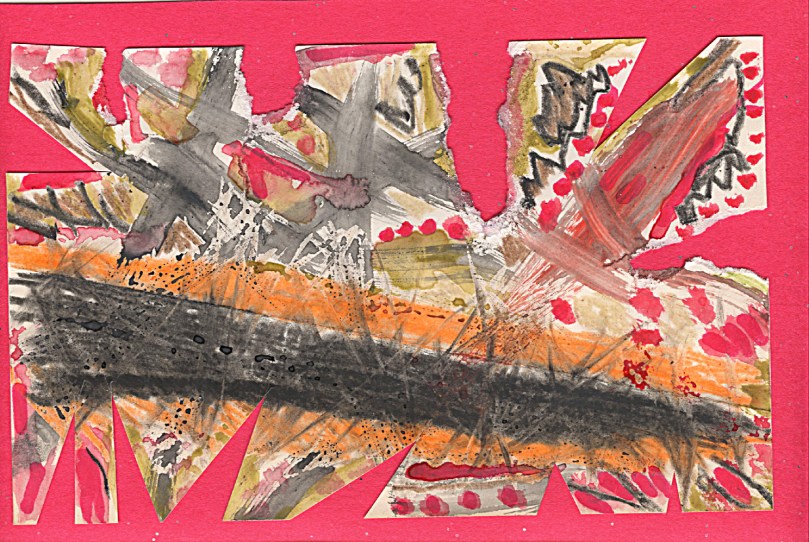
I could wonder if my spontaneous, quick art work images will ever come out innocuous instead of intense and unsettling, but then I would be contradicting myself.  When I write about not believing images come from any invisible ‘inner child’, I am at the same time very aware of how people could interpret this kind of creative process I am doing as being related to having an experience with such an invisible entity.

3 102909
From today's artwork link - Borderline Mother

What I know about how my child abuse altered brain operates helps me to understand my artistic process in a different way.  Particularly because my Borderline mother’s abuse of me began when I was born, neither of the hemispheres of my brain nor the way they operate together developed in an ‘ordinary’ way.  All of us have access to an unending storehouse of images.  The biggest problem is trying to get around our left brain’s inner critic, as  Betty Edwards describes in her excellent books about drawing.

Perhaps because of the affects my early abuse had on my developing brain, I have an almost literal switch I can flip, or a door I can simply open, that turns my left brain critic off and allows my creativity to escape.  I don’t believe my left and right brain hemispheres ever developed an ‘ordinary’ working partnership with one another, so I-Linda am learning that I can tell them what to do.  I can tell my left brain to just get out of the way, making an art image is not its concern.

There is no reason for any of us to worry about how we make our images, what they contain, or even what they look like.  To me, the important part of the process is simply to trust ourselves with the process of creating a representation of any image our right brain passes ‘out’ to us.  As humans, we have a clear inner sense of imagery.  What I really suspect is going on is that, as Alice Miller considers in her book I mentioned in yesterday’s post, Pictures of a Childhood: Sixty-Six Watercolors and an Essay, is that being an adult in our ‘modern culture’ makes us afraid of the image making process because we are afraid of what we will see.

Images cannot hurt us.  Giving them tangible visibility will not hurt us.  Most likely we will be helped, not harmed.  If we ‘give birth’ to an image that is intense or unsettling, all we have to do is put it away somewhere and keep it for as long as it takes for us to be able to be able to tolerate our own images so that we can witness our own expression.

++++

Every image has something powerful to say.  Because we are often raised, particularly those of us with severe child abuse histories, unable to stand in our own power as individual selves, it is often the experience of the power of creating itself that feels frightening to us.  Making art is a personal-power-enhancing process that belongs to all of us.  It is very simple.  We simply have to give ourselves permission and that whole world of making art is ours.

I am working with dollar store art supplies.  I use larger 5″ by 8″ index cards.  These ones happened to be included in a metal file box designed for that sized card I bought at the thrift store to save my childhood-related photographs in once they have been scanned and posted.  I like that size, though any size will do.  One advantage of choosing a size to begin an art image exploration series is that the limitation of size becomes a freeing factor because it does not need to be renegotiated as a choice every time a person begins to work.  I also have glue and colored paper, cheap paint, markers and crayons.  I am wishing for some oil pastels, but I don’t have any and that lack is NOT going to stop me.

I am, of course, encouraging every single one of my readers to get themselves some basic art materials and something to put them on, and go to work playing with their own image making process.  You will be amazed at the process and the results.  Show your images, keep them, hide them, post them.  One thing I strongly recommend is that on the back of whatever you make, always put the full date and the sequence number of the piece for the date you make them.  I can — and probably will at some point — explain why this matters.

++++

If I wanted to ‘work with’ my own images as an art therapist, I would have my work cut out for me.  They seem simple, they produce themselves quickly, but each one holds a universe all its own of ‘in-form-ation’.  I’m not at all concerned with that right now.  I only want to make them as a part of my commitment to myself to allow my self to ‘speak’.  I am eager to discover what this process has to teach me — both the process of making and the art images themselves.

But I do not wish to fly too close to the sun.  I have no intention of overwhelming myself by being too brazen about ‘digging out the truth’.  Whatever I do or don’t do, the truth already exists.  I simply need to get strong enough to visit it.

+++++++++++++++++++++++++++

Don’t miss this

Traumatic Childhood Can Reduce Life Expectancy

+++++++++++++++++++++++++++

+THE GLIMMER OF BEGINNING TO KNOW WHO I AM

+++++++++++++++++++++++++++++

I was feeling better in this section of my journal that ends on my ‘Golden Birthday’ of turning 31 on the 31st of August, 1982.  I was beginning to take form as a person, becoming less hollow and less like a ghost-girl in my own life.

I think the successful definite steps forward I had made by working through some very difficult school work bolstered me.  My feet might have still been mired in the unknown of my past, my ‘true self’ was still missing in action, but the woman I was becoming had begun to find some sunshine for herself.  The vigorous exercise workout I was doing made me physically strong and began to anchor me into my body.  I was gaining a sense of self-confidence for the first time in my life.

I now had nearly two years ‘clean and sober’ (from nonprescription drugs), had a sponsor and faithfully attended at least one AA meeting every week.  I also attended a weekly woman’s growth and support group through the local mental health center.

Part of my transformation was coming through my ‘discovery’ of so-called ‘feminism’ as I began to understand that women experience their lives very differently than men do.  I believe I was for the first time beginning to collect for myself a sense of my own personal empowerment.

*Age 30 – Journal from May 1982 through August 1982

+++++++++++++++++++++++++++++

May 22, 1982

Things OK in the water bed – Leo is keeping to himself.  I think he’s afraid to touch me – sometimes I’d like to be touched; not sexually — just touched.

++

We could not get anything larger than a double bed up our little stairs, so the king size water bed was the only solution we could think of.  Well……

++

I knew inside on some level there was something ‘wrong’.  I really knew.   I found this in one of my little poems on this date —

Do I have a personality

When there’s no one here but me?

++++

June 9, 1982

Perhaps calcium now

Will help calm me down

But I don’t feel like myself

My spirit feels larger

Than my body

Like a wad of bread dough

Or play dough

Yellow

++++

June 16, 1982

Decided I may try writing an autobiography –

++

I record a 2009 note with this journal entry about two statements made, on two occasions by two different people — that changed the course of my life — because I heard them and I knew they were true.

++++

June 26, 1982

Been cleaning – sorting clothes in closets and dressers all day.  Felt real depressed yesterday – [Doctor] decided to up the Imipramine to the 150 mg.  I was taken off of Desipramine – slow the thoughts down – don’t handle being alone very well.

I could not handle letting my own inner reality surface — not yet, anyway.  I can sense my insecure attachment disorder here, like an invisible electric current running inside a live wire.

++++

July 2, 1982

I’m feeling my wild feeling, and walked down the “trail” to an old grain wagon parked in the grasses.  The sun is still above the horizon, and it is hot.  Clouds below the sun will soon swallow it.

Wind is rustling the trees, and I am reminded of the homestead – the trees on the mountainside and the river on the valley floor.

I’d like to be that wind – free – from thought.

++

Oceans lie where we can always find them.  Why can’t I?

++

And as I write, capturing time,

I can reread, and see my past

In my present.

++++

August 3, 1982

Now

I’m a spider

Expertly spinning

My thoughts

Into miraculous

Flowing webs

When I’m depressed

I’m a fly

Tangled

Frightened

Captured

By these same

Silken

Threads

++

I just had a 2009 thought as I read this.  I wasn’t only unaware of HOW to feel, I did not know HOW to think, either (not about anything personal).  I did not grow up in my insanely abusive childhood being able to think.  ‘Ordinary’ childhoods, without a need for continual and nearly constant dissociation, no doubt allow children to grow up THINKING, and to grow into their thoughts.  I never had that opportunity to get familiar with my own thoughts, to practice being a person WITH thoughts.  No wonder ‘thinking’ felt so foreign, uncomfortable and dangerous to me!

(Also glad to see at least I was still doing some spinning and weaving at this time.)

+++++++++++++++++++++

AND A GIFT OF INFORMATION FROM:

Prevent Child Abuse New York Blog


Making Kids a Priority


Posted: 29 Oct 2009 10:57 AM PDT

Guest post by Michelle Gross, Project/Public Policy Manager, Prevent Child Abuse New York

In this recession, working families are struggling to meet their children’s basic needs. Five out of six children in low-income families have at least one adult who works.   These families are struggling to keep a roof over their heads, food on the table, and gas in the car so they can get to work. The stress of these difficult financial times takes the heaviest toll on at-risk families. More than ever before, programs that support families, like home visiting, parenting education, family resource centers, fatherhood and kinship support, and child advocacy centers play a pivotal role in ensuring a stable and more prosperous future.

Yet, these services continue to be in danger of funding cuts. New York’s families’ health and well-being rests on the voices of advocates like you.  As we prepare for the New York State Budget proposal for 2010-11, we must be vigilant in continuing to contact our state government representatives, from the governor to the legislature, and even locally. Regularly updating your elected officials on your program’s successes helps to reinforce the important role it plays in supporting families. Every voice counts, and it is up to us to speak for those who cannot. It can be daunting to contact your representative, but your advocacy can make the difference between a program funding cut and a program funding expansion. Here are a few tips on calling your elected official’s office:

  • When calling, you will likely reach a staff member rather than your representative directly. Staff             members can be just as influential as the legislator themselves.
  • Be sure to tell the staff member your name and where you live. It’s important that they know you are a constituent.
  • Inform the staffer of the reason for your call. It can  be as simple as saying that you’d like to make sure the program does not get cut in the state budget.
  • Tell the staffer why the program is important and what difference it has made in your life or the lives of those around you.
  • Thank the staffer for their time and ask for a follow  up if you feel its necessary.
  • Always follow up a phone call with a letter restating your call.
  • Call again in a month just to check in, and ask others to call on behalf of the program. Persistence is key in advocacy!

Again, remember that what you have to say matters. As Margaret Mead said, “Never doubt that a small group of thoughtful, committed citizens can change the world.  Indeed, it is the only thing that ever has.” Children’s needs, long overlooked, should receive the highest priority during critical discussions leading to cuts in the New York State Budget. Far too few services are available at a time when demand is increasing greatly. We encourage our legislators to support programs that work, and to support families through this fiscal crisis.

For more information about Prevent Chils Abuse New York’s Advocacy Programs, please visit our website: http://preventchildabuseny.org/advocacy.shtml

Traumatic Childhood Can Reduce Life Expectancy


Posted: 29 Oct 2009 08:27 AM PDT

A difficult childhood reduces life expectancy by up to 20 years according to a study published in the American Journal of Preventive Medicine. The study found that participants who were exposed to more then five different types of adverse childhood experiences (ACEs) were over 50 percent more likely to die during the 10-year period of the study. On the other hand, people who reported fewer than six ACEs did not have a statistically increased risk of death compared with the control group.

Listen to a podcast Adversce Childhood Experiences and the Risk of Premature Mortality.

To explore the effect that childhood trauma could have on life span, Kaiser Permanente mailed questionnaires to adults who were 18 years and older, and who had visited the Kaiser clinic in San Diego from 1995 to 1997. Overall, the study subjects were middle-class and had good health coverage. Of those surveyed, 75 percent were white, 11 percent Latino, 7 percent Asian, and 5 percent African-American. They’re educated: 75 percent attended college and 40 percent have a basic or higher college education. When they filled out the questionnaire, their average age was 57. Most of them had jobs. Half were women, half were men.

The participants were asked about their exposure to eight categories of abuse or dysfunction based on previous Kaiser studies. One third of the 17,337 participants who replied to the questionnaires had an ACE score of zero, meaning they had not been exposed to any of the eight types of abuse or household dysfunction. The majority of the remaining responders registered a score of between one and four, whereas about 8 percent of the scoring participants were rated five, and roughly three percent, six to eight.

During the next decade, the study authors, kept records of which of the 17,337 participants passed away by matching identifying information such as Social Security numbers from the questionnaire with data from the National Death Index. In total 1,539 of the participants died during the follow-up period. When the increased number of deaths in those subjects with an ACE score of six or greater was compared with the control group, their mortality risk was 1.5 times higher than for people whose childhoods had been free of all eight types of abuse. They lost about 20 years from their lives, living to 60.6 years on average, whereas the average age of death for the control group was 79.1.

It is unclear why the authors saw more death ages during the 10-year period only for the group with an ACE score of six or greater. Previous studies by these authors found that the risk of chronic illnesses, such as heart disease, lung disease and cancer, was greater only for people with these high ACE scores. In contrast, the risk of substance abuse and suicide increased stepwise from low to high scores. The authors found that ACE-related health risks, namely mental illness, social problems and prescription medication use, accounted for about 30 percent of the 50 percent greater risk of death seen in this population. “As would be expected, the documented ACE-related conditions among participants appear to account for some, although not all, of the increased risk of premature death observed in the current study,” wrote David Brown, an epidemiologist at the U.S. Centers for Disease Control and Prevention (CDC), and lead author of the study.

This posting includes an audio/video/photo media file: Download Now