+WATCHING WHOLENESS AND HAPPINESS HAPPEN

++++++++++++++++++++++++++++++++++

I discovered a portrayal of happiness when I found online the videos of these 40 piano lessons.  It’s a great place to go for a brush-up on music reading and keyboard playing if you have already had some experience in your past with playing music and might – for great benefit and healing – wish to pick up this pastime again.  For those, like me, who have never experienced the joys of playing music, these lessons are a great place to start!

However, my bigger purpose in posting these links today is to present to you the visual of the teacher, an obviously talented and well-skilled young man, who appears to be quite genuinely happy!

I simply wanted to point out today that I think it’s highly doubtful that someone who appears to possess such an ability for humor, for spontaneous laughter and for genuine smiles lives within a body that was formed in a malevolent environment of infant-childhood abuse, maltreatment and trauma.

When I watch the face and body movements of someone like this young man, I can see that I am actually watching a body-nervous system, including a brain that was allowed to form within a safe and secure attachment environment.  Nowhere in these videos do I see the flash of a stress response in the eyes and face.  Nowhere do I hear the millisecond pause in his speech that would let me know the body itself has detected threat to safety and security in its ongoing appraisal of itself in the world.

Not only is the ‘presence of happiness’ well, present in this young man, but just as importantly the ‘absence of anxiety and sadness’ is, well, also equally present.  As a result, he can probably move through his life unimpeded in his intentions and actions by the interrupting ongoing inner experience of having to be hypervigilant about either himself or others in the world.

Along with the happiness apparent in this young man is the competent confidence that comes with being a self in the world that can be fully present in the moment.  This includes having the ability to be a present self in the presence of others.

This young man seems obviously capable of enjoying himself (in-joying himself) in his life.  Nobody seems to have communicated to him that he doesn’t have that right.  It is important to realize that the invisible physiological nervous system-brain underlying circuits and pathways of competence and joy were built into the body of this young man from the time he was born (and before).  What others SEE when they witness this young man in his body in his life is the physical manifestation of well he has been treated throughout his life.

He has been allowed and encouraged on all the important levels that matter to be himself because he was allowed to be safe and secure.  As I have said so many times before, this IS a matter of availability of resources.  Certainly there may well me economic stability in his family that enabled him to have access to instruments and training (not to mention all the other vital requirements for sustaining life).  Yet while these advantages are obviously important to tutor and train inborn talent, it is the social-emotional environment of safe and secure attachment to caregivers from birth (and before) that were vital to the ongoing experience of confidence and joy that this young man seems so able to demonstrate.

While watching these piano lesson videos gives me a visual related to what this young man was given in his life compared to what I was not given, at the same time it gives me a visual of the goal I suggest all survivors can work for.  Even though our long ago formed body (with its nervous system including our brain and our connection to self) may have been altered in our earliest developmental stages due to trauma and abuse, being THIS happy and confident while experiencing safety and security in our body within our environment, with our self present in our experience, is what we need, desire and work for.

Check out How to play piano: Lesson #2 and How to play piano: Lesson #3 Piano Lounge: Andrew Furmanczyk to see for yourself this young man who offers an example of happiness.

+++++++++++++++++++++++++++++++

The next example I encountered in my musical searches online yesterday offers yet another example of what I am talking about here today.  For all the amazing talent visible in the video attached to this link, six-year old girl mastering piano, it is the joy and happiness visible not only in the little girl’s body-face that captured my attention, but MORE SO the joy and happiness visible in her MOTHER’S face.

Here again we are presented with a visual of advantage.  This little girl is not homeless or going to bed hungry at night.  But most importantly this little girl is obviously fully loved.  Look at her face.  Watch her.  You can see that her SELF is fully present in that little body.  You can see that she is safely and securely attached to her own self BECAUSE she has been offered the opportunity to safely and securely attach to her caregivers.

Certainly this little girl was born with an amazing talent.  But the most important talent I want to emphasize, the one that we are all conceived with and hopefully born with, is this ability to thrive and blossom as our body-brain-mind-self grows and develops in interaction with its earliest caregiver environment.

Neither of these young people presented in these videos would LOOK the same, ACT the same, FEEL the same or BE the same if they had been raised within a malevolent rather than a benevolent environment.  They would NOT HAVE THE SAME PHYSIOLOGICAL BODY.  If they had been raised within an early unsafe and insecure attachment environment, they would not think the same, feel the same, act the same, or be the same people they turned out to be.  No way, no how.

So for all the obvious musical virtuosity present in these video samples, what I end up being most aware of is that what these videos are showing most clearly IS THE ABSENCE OF TRAUMA.  While we know that much talent still arises within people who did suffer early trauma and live a life within a trauma-changed body, it is also equally true that talent does not need to be automatically paired with angst and suffering.

++++

What I believe is most empowering for infant-child abuse survivors to know is that not only does early trauma change our physiological development, but also that these consequences follow us for the rest of our lives.  For all the well-wishers that tell us to simply “get over it” or “leave your childhood behind you” or “You could be happy if you really wanted to,” it is vital for us to realize that these statements are not actually grounded in the truth of our trauma-changed physiological reality.

At the same time I believe it is important for we survivors who have been ‘diagnosed’ with so-called ‘mental illnesses’ to realize that most often the best creative and expressive gifts of our species are directly tied genetically to the highest risks for the experience of difficult consequences from trauma-changed bodies during our earliest development.  I suspect that it is equally true that the kinds of changes our genes allow us to make include not only high risk for later complications from these changes, but also gave us immense resiliency factors that allowed us to survive at all.

In essence, if my thinking is correct, I would suggest that both of these piano wizards presented in these videos would have been at extremely high risk for developing serious ‘mental disorders’ had their infant-childhoods been malevolent and traumatic rather than benign and benevolent.  At the same time, their sensitivities and vulnerabilities to trauma-related consequences WOULD STILL HAVE ALLOWED THEM TO ENDURE AND SURVIVE.  But they each would probably have suffered greatly in a trauma-changed body.  Neither would have been the same people we see in these videos.

++++

All of this brings to my mind the question, “Who is the self?”  When I say these musical children would be different, I am not saying that the essence of who they are as individual people could even possibly be altered under any circumstances.  That is equally true for all of us, infant-child abuse survivors or not.

The consequences of enduring within malevolent early-body-brain-forming developmental stages means that the expression of the self, the inner relationship with the self, the outward manifestation of the exact nature of the individual self will be changed and altered, not the actual self itself!  What all of us are working toward is the discovery of who our own individual self IS so that we can learn how to give this self as many opportunities to experience safety and security in the body in the world as is humanly possible to do.

No matter what our age, the process of being a self in a body in the world is essentially the same.  Severe early abuse survivors, however, have to experience, face and deal with all the trauma-related physiological changes that mean for us that an ongoing assessment of potential threat and danger to our SELF (and to our body) is likely to be at the forefront for us the rest of our lives.  Our ability to simply BE a self, with full free interactions and expression, becomes far more difficult for us to obtain.

Coupled with these difficulties is the fact that within our trauma changed body-brain we were robbed of the fullest development of a genuine happy center and the neural development of all the corresponding ‘be safe in the world’ pathways and circuitry.  We have to train and retrain our physiology as we seek to improve our presence in our own body in our own life in the world.

Yes, our experience and the resulting body-brain we would have developed COULD have been different for us as it obviously was for these two musical wizards.  Yes, we do have a lot to mourn for in our loss not only of the actual experiences of a safe and secure infant-childhood, but most importantly for the different body-brain we would have developed under benevolent rather than malevolent conditions.

Yet for severe infant-childhood trauma survivors I believe it is ultimately and importantly empowering for us to realize what we are REALLY dealing with.  As we try to ‘change’ our self to be a ‘better’ person to life a ‘better’ life we need to understand that we are participating in acts of creation as we heal.  We are ‘recreating’ the very molecular structure and operation of our trauma-adjusted, trauma changed body.

Yes, resiliency is possible as long as we breathe.  At the same time, the healing changes we make affect our entire being in the world on every level.  Just as a benevolent safe and secure world created the physiology of these video children, changing our own physiology as survivors means that we need as much of what these children were given as we can possibly get.

++++

In the same way that how these musical children are in the world is a result of the sum total of their genetics in interaction with their environment, our own healing happens in the same way.  I don’t believe it’s possible or even realistic to ‘just’ treat a so-called ‘mental illness’ with drugs, or ‘just’ treat harmful parenting or anger or sadness or anxiety or relationship difficulties with classes or education, or to ‘just’ treat addictions of any kind.

We can become consciously aware that any single ‘part’ of us that heals is providing a healing for our whole self on every level of who we are.  Just as growing a body-brain in the beginning was a ‘whole’ process, healing happens in the same way.  Watching these delightfully whole children in their experiences portrayed on these videos tells me that once the camera lens is taken off of them, their whole self is equally occupied with living their whole life just as happily as their fingers play their music.

++++++++++++++++++++++++++++++

This information today ties into the posts I presented earlier on the genuine, authentic D-smile and true happiness:

+HOOKED ON ‘D’ SMILES – THE HAPPINESS CENTER

+RESEARCHER BIAS ON THE ‘D’ SMILE = SICKENING

+MISSING LAUGHTER IN MY MOTHER’S MONKEY HOUSE

+IT WASN’T FUNNY: THE BUZZARD THAT ATE MY MOTHER

++++++++++++++++++++++++++++++++++
+WHAT I HAVE TO SAY TODAY ABOUT DISSOCIATION

++++++++++++++++++++++++++++++

I wonder if there will be a day that we will understand what dissociation really is.  It seems that people talk about it and write about ‘as if’ at least someone has actually defined it.  Coming from my severe infant-childhood abuse background, I don’t believe anyone is much past the dark ages in terms of actually knowing what dissociation is.

In looking at the abstract for this 2007 article by Dr. Matthias Michal and colleagues, Depersonalization, Mindfulness, and Childhood Trauma, I can’t even get the first sentence before I find myself in disagreement with one of the main premises of this ‘expert opinion’ of an experience related to dissociation:

Depersonalization (DP), i.e., feelings of being detached from one’s own mental processes or body, can be considered as a form of mental escape from the full experience of reality. This mental escape is thought to be etiologically linked with maltreatment during childhood. The detached state of consciousness in DP contrasts with certain aspects of mindfulness, a state of consciousness characterized by being in touch with the present moment.”

Here again I see yet another example of what I call ‘sloppy science’.  Researchers seem to build their hypothesis into their studies in such a way that they are nearly guaranteed to supposedly prove their own point.  Nobody wants to publish failure research.

The gulf that exists between infant-child abuse survivors and those who study us like we are some malformed off shoots of what is considered normal continues to widen because the basic premises researchers use to discover facts about so-called ‘reality’ come from their own ‘mental processes’ that they never question within themselves.

I know what depersonalization feels like because I live with it.  My body-brain formed through trauma that did not allow me as a person to exist from the time I was born.  So, NO, this cannot “be considered as a form of mental escape from the full experience of reality.”  Sorry to disappoint you well-funded and supposedly well meaning wise ones.

Mind, itself, along with its relatives ‘mental’ and ‘mindful’ exist as metaphors for physiological, very real molecular operations within the structures of the body-brain.  The operations that are suggested to represent ‘mind’ happen through biochemical interactions.  Early experiences from conception onward during the critical growth windows, or periods of specific development form circuits and pathways that are not the same for infant-childhood severe trauma and abuse survivors.

The experience of dissociation, depersonalization and derealization are connected to the physiological changes our early developing body-brain was forced to make in the midst of trauma.  In my experience, and I suspect for many other people, what I experience as dissociation is NOT any “form of escape from the full experience of reality.

IT IS MY REALITY.

I cannot “escape from the full experience” of my reality as long as I exist in this trauma-changed-during-development body that does not process information in the same way as the (evidently) NOT trauma changed body of the researchers who define the terms and design the research that names something survivors live with that these researchers will never REALLY know a damn thing about.

++++

The detached state of consciousness in DP contrasts with certain aspects of mindfulness, a state of consciousness characterized by being in touch with the present moment.”

I am not going to ever say that there is not a contrast between the way I experience life in the body I live in and the way a non trauma built body person experiences life.  But what the “H” does “being in touch with the present moment” even BEGIN to mean?  What, exactly, does these researchers’ term “detached state of consciousness” even begin to mean?

++++

I will try to describe to you an experience I had yesterday that has brought this subject into my ‘mindful awareness’ tonight.  I recognized the experience because it was so familiar to me.  I know the state, I know the feeling, I know what it WAS with every sense I possess.

The event was a simple one.  Nothing in particular happened at any point yesterday up until the instant I am going to tell you about.  I was out running errands in the morning in the small town I live near, and had just driven over to my favorite spot to meet my friend for a simple lunch at our local laundromat café.

I pulled into the spacious, nearly empty parking lot, reached to turn off the motor of my car and as I was in the act of pulling my key out of the ignition I froze in the instant my eyes passed by the ‘visual’ of my steering wheel.

I’ve owned this particular car for over four years.  I’ve driven it hundreds of times.  There was nothing, absolutely nothing different about my driving it yesterday.  And yet in the split second my visual field passed over my steering wheel I had the most strange, bizarre feeling that this was NOT my steering wheel.  I had never seen it before.  Did someone change my steering wheel and give me a different one?  Not likely.

Not only did it not look right, and was not shaped ‘right’, it wasn’t attached to the steering column at the ‘right’ angle.  Nothing about the steering wheel looked or seemed remotely familiar to me.  I pulled out the key and sat staring at that steering wheel for a full five minutes as my brain scanned for information about both the nature of the wheel itself and the experience I was having in relationship to it.

I searched, just in case, for any kind of button or possible means to shift or tilt the angle of the wheel.  The car is a 1978 model that has no such option.  The only information that I could possibly find in my brain was the familiar realization that who I was at that moment, sitting in that car behind the steering wheel, was in some way not related to any one of me that had ever been in that car before that instant.

Yes, I knew about every other usual familiar aspect of Linda and of my life.  But I was SEEING that steering wheel for the first time in my life.  Am I supposed to believe that only at this single instant I simply became ‘mindfully conscious and aware’ of my steering wheel?  I wish, oh how I wish the explanation could be that simple.

Was I somehow suddenly in a different reality?  Was I somehow (using researcher logic) suddenly in an ATTACHED rather than in a “detached state of consciousness?”  Did something magically happen that snapped me into “being in touch with the present moment?”  Am I (chuckle, chuckle!) supposed to believe that I have, until that instant, needed some form of “mental escape” from the reality of my automobile’s steering wheel?

Hogwash.

I have thousands and thousands and thousands of running-time and space memories from 18 years of extreme trauma and abuse from my infant-childhood that were simply never actually connected to me.  How could they have been when the abuse began at the moment I was born, far before my brain had formed any neurological abilities to process the information of myself in my life beyond the absolute ‘born with’ essentials?

Picture a child’s toy of a spinning top.  Pick one tiny point on the top, and imagine it spinning at full speed.  Imagine a newborn ‘self’ with senses to the world attached to that single spot as the spinning goes on minute after minute, day in and day out, year after year.  Never did the insanity of the abuse of my childhood actually end.  Never was I safe.  Never did anything make any sense.  Never was there any real cause and effect.  There was – continually and always – no opportunity for me to form my own thoughts, to have my own feelings, to find my own self, anywhere in my body-brain forming years as my mother’s traumatized daughter.

Evidently, for some inexplicable reason, as I reached to remove the keys from my car’s ignition yesterday, while I was under no particular stress, about to have a good lunch and a relaxing visit with my friend, a millisecond snapshot was taken by my being of exactly and specifically ONE THING – the steering wheel of my car.  The top stopped spinning, frozen for one instant of time, as the ME that lives inside this body, and processes my life with this chaos-built traumatized brain saw one particular slice of my life – of my reality — perfectly in focus, absolutely clearly:  My steering wheel.

Did I feel remote at that instant?  Yes.  Did I feel like a stranger in my body, in my car, in that parking lot, at that instant of time?  Yes.  Do I remember this feeling from my childhood?  Yes.  Any memory I have of my childhood is a snapshot, or what is called a flashbulb trauma memory.

My brain did not form itself to process information so-called normally.  I live in what I call a ‘parallel’ life where time and space are related to one another, and to me through combinations of associations that shift like specks of sand in the wind.  If I become ‘mindfully aware’ of this fact, I find myself marveling that there is some core cognizant centralized self of Linda that is aware of itself in this lifetime as being anything other than a figment of a passing (and passed) dream.

So if any Ivory Tower researcher wants to devise a study that might provide any really useful or accurate information about what dissociation, depersonalization and derealization might actually BE, they might want to study the consciousness-invested relationship any severe infant-child abuse survivor might have with their automobile’s steering wheel.

++++++++++++++++++++++++++++++

+RESEARCH ON ISOLATION – ANOTHER STUPID SCIENCE AWARD

+++++++++++++++++++

My opinion?  MORE UNBELIEVABLY STUPID SCIENCE!

++++++++++++++++++++

Written by:  Wray Herbert

Full Frontal Psychology

Why does self-reliance make you sick?

Newspapers used to run occasional human interest stories about very old people dying. These profiles often had a subtext, which went something like this: So-and-so died yesterday at the age of 102, and remained fiercely independent to the end. He never took very good care of himself, smoking two packs a day since he was a teenager. He liked his whiskey.

You don’t see these stories nearly so much anymore. That’s in part because living past 100 isn’t all that uncommon anymore, but it’s more than that. In our hearts, we knew all along that these misbehaving centenarians were aberrations. What’s more, our sensibilities about personal health have shifted dramatically, so that journalists are less likely to romanticize unhealthy habits. The fact is, smoking and excessive drinking don’t prolong life. They shorten life and diminish its quality.

That’s true of the “fiercely independent” part, too. Health psychologists have known for years that isolation is rarely the path to health or longevity. Health comes with a rich and diverse social life, with lots of friends and family, church membership, political engagement. Old people with many relationships of different kinds live longer, stay sharper with age, and suffer less disease.

But why? What is it about being connected to others that makes us healthier and more long-lived. How does a rich social life translate into healthy cells and tissue, and conversely, how does isolation trigger the biological processes of disease and death?

Carnegie Mellon University psychologists Sheldon Cohen and Denise Janiki-Deverts have been studying these important questions, and in the new issue of Perspectives on Psychological Science, they provide a progress report. Here’s the gist:

Most the evidence so far is what scientists call “correlational,” which means that it doesn’t really say anything about cause and effect. It may be indisputable that socially integrated people are far healthier than loners, but that doesn’t mean that a rich social life causes better health. It could very well be that healthier people feel more like being around other people, and that people who feel lousy simply prefer to be alone. This needs to be sorted out.

One way to sort it out is to actually intervene in people’s lives–enrich their lives and see what happens. But this isn’t easy to do. Scientists can’t really tell people to join the Rotary or to reconcile with estranged love ones. As a result, interventions haven’t been done much, and the ones that have been done mostly put people together with others facing the same health challenges, like cancer. These efforts have had mixed results at best.

So the existing studies leave a lot of questions begging for answers. For example, do socially connected people have particular psychological traits that help them cope with disease, or avoid it altogether? Do they have different expectations or world views? Are they more optimistic, trusting, or confident? Do they help others more, and could that selflessness have health benefits?  And how about the social network itself: Is the diversity more important that the sheer numbers, or the other way around?

Most important, what can be done to help? Perhaps there are ways to reunite estranged family members, if that is proven to mitigate loneliness and improve health. Or maybe the elderly can be encouraged to join social and recreational groups. Perhaps some basic social skills training would give people the psychological tools to connect more on their own.

It’s also possible that people’s perceptions of their social networks are more important than the actual details of their lives, so that interventions might target how people think. One study of this type did bolster people’s sense of being supported, but it didn’t have any appreciable effect on health or disease. And that, of course, is what matters in the end: how social connections “get under our skin” to influence disease and mortality.”

MY COMMENT:

In light of the Center for Disease Control’s findings from their Adverse Childhood Experiences study, it is most likely that those who suffer from so-called isolation are survivors of traumatizing childhoods.  Any attempt to change the isolation of later life without considering probable cause is like giving shoes to a person without legs and telling them to get up and run.

Severe early abuse and trauma changes the developing body-brain, including the limbic emotional-social brain, the vagus nerve system, the autonomic nervous system, stress response, immune system, etc., leading to lifetime negative consequences, isolation being just one of them.

Frankly I am appalled at the continued resistance of well-funded researchers to comprehend what is to survivors of severe child abuse a very obvious fact, as per links below:

ACES Implications Slideshow


Relationship of Childhood Abuse and Household Dysfunction to Many of the Leading Causes of Death in Adults: The Adverse Childhood Experiences (ACE) Study


Adverse Childhood Experiences Study Pyramid


+CHILD ABUSE SURVIVORSHIP – info and links


Childhood Trauma May Shorten Life By 20 Years


CDC Research Finds Problems in Childhood Can Be Lifelong


The Adverse Childhood Experiences Study: New York’s Response


ACE Study videos

++++++++++++++++++++++++++++++++++++++

By the way, if severe infant-child abuse and trauma survivors weren’t self reliant from the time we were little tiny people, we would all be D-E-A-D!

++++++++++++++++++++++++++++++++++++++

+POWER OF SOUND FOR HEALING OUR NERVOUS SYSTEM-BRAIN

+++++++++++++++++++

How much of my trauma changed development happened because of the overwhelming traumatic sound of my mother?  How much vicious screaming, yelling and shouting did you hear from before the time you were old enough to begin to know what words were?  How much terrifying noise was directed at YOU?

I know I heard lots of terrible sound as an infant-child, most of it directed at me.  In between, during the extensive periods of forced isolation, I learned to listen in unusual ways as my body-brain developed.  All kinds of sounds are trauma triggers for me, many times even the sound of the human voice.

Music and sound therapy are used in lots of ways to help abused children heal.  We must not lose sight of the power that sound has to heal us as adults, either.  Sound and music therapy is used to help and heal everything from stress relief, the vagal nerve system, diabetes, Parkinson’s disease, epilepsy, the autistic brain, and the immune system.

What might sound and music therapy have to offer each of us in our efforts to heal from abuse and trauma of all kinds?

Here is some information about our ears, our hearing, and about how music and sound offer resonance that can help heal our limbic right emotional-social brain, our nervous system (stress response), the vagus nerve ( the nerve of calmness and compassionate caring) and MORE!!!

+++++++++++++++++

For your listening pleasure!  Does Music therapy belong to India?  “It helps in the quality of neurotransmitters secreted in brain and the behavior of the individual.”

Emusictherapy.com – listen online — Music Therapy Albums

Music to enhance Concentration and Memory
Music to overcome Depression
Music Therapy for Diabetes
Music to overcome Fear and Anxiety
Music for the Heart
Music for Peace of Mind
Music for Pregnancy & Babies
Music for Sleep and Relaxation
Music to overcome Stress and Strain
Music to Enhance Intellect & Creativity
Music to Reduce Pain and for advance Healing
Music to overcome Headache & Migraine

++++++++++++++

How Music Therapy Works

Sound therapists recognize that certain sounds can slow the breathing rate and create a feeling of overall well-being; others can slow a racing heart, even soothe a restless baby. Sound can also alter skin temperature, reduce blood pressure and muscle tension, and influence brain wave frequencies. Although some sounds (like ultrasonic waves) are beyond the range of the ear, they can have a profound effect on the human condition.

How We Respond to Sound

People respond to sound vibrations in two main ways: via rhythm entertainment and resonance. According to Steven Halpern, Ph.D., of San Anselmo, California, “Rhythm entertainment describes the phenomenon whereby, in the presence of any external rhythmic stimulus, the natural rhythm of the heartbeat will be overridden and caused to pulse in sync with the sound source. This may be the rhythm of drums, or the rhythmic pulse of the music, or it may just be your refrigerator’s motor.

“Resonance refers to the physical phenomenon in which different frequencies of sound (different pitches) stimulate the body to vibrate in different areas. Typically, low sound resonates in the lower parts of the body and high sound resonates in the higher parts of the body.”

Sound and the Brain

Sound is linked to the physical body by the eighth and tenth cranial nerves. These carry sound impulses through the ear and skull to the brain. Motor and sensory impulses are then sent along the vagus nerve (which helps regulate breathing, speech, and heart rate) to the throat, larynx, heart, and diaphragm.

Don G. Campbell, B.M.E.D., Director of the Institute for Music, Health, and Education in Boulder, Colorado, explains, “The vagus nerve and the emotional responses to the limbic system (specific areas of the brain responsible for emotion and motivation) are the link between the ear, the brain, and the autonomic nervous system that may account for the effectiveness of Music Therapy in treating physical and emotional disorders.”

Various elements of sound influence separate parts of the brain. Rhythm, for example, engages the reptilian or hindbrain, while its tempo can alter the sense of time. The human body also has its own rhythmic patterns, and there is growing evidence that the rhythms of the heart, the brain, and other organs enjoy a special synchronicity. Illness can arise when these inner rhythms are disturbed.

Tone engages the limbic midbrain, which governs emotion. According to Campbell, “The real power of sound is in the way the tonal or harmonic aspects influence our emotions and midbrain functions.”

Sound can also be used to help the body regulate its corticosteroid hormone levels, helping to control the severity of spastic muscle tremors, reduce cancer-related pain, and reduce stress in heart patients.

Alternative Medicine: The Definitive Guide
Complied by the Burton Group
Future Medicine Publishing, 1997

+++++++++++++++++++++++++

What follows comes from this website:

MUSIC THERAPY LINKS THE UNIVERSAL VOICE OF ACADEMIC SCIENCE IN MUSIC THERAPY

The Special Status of the Ear in the Organism

1.  Our ear is the first organ to develop to its full size and become fully functional – approx. 18 weeks after conception, our ear is ‘ready’.

2.  Our ear is the first sensory organ to begin working – from the 8th week of life. We began to hear whilst we were still in our mother’s womb – and at 18 weeks our hearing capability was fully developed.

3.  In order for our nerves to be fully operational, our organism surrounds them with a layer of myelin – the auditory nerve is the first to receive this layer of myelin.

4.  The ear is not only the first sensory organ to start working – it is generally also the last sensory organ to cease functioning.
For this reason, it also plays an important part in the determination of brain death: when various brain centers have already ceased to react to the relevant stimulation, the brain usually continues to react to stimulation of the auditory nerve.
Therefore, the response to stimulation of the auditory nerve is an important criterion in the determination of brain death.

5.  Our ear is the brain’s greatest supplier of sensory energy and, as such, is probably the greatest changer of our brain’s electrical activity.

Our ears, our skin, our eyes, our mouth, and our nose constantly receive sensory stimulation from our surroundings which they then convert into electrical impulses in their sensory cells and pass on to our brain. Thus, in our brain, no sound, no touch, no pictures, no taste and no smells are encountered, just electrical impulses which only become our sensory experiences through multifarious processing steps taking place in our brain. In this way, our brain receives a constant flow of bioelectrical energy from our sensory organs, without which it is unable to function correctly. As to how much energy each of the five sensory organs supplies, medicine science now provides the following amazing answer: of 100% of the sensory energy which enters the brain, 80-90% is supplied by the ear! As such, our ear is probably the greatest changer of our brain’s electrical activity – the central administration of our entire organism.

6.  Our ear has a definitive role in the construction of our brain.

However, the sensory organs do not only supply our brain with energy, but the electrical impulses produced by them also work themselves in our brain, in that they play a definitive role in deciding in which way our brain cells link up or ‘switch’, so that the necessary circuits required for the exchange of data and the management of the infinite number of processes within our human organism are created.
So what does our ear that has been sending electrical impulses to the brain since our 8th week of life, have a hand in building?
Some medical experts suspect that it controls the entire maturation of our brain.
It is, however, certain that it definitively has a determining influence on how each of those areas of our brain develops which control our feelings, our understanding, our speech and our movements. So our ear plays an active part in the most important areas of our brain.

7.  Our ear controls all of our organism’s muscular activity, and plays a part in the distribution of tension and relaxation.

In the regulating circuit of the movement processes, the brain gives the order to the muscles to move and when they are carrying out these orders, the muscles are controlled by the organ of balance in the ear. In this way our ear also determines our body’s tension profile – that is the distribution of the different states of tension and relaxation in the different parts of our body.

8.  Our ear influences the control of our organism’s thermal balance.

The flow of blood of our tympanic membrane is supplied by a blood circulation which is directly connected to our organism’s thermal regulation center in the brain. Studies with Medical Resonance Therapy Music® have now revealed that certain music structures can decisively change the thermal regulation. Thermal regulation, however, has a significant influence on overcoming illnesses, as is familiar to us with fevers, for example.

9.  Our ear is directly connected via nerve channels with many important organs.

Neural management of our ear concha or flap and our tympanic membrane is largely effected by the 10th cerebral nerve, the so-called vagus nerve. This nerve is also connected, as an important neural manager, with the larynx, the bronchi, the heart, the stomach, the pancreas, the liver, the kidneys, the intestines, and the solar plexus. It also has a definitive role in triggering physiological stress reactions. Thus, via the vagus nerve, our ear has access to transmission lines to important organs in our body, and exerts a direct influence on the regulation of stress.

Traditional Chinese medicine teaches that there are connections within the ear to all areas of the body. Here are just a few of the most important parts of the body which are accessed by ear-acupuncture: the top of the skull, back of the head, forehead, eyes, ears, nose, neck, cervical vertebrae, clavicle, chest, heart, lungs, stomach, kidneys, liver, large intestine, genitals, urinary tracts, hip joints, buttocks, knee joints, joints of the foot and cartilaginous tissue in various parts of the body.
NEWS

“Studies with Medical Resonance Therapy Music® have now revealed that certain music structures can decisively change the thermal regulation.  Thermal regulation, however, has a significant influence on overcoming illnesses, as is familiar to us with fevers, for example.”

+++++++

I find this most fascinating, true I imagine for both physical and emotional pain:

“A positive emotional reaction to music is of course infinitely valuable to cancer patients, but studies have shown that music therapy can also trigger important physical responses.  Alleviation of pain is one such area, says Dr. Delforia Lane, explaining that the brain uses the same neurotransmitter to send the sensations of both pain and music.  If both elements are received at the same time, neither can reach the brain with full intensity.  Hence pain is felt less intensely, so patients may experience a decreased dependence on pain medications.”

From the Music Center page of the Cancer Consultants website

SEE ALSO:  Music strikes chord on coping with pain [and anxiety]

++++++++++++++++++++++++++++++++++++++

Music strikes chord on coping with pain [and anxiety]

+CONSCIOUS AWARENESS AND EMOTIONAL AROUSAL REGULATION

+++++++++++++++++++++++++++

Try as I might, I just cannot think of any way that anyone exposed to severe infant-childhood trauma and abuse could NOT change in their body-brain development as a consequence.  The more that is learned about how epigenetic forces creatively alter the pathways of our genetic manifestation the more we are learning about where, how and when these changes can – and do – occur.

I came across a statistic once that suggested that 50% of who we are is in our genes, and 50% of who we are can be changed by the influence of the early environment (and the continued one) that we are developing within.  I think about that now, knowing how severe the infant-abuse was that I endured from birth (and for the next 18 years) and I find that this 50% ‘rule’ gives me a firm place to get my feet under me as I try to understand more and more about who and how I am in the world today.

I will always be 100% me, but as this blog’s commenter stated today, we all “mourn for the who-I-would-have-lived-to-be.”

How on earth could we possibly NOT mourn?

Yet for all the specific variations that exist in the trauma and abuse history of each survivor individually in terms of actual experiences we had, the range of possible changes that our body-brain was able to make in response to the trauma and abuse seem to be contained within increasingly defined (through new research) ways.

From my perspective as a severe early abuse survivor, I find this fact both exciting and extremely hopeful!  The mystery of the unknown is fine if we want to contemplate with wonder the marvels of creation or follow a storyline in some mass market paperback.  But the more mystery we can take out of severe traumatic infant-childhood survivorship, the better!

The 100% of me wants to know and understand how the 50% of me was changed in my development.  I see the wordless image right now in my mind of a complex archeological dig in progress.  Sooner or later all the pieces will be unveiled, one tiny brush sweep at a time, until the whole picture of the civilization of the past becomes revealed.

Severe infant-child trauma survivors are like members of a particular kind of ancient civilization – the civilization of the early attachment world we lived in from conception certainly through age 2 (where our self is clearly established) and on into and through about age 10 when our Theory of Mind is formed (using all the early formed body-brain circuitry established before age 2).

Severe infant-childhood trauma and abuse survivors had to grow their body-brain in a toxic environment.  Nobody gave us one of those fancy suits to wear to protect us from the toxins.  The only protection we had available to us was in the form of the internal changes we could make in our early development so that we could survive.  The newest research is telling us more and more about what these changes were and how they continue to affect us.  We were made in, by and for enduring within a malevolent world in very specific ways.  What we most need to know about how to live a BETTER life while living with these changes will be found in this research that tells us how the ancient civilization of our toxic early environment actually affected us.

+++++++++++++++++++++++++++++++++++++++++++++++++++++++

Because our right limbic emotional-social brain, as it connects into our body through our vagus nerve system, is directly formed through the kinds of attachment experiences we have with our earliest caregivers, it is to this region that we can pay special and care-full attention for clues about how to live a better life NOW.

Some of these clues can be found in Dr. Daniel J. Siegel ‘s book, The Developing Mind: How Relationships and the Brain Interact to Shape Who We Are, as I mentioned in yesterday’s post.

Siegel has also written what I consider to be the most up-to-date accurate parenting book available:  Parenting From the Inside Out.  The author describes how our early caregiver attachment experiences formed our own attachment patterns, how those patters are likely to affect our relationships with our offspring, and what we can do to make positive changes.

Please consider purchasing and reading these two books, and also make a visit to Siegel’s Mindsight Institute website, whose theme “Inspire to Rewire” lets us know that no matter what the toxic conditions of our earliest ‘ancient civilization’ were that changed us in our infant-child development, we CAN take control over how we experience our life NOW.

++++

I want to return to Siegel’s writing in The Developing Mind for awhile this morning because we do not exist in our Earth Suit without emotions.

We are born with emotion as we are born with a body.  How our earliest caregivers interact with us forms our emotional brain.

If these early caregiver interactions are neglectful, traumatic and malevolent, our emotional right limbic brain will have to form itself in adaptation to these interactions – as will our immune system, our nervous system, and our body.

One way or the other our Earth Suit has to encompass ways to handle our emotion.  The patterns we are given from our earliest caregivers’ interactions with us (most importantly our mother) will either help us to regulate our emotions smoothly, or will hinder us with emotional dysregulation.

Personally, I have to wonder if what is called ‘emotional dysregulation’ is even possible, because however our body-brain manages to stay alive incorporates SOME VERSION OF EMOTIONAL REGULATION or we would be dead.

However, the very extreme ways our body finds to adapt its regulation of overwhelming, toxic, traumatic and malevolent emotional experiences will not be in ideal ways for living a life of well-being in a benevolent world.  Those ways of regulating our emotions built into our brain in our toxic ancient civilization of our early life do not match the conditions of a more benign, benevolent present day civilization.

Nor will a severe early trauma survivor’s body-brain’s operation match those of people who were not raised in toxic early environments.

I think we have to empower ourselves for positive change by understanding how completely adaptable our body-brain became in early trauma.  That those adaptations appear in our present more benevolent life as ‘dysregulation’ has more to do with the relative safety and security of the world we find ourselves in NOW than it does with there being something WRONG within US!

True, looking at how someone can be so out-of-the-loop between emotion and higher cognitive functions that they can do something like the pilot did yesterday in Austin, blowing up his house with his wife and child inside and then flying himself to death into a building, obviously appears ‘dysfunctional’, dysregulated and WRONG!  At the same time, if I wanted to understand how the adult got to that point, I would need to accomplish a version of an archeological dig to find out what the environmental influences on his body-brain development were from the time he was conceived through at least age 2 before I could begin to understand the pathway and pattern his life took from that point forward.

++++

As humans, we seem tempted to couch our consideration of aberrant actions of others in terms of ‘good and evil’ and ‘right and wrong’.  Probably because I was raised from birth and for the next 18 years by a mother who was obviously capable of beating me thousands of times, or abusing me consistently and chronically for all that time, by a woman who was not capable of knowing I was human and not the devil’s child, I have a unique position when I look at what being human actually means.

My mother was not fundamentally different from anyone else.  Nor was pilot Mr. Joseph Stack.  Because we are all members of the same species, we are always actually doing the same thing only in different ways:  We are all, always, regulating our state of emotional arousal one way or the other.

My mother regulated her emotional arousal by torturing and abusing me.  Mr. Stack regulated his state of emotional arousal by taking the actions that he did.  Any consideration we might have that these people seem emotionally and mentally ‘dysregulated’ can only happen because we have the luxury of taking an outside perspective on them.  What we might understand about being human, about how humans are supposed to regulate their emotional states of arousal, does not match their understanding.

++++

So what are we really looking at when we turn our thinking toward another human being – no matter what they do?  Turning to Siegel’s writing in The Developing Mind I find that he talks about emotion regulation in terms of basic components that operate within our species no matter who we are.

The problems happen when a developing body-brain-mind-self does not achieve what is most vital and needed for successful living in a benign, benevolent world.  Siegel calls this desired “achievement” as having “a flexible and adaptive capacity for the regulation of emotional process.”  (page 244)

Neither my mother nor Mr. Stack had this “flexible and adaptive capacity.”  In all cases where trauma influences development – even if we are to believe that ONLY that the trauma is in a person’s genetics that manifested without malevolent early influences on development – it is always a resulting rigidity rather than flexibility coupled with an absence of the capacity to adapt appropriately to the conditions of a present benevolent environment that causes such terribly harmful actions and their consequences to happen.

The brain is, according to Siegel, SUPPOSED to develop

“…a rich circuitry that helps regulate its states of arousal.  The nature of this process of emotion regulation may vary quite a lot from individual to individual and may be influenced both by constitutional features and by adaptations to experience….

Attachment studies support the view that the pattern of communication with parents creates a cascade of adaptations that directly shape the development of the child’s nervous system [including the brain]….what parents do with their children makes a difference in the outcome of the children’s development….  It is important to realize that both temperament and attachment history contribute to the marked differences we see between individuals in their ability to regulate their emotions.”  (pages 244-245)

I read Siegel’s words literally.  Everyone has some version of an “ability to regulate their emotions.”  Therefore in my thinking the concept of ‘dysregulation’ really does not apply.  We are all, always, involved in processes of regulating our emotional arousal one way or the other.  What we see are variations, or the “marked differences” between individuals in their capacity to regulate their emotional arousal flexibly and adaptively.  It is the variety of ways, the variation in the ways that different individuals regulate their states of arousal through the “process of emotion regulation” that we can question, not the fact that this process is happening even in the most extremely harmful ways.

If we are going to make any use whatsoever of the concept of ‘emotional dysregulation’ we need to be clear that it only applies when there is a need for change in a person’s capacity to regulate their emotional arousal differently than the way they are doing it.

Once a human being’s body-brain circuitry has been built and established during their early trauma-full or trauma-free development, the patterns of operation for these circuits is automatic.  Trauma-free development enables far more mind-full, free-will dominated, conscious choice to be included in the operation of the feedback and feedforward physiological information-activity loops working in a person’s body-brain.  In this way although consciousness can be applied to override automatic processes, even the presence of the ability to BE conscious has entered the automatic range of options.

Having consciousness is an evolutionary advanced ability.  Trauma-formed early body-brains have had this evolutionary advanced ability interfered with.

I see no way for change to occur in emotional arousal patterns when, where and as needed — no matter how destructive and hurtful they may be to self and others — without there being a corresponding match in increased conscious awareness.  Even though from the outside we can look at my mother, or look at pilot Mr. Stack and consciously know that their patterns of regulating their emotional arousal were not flexible or adaptive within the conditions of the larger environment they lived in.  Yet because it is doubtful that the evolutionary advanced ability to gain conscious control over their emotional arousal regulation was available to these individuals, it is for those on the outside to know they were ‘emotionally dysregulated’.

++++

Learning about the concepts of emotional regulation and dysregulation has given me a new arena to look at my mother, at myself, and at others around me in a new light.  As I begin to understand that everything humans do is about regulating emotional arousal, and that the patterns of regulation we use was built into us through the conditions within our earliest caregiving attachment environment, I can begin to understand more about the experience of being human.

I did not form a right emotional-social brain in a benign, benevolent world.  Therefore my options for processing emotional regulation flexibly and adaptively were changed.  I have to become increasingly conscious of the automatic patterns of emotional arousal regulation that my body-brain uses if I want to change them.  It is helpful for me to know that these patterns I use are the same thing as my attachment patterns.  They have to do with how I am attached within my own body-brain to my own self and to everyone and everything in the world I live in.

Automatic physiologically-based reactions are survival enhancing because they are FAST.  Consciousness happened as an evolutionary advantage only because the environment allowed for enough TIME in enough situations that it was helpful.  Trauma itself has its own time frame reality.  SLOW is not what our survival-based fight/flight/freeze reactions are about.  They have to be FAST, so they have to be automatic.

If we have a body-brain built in, by and for a malevolent world of trauma, and if we want to change how we regulate our emotional states of arousal, we have to realize that we will have to make use of the much SLOWER processes related to consciousness and choice.  BUT, and this is important, as we consciously LEARN to do things differently, the plasticity of our body-brain will eventually move us closer to an automatic capacity to include our NEW learnings in our life.

I am paying attention to the process I am going through as I consciously learn to read music and play the piano keyboard.  I have to be almost painfully conscious of every single step in this process.  Yet my goal HERE is NOT to have to remain conscious of playing.  My goal is to so learn how to read music and to play this instrument that the entire process can move into unconscious, automatic action.

I had a few continuous seconds last evening of what this experience will FEEL like once the conscious learning has moved to unconscious automatic action.  I played five full lines of the music of this song I am learning automatically and without thought – and there it was!!  The feeling of being one with the music.  I WAS the music for those few seconds.  It was an experience I imagine might be like BEING a ray of sunlight or BEING a breath of wind.

At the same time I am extremely aware that when I sit down and put my fingers on those keys, rest my eyes on the first note of the song, I am changing my thoughts and my emotions through my intention, through my focus, and through this process.  No matter what I might be thinking when I sit down at that keyboard, no matter what I might be feeling, the moment I start the playing I can physiologically feel the switch happening in my body-brain.

Because I suffered extreme, ongoing, chronic trauma for my entire infant-childhood, I have no illusion that I will live long enough to be able to consciously change the body-brain patterns of emotional arousal regulation that happen mostly unconsciously and automatically for me.  But at least now I know what I am up against and why.  I live on full disability because of these trauma-changes that are built into me.

At the same time I remain extremely grateful that somehow I retained the capacity to increase my consciousness about how I am in my body-brain in the world.  Knowing that people like my mother and like Mr. Stacker did not seem to gain or retain this ability for consciousness makes me feel humble and contributes to my gratitude for myself as being different from them.  I do not take conscious awareness for granted.

Having degrees of this ability does not make me feel arrogantly superior to those without it.  I too narrowly escaped the traumatic horror of my infant-childhood with my consciousness ability relatively intact not to have a compassionate appreciation for how cherished a gift conscious awareness of ourselves in the world really is.

Leaving infant-childhood bereft of this gift of the ability to have mindful, reflective, conscious awareness of how we regulate our emotional arousal dooms us to a life where the trauma that engulfed us in the beginning will surround us and follow us to our death.

Leaving infant-childhood bereft of this gift of the ability to have mindful, reflective, conscious awareness of how we regulate our emotional arousal dooms us to a life where the trauma that engulfed us in the beginning will surround us and follow us to our death.  At the same time I can mourn for who I could have become if I had not been so traumatized as an infant-child, I can also celebrate that I did not lose the wonderful abilities that I DO have even though I survived such trauma.

++++++++++++++++++++++++++++++++++++++++++++++++

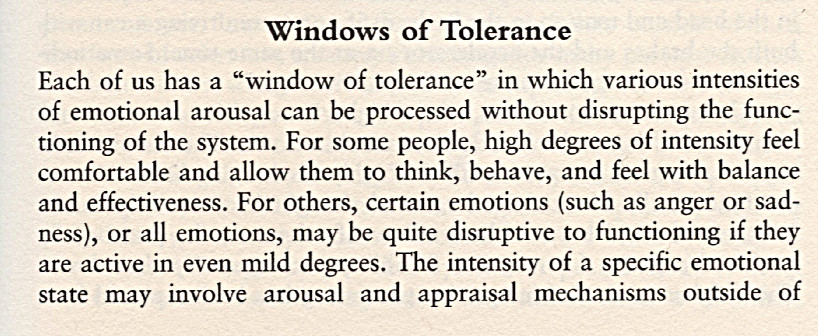
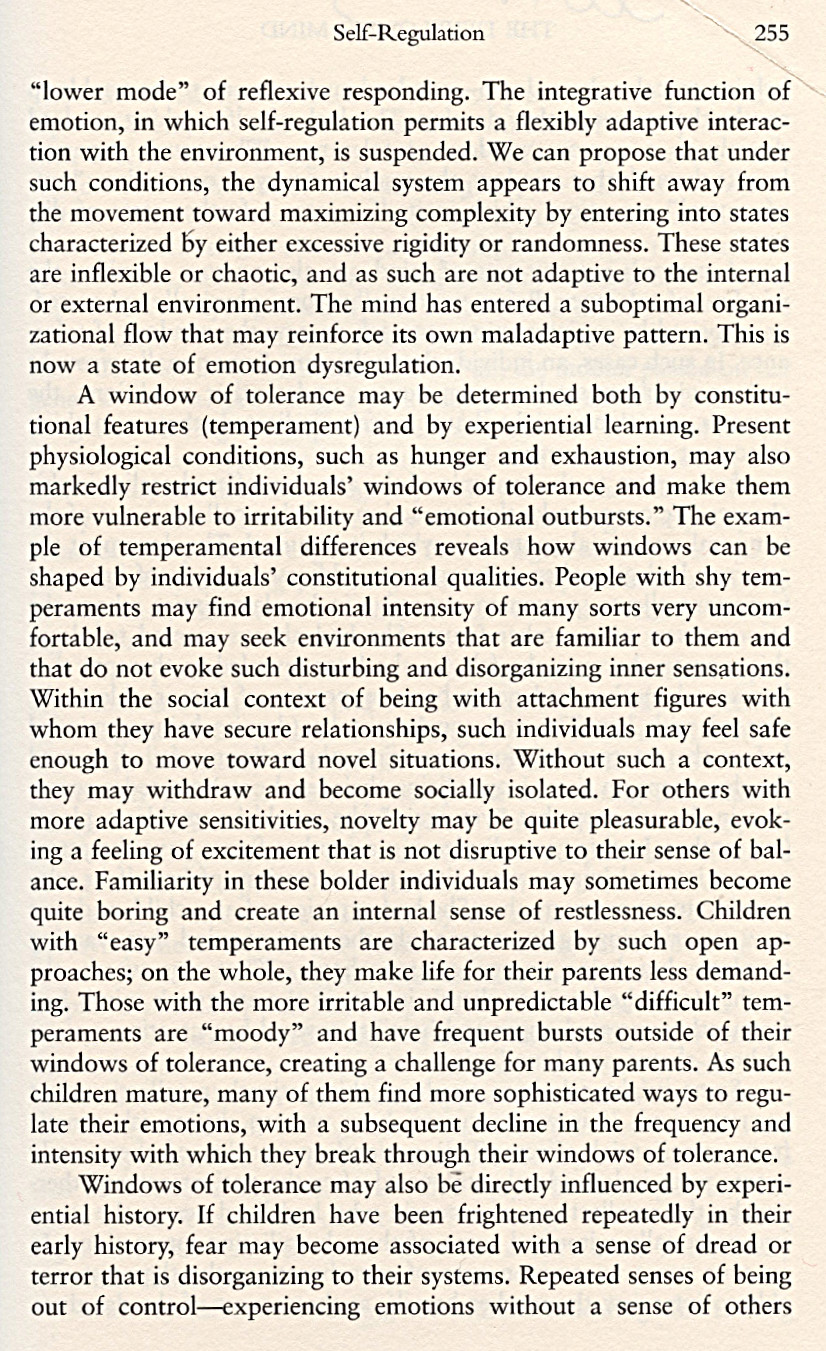
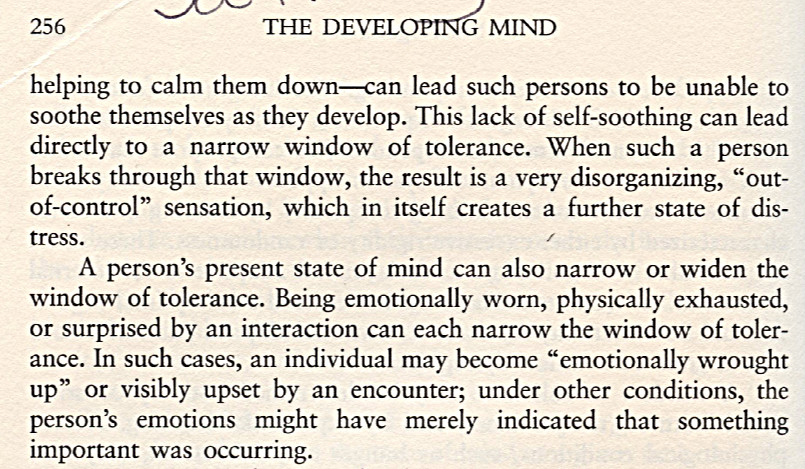
+INFO ON WINDOWS OF EMOTIONAL TOLERANCE

+++++++++++++++++++++++++++++++++++

Sometimes I have to force myself toward the study of information that I KNOW will help me in my life.  The choice is between continuing to live in ignorance while experiencing intensity of emotions I don’t understand and cannot easily regulate (along with repeated dissociation which I believe is one of a survivor’s ‘tools’ for regulating overwhelming emotion), or trying to learn SOMETHING that can help me make sense of the way I experience my life in this trauma-changed body.

The information presented in the article in my post +TRUE HEALING POSSIBLE – MY #1 CHOICE FOR TREATMENT is about the limbic social-emotional right brain as it connects into our body.  It is about how we experience emotion.  It is about how our interactions with other people starting from the beginning of our life form the patterns that either regulate or dysregulate our emotional life.

Our emotions are supposed to be the factors of our existence as human beings that are supposed to guide us toward approach or avoid through a process that lets us know what is good for us and what is harmful for us.  In other words, our limbic brain is intimately connected to our appraisal system, and from there to our reaction-action systems.  Severe infant-abuse survivorship changes the development not only of this limbic region of our brain, but also of our appraisal and our reaction system.

I am going to present some very specific information today about what is termed our Windows of Tolerance as it applies both to our emotional well- or ill-being and to the ways that we get information in the first place through our body.  This information comes from the writings of Dr. Daniel J. Siegel in his book The Developing Mind: How Relationships and the Brain Interact to Shape Who We Are.

The pages that precede the ones I am posting here today talk about how emotions are differentiated early infancy — or not.  These processes all occur within the earliest caregiver attachment interactions we have as our brain and nervous system-body is growing and developing.  All these processes are literally wired into the cells of our body and will determine how we ARE in the world.  The kind of therapy described in my earlier post is recognizing how fundamental these processes are and how they are wired into our body-brain.

Siegel states:

“Creating change within rigid patterns of specific appraisals requires a fundamental change in the organization of information and energy flow….

“Value circuits determine specific appraisal, creating the basic hedonic tone of “this is good” or “this is bad” and the behavioral set of “approach” or “withdraw.”  Value circuits also continue to assess the meaning of these initial activations as they are elaborated into more defined emotional states, including the categorical emotions.  What determines the nature of the appraisal/value process itself?  How does the mind “know” what should be paid attention to, what is good or bad, and how to respond with sadness or anger?

“For human beings to have survived, this complex appraisal process had to be organized by at least two components.  According to the fundamental principles of evolution, the characteristics of those that helped the individuals to survive and pass on their genes are more likely to be present today.  This is one explanation, for example, of why some people are frightened of snakes though they may never have seen one before.  This may also explain why infants have a “hard-wired,” inborn system to appraise attachment experiences as important.

“A second evolutionarily crucial influence on the appraisal mechanism is that it had to be able to learn from an individual’s experience.  Individuals who did not learn, for example, that touching a flame hurts would have been more likely to be repeatedly injured and unable to defend themselves, and therefore less likely to survive and pass on their genes.  Those individuals whose brains could alter their evaluative mechanisms would have been more likely to survive.  Hence, the appraisal system is also responsive to experience; it learns.  Emotional engagement enhances learning.”  (pages 252-253)

As pointed out in the article I posted two days ago on limbic resonance therapy, much of our learning ability happens through epigentic changes.  The healing that severe early abuse survivors need to accomplish happens at these molecular levels through processes that are also described in this article.

Early trauma overwhelms and over-arouses, over stimulates and over amps our nervous system, body and brain.  During our developmental stages that are designed to build emotional regulation into us, we were instead given far, far too much information at the same time we were left to our own physiological adaptations to survive.  As a result our appraisal system changed, a fact that means our Window of Tolerance for emotion and our reaction to emotion was also changed.

++++

While many of us know perfectly well what it FEELS like to have had our emotional, limbic, right brain’s internal guidance system changed because we LIVE with the consequences every day, most of us have never been given the information we need to understand what really happened to us.  We suffer from so-called ‘symptoms’ and ‘mental illnesses’ that are directly a consequence of how our extreme early trauma changed our body-brain in development.

These pages I scanned today from Siegel’s book give us some vital information that lets us begin to think more mindfully and consciously about what we experience in our body.  While change and healing is always possible, I believe that we need to comprehend how pervasive our trauma-related developmental changes in our body-brain’s arousal and reaction systems were so that we can be realistic in our expectations of ourselves as we go forward in our lives practicing gentle kindness.

NOTE:  It is important to realize that what Siegel states here about temperament are factors that are influenced in early development and by any exposure to trauma.  Hence, anxiety disorders, PTSD, depression, dissociation are all related to windows of emotional tolerance and our nervous system’s STOP and/or GO response, influencing how ‘shy’ or ‘bold’ we feel in our body-brain.  (It also might explain why/how things like this can happen:  http://www.kvue.com/news/KVUE-Live-Streaming-Video-81260087.html)

++++

+++++++++++++++++++++++++++++++

+HEALING GENTLE KINDNESS HAPPENS IN OUR BODY

++++++++++++++++++++++++++++++++

I hope from the article posted yesterday that we can begin to understand how what happened to us at the hands of our mothers created patterns in our body and our brain that affect us every moment of our lives.

Change can happen, and when it does it affects our genetics just as the article describes.  What we need is gentle kindness from others we participate in life with, and from ourselves.  Kindness happens in little ways, as each moment moves into the next.  Kindness comes as appreciation — a particular kind of understanding that allows us to appreciate how our anxiety, PTSD, depression, dissociation, and the processes of our free will and choice is fundamentally connected to our SELF within the body-brain we live within (and at one with).

Gentle kindness can come from these new levels of understanding, along with healing.  Just as who we are happens with molecular changes that bubble up to our consciousness, so does change happen the other way around.

I was disturbed in my sleep last night as I seldom am, and cannot remember my dreams except that I need to make certain I learn ‘happy’ songs first as I learn to read music and play this piano because I was ‘told-shown’ that these songs can change me on my insides.  “OK,” I say.  I can do that.  I can learn to play the happiest songs I can find — each tiny note and pause at a time.

I can pay very close attention today to all life’s gifts around me and bring gratitude into my thoughts during this day that I started with feeling (inexplicably) so very, very blue as if I woke an entirely different person than the one I was yesterday.  And I very possibly am.

So I anchor and ground myself in my body in this world, in this sunshine, putting real blankets on the real clothesline to make them smell so sweet and fresh when I put them back on my real bed tonight.  I use real water to take care of my real cats and my real plants.  I peel real oranges, and dig my real coffee grounds into my real compost pile where the real curling gray worms can really eat them up and give me back healthy soil for my little gardens.

The chronic stress reactions my body knows so well, communicated through my vagus nerve to my brain and back again, need me to constantly be aware that time is real because peritrauma timelessness can so easily take over my experience, and steal my life away from me.  Anxiety makes things unreal to me, and feeds that continuing sense of disconnection I feel between my self and my self and my self and the world.  Paying close attention to the littlest things is kind and gentle to me.  I can watch it with my breathing, “Exhale, Linda, Exhale,” knowing as I do this my vagus nerve begins to smile and with every careful, mindful breath and with every careful, mindful action I can steal another instant of my own life away from the trauma that built my body and experience my life as ME.

++++++++++++++++++++++++++++++++

+HARDHITTING ON THE TOPIC OF BAD RELATIONSHIPS

++++++++++++++++++++++++++

Of all the tragedies that life can find to place in our way along our path from start to finish, those connected to our early histories of growing up in homes with what the Center for Disease Control refers to as Adverse Childhood Experiences could become the easiest ones for us to spot.  Sure, there are plenty of self help books and programs that more and more of us eventually discover that tell us how to ‘get better’, but are they really telling us anything like the REAL truth about who and how we are in the world?

Is there anything like a product guide, a user’s guide, or a reliable guarantee of ‘full disclosure’ as we leave our abusive homes of origin and seek to join the mainstream world, jumping into the flow of major life choices and their resulting consequences?  Of all the things we leave our abusive homes not knowing anything about, perhaps the one that follows along with us the longest is our mistaken idea that we can somehow create safe and secure adult relationships between partners who do not have an early history of safe and secure attachments.

We are heroic in our attempts to build sandcastles to live within as if they will shelter us from the storms we face in life, as if they can withstand the onslaught of storms that sweep over and around us over the years of our life time.  How hard it is to let ourselves know that we are really homeless in the world of our partnerships, that no matter what any self help book tells us, those of us who survived an infant-childhood filled with trauma, abuse and madness will not live long enough to learn enough to begin to change enough to be able to sustain and maintain a mate relationship of safe and secure attachment.

So many people, especially in today’s unsafe and insecure economic environment, are facing limitations of choice to exit unstable, abusive, and simply put, very BAD relationships, especially if they are still caring for dependent children.  Those now left without the ability to create a sustainable exit plan out of one of these BAD relationships will experience increasing levels of stress for themselves and for their children.

These children, growing up with the pressure and strain of Adverse Childhood Experiences of their own are likely to seek attachment relationships themselves that are the equivalent of sandcastle and cardboard box partnerships that will never do more than temporarily appear to be sustainable.  What the self help books don’t tell us, is that we would be far better off building a concrete vault to sustain ourselves within independently and autonomously than we would be pretending that we have the first clue what a safe and secure attachment relationship is – because we don’t.

++++

Which is harder, learning to avoid getting into these unsustainable relationships in the first place or trying to get ourselves out of them after we have committed our hearts and entangled our lives?  Actually, I could be accused of cheating and that accusation would be correct.  At age 58, I am far enough down the road of life to be able to look backwards at my own life and sideways at the lives of others to see that a sustainable, autonomous, independent and FREE life alone has – the way I see it from here – so much more to offer me as a severe infant-child abuse survivor that I can no longer even pretend that I even WANT another sandcastle or cardboard box attachment relationship in my lifetime.

Coming out of abusive childhoods leaves many people prepared to continue struggling against insurmountable obstacles for the rest of their lives.  If the goal is to survive given the difficult conditions of life, then we are experts at trying to reach our goals.  Over and over again, on and on we go repeating our efforts to make a truly crappy situation and/or relationship into a good one.  We learned at the start of our life that to give up is to die.  We can continue to apply our simple rules of trying to stay alive to all kinds of situations that we would be better served simply walking away from.

++++

The goal of a truly sustainable infant-childhood is to form, through safe and secure attachment relationships with our caregivers, our own clear, strong, independent and autonomous self that can then continue down the road of life with enough inner resources to appropriately interact empathically, responsibly, appropriately and compassionately with others.  The more I learn about the physiological body-brain changes that are a direct result of growing and developing within malevolent early environments, the more I see that we survivors were simply never given what we needed to create one of these best-selves-possible.

Our handicaps show up in some way in nearly every choice we make.  Our choices for our adult attachment relationships are probably the most volatile and unsustainable ones we make.  While we continue to believe that somehow if we work hard enough we can perform the magic act of alchemy to transform ourselves in our relationships and that our partners can also transform themselves, we are most often struggling to accomplish the impossible.  We are like the dolphins caught in tuna nets who struggle until they die.

From my age 58 perspective I am beginning to finally understand something that appears to be one of the greatest paradoxes, if not downright ironies of life:  Those people who are most able to sustain themselves comfortably as independent and autonomous people outside of a mate relationship are the ones that will be able to sustain themselves – AND THEIR PARTNER – in a safe and secure attachment relationship – IF THEY EVER CHOOSE TO HAVE ONE.

While this might seem obvious, simplistic, and intellectually believable, severe infant-child abuse survivors are likely to NEVER TRULY GET THIS POINT.  I think back nearly 30 years ago when I was going through a treatment program designed to address my ‘child abuse issues’.  I was unhappily married for the second time.  My therapist told me and my husband that unless and until we each, on our own, separately and independently improved our own well-being, that ‘working on the marriage was impossible.  This therapist told us that otherwise it would be like scraping two piles of mold from different corners of the bottom of a refrigerator into one pile and expecting something good and healthy to come of the effort.

He was right.  I will grant him that point.  But I was not told NEXT what I now know, and needed to be told THEN.  I could apologize here for mentioning what I am going to say next, but with my advancing years I now see this as the rest of the story.  Never in my lifetime is it possible for me to make enough so-called changes so that I will ever be able to have a sustainable mate relationship with anyone.

That’s an extremely harsh reality, but reality it is.  I can spend the rest of my life, literally working to improve my independent, autonomous, sustainable own self and while I can make progress within myself, I do not believe that I have a long enough lifetime to make myself into this kind of self.

Even if my therapist in 1983 had told me this fact, it’s doubtful I would have believed him.  I would have thought, “Well, that might be true for others, but I am special.  I can be the exception.”  That would have been a delusion I could freely have believed in.  But sooner or later things that are true remain standing, like stone pillars strong enough to withstand millions of years of erosion.  That’s one of the things that the truth actually does:  It remains standing when all else has crumbled and vanished away.

++++

Knowing this fact now, that unless and until I can become an independent, autonomous, sustainable single self I will not be capable of forming safe and secure attachment with a mate, actually gives me a point of reference that acts like a true-north orientation of myself in relationship to my entire life.  I can kick and scream, deny and try to make deals, compromise, suffer and struggle, sacrifice and fantasize that somehow I can escape the consequences of having been forced to grow and develop a body-brain in a horribly abusive, deprived, malevolent world that in no way created a physiology in me that operates the way a safely and securely-built attachment physiology operates.  Or I can accept the facts and begin to realize that life offers me an acceptable alternative – the freedom of being alone that I need to heal what can be healed inside of my own self.

I say this as I come to realize why I cannot ever be with the man I love completely.  As I understand that WHY from inside my own body I am at the same time gaining understanding about the WHY as it relates to his attachment physiology.  I know of no attachment therapy approach that even begins to explain the facts of what makes our relationship so much more than difficult.  Our relationship is impossible.  Survivors need to be told what is really going on for us.  Dancing around the facts of our changed attachment physiology continues to give us the illusion that there really is ‘hope’ for such impossible relationships.

++++

Anyone who reads this post is of course perfectly free to take their own stand and make their own choices regarding any relationship they may be in.  I am simply stating my own point of view based on what I have learned about the nature of terrible infant-childhoods and how they change our physiological development.  These changes operate in unsafe and insecure attachment patterns that are visible and definable once we understand how basic and fundamental these patterns truly are.

These changes are, I believe, the root causes of all the trauma dramas we enact in our lives.  They are at the root of our suffering.  They created a lack of ability to smoothly and consciously regulate our emotions – in our body, our brain and our mind – through safe and secure attachments between ourselves and the world we live in.

As a result we are more like unstable nuclear reactors than we are like independent, autonomous, sustainable people.  It is at this level of woundedness – in our trauma-changed body-brains — that our problems with mates and relationships actually originates.  It is at this level, for those of us who are survivors of traumatic infant-childhoods, that our physiology does not support recovery.  We had no opportunity to create in the first place what would help us to go ‘back’ and ‘recover’ now.  We cannot ‘recover’ what we never had in the first place.

All human actions and interactions are ultimately about regulating our individual physiology, including our emotions.  That is what being a human being living in an Earth Suit really means.  The experiences of our early attachment relationships tailor fit our Earth Suit accordingly.  We need to understand ourselves and others at this most basic physiological-change level if we want the misery-patterns of our lives to end.

It’s not the relationships we participate in that we need to change.  It’s the Earth Suit we live in while we have these relationships.  Changing the Earth Suit we live in while in the midst of trauma drama is about as impossible as flying into the sun.

++++++++++++++++++++++++++++++++++++++

+REVISIONS FOR THE ‘MENTAL HEALTH BIBLE’ – DO YOU HAVE SOMETHING TO SAY?

++++++++++++++++++++++++++++++

When a consumer seeks help from a ‘mental health’ professional they seldom think first about the credibility of the ‘mental health’ professional system itself.  Yet this powerful system is not infallible.   As of February 10, 2010 the American Psychiatric Association (APA) has a website up and running for the public to make comments  and suggestions during the revision of the very ‘bible’ that is used to ‘diagnose’ everyone who seeks ‘mental health’ assistance.  If we have something to say, NOW is the time to do so.

From what I can tell the following links only work for dues-paying members of the American Psychiatric Association (APA), which few of us are!  So please use the comment suggestion categories presented here and either send them snail mail or email to:

American Psychiatric Association
1000 Wilson Boulevard, Suite 1825, Arlington, Va. 22209-3901
phone: 703-907-7300 email: apa@psych.org

REMEMBER:  Surviving severe infant-child trauma, maltreatment and abuse — which created alterations in our young developing body-brain — is the single most likely experience to lead to a ‘mental health’ diagnosis!  What appears in the Big Bible Book of the APA matters to us!

Suggestions/comments have been categorized into one of five types. Please select the type that best fits your suggestion or comment:

  • Submit comments that serve to alert us about problems, limitations, or shortcomings with DSM-IV-TR (without specific suggestions about how to fix them). Miscellaneous comments that do not fit into the other categories go here as well.
  • Submit suggestions for specific changes to diagnostic criteria or diagnostic class groupings.
  • Submit suggestions for a new subtype to be added to an existing disorder.
  • Submit suggestions for a new disorder to be considered for addition to DSM-V.
  • Submit suggestions for deletion of an existing disorder.

++++

SEE:   psychdiagnosis.net for more information about this subject, including stories about a variety of kinds of harm caused directly by psychiatric diagnosis and six different solutions to problems of diagnosis.

++++

I am presenting a paper about the revision process currently under way for the American Psychiatric Association’s (APA) Diagnostic and Statistical Manual of Mental Disorders (DSM-V), sometimes known as “the therapist’s Bible,” that was recently included in a post by a member of an online group I joined.  The revision of this manual is slated for publication for 2013.

++++++++++++++++++++++++++++++

WEBSITE: THE ASSOCIATION FOR WOMEN IN PSYCHOLOGY

Psychiatric Diagnosis: Too Little Science, Too Many Conflicts of Interest [i]

BY: Paula J. Caplan, Ph.D.
Harvard University

The Concerns

There is a lot of pain and suffering in the world, and it is tempting to believe that the mental health community knows how to help.  It is widely believed, both by mental health professionals and the general population, that if only a person gets the right psychiatric diagnosis, the therapist will know what kind of measures will be the most helpful. Unfortunately, that is not usually the case, and getting a psychiatric diagnosis can often create more problems than it solves, including a lifetime of being labeled, difficulties with obtaining affordable (or any) health insurance (due to now having a pre-existing condition), loss of employment, loss of child custody, the overlooking of physical illnesses and injuries because of everything being attributed to psychological factors, and the loss of the right to make decisions about one’s medical and legal affairs. The creation and use of psychiatric diagnosis, unlike, for instance, psychiatric drugs, is not overseen by any regulatory body, and rarely does anyone raise the question of what role the assignment of a psychiatric label has played in creating problems for individuals. [ii]

The Problematic History

Contrary to popular belief, the enterprise of psychiatric diagnosis is largely unscientific and highly subjective (Caplan, 1995; Caplan & Cosgrove, 2004). Therapists often disagree about which label to assign to a given patient, and there is perhaps surprisingly little definitive research to prove that, “A person with diagnosis X will benefit from and not be harmed by treatment Y.”

These serious limitations have not prevented the authors of the American Psychiatric Association’s (APA) Diagnostic and Statistical Manual of Mental Disorders (DSM), sometimes known as “the therapist’s Bible,” from making expansive claims about their knowledge and authority and wielding enormous power to decide who will and will not be called mentally ill and what the varieties of alleged mental illness will be. The DSM’s current edition is called DSM-IV-TR, and it was preceded by the original DSM (in 1952), then DSM-II (1968), DSM-III (1980), DSM-III-R (Third Edition Revised) (1987), DSM-IV (1994), and DSM-IV-TR (2000). The DSM-V is currently in preparation and slated for 2013 publication.  Each time a new edition appears, the media ask whichever psychiatrist is the lead editor why a new edition was necessary, and like clockwork, each editor replies that it was because the previous edition really wasn’t scientific (Caplan, 1995).  And each time a new edition appears, it contains many more categories than does the previous one.  For instance, DSM-III-R contained 297 categories, and DSM-IV contained 374 (Caplan, 1995).

I served as an advisor to two of the DSM-IV committees, before resigning due to serious concerns after witnessing how fast and loose they play with the scientific research related to diagnosis (Caplan, 1995).  The DSM is widely used, not only in the mental health system, but also in general medical practice, in schools, and in the courts.  I have been involved since 1985 in trying to alert both therapists and the public to the manual’s unscientific nature and the dangers that believing in its objectivity poses.  Since then, I have watched with interest a national trend toward gradually increasing openness to the idea that psychiatric diagnosis (A) is largely unscientific, (B) is highly subjective and political, and (C) can cause untold harm, ranging from the patients’ lowered self-confidence to loss of custody of children to loss of health insurance (because any psychiatric label can be considered evidence of a pre-existing condition) to loss of the right to make decisions about their medical and legal affairs.

What many do not consider is that psychiatric diagnosis is at the foundation of much of the harm that is done in the mental health system.  Without assigning a diagnosis, a therapist is not supposed to choose what treatments to use or even whether or not to suggest treatment.  And rarely are patients prescribed psychotropic drugs or told they need psychotherapy unless they get a psychiatric label.  This is not to say that psychotherapy and medication is never helpful for anyone but simply that the first step toward the harm that sometimes results from these is assignment of a diagnosis.  Furthermore, increasingly people have learned about the connections between drug companies’ concealment of the harm their products can cause and some professionals’ pushing of particular drugs while being paid well by the drug companies.  It has been well documented that some of the professionals who help write the DSM are on drug companies’ payrolls (Cosgrove, Krimsky, Vijayraghavan, & Schneider, 2006).

Coming Up Next: DSM-V and Secrecy

With the next edition of the DSM in preparation, and perhaps due to increasing scrutiny and questioning of the process of creating psychiatric categories and an increasing public awareness of the harm that results from their use, the current DSM team has tried to envelop the process of compiling the next edition in a shroud of secrecy (Frances & Spitzer, 2009).  Interestingly, the editors of the current and previous editions, Allen Frances and Robert Spitzer, respectively, in a letter to the APA’s Board of Governors described the DSM-V process as characterized by a “rigid fortress mentality” that included asking that those compiling the new edition to sign a statement agreeing to keep confidential the deliberations about it (Frances & Spitzer, 2009).  This seems a curious requirement for a group that has often claimed that it bases its decisions strictly on scientific evidence.

In addition to this secrecy, as I learned when asked by Ms. magazine in 2008 to write an article about the future of the category “Premenstrual Dysphoric Disorder” in the DSM-V, those joining DSM-V committees have been told that they must divest themselves of most drug company connections.   However, it turns out that this divestment is only temporary, and connections can resume once work on the DSM is finished.  Furthermore, as one DSM-V committee chair told me in a telephone interview, this requirement delayed the process of committee formation substantially, because it was difficult to find enough people who were willing to go through with the divestment (Fawcett, personal communication) .

Some Problems Already Identified in DSM-V Plans

In keeping with the tradition of DSM editors claiming that, in contrast to previous editions, their edition will be scientific, a proposal apparently receiving serious consideration is the creation of an entirely new system of organizing categories within the DSM-V (Frances & Spitzer, 2009), yet this proposed system is riddled with problems and does not even appear to be a particularly useful – not to mention valid – system for helping people with emotional problems.

In addition, despite the secrecy surrounding the process, additional alarming information about what committee members are considering has already appeared.  For instance, a committee was appointed to consider whether “racism” should appear in the DSM-V, a step that would disguise a social evil by making it seem “merely” an individual problem, a mental illness.   One danger of such a diagnostic category is that people who commit hate crimes would blame their crimes on alleged mental illnesses and thus avoid criminal punishment (Profit, 2004).  This is similar to the category of “rapism,” which was proposed for DSM-III-R and which feminists successfully battled (Caplan, 1995).

In a different realm altogether, one prominent DSM author has proposed that “relational disorder” be added to the manual (Caplan & Profit, 2004). “Relational disorder” would be applied to a couple, neither of whom individually might be considered mentally ill but whose relationship would be considered sick.  One of the category’s inventors has suggested that this would provide a terrific opportunity to try out psychotropic drugs. But there are serious ethical problems involved in prescribing drugs to treat people who are not individually diagnosed as mentally ill. It is revealing to picture this scene:   Two people sit in a psychiatrist’ s office; neither of them is considered mentally ill, though their relationship is; the psychiatrist removes a pill from its bottle…where does the psychiatrist put the pill?   Clearly, the ethics, absurdities, and dangers of DSM-V proposals must see daylight and be thoroughly debated as soon as possible.

This Website

Even during the preparation of past editions of the manual, changes have been rapidly and often surprisingly made by various DSM subgroups and by those at the top of the hierarchy.   For this reason, it would be almost impossible to write a book about concerns related to the DSM-V process.   As a result, sponsored and supported by the Association for Women in Psychology (AWP), which has long had as a primary social action objective the understanding of psychiatric diagnosis and prevention of harm that results from it, a task force of academics and clinicians has produced the articles on this website.   Most of the articles are about particular diagnostic categories, some are about particular “isms” such as sexism, classism, and racism, and many involve elements of more than one of these.   This website is a grassroots project of AWP, and due to limitations of time and personnel, we have only attempted to critique some (though a wide variety) of the 374 different diagnostic categories listed in the current DSM and some that are being considered for inclusion.   Furthermore, the secrecy surrounding the DSM-V process makes it impossible to know much the new categories being proposed.  So with this website, we offer a sampling of the kinds of problems and concerns that we want to urge professionals and the public alike to watch for as the DSM-V steamroller moves on.  In fact, several of the categories addressed on this site have been proposed in major mental health journals and books as DSM-V diagnoses. Unfortunately, many changes in past editions have been made at the last minute and without the public’s knowledge, so that serious problems have become widely known only after the editions were published; those problems have persisted for many years. Indeed, in the case of the widely publicized claim in the early 1970s that “homosexuality” was being removed from the next edition of the manual – a claim that is still generally believed to be true – it emerged that “ego-dystonic homosexuality” actually remained in the next edition after all (Metcalfe & Caplan, 2004).[1] Situations like this make it difficult to think how to protect the public and how to educate the public and professionals about ways to stop the DSM-V authors from causing harm. We hope that this website will provide some resistance to the DSM-V steamroller.

References

Caplan, P. J. (1995). They say you’re crazy: How the world’s most powerful psychiatrists decide who’s normal. Reading, MA: Addison-Wesley.

Caplan, P. J., & Cosgrove, L. (2004). Bias in psychiatric diagnosis. Lanham, MD: Rowman and Littlefield.

Caplan, P.J., & Profit, W.E. (2004). Some future contenders. In P. J. Caplan & L. Cosgrove (Eds.), Bias in psychiatric diagnosis (pp.249-54). Lanham, MD: Rowman & Littlefield.

Cosgrove, L., Krimsky, S., Vijayraghavan, M. & Schneider, L.  (2006). Financial ties between DSM-IV panel members and the pharmaceutical industry. Psychotherapy and Psychosomatics, 75, 154-160.

Fawcett, J. Personal communication.

Metcalfe, W.R., & Caplan, P. J. (2004). Seeking “normal” sexuality on a complex matrix. ”? In P. J. Caplan & L. Cosgrove (Eds.), Bias in psychiatric diagnosis (pp.121-6). Lanham, MD: Rowman & Littlefield.

Profit, W.E. (2004). Should racism be classified as a mental illness? In In P. J. Caplan & L. Cosgrove (Eds.), Bias in psychiatric diagnosis (pp.81-8). Lanham, MD: Rowman & Littlefield.

[1] The category “Ego Dystonic Homosexuality” appeared in the manual, thus leading to the labeling as mentally ill many people who were not thoroughly comfortable and happy with being homosexual. The fact that in a homophobic society, the lack of total comfort with being homosexual should hardly be construed as proof of mental illness was not acknowledged. Even today, although the words “homosexual,” “lesbian,” “gay,” and “bisexual” do not appear as diagnostic categories in the manual, the category “Sexual Perversion Not Otherwise Specified” does appear, and that is so broadly defined that it could certainly be applied to anyone who is not heterosexual, as long as their particular therapist decides that their sexual orientation is a perversion.

++++

SEE:   psychdiagnosis.net for more information about this subject, including stories about a variety of kinds of harm caused directly by psychiatric diagnosis and six different solutions to problems of diagnosis.

[ii] The Association for Women in Psychology, the Society for Menstrual Cycle Research, and the National Women’s Health Network, sponsored by Congresswoman Louise Slaughter and cosponsored by many other organizations, held a Congressional briefing about some of these concerns, and a second briefing was held by the author of this paper (Caplan, Paula J. (2002). You, Too, Can Hold a Congressional Briefing: The SMCR Goes to Washington About “Premenstrual Dysphoric Disorder” and Sarafem. The Society for Menstrual Cycle Research Newsletter, Summer, 1-5. Reprinted in Women’s Health: Readings on Social, Economic, and Political Issues. Fourth Edition. Nancy Worcester & Mariamne Whatley (Eds.). Kendall-Hunt: Dubuque, IA, pp.246-9.) However, no Congressional action to propose hearings or legislation about psychiatric diagnosis has yet resulted from these briefings.

http://awpsych. org/index. php?option= com_content&view=article&id=102&Itemid=126

Bias in Psychiatric Diagnosis: Concerns about DSM-V


Mission:
To provide information for people (including but not limited to professionals and journalists) about biases and other problems in psychiatric diagnosis, an especially important goal in light of the American Psychiatric Association’ s preparation for the 2013 publication of the next edition of the psychiatric diagnostic manual.

NEWS FLASH
1.[i] see psychdiagnosis.net for more information about this subject, including stories about a variety of kinds of harm caused directly by psychiatric diagnosis and six different solutions to problems of diagnosis.

2. Click Here for an important article in New Scientist about problems in the preparation for DSM-V

3. Click here to go to a website that is presented as allowing anyone who wants to make suggestions about DSM-V to do so.

Note:  AWP’s Committee on Bias in Psychiatric Diagnosis does not know what plans may have been made by the DSM-V authors to consider these suggestions.

4. Call for papers for a special issue of Social Science and Medicine, Sociology of Diagnosis

5. PSYCHOUT – A conference for organizing Resistance against Psychiatry – Call for submissions

+++++++++++++++++++++++++++++++++++++++++++++

+++++++++++++++++++++++++++++++++++++++++++++

Given even the physiological developmental changes that happened to our body-brain as a result of having to adapt to severe traumas in our early infant-childhood, the following is still the very best ‘advise’ we can probably ever follow.  Our new power, our increased self-respect, and our advanced experience are tied into learning — for the first time in our lives — what these developmental body-brain changes are, how they actually happened, how they affect us, and how we can still work to vastly improve our well-being in our life time.

++++

“Be not the slave of your own past. Plunge into the sublime seas, dive deep and swim far, so you shall come back with self-respect, with new power, with an advanced experience that shall explain and overlook the old.”

Ralph Waldo Emerson

US essayist & poet (1803 – 1882)
+++++++++++++++++++++++++++++++++++++++++++++

+OUR STRESS RESPONSE IS WHAT WE PASS DOWN TO OUR KIDS

++++++++++++++++++++++++++++++++

It is not so much the nature of any particular trauma or stress that we experience in life that matters most; it is how well equipped we are with both the inner and outer resources to respond to them.  It is our response patterns that most affect our children.  It is our response patterns that we pass down to them.

The vagal nerve is directly tied both to our stress response system and to our ability to act with compassionate caregiving.  I believe that it is our response to trauma and stress in relation to how compassionately we can take care of our children that matters most to them during their early growth and developmental stages.

++++

How can this fact (as presented in my last post) not be of central concern to everyone living in America?

44 percent of American children — that’s nearly half of all children in the U.S. — live in families that face serious struggles to make ends meet.”

Poverty is a stressor that affects not just the adults caring for this 44% of our nation’s children, but also impacts each and every one of the children in some way.  How do we care for ourselves and others when our stress response system is itself overly and chronically stressed?

Poverty is not a single problem that can be dissociated from the ever expanding circles of society that create both the poverty conditions and the solutions for these conditions.  My concern with the vagal nerve system and its connection to the capacity to care-give compassionately or not lead me to finding the information I am presenting today.  Parents still have to take care of their children no matter what lack they may be experiencing in their external resources.  Yet it is the actual condition of a parent’s body and brain that influences how all of their caregiving actions take place in every situation – stressful or not.

If parents experienced severe stress and trauma during their own early developmental stages, their stress response system has most likely changed in response.  This altered stress response system is the only one they have available in their body-brain to use for the rest of their lifetime.  Because how the stress response system operates is directly connected to the vagal nerve system, and because parental interactions with their children directly influence the development of their little one’s stress response-vagal nerve system, these stress responses can easily be automatically passed on down the generations – often along with poverty.

Even though the current economy is creating an ever widening circle of financial stress on families in our nation, it is the response TO THE STRESSORS that are perhaps more significant in the long run than are the actual experiences of lack of financial well-being themselves.  The more we can all understand how our body-brain handles stress, anxiety and trauma the more empowered we can be to intercept automatic responses to children in our lives that will harm their body-brain development in ways that will create physiological lack of well-being for their lifespan – no matter what their financial conditions end up to be.

++++

Two important words that emerged for me today as I read this information presented below are ‘inspiration’ and ‘expiration’.  True, this article is talking about our breathing and our heart rate.  But it is more than that.  The more flexible we can be in every single way the more ‘inspiration’ we can experience in our lives that will counteract the hardships we encounter.  Stress responses in our body, through the operation of our vagal nerve system, happen in response to threats to our actual life as well as to threats against our self esteem (and to our actual ‘self’).

Mindful consciousness over our stress response actions empowers us.  Becoming mindfully conscious of how we are in-the-moment allowing our own stress responses to affect our children MATTERS to their physiological development.  Once we begin to more fully understand that our stress response system IS THE SAME SYSTEM that operates in connection to our breathing and heart rate, through our vagal nerve, that is ALSO  OUR COMPASSIONATE CAREGIVING SYSTEM we can learn to take every possible precaution not to pass the stress onto our children through the way we directly offer caregiving to them.

Yes, children need the most basic physical necessities of life, but it is most likely to be the way caregivers respond to children on the personal level of interactions with them that is most likely to cause our children permanent growth and development harm if we aren’t care-full – not poverty or other external factors.

The way parents experience and handle stress is directly passed down to their offspring.  These patterns are built right into the developing body-brain of infant-children and will have profound affect on how these children will handle stress and regulate their emotions and social interactions themselves for the rest of their lives.  It is from this perspective that I present the following information today on the vagal nerve system and the stress response.

++++++++++++++++++++++++++++++++

What is Vagal Tone?

The parasympathetic nervous system influences the tonic or resting heart beat by means of signals from the tenth cranial nerve, the Vagus nerve.  In the resting or baseline state the heart rate will fluctuate with the breathing cycle; inspiration is accompanied by heart rate elevation and expiration is accompanied by heart rate depression….  [in the example given at this LINK page 69] you will see an example of this phenomenon.  The top tracing is the heart beat, the middle tracing is the respiratory cycle (up for inspiration, down for expiration), and the bottom tracing is the heart rate from the ratemeter.  Notice the coincident rise and fall of heart rate with each respiratory cycle.  This event is termed the respiratory sinus arrhythmia or RSA.  The extent of the RSA is a rough measure of Vagal control over the resting heart beat, referred to as Vagal tone.  The size of the RSA (degree of variability of the heart rate for each respiratory cycle) is what is determined by the Vagus nerve.  When the heart rate varies considerably for each respiratory cycle, then we say there is good or high Vagal tone.  When the heart rate is relatively steady with low variability for the respiratory cycle, we say there is poor or low Vagal tone.  In general Vagal control over the heart rate lessens during stressful experiences when sympathetic activity is heightened, thus allowing the heart rate to rise to meet the challenge.” (page 68)

Personality and Vagal Tone

Vagal tone has been related to temperament (the innate building blocks of personality) and stress vulnerability in children.  Children who show behavioral inhibition in novel situations (somewhat comparable to shyness) have low Vagal tone as evidenced by higher and less variable resting heart rates.  Preschoolers who fail to show emotional expression also have low Vagal tone and are vulnerable to later depression and anxiety. [my note:  These children may well be exhibiting early manifestations of insecure attachment disorders.]  There is also evidence that adults who are extremely shy or behaviorally inhibited have higher and less variable resting heart rates.  Also adults with high Vagal tone may have lower blood pressure responses to stress, making them less vulnerable to hypertension and coronary heart disease.  Interestingly, adults with high Vagal tone are more susceptible to hypnosis.  [my note:  And high Vagal tone ‘superstars’, as Keltner notes, show more compassionate, caring response to others.]  The exact relationship between the autonomic nervous system’s regulation of physiological responses and personality is unknown, but many hypothesize that the innate sensitivity and reactivity of the nervous system may be the fundamental mechanism for biasing personality development and expression.”  (page 69) [my note:  bolding is mine — and this sensitivity and reactivity of the nervous system and brain are directly influenced in development by the nature of early infant-child interactions.]

++++

Because a person’s resting and responsive Vagal nerve system is tied to overall degrees of well-being in the world, it is helpful to understand how this system operates on both the physiological and ‘psychological’ level.

Heart Rate

Heart rate is the number of beats per minute of the heart (BPM) and it is determined by factors intrinsic to the heart as well as regulatory pathways from the brain and hormonal signals for the adrenal glands.  Once again, when the brain is involved, psychological states may show themselves in the peripheral response [my note:  in the body.]

The obvious purpose of the heart beat is to move blood around the body.  The rate of the heart beat is one factor which influences cardiac output and the volume and speed of delivery of the blood to body cells.  Clearly, there are times when the blood needs to reach those cells more or less quickly.  Exercise, responding to stressors, and even just standing up may create greater cellular needs for oxygen and blood nutrients (mainly glucose).  Relaxation, sleeping and other vegetative states generally create a reduced cellular need.  Sensors in the brain stem and hypothalamus provide feedback regulation of the heart rate to meet the demands of body cells.  Responding to stressors involves the activation of higher limbic system structures [my note:  Remember, this region of the brain forms early and is hypersensitive in its formation to the conditions of the earliest environment, especially ‘good’ and ‘bad’ signals sent to the infant from its earliest caregiver interactions.] such as the amygdala and hypothalamus, which then send signals via the autonomic nervous system to increase (or decrease) the heart rate.  Neurotransmitter signals from the sympathetic branch [“GO” branch] (norepinephrine) increase the heart rate (by binding to beta 1-adrenergic receptors), while neurotransmitter signals from the parasympathetic branch [“STOP” branch] decrease the heart rate (by binding to muscarinic cholinergic receptors).

There are individual differences in the resting heart rate which are related to genetics [my note:  Which includes environmental influences over the mechanisms that tell our genetic code what to do, and epigenetics], gender (females generally have faster heart rates than males), and to physical condition (state of health as well as fitness).  Also, there are individual differences in the size (and sometimes the direction) of the adaptive changes which take place to environmental events.  Some of these differences are related to personality, psychological state, and perhaps fitness as well.”  (pages 65-66)

++++

All of the factors that affect our well-being are influenced in early development of the body-brain by the condition of an infant-child’s environment, particularly by early caregiver interactions.  This includes the operation of our nervous systems – including our autonomic nervous system.

Please read the following keep in mind how a very young developing body-brain can be altered in response to stress and trauma so that the adult operation of the stress response system is altered for a life time.  Also keep in mind that it is the mother’s ability to reflectively and appropriately modulate her own emotions as she interacts with her young infant that builds (or does not build) emotional regulational abilities into her infant’s early forming right limbic brain and autonomic nervous system.  (Here again, too much over stimulation, even too much ‘happiness’ stimulation can overtax and overload an infant’s developing body-brain regulatory abilities.)

Also note in the writings below the introduction of dissociation – which is a body-brain reaction that involves both the body and the brain equally on occasions where it occurs in connection to stress triggers including anxiety.

++++

Psychological States and Cardiovascular Responses

Cardiovascular responses have been studied most often in the context of arousal and emotional states.  The stress response (fight or flight) is a physiologically adaptive set of bodily changes in the presence of a life threat or a threat to one’s self worth.  In general, activity of the sympathetic nervous system is enhanced, bringing about elevations in heart rate and blood pressure necessary to deal with the perceived threat.  These responses are adaptive in the short and generally improve human performances which require speed, strength, and endurance.  Human performance which requires fine motor skills or complex cognitive processes is generally affected in a curvilinear fashion;  performance is enhanced with moderate or optimal levels of the stress response, but hindered with high levels of the stress response (as anyone who plays the piano knows).

Studies have shown that anxiety, frustration, anger, fear, anticipation of pain and other negative emotional states can bring about elevations in heart rate and/or blood pressure.  Positive emotional states of excitement, joy, and interest can also bring about elevated cardiovascular responses.  There are, however, individual differences in the nature and the extent of cardiovascular responses in emotional states.  [my note:  Think about early developmental changes along with what this author writes about next.]  Some of these differences stem from the nature of the individual personality (for example cynicism and hostility…) and some stem from the nature of the environmental demands.  Complicating the picture is the fact that heart rate and blood pressure may disassociate in response to environmental events.  [my note:  bolding is mine.]  Research has supported the idea that tasks which require environmental intake or monitoring, cause heart rate lowering (blood pressure may rise or remain unchanged), while tasks which require environmental rejection (events which are aversive or bring about escape motivations) result in heart rate and blood pressure elevations.  [my note:  As can be seen in the research on Borderline Personality Disorder and their vagal nerve response.]  Similarly, it has been shown that tasks which tend to produce anxiety and self-focus (for example giving a speech if you have presentation anxiety) tend to elevate heart rate and blood pressure, while tasks which tend to produce anxiety and environmental-focus (for example listening to a lecture that you will be tested on later) tend to reduce heart rate while blood pressure may elevate or remain unchanged.”  (pages 67-68)

From:  Chapter 5,  Experiment HP-5:  Heart Rate, Blood Pressure, and Vagal Tone

READ WHOLE ARTICLE INCLUDING THE EXPERIMENT AT THIS LINK:

Human Pyschophysiology HP-5-1 (through page 14) – no author or further reference information given —

++++

References on Personality and Vagal Tone (even though older research, still presents excellent background information)

Cole, P.M., Zahn-Waxler, C., Fox, N.A., Usher, B.A., & Welsh, J. D. (1996).  Individual Differences in Emotion Regulation and Behavior Problems in Preschool children.  Journal of Abnormal Psychology, 105(4), 518-529.

Eisenberg, N., Fabes, R.A., Karbon, M., Murphy, B.C., Carlo, G., & Wosinski, M. (1996).  Relations of School Children and Comforting Behavior to Empathy-related Reactions and Shyness.  Social Development, 5(3), 300-351,

Jemerin, J.M. & Boyce, W.T. (a990).  Psychobiological Differences in Childhood Stress Response.  II.  Cardiovascular Markers of Vulnerability.  Journal of Developmental Behavioral Pediatrics, 11(3), 140-150.

Jemerin, J.M. & Boyce, W.T. (a990).  Psychobiological Differences in Childhood Stress Response.  II.  Cardiovascular Markers of Vulnerability.  Journal of Developmental Behavioral Pediatrics, 11(3), 140-150.

Porges, S.W. (1992).  Vagal tone:  A Physiological Marker of Stress Vulnerability.  Pediatrics, 90(3), 498-504.

Thayer, J.F., Friedman, B.H. & Borkovec, T.D. (1996).  Autonomic Characteristics of Generalized Anxiety Disorder and Worry.  Biological Psychiatry, 39(4), 255-266.

++++++++++++++++++++++++++++++++++++++++