
+GREAT BOOK ABOUT THE BEST IN HUMANS

+++++++++++++++

My book Born to Be Good: The Science of a Meaningful Life – Paperback (Oct 5, 2009) by Dacher Keltner has arrived.  I am eagerly embarking on its study about what’s best about humans.  My insanely abusive Borderline mother sure didn’t teach me anything about THAT!

Keltner resides in the camp of study about positive human emotions.  Interestingly, researchers could not really study what has always been termed ‘happiness’ equally with the survival emotions such as fear and rage until technology invented photographic equipment that operates as fast as our face moves when we express emotion.

The more survival-based emergency related emotions happen in bigger ways so that we can watch them happen more easily than we can (could) watch expressions related to happiness and well-being.  Just as we needed really FAST photography to accurately be able to watch the visual information transmitted and received between infants and mothers (that build our earliest fundamental brain regions), we also needed it to see what happens when we treat one another well and with kindness.

(For an example of how the extremely rapid fraction-of-a-millisecond mother-infant communication takes place please scroll down to page 22 in Dr. Allan N. Schore’s paper, EFFECTS OF A SECURE ATTACHMENT RELATIONSHIP ON RIGHT BRAIN DEVELOPMENT, AFFECT REGULATION, AND INFANT MENTAL HEALTH)

++++

Humans are born with the capacity to experience emotion.  We simply live them without thinking about what they are, what they mean, or what they are named.  In safe and secure infant-childhood environments we are helped by our caregivers to gradually learn about our emotions as we learn about our self and others in the world.  Eventually we learn what emotions are named and about how to ever more effectively regulate them.

Because this ability to regulate and differentiate emotions happens within our earliest infant-child attachment relationship environment, the process is either assisted or interfered with by our caregivers.  In my own case, as I study Keltner’s book, I doubt I will be able to think about very many instances from my infant-childhood at all where I would have even been allowed to experience the positive emotional states.

I find it interesting that even in the field of vastly expensive scientific research that the differentiation of ‘happiness’ and the study of this state had to wait until technology caught up with our desire and need to better understand the happiness aspect of who we are.

Dr. Keltner is at the cutting-edge of this research.  His study happens because he can use the new lens of sophisticated super-stop action photography to see our human finely tuned happiness communications in the same way that evolution of the lens allowed us to see new aspects of our world through microscopes and telescopes.

++++

Keltner states about the study of happiness in the first chapter of his book:

“The canonical [orthodox] studies of human emotion, studies of the universality of facial expression, of how emotion is registered in the nervous system, how emotion shapes judgment and decision making, had never looked into these states.  The groundbreaking studies of emotion had only examined one state covered by the term “happiness.”  But research is often misled by “ordinary” language, the language we speak rather than the language of scientific theory.  Happiness is a diffuse term.  It masks important distinctions between emotions such as gratitude, awe, contentment, pride, love, compassion and desire – the focus of this book – as well as expressive behaviors such as teasing, touch, and laughter.  This narrow concentration on “happiness” has stunted our scientific understanding of the emotions that move people toward higher jen ratios.  By solely asking, “Am I happy?” we miss out on the many nuances of the meaningful life.

My hope is to shift what goes into the numerator of you jen ration, to bring into sharper focus the millisecond manifestations of human goodness.  I hope that you will see human behavior in a new light, the subtle cues of embarrassment, playful vocalizations, the visceral feelings of compassion, the sense of gratitude in another’s touch to your shoulder, that have been shaped by the seven million years of hominid evolution and that bring the good in others to completion.  In our pursuit of happiness we have lost sight of these essential emotions.  Our everyday conversations about happiness are filled withy references to sensory pleasure – delicious Australian wines, comfortable hotel beds, body tone produced by our exercise regimens.  What is missing is the language and practice of emotions like compassion, gratitude, amusement, and wonder.  My hope is to tilt your jen ratio to what the poet Percy Shelley describes as the great secret of morals:  “the identification of ourselves with the beautiful which exists in thought, action, or person, not our own.”  The key to this quest resides in the study of emotions long ignored by affective science.”  (pages 14-15)

++++

My mother was extremely short on jen, as are all people who outright neglect, abuse and maltreat people – infants and children most included.  My mother’s experiences in her own abusive childhood seemed to completely obliterate any ability she was born with to understand what ‘being good’ was all about.  Certainly it was my experience with her that she was never able to ‘be good’ to me and in fact she did not believe I even had the capacity to ‘be good’ myself.

In fact, my mother projected her own ‘badness’ that she found intolerable inside herself out onto me and proceeded to spend the 18 years of my childhood ‘punishing’ me for being ‘that bad’.  This process was, I believe, entirely connected to abuse in her own childhood as she had been told her ‘badness’ made her unlovable, but if she could only be ‘good enough’ she would be lovable and loved again.  Something became permanently broken in my mother’s early ‘good-bad’ early forming brain, and it made her into a monster.

Knowing this about my Borderline mother makes me very curious about Keltner’s book whose very title —  BORN TO BE GOOD — addresses the underlying conflicts my entire childhood was consumed with:  Evil versus Good versus Evil versus Good……..  Every interaction I had with my mother from the time I was born was in reality a communication from her to me about how essentially and fundamentally un-good and totally evil I was.

The extremes of my mother’s psychosis were so severe that she literally believed I was satan’s child and was not even born as a human being.  I was condemned beyond salvation, though my mother believed through every word and deed she abused me with that she was doing her very super-human best to save me as she battled to accomplish the impossible task of turning me into ‘something good’.

Keltner’s book is about the best in human social interactions.  I want to know more about this because I certainly have vast personal experience about what the worst in human social interactions can be like.  I want to improve my own ‘jen ratio’.  What might this mean?

By first translating the broad term ‘happiness’ into the broader term ‘goodness’, Keltner then describes the kinds of minute human interactions that both communicate goodness and build it into self and others.  The term “jen ratio” is the kingpin of his writing    About jen itself Keltner states:

“…Confucius taught a new way of finding the meaningful life through the cultivation of jen.  A person of jen, Confucius observes, “wishing to establish his own character, also establishes the character of others.”  A person of jen “brings the good things of others to completion and does not bring the bad things of others to completion.”  Jen is felt in that deeply satisfying moment when you bring out the goodness in others.

Jen science is based on its own microscopic observations of things not closely examined before.  Most centrally, it is founded on the study of emotions such as compassion, gratitude, awe, embarrassment, and amusement, emotions that transpire between people, bringing the good in each other to completion.  Jen science has examined new human languages [My note:  New to scientific study, ancient to humans] under its microscope – movements of muscles in the face that signal devotion, patterns of touch that signal appreciation, playful tones of the voice that transforms conflicts.  It brings into focus new substances that we are made of, neurotransmitters as well as regions of our nervous system that promote trust, caring, devotion, forgiveness, and play.  It reveals a new way of thinking about the evolution of human goodness, which requires revision of longstanding assumptions that we are solely wired to maximize desire, to compete, and to be vigilant to what is bad.

“The jen ratio is a lens onto the balance of good and bad in your life.  In the denominator of the jen ratio place recent actions in which someone has brought the bad in others to completion….  Above this, in the numerator of the ratio, tally up the actions that bring the good in others to completion….  As the value of your jen ratio rises, so too does the humanity of your world.

“Think of the jen ratio as a lens through which you might take stock of your attempt at living a meaningful life.”  (pages 3-5)

++++++++++++++++++

I haven’t seen these two words in Keltner’s book yet, hope and enthusiasm, but this is how I feel as I enter into this new journey.  For all my awarenesses about the differences between how my body-brain-mind-self was formed in comparison to others who benefited from having a safe and secure attachment foundation rather than one formed in, by and for trauma, I enthusiastically hope that by understanding how we ALL have a jen ration operating in our lives I can begin to make my own ration better.

I will keep you posted (literally!) about my experiences with the information contained within the pages of Keltner’s BORN TO BE GOOD book I was fortunate to discover!

+++++++++++++++
+21 RICH NATIONS COMPARED ON CHILD WELL-BEING – U.S. AND U.K. AT THE BOTTOM

++++++++++++++++

Please spend some time reading the UNICEF 2007 Report Card on six measurements of the well-being of children.  The United States and the United Kingdom have total scores at the bottom of the 21 OECD [Organization for Economic Co-operation and Development] industrialized nations included in this study (page 2).

While every measurement is extremely important, the one that is of greatest concern to me in regard to the well-being particularly of infants and very young children is the finding that the United States rates highest in the percentage of births per 1,000 women

ages 15-19.  See Report Card page 31, Figure 5.2f.

This report states this about teenage births:

For most girls growing up in an OECD country, the norm today is an extended education, a career, a two income household, delayed childbearing and a small family.   And it is in this context that teenage pregnancy has become a significant problem: giving birth at too young an age is now associated with wide ranging disadvantage for both mother and child – including a greater likelihood of dropping out of school, of having no or low qualifications, of being unemployed or low-paid, and of living in poor housing conditions.   But as always, association is not the same as cause.   Many girls who give birth in their teens have themselves grown up with the kind of poverty and disadvantage that would be likely to have negative consequences whether or not they wait until they are in their twenties before having children.  Becoming pregnant while still a teenager may make these problems worse, but not becoming pregnant will not make them go away.

Beyond the immediate problem, teenage fertility levels may also serve as an indicator of an aspect of young people’s lives that is otherwise hard to capture.  To a young person with little sense of current well-being – unhappy and perhaps mistreated at home, miserable and under-achieving at school, and with only an unskilled and low-paid job to look forward to – having a baby to love and be loved by, with a small income from benefits and a home of her own, may seem a more attractive option than the alternatives.   A teenager doing well at school and looking forward to an interesting and well-paid career, and who is surrounded by family and friends who have similarly high expectations, is likely to feel that giving birth would de-rail both present well-being and future hopes.

It is as an approximate measure of what proportion of teenagers fall on which side of this divide that the teenage fertility rates shown in Figure 5.2f may be an especially significant indicator of young people’s well-being.”

++++++++++++++++

I consider these findings also especially significant in light of this blog’s strong emphasis on the critical importance of safe and secure attachments as a foundation of body-brain-mind-self development of people.  Take a look at these findings.  The United States and the United Kingdom appear to be failing miserably on these measures of child well-being and are at the bottom of this combined initial attempt to measure attachment on the national level.

On page 22, Figure 4.0 shows young people’s family and peer relationships – and an OECD overview is presented in graphic form.  The Report states:  “The quality of children’s relationships is as difficult to measure as it is critical to well-being.  Nonetheless it was considered too important a factor to be omitted altogether and an attempt has therefore been made to measure the quality of ‘family and peer relationships’ using data on family structures, plus children’s own answers to survey questions.”

++++

Among the measurements on behaviors and risk-taking of young people presented beginning on page 26, Figure 5.0, the Report states:   “Any overview of children’s well-being must attempt to incorporate aspects of behaviour which are of concern to both young people themselves and to the society in which they live.   This section therefore brings together the available OECD data on such topics as obesity, substance abuse, violence, and sexual risk-taking.”

Again, the United States and the United Kingdom are at the very bottom in their total scores on these measurements.  Page 27, Figure 5.1 Overview — Children’s health behavior the United States is at the bottom.  Page 28, Figure 5.1d, the United States has the highest percentage of young people age 13 and 15 who report being overweight.    “…the EU [European Union] Health Commissioner has said:   “Today’s overweight teenagers are tomorrow’s heart attack victims”.”

“…in most countries young people’s health behaviours do not deviate very far from the average for the OECD as a whole.  The exceptions are Poland, where children’s health behaviours are considerably better than average, and the United States whose overall ranking suffers because of high levels of obesity.”

++++++++++++++++

The great majority of young people growing up in all OECD countries score themselves above the midpoint on the ‘life satisfaction ladder’.”  Fortunately, United States’ young people are among this majority (page 37).

An interesting observation in this section of the Report about student agreement with negative statements about personal well-being in regard to feeling ‘out of place’ comes from Japan (page 38):

The most striking individual result is the 30% of young people in Japan who agreed with the statement ‘I feel lonely’ – almost three times higher than the next highest-scoring country. Either this reflects a difficulty of translating the question into a different language and culture, or a problem meriting further investigation, or both.”

++++++++++++++++

From the Report Card:

The true measure of a nation’s standing is how well it attends to its children – their health and safety, their material security, their education and socialization, and their sense of being loved, valued, and included in the families and societies into which they are born.

++

When we attempt to measure children’s well-being what we really seek to know is whether children are adequately clothed and housed and fed and protected, whether their circumstances are such that they are likely to become all that they are capable of becoming, or whether they are disadvantaged in ways that make it difficult or impossible for them to participate fully in the life and opportunities of the world around them.   Above all we seek to know whether children feel loved, cherished, special and supported, within the family and community, and whether the family and community are being supported in this task by public policy and resources.

All families in OECD countries today are aware that childhood is being reshaped by forces whose mainspring is not necessarily the best interests of the child.   At the same time, a wide public in the OECD countries is becoming ever more aware that many of the corrosive social problems affecting the quality of life have their genesis in the changing ecology of childhood.   Many therefore feel that it is time to attempt to re-gain a degree of understanding, control and direction over what is happening to our children in their most vital, vulnerable years.

That process begins with measurement and monitoring. And it is as a contribution to that process that the Innocenti Research Centre has published this initial attempt at a multi-dimensional overview of child well-being in the countries of the OECD.”  (page 38)

++++

Any part of the Innocenti Report Card may be freely reproduced using the following reference:

UNICEF, Child poverty in perspective: An overview of child well-being in rich countries, Innocenti Report Card 7

2007 UNICEF Innocenti Research Centre, Florence. © The United Nations Children’s Fund, 2007

Full text and supporting documentation can be downloaded from the UNICEF Innocenti Research Centre website.

This Report Card provides a comprehensive assessment of the lives and well-being of children and young people in 21 nations of the industrialized world.   Its purpose is to encourage monitoring, to permit comparison, and to stimulate the discussion and development of policies to improve children’s lives.

The report represents a significant advance on previous titles in this series which have used income poverty as a proxy measure for overall child well-being in the OECD countries.   Specifically, it attempts to measure and compare child well-being under six different headings or dimensions: material well-being, health and safety, education, peer and family relationships, behaviours and risks, and young people’s own subjective sense of well-being.   In all, it draws upon 40 separate indicators relevant to children’s lives and children’s rights (see pages 42 to 45).

Although heavily dependent on the available data, this assessment is also guided by a concept of child well-being that is in turn guided by the United Nations Convention on the Rights of the Child…. The implied definition of child well-being that permeates the report is one that will also correspond to the views and the experience of a wide public.”

* The United Kingdom and the United States find themselves in the bottom third of the rankings for five of the six dimensions reviewed  [material well-being, health and safety, education, peer and family relationships, behaviors and risks, and young people’s subjective sense of their circumstances]

* There is no obvious relationship between levels of child well-being and GDP per capita.  The Czech Republic, for example, achieves a higher overall rank for child well-being than several much wealthier countries including France, Austria, the United States and the United Kingdom

+++++++++++++++++++++++++++++++++++++++++++

SEE ALSO – The United States has been taking internal measurements on our nation’s children’s well-being for over 30 years.

CHILD WELL-BEING STATISTICAL REPORT, SPECIFIC TO THE UNITED STATES:

The 2009 Foundation for Child Development — Child and Youth Well-being Index (CWI) Report

Children and youth live unique lives and as such, at some point, each experiences a range of social conditions.   The Index is comprised of Key Indicators associated with different stages of the life course in the first two decades of life.

The CWI includes the following 28 Key Indicators organized into seven domains of child well-being in the United States that have been found in numerous social science studies to be related to an overall sense of subjective well-being or satisfaction with life.

Family Economic Well-Being Domain

1. Poverty Rate (All Families with Children)

2. Secure Parental Employment Rate

3. Median Annual Income (All Families with Children)

4. Rate of Children with Health Insurance

Health Domain

1. Infant Mortality Rate

2. Low Birth Weight Rate

3. Mortality Rate (Ages 1-19)

4. Rate of Children with Very Good or Excellent Health (as reported by parents)

5. Rate of Children with Activity Limitations (as reported by parents)

6. Rate of Overweight Children and Adolescents (Ages 6-19)

Safety/Behavioral Domain

1. Teenage Birth Rate (Ages 10-17)

2. Rate of Violent Crime Victimization (Ages 12-19)

3. Rate of Violent Crime Offenders (Ages 12-17)

4. Rate of Cigarette Smoking (Grade 12)

5. Rate of Binge Alcohol Drinking (Grade 12)

6. Rate of Illicit Drug Use (Grade 12)

Educational Attainment Domain

1. Reading Test Scores (Ages 9, 13, and 17)

2. Mathematics Test Scores (Ages 9, 13, and 17)

Community Connectedness

1. Rate of Persons who have Received a High School Diploma (Ages 18-24)

2. Rate of Youths Not Working and Not in School (Ages 16-19)

3. Rate of Pre-Kindergarten Enrollment (Ages 3-4)

4. Rate of Persons who have Received a Bachelor’s Degree (Ages 25-29)

5. Rate of Voting in Presidential Elections (Ages 18-20)

Social Relationships Domain

1. Rate of Children in Families Headed by a Single Parent

2. Rate of Children who have Moved within the Last Year (Ages 1-18)

Emotional/Spiritual Well-Being Domain

1. Suicide Rate (Ages 10-19)

2. Rate of Weekly Religious Attendance (Grade 12)

3. Percent who report Religion as Being Very Important (Grade 12)

Taken together, changes in the performance of these 28 Key Indicators and the seven domains into which they are grouped provide a view of the changes in the overall well-being of children and youth in American society.   Each domain represents an important area that affects well-being/quality of life: economic well-being, health, safety/behavior, educational attainment, community connectedness (participation in major social institutions), social relationships, and emotional/spiritual well-being.   The performance of the nation on each indicator also reflects the strength of America’s social institutions: its families, schools, and communities.   All of these Key Indicators either are well-being indicators that measure outcomes for children and youths or surrogate indicators of the same.

SEE ALSO:

THE CHILD AND YOUTH WELL-BEING INDEX (CWI)

Foundation for Child Development and the CWI

++++

Check out this article:

How Is the Economic Recession Affecting U.S. Children?

The 2009 Child Well-being Index

by Eric Zuehlke

+++++++++++++++++++++++++++++++++++++++++++

+SILENCE. TURN AROUND AND WALK AWAY?

+++++++++++++++++++++++++++++

I cannot imagine anyone WANTING to write about or talk about child abuse.  Why spoil a perfectly gorgeous day by even thinking about that so dark side of life, especially when those days lie so far back hidden in the dim and distant past?

Why no simply enjoy, if not cherish, everything that seems so good and right in one’s present moment?

If nobody wants to speak or write about those days and nights of misery, those months, those years of abuse and torture — so the silence can continue without words — can each of us forget equally?  Both those of us who have endured abuse equally with those who have not?

Who will tell those stories?  “I don’t want to,” people say.  So they don’t.  “What’s the point of it?”

Today I join those people who have to still admit we don’t know the point of it.  I don’t know the good of it.

Turn around and walk away?

+++++++++

What matters?

From service dog to SURFice dog…

turning disappointment into a joyful new direction

+++++++++++++++++++++++++++++

+ATTACHMENT: SMART AND STUPID RESEARCH

++++

Personally I am tired of wandering around in the darkness wondering why I am not a particularly HAPPY person with some kind of an active, exciting, thrilling, fulfilling life full of social connections and emotional well-being.

Sure, my childhood sucked.  But, so what?  “Too bad, so sad, be glad you are grown up now and can make any choice you want to make about yourself in your life.  Get over it!  Get on with it!  Quit feeling sorry for yourself!  Your life is what you make of it.  Still having problems?  You must have bad genes.”

My response is, “Oh, yeah?  Says who?  What can ‘the research’ tell us?”

++++

My sister sent me an interesting link the other day that presents information directly connected to what I wrote in my December 26, 2009 post where I mentioned that I suspect my social-emotional brain shares some characteristics with autism.  Take a look at this Yahoo news article about research coming from a study of school children:

Texas study confirms lower autism rate in Hispanics

For every 10 percent increase in Hispanic schoolchildren in a given district, the researchers found, the prevalence of autism decreased by 11 percent, while the prevalence of kids with intellectual disabilities or learning disabilities increased by 8 percent and 2 percent, respectively.

The reverse was seen as the percentage of non-Hispanic white children in a district increased, with the prevalence of autism rising by 9 percent and the prevalence of intellectual and learning disabilities falling by 11 percent and 2 percent.

The observed relationships remained for Hispanic children after the researchers accounted for key socioeconomic and health care provider factors, although “urbanicity” of a district, median household income, and number of health care professionals did explain the increased percentage of autism among districts with more non-Hispanic white kids — a finding the researchers call “curious.”

Whether lower autism prevalence in Hispanics is attributable to other, still-unexamined socioeconomic, health care delivery or biological factors “remains a crucial area for further research,” Palmer and colleagues conclude.”

SOURCE: American Journal of Public Health, December 2009.

++++++++++++++++

Well, will you look at that.  All that time, effort and money spent on this research study and did they think to include a measurement of what matters most?  Did they include any kind of questions about size of immediate family, number of siblings, size of the dwelling, or amount of contact with extended family?

I can’t access the full research article online, but here’s what its abstract says:

Am J Public Health. 2009 Dec 17. [Epub ahead of print]

Explaining Low Rates of Autism Among Hispanic Schoolchildren in Texas.

Palmer RF, Walker T, Mandell D, Bayles B, Miller CS.

University of Texas Health Science Center.

In data from the Texas Educational Agency and the Health Resources and Services Administration, we found fewer autism diagnoses in school districts with higher percentages of Hispanic children. Our results are consistent with previous reports of autism rates 2 to 3 times as high among non-Hispanic Whites as among Hispanics. Socioeconomic factors failed to explain lower autism prevalence among Hispanic schoolchildren in Texas. These findings raise questions: Is autism underdiagnosed among Hispanics? Are there protective factors associated with Hispanic ethnicity?

++++

Researchers are evidently content to conclude their research with such statements as “this is a curious finding,” while they continue to ask their unanswered questions like, “Are there protective factors associated with Hispanic ethnicity?”  There is no reason I can think of to expect that degrees of human attachment don’t affect genes for autism just like it does for schizophrenia, suicide, depression, PTSD and other ‘disorders’ of the body-brain.

I have lived for the last ten years in a small town in southeastern Arizona on the Mexican-American border line.  The fence lies right behind my back yard.  99.9% of this town’s community is Hispanic.  Every family I know has a lot of children.  The children are cherished.  Every family has extended ties to extended family.  Their median income is low.  Many children often share a bedroom.  I have watched them as they grow from infanthood in the closest of interactions with one another within all age groups.  They are social and they are connected to one another.  Nobody is alone.

Duh, researchers.  Do you think that MAYBE the research findings might have to do with safe and secure attachment that builds for these people an excellently formed early social-emotional brain so that autism is not as likely to appear among their culture?

Is there some kind of STUPID gene operating among researchers that prevents them from bothering to consider collecting what is the most obvious information that would answer their questions?  Or is there some kind of implicit agreement among researchers to keep skipping the gathering of the most important attachment related information so they can keep on doing more and more stupid research without gaining any true understanding – because it gives them job security?

++++

I know this pattern exists.  The same kind of researcher ‘stupid gene’ operated during the South African – Kenyan youth research project on the consequences of trauma.  Follow this link for a description of the kinds of information the researchers collected on the 2000 teenagers in their study.  Did they include any standardized, accurate and useful assessment of attachment relationships among their subjects?  Of course not!  How could they justify spending more and more money on research to answer the puzzling results they found?

The most striking finding was the discrepancy in the rate of PTSD between South African and Kenyan adolescents in the context of equally high rates of trauma exposure (and even higher for specific types of trauma in the Kenyan sample).  The lower rate of PTSD in Kenya adolescents is difficult to explain.”  Seedat et al, 2004, p 173

Note the “difficult to explain” statement.  Read for yourself, “Give me more money so I can use my stupid genes and do more research.  I want to keep my job.”

These researchers noted at the conclusion of their massive project that for all the money spent and for all the extensive effort they put into their research, the were left unable to

“…account for higher rates of PTSD in the South African students, despite higher rates of exposure in Kenyan youth to both sexual assault and physical assault by a family member, as these are traumas that are likely to be repeated.  Further, these traumas were most likely to e associated with a PTSD full-symptom diagnosis.  This discrepancy is one for which we do not have an adequate explanation.”  Seedat et al, 2004, p 174

Obviously these Kenyan children were not necessarily safe and secure in their own home, so how might we consider that attachment information might help explain the difference in outcome between these two groups of extremely traumatized youth?

No standardized or valid attachment assessment tool exists.  These researchers do not seem to be bothered by its absence.  Even though they did not use the word ‘attachment’ in their research conclusions, these researchers did ‘wonder’ if the patterns of differences they observed might be related to the long history of cultural disruption that South Africa has endured in contrast to the retained cultural integrity of Kenya.

Can degrees of safe and secure versus unsafe and insecure attachment be related to degrees of cultural integrity?  The findings of both of these two research studies point in that direction.  Because neither study contained any (nonexistent) standardized collection of attachment information, both studies are left simply pointing in a “a direction for further research.”  Of course this doesn’t bother the researchers.  It guarantees their job security.

++++

The hole in the bucket of both of these studies validates my thinking.  It is the degree of safe and secure attachment that an infant-child has in its beginning with its mothering caregiver that most influences how a person’s genes manifest themselves as the very young body-brain develops.  The protective factors against any so-called ‘mental illness’, be it depression, aspects of autism, or PTSD are activated very early in a person’s development.

Looking at the end result of degrees of attachment security, even within school age children, tells researchers nothing about how their ‘subjects’ got to be the way they are.  I want to know, “How safe and securely attached were these children to their mothers and their other earliest caregivers from the time they were born – as their body-brain developed in interaction with the experiences the little one had in its environment?”

In my thinking, cultural integrity protects mothers and therefore protects the infants who benefit in their earliest, fundamental development from safe and secure attachment.  As the early body-brain is forming, information from the environment has already told an individual’s genes how to respond and adapt.  Although safe and secure attachment is certainly not guaranteed to children like those in Kenya, not EVEN in their home, the underlying structure of their body-brain seems to have included residency factors that protect them from PTSD.

++++

Without trying to explain the research today that describes the physiological impact that early stress has on development (notes for a lot of this research can be found HERE), I will simply present some links here today related to research that is showing how child abuse changes genetic expression:

Child Abuse Causes Damage at Genetic Level

++

Child abuse ‘impacts stress gene’

++

Infant Abuse Linked To Early Experience, Not Genetics

++

Gene protects adults abused as children from depression

Influence of child abuse on adult depression: moderation by the corticotropin-releasing hormone receptor gene.

++

The Neurobiology of Child Abuse and Neglect

++

Do Genetics and Childhood Environment Combine to Pose Risk for Adult PTSD?

Association of FKBP5 polymorphisms and childhood abuse with risk of posttraumatic stress disorder symptoms in adults.

++

Selected Publications of the Members of the Attachment Parenting International Research Group

++

And also, the results of a Google search for child abuse brain development

++++

Researchers need to come up with an accurate way to measure degrees of safe and secure versus unsafe and insecure attachment and add this measurement tool into the design of all research about the affects that trauma has on human beings throughout the lifespan.

Every research study being done that does not include a measure of degrees of attachment is missing the critical piece of information about how attachment creates resiliency factors that protect humans from ongoing problems related to trauma experiences.

All funding channels that support trauma-related research need to mandate that an assessment of the quality of human attachment be included.  Of course, this means that attachment patterns need to be taken most seriously as a primary factor that profoundly influences trauma research results.  Let’s do smart rather than stupid research!  Find a way to accurately measure degree and quality of human attachment – NOW!

++++

Please note:  I will be taking a break from the blog until Wednesday, January 6, 2010.  Best wishes for a Happy New Year 2010!

+++++++++++++++++++++++++++++++++++++

+TRAUMA SIGNALS THROUGH ATTACHMENT

+++++++++++++++++++

Human attachment patterns exist within and are communicated by the body either through the use of words or not.  Degrees of safe and secure or unsafe and insecure attachment are physiological communications about either the presence of or the absence of unresolved trauma.  This is true for humans at every stage of our development from birth until death.

++++++++++++++++++++++++++

The first thought that came to my mind the first time I encountered a description of the research strategies used to assess infant-mother attachment such as was presented in yesterday’s post was that under no circumstance can I possibly imagine my mother agreeing to participate in such an activity.

Nor can I imagine any severely abusive parent being willing to agree to participate in such research.  Nowhere have I seen a discussion in the research about this fact.  It is not the researcher’s concern.  Abuse is not what they directly intend to measure even though I believe it would clearly be seen in the patterns of attachment between an abused and maltreated infant and its primary caregiver.

As described in the 13 scanned pages presented yesterday about parent-infant attachment research, it is clear that attachment patterns cannot be shown to be related to either personality traits or to intelligence.  They have also found that a mothering caregiver’s attachment patterns are not formed directly in relationship with any particular personality trait of their infant, either.

Attachment patters are being shown to be transmitted from caregiver to infant as the research shows the remarkable fact that a pregnant mother’s attachment patterns have great power to predict and to form her infant’s attachment patterns.  Research is showing that these transmitted patterns of infant attachment are carried by her offspring through from infancy into adulthood.

One big hole in the research that I find when I look at it from my own point of view is that while researchers seem to clearly understand that an infant can have entirely different attachment patterns with different attachment caregivers, nowhere in the research do I see these experts talk about the fact that caregivers can have different attachment patterns with their different offspring.  This matters a great deal in cases where a parent singles out one of their offspring for severe abuse even though they do not abuse all of their children.  This was the case in my childhood.

Assuming that a severely abusive mother would ever show up in a research setting such as the ones used in these studies, has research ever been done that shows how any mother might interact differently with her different offspring?  Not to my knowledge.  (I will have to hunt for this kind of research).

I think the results of the adult attachment research being presented in Siegel’s writing makes the assumption that the adult’s attachment patterns are so formed within the caregiver that the operate consistently across relationships that adult has with everyone, including her offspring (any and all of them).

++++

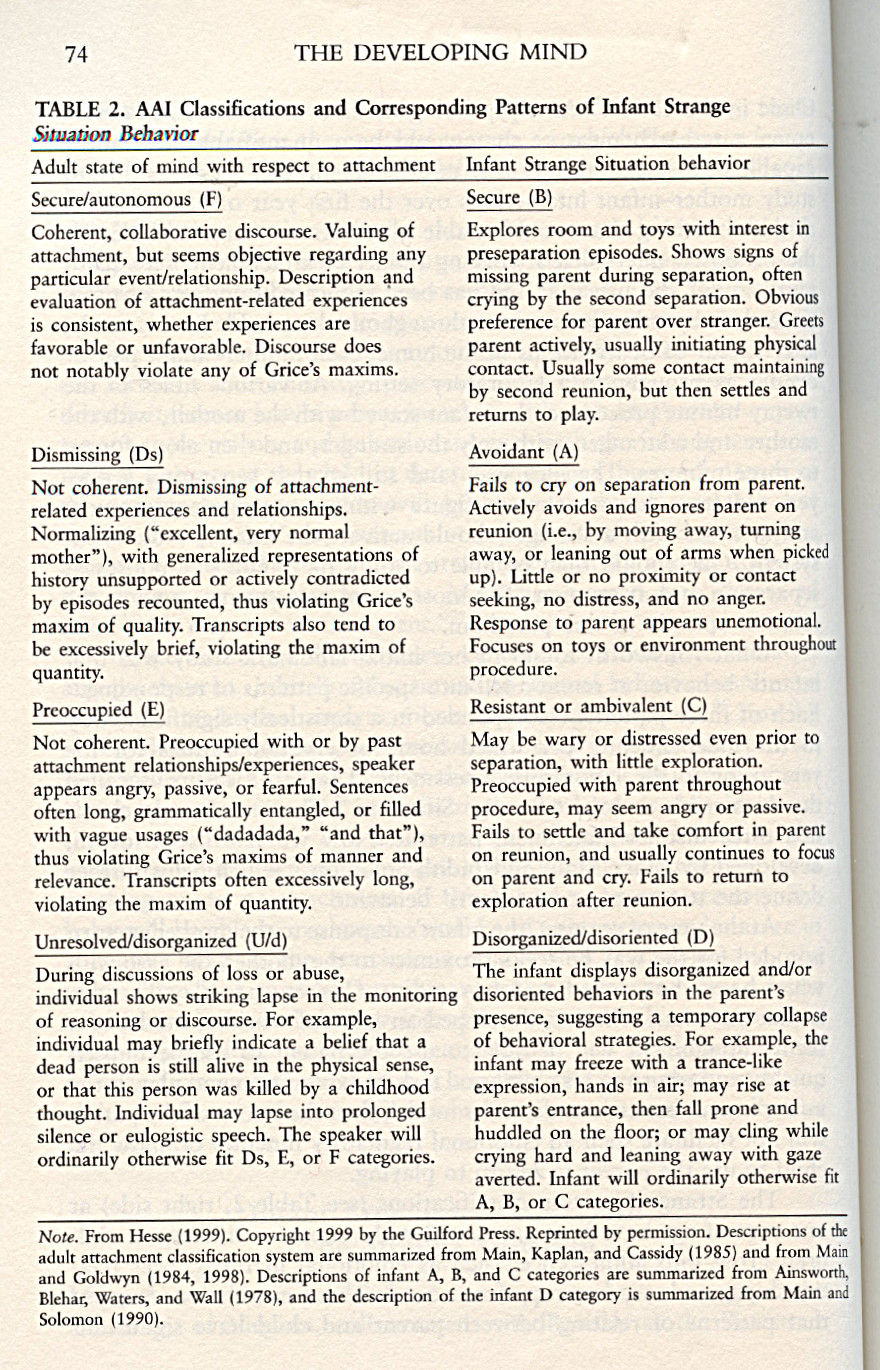
When reviewing the findings presented in the comparison table about how a particular mother’s own attachment patterns correspond to her infant’s, the reason why the name of the attachment patterns are different between adult and infant seems to be that while the infant’s classification is based specifically on the mother-infant relationship, the mother’s is based on what researchers determine to be her attachment states of mind.

Researchers suggest that not until the age of 18 months does an infant-child’s brain have the capacity for form and use ‘mental representations’ that are required for it to have a ‘state of mind’.  This belief is reflected in the process used to determine attachment depending on age.  Infant attachment is based on observable body behavior.  Adult attachment is assessed on the basis of verbal communication patterns.

I am not clear as to why researchers do not assess a mother’s attachment to her infant by reproducing a clinical scenario like the one they used to watch how an infant responds in the Strange Situation.  I don’t think they watch the mother.  They are watching the infant.  If they DID watch the mother, what visible patterns would they see in the mother as she came and went from her infant?  How does she hold it?  How does she let go of it?  Does she reach for her infant?  What do her facial expressions communicate to the infant or the tone and pitch of her voice?

++++

Adult assessment of attachment is designed to notice patterns of communication and signaling used in a verbal interview.  These same patterns of communication happen between infants and their caregivers even though verbal communication is NOT what matters to the infant.  It is the patterns of communication signaling that is being assessed in both infants and adults.  The communication of emotion is at the core of these assessed signals for both.

Because of their youth, infants do not use clear mental representations or process their emotions through the filter of a clear state of mind.  What they feel is what they do, and what they do shows in the actions their body takes.  If you take a look at the information contained in the 13 scanned pages it is clear that because infants cannot yet use words, they are left still communicating with their body.

It is the nature and the quality of a mother’s ability to read, resonate with and to respond appropriately to all the body-based signals of communication her infant has expressed to her from the moment of its birth that create the bedrock of her infant’s social-emotional brain as they also steer and direct the development of her infant’s nervous system, immune system and body.  These patterns of interactions between a mother and her infant, the same ones that built the infant, show in the infant as it interacts with its mother during these attachment assessment experiences.

That the physiological, actual body-based actions of a one-year-old infant very accurately are reflected in how its mother TALKS about her own experiences of childhood fascinates me.  It shows me that words and the expression of them simply exist on the end of a physiological-response continuum that just gets more sophisticated in its expression the older we get – the more our brains develop – and according to the more options we have to express our emotions.

Language is body-based.  It happens through our body.  Infants use language from the moment they are born, certainly well before they can use actual words.

++++

My suspicion is that the farther down the attachment scale into insecure attachment patterns a mother might be appearing to slide — which researchers assess through verbal communication — the more she is communicating as she did when she was an infant.  I say this because as researchers watch a mother’s ability to follow Grice’s maxims disintegrate as she attempts to TALK about her childhood, the closer she is getting to body-based emotion that she cannot put into words.

We don’t expect an infant to be able to talk about its ongoing experience of trauma in words.  At the same time we also know that it is the nature of ongoing unresolved trauma to NOT be integrated into anyone’s ongoing experience of being a self in the world.  This is just as true when ongoing trauma exists in an infant’s reality as it is when it exists in an adult’s.

Experiences of trauma interfere with ongoing experience in a safe and secure world.  If trauma can be resolved, it becomes digested and integrated as safety and security return to the individual irregardless of a person’s age.  If trauma cannot be resolved, it is not integrated and it then shows itself in interruptions in patterns of signaling communication that can be seen in attachment relationships – again, irregardless of a person’s age.

Patterns of unintegrated and unresolved trauma are what researchers are ‘measuring’ in both infants and in adults while they watch and interpret movements of the body during these studies.  It just happens that words and verbal communication styles and patterns in adults are watched more closely than are their bigger bodily movements.

Unresolved and unintegrated trauma exists at the physiological level.  This trauma communicates its presence physiologically – even in words and in patterns of spoken communication.  It is not only the bigger the unresolved trauma is, but also the older it is that we can see in patterns of insecure attachment – at any age.

The older a trauma is, meaning the younger we were when it overwhelmed us, the more it appears body-based in its signals.  That is why an adult will appear increasingly inarticulate (does not follow Grices’s maxims) the more they approach their earliest traumas.  The more incoherent a mother’s attachment interview becomes, the more she is becoming her younger body-based (without words) self-in-the-world.  The memories the interviewer is asking her to access do not exist with words.  They do exist in her body.

The more insecurely and unsafely attached a mother was in her earliest body-brain formation stages of development, the more her early traumas actually changed the body-brain she lives in the world with.  Whether researchers are watching (listening to) body-based signals in words or not, in infants or in adults, they are watching degrees of safe and secure being in a benevolent world – or not.  They are watching early trauma changed body-brain development – or not.

++++

Actions are always body-based expressions.  The older we get the more options for actions we have.  As trauma-laden infants grow through their younger years into their adulthood, the more obvious the trauma drama patterns of communication become.  If we separate ourselves from our own experiences of trauma drama and picture them as occurring among actors on a stage, we can easily see that it is simply unresolved trauma itself that is communicating its presence.

If an infant that researchers watch behaves in a safe and secure manner with its mother, those researchers don’t see trauma drama.  If an infant behaves in ways that can be seen to represent increasing levels of unsafe and insecure attachment patterns with its mother, researchers can already watch trauma drama taking place.

We could ‘mute the sound’ for any trauma drama we might be watching, at any age, because words really tell us very, very little about the presence of trauma.  In fact, the older we get, the more present verbal communication according to Grice’s maxims is, the less trauma will be present!  Because unresolved trauma remains physiologically body-based, it best shows itself in the actions of the body.  Words themselves are the very, very tip of the proverbial iceberg.

++++

Speaking of attachment, trauma – resolved or not – I want to highly recommend a film to you.  My children gifted me with a Netflix subscription for Christmas, and I streamed this one and watched it last night.  It is a true story.

++++++++++++

The Children of Huang Shi (2008)

At is about young British journalist, George Hogg, who with the assistance of a courageous Australian nurse and a Chinese partisan fighter, saves a group of orphaned children during the Japanese occupation of China in 1937. Written by anonymous

+++++++++++++

As you watch this movie notice that you would completely understand the entire story, including all the emotions of it, without listening to a single word of dialog.  It is a powerful portrayal of the human condition with nearly its fullest spectrum of relationship to, with and within trauma.

As you watch this film notice also that at the same time this entire story is about trauma it is also equally about attachment.  We can never consider one without the other – never.

+++++++++++++++++++++++++++++++++++++++

IN MEMORY OF MY BORDERLINE MOTHER:

In the Spotlight | More Topics |
from Kristalyn Salters-Pedneault, PhD
Here we are again, preparing to begin a new year. I’m not one for new year’s resolutions (most people don’t keep them anyway), but thinking of changes you’d like to make this year can help. Getting treatment, or working on particular skills, or committing to developing a life more worth living might be on your list this year.
In the Spotlight
Time to Find Treatment? Here’s How!
When you’re ready to make the move into treatment, this article will give you tips on finding a good therapist who treats BPD.
More Topics
Building More Meaning: A Values Exercise
The first step toward finding meaning in your life is to determine what aspects of your life are meaningful to you. This exercise can help you assess what is meaningful to you.
Training Your Skills: Active Problem Solving
Sometimes it’s more effective to focus on the problem at hand than to focus on trying to control your emotions about the problem. Tackling problems head on can help you feel that your life is more manageable and less stressful.

+ATTACHMENT – HOW WE ARE WHO WE ARE

++++

Trying to understand the research and literature on secure and insecure attachment patterns seems to me to be a bit like this image:

Picture a cold winter day.  Someone comes out of their house, shuffles through the snow to a wood pile, brushes a pile of snow off of a corner of the tarp that covers it, pulls the cover back and begins to pile stove size logs into their arm.  They pull the tarp back over the pile, return to their house, and go through the process of adding the wood into a fire.  All is well, warmth is achieved, and life goes on.

When attachment specialists write about attachment styles and patterns they divide their thinking in half.  Half talk about how attachment can be ‘measured’ for infants at about a year of age.  The other half talk about attachment styles and patterns in parents as they relate to their infants that created the attachment styles and patterns one can measure in the infants.

I have found no clear description about how the birth to age one experience an infant has with its earliest caregivers BUILDS its age-one attachment pattern that continues through to create the attachment patterns it has in adulthood.  The topic of attachment is chopped into pieces just like a tree needs to be if its pieces are going to fit into a stove.

Going back to the image I just presented of the woodpile as it might relate to the study of attachment.  To get the WHOLE picture we would have to include a lot more information.  Where did the seed come from that grew into the tree that eventually found itself in pieces heading into a wood stove or a fireplace?  What were all the steps that had to happen for the seed to find itself into the ground, for it to crack open into life, grow into a sapling, into a tree big enough to use for firewood?  What was the process that went on as someone found the tree, cut it down, hauled it home, chopped it up, and made a covered pile of firewood?

Where do we turn for the whole story about human attachment from conception to death?

++++

Dr. Daniel J. Siegel has written what is, I believe, the only book that approaches parenting from an attachment point of view:  Parenting From the Inside Out by Daniel Siegel and Mary Hartzell.  Please read this book for a fuller understanding of what I am going to write about today.

Today I scanned in 13 pages for your study taken from another of Siegel’s books, The Developing Mind: How Relationships and the Brain Interact to Shape Who We Are (The Guilford Press, 1999)) — available for purchase by clicking on the title link –

These pages can be seen at this link:

**Siegel – Attachment Measurement (kid and adult)

++++++++++++++

As critically important as this attachment information is, I still think it is dense, complicated, hard to read, hard to understand, and hard to relate to anyone’s ongoing experience of their life with others and with their own self.

Because these early attachment experiences actually build the foundation of the human social-emotional brain (and direct the development of the body), it is critical to understand that the attachment patterns that can be ‘measured’ at age one happened one tiny step after another from birth.  The same patterns that can be seen in a one year old continue to operate for a life time – because they built the body-brain-mind-self of the person from the start.

++++

All the specialized fields of research are themselves each like a single piece of firewood cut from a whole tree.  The fields of study examine and report on their little piece of the tree, but nobody seems willing or able to put the whole picture together and look at the whole.

Attachment, in my thinking is the whole tree from which all other aspects of being human connect to and originate from.  Every single other facet of study concerning ‘the human condition’ stems from this tree.

Nowhere along the line of a lifetime, from conception to death, can attachment be ‘simply’ considered to be like the pile of firewood under the tarp.  Human attachment is about the entire process of the journey of each of us – like the firewood — from seed to ashes.  And just as the entire journey of our proverbial tree was influenced by the conditions within its environment from start to finish, so too are we.

++++

In yesterday’s post I laid out which of all the horses related to the betterment of the human condition I would lay my money on.  Coming to understand the attachment continuum of our lifetime – what it is, how it operates, how it determines the manifestation of our genetic potential, how it directs the building of our body-brain-mind-self’s foundation, how it affects our relationship with our own self, with others of our species, and with the entire environment we live and die within – is, in my belief, the most important conscious learning we can ever pursue and accomplish.

Improving our ability to experience safe and secure attachment will improve the quality of our life.  Finding ways to overcome whatever our degrees of unsafe and insecure attachment will be the most effective tool we can have to improve our degree of well-being within our own self and within the world we live in.

Yet where in the fragmented, disjointed, cut-into-tiny-pieces world of academic information can we look for the attachment-related facts we need to improve our lives?

Sadly I would have to say – nowhere.

Siegel’s book on parenting (link above) is probably the most complete effort anyone has accomplished to help us understand how our adult attachment patterns affect us as parents.  His work cannot possibly be comprehensive in my thinking (give us a picture of the whole of the living tree) for several reasons.

First of all, as you will notice if you follow the link to the 13 scanned pages, the terms used to describe attachment patterns seen in infants does not match the terms used to describe attachment patterns in adults.  This fact has made it difficult for me to think about the life continuum of attachment.

Pneumonia is pneumonia, diarrhea is diarrhea, and cancer is cancer no matter what age is of the body that might be suffering from these conditions.  Attachment patterns ARE physiological patterns within the body-brain.  They are not imaginary events that can be arbitrarily called one thing for an infant and something else for an adult.

In addition, as you read the 13 scanned pages you will be learning about the two accepted measurement tools available to measure attachment accurately – one for infants at about a year of age and the other for adults.  Both of these measurement tools are designed for use in a professional research setting.  To my knowledge, no one has ever yet designed accurate assessment (rather than measurement) tools that can be used in public settings to either assess infant or adult attachment patterns.

++++

Most people can read the information about how attachment is measured in infants and think about what we know in our real life about infants and their caregivers.  We can imagine the clinical experience as it happens around us in our lives.  We can begin to use our common sense to make the connection between the information about early mother-infant brain building interactions that Schore describes and the year-old patterns of interactions an infant has with its mother as presented in these 13 scanned pages.

This still does not leave us with any clear idea about how we could translate the clinical measurement tool so anyone could assess infant attachment in the ‘real world’.

Nor does the presentation of information about adult attachment measurement presented in the 13 scanned pages give us any everyday working idea about how we could assess our own adult attachment patterns.  It does not present a means to assessing adult attachment ‘on the streets’ or ‘in the trenches’ so that ordinary people could better come to understand how attachment patterns are affecting all our relationships – everywhere – every day and every night of our lives.

We are left reading the 13 scanned pages and trying to imagine an ordinary context in the same way we might be able to imagine the whole story about how a seed was planted that eventually ended up in firewood pieces giving warmth within someone’s home.

++++++++++++++

This scanned table about adult attachment refers to something called Grice’s maxims.  Here is the clearest description of these maxims, which originated historically in Kant’s philosophy, that I can find:

Grice’s Conversational Maxims

Maxim of Quantity:

1. Make your contribution to the conversation as informative as necessary.
2. Do not make your contribution to the conversation more informative than necessary.
Maxim of Quality:

1. Do not say what you believe to be false.
2. Do not say that for which you lack adequate evidence.
Maxim of Relevance:

Be relevant (i.e., say things related to the current topic of the conversation).
Maxim of Manner:

1. Avoid obscurity of expression.
2. Avoid ambiguity.
3. Be brief (avoid unnecessary wordiness).
4. Be orderly.

These maxims are considered to be reflected within rational ‘cooperative discourse’, and have been incorporated into the rating structure of the Adult Attachment Interview (AAI) used clinically and in research to assess adult attachment.

The AAI is a research tool.  People who administer the interview and rate it must go through specialized training.  This tool’s usefulness even in research is complicated because there are many factors about it that cannot be easily controlled, such as how the environment where the interview is given influences responses, how the person of the interviewer interacts with the ‘subject’, how interviewer’s biases might influence ratings, etc.

If I go back to my wood pile analogy and change the ‘end result’ of a tree’s lifetime into a toothpick or a piece of toilet paper instead of a log of firewood, and then expect us to be able to exactly imagine the entire process accurately that the seed went through to get to its end, we have a more accurate picture of how hard it would be to connect the results of an Adult Attachment Interview back through all the experiences of a person’s life back to their beginnings.  That would be if we even believed that the results of an AAI accurately described an adult’s attachment pattern in the first place.

++++

In the end, the simplest description of what an adult’s insecure attachment pattern might look like ‘on the streets’ or ‘in the trenches’ has to do with having some ability to tell a coherent life story – or not.

If I look at the piece of toilet paper version of how an AAI result might look, I would consider the ‘lowest’ grade of adult attachment that is not even mentioned in the 13 scanned pages.  It is called the ‘Cannot Classify Category’ and looks something like what 1998 research article describes:

Discourse, memory, and the adult attachment interview: A note with emphasis on the emerging cannot classify category

This brief report focuses on the emergence of a new Adult Attachment Interview (AAI) category, Cannot Classify. The Adult Attachment Interview classification system is discussed with emphasis upon differences in AAI categories as they relate to strategies or lapses in strategy for the integration and focus of attention and memory. The Cannot Classify category is understood to differ from the other AAI categories in that it appears to represent a global breakdown in the organization and maintenance of a singular strategy for adhering to the discourse tasks of the AAI.”

++

strategies or lapses in strategy for the integration and focus of attention and memory

This is what the researchers are looking for when they try to pin down what varying styles of adult attachment patterns look like.  That doesn’t give the rest of us much to go by in terms of learning about our adult attachment patterns, does it?

The fascinating point is that right within the few words of that sentence lies the heart of our concerns – TRAUMA.  What happened, when it happened, how it happened, what strategies either did or did not exist to integrate the experience of trauma, how these trauma experiences influenced and were influenced by attention and memory processes are all connected to attachment patterns.

++++

Attachment patterns are patterns of dealing with trauma.  If trauma built the early brain in the first place, these patterns show up in infant insecure attachment patterns such as the 13 scanned pages describe.  If trauma built the early brain, the same trauma-formed patterns continue into adulthood and manifest themselves in the disruptions of conversation about one’s self in one’s life that the AAI is designed to define.

Because our concern is with ‘trauma dramas’ that repeat themselves throughout a person’s lifetime, it is essential that we recognize what we are looking FOR as we find it in what we are looking AT.  We are looking for early infant-caregiver traumatic interactions (or their absence in safe and secure attachment) that built social-emotional brain in the first place because that is where the seed of who we are as a body-brain-mind-self originated.  We can tell the trauma was there at the beginning and that it influenced all later development if an insecure attachment pattern exists – in infant-children and in adults.

++++

So, if I disappoint my readers my not being able to clearly describe what adult attachment IS, let alone how it operates, how we identify the patterns, or how we change them, I hope you will be patient.  I might as well take what I have on hand and go into my back yard thinking I can build myself a space shuttle that actually works.

Humans had the capacity to figure out how to fly to the moon long before we did so.  We have the capacity to find a way to clearly assess human attachment, but we haven’t done so yet.  Because most of what goes wrong in human lives can be traced to the quality of attachment that formed the brain foundation and lies at the root of all of our social interactions – including the one we have with our own self – I believe this field of study should become the single most important one we pursue.

I have faith in US.  WE can figure this out – if and when we want to.  After all, as members of a social species our attachment patterns determine WHO we are in the world because they determine HOW we are in the world.

+++++++++++++++++++++++++++++++++++++++++++++++++++++

+INSECURE ATTACHMENT BREEDS CHILD ABUSE

+++++++++++++++++++++++

I did not intend to write myself around in a big circle about attachment today, but I did.  I guess that is what my ‘global’ thinking just naturally does.  In the end my conclusion is that child abuse continues to happen quite simply because we let it.

+++++++++++++++++++++++++

As usual I have a collection of thoughts that I can’t make sense out of until I write them down.  Once I open a Word page and begin to place all these letters together, one after the other, in rows I begin to see a THING, a post, as it forms itself on my computer screen.

Hum.  What is it I want to say?  I think about myself at age 18, having been sent away from my parents’ home out into the world some thousands of miles away from Alaska and into Navy boot camp.  What did I know of the world outside the doors of my childhood home(s)?  Nothing.

What did I know about interacting with other humans on the level playing field of so-called adulthood?  Nothing.  What did I know about what had been done to me, all the violence and hatred, fear and sadness my childhood had built up inside of me?  Nothing.

Who could I talk to about what had been done to me?  Nobody.  Who cared?  No one.  Did any of this matter to the bigger world outside of my own skin?  No, it didn’t.

++++

Sometimes I find myself thinking about what good I could do with the profits of a bestseller if I actually could write one and it sold well.  How could one book, or even two or three generate enough capitol to do anything that could make much of a difference toward improving the quality of life – either for survivors of child abuse or for the offspring of those trauma-changed people?

Whenever I think about efforts that might be designed to prevent child abuse my thoughts return to my mother like a compass needle pointing North.  I can’t say that women like me, who become pregnant in their teens and face the world alone are at highest risk for abusing their children.  I didn’t abuse mine.  My mother wasn’t married until she was 23.  She and my father wanted children, planned them, brought them into the world as if they were part of some perfectly orchestrated drama with the stage set and all the necessary actors trained, present and accounted for.

Would it have made a difference in my case if someone had given my parents an infant-child growth and development chart that described the needs of a human social-emotional brain in some up-beat, attractive, catchy format that would have told them clearly what safe and secure human attachment LOOKS like and FEELS like especially between a mother and her offspring?

Well, gee.  Any kind of a cutesy, informative infant-child brain growth and early development chart presented to MY MOTHER in a little pamphlet would have had to say inside as soon as she opened it up:

1)  DO NOT HATE YOUR BABY

2)  YOUR BABY IS NOT SATAN’S CHILD

3)  YOUR UNBORN INFANT DID NOT TRY TO KILL YOU AS SHE WAS BEING BORN

4)  YOUR INFANT-CHILD IS NOT A CURSE UPON YOUR LIFE

5)  YOUR BABY WAS BORN PERFECT AND IF YOU CANNOT LOVE HER, GIVE HER AWAY TO SOMEONE WHO WILL

OK.  So what if I don’t think about my mother and about other mothers and fathers who obviously have something seriously wrong with the way their own early social-emotional brain-body-mind-self developed.  Do I aim at simply trying to heighten the overall public mindset about the critical impact that all early interactions with an infant have on its growing brain?

Would anyone who had been so specifically enlightened have EVER recognized what my mother was doing to me even if they had learned this infant-brain building information.

Nope.

++++

I reached a dead end in my thinking.  Don’t you hate it when that happens?  Where do I go next?  Toward educating the mates of mothers such as mine was?

When I turn my thinking in the direction of my father the first thing that comes to mind is adult attachment disorders.  In order to begin to think about what kind of information could have reached my father, I think about how I could perhaps put proceeds from a bestseller into an effort to enlighten the public about what human attachment is, about how our attachment patterns are formed through our earliest brain-building experiences with our mothering caregiver, and about how those attachment patterns form how we relate to others – including our mates and offspring – for the rest of our lives.

My mother was a gregarious, charming, extremely attractive woman.  She LOOKED like quite the catch.  She ACTED like quite the catch.  My father was quiet, reserved, gentle, handsome, smart and educated.  He also appeared at quite the catch.  Mildred meets Bill, Bill marries Mildred.  End of story for the next almost 40 years until my father gave up and divorced my mother.

How to have reached my father so that he could possibly have understood that something was terribly, terribly wrong in my home of origin?

OK.  So my father did not abuse me.  So my father never once intervened to protect me.  Nobody would have spotted what was happening to me through studying my father.

UNLESS……What?

++++

Let me talk for a moment about how infant-childhood formed insecure attachment patterns operate in adult relationships.  First of all, if we still believe that about 50% of infant-children grow up in ‘normal’ families with good enough safe and secure attachment so that their social-emotional brain foundation operates in safe and secure patterned ways, we would pretty well know just from a description of how safe and secure adult attachment operates that even if a securely attached person should choose a mate who is insecurely attached, chances are that relationship will not last.

In fact, given that the securely attached person has a much better formed social-emotional brain from the start, they are likely to recognize the insecurely attached pattern from the beginning and then will smartly avoid any involvement in the first place.

Think about the groups of brain-changed primates I wrote about in yesterday’s post.  Those primates expertly found one another according to the patterns of signaling that each transmitted, received and understood.  If we understood ourselves better as humans, our changed-brain detection systems are every bit as capable of knowing the truth about one another as any ‘lower’ primate does.

Humans ignore the signals of secure and insecure social-emotional brain patterns.  We ignore the signs of insecure attachment.

++++

This brings to mind a strange collection of images.  First I think about the Ray Bradbury story that was made into a movie, Something Wicked This Way Comes.  Bradbury wrote the signs of Wicked into the story.  Signs of Wicked exist in humans.  Do we know what they are?  That depends.

In a social-emotional brain-body that has had trauma built into it and then responds to the world with insecurely attached patterns, changes in the Wicked, or Danger detection systems have been changed.  Although primates would still evidently be able to detect signals and signs from one another clearly enough to act on these differences, humans have reached a social evolution point where they can choose to ignore them and still survive.

Another image that comes to my mind is about how all kinds of living creatures can detect and ‘predict’ earthquakes.  They can sense the coming of a Tsunami.  That happens because they have no interference with their ability to remember signs and signals and to act on them the best way that they can.

Living creatures have amazing abilities to know when threat and danger is coming so that they can avoid the consequences of related potential harm whenever possible.  While humans might not have senses refined enough to be able to sense and predict earthquakes and Tsunamis that other living creatures do, we are certainly supposed to be able to do so in regard to human relationships.  If we LACK the ability to sense and detect danger that lies ahead if we chose to become ‘involved’ with another person, that only happens if we have an insecure attachment-formed early social-emotional brain.  Unfortunately, in a best-case scenario, this group includes – on some level – at least half of our adult population.

++++

If suddenly we gained our ability (I can’t say regained because we never got to build a securely attached social-emotional brain in the first place) to detect ‘Something Wicked This Way Comes’ both in ourselves and in those around us, we would still have to be able to ACT appropriately (better) in response to this information.  Very few of us with insecure attachment patterns are going to be able to do this.

We would need to be able to recognize the signs of insecure attachment patterns BOTH within our own self and within other people.  It is the nature of insecure attachment patterns that we are lacking in the ability to recognize the signs within EITHER others or within our self.  This does not mean that the signs do not exist and it does not mean that we cannot learn to understand what they are.  Once we do this, we empower ourselves to make different choices every single step of the way.

Those of us trained to drive a vehicle on public roads are trained to know what a green, yellow and red light mean when we encounter one at an intersection.  This brings to my mind one of my very favorite ideas:  BIFURCATION POINT.  A bifurcation point is a decision point where a choice is made.

Some people describe chaos as a state where all possibilities exist.  As we move forward through space and time in our life, we make billions and billions of choices we don’t think about.  For every choice we make we are ordering chaos into patterns.  One of my favorite books, Eskimo Realities, by Edmund Snow Carpenter, describes an ancient cultural approach to bringing life into existence through the ordering of chaos.

++++

My mother and father reached a significant bifurcation point when they met one another in the winter of 1948-1949.  Both of them ignored (for whatever reasons) the warning signs and signals about the Something Wicked that would come if they continued their relationship on down wedding lane.  What happened to me was obviously a result of their choices – or I would not exist.  The rest of what happened to me, the 18 years of severe abuse I suffered from my mother with my father’s full support of my mother, also happened to be because of the choices they made at their significant bifurcation points.

Trauma Altered Development that changes the way an infant-child’s body-brain-mind-self forms itself in a malevolent environment happens every infitesimally small bifurcation point at a time.  Every single brain neuron that responds to the conditions of an infant-child’s early environment does so at the molecular bifurcation point of early brain development.  The resiliency factors that we have as humans within our DNA operate in response – continually – to and within our environment.  This is how our attachment patterns come into being within us.

++++

At this point in my writing today as some inner force nudges each letter into existence on this page boils down to one single word.  INFLUENCE.

Our early environment, as it communicated its condition to us during our earliest development through our attachment experiences with our earliest mothering caregiver, influenced the molecular decisions our body-brain chose to make as it built itself.  Every time a bifurcation point was reached our body-brain physiologically, automatically and without our conscious informed consent made a decision and a choice for us.

What we need to understand is that ALL of these influences and the corresponding choices that were made within our body-brain are essentially and fundamentally ABOUT attachment in the world.  Because we are a social species (not something we have a choice over), which means that social attachment patterns are at the core of our existence, and because being a social species means that we have a prescribed range of possible responses to an influence when it occurs, ALL OF OUR RESPONSES at every bifurcation point we encounter and pass through in our lifetime means that we are having a social attachment-related experience.

We have no choice but to be influenced by all the containing parameters of the species to which we belong – our social one – in whose image we are created.

This means to me that if there is one thing that would most benefit us from learning about so that we can empower ourselves to make the best and wisest conscious choices at every bifurcation point we reach, it would be about how our human attachment systems operate.

++++

I could duck briefly under the umbrella of ‘ongoing life’ here and simply state that as long as we remain attached to this world we remain alive.  When we are no longer attached to this world we die.  We need basics, like air, water and food to remain attached and alive.  We have ongoing attachment systems within us that let us utilize this air, water and food.  All of our attachment systems are connected and operate together throughout every instant of our ongoing life.  Our connections to one another as members of a social species are, most simply put, a part of the same ongoing attachment-to-life system.  Our environment influences us, and our attachment systems respond.

Consciousness cannot be in any way disconnected in our thinking from attachment.  The same brain that formed itself within us during our critical windows of early infant-child development allows or disallows consciousness to manifest according to how our early attachment experiences influenced our growth.  This was no less true for my father as it was for my mother or for my self, or for any of the rest of us.

Our brain-building human attachment experiences influenced what we are conscious of and how.  There is only one other point that comes to mind as I write these words:  CARING.  Although what we care about and how is obviously tied to the body-brain we were built with from the start of our life here, I believe that it is at the level of CARING that we can most influence not only one another, but our own ongoing experience in the world.

The saying “You can lead a horse to water but you cannot make it drink” comes to mind.  Interestingly, some say that this might be the oldest proverb in the English language.  If a horse doesn’t care to drink, it won’t.

What might influence human caring?  A donkey or a chicken could detect the signs and signals from the environment that an earthquake or a Tsunami is coming until it was ‘blue in the face’, but if nobody pays attention, if nobody gives a damn, if nobody cares, what is the point?

So, again, what might influence human caring?  One thing and one thing only comes to mind:  PAIN.  Yet the word ‘pain’, as it came into modern English in the 14th century, has roots to both ‘punishment’ and through Sanskrit roots to ‘he revenges’.  These ideas are connected in our language to ‘vengeance’, ‘payment’, and ‘penalty’.  In order to find the oldest 9before the 12th century) connecting concept in the roots of our language, I had to go back to the word ‘bear’ as in ‘to bear’.

It all goes back to what influences we tolerate, either through choice or because we have to.  The word ‘tolerate’ in our language goes directly back in its roots to ‘to bear’, which of course goes back to ‘carry’.

As severe infant-child abuse survivors, we had no choice but to tolerate, bear and carry within our body-brains the malevolent treatment we received.  Our deprivation-traumas changed how we developed.  That means our attachment patterns within our self to the world changed.  These changes happened according to the degree of safe and secure or unsafe and insecure attachments we had with our earliest caregivers.

How much we continue to bear remains up to us.  When and if it ever comes down to how I choose to spend any future book sale proceeds, I will allocate them exactly and specifically to public education efforts about the human attachment continuum because attachment is how our life originates and how it continues.

++++

What each of us had to bear when we were little is exactly what we continue to bear unless and until we care enough to change.  Caring enough will happen as people come to understand exactly what IT is that they are bearing in the first place, and that different options DO exist so they don’t have to bear IT any more.  Neither do they have to pass what they are bearing down to future generations.

IT is made up of the unsafe and insecure attachment patterns that were built into our body-brain when we were tiny while our body-brain was being built.  Conditions of our early life influenced our entire existence in the direction of survival in either a benevolent or a malevolent world.

While everyone after the age of consciousness can be influenced to be informed enough to care enough to learn to make better attachment-related choices, it is only each individual person who can actually make their own choices.  As a social species we have the power collectively to care enough to prevent – what?

I have come around full circle to the concept of free will, free choice, freedom.  Our word ‘free’ (before the 12th century word) ties back to Sanskrit ‘own, dear’.  ‘Own’ goes back to roots before the 12th century to ‘owe’.  ‘Owe’ goes back before the 12th century to Sanskrit ‘he possesses’.  The word ‘dear’ also goes back in our language to before the 12th century as it connects to ‘costly’.  Not surprisingly, by following the connections through the concept of ‘cost’ back through ‘constant’ to before the 12th century we end up here:  ‘to stand’.

What are we able to bear?  What are we able to stand?

What are we willing to bear?  What are we willing to stand?

Are we as a society willing and able to bear that little tiny infants and children are being maltreated?  Are we as a society willing and able to stand for infant-child abuse to continue along with its cost to individual and collective well-being?

Or are we willing and able to care enough to stand up and stop it?

Think about the nature and quality of your own human attachment system.  Who do you include and who do you exclude?  If other people do not care about other people’s children enough to take a stand against all maltreatment of all children, the tragedy of child abuse will remain a reality quite simply because we choose to bear it.

++++++++++++++++++++++++++++++++

Don’t forget to check out — Brain Facts – A primer on the brain and nervous system

++++

— NEW:  CLICK ON POST, PAGE AND/OR COMMENT TITLE

AND LOOK FOR ‘YOU RATE IT’ STARS AT BOTTOM OF PAGE —

Please feel free to comment directly at the end of this post or on

+++++++

Your Page – Readers’ Responses

+++++++++++++++++++++++++

+LEARNING STYLES AND LONELINESS

+++++++++++++++++++++++++++

People have differing styles of learning about themselves in the world which are no doubt influenced by our earliest experiences.  I present a link today to a very simple ‘test’ that will show you clearly what your own individual preferences for processing yourself in the world are.  This information comes to us ‘free and easy’ from the engineering department of North Carolina State University.  I found their website today that presents extremely clear and concise information about the four main styles of learning:

INDEX OF LEARNING STYLES (ILS)

It contains a link to the  ILS questionnaire.   Click on this link and complete the 44-item questionnaire that can be submitted and automatically — and instantly — scored on the Web.  This is an ‘older person’s’ version for determining learning styles – just right for us!

Many people believe (myself included) that if our public educational system bothered to do a version of this simple assessment for students, and then bothered to tailor instruction for students according to the learning styles that are most a part of their individual nature, the current miserable state of education among our youth would not exist as it does.  Our learning styles continue to influence how we process ourselves in the world for the rest of our lives.

I hope you will take a few moments to take this test for yourself before you read the rest of this post because I think our first response to the questions will be more on target if we don’t think too much about them ahead of time.  I would recommend going through this experience from your ‘gut’ (body) rather than from your ‘head’ (second-guessing) so that you can better ALLOW your responses to come naturally rather than force them.

After you complete the 44-item questionnaire, your results will appear immediately as soon as you submit them.  You will see a continuum between the extreme ends of all four main learning styles.  Your result will show an ‘X’ above some point on each of these four lines.  THEN click on LEARNING STYLES AND STRATEGIES for the description of what each of these four styles are.  (This link is also at the bottom of your ‘results’ page.)

If you are the type of learner who wants as much information as possible BEFORE you attempt any unfamiliar task, this link (above) will give you an explanation related to the results as it describes the ‘playing field’!

+++++++++++++++

How did your scores come out on the continuums between these four dimensions of learning styles?

These are my scores::

—  ‘1’ toward the ‘reflective’ end on ‘active-reflective

— ‘11’ toward the ‘intuitive’ end on ‘sensing-intuitive

— ‘9’ toward the ‘visual’ end on ‘visual-verbal

— ‘9’ toward the ‘global’ end on ‘sequential-global

++++++++++++++

I believe that where we find ourselves on this MAP shows us how we are in the world, period.  Our learning style shows us how we pay attention, how we perceive, how we process, how we order and orient ourselves in the world.

Here, as with everything else about how I am in the world, I have to consider the impact that severe ongoing early trauma and abuse had on me as my body-brain-mind-self developed in the world through Trauma Altered Development.

How did the trauma of my childhood affect and influence the development of my learning style for me?  I see that I am very nearly at the extreme ends on three of the four continuums.  Only on the ‘active-reflective’ scale do I lie within a middle, more balanced range.

I can more clearly NAME and understand my own writing process when I think in terms of my position on these four scales.  I intuit my writing, I visualize from within myself (really by a sort of sensing and feeling from within my body) what ‘wants’ to be said, and the whole process operates in a globalized fashion where the end result becomes a ‘whole’ rather than a collection of parts that can be rearranged, reordered or restructured.

+++++++++++++++++++++++

For example, my thinking about how things end up being connected to one another makes more sense when I can simply allow my own individual style to shine.

As I have been thinking about my Christmas Eve post +TRAGEDIES OF CHILD ABUSE REFLECTED IN STORIES, I realize that my ‘cup runneth over’ with thoughts than seem disconnected (dissociated)  from the theme of the post.  Yet I know they are related and are connected (associated) in some way or I wouldn’t have them all tumbling around inside of me.

So, what is my inner logic?  What is the pattern and what are the connections?  I won’t begin to know until I write them down!

First of all, to own for myself the truth of what I wrote in this December 24th post I have to accept that my brain did not form in an optimal way through safe and secure attachment – obviously – or I would not have had the experience as a child in relation to the story-movie I wrote about.

In-tune reflection, empathy and mirroring between an infant as it grows its brain and its earliest mothering caregiver are meant to build a social-emotional brain that is built with patterns of human familiarity and connectedness.  The infant is supposed to see its own emotion-states-self mirrored back to it by its mothering caregiver.  As this happens, the infant is learning about patterns of harmonious similarity between itself and the human world it has been born into as these patterns both build the brain and build themselves into it.

At the same time patterns of how the infant is a separate DIFFERENT individual get harmoniously built into the early forming foundation of the infant’s social-emotional brain at the same time it is learning about similarities.  Ideally patterns of ASSOCIATION (similarities – “WE are socially human.”) form the foundation of the social-emotional brain rather than patterns of DISSOCIATION (“Gee, I have no idea what’s going on, or who is who, or what in the UNIVERSE is happening here!”)

++++

The first scenario happens through safe and secure attachment in a benevolent world.  The infant has repeated experiences of being shown that there is a WE that is made up of two separate people.  The self of the infant is growing in relationship to the self of the caregiver.

The second scenario happens in a malevolent environment where trauma is present.  Trauma is trauma because it is not ordinary or normal, and because it interrupts the ongoing experience of being safely and securely attached in the world.  If trauma is not resolved, and continues to place itself at the center of infant-mothering caregiver interactions (in all kinds of miserable ways), the infant will not be able to either clearly see the OTHER or be able to form its own self in relationship to this scrambled and scrambling messed up maybe-other.

The main relationship then ends up being to the ongoing TRAUMA rather than being a relationship between two benevolent entities in a benevolent world.

Voila!  Enter here a connection to my December 24th post.  What amazes me most is that I survived my severely traumatic childhood being able to function in anything like a human way!!  Making point one:  My version of being human is NOT normal!

If my first truly social-human experience of feeling myself mirrored back to myself happened the way I describe in my December 24th post, there is no possible way that I can feel – and here comes point number two – connected within myself to other people in anything like a normal way.

Oh – I am going to pause here and say something about use of the word NORMAL.  I have avoided this word, but my professional statistician daughter assures me that it is a fallacy to ever think that normal is not real.  Take a look at any Bell Curve.  Think about these images.  NORMAL is there in the middle, and pretending it isn’t is a childhood magical thinking stage illusion!  Normal exists, and it IS measurable once we define what we are talking about.

So, normal.  Oh, yes.  I experienced Trauma Altered Development and I am not normal.  Normal for members of a social species like ours has to do with comfort level that is connected to our experience of well-being – being well as a safely and securely attached member of our species.

What is my own experience of being an evolutionarily changed, adapted to trauma since my early social-emotional brain formed human?

++++

I am alone.  That is what happens within a traumatized infant-child’s brain in an unsafe and insecure, violent, chaotic, unstable, unpredictable malevolent early brain forming world.  Patterns of overwhelming isolation and DISSOCIATIONS built my brain.  My brain did not form within itself patterns of associations and similarities between myself and others.

If we go back to the foundational brain-building facts of Dr. Allen Schore’s most important 60-page article about infant early development, we can see how things are normally supposed to work between an infant and its mothering caregiver as its social-emotional brain is being built – from the beginning.  My brain did not get built normally.  I am a trauma altered person.

My growing brain could invent nothing outside of the experiences I had that built it.  I had very limited exposure from my birth to anyone besides my mother.  She designed my environment.  She controlled it.  In the beginning, most fortunately, she did not ban my 14-month-older brother from having contact with me.  It was those experiences that my earliest forming infant brain had with a human being – my little brother who loved me as much as it is possible for a human being to love another person – that I believe most saved my life.

Without those early human interactional face-to-face mirroring interactions with my baby brother, my growing brain would not have formed hardly ANY human connection circuits, pathways and patterns into my brain.  As I continued to grow from being an infant into a toddler, my mother began to interfere with and prevent contact even between me and my brother in the same ways she prevented my contact with my father, grandmother and other children.

But while the early interactions I had with my brother probably saved my life, they were NOT enough to save me from Trauma Altered Development.  My brain formed itself with human beings on one side of an impenetrable wall, and what self I could manage to form on the other side.

That means I was formed ALONE, disconnected and dissociated from the experience of being WITH other humans in the world.  That fundamental fact is what my December 24th post is ultimately about.

++++

My brain formed in isolation.  Isolation is NOT a GOOD condition for humans or any other mammal to form within.  I believe my Trauma Altered Development contributed to the fact that how my self is in the world lies on the extreme ends of three of the four learning style spectrums presented at the beginning of the post.  In my intuitive, visual, global way of knowing things, I KNOW that how my social-emotional early-formed brain developed itself is so far outside the Bell Curve range of normal that it is far closer to one shared on a continuum with autistic people.

I do not anticipate ever being able to find a so-called ‘mental health’ professional who would agree with me.  But I KNOW what I KNOW, and I am right.  I am my own living proof that I know what I am talking about.

It enrages me that I was forced to form a social-emotional brain that does not contain within it normal patterns of being a social human being.  I was BORN with full potential to have a normal brain.  I was FORCED through abuse and trauma to grow a different one.

Another thing that enrages me is that nobody ever told me – ever HAS told me about the facts regarding how my social-emotional brain formed differently from normal.  Luckily ‘they’ did the research, I found it, and now I DO understand what happened to me to give me this unending inner feeling of being not just lonely in any normal sense of the word – but fundamentally isolated and alone – within the very fabric of my body-brain-mind-self’s molecular construction.

++++

I write this post today for all readers who suffered extreme early trauma and abuse and who suffered from Trauma Altered Development as a consequence.

If you picture Michelangelo’s image of God giving life to Adam painted on the Sistine Chapel ceiling, and imagine the space between the finger tips as a visual presentation of a gap that cannot ever be bridged between an individual self and the world of other people, others of you without Trauma Altered Development might begin to get a sense of what our kind of isolation, aloneness and loneliness is like.

I believe that a person with a social-emotional brain built through mostly safe and secure early attachment experiences can FEEL connected to others which bridges this gap.  The gap that is supposed to exist between people is supposed to be closed through this ‘feeling felt’ experience.  This gap is only supposed to exist between human beings on the most central levels of selfhood where the boundaries that allow for selfhood itself to exist are not meant to be crossed.

On all other levels people are supposed to have early brains formed that can so communicate with one another between selves through empathic reflective mirroring — that happens in their normally formed social-emotional brain — that they have a choice about being connected to others of their species that the rest of us will never have (including people on the Autistic spectrum).

I am no longer remotely concerned with couching the reality of my state of being in any kind of terms that might make other normally developed social-emotional brained people feel comfortable.  I am different from most human beings, and now I know it – along with the why, how and what of it.  I am not ‘disordered, dysfunctional, blah, blah, blah’ either.  I am different.

I was left isolated and alone with a brutal monster of a mother who did not want me to be alive.  How she treated me – along with the absence of anyone else in my life who gave a damn – gave me a nonsocial emotionally altered body-brain-mind-self.  None of these changes happened as a result of my choice.

++++

I attended a community Christmas dinner yesterday.  Now that I know HOW I feel being a human in relationship to other humans, I can understand and accept that at no time in my life have I EVER, nor do I hope to in the future to EVER, feel connected to or with them.

I now know I am specifically skilled at pretending to be ‘one of them’.  I can watch them and interpret their actions.  I can mimic these communications in return.  I have a human body, so I look like other people.  But I know the differences between us now, and because I do I also know more and more about how my own feelings inside of myself stem from this fundamental disconnection (dissociation) between myself and other people that exists at the foundation of my long ago formed right social-emotional brain.

I might as well be on the other side of a glass wall forming a barrier between myself and others that can never be removed.

I cannot imagine a greater loss in life than is the loss of any ability to truly FEEL connected – through the circuitry of our brain – to others of our species.

When I write about child abuse, when I speak about the abridgment of fundamental universal human rights of children, when I talk about the consequences of maltreatment in infant-childhood that CAUSES Trauma Altered Development, I am talking about the crime of allowing human beings to be formed in the world so absolutely, fundamentally, essentially ALONE in a dangerous world that their brains are prevented from forming the beginning circuitry that would allow human connection to take place.

++++

About three years ago I accidentally discovered information that came about through an offshoot of primate brain research that was accomplished through surgical alteration of the victim brains.  I cannot locate my source, and will be very happy when I can.

The gist of it is that at some primate brain study facility that had a very large and ‘nice’ compound for the subject-victims to live in, a discovery was made in a surprising way.  All the primates in the compound had enough space and enough food, etc. so that their social patterns happened most certainly according to the following:

Researchers discovered that the primates bonded to one another and formed their social groups exactly and specifically according to which area of their brain had been tampered with, damaged and changed.  The victims of brain region alteration found one another based only on the similarity of changes caused by what had been done to them.  Each group was self sustaining and had no interaction with any other group who had suffered from damage to any different part of their brain.

++++

When I talk about having a changed social-emotional brain due to Trauma Altered Development, I am talking about every one of us who survived our terrible childhoods because of these changes knowing on an intuitive, global and visual level – which includes ALL of the information we KNOW from within our entire body-brain-self – that we are lost in a world where we cannot find one another in the way that these (really) trauma-changed-brain primates could.

When we feel lonely, when we feel isolated and alone, when we feel ‘alien’ and ‘different’ from mainstream normal others – it’s because we are.  If nonhuman primates can figure this out, it’s certainly time that the humans did.

I am tempted to say that we DO find one another – in prisons, on the streets, in battered spouse centers, in poverty, ‘mental health’ centers, etc.  While I DO believe this is true, there’s far more to the story.  Most of us find ourselves among people who did not suffer developmental early social-emotional brain changes.  We then additionally suffer from all kinds of mismatches between our experience of being alive and theirs.

We need to validate what we KNOW and how we KNOW it so that we can fully celebrate who we are.  We need to understand HOW and WHAT happened to us – on our most basic, fundamental, essential levels.  We need to know how to live better lives in spite of the changes that happened to us, and I will never be able to say this enough:  We need to HONOR who we are and how we are in the world.  (And we must remember that changes to our early growing social-emotional brain happened according to degrees of early deprivation-trauma we experienced.)

So — THIS is what I wanted to write about today.  Now that I wrote it – I know it – and so do you.  Those brain-changed primates evidently can easily tell how they are different – so they can be different together.  As members of another social species, it is time humans understand this same fact.

If we don’t like the fact that some people end up with a trauma-changed social-emotional brain, we need to  – STOP CHILD ABUSE NOW!  STOP TRANSMITTING UNRESOLVED TRAUMA DOWN THE GENERATIONS NOW!  STOP THE STORM NOW!

++++++++++++++++++++++++++++++++

Don’t forget to check out — Brain Facts – A primer on the brain and nervous system

++++

— NEW:  CLICK ON POST, PAGE AND/OR COMMENT TITLE

AND LOOK FOR ‘YOU RATE IT’ STARS AT BOTTOM OF PAGE —

Please feel free to comment directly at the end of this post or on

+++++++

Your Page – Readers’ Responses

+++++++++++++++++++++++++

+TRAGEDIES OF CHILD ABUSE REFLECTED IN STORIES

++++

Something related to my abusive childhood experiences with Christmas stands out so clearly and powerfully I am not going to ignore it.  I can’t put bows or shiny tinsel or colored lights on this post to pretty it up.  I can only present what I know.

I have already written a holiday season post presented on December 8, 2009 – +CONSUMERS BEWARE OF TRAUMA TRIGGERS LURKING IN ‘HOLIDAY SEASON MAGIC’.  I would rather not write another one, but tonight is Christmas Eve, and in America it is hard to escape from the reality that the holiday season is often a complicated one for abuse survivors of any age.

How well does our internal experience of the holiday season match what we see mirrored back to us about what we think the holidays are SUPPOSED to be like?  How closely does our personal experience match other people’s?  How much mirroring and ‘reflecting back and forth’ actually goes between ourselves, our own reality, and the social environment we are immersed within?

How might our early infant-child experiences of maltreatment be influenced by our mirror neuron system?

++++

Much has been written in recent years about our brain’s mirror neurons which allow our brain to fire parallel patterns in the motor areas of our brain as the one’s that are firing in the brain of somebody we are watching perform an action.  Whether or not these mirror neurons operate in regard to empathy or not is still open to neuroscientific debate.

Do our mirror neurons allow us to predict the actions of others?  Are mirror neurons a part of what allows us to form a Theory of Mind because they help us to understand other people?  How do they operate in allowing us to learn actions that better facilitate our existence in the world?  How might mirror neurons interact with our ability to understand gestures and body movements as a part of human language and signaling communication?

We know that the patterns of signaling communication between a very young infant and its earliest mothering caregiver create the circuits, pathways and patterns of development within the human emotional-social limbic brain.  These patterns of communication are supposed to operate through a mutual reflective, attuned, mirroring process.  Trauma interrupts the optimal development of this early forming brain as it communicates a need to change development to match conditions in a malevolent world.

An infant-child’s experiences within an abusive, neglectful, malevolent world do not magically skip the holiday season even if and when, as happened in my childhood home, an infant-child’s parents PRETEND the holidays are a safe, secure, happy and wonderful time.  Patterns of trauma that built our body-brain in early malevolent conditions do not magically disappear from our adult body during the holiday season, either.

Trying to match ourselves to a HAPPY holiday reality that we see reflected within our culture and mirrored back to us can create an incongruous, dissociated experience.

++++

Song, music, story, dramatic expression, dance, movement, gestures, active story telling and eventually written literature and film carries power to invoke imagination through a sharing of experience between human beings.  Our mirror neuron system is involved in how we process information contained in these forms of expression.

As members of a social species, we respond to patterns that resonate with our own experience either because we can recognize ourselves within the messages being communicated, or because we have an active imaginal interaction with them.

I bring this up today because I am going to share with you a story that moved me as a young extremely abused child.  I didn’t read the story in print.  I watched the movie version.  Looking back, I now understand that my 6, 7, 8, 9-year-old experiences with this movie was not a ‘normal’ one.  I loved the story because it was the first time I ever saw my own inner experience as a child clearly and accurately mirrored and reflected back to me in the fullest possible way.

Of course as a child watching this movie on television I did not know that it was speaking back to me the reality of my own heart, mind and life.  I was simply mesmerized because I was involved with the story as if it was happening inside of me rather than on the outside.

I resonated with the story.  It and I were in harmony as if we were telling this story together as two people might sing a song together, perfectly matched either note for note or harmonizing together perfectly.  It was this TOGETHER-WITH feeling that I had never experienced before that tells me now that only in this movie did I experience a sharing of the emotions that had formed and filled my body-brain-mind-self from the time of my birth.

The little girl character in this story matched me.  I knew there was some matching between my experience and that portrayed in Cinderella, for example.  But I also knew inside the marrow of my bones that I did not match any chance of a happy ending like Cinderella had.  My story could only match one with a different kind of ending, and this story I am including the text of today more closely matched what might be my kind of happy ending.

+++++++++++++++++

The Little Match Girl (or The Little Match-Seller)

Hans Christian Andersen wrote “The Little Match Girl” (Danish: Den Lille Pige med Svovlstikkerne, meaning “The little girl with the sulphur sticks”).  The story was first published in 1845 and has been adapted to various media including animated film, and a television musical.

I don’t remember which movie version of the story I saw on television as I watched it over repeated holiday seasons of my young childhood.  Here is the text of the story.

The Little Match-Seller

Most terribly cold it was; it snowed, and was nearly quite dark, and evening– the last evening of the year. In this cold and darkness there went along the street a poor little girl, bareheaded, and with naked feet. When she left home she had slippers on, it is true; but what was the good of that? They were very large slippers, which her mother had hitherto worn; so large were they; and the poor little thing lost them as she scuffled away across the street, because of two carriages that rolled by dreadfully fast.

One slipper was nowhere to be found; the other had been laid hold of by an urchin, and off he ran with it; he thought it would do capitally for a cradle when he some day or other should have children himself. So the little maiden walked on with her tiny naked feet, that were quite red and blue from cold. She carried a quantity of matches in an old apron, and she held a bundle of them in her hand. Nobody had bought anything of her the whole livelong day; no one had given her a single farthing.

She crept along trembling with cold and hunger–a very picture of sorrow, the poor little thing!

The flakes of snow covered her long fair hair, which fell in beautiful curls around her neck; but of that, of course, she never once now thought. From all the windows the candles were gleaming, and it smelt so deliciously of roast goose, for you know it was New Year’s Eve; yes, of that she thought.

In a corner formed by two houses, of which one advanced more than the other, she seated herself down and cowered together. Her little feet she had drawn close up to her, but she grew colder and colder, and to go home she did not venture, for she had not sold any matches and could not bring a farthing of money: from her father she would certainly get blows, and at home it was cold too, for above her she had only the roof, through which the wind whistled, even though the largest cracks were stopped up with straw and rags.

Her little hands were almost numbed with cold. Oh! a match might afford her a world of comfort, if she only dared take a single one out of the bundle, draw it against the wall, and warm her fingers by it. She drew one out. “Rischt!” how it blazed, how it burnt! It was a warm, bright flame, like a candle, as she held her hands over it: it was a wonderful light. It seemed really to the little maiden as though she were sitting before a large iron stove, with burnished brass feet and a brass ornament at top. The fire burned with such blessed influence; it warmed so delightfully. The little girl had already stretched out her feet to warm them too; but–the small flame went out, the stove vanished: she had only the remains of the burnt-out match in her hand.

She rubbed another against the wall: it burned brightly, and where the light fell on the wall, there the wall became transparent like a veil, so that she could see into the room. On the table was spread a snow-white tablecloth; upon it was a splendid porcelain service, and the roast goose was steaming famously with its stuffing of apple and dried plums. And what was still more capital to behold was, the goose hopped down from the dish, reeled about on the floor with knife and fork in its breast, till it came up to the poor little girl; when–the match went out and nothing but the thick, cold, damp wall was left behind. She lighted another match. Now there she was sitting under the most magnificent Christmas tree: it was still larger, and more decorated than the one which she had seen through the glass door in the rich merchant’s house.

Thousands of lights were burning on the green branches, and gaily-colored pictures, such as she had seen in the shop-windows, looked down upon her. The little maiden stretched out her hands towards them when–the match went out. The lights of the Christmas tree rose higher and higher, she saw them now as stars in heaven; one fell down and formed a long trail of fire.

“Someone is just dead!” said the little girl; for her old grandmother, the only person who had loved her, and who was now no more, had told her, that when a star falls, a soul ascends to God.

She drew another match against the wall: it was again light, and in the lustre there stood the old grandmother, so bright and radiant, so mild, and with such an expression of love.

“Grandmother!” cried the little one. “Oh, take me with you! You go away when the match burns out; you vanish like the warm stove, like the delicious roast goose, and like the magnificent Christmas tree!” And she rubbed the whole bundle of matches quickly against the wall, for she wanted to be quite sure of keeping her grandmother near her. And the matches gave such a brilliant light that it was brighter than at noon-day: never formerly had the grandmother been so beautiful and so tall. She took the little maiden, on her arm, and both flew in brightness and in joy so high, so very high, and then above was neither cold, nor hunger, nor anxiety–they were with God.

But in the corner, at the cold hour of dawn, sat the poor girl, with rosy cheeks and with a smiling mouth, leaning against the wall–frozen to death on the last evening of the old year. Stiff and stark sat the child there with her matches, of which one bundle had been burnt. “She wanted to warm herself,” people said. No one had the slightest suspicion of what beautiful things she had seen; no one even dreamed of the splendor in which, with her grandmother she had entered on the joys of a new year .

Literature Network » Hans Christian Andersen » The Little Match Girl

This translation posted on The Literature Network

+++++++++++++++++++

I can say what a terribly sad state of affairs it was that watching this story made me feel warm inside, and this is true.  I can also say what a miracle it was that I was exposed to an art form that allowed me to experience what it felt like to have my inner experience matched and mirrored back to me.  I finally felt that majestic feeling of mutual resonance that allowed me to know that someone out there knew my reality.

Although I wasn’t literally freezing or starving to death physically as a child, my world was that cold on the inside.  I knew what it felt like to be beaten.  I knew what it felt like to be alone.  I knew what it felt like to be unloved.  But I had no words for my own experience.  I did not even have the ability to think about my own experience or about my own feelings as I experienced my experiences.  All I could do was endure.

I had lost the only person who ever loved me when we left my grandmother behind in Los Angles the year I turned six when we moved to Alaska.

Did I empathize with the little match girl or did I simply completely know with the entirety of my being what her experience was?  I think what mattered to me most was that I knew that little match girl would know completely how I felt.  On a very deep unconscious level I knew that this little match girl was having my feelings.  I watched her have them in this story.

Is this experience what empathy is all about?  How starved I was for affection.  How starved I was for warmth and love.  How starved I was for understanding.  How fundamentally starved I was for a mutual experience of sharing my inner reality with any other single person in the universe.

How including rather than excluding is the human experience that I could feel this understood and connected to a century old story portrayed by an actress showing through the hard cold screen of a television set?

Others might have the luxury of being able to feel compassion for the girl in this story.  I certainly didn’t.  Others might pity her.  How many would experience harmonious, resonating empathy WITH her?

I never pitied myself as a child.  I did not experience anger or resentment.  I had no fight left in me because my mother had put the full force of her considerably powerful and successful efforts into obliterating any trace of Linda from my existence.  But she could not touch the warmth inside of me I felt watching that movie as the power it had to touch me reached out of that television like the light of that little girl’s shooting star.

I had no ability to imagine my life as being different or better.  I did not know how overwhelmingly sad I was.  I only felt the great sorrow of knowing that I could not die and be with my grandmother like this girl in the movie got to do.  I knew I couldn’t have this same happy ending to my story because my grandmother wasn’t dead yet.

++++

Before we moved to Alaska I had the opportunity to experience a little bit of an attachment relationship with my grandmother, but my mother was able to interfere with and mostly completely prevent my grandmother from having contact with me.  This experience of ‘feeling felt’ is SUPPOSED to build our early-forming emotional-social right limbic brain:

The feeling of being felt

In The Developing Mind, Daniel J. Siegel uses the phrase “the feeling of being felt” to describe relationships that shape the mental circuits responsible for memory, emotion, and self-awareness. Brain-altering communication is triggered by deeply felt emotions that register in facial expressions, eye contact, touch, posture, movements, pace and timing, intensity, and tone of voice.”

Looking back I believe that being able to watch this movie changed my life.  It created for me one of the few times in the 18 years of my infant-childhood that I clearly experienced the feeling of ‘feeling felt’.  This is a critically important experience for us to have as members of a social species.  It involves looking out into our social world and seeing in other people our own experience mirrored back to us.

In today’s world of sanitized and ‘prettified’ young children’s stories, even to the outright fabrication of happy endings for stories like Andersen’s and the other old fairy tales, I would have been deprived of even having this single most significant self-building experience of being able to see my own reality mirrored back to me from the social human world outside of me.

I might wish to believe that infant-children are no longer suffering in the kinds of childhoods I had, that their lives have been sanitized and prettified right along with the stories they have access to through the media including books.  But I know this is not true.

I am not talking about monsters portrayed in imaginary form.  I am talking about the impact this movie had on me BECAUSE it involved a human girl in a human world with humans that ignored her, mistreated her, did not help her, and let her die.  HUMANS do this to HUMAN children, and we cannot pretend that they don’t simply because we have changed and banned the stories that might let these children see their own reality mirrored back to them so that they can have the feeling of ‘feeling felt’ which will be the most important experience humans can ever have.

It is only through having this experience of ‘feeling felt’ that we can ever truly know that we exist at all as an individual self, and that we are not here in this world fundamentally isolated and alone.  It is this feeling that lies at the heart of safe and secure attachment.  It is this feeling that is supposed to be at the basis of our early forming social-emotional brain and that directs our development toward life in a benevolent.   When it is missing in a malevolent world our development changes to help us survive.

++++

There is one other aspect of our humanity that I want to mention here.  There are times when we cannot use a mirroring, reflecting empathy process with someone else.  There are times when we cannot truly give back to someone else that feeling for them that they are being truly felt by us.  There are times when we reach a line we cannot cross in our own ability to feel what another person is feeling.

When we reach this line we cannot fake it.  It is at these times when we cannot share with another person our feelings that need to be shared — so that they can experience that we truly feel what they are feeling — we have something else to give them.  That something else is compassion.  Not pity, not sympathy, but a compassion that means we are WITH that other person with a genuine concern for their well-being that lets us both know we are not alone.

According to Dr. Dacher Keltner, there is an additional aspect to compassion that makes it different from empathy.  He states in his article, The Evolution of Compassion:

Compassion has a biological basis in the brain and body. It can be communicated in the face and with touch. And when experienced, compassion overwhelms selfish concerns, and motivates altruistic behavior.

As children, both the imaginary little match girl and me needed NOT to be left alone in a malevolent world.  We needed someone not only to empathize with our feelings; we needed someone to DO something to help us.  I never even knew as a child that I had this need.  Someone on the outside of my world needed to care enough to not only tell me I needed help, but to show me by actually caring enough to help me.

There never was anything about Christmas, or about any other holiday of my childhood that made this fact less true.  When I mirror back to myself my own memories of the holidays of my childhood, the memory of myself seeing myself reflected back to myself in the story of The Little Match Girl always stands out in stark contrast to all the phony, fake efforts at holiday cheer my abusive mother created in her pretend version of reality.

++++++++++++++++++++++++++++++++

Don’t forget to check out — Brain Facts – A primer on the brain and nervous system

++++

— NEW:  CLICK ON POST, PAGE AND/OR COMMENT TITLE

AND LOOK FOR ‘YOU RATE IT’ STARS AT BOTTOM OF PAGE —

Please feel free to comment directly at the end of this post or on

+++++++

Your Page – Readers’ Responses

+++++++++++++++++++++++++

+SOMEONE AT BERKELEY, HEAR MY PLEA!

Dear Dr. Dacher Keltner,

I have committed myself to the search for understanding about what goes so terribly wrong in early infant-child development in an environment of deprivation-trauma that can make someone like my mother end up being an extremely violent and abusive mother.  I suffered from her malevolent treatment from my birth until I left home at 18, and I suffered Trauma Altered Development as a result.  My mother completely lacked the ability to experience compassion.

I have read the work of Doctors Damasio, Schore, Siegel, Perry, Scaer, Allen, LeDoux and others but only discovered your work yesterday as I searched for the connections that might give credence to my thoughts about both the experience of being a survivor of severe abuse from birth and about the experience that leads some parents to be so absolutely abusive.

I discovered the work of Dr. Martin Teicher and ‘the Harvard Research Group’ several years ago as these researchers describe the ‘evolutionarily altered brain’ that severe infant-child abuse survivors end up with due to what I call the Trauma Altered Development that they experienced during their critical window periods of early development.

I have never believed that these trauma alterations exist solely within the brain.  I believe every aspect of a young survivor’s body is changed, and I believe that these changes, including and especially the epigenetic ones, happen as a result of signaling from the immune system.

I believe that most of what we label (and stigmatize) as mental and behavioral ‘dysfunction’ and ‘disorder’ can be more accurately and helpfully understood in terms of the Trauma Altered Development that severely abused infant-children must undergo during their development in order to survive it.  I believe the underlying mechanisms (including the opioid and cannabinoid systems) are all affected through deviations away from safe and secure attachment.

The Center for Disease Control is finally releasing statistics about the devastating lifelong consequences of infant-child abuse survivorship.  I believe that our systems that ‘treat’ lack of well-being among all age groups need to first assess an individual’s level of deprivation-trauma during early development through tools similar to the Adverse Childhood Experience (ACE) questionnaires the CDC is using, along with an assessment of safe and secure attachment (or the opposite) of everyone before anything like a ‘diagnosis’ of a ‘mental’ or ‘behavioral’ condition is given.

I am a 58 year old severe infant-child abuse survivor.  My body has within it a long and nearly unbelievable history of trauma from birth.  This information informs my work and my thinking, but I must be able to connect what I know from my insides with what research is showing as a whole.  Discovering your work yesterday let me know I am thinking in the right direction.

++++

I am asking for any help in locating resources about the vagus nerve-immune system connection as it relates to the very earliest signaling within a deprivation-traumatized developing infant-child that sets into motion the cascade of evolutionary alterations within a survivor’s body.  I believe that in many if not most cases of severe child abuse the perpetrator’s early development was changed within an early malevolent environment in such a way that the ability to experience compassion was erased from their range of response options.

Since the beginning five years ago of my attempt to understand what happened to my mother to turn her into a psychotic, violent, dangerous Borderline (and what happened to me as a consequence of the abuse I suffered from her), I have searched for what I call ‘informed compassion’.  I work continually on my blog, Stop the Storm, to present my ongoing ideas in order to perhaps help others who have experienced the level of abuse that I did.

We were forced to become evolutionarily altered beings in order to survive our infant-childhoods, and while I can find in the developmental neuroscience literature many descriptions of how we are changed, I find nothing that specifically talks about how we experience ourselves in our body-brain-mind-self as BEING these trauma-changed people and what this means to the WHOLE of who we are.

What you write about is what we need to know to help us live good lives to the best of our ability in spite of the trauma changes we experienced in our early development that makes us into a different kind of human being.  The response of our immune system, through signaling from our vagus nerve ‘system’ in a malevolent unsafe and secure early environment, gave us what we needed to reach our adulthood.  But we suffer.  We continue to suffer – and that needs to change.

Being stigmatized, labeled, diagnosed and given drugs is not our best solution!  I believe that we are alive because of the incredible human capacity for resiliency that allowed us to so adapt to our intolerable early malevolent world that we made it out alive.  But we did so by paying a price.

We need to lessen the cost of remaining alive.  Severe infant-childhood abuse survivors with Trauma Altered Development (as the CDC research is showing) fill our prisons, our homeless shelters, our domestic abuse centers, our poverty ranks, our hospitals and our cemeteries.  The unresolved trauma that we experience is most likely to be transmitted down the generations to and through our offspring.

We have a right to know the truth about what happened to us, how and why.  If, as I believe, our vagus nerve-immune system response to early trauma in unsafe and insecure early attachment environments told our body that we had to change in order to survive in a completely malevolent world – we need to know this and no longer be told that we are ‘maladapted’, ‘maladjusted’, ‘dysfunctional’, ‘disordered’, ‘diseased’, ‘sick’, ‘mentally ill’, ‘genetically faulty’, ‘flawed’ and ‘inadequate’ human beings.

We have a right to be joined in our recognition of the gift of resiliency that the human body has retained to survive in harsh and malevolent environments and in our celebration of survivorship.  We also need help in understanding what REALLY happened to us – what that means – and how we can truly improve our lives.

If there is anyone in the great academic institution of which you are a part that might be willing to assist me in my work I would be extremely grateful.  I am in ‘a think tank of one’ over here!

I believe your work is at the connecting point of where unsafe and insecure attachment interacts with an infant-child’s immune system-vagus nerve that causes early trauma adaptations to occur.  I ordered your book today and enthusiastically await its arrival.

I thank you for reading my letter and for any assistance you might be able to offer me in my work.

Very sincerely,

Linda A. Danielson

(‘alchemynow’)

+++++++++++++++

DR. KELTNER’S BOOK:

Born to Be Good: The Science of a Meaningful Life by Dacher Keltner

HIS VIDEO:

Dacher Keltner in Conversation

43 min – Feb 5, 2009
Why have we evolved positive emotions like gratitude, amusement, awe and compassion?

++++++++++++++++++++++++++++++++

Don’t forget to check out — Brain Facts – A primer on the brain and nervous system

++++

— NEW:  CLICK ON POST, PAGE AND/OR COMMENT TITLE

AND LOOK FOR ‘YOU RATE IT’ STARS AT BOTTOM OF PAGE —

Please feel free to comment directly at the end of this post or on

+++++++

Your Page – Readers’ Responses

+++++++++++++++++++++++++