
+EARLY ABUSE SURVIVORS SUCH AS MY MOTHER WAS – PROGRAMMED TO SURVIVE AT ALL COSTS

+++++++++++++++++++++++++++++++++++++++++++

There are some things that I find I cannot contemplate without including a spiritual dimension to my considerations.  Even though I live a simple life I am not oblivious to the disintegration that is happening all around this glorious globe of a planet we live on.  I have known trouble.  Billions of people on this planet know trouble with every breath they take.  Why is there so much trouble on this earth and what will it take for people to understand that it is we who create most of it and therefore it is we who also have the power to change things for the better – for ourselves, for all who share life at this moment, and for the generations that are coming along behind us.

I am participating in a series of Study Circles lead by a local Baha’i woman who is kind enough to make the trip to the little town I live in to teach it.  There are at present 8 books in this Ruhi (‘Persian’ for ‘spirit;) series of studies.  The first one is titled Reflections on the Life of the Spirit.  These studies are designed for every culture the globe over, and all include phrases from the Baha’i writings.

There are two passages from the second class that we finished this week that I can’t help but tie together with what I understand about Trauma Altered Development and how it both happens during extremely malevolent infant-childhoods – and what it does to people.

The first one:

Truthfulness is the foundation of all human virtues.”  (‘Abdu’l-Baha, cited in The Advent of Divine Justice, p. 26)

The second one:

Without truthfulness progress and success, in all the worlds of God, are impossible for any soul.”  (Same citation)

++

I have a very simple, delicate rose that has begun to bloom in my back yard.  The flowers have few petals, meaning that this rose is very close to its wild relatives.  Its small buds have a faint yellow-peach tinge to them, but when they open the flowers are light pink-white.  As I stop in passing to gaze at these flowers I think about how perfect they are – how pure and how perfect.  Although each one of them is a new creation, a flower that has never before now bloomed in all the history of this world, each is also following a pattern over which this rose has absolutely no choice but to fulfill.  These roses are both their own unique self at the same time their range of existence is extremely limited.
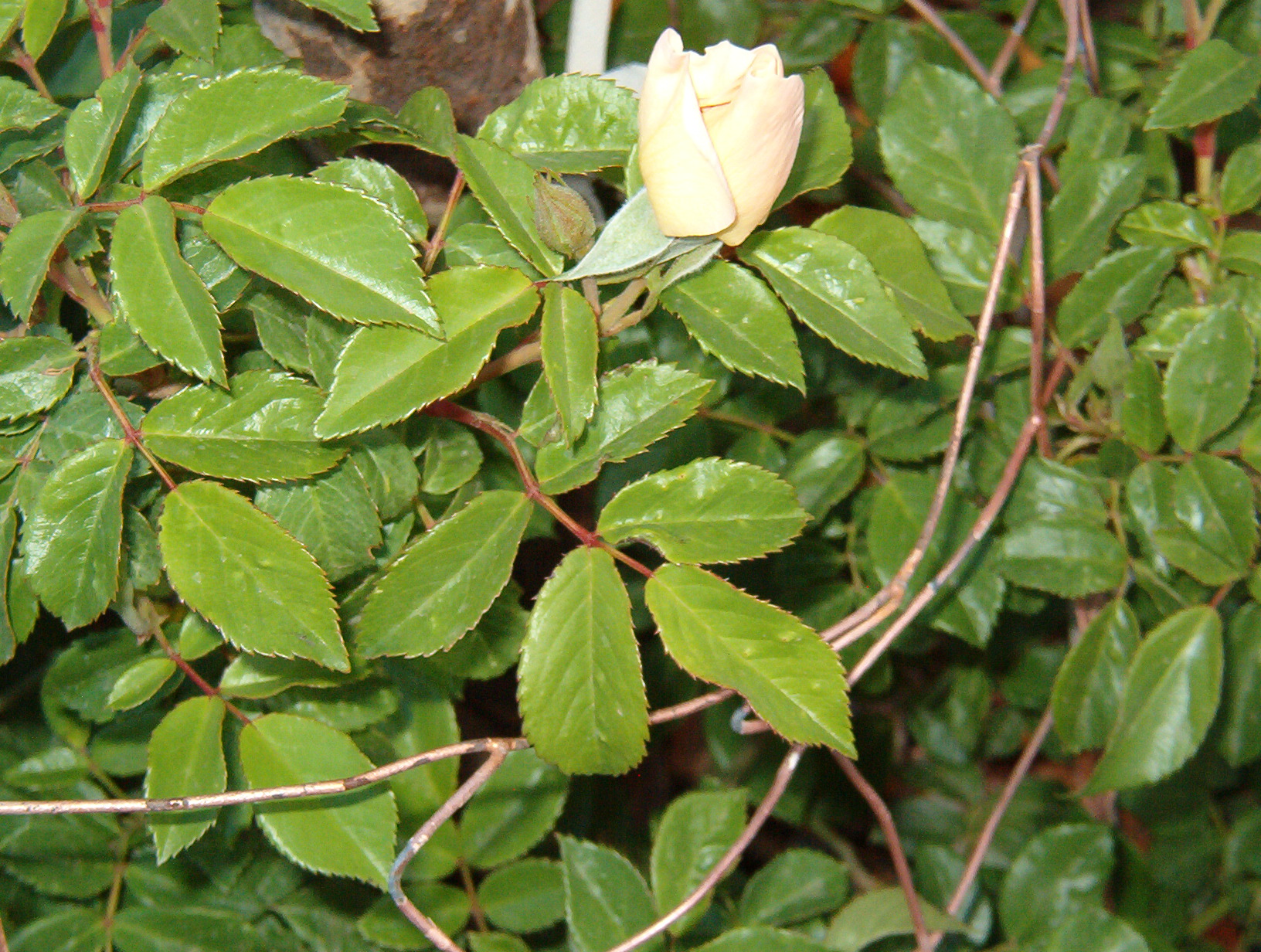

I think about all the rest of creation, but when my thoughts wander to the realm of the species of man my thoughts begin to follow a different course.  Spiritually it is the race of humankind that is unique in all of our Creator’s vision and intention.  To humankind has been given options as to how we behave and what we do because we have been given free will and the power to make choices that this simple rose – and all other creation – have not been given.

All the other forms of creation are true to their ‘mission’ in life.  They all fulfill their destiny.  And yet this rose will always be subject to the conditions of the environment that it lives in.  Good environment that meets its needs = great flowers.  Bad environment that does not meet its needs = degrees of disintegration and death.

++

Of course because this blog and my writings are concerned with the consequences of severe infant-childhood abuse and trauma, I think about my abuse perpetrator (my mother with my father’s cooperation) and about other perpetrators of abuse and harm upon others.  How did my mother continue to choose to act the way that she did against me?  Did she have a choice?  Could she have chosen to act differently – and BETTER?

++

According to the Teachings of the Baha’i Faith it is only the human race that has been given free will and the power of conscious choice.  This can happen because of all creation humans have two dual natures:  One is our mammal-animal nature and the other is our spiritual-soul nature.  When humans do ‘good’ we are choosing to operate with our higher spiritual nature.  When humans do ‘bad’ we are choosing to operate with our lower animal nature.

When I think about Trauma Altered Development that changes the way a traumatized, maltreated infant-child physiologically forms its body-brain (no choice on this matter) I understand that the altered development happens in direct response to the overwhelming stressful challenges of its earliest harmful environment.  These changes, because they happen IN THE BODY and to the body absolutely affect how an individual experiences its entire life.

I believe that there are degrees of change that automatically affect a survivor’s range of free will-choices because the body-brain itself has been prepared for primarily one thing:  Physical survival in an incredibly hostile world AT ALL COSTS.  Unless and until such a biologically programmed person can achieve a stance of truthfulness about what happened to them that changed their physiological development in the first place, and about how those changes affect how they live their life with every passing moment in time and space, it is the ‘lower’ or animal side of their nature that will govern their life.

Rules of GOOD do not rule this animal side of our nature.  All that is GOOD belongs to and comes from the spiritual realm of existence.  When the GOOD is missing – well, humans are capable of doing BAD that is nearly beyond imagination.  Here enters the concept of  ‘evil’ as it manifests the absence of GOOD – or higher human nature qualities.

++

It strikes me that these passages I mentioned above are making clear that the ONLY starting place for any of us to begin to examine how we live in relationship to how our Creator wants us to live happens at the point where we allow truthfulness – itself being a primary spiritual quality – to enter into our consciousness.  I can say without any question that my mother lacked the ability to do this.  Her truth existed in her altered vision and experience of reality.  According to HER version of reality everything that she ever did was RIGHT.  Her body-brain had not formed in such a way that she could detect, let alone experience, any other version of reality.

++

Harshness in the early environment of a rose is not going to turn it into a mean and dangerous creation.  Harshness in the early environment of a human being can – and does – do this.  While it is certainly possible that people who were given an excellent infant-childhood can make incredibly harmful choices and decisions, my concern will always primarily be with people who make those decisions because their biology was changed in their earliest development that caused them – on their deepest levels – to become nothing more than a single-point-of-focus I-will-survive-at-any-cost BODY of a human being.

Here I entertain the thought that it then becomes the responsibility of the society people live within to find the truth about Trauma Altered Development and then to act on it in a responsible and GOOD way.  Education and intervention from the outside not only CAN begin to bring the light of truth into the lives of trauma-altered people – it WILL bring it.

NOBODY ever brought the light of truth to bear upon my mother’s life – EVER.

Some people (perhaps many) do not believe that there is such a thing as ‘truth’.  Instead they might say “Everything is relative.”  I believe there is TRUTH and that it is described for humans by God.  Because ‘religion’ has always been progressive over time, and God has sent us ‘Messengers’ over time that have described both the enduring Truth and the age-appropriate instructions for living our lives, it has always been humankind’s choice to listen-follow-obey or not to.

But I see from my perspective that there ARE exceptions along the range of ability to know ‘the truth’ that stem directly from trauma alterations to physiological development that change a body-brain so that it knows and responds to the oldest biological imperative that there is:  I will survive at all costs.

This is, fundamentally, what my mother did.  How her biological imperative came to include all but destroying me – I believe – can truthfully and accurately be explained, described and understood.  I do not believe it is a mystery that defies explanation.  While I still struggle about coming to my own definite conclusion about how I feel about my mother, neither have I wavered in my 59 years of life from making a pretty good guess that my mother did not have any other choice but to act the way that she did BECAUSE nobody on the outside intervened.

+++++++++++++++++++++++++

Humans are always engaged in ‘building up’ or in ‘sinking down’ – either to our higher spiritual nature or to our lower animal nature.  In cases like my mother’s her instinctual animal survival BODY had such power over her that what should have been her more highly evolved options did not exist for her.

There is only one place I can go in my thinking when I think about my mother because I believe it is within this realm of ‘mothers who kill their children’ that my mother’s truest biological trauma-altered in their earliest physiological development kin would be found.  The fact that this is a grim picture of possible reality does not make it any less true – or real.

++

Mothers Who Kill By Mark Gado

Women Who Kill Their Children — 11 Women Are on Death Row for Killing Their Kids By Charles Montaldo, About.com Guide

Mother Kills Son And Daughter For Being ‘Mouthy’ By TAMARA LUSH

Child Murder by Mothers: A Critical Analysis of the Current State of Knowledge and a Research Agenda By Susan Hatters Friedman, M.D., Sarah McCue Horwitz, Ph.D., and Phillip J. Resnick, M.D.

When Parents Kill — Why fathers do it. Why mothers do it. By Dahlia Lithwick

Parents Who Murder

++

From my point of view, and in the interest of what is most likely the truth, every parent who kills (and those who severely abuse infants and children) suffered from trauma altered development so that their physiology was drastically changed.  I have do doubt that if my mother could have ‘gotten away with it’ that she would have killed me (except she also needed me alive to work her own ‘troubles’ out on!).

What matters to me is that society at large has the obligation – and it is a spiritual one – to discover the truth about how early severe infant-child maltreatment operates in tandem with biological mandates for survival to create human beings who live in a different reality than ‘ordinary’ or ‘normal’ that other people live in.  Their reality IS ordinary and normal TO THEM because their trauma-changed body-brain says that it is.

I will never waste my time to read anything anyone says about parents who murder their children because I already know that in nearly all cases the evolutionary power to change the development of such a person during their own malevolent early years will not be included in these considerations – therefore the truth is being left out.  It is ONLY by considering the information presented by researchers such as Dr. Martin Teicher that the truth can be known about terrible parents.

If we do not choose to consider the facts as they are becoming known about Trauma Altered Development and the degrees of changes it creates in a growing body-brain during especially the first 33 months of life we are choosing to participate in the lie rather than the truth.  I choose not to walk down the pathway of ignorance.  It does not lead to the goodness I wish for myself – or for the larger world I am a part of.

Biologically programming a human being for survival-at-all-costs in the worst of worlds has devastating consequences for many survivors of this process.  This is what happened to my mother.

+++++++++++++++++++++++++++++++++++++++++++

+WHAT I DON’T WANT TO SAY ABOUT BEING IN LOVE

+++++++++++++++++++++++++++++++++++

I am going to write this post this morning – because I don’t want to.  I mean, I REALLY don’t want to!  The truth of the matter is that I am deeply in love with a man that is most likely suffering from Narcissistic Personality Disorder (NPD).  Being in love with this man for the past 11 years, and remaining in love with this man – no matter what – has of course allowed suffering in the present to merge powerfully with all the suffering I know from the past.  And yes, being raised as the central target of my Borderline Personality Disordered mother severe abuse for the first 18 years of my life has no doubt vastly contributed to this ‘predicament’ I remain in.

It is very hard for me to approach this target without feeling greatly ashamed of myself!  It is very hard for me to ‘let myself off of the hook’ – in any way – regarding this matter.  I obviously have not extricated myself emotionally from this mostly non-relationship.  I love this man – and that is that.  No amount of effort on my own behalf, no amount of intellectual propping myself up with the facts about myself (or about what I see in him) has lessened my insecure attachment to THIS man at all!

Someone very close to me simply tells me, “He lives entirely within a bubble of his own making.”  Looking at this fact head-on tells me she is exactly correct.

++

Research shows that NPD men seem most likely to target their rage at heterosexual women.  That this rage operates with manipulation based on a need to maintain ‘supremacy’ and control is not surprising.  That these kinds of patterns are very familiar to me from my own abusive history is not surprising, either.  That I have high tolerance to remain focused on this man DOES surprise me at the same time I feel this shame and disappointment in myself for being in love with my very own ‘specimen’ NPD man.

This article online is very clear about the patterns that are familiar to me and perhaps some of my readers:

Narcissistic Personality Disorder – How to Recognize a Narcissist

Are you in a relationship with a narcissist?

In order to “qualify” as a narcissist, a person must meet some or all of the below criteria:

  • Inability to [display] empathy
  • Expects special treatment
  • Feeling of entitlement
  • Inability to admit that he or she is wrong
  • Inability to receive criticism
  • Unexpected, strong bursts of rage in situations that would not trigger rage in normal people. There aggressive outbursts are referred to as narcissistic rage.
  • Does not react to tears. If other person starts crying due to the cruel behavior of a narcissist, that may even aggravate the rage of a narcissist
  • Perceives oneself as omnipotent, superior individual
  • Strong need for admiration. Admiration serves as a form of a narcissistic supply. Without sufficient amount of narcissistic supply a narcissist feels empty and unsatisfied. A narcissist is like a drug addict, and narcissistic supply in its different forms is the drug.
  • Is often envious and mocks other people (often behind their back)
  • In the beginning of the relationship idealizes one’s partner and often talks about supreme, never-ending love. However as the relationship proceeds a narcissist often withdraws his or her attention and may become cold and uncaring, even cruel.
  • Is often untruthful and due to this often ends up cheating in a relationship. Cheating is often a consequence of other traits of a narcissist, such as the feeling of entitlement (it is impossible for a narcissist to do anything wrong and so a narcissist does not perceive cheating to be a huge “crime”), inability to emphasize with the cheated partner and the need for admiration (narcissistic supply).
  • Double standards: A narcissist twists the rules so that they fit to the current needs of a narcissist. For example, if the spouse of a narcissist is cheating on a narcissist, the spouse is considered to be dishonest and bad person, whereas if a narcissist is cheating it is not wrong, because a narcissist simply “fell in love” and followed his or her heart. Double standards also apply to other areas in life.

Read more HERE

++

This man I love has himself very grounded in the material world (and does not display overt rage).  Whatever ‘grandiosity’ he displays happens in ways that only those people closest to him are truly exposed to.  Most of what ‘the public’ can see seems perhaps over-the-top in terms of ‘ego’ expression, but not beyond ‘reason’.  In the end this man most likely shares patterns of Trauma Altered Development caused by early infant-child neglect/abuse/trauma/maltreatment like I do.

A child who grows up in a disturbed home may enter the adult world emotionally injured. Without having developed strong bonds, he is self-absorbed and indifferent to others. The lack of consistent discipline [abuse is not consistent discipline] results in little regard for rules and delayed gratification. He lacks appropriate role models and learns to use aggression to solve disputes. He fails to develop empathy and concern for those around him.”  Read more HERE

++

For all the information about NPD and the brain, for all the information that shows that NPD lies along the same Personality Disorder spectrum that Borderline does, for all the information that can show a link (in my opinion) between all the personality disorders and insecure attachment disorders, it is probably the information that talks about the development from early in childhood of the NPD person’s FALSE SELF that most helpfully gives me an opportunity to better understand how my own ‘dis-abilities’ operate in cooperation with this man’s.

Doing an online Google search for the terms narcissistic personality disorder false self leads to a host of pages that discuss this topic.  The first page of this search states:

Basics of Narcissistic Personality Disorder (NPD)

What is the false self?

The simple answer is it’s whatever the Narcissist wants it to be. In essence whatever mask they can use to hide the insecure and damaged part of themselves to obtain the narcissistic supplies they need to support an inflated view of themselves.

The more complex answer is that the false Self is a protection mechanism against attack from the outside world. The Narcissist may suspect that something is wrong in their make up but they choose not to investigate the source of their insecurities and fears, they deny their feelings because it would mean they are not perfect. They don’t want others to see their defects because if they are pointed out it casts doubt on the grandiose image they have of themselves. Hence the development of a false Self that they and others can respect, admire and “love”. This is what their childhood has taught them, if they always behave as expected people will perceive them as special. If they show them their faults they are not special and others will deny them their respect, admiration and “love“.

++

For all the information that exists about NPD, what matters most to me is that I believe I DO KNOW that the false self of this man (as with the false self that I still believe my BPD mother displayed throughout her lifetime which included unbelievable abuse of me) is NOT the true self.  It is the true self that I have been especially formed to be able to detect – and evidently to love.

The pain I experienced (and still do to degrees) because of my emotional involvement with NPD stimulated me to begin my own search into the truth of my own Trauma Altered Development nearly 8 years ago.  What I understand today is that my own insecure attachment system is NEVER turned off – and it is the operation of my continually activated insecurely attached OWN body-self (to put this most imply) that creates my pain – NOT this man and not my affection for him.

The other significant contributing factor to this whole picture for me is that I believe that while all people who have a Dismissive-Avoidant insecure attachment do NOT develop NPD, I am willing to bet that all people with NPD do have this form-pattern of insecure attachment – AS DID MY FATHER.  Interacting with a Dismissive-Avoidant insecurely attached man is therefore very familiar to me.

++

I simply know that the fact that I will never live with a man I am not married to (and this man will never marry again and does have a live-in woman) I am spared from the major impact of NPD.  At the same time I very much remain ‘in the learning ground’ about my own self related to my great – and very true – affections for this man.  All my difficulties that I experience are my own.  I do not hold him responsible for any of them.

To continue my own growth and development I DO need to work toward finding out my own truth, no matter how difficult that might be.  Being able to accept myself (and him) without shame-filled condemnation is a part of this process.  Writing this post is a step in that direction.

+++++++++++++++++++++++++++++++++++

+INSECURE DISMISSIVE-AVOIDANT MOTHERS – THEIR BRAIN OPERATES DIFFERENTLY IN RESPONSE TO THEIR BABY

+++++++++++++++++++++++++++++++

Insecurely attached dismissive-avoidant mothers’ brains show differences in how they respond to their babies. I found a slideshow online with lots of pictures and diagrams called The Neurobiology of Mother-Infant Attachment.  Once I had the page open and my cursor placed on top of it, I simply used the roller between the buttons on my computer’s mouse to scroll through all this visual information and its accompanying captions to ‘get a picture’ of what the differences look like within the brain of a securely attached mother of an infant and the brain of an insecurely attached dismissive-avoidant mother’s brain looks like as they interact with facial cues from their infant.

I was curious about who exactly put this remarkable informative slideshow together, so continued my online search until I found a leaflet featuring a workshop on this same topic that was held in London March 3, 210.  The slideshow matches.  All of this is the work of Dr. Lane Strathearn, a developmental pediatrician working in Houston, Texas.

++

Oh, MY!  What a range of research listings appeared on my computer screen when I Googled this doctor’s name!  (This was my mother — who DELIGHTED in my suffering from the moment I was born!)  The first one that catches my eye is this one reported on FOX News Thursday, August 27, 2009:

Study: Crying Baby ‘Natural High’ for Some Moms

A screaming, crying baby is not usually a source of enjoyment for new mothers, but a recent study has found that some moms actually get a “natural high” when faced with their crying infant.

The study, which looked in the cause of maternal neglect, involved 30 first-time mothers. Researchers studied their brain activity as they were shown photos of their newborns, with various facial expressions.

The researchers also looked at the factors related to the new mothers own upbringing, including how “secure” their attachment was to parents and careers.

“For mothers with a secure attachment, we found that both happy and sad infant faces produced a reward signal in their brain, or a ‘natural high’,” said Dr. Lane Strathearn of University of Queensland in Australia.

“However, mothers with an insecure attachment pattern didn’t show the same brain response … their own infant’s crying face activated the insula, a brain region associated with unfairness, pain or disgust.”

Moms found as having a secure attachment in childhood showed a greater release of the hormone oxytocin into their bloodstream, according to the report.”

Click here to read more from AAP.

++
I am reminded of this post:  +HOOKED ON ‘D’ SMILES – THE HAPPINESS CENTER

And about all the others that I wrote about the genuine smile:  Follow this to blog posts

++

This link follows to an article that mentions exactly what my daughter and I have been thinking about regarding the writing of ‘our book’ about my childhood.  We cannot consider secure and insecure attachments and the conditions that create them without looking for our answers in the bigger picture – that really shows us what the society is like that creates the individuals that are its members.

University of Queensland – UQ research finds the mum-bub bond may reduce neglect

UQ researcher Dr Lane Strathearn sees strengthening the bond between mother and baby as a possible way of reducing childhood neglect.

Dr Strathearn’s recently completed PhD identifies how increased pressures placed on mothers by society have reduced the perceived importance of raising children.

“Over the past decade we have seen dramatic changes in the social landscape in which our children are raised, with increasing demands on mothers in particular to balance raising a family with providing an income and meeting educational and career-related demands,” Dr Strathearn said.

“I feel that the basic needs of children have fallen lower and lower on the priority list of families and society, with physical or emotional neglect often the unfortunate result.

“This study emphasises the need to address the basic, universal needs of children, and stresses the importance of this early mother-infant relationship.

Strengthening this crucial relationship may help to prevent some of the long term consequences of neglect that we are seeing more commonly today, such as delinquency, crime, developmental delay and psychiatric disorders.”

A father of seven, Dr Strathearn grew up in Redcliffe, studied medicine at UQ and completed paediatric training at the Brisbane Mater Children’s Hospital, before heading to the US in 2001.

Now based at Baylor College of Medicine, Texas, he still has close ties to Brisbane, with his PhD completed through UQ’s School of Medicine.

Spanning nine years and drawing upon large longitudinal studies based in Brisbane and brain imaging data collected in Houston, Dr Strathearn’s research aimed to develop a better understanding of the pervasive problem of child neglect.”  READ ARTICLE HERE

++

There seems to be no scientific doubt that emotional neglect creates insecure dismissive-avoidant attachment.

+++++++++++++++++++++++++++++++

+THOUGHTS – INCLUDING DISMISSIVE-AVOIDANT INSECURE ATTACHMENT DISORDER

+++++++++++++++++++

Before I remove myself from my writing again for this upcoming week during which I will again go sit in the office of my friend to cover for her while she is on vacation, I want to say a few more things.

First, as I wrote my previous post I hit the ‘level of truth’ for myself for the first time in my life where I could make the connection inside of myself that allowed me to honestly and truthfully say, “I love my mother.”  That is not an insignificant step for me, and is one I will be able to appreciate as a useful tool when it is time for me to go ‘back there’ to retrieve my childhood abuse story.

The next comment I want to make has to do with my childhood stories as I have already written them (available here with some digging around through the links:  +DEVIL’S CHILD – My Childhood.)  As I just told my daughter in our telephone conversation, my ‘stories’ are nothing more than dissociated, discontinuous vignettes that exist not unlike letters of the alphabet or individual musical notes that have yet to be composed into a cohesive whole.

My mother’s insecure attachment disorder showed up in her incoherent life.  She could not tell a coherent life narrative, and she gave this disability to me.  My main motivation for spending the years that I did transcribing and ordering my mother’s papers was to create a linear time line that I needed to begin to place my own childhood experiences in a linear line, also.

The other comment I wanted to write concerns my father.  At least NOW I know I have hit the point within my own self where I am clear how I love my mother.  I love her as I described in my previous post.  But I have not reached that level with my father.

When it comes to thinking about, describing and feeling emotions, I always have a sideline running in the background concerning my father.  I think about the dismissive-avoidant insecure attachment disorder patterns as researchers are now being able to actually see them operate through visually watching the brains of such people.

Researchers can watch how some brains create in effect a firewall that leaves actual emotions as they ARE triggered in the body completely out of conscious awareness.  Researchers can see the emotion being experienced in the brain AND at the same time be screened from a person so that they do not know they are even there — AT ALL.  The brain is consuming massive amounts of energy during this screening process, and these ‘brain-holders’ never know it.

There are specific early caregiver-to-infant interactions that create these brains from birth to age one.  These changed brains are intimately connected to the changed nervous system and body of their ‘holders’.  Being cared for by unresponsive, unemotional, cold, depressed and ‘blank-faced’ caregivers are some of the ways these dismissive-avoidant brains are created in infants from the beginning.

These same infants, had they been interacted with by securely attached and appropriate-adequate early caregivers would have developed entirely different brains.  My father was an unwanted infant born to an unwilling and depressed mother, raised by his teenage sister primarily who was not caring or nurturing.  In the end, my father’s dismissive-avoidant insecurely attached brain worked very well on his behalf as he could NOT FEEL — did not HAVE to feel — and hence could ignore what he NEEDED to pay attention to and react to appropriately.

I have an important person I care deeply about who I believe also has a dismissive-avoidant insecure attachment disorder, and I can see how easily this pattern fits with Narcissistic Personality Disorder.  Very nicely indeed.  The fact is that people who fit into this range can most often manage to get along just fine — but have extremely limited (if any) ability to FEEL and therefore to CARE how others feel, either.  It would be easy to call them ‘intimacy disabled’.

Sometimes given the intensity of my emotions and my difficulties with them, I find myself tempted to envy these people for their cool, unemotional detachment.  I then remind myself that to miss out on FEELING is to miss out on the entire color range of being alive.  I also remind myself of the dangers of living without feelings — they have a purpose just as our physical body needs to feel its way through life, and to NOT be able to feel puts a person dangerously close (in my mind) to being ‘sociopathic’ — and therefore dangerous!  It is not a good thing to NEED anything from these people.

And it is a sure thing that any infant born to its earliest caregiver with a dismissive-avoidant insecure attachment is going to have that same brain downloaded into their own forming brain — UNLESS there is another strong influence by another early caregiver who is safely and securely attached and therefore has a brain that operates with feelings included.

*Note:  People with the other insecure attachment disorders of preoccupied and disorganized-disoriented tend to be attracted to those with dismissive-avoidant because they know these people will not overwhelm them emotionally.

+++++++++++++++++++

+’DIS-ASSOCIATION’ BETWEEN RIGHT-LEFT BRAIN HEMISPHERES AND DISMISSIVE-AVOIDANT INSECURE ATTACHMENT DISORDERS

+++++++++++++++++++++++++++++

Dr. Daniel Siegel, in his book The Developing Mind: How Relationships and the Brain Interact to Shape Who We Are (2001), describes how “dis-associated hemispheric processing” between our left and right human brain regions each contribute to differently as he describes in what he calls a “laterality-attachment hypothesis.”  This hypothesis seems to be particularly related to what attachment experts refer to as ‘dismissive-avoidant’ insecure attachment disorders (one I suspect my father had and ‘got’ from his depressed mother).

In this post I am presenting some of Siegel’s creative and thought provoking ideas on the subject:

“Patterns of representations differ markedly between the left and right halves of the brain.  An important distinction, often underrecognized within the fields of clinical psychiatry and psychology, is the distinction between the modes of representation within the two hemispheres of the brain.  The left hemisphere has been described as having a logical “interpreter” function that uses syllogistic reasoning to deduce cause-effect relationships from the representational data it has available to it.  The right hemisphere specializes in the representation of context and of mentalizing capacities.  It is therefore uniquely capable of registering and expressing affective facial expressions, developing a “theory of mind,” registering and regulating the state of the body, and having autobiographical representations.

“How are these bilateral processes relevant to relationships?  Communication is crucial in establishing neural connections early in life and involves the sharing of energy and information.  Levels of arousal (energy) and mental representations (information) are very different on each side of the brain.  The sharing of arousal and representations from one brain to another — the essence of connecting minds — will thus differ between the hemispheres.  One can propose, in fact, that the right brain perceives the output of the right brain of another person, whereas the left brain perceives the left brain’s output.

“In intimate, emotional relationships, such as friendship, romance, parent-child pairs, psychotherapy, and teacher-student dyads, what does this look like?  The left brain sends out language-based, logical, sequential interpreting statements that attempt to make sense of things [in a particular way].  The left brain receives these messages, decodes the linguistic representations, and tries to make sense out of these newly arrived digital symbols.  At the same time, the right brain is sending nonverbal messages via facial expressions, gestures, prosody [the music of speech], and tone of voice, which are perceived by the other’s [sic] right brain.  OK.  So what?

“The “what” of it is that the right brain takes this information and uses its social perceptions of nonverbal communication to engage directly in a few very important processes.

— It creates an image of the other’s [sic] mind (“mindsight”).

— It regulates bodily response while at the same time registering the somatic [body-based] markers of shifts in bodily state.

— It creates autobiographical representations within memory.

— It appraises the meaning of these events and directly affects the degree of arousal, thus creating primary emotional responses.  Intense and primary emotional states are therefore likely to be mediated via the right hemisphere.”

“When we examine these findings alongside the independent set of data from attachment research, certain patterns are suggested.  The early affect attunement and alignment of mental states can be seen as a mutually regulated hemisphere-to-hemisphere coordination between child and parent.  In this view, we can propose that avoidant attachment involves a serious lack of this form of communication between the right hemispheres of child and parent.  The extension of this finding to laterality research raises the possibility that the left hemisphere serves as the dominant mediator of communication between an avoidant child and a dismissing parent.

“In support of this perspective, it turns out that in 1989, [attachment experts] Main and Hesse examined exactly this hypothesis in two large-scale samples of Berkeley undergraduates, each of whom were asked about their degree of right (or left) handedness, as a rough approximation of brain dominance….  At the same time, Main and Hesse had devised a set of self-report items that they considered indicative of a “dismissing” state of mind.  Although this type of scale was not ultimately able to predict AAI [Adult Attachment Interview] classifications [of attachment styles] statistically, and therefore these findings were never published, in keeping with the hypothesis both studies found that the degree of right handedness was significantly correlated with elevated scores of the scale for “dismissing” state of mind.

“Further extensions of these ideas to relationships allow us to look more deeply into why certain couples may be “unable to communicate” with any emotional satisfaction.  When we know about the different languages of the right and left hemispheres, it is possible to make hypotheses  about why interactions may be frustrating:  Individuals may not know how to understand the particular language being expressed by their significant others.  If we then integrate past attachment history in understanding the pattern of these difficulties, it is possible to create a framework of understanding that can help the partners in such relationships escape their well-worn ruts.   [My note:  I would think parents, as well, would benefit so that the intergenerational transmission of dismissive-avoidant insecure attachment patterns could be eliminated.]

“If this laterality-attachment hypothesis is correct, then a logical implication would be that any experiences that help to develop the processing abilities of each hemisphere and/or the integrated activities of the two hemispheres may improve certain individuals’ internal and interpersonal lives.  Such movement toward more coordinated interhemispheric functioning would be quite welcomed by many people (especially the lonely and frustrated spouses [and I would say infant-children0 of dismissing individuals).

“The developmental and experiential histories that have led to a lack of integration of the functioning of the two hemispheres may leave individuals vulnerable to emotional and social problems.  Unresolved trauma and grief, histories of emotional neglect, and restrictive adaptations may each represent some form of constriction in the flow of information processing between the hemispheres.  This proposal of the central role of the dis-associated hemispheric processing in emotional disturbances is supported by the finding that insecure attachments in childhood may establish a vulnerability to psychological dysfunction.

“Emotional relationships that enhance the development of each hemisphere and its unrestricted integration with the activity of the other can thus be proposed to be likely to foster the development of psychological well-being.  In this way, a secure attachment can be seen as a developmental relationship that provides for an integration of functioning of the two hemispheres, both between child and caregiver and within the child’s own brain.

“At the most basic level, right-hemisphere-to-right-hemisphere communication can be seen within the affectively attuned communications that allow for primary emotional states to be shared via nonverbal signals. Left-hemisphere-to-left-hemisphere alignment can be seen in shared attention to objects in the world.  Reflective dialogues, in which language is used to focus attention on the mental states of others (including the two members of the dyad), may foster bilateral integration between the two hemispheres of both child and parent.  The resilience of secure attachments can thus be proposed as founded in part in the bilateral integration that these relationships foster.”  (pages 205-207 – all bold type is mine)

++++++++++++++++++++++++++++++

+A WORD ON TRAUMA TRIGGERS AND FALLING APART

+++++++++++++++++++++++

Have you ever played the Jenga Stacking Game?  Have you ever felt so emotionally and mentally fragile that if even one block of what gives you calmness and stability is removed that you and your life will topple into a pile of rubble?  It is far too easy for severe infant-childhood trauma and abuse survivors to stumble and crumble if our inner and outer resources are at times not adequate to meet the unforeseen challenges of our adult lives.  We need to anticipate events that might trigger our trauma overload reactions ahead of time if we possibly can.

I’ve never played this game, but my sister brought the image of it up tonight in our telephone conversation about the life long consequences of living within a body that was built in childhood by trauma.  Players are supposed to pull blocks out of the stack with care without toppling the tower.  My sister was talking about how fragile infant-child trauma survivors really are, and about how we have to be so very careful when changes have to be made in our lives not to topple over whatever precarious sense of safety and security we might have constructed within our lives.

I am thinking again about the image I posted yesterday:

I have no idea how life is for people who were not abused as children.  From my point of view as a survivor, finding ways to fill the positive side of this scale is a full time job.

I also want to note that as hard as I try to be in my posts about the possibilities and opportunities we can find for healing, trauma survivors have to ALWAYS be realistic.  When the trauma side of the scale is overloaded, and when our body-brain formed within these terrible conditions, not only is our center point not set at calm and balanced equilibrium in our body-nervous system, but terrible pain and suffering is also built into us.

We need to know, identify, understand and recognize not only the factors in our lives that trigger our pain, but also the signs that we are being triggered and are in danger of melt-down.  We need to know the nature of our woundedness.  Because of the unsafe and insecure attachment experiences we had as our body-brain formed, we can think of our vulnerabilities to threats to our present safe and secure attachment to and in the world as if we have a severe, deadly allergy that if triggered without adequate resources to combat our reaction can destroy us.

If and when we reach a point where our full-blown trauma reactions have been triggered, we are in a state of emergency that is every bit as life threatening as any other kind we can imagine.  The emergencies happen to us when in-built, body-brain based infant-childhood traumas (or any other unresolved, overwhelming traumas) emerge beyond what we have the inner and outer resources to handle, regulate and resolve.  We need to learn how to avoid, if at all possible, reaching these critical states because once we do reach them, we will be caught within what is, for severe trauma survivors, a reaction that is as completely understandable and natural for our body-brain as it CAN be predictable.

As we begin to understand how trauma built our physiology we begin to realize that we have to be as careful as possible to not topple our internal tower.  Not only did our emotional right brain not receive what it needed so that we can smoothly and easily regulate our emotional states, but our emotions were overloaded early in our lives.  These emotions for the most part have gone NOWHERE.  They remain in our body and can overwhelm us in our present life when stress, threat, danger and trauma threaten us just as they did when we were very small.

I remember years ago telling someone that if I ever (so-called) “got in touch with my pain” that I would start crying and never stop.  I knew there was an ocean of tears inside of me.  One time I got myself into a relationship with a man — well, skipping the story — I will just say that the relationship patterns triggered my insecure attachment patterns.  I of course did not know this.  At one point my ancient infant-childhood emotions caused by my severely traumatic childhood exploded through a fissure created in my present within this relationship.

I started crying.  I could not stop crying.  I cried for three weeks.   I cried myself to sleep.  I woke up crying and I could not stop.  (Talk about puffy, sore eyes!)  I fortunately had many close women friends at that time in my life.  One by one they came to visit me, sitting beside me on my bed, stroking my back, patting my hand, bringing me and my children food.  I could not talk about the pain, I could only cry it out and it took a long time for this pain outbreak to begin to diminish.

I do everything I possibly can in my life today to avoid that precipice.  I cannot afford to let the depth of my pain overwhelm me again if I can possibly help it.  That kind of crying is like having an emotional jugular vein sliced wide open.  We can hemorrhage tears like we are imploding and bleeding to death.

As I have written about the chemical that signals our body that we are in pain — Substance P.  Pain, the physiological signaling of it and the experience of the pain itself,  is equally as real for emotional pain as it is for any physical pain.

We cannot afford to allow this pain we carry to be triggered if we can find any way to avoid it.  We need to realize our well-being is at best precarious.  We need to realize that a proactive consideration about how to make changes in our lives, especially major ones, can mean the difference between life and death.  We have to understand that there are times when our inner resources will not be available to match the demands of situations that stress and distress us.

No matter what else happened to us, our deepest and truest childhood trauma, at its core, was our lack of safe and secure attachment at the time of our beginnings.  We have to remember that child trauma survivors who were deprived of the benefits of safe and secure early attachments that would have built a well-regulated emotional right brain translate stress immediately into distress on occasions in adulthood when their safety and security is threatened.

These threats can be caused by such things as change in relationship status including loss and absence of loved ones (including ’empty nest’), threat of loss and of actual loss of financial security including job loss and change, moves, sickness — you name it, anything that makes our precarious tower of safety tremble if not collapse.

Even though these types of situations might not seem to be directly related to our infant-childhood traumas, we need to realize that anything that threatens our degree of safety and security is a trauma trigger because we did not escape our earliest trauma with a strong sense of safety and security built into us as it should have been.  It is also important to realize that some people will react violently, radically and drastically to threat that triggers pain, loss and sadness because they CAN come up with ways to escape the experience of their own pain (dismiss-avoid and/or fight back actively or passively).

These people cannot tolerate the experience of their own childhood pain and will defend themselves against it (often true of men but also true for my mother).  These people will protect and defend themselves first, and anyone dependent upon them is at risk for some kind of harm.  All trauma reactions are un-reason-able because they are automatic and come directly from body memory connected to an unregulated right emotional brain and trauma built nervous system.  Our body-brain does not process threat or stress information ‘normally’ in a way that includes the slower reason-able processes of the higher cortex.

At those times that circumstances of our life threaten to or actually trigger the pain of our deepest traumas, we can so lose our sense of safety and security, of calm, peacefulness and connection in the present that our self seems to completely disappear.  We can become overcome and overwhelmed with the physiological experience of our body, including its emotions.  In this maelstrom it is critical that we find ways to reestablish the anti-distress, anti-trauma conditions that support and affirm our SELF so that we can regain the functions of our higher cortex as we find ways to address the conditions that triggered the severe trauma reactions in the first place.

As my sister mentioned tonight, we need to be careful not to topple the tower of our lives if we can possibly avoid it.  If we have found ways to begin to fill up the un-stressed side of our inner selves, the sense of balance we might be able to finally feel in our lives MUST be maintained.  Our life can depend on it.

We need to understand what our trauma triggers are so we can avoid inner disaster.  The threat and the danger of crumbling inside is very, very real and I do not believe we can survive it without supportive and appropriate help from others.  (So few of us can access the kind of quality therapy we need that I can’t even consider therapy a realistic resource.)

I believe that human beings are more than the sum of our parts.  We are more than the automatic physiological reactions that our body creates in response to threat and trauma in our lives.  We most need to find a way to connect with our own sense of our strong, clear SELF at those times that we experience our ‘falling apart’.  Of course proactive prevention is best for us, but when our trauma is triggered knowing that we are able to accomplish this critical action of regaining our own SELF in the midst of the storm empowers and heals us beyond words.

PLEASE NOTE:  The experience of severe and overwhelming emotion that is related to right limbic brain sensitivity, irritability and lack of adequate ability to regulate emotion — due to having been formed in early infant-childhood malevolent environments — not only FEELS like some kind of ‘seizure activity’, but actually IS closely related.  Please spend some time taking a look at some of the online information about emotional KINDLING in the right limbic brain and its connection to infant-child abuse.

Think of our emotional injuries affecting us like deep splinters and bad burns and other wounds do — all sharing the Substance P physiological pain signaling systems within our body-brain.  Severe infant-childhood trauma and abuse leaves us bruised and battered inside.  Even as we heal gradually over time, we will always still have scars.  Some of us have a broken heart that will never heal in this lifetime.  We have to try to be as gentle and kind to ourselves as we possibly can.

This process must include our being as aware as we can possibly be of what is coming down the road at us so we can be prepared to take wise and protective steps to take care of our self before we get overrun with the ongoing changes and traumas that everyone’s life is prone to.

++++++++++++++++++++++

+GREAT BOOK ABOUT THE BEST IN HUMANS

+++++++++++++++

My book Born to Be Good: The Science of a Meaningful Life – Paperback (Oct 5, 2009) by Dacher Keltner has arrived.  I am eagerly embarking on its study about what’s best about humans.  My insanely abusive Borderline mother sure didn’t teach me anything about THAT!

Keltner resides in the camp of study about positive human emotions.  Interestingly, researchers could not really study what has always been termed ‘happiness’ equally with the survival emotions such as fear and rage until technology invented photographic equipment that operates as fast as our face moves when we express emotion.

The more survival-based emergency related emotions happen in bigger ways so that we can watch them happen more easily than we can (could) watch expressions related to happiness and well-being.  Just as we needed really FAST photography to accurately be able to watch the visual information transmitted and received between infants and mothers (that build our earliest fundamental brain regions), we also needed it to see what happens when we treat one another well and with kindness.

(For an example of how the extremely rapid fraction-of-a-millisecond mother-infant communication takes place please scroll down to page 22 in Dr. Allan N. Schore’s paper, EFFECTS OF A SECURE ATTACHMENT RELATIONSHIP ON RIGHT BRAIN DEVELOPMENT, AFFECT REGULATION, AND INFANT MENTAL HEALTH)

++++

Humans are born with the capacity to experience emotion.  We simply live them without thinking about what they are, what they mean, or what they are named.  In safe and secure infant-childhood environments we are helped by our caregivers to gradually learn about our emotions as we learn about our self and others in the world.  Eventually we learn what emotions are named and about how to ever more effectively regulate them.

Because this ability to regulate and differentiate emotions happens within our earliest infant-child attachment relationship environment, the process is either assisted or interfered with by our caregivers.  In my own case, as I study Keltner’s book, I doubt I will be able to think about very many instances from my infant-childhood at all where I would have even been allowed to experience the positive emotional states.

I find it interesting that even in the field of vastly expensive scientific research that the differentiation of ‘happiness’ and the study of this state had to wait until technology caught up with our desire and need to better understand the happiness aspect of who we are.

Dr. Keltner is at the cutting-edge of this research.  His study happens because he can use the new lens of sophisticated super-stop action photography to see our human finely tuned happiness communications in the same way that evolution of the lens allowed us to see new aspects of our world through microscopes and telescopes.

++++

Keltner states about the study of happiness in the first chapter of his book:

“The canonical [orthodox] studies of human emotion, studies of the universality of facial expression, of how emotion is registered in the nervous system, how emotion shapes judgment and decision making, had never looked into these states.  The groundbreaking studies of emotion had only examined one state covered by the term “happiness.”  But research is often misled by “ordinary” language, the language we speak rather than the language of scientific theory.  Happiness is a diffuse term.  It masks important distinctions between emotions such as gratitude, awe, contentment, pride, love, compassion and desire – the focus of this book – as well as expressive behaviors such as teasing, touch, and laughter.  This narrow concentration on “happiness” has stunted our scientific understanding of the emotions that move people toward higher jen ratios.  By solely asking, “Am I happy?” we miss out on the many nuances of the meaningful life.

My hope is to shift what goes into the numerator of you jen ration, to bring into sharper focus the millisecond manifestations of human goodness.  I hope that you will see human behavior in a new light, the subtle cues of embarrassment, playful vocalizations, the visceral feelings of compassion, the sense of gratitude in another’s touch to your shoulder, that have been shaped by the seven million years of hominid evolution and that bring the good in others to completion.  In our pursuit of happiness we have lost sight of these essential emotions.  Our everyday conversations about happiness are filled withy references to sensory pleasure – delicious Australian wines, comfortable hotel beds, body tone produced by our exercise regimens.  What is missing is the language and practice of emotions like compassion, gratitude, amusement, and wonder.  My hope is to tilt your jen ratio to what the poet Percy Shelley describes as the great secret of morals:  “the identification of ourselves with the beautiful which exists in thought, action, or person, not our own.”  The key to this quest resides in the study of emotions long ignored by affective science.”  (pages 14-15)

++++

My mother was extremely short on jen, as are all people who outright neglect, abuse and maltreat people – infants and children most included.  My mother’s experiences in her own abusive childhood seemed to completely obliterate any ability she was born with to understand what ‘being good’ was all about.  Certainly it was my experience with her that she was never able to ‘be good’ to me and in fact she did not believe I even had the capacity to ‘be good’ myself.

In fact, my mother projected her own ‘badness’ that she found intolerable inside herself out onto me and proceeded to spend the 18 years of my childhood ‘punishing’ me for being ‘that bad’.  This process was, I believe, entirely connected to abuse in her own childhood as she had been told her ‘badness’ made her unlovable, but if she could only be ‘good enough’ she would be lovable and loved again.  Something became permanently broken in my mother’s early ‘good-bad’ early forming brain, and it made her into a monster.

Knowing this about my Borderline mother makes me very curious about Keltner’s book whose very title —  BORN TO BE GOOD — addresses the underlying conflicts my entire childhood was consumed with:  Evil versus Good versus Evil versus Good……..  Every interaction I had with my mother from the time I was born was in reality a communication from her to me about how essentially and fundamentally un-good and totally evil I was.

The extremes of my mother’s psychosis were so severe that she literally believed I was satan’s child and was not even born as a human being.  I was condemned beyond salvation, though my mother believed through every word and deed she abused me with that she was doing her very super-human best to save me as she battled to accomplish the impossible task of turning me into ‘something good’.

Keltner’s book is about the best in human social interactions.  I want to know more about this because I certainly have vast personal experience about what the worst in human social interactions can be like.  I want to improve my own ‘jen ratio’.  What might this mean?

By first translating the broad term ‘happiness’ into the broader term ‘goodness’, Keltner then describes the kinds of minute human interactions that both communicate goodness and build it into self and others.  The term “jen ratio” is the kingpin of his writing    About jen itself Keltner states:

“…Confucius taught a new way of finding the meaningful life through the cultivation of jen.  A person of jen, Confucius observes, “wishing to establish his own character, also establishes the character of others.”  A person of jen “brings the good things of others to completion and does not bring the bad things of others to completion.”  Jen is felt in that deeply satisfying moment when you bring out the goodness in others.

Jen science is based on its own microscopic observations of things not closely examined before.  Most centrally, it is founded on the study of emotions such as compassion, gratitude, awe, embarrassment, and amusement, emotions that transpire between people, bringing the good in each other to completion.  Jen science has examined new human languages [My note:  New to scientific study, ancient to humans] under its microscope – movements of muscles in the face that signal devotion, patterns of touch that signal appreciation, playful tones of the voice that transforms conflicts.  It brings into focus new substances that we are made of, neurotransmitters as well as regions of our nervous system that promote trust, caring, devotion, forgiveness, and play.  It reveals a new way of thinking about the evolution of human goodness, which requires revision of longstanding assumptions that we are solely wired to maximize desire, to compete, and to be vigilant to what is bad.

“The jen ratio is a lens onto the balance of good and bad in your life.  In the denominator of the jen ratio place recent actions in which someone has brought the bad in others to completion….  Above this, in the numerator of the ratio, tally up the actions that bring the good in others to completion….  As the value of your jen ratio rises, so too does the humanity of your world.

“Think of the jen ratio as a lens through which you might take stock of your attempt at living a meaningful life.”  (pages 3-5)

++++++++++++++++++

I haven’t seen these two words in Keltner’s book yet, hope and enthusiasm, but this is how I feel as I enter into this new journey.  For all my awarenesses about the differences between how my body-brain-mind-self was formed in comparison to others who benefited from having a safe and secure attachment foundation rather than one formed in, by and for trauma, I enthusiastically hope that by understanding how we ALL have a jen ration operating in our lives I can begin to make my own ration better.

I will keep you posted (literally!) about my experiences with the information contained within the pages of Keltner’s BORN TO BE GOOD book I was fortunate to discover!

+++++++++++++++

+21 RICH NATIONS COMPARED ON CHILD WELL-BEING – U.S. AND U.K. AT THE BOTTOM

++++++++++++++++

Please spend some time reading the UNICEF 2007 Report Card on six measurements of the well-being of children.  The United States and the United Kingdom have total scores at the bottom of the 21 OECD [Organization for Economic Co-operation and Development] industrialized nations included in this study (page 2).

While every measurement is extremely important, the one that is of greatest concern to me in regard to the well-being particularly of infants and very young children is the finding that the United States rates highest in the percentage of births per 1,000 women

ages 15-19.  See Report Card page 31, Figure 5.2f.

This report states this about teenage births:

For most girls growing up in an OECD country, the norm today is an extended education, a career, a two income household, delayed childbearing and a small family.   And it is in this context that teenage pregnancy has become a significant problem: giving birth at too young an age is now associated with wide ranging disadvantage for both mother and child – including a greater likelihood of dropping out of school, of having no or low qualifications, of being unemployed or low-paid, and of living in poor housing conditions.   But as always, association is not the same as cause.   Many girls who give birth in their teens have themselves grown up with the kind of poverty and disadvantage that would be likely to have negative consequences whether or not they wait until they are in their twenties before having children.  Becoming pregnant while still a teenager may make these problems worse, but not becoming pregnant will not make them go away.

Beyond the immediate problem, teenage fertility levels may also serve as an indicator of an aspect of young people’s lives that is otherwise hard to capture.  To a young person with little sense of current well-being – unhappy and perhaps mistreated at home, miserable and under-achieving at school, and with only an unskilled and low-paid job to look forward to – having a baby to love and be loved by, with a small income from benefits and a home of her own, may seem a more attractive option than the alternatives.   A teenager doing well at school and looking forward to an interesting and well-paid career, and who is surrounded by family and friends who have similarly high expectations, is likely to feel that giving birth would de-rail both present well-being and future hopes.

It is as an approximate measure of what proportion of teenagers fall on which side of this divide that the teenage fertility rates shown in Figure 5.2f may be an especially significant indicator of young people’s well-being.”

++++++++++++++++

I consider these findings also especially significant in light of this blog’s strong emphasis on the critical importance of safe and secure attachments as a foundation of body-brain-mind-self development of people.  Take a look at these findings.  The United States and the United Kingdom appear to be failing miserably on these measures of child well-being and are at the bottom of this combined initial attempt to measure attachment on the national level.

On page 22, Figure 4.0 shows young people’s family and peer relationships – and an OECD overview is presented in graphic form.  The Report states:  “The quality of children’s relationships is as difficult to measure as it is critical to well-being.  Nonetheless it was considered too important a factor to be omitted altogether and an attempt has therefore been made to measure the quality of ‘family and peer relationships’ using data on family structures, plus children’s own answers to survey questions.”

++++

Among the measurements on behaviors and risk-taking of young people presented beginning on page 26, Figure 5.0, the Report states:   “Any overview of children’s well-being must attempt to incorporate aspects of behaviour which are of concern to both young people themselves and to the society in which they live.   This section therefore brings together the available OECD data on such topics as obesity, substance abuse, violence, and sexual risk-taking.”

Again, the United States and the United Kingdom are at the very bottom in their total scores on these measurements.  Page 27, Figure 5.1 Overview — Children’s health behavior the United States is at the bottom.  Page 28, Figure 5.1d, the United States has the highest percentage of young people age 13 and 15 who report being overweight.    “…the EU [European Union] Health Commissioner has said:   “Today’s overweight teenagers are tomorrow’s heart attack victims”.”

“…in most countries young people’s health behaviours do not deviate very far from the average for the OECD as a whole.  The exceptions are Poland, where children’s health behaviours are considerably better than average, and the United States whose overall ranking suffers because of high levels of obesity.”

++++++++++++++++

The great majority of young people growing up in all OECD countries score themselves above the midpoint on the ‘life satisfaction ladder’.”  Fortunately, United States’ young people are among this majority (page 37).

An interesting observation in this section of the Report about student agreement with negative statements about personal well-being in regard to feeling ‘out of place’ comes from Japan (page 38):

The most striking individual result is the 30% of young people in Japan who agreed with the statement ‘I feel lonely’ – almost three times higher than the next highest-scoring country. Either this reflects a difficulty of translating the question into a different language and culture, or a problem meriting further investigation, or both.”

++++++++++++++++

From the Report Card:

The true measure of a nation’s standing is how well it attends to its children – their health and safety, their material security, their education and socialization, and their sense of being loved, valued, and included in the families and societies into which they are born.

++

When we attempt to measure children’s well-being what we really seek to know is whether children are adequately clothed and housed and fed and protected, whether their circumstances are such that they are likely to become all that they are capable of becoming, or whether they are disadvantaged in ways that make it difficult or impossible for them to participate fully in the life and opportunities of the world around them.   Above all we seek to know whether children feel loved, cherished, special and supported, within the family and community, and whether the family and community are being supported in this task by public policy and resources.

All families in OECD countries today are aware that childhood is being reshaped by forces whose mainspring is not necessarily the best interests of the child.   At the same time, a wide public in the OECD countries is becoming ever more aware that many of the corrosive social problems affecting the quality of life have their genesis in the changing ecology of childhood.   Many therefore feel that it is time to attempt to re-gain a degree of understanding, control and direction over what is happening to our children in their most vital, vulnerable years.

That process begins with measurement and monitoring. And it is as a contribution to that process that the Innocenti Research Centre has published this initial attempt at a multi-dimensional overview of child well-being in the countries of the OECD.”  (page 38)

++++

Any part of the Innocenti Report Card may be freely reproduced using the following reference:

UNICEF, Child poverty in perspective: An overview of child well-being in rich countries, Innocenti Report Card 7

2007 UNICEF Innocenti Research Centre, Florence. © The United Nations Children’s Fund, 2007

Full text and supporting documentation can be downloaded from the UNICEF Innocenti Research Centre website.

This Report Card provides a comprehensive assessment of the lives and well-being of children and young people in 21 nations of the industrialized world.   Its purpose is to encourage monitoring, to permit comparison, and to stimulate the discussion and development of policies to improve children’s lives.

The report represents a significant advance on previous titles in this series which have used income poverty as a proxy measure for overall child well-being in the OECD countries.   Specifically, it attempts to measure and compare child well-being under six different headings or dimensions: material well-being, health and safety, education, peer and family relationships, behaviours and risks, and young people’s own subjective sense of well-being.   In all, it draws upon 40 separate indicators relevant to children’s lives and children’s rights (see pages 42 to 45).

Although heavily dependent on the available data, this assessment is also guided by a concept of child well-being that is in turn guided by the United Nations Convention on the Rights of the Child…. The implied definition of child well-being that permeates the report is one that will also correspond to the views and the experience of a wide public.”

* The United Kingdom and the United States find themselves in the bottom third of the rankings for five of the six dimensions reviewed  [material well-being, health and safety, education, peer and family relationships, behaviors and risks, and young people’s subjective sense of their circumstances]

* There is no obvious relationship between levels of child well-being and GDP per capita.  The Czech Republic, for example, achieves a higher overall rank for child well-being than several much wealthier countries including France, Austria, the United States and the United Kingdom

+++++++++++++++++++++++++++++++++++++++++++

SEE ALSO – The United States has been taking internal measurements on our nation’s children’s well-being for over 30 years.

CHILD WELL-BEING STATISTICAL REPORT, SPECIFIC TO THE UNITED STATES:

The 2009 Foundation for Child Development — Child and Youth Well-being Index (CWI) Report

Children and youth live unique lives and as such, at some point, each experiences a range of social conditions.   The Index is comprised of Key Indicators associated with different stages of the life course in the first two decades of life.

The CWI includes the following 28 Key Indicators organized into seven domains of child well-being in the United States that have been found in numerous social science studies to be related to an overall sense of subjective well-being or satisfaction with life.

Family Economic Well-Being Domain

1. Poverty Rate (All Families with Children)

2. Secure Parental Employment Rate

3. Median Annual Income (All Families with Children)

4. Rate of Children with Health Insurance

Health Domain

1. Infant Mortality Rate

2. Low Birth Weight Rate

3. Mortality Rate (Ages 1-19)

4. Rate of Children with Very Good or Excellent Health (as reported by parents)

5. Rate of Children with Activity Limitations (as reported by parents)

6. Rate of Overweight Children and Adolescents (Ages 6-19)

Safety/Behavioral Domain

1. Teenage Birth Rate (Ages 10-17)

2. Rate of Violent Crime Victimization (Ages 12-19)

3. Rate of Violent Crime Offenders (Ages 12-17)

4. Rate of Cigarette Smoking (Grade 12)

5. Rate of Binge Alcohol Drinking (Grade 12)

6. Rate of Illicit Drug Use (Grade 12)

Educational Attainment Domain

1. Reading Test Scores (Ages 9, 13, and 17)

2. Mathematics Test Scores (Ages 9, 13, and 17)

Community Connectedness

1. Rate of Persons who have Received a High School Diploma (Ages 18-24)

2. Rate of Youths Not Working and Not in School (Ages 16-19)

3. Rate of Pre-Kindergarten Enrollment (Ages 3-4)

4. Rate of Persons who have Received a Bachelor’s Degree (Ages 25-29)

5. Rate of Voting in Presidential Elections (Ages 18-20)

Social Relationships Domain

1. Rate of Children in Families Headed by a Single Parent

2. Rate of Children who have Moved within the Last Year (Ages 1-18)

Emotional/Spiritual Well-Being Domain

1. Suicide Rate (Ages 10-19)

2. Rate of Weekly Religious Attendance (Grade 12)

3. Percent who report Religion as Being Very Important (Grade 12)

Taken together, changes in the performance of these 28 Key Indicators and the seven domains into which they are grouped provide a view of the changes in the overall well-being of children and youth in American society.   Each domain represents an important area that affects well-being/quality of life: economic well-being, health, safety/behavior, educational attainment, community connectedness (participation in major social institutions), social relationships, and emotional/spiritual well-being.   The performance of the nation on each indicator also reflects the strength of America’s social institutions: its families, schools, and communities.   All of these Key Indicators either are well-being indicators that measure outcomes for children and youths or surrogate indicators of the same.

SEE ALSO:

THE CHILD AND YOUTH WELL-BEING INDEX (CWI)

Foundation for Child Development and the CWI

++++

Check out this article:

How Is the Economic Recession Affecting U.S. Children?

The 2009 Child Well-being Index

by Eric Zuehlke

+++++++++++++++++++++++++++++++++++++++++++

+TRAGEDIES OF CHILD ABUSE REFLECTED IN STORIES

++++

Something related to my abusive childhood experiences with Christmas stands out so clearly and powerfully I am not going to ignore it.  I can’t put bows or shiny tinsel or colored lights on this post to pretty it up.  I can only present what I know.

I have already written a holiday season post presented on December 8, 2009 – +CONSUMERS BEWARE OF TRAUMA TRIGGERS LURKING IN ‘HOLIDAY SEASON MAGIC’.  I would rather not write another one, but tonight is Christmas Eve, and in America it is hard to escape from the reality that the holiday season is often a complicated one for abuse survivors of any age.

How well does our internal experience of the holiday season match what we see mirrored back to us about what we think the holidays are SUPPOSED to be like?  How closely does our personal experience match other people’s?  How much mirroring and ‘reflecting back and forth’ actually goes between ourselves, our own reality, and the social environment we are immersed within?

How might our early infant-child experiences of maltreatment be influenced by our mirror neuron system?

++++

Much has been written in recent years about our brain’s mirror neurons which allow our brain to fire parallel patterns in the motor areas of our brain as the one’s that are firing in the brain of somebody we are watching perform an action.  Whether or not these mirror neurons operate in regard to empathy or not is still open to neuroscientific debate.

Do our mirror neurons allow us to predict the actions of others?  Are mirror neurons a part of what allows us to form a Theory of Mind because they help us to understand other people?  How do they operate in allowing us to learn actions that better facilitate our existence in the world?  How might mirror neurons interact with our ability to understand gestures and body movements as a part of human language and signaling communication?

We know that the patterns of signaling communication between a very young infant and its earliest mothering caregiver create the circuits, pathways and patterns of development within the human emotional-social limbic brain.  These patterns of communication are supposed to operate through a mutual reflective, attuned, mirroring process.  Trauma interrupts the optimal development of this early forming brain as it communicates a need to change development to match conditions in a malevolent world.

An infant-child’s experiences within an abusive, neglectful, malevolent world do not magically skip the holiday season even if and when, as happened in my childhood home, an infant-child’s parents PRETEND the holidays are a safe, secure, happy and wonderful time.  Patterns of trauma that built our body-brain in early malevolent conditions do not magically disappear from our adult body during the holiday season, either.

Trying to match ourselves to a HAPPY holiday reality that we see reflected within our culture and mirrored back to us can create an incongruous, dissociated experience.

++++

Song, music, story, dramatic expression, dance, movement, gestures, active story telling and eventually written literature and film carries power to invoke imagination through a sharing of experience between human beings.  Our mirror neuron system is involved in how we process information contained in these forms of expression.

As members of a social species, we respond to patterns that resonate with our own experience either because we can recognize ourselves within the messages being communicated, or because we have an active imaginal interaction with them.

I bring this up today because I am going to share with you a story that moved me as a young extremely abused child.  I didn’t read the story in print.  I watched the movie version.  Looking back, I now understand that my 6, 7, 8, 9-year-old experiences with this movie was not a ‘normal’ one.  I loved the story because it was the first time I ever saw my own inner experience as a child clearly and accurately mirrored and reflected back to me in the fullest possible way.

Of course as a child watching this movie on television I did not know that it was speaking back to me the reality of my own heart, mind and life.  I was simply mesmerized because I was involved with the story as if it was happening inside of me rather than on the outside.

I resonated with the story.  It and I were in harmony as if we were telling this story together as two people might sing a song together, perfectly matched either note for note or harmonizing together perfectly.  It was this TOGETHER-WITH feeling that I had never experienced before that tells me now that only in this movie did I experience a sharing of the emotions that had formed and filled my body-brain-mind-self from the time of my birth.

The little girl character in this story matched me.  I knew there was some matching between my experience and that portrayed in Cinderella, for example.  But I also knew inside the marrow of my bones that I did not match any chance of a happy ending like Cinderella had.  My story could only match one with a different kind of ending, and this story I am including the text of today more closely matched what might be my kind of happy ending.

+++++++++++++++++

The Little Match Girl (or The Little Match-Seller)

Hans Christian Andersen wrote “The Little Match Girl” (Danish: Den Lille Pige med Svovlstikkerne, meaning “The little girl with the sulphur sticks”).  The story was first published in 1845 and has been adapted to various media including animated film, and a television musical.

I don’t remember which movie version of the story I saw on television as I watched it over repeated holiday seasons of my young childhood.  Here is the text of the story.

The Little Match-Seller

Most terribly cold it was; it snowed, and was nearly quite dark, and evening– the last evening of the year. In this cold and darkness there went along the street a poor little girl, bareheaded, and with naked feet. When she left home she had slippers on, it is true; but what was the good of that? They were very large slippers, which her mother had hitherto worn; so large were they; and the poor little thing lost them as she scuffled away across the street, because of two carriages that rolled by dreadfully fast.

One slipper was nowhere to be found; the other had been laid hold of by an urchin, and off he ran with it; he thought it would do capitally for a cradle when he some day or other should have children himself. So the little maiden walked on with her tiny naked feet, that were quite red and blue from cold. She carried a quantity of matches in an old apron, and she held a bundle of them in her hand. Nobody had bought anything of her the whole livelong day; no one had given her a single farthing.

She crept along trembling with cold and hunger–a very picture of sorrow, the poor little thing!

The flakes of snow covered her long fair hair, which fell in beautiful curls around her neck; but of that, of course, she never once now thought. From all the windows the candles were gleaming, and it smelt so deliciously of roast goose, for you know it was New Year’s Eve; yes, of that she thought.

In a corner formed by two houses, of which one advanced more than the other, she seated herself down and cowered together. Her little feet she had drawn close up to her, but she grew colder and colder, and to go home she did not venture, for she had not sold any matches and could not bring a farthing of money: from her father she would certainly get blows, and at home it was cold too, for above her she had only the roof, through which the wind whistled, even though the largest cracks were stopped up with straw and rags.

Her little hands were almost numbed with cold. Oh! a match might afford her a world of comfort, if she only dared take a single one out of the bundle, draw it against the wall, and warm her fingers by it. She drew one out. “Rischt!” how it blazed, how it burnt! It was a warm, bright flame, like a candle, as she held her hands over it: it was a wonderful light. It seemed really to the little maiden as though she were sitting before a large iron stove, with burnished brass feet and a brass ornament at top. The fire burned with such blessed influence; it warmed so delightfully. The little girl had already stretched out her feet to warm them too; but–the small flame went out, the stove vanished: she had only the remains of the burnt-out match in her hand.

She rubbed another against the wall: it burned brightly, and where the light fell on the wall, there the wall became transparent like a veil, so that she could see into the room. On the table was spread a snow-white tablecloth; upon it was a splendid porcelain service, and the roast goose was steaming famously with its stuffing of apple and dried plums. And what was still more capital to behold was, the goose hopped down from the dish, reeled about on the floor with knife and fork in its breast, till it came up to the poor little girl; when–the match went out and nothing but the thick, cold, damp wall was left behind. She lighted another match. Now there she was sitting under the most magnificent Christmas tree: it was still larger, and more decorated than the one which she had seen through the glass door in the rich merchant’s house.

Thousands of lights were burning on the green branches, and gaily-colored pictures, such as she had seen in the shop-windows, looked down upon her. The little maiden stretched out her hands towards them when–the match went out. The lights of the Christmas tree rose higher and higher, she saw them now as stars in heaven; one fell down and formed a long trail of fire.

“Someone is just dead!” said the little girl; for her old grandmother, the only person who had loved her, and who was now no more, had told her, that when a star falls, a soul ascends to God.

She drew another match against the wall: it was again light, and in the lustre there stood the old grandmother, so bright and radiant, so mild, and with such an expression of love.

“Grandmother!” cried the little one. “Oh, take me with you! You go away when the match burns out; you vanish like the warm stove, like the delicious roast goose, and like the magnificent Christmas tree!” And she rubbed the whole bundle of matches quickly against the wall, for she wanted to be quite sure of keeping her grandmother near her. And the matches gave such a brilliant light that it was brighter than at noon-day: never formerly had the grandmother been so beautiful and so tall. She took the little maiden, on her arm, and both flew in brightness and in joy so high, so very high, and then above was neither cold, nor hunger, nor anxiety–they were with God.

But in the corner, at the cold hour of dawn, sat the poor girl, with rosy cheeks and with a smiling mouth, leaning against the wall–frozen to death on the last evening of the old year. Stiff and stark sat the child there with her matches, of which one bundle had been burnt. “She wanted to warm herself,” people said. No one had the slightest suspicion of what beautiful things she had seen; no one even dreamed of the splendor in which, with her grandmother she had entered on the joys of a new year .

Literature Network » Hans Christian Andersen » The Little Match Girl

This translation posted on The Literature Network

+++++++++++++++++++

I can say what a terribly sad state of affairs it was that watching this story made me feel warm inside, and this is true.  I can also say what a miracle it was that I was exposed to an art form that allowed me to experience what it felt like to have my inner experience matched and mirrored back to me.  I finally felt that majestic feeling of mutual resonance that allowed me to know that someone out there knew my reality.

Although I wasn’t literally freezing or starving to death physically as a child, my world was that cold on the inside.  I knew what it felt like to be beaten.  I knew what it felt like to be alone.  I knew what it felt like to be unloved.  But I had no words for my own experience.  I did not even have the ability to think about my own experience or about my own feelings as I experienced my experiences.  All I could do was endure.

I had lost the only person who ever loved me when we left my grandmother behind in Los Angles the year I turned six when we moved to Alaska.

Did I empathize with the little match girl or did I simply completely know with the entirety of my being what her experience was?  I think what mattered to me most was that I knew that little match girl would know completely how I felt.  On a very deep unconscious level I knew that this little match girl was having my feelings.  I watched her have them in this story.

Is this experience what empathy is all about?  How starved I was for affection.  How starved I was for warmth and love.  How starved I was for understanding.  How fundamentally starved I was for a mutual experience of sharing my inner reality with any other single person in the universe.

How including rather than excluding is the human experience that I could feel this understood and connected to a century old story portrayed by an actress showing through the hard cold screen of a television set?

Others might have the luxury of being able to feel compassion for the girl in this story.  I certainly didn’t.  Others might pity her.  How many would experience harmonious, resonating empathy WITH her?

I never pitied myself as a child.  I did not experience anger or resentment.  I had no fight left in me because my mother had put the full force of her considerably powerful and successful efforts into obliterating any trace of Linda from my existence.  But she could not touch the warmth inside of me I felt watching that movie as the power it had to touch me reached out of that television like the light of that little girl’s shooting star.

I had no ability to imagine my life as being different or better.  I did not know how overwhelmingly sad I was.  I only felt the great sorrow of knowing that I could not die and be with my grandmother like this girl in the movie got to do.  I knew I couldn’t have this same happy ending to my story because my grandmother wasn’t dead yet.

++++

Before we moved to Alaska I had the opportunity to experience a little bit of an attachment relationship with my grandmother, but my mother was able to interfere with and mostly completely prevent my grandmother from having contact with me.  This experience of ‘feeling felt’ is SUPPOSED to build our early-forming emotional-social right limbic brain:

The feeling of being felt

In The Developing Mind, Daniel J. Siegel uses the phrase “the feeling of being felt” to describe relationships that shape the mental circuits responsible for memory, emotion, and self-awareness. Brain-altering communication is triggered by deeply felt emotions that register in facial expressions, eye contact, touch, posture, movements, pace and timing, intensity, and tone of voice.”

Looking back I believe that being able to watch this movie changed my life.  It created for me one of the few times in the 18 years of my infant-childhood that I clearly experienced the feeling of ‘feeling felt’.  This is a critically important experience for us to have as members of a social species.  It involves looking out into our social world and seeing in other people our own experience mirrored back to us.

In today’s world of sanitized and ‘prettified’ young children’s stories, even to the outright fabrication of happy endings for stories like Andersen’s and the other old fairy tales, I would have been deprived of even having this single most significant self-building experience of being able to see my own reality mirrored back to me from the social human world outside of me.

I might wish to believe that infant-children are no longer suffering in the kinds of childhoods I had, that their lives have been sanitized and prettified right along with the stories they have access to through the media including books.  But I know this is not true.

I am not talking about monsters portrayed in imaginary form.  I am talking about the impact this movie had on me BECAUSE it involved a human girl in a human world with humans that ignored her, mistreated her, did not help her, and let her die.  HUMANS do this to HUMAN children, and we cannot pretend that they don’t simply because we have changed and banned the stories that might let these children see their own reality mirrored back to them so that they can have the feeling of ‘feeling felt’ which will be the most important experience humans can ever have.

It is only through having this experience of ‘feeling felt’ that we can ever truly know that we exist at all as an individual self, and that we are not here in this world fundamentally isolated and alone.  It is this feeling that lies at the heart of safe and secure attachment.  It is this feeling that is supposed to be at the basis of our early forming social-emotional brain and that directs our development toward life in a benevolent.   When it is missing in a malevolent world our development changes to help us survive.

++++

There is one other aspect of our humanity that I want to mention here.  There are times when we cannot use a mirroring, reflecting empathy process with someone else.  There are times when we cannot truly give back to someone else that feeling for them that they are being truly felt by us.  There are times when we reach a line we cannot cross in our own ability to feel what another person is feeling.

When we reach this line we cannot fake it.  It is at these times when we cannot share with another person our feelings that need to be shared — so that they can experience that we truly feel what they are feeling — we have something else to give them.  That something else is compassion.  Not pity, not sympathy, but a compassion that means we are WITH that other person with a genuine concern for their well-being that lets us both know we are not alone.

According to Dr. Dacher Keltner, there is an additional aspect to compassion that makes it different from empathy.  He states in his article, The Evolution of Compassion:

Compassion has a biological basis in the brain and body. It can be communicated in the face and with touch. And when experienced, compassion overwhelms selfish concerns, and motivates altruistic behavior.

As children, both the imaginary little match girl and me needed NOT to be left alone in a malevolent world.  We needed someone not only to empathize with our feelings; we needed someone to DO something to help us.  I never even knew as a child that I had this need.  Someone on the outside of my world needed to care enough to not only tell me I needed help, but to show me by actually caring enough to help me.

There never was anything about Christmas, or about any other holiday of my childhood that made this fact less true.  When I mirror back to myself my own memories of the holidays of my childhood, the memory of myself seeing myself reflected back to myself in the story of The Little Match Girl always stands out in stark contrast to all the phony, fake efforts at holiday cheer my abusive mother created in her pretend version of reality.

++++++++++++++++++++++++++++++++

Don’t forget to check out — Brain Facts – A primer on the brain and nervous system

++++

— NEW:  CLICK ON POST, PAGE AND/OR COMMENT TITLE

AND LOOK FOR ‘YOU RATE IT’ STARS AT BOTTOM OF PAGE —

Please feel free to comment directly at the end of this post or on

+++++++

Your Page – Readers’ Responses

+++++++++++++++++++++++++

+SOMEONE AT BERKELEY, HEAR MY PLEA!

Dear Dr. Dacher Keltner,

I have committed myself to the search for understanding about what goes so terribly wrong in early infant-child development in an environment of deprivation-trauma that can make someone like my mother end up being an extremely violent and abusive mother.  I suffered from her malevolent treatment from my birth until I left home at 18, and I suffered Trauma Altered Development as a result.  My mother completely lacked the ability to experience compassion.

I have read the work of Doctors Damasio, Schore, Siegel, Perry, Scaer, Allen, LeDoux and others but only discovered your work yesterday as I searched for the connections that might give credence to my thoughts about both the experience of being a survivor of severe abuse from birth and about the experience that leads some parents to be so absolutely abusive.

I discovered the work of Dr. Martin Teicher and ‘the Harvard Research Group’ several years ago as these researchers describe the ‘evolutionarily altered brain’ that severe infant-child abuse survivors end up with due to what I call the Trauma Altered Development that they experienced during their critical window periods of early development.

I have never believed that these trauma alterations exist solely within the brain.  I believe every aspect of a young survivor’s body is changed, and I believe that these changes, including and especially the epigenetic ones, happen as a result of signaling from the immune system.

I believe that most of what we label (and stigmatize) as mental and behavioral ‘dysfunction’ and ‘disorder’ can be more accurately and helpfully understood in terms of the Trauma Altered Development that severely abused infant-children must undergo during their development in order to survive it.  I believe the underlying mechanisms (including the opioid and cannabinoid systems) are all affected through deviations away from safe and secure attachment.

The Center for Disease Control is finally releasing statistics about the devastating lifelong consequences of infant-child abuse survivorship.  I believe that our systems that ‘treat’ lack of well-being among all age groups need to first assess an individual’s level of deprivation-trauma during early development through tools similar to the Adverse Childhood Experience (ACE) questionnaires the CDC is using, along with an assessment of safe and secure attachment (or the opposite) of everyone before anything like a ‘diagnosis’ of a ‘mental’ or ‘behavioral’ condition is given.

I am a 58 year old severe infant-child abuse survivor.  My body has within it a long and nearly unbelievable history of trauma from birth.  This information informs my work and my thinking, but I must be able to connect what I know from my insides with what research is showing as a whole.  Discovering your work yesterday let me know I am thinking in the right direction.

++++

I am asking for any help in locating resources about the vagus nerve-immune system connection as it relates to the very earliest signaling within a deprivation-traumatized developing infant-child that sets into motion the cascade of evolutionary alterations within a survivor’s body.  I believe that in many if not most cases of severe child abuse the perpetrator’s early development was changed within an early malevolent environment in such a way that the ability to experience compassion was erased from their range of response options.

Since the beginning five years ago of my attempt to understand what happened to my mother to turn her into a psychotic, violent, dangerous Borderline (and what happened to me as a consequence of the abuse I suffered from her), I have searched for what I call ‘informed compassion’.  I work continually on my blog, Stop the Storm, to present my ongoing ideas in order to perhaps help others who have experienced the level of abuse that I did.

We were forced to become evolutionarily altered beings in order to survive our infant-childhoods, and while I can find in the developmental neuroscience literature many descriptions of how we are changed, I find nothing that specifically talks about how we experience ourselves in our body-brain-mind-self as BEING these trauma-changed people and what this means to the WHOLE of who we are.

What you write about is what we need to know to help us live good lives to the best of our ability in spite of the trauma changes we experienced in our early development that makes us into a different kind of human being.  The response of our immune system, through signaling from our vagus nerve ‘system’ in a malevolent unsafe and secure early environment, gave us what we needed to reach our adulthood.  But we suffer.  We continue to suffer – and that needs to change.

Being stigmatized, labeled, diagnosed and given drugs is not our best solution!  I believe that we are alive because of the incredible human capacity for resiliency that allowed us to so adapt to our intolerable early malevolent world that we made it out alive.  But we did so by paying a price.

We need to lessen the cost of remaining alive.  Severe infant-childhood abuse survivors with Trauma Altered Development (as the CDC research is showing) fill our prisons, our homeless shelters, our domestic abuse centers, our poverty ranks, our hospitals and our cemeteries.  The unresolved trauma that we experience is most likely to be transmitted down the generations to and through our offspring.

We have a right to know the truth about what happened to us, how and why.  If, as I believe, our vagus nerve-immune system response to early trauma in unsafe and insecure early attachment environments told our body that we had to change in order to survive in a completely malevolent world – we need to know this and no longer be told that we are ‘maladapted’, ‘maladjusted’, ‘dysfunctional’, ‘disordered’, ‘diseased’, ‘sick’, ‘mentally ill’, ‘genetically faulty’, ‘flawed’ and ‘inadequate’ human beings.

We have a right to be joined in our recognition of the gift of resiliency that the human body has retained to survive in harsh and malevolent environments and in our celebration of survivorship.  We also need help in understanding what REALLY happened to us – what that means – and how we can truly improve our lives.

If there is anyone in the great academic institution of which you are a part that might be willing to assist me in my work I would be extremely grateful.  I am in ‘a think tank of one’ over here!

I believe your work is at the connecting point of where unsafe and insecure attachment interacts with an infant-child’s immune system-vagus nerve that causes early trauma adaptations to occur.  I ordered your book today and enthusiastically await its arrival.

I thank you for reading my letter and for any assistance you might be able to offer me in my work.

Very sincerely,

Linda A. Danielson

(‘alchemynow’)

+++++++++++++++

DR. KELTNER’S BOOK:

Born to Be Good: The Science of a Meaningful Life by Dacher Keltner

HIS VIDEO:

Dacher Keltner in Conversation

43 min – Feb 5, 2009
Why have we evolved positive emotions like gratitude, amusement, awe and compassion?

++++++++++++++++++++++++++++++++

Don’t forget to check out — Brain Facts – A primer on the brain and nervous system

++++

— NEW:  CLICK ON POST, PAGE AND/OR COMMENT TITLE

AND LOOK FOR ‘YOU RATE IT’ STARS AT BOTTOM OF PAGE —

Please feel free to comment directly at the end of this post or on

+++++++

Your Page – Readers’ Responses

+++++++++++++++++++++++++