+CHILDHOOD DISSOCIATION, DEPERSONALIZATION, DEREALIZATION – I NEVER HAD A CHOICE TO BE OR NOT TO BE

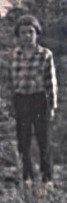
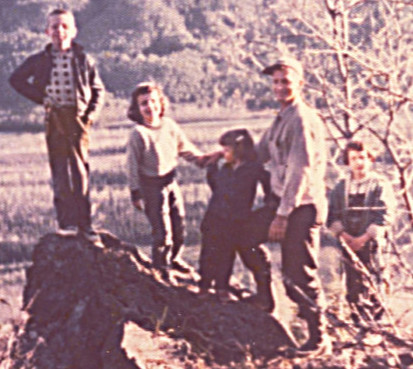
June 1959 - Age 7 - Me on the right - excluded from the family
May 23, 1959 - Age 7 - Me on the right - excluded from the family
July 1959 - Age 7 - Me on the right - cut off from the family
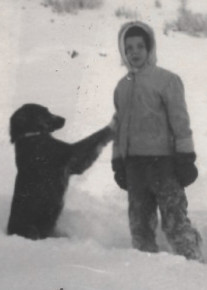
December 1959 - Age 7 - Me cut off from Smokey
December 1959 - Age 8 - Me cut off from Smokey

++++++++++++++++++++++++++++++++++++++++++++++

I cannot improve the focus in these pictures.  I expanded from the originals because I wanted to see the similarities between the three pictures in terms of my body language reflected in the three of them.

++++++++++++++++++++++++++++++++++++++++++++++

AND THIS IS HOW I SEE ‘THE WHOLE BALL OF WAX IN A NUT SHELL’

— the professionals back me up!

This describes what happened to me, to my mother, and the how and why of it all — the 18 years of severe child abuse I suffered — and how my mother became ‘mad’ enough to do it.

+++++++++++++++++++++++++++++++++++++++++++++++++++++++++++++

Guidelines for the Evaluation and Treatment

of Dissociative Symptoms in Children

and Adolescents

International Society for the Study of Dissociation

Journal of Trauma & Dissociation, Vol. 5(3) 2004

Digital Object Identifier: 10.1300/J229v05n03_09 119

++++++++++++++++++++++++++++++

Please follow (above) link to read this entire article and to find the exact references the authors are referring to in this section of their article (below):

“There is no consensus yet on the exact etiological pathway for the development of dissociative symptomatology, but newer theoretical models stress impaired parent-child attachment patterns (Barach, 1991; Liotti, 1999; Ogawa, Sroufe, Weinfield, Carlson, & Egeland, 1997) and trauma-based disruptions in the development of self-regulation of state transitions (Putnam, 1997; Siegel, 1999).

Newer theorizing ties maladaptive attachment patterns directly to dysfunctional brain development that may inhibit integrative connections in the developing child’s brain (Schore, 2001; Stien & Kendall, 2003).

From the vantage point of treating children and adolescents, a developmental understanding of dissociation makes the most sense.

That is, dissociation may be seen as a developmental disruption in the integration of adaptive memory, sense of identity, and the self-regulation of emotion.

According to Siegel (1999), integration is broadly defined as “how the mind creates a coherent self-assembly of information and energy flow across time and context” (p. 316).

In other words, Siegel sees the development of an integrated self as an ongoing process by which the mind continues to make increasingly organized connections that allow adaptive action.

Children and adolescents may present with a variety of dissociative symptoms that reflect a lack of coherence in the self-assembly of mental functioning:

1. Inconsistent consciousness may be reflected in symptoms of fluctuating attention, such as trance states or “black outs.”

2. Autobiographical forgetfulness and fluctuations in access to knowledge may reflect incoherence in developmental memory processes.

3. Fluctuating moods and behavior, including rage episodes and regressions, may reflect difficulties in self-regulation.

4. The child’s belief in alternate selves or imaginary friends that control the child’s behavior may reflect disorganization in the development of a cohesive self. 

5. Depersonalization and derealization may reflect a subjective sense of dissociation from normal body sensation and perception or from a sense of self.

+++++++++++++++++++++++++++++++++++++++++++++++++++++++++++++

This condition and these symptoms originate with insecure early attachments.  I believe they lie at the core of many (if not most) later-developing adult-onset ‘mental illness’ disabilities.

These descriptions of childhood dissociation apply to me, except for #4.  I did not have enough of a self to even imagine friendship, real or imaginary.  I also believe they all apply to my mother, with a shift in #4.  She developed the imaginary belief that she could CONTROL her imaginary friends — her children (me being the enemy) rather than being controlled by them.

I can see the lost, empty child in these pictures, cut off from being a member of a family, cut off from the development of a clear and cohesive self.  Devoid of a connected lifetime of experience, I appeared simply as a physical body taking up space in the universe, not as an animated LIVING child present as an identity within that body.

At any given moment my exact existence was only determined by the situation I was present in at that moment.  If the conductor of an orchestra points the baton at an individual with a particular instrument, it is time for all to hear that instrument play.  If we place our computer cursor over a particular link and click on it, we expect and anticipate that a particular action is going to occur.

From the moment of my birth my mother determined in her profound and comprehensive control of me how Linda was allowed to be in the world.  Because she never knew me as a human being, nor wished to, I existed as a puppet-fied manifestation of her inner psyche – as her projection of the BAD CHILD.

++++

There was no room for Linda to exist at all, and I can clearly see that emptiness of personhood and of selfhood in me in these pictures.  I appear as a child ‘stripped of a self’.

My emptiness, my dissociation was on an on-again, off-again condition.  The few times that I was left alone to be with myself simply existed in their own dissociative bubbles that never connected themselves to the ongoing experiences of me in my own body, in my own life.

I existed in relation to myself as I existed in the world these photographs captured – isolated, cut off, alone, unanimated, empty – like a husk of a child, a shell of a child – a body that existed to be battered, shoved, yanked, slapped, hit, punched, etc.  As an empty person to be screamed at, stormed at, thrown around in every imaginable way – at any time for any reason or for no reason whatsoever.

As an individual child-person, I was not allowed to exist.  I was not given permission to exist.  I ONLY existed as a figment of my mother’s twisted and brutalizing imagination

I no more had an identity or existed as a person (let alone as a child) than did the stone we stood on, the background trees, the tumbling rivers, the passing clouds, or the freezing snow.  I was less alive and less whole than was our dog, Smokey.  I was an apparition, a wraith, a mirage of a child.  Linda wasn’t there at all.

I was a missing child, and nobody noticed because nobody cared.  I experienced no difference between the cells of my body, the skin I wore like my clothing, the earth I walked upon or the air I breathed.  Moment to moment I could not count on anything.  I had always lived in an insecure, unpredictably unsafe world.

No child can for its self, its one self, if it is not allowed to.  I was never given permission to exist, so I didn’t.  I was as invisible and as intangible as the sound of rushing water or the wind.  I was given no more permission to exist than a leaf is, and less permission to exist than Smokey the dog was.  The homestead was more real to my mother, to both my parents, than I was.

++++

If I isolate the image of myself out of these photographs what remains is an unfocused child posed in a rigid standing posture.  That, sadly, is about all there was, a child existing by posing as a body – like a tree exists by posing with a trunk, limbs, branches, twigs and sometimes leaves – its root invisible beneath the soil.

But I had no roots.  From moment to moment I had no history of my own.  I didn’t even have the history of what mother did to me.  Even those experiences were not retained, kept, stored or retrieved in any stuck-together ongoing autobiographical coherent story-of-an-ongoing-child’s- life.  There ONLY existed each separate ongoing moment, and each of those moments was a likely to change into something else, something terrifying and painful, at any second. — unpredictably, unexpectedly, unfathomably.

Nothing mattered any more to me nor did I matter any more than if I was a snowflake, a scrap of cloth, or a pot to be scrubbed or pounded upon.  I simply existed without a self as a body that continued to grow over time without ME KNOWING I was in it.  I was my mother’s chosen ‘evil-bad’ projection, barely an object, not a person — and most definitely NOT a child.  Does an object have a sense of itself?

Just me age 7 in a body on a rock on a mountain
Just me age 7 in a body, rigid, at this second no more real than the grass I am standing on
Just me age 7 in the snow in a parka that meant more to mother than I did with a dog mother could love even though she could not love me
Just me age 8 in the snow in a parka that meant more to mother than I did with a dog mother could love even though she could not love me

++++++++++++++++++++++++++++++++++++++++++++

My mother was a master magician.  She was an expert at her craft.

Often she would banish me “from her sight”

— sometimes for days or weeks at a time —  so I would vanish from the family all together — body and all.

In the family pictures taken of  bringing in the Christmas tree in 1957 when I was 6, our first winter in Alaska, I am nowhere to be seen.

I have disappeared completely.

I am ‘missing in action’ and nobody seems to notice I am gone.

I am invisible.   I don’t exist at all.

I was erased.

+++++++++++++++++

See

++MY CHILDHOOD STORIES
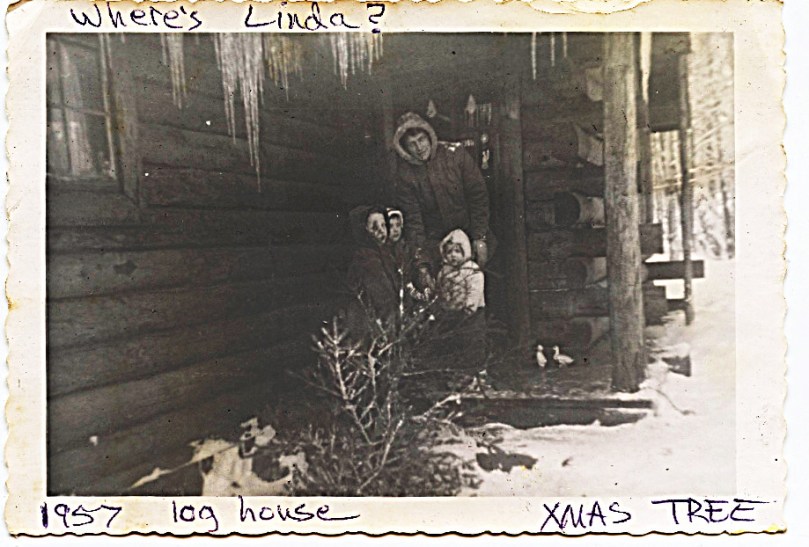
Age 6 - Mother's magic -- Linda has completely vanished from the family picture of bringing in the Christmas tree

+IN MY GRANDMOTHER’S circa 1930 WORDS – Hard times in my mother’s age 4 and 5 year old life

093009 post on my Grandmother Cahill’s 1930 autobiographical piece about the death of her father and the ‘queer’ behavior of her husband — (my mother’s grandfather and father).

+++++++++++++++++++++++

If I were about to launch into spoken speech right at this moment, I would start by saying, “I am speechless.”  Because I am going to write these words, I can pause in my silence and my writing will continue across this page.

I just copied the types words that reached my hands today in my mailbox.  They were written by my mother’s mother 79 years ago.  They have taken a circuitous route to reach me, having once been in the hands of my sister when she read these words to me over the telephone two months ago.  Before she could mail me a copy of them, the papers that she read to me vanished – inexplicably and completely.

Weeks later she came across another copy of them that were stored within a small blue file box she did not even remember was in her possession.  Delighted, she made copies and here I have them with me today.  Over the span of their existence, they must have passed through my mother’s brother’s hands, my mother’s cousin’s hands, and my mother’s children’s hands.  I do not know, however, if they ever passed through my mother’s hands.

++++

I am thinking about what many

Native American cultures say about The Seven Generations.

Much of this

wisdom belongs to the Grandmothers.

Wisdom.  Wisdom shared down the generations.  Wisdom passed onto the future generations.  Living a life that considers the future seven generations that will follow me.  Thinking about how 150 years seems like a long time, but it is not.

++++

My mother’s grandmother is dead.  My grandmother Cahill is dead.  My mother is dead.  Here I sit, age 58.  If my children had chosen to have children of their own at a young age, it is very possible that those grandchildren would be old enough at this moment to be having children of their own.

One hundred and fifty years doesn’t seem like a very long reach to me at this moment.  After all, my grandmother’s words in my hands right now came to me from a time point half that distance away from me.  I could easily have five generations even of my own family to consider from this chair I now sit in.

Yet what are we learning from one another?  What do we pass onto one another?  What word, what actions, what wisdom, WHAT?  There has to be something good passed down here, not just intergenerational unresolved traumas.

++++

This link I am posting right now connects all who read my grandmother’s words to a time in her life, and therefore in the life of my 4 to 5 year old mother at that time, when times were hard, circumstances difficult, and emotions complex.

I have always suspected some things about my mother’s early life that are referred to in this piece of my grandmother’s writing.  Yes, there was a maid, a ‘nanny’ in my mother’s young life.  Yes there were emotionally difficult times that I think overloaded whatever capacity my young mother had to deal with them effectively.

There’s a lot I could say here, but I won’t.  I need to remain speechless.  I need to consider what it might be that my grandmother could teach today with her words.  I need to listen for the wisdom.  Is there anything about the story she elucidates in her words here that can somehow assist someone in the next Seven Generations?  What are her words really saying now, 79 years later?

Again, like with my mother’s childhood stories, her letters and even with the letters that are still here that were preserved in mine and my siblings’ childhood handwriting, isn’t it more than mere coincidence that all these papers have endured all these years with their messages inscribed and preserved – until such time they could be translated into digital ones and zeros, coded and sent out into the worldwideweb – to perhaps inform or assist someone else ‘out there’ with their own struggles?  (And there are more pages here I will be entering ASAP.)

I don’t know.  I am just doing my tiny part of the job.  Here’s the link for you —

+++++++++++++++++++++++

*Grandmother Cahill’s circa 1930 Writing About Her Father and Husband

+++++++++++++++++++++++

+WAS MY FATHER’S ‘SELF’ MISSING IN ACTION DURING OUR CHILDHOOD?

+++++++++++++++++++++++++++++++

Please don’t miss my siblings’ comments about my father at the end of this page —

*Age 8 – Photograph – Me, Smokey and Snow

+++++++++++++++++++++++++++++++

And included with comments at the end of this post —

+CRIMES OF MY FATHER: WAS HE AS BAD AS MY MOTHER WAS?

+++++++++++++++++++++++++++++++

I just watched my gold girl kitty, Goldilocks, sneak up on and capture a small lizard in my newest flower bed this morning.  Of course, she first nabbed its tail and if fell off in her mouth.  That’s OK.  Only in the most dire circumstances does a lizard have to sacrifice its tail, but when they do it is in an effort to survive the nearly unsurvivable.  Lizards are designed to grow a new tail — if they escape to a place of safety.

Of course Goldilocks was not about to let this poor little thing get away.  She tossed it into the air and followed it wherever it went.  Then the other two half grown kittens joined her.  Hunter, the boy, ended up with the lizard cornered on the sidewalk.  Once flipped onto its back it laid there — as if it was dead.

None of the three wanted to eat this prey, I’m sure there’s something about lizards that make them far more unpalatable than rodents are.  Yet as I watched Hunter watching this tailless lizard plopped onto its back with its silver belly to the sky, feet splayed out straight to its sides — I saw it miraculously flip itself over and try to get away again.

Of course Hunter would have pursued it as long as it had life left in its body to move.  So I chased away the kitten and picked the lizard up by its tiny little foot and tossed it into the massive azalea bush where I hope it can find its way to safety — and grow a new tail.

It made me think of my father, as my sister mentions in her comments perhaps nearly entirely invisible to us when we were children except for the few precious artifacts of his ‘truer’ self, his original self, his OTHER self that we were on occasion privileged to discover.

++++

My mother always said that she came to Alaska because father wanted to.  She said it was a good thing because he loved the out-of-doors.  He loved the mountains, he loved to hike and fish.  Before we left Los Angeles he was a member of the Mountaineers’ Club that accomplished search and rescue for hikers in the mountains surrounding the city.  He disappeared on week-ends, perhaps to escape her, but she hated that.

Move to Alaska.  Homestead.  For father’s benefit?  For ours?  Or because her sick mixed up disturbed mind found for itself the perfect obsession?

All of our lives with my mother were grueling.  I wonder what happens to the spouses and partners of those with serious, unrecognized mental disorders.  The 12-step program of Al-anon for people with active addicts and alcoholics in their lives says that the people who live with the addicts become ‘as sick or sicker’ than the addict.  Isn’t this just as true for spouses of people like my mother was?

Did everyone in my family, my father included, end up like this tailless lizard unable to escape the pervasive effects of my mother’s disturbed psyche?  Were we all her prey?  Did my father pay the price of losing himself by staying with her for nearly 30 years?  Did he flip onto his back and play dead during her attacks on him?  If he was so ineffective in being able to preserve his own self with her, how aware and concerned could he have been about what was happening to his children — especially to me?

++++

It is possible that given a less-than-optimal early developmental environment that a person’s self never develops ‘optimally’ in the first place.  Nor would a person’s connection to their ‘self’ develop optimally under malevolent early conditions, either.  Perhaps the human ‘optimal self’ is designed through the forces of evolution under harsh conditions to be as dispensable under severe trauma conditions as is a lizard’s tail.

Perhaps only when the forces of ongoing trauma are removed can the self and connection to it be reestablished — or even be established at all, such as in my situation.  My mother’s self did not develop properly in her early childhood, nor did her connection to her self.  There’s a very good chance that my father’s earliest developmental environment did not allow him the chance to develop his ‘best self’, either.  He was NOT a wanted child.  Putting these two wounded selves together was a recipe for disaster.  Need we be surprised that disaster was exactly what happened?

++++

PLEASE NOTE:

Just as a lizard has an ‘insecure attachment’ to its tail when its life is threatened, both of my parents came out of their early childhoods with insecure attachment disorders — primarily to their selves.  My father’s was an ‘organized’ insecure attachment disorder, the dismissive-avoidant one, I believe.  This allowed him to appear to function as a professional civil engineer and as a provider, even under incredible duress.

My mother’s was of the disorganized insecure attachment disorder variety, I believe of the worst kind — a disorganized-disoriented insecure attachment disorder.  Her true level of functioning was just about zero!  If she could manipulate her ‘stage’ according to her fairy tale wishes, she could orchestrate floor-waxing, curtain-washing and cookie-baking like a pro.  Anything else?  She was a disoriented, disorganized mess.

It took my father’s super human efforts, every single time, to try to get her, and us, out of the incredible messes she made — except for the most important one.  He could not rescue any of us — not even himself.  We would all have needed outside intervention and assistance for that to happen — and it never did!

+++++++++++++++++++++++++++++++

+++++++++++++++++++++++++++++++

This is interesting!

The following website belongs to Dr. Leland M. Heller, author of the book, ‘Biological Unhappiness’.

Here’s one review of the book by Zig Ziglar:

“Open this book and it will open your mind.  By combining proven medical procedure with hope and inspiration, Dr. Heller has made a significant difference in thousands of patients who had little hope for recovery.  “Biological Unhappiness” contains critical information for those who have lost hope.”

Zig Ziglar, motivational speaker, author, See You at the Top, Over the Top, Success for Dummies, Raising Positive kids in a Negative World.

Check out this fascinating website!

http://www.biologicalunhappiness.com

+++++++++++++++++++++++++++++++

+IN THINK IN MY MIND MY FATHER AND THE MOUNTAIN WERE ONE

+++++++++++++++++++++++++++++++++++++

*1959 July Birthday on homestead

*1959 – 1960 Serious winter – Dad smiling on tractor

— In my mind, the mountain and my father were one — I never expected either one to save me.  But never did I love him like I love that mountain place.

+++++++++++++++++++++++++++++++++++++

*1960 – May 7 – 4 of us all genuinely HAPPY! YAY!!!

*1959 June – Homesteader Sharon and the Hut

*1962 – Summer -Mother washing face after planting fields with dad

++++++++++++++++++++++++++++++

(Use your ‘back button’ on these or open them in new tabs or windows you can close after each picture-link view)

+++++++++++++++++++++++++++++

I hope one of my younger brothers might write the story of the fire that happened in my father’s apartment — with both his Alaskan sons sleeping there — that my family members — and these pictures survived.  It happened long after I left home.

+++++++++++++++++++++++++++++

+TIME HAS COME FOR ME TO ASK THE SERIOUS QUESTIONS ABOUT MY FATHER

++++++++++++++++++++++++++++++++

The following are the words that begin a new chapter in my healing journey.  Tonight I give myself permission  to get to know what I can about my father.  I have created a new heading page for him.

WHERE WAS MY FATHER?

Under this tab I will begin to accumulate information about my father.  I will be brave enough to let my inner self guide me in my searching and re-searching.

++++++++++++++++++++++++++++++++

Today, September 28, 2009 I feel I am finally ready to begin to face down my own feelings about my father.  I want to do this because I have NEVER made any progress toward finding my own truth about who and how my father was in my life — either when I was a child or when I was an adult — by continuing to ‘try’ to be angry with him.

My truth today is that there’s a mystery here.  I don’t KNOW my father.  He is talked about in my mother’s letters.  I even have access to letters that he wrote himself.  I have a right to explore and examine my father — as much a right as I have to do this in regard to my mother.

These pages will reflect my efforts to find my father.  I have nobody to answer to about him but myself.  I am granting myself permission to do my own explorations, find my own ‘evidence’,  search for my own understandings, come to my own conclusions — about my father.  Nobody stops me but myself.

++++++++++++++++++++++++++++++++

+LINK TO PHOTOGRAPH OF MY FATHER

++++++++++++++++++++++++++++

Blog’s first picture of my father:

*1961 September – Dad In Suit and Baby David

++++++++++++++++++++++++++++

Please note that the

*1962 – MOTHER’S LETTERS

are now transcribed and posted (unless I find more later!)

++++++++++++++++++++++++++++

+LINKS TO BORDERLINE PERSONALITY DISORDER SITE

++++++++++++++++++++++++

I am passing on some more vital information on

Borderline Personality Disorder

++++++++++++++++++++++++

HERE’S THE LATEST FROM:

About.com Borderline Personality Disorder

In the Spotlight More Topics

Kristalyn Salters-Pedneault, PhD

Some researchers think that emotion dysregulation– strong negative emotions and emotional reactivity– is the core feature of BPD. Why is it the core feature? Well, emotion dysregulation could drive other symptoms of BPD, including impulsive behavior and self-harm.

In the Spotlight
What is Emotion Dysregulation?
People with BPD experience a lot of dramatic shifts in their emotional states. They may feel okay one moment but feel extremely angry, sad, lonely, afraid, jealous, or shameful moments later.
More Topics
When Emotions Strike — Impulsive Behaviors in BPD
Are you someone who tends to take action without thinking through the consequences? Do hasty decisions often get you into trouble? Do you often act based on your feelings in the moment rather than on a long-term plan?
A Misguided Emotional Survival Strategy — Self-Harm
Self mutilation is very difficult to understand from the prospective of people who have never experienced the behavior themselves.

++++++++++++++++++++++++

+TERRORISM – FEAR AND THE THREAT OF BRUTAL ATTACK

+++++++++++++++++

What is life like for the millions of our globe’s population that are destined to live their entire lifespan under the threat of brutal attack?

+++++++++++++++++

Do we remember the community terror instigated by the fear that Russia was going to launch nuclear weapons at America?

The following letter (link below) was sent home from public schools after the events of the Bay of Pigs April 15 – 21, 1961 and the Cuban Missile Crisis of October 14 – 28, 1962.  This was the closest the world has ever gotten to all-out nuclear war — so far.

— I remember my parents sending all of us older kids outside the Jamesway where I could still clearly hear through the canvas walls mother’s rantings at father about what she wanted him to do if/when the Russians invaded.  She told him to shoot her first and then gave him the order in which she wanted him to shoot the rest of us before he shot himself.

I remember standing at the kitchen of the log house doing dishes probably in the spring of 1962.  I kept looking over my shoulder out the window at the woods in back of the house waiting for the Russians in full military regalia to appear at the door.  I knew Alaska was only two miles from Russia at the narrowest passage point, and based on the adults’ terror at this time I was quite certain that an invasion was likely.

+++++++++++++++++

I could THINK about this externalized terror — and I could fear it.  I had no capacity, however,  to ever think about the terror that existed within my own home.  There was a concept for attack from ‘the outside’ enemy.  There was no concept for attack from ‘the inside’ enemy — the mother who birthed and abused me.

The entire culture surrounding me in my small childhood world feared the Russians and a devastating attack from them.  There was no culture about fearing my mother!

+++++++++++++++++

*Age 10 — 1962 Civil Defense Letter from School

+++++++++++++++++

+FINALLY — FIRST PICTURE OF MY MOTHER ON MY BLOG

+++++++++++++++++++++++++++++++++++

Sometimes I don’t think learning something new is fun.  Sometimes it is still necessary, so I have to believe this is going to get easier!!

Evidently Adobe has expired the free old version of Photoshop that came with my scanner — and I’m not one bit happy to have to dink around with their online version of photo doctoring.  There is no way I can “fix” the photo damage to my mother’s face, for example.

I’ll have to decide if I can afford to fork out the bucks to get their NEW version now.  And here I thought the one they gave me with the scanner could continue working just fine.  No warning — just tried to use it tonight and —  DEAD!

I uninstalled my Photoshop thinking I could reinstall it in case I forgot to register this software in the first place.  Only now the door on my computer for the disc drive won’t open.  It’s a fairly new computer, not abused, and now I couldn’t install a brand new version, either.  I guess these fire damaged pictures will just have to stay this way for awhile!  Anyway – – –

I FINALLY have my very first photograph of my mother — and of the homestead ready for viewing!  Please take a look!

+++++++++++++++++++++++++++++++++++

It strikes me that my mother is literally and figuratively standing on the epitome of a Borderline Personality Disordered woman’s BORDERLINE in this picture.  On this spot, at this point in time, she is standing on the borderline of where civilization met the wilderness, on the borderline of where civility met ‘the frontier’ — in all actuality — of madness:

*1959 June – Mom, Tractor, Stuff

+++++++++++++++++++++++++++++++++++

*1959 June – Two Views of Hut and Mountains

I’ll be working with more pictures — this should all eventually get easier with practice, at least, but the online photo editing is technically CRAPPY!

+++++++++++++++++++++++++++++++++++

+IMMUNITY AGAINST INSECURE ATTACHMENT DISORDERS BEGINS AT CONCEPTION

092609 post Origins of Emotional Abuse

++++++++++++++++++++++++++++++++++++

Emotional Abuse Recovery NOW

Annie Kaszina offers free assistance on her site and through her free email support to women who have experienced emotional abuse.  I personally find it disheartening that she does not equally offer her advise and expertise to men as well as to women, but I am mentioning her work here because I want to consider information presented in her writing about emotional abuse.

++++++++++++++++++++++++++++++++++++

Emotional abuse is not JUST a woman’s issue, it is a human issue.  Emotional abuse is not JUST an adult issue.  The seed potential for being both a perpetrator and a victim of emotional abuse begins – believe it or not – even before our conception.

No matter our sex, no matter what our genetic potential makeup may be, a mother’s emotional state influences her body to such an extent that her hormones and other body chemicals affect whether or not conception even takes place, as well as affects whether or not the tiny new human can or does implant itself on her uterine wall to further its growth and development from that time forward.

A mother’s hormones and internal chemical environment constantly signal through molecular communication what the world is going to be like that this new human is going to be born into.  Those signals about stress, distress or future well being influence how the genetic potential of a human manifests itself – from conception onward.

These early signaling processes particularly influence the future sensitivity of the new human.  I mention this now because Ms. Kaszina’s words this morning, as they arrived new and shiny in my email inbox, are concerned with emotional sensitivity.

Emotional sensitivity is not something that some of us have and some of us don’t have.  All humans have emotions.  All humans also vary in degree of sensitivity according to their fundamental genetic makeup, according to the information all kinds of molecular signaling has given them about the benevolence or malevolence of the world their body is growing up to live in, and according to the information that a newborn infant’s body-brain-self receives from its first early caregiver environment.

++++

We cannot possibly disentangle the topic of secure and insecure attachment disorders – from conception onward – from any discussion about so-called emotional abuse.  What we are actually considering when we talk about emotions and sensitivity, in my opinion, has to do with the quality and kind of human attachment system we developed from conception.

If adults do not provide safe and secure attachments to infants and young children from the beginning of their lives, HOW this tiny person develops will be affected on every level.  This most certainly includes emotional sensitivity.  If the safe and secure attachments do not exist in an infant’s life, its body-brain-mind will be forced to take a pathway in its development that is less-than-optimal.  An insecure attachment pattern, or insecure attachment disorder, WILL result from these conditions.  That is the way our social species is designed.

++++

If a person could actually weigh information, tons of it exists at our fingertips about secure and insecure attachments.  My purpose is to encourage readers to go poke around and take a look at this information for themselves.  Without including the facts about our human attachment system in our thinking about ANYTHING that has to do with ANY human relationship, we are like children ourselves who might expect to sit in a broken down car out behind a weathered barn in some countryside – hoping and hoping if we just hope enough that useless car will take us out away from our miseries.

++++

Every human being whose brain-mind did not develop in an early environment that included a caregiver to whom that infant could safely and securely attach – on a predictable and sustained level – will end up with an altered brain-mind that includes an insecure attachment disorder built into it.  All humans are amazingly resilient, and even a tiny infant can make amazing use of whatever safe and secure human attachment opportunities that DO actually exist in its early environment.

But at the same time we ARE human, and we are vulnerable and fragile.  Degrees of damage are exactly that!  If you spend some time following links included above, you will discover enough information for yourself to begin to understand what Dr. Allan Schore says about all insecure attachment disorders include empathy disorders.  Nobody is immune to the consequences of forming a body-brain-mind in a malevolent world.

++++

With this very brief survey as an introduction to the following words written by Annie Kaszina, I encourage readers to begin to realize that both ‘perpetrators’ and ‘victims’ of emotional abuse most likely suffer from an adult version of an insecure attachment disorder – either an ‘organized’ one or a ‘disorganized’ one.  If our first displays of our emotions were not consistently appropriately and adequately responded to from the time we were born by one or more early caregivers – our emotional self will have altered the way it developed.  This naturally affects both how we respond to our own and to others’ emotions.

If we are going to refer to these changed patterns as ABUSE, we need to include in our thinking that all these emotional patterns exist in our brain’s construction and operation.  They can sometimes be changed to some degree, but our emotional construction is as much a part of our body as are our organs and limbs.

++++

From my own childhood experience I can say that the environment of the home I grew up in, with my Mad Monster Mother at the helm, contained no real emotional health and well being except as it was accidentally provided – mostly to my siblings.  My entire blog is devoted to this HUGE topic.  My point this morning is that I encourage every reader to read the following words as if they are simply and completely referring to interactions between parents and children – not between adults.

Focus your inner vision.  Consider your childhood – whether you were a girl or a boy — for awhile ONLY as it either sustained the development of your authentic self emotionally – or did not.   Parents are not their offspring’s’ partners.  They have assumed the job of raising their children so that they themselves can later be other human’s partners.

Please ‘translate’ this information provided below through the lens of your own very young childhood perspective.  What you were given THEN is reflected in how you are NOW!  We had no choice as infant-children but to build into our growing body-brain-mind the attachment patterns our early caregivers ‘fed us’.

Down the road, the following is exactly how insecure attachment disorders (systems) can show themselves when we are all grown up.  We can repeat them with both the adults and the children in our lives.  We need to understand what this means by beginning to in-form our thinking about how these patterns established themselves PHYSIOLOGICALLY into our very young developing bodies — and remain within us for the rest of our lives.  Once recognized consciously, we can begin to alter the effects our inner attachment system has on the quality of our life.

++++++++++++++++++++++++++++++++++++

++++++++++++++++++++++++++++++++++++

Emotional Abuse Recovery NOW

Written and published by Annie Kaszina
Women’s Self-Discovery Coach
www.EmotionalAbuseRecoveryNow.com

To sign up to this ezine, go to www.EmotionalAbuseRecoveryNow.com

My name is Annie Kaszina and I spent over twenty years in an abusive marriage, before I learned how I could become the woman I want to be. Now I work with women who have been in controlling and abusive relationships, to facilitate their journey into joy and self-realisation.”

“You’re just too sensitive!”

“Has an abusive partner ever told you: “You’re just too sensitive?”

Okay, let’s be more precise about this; has your abusive partner repeatedly told you that you are too sensitive?  Because the chances are, if he has said it to you once, he’s said it a thousand times.  That’s how abusive relationships work; an abusive man throws the same complaints at you over and over again.

Why?

We’ll come to that in a moment.  First, let’s deal with the really important question: How has that left you feeling?

Clearly, I don’t know you, and I can’t know how you think, but I’m guessing that it leaves you feeling small, needy, pathetic and very, very flawed.  Accusing a partner of being ‘too sensitive’ tends to make them feel as if someone has exposed a very dark, unlovable, immature feeling at the very heart of their being.

In short, it makes them feel unlovable.

There is a reason for this.  When an abusive man says his partner is ‘too sensitive’, that is not just a throwaway remark, triggered by frustration; it is, actually, a well-calculated barb with a venomous hidden agenda.

“You’re too sensitive”, is code; a code that, I suspect, you have not been translating correctly, until now.  If you had, you probably would not have given your accuser the opportunity to wound you with that well-honed barb, time after time.

“But”, you might object, “I am very sensitive.”   You might even say: “I am too sensitive.”

There is a distinction here that we need to clarify.  When you say that you are ‘very sensitive’, or even ‘too sensitive’, what you actually mean is this: “I can feel hurt very easily; it doesn’t take much.  I really wish that it wasn’t like this, but it is.  There doesn’t seem to be much I can do about it.”

Acknowledging the acuity of their sensitivity tends to be a kind of apology that I often hear form abused women.  They wish they could change it, but they can’t; at least not with the tools currently available to them.

When an abusive partner, or other near one, tells you that you are ‘too sensitive’, it is, apparently, because they wish you could change.  (The subtext is that if you could change that it would, somehow, transform the abusive relationship.)  Not that they are offering you any clues as to how you might reduce that sensitivity.

In reality, they don’t know how you could reduce that sensitivity; nor do they care.  Much as they may criticize you for it, your sensitivity fits very nicely with their agenda.  But they are not in a rush to admit that to you.

Think for a moment about the circumstances in which have been told that you are too sensitive.  Most probably it happens when you feel hurt by something your abusive partner said; or else something they did, or did not do.  Had you been ‘less sensitive’, they figure, you would not have reacted.  In other words, you would have just ‘got on with it’, and spared them the trouble of having to consider your feelings.

This holds true for other circumstances in which your ‘hypersensitivity’ means that you would like to receive comfort or reassurance.

That is not what your abusive partner, or other near one, had in mind.

When they say: “You’re too sensitive”, what they really mean is this: “Please don’t visit your feelings on me, I don’t want to hear about them.”  There’s more as well – and it doesn’t get any better.

“You’re too sensitive” is shorthand for; “I’m really not prepared to take your feelings into account.  In fact, I thoroughly resent your visiting them on me.  As far as I am concerned, this is the way I believe our relationship should work: I can say whatever I like to you, and you will get on and deal with it, without making a fuss and trying to make me feel bad about it.  What’s wrong with you, anyway?  Why can’t you just get on with being in an abusive relationship without moaning about it?”

The question, “What’s wrong with you, anyway?” is the key to your partner’s thinking.  There must be something wrong with you, or else you would respond to whatever it is that they said or did in exactly the way they would have you respond.  In other words, what they wanted was no response from you.  (In an abusive relationship, all communication is intended to be a one way street.) Whatever it was that they said or di, they hoped that you would let them ‘get away with it’.  And you did not.

It’s not as if you took a strong stand; anything but.  A strong stand would have meant saying: “This is unacceptable.”  You would then make yourself scarce, as far as they were concerned.  Your abusive partner would duly get the message that they were out of order, and would need to clean up their act, or else lose you.

Whether or not they would clean up their act is another story.  If, instead, your refusal to accept abuse led to the earlier end of a damaging relationship that was bound to end in unhappiness anyway, then your strong stand has paid off handsomely.  That would save you time and misery.  And if it concentrated their mind, and led them to behave better in the future, even better.

But just asking an abusive man to behave, and/or speak to you, differently, is as ineffectual as saying to a child: “Oh, don’t do that!” All it conveys is your weakness and your reluctance to act.

It leaves your abuser free to repeat the pattern time and time again.  He will continue to speak and act as he pleases and, when you object, he will reproach you, again, for ‘being too sensitive’.

With that one simple phrase he has laid the blame for the hurt in the situation on you.  With one simple piece of sleight of mouth, he has dumped blame for the situation on you, so that he comes up smelling of roses.  Or, at least, as close to smelling of roses as he is ever likely to get.

How did you get into an abusive relationship like that in the first place?

Here’s the irony: it happened, in part, because of your sensitivity.  Not that there is anything wrong with being sensitive; there is not.  However, an abusive man has a finely tuned nose, and can smell sensitivity a mile off.  He knows that he can exploit that sensitivity to gain control over another person.  He knows just how to do that – as you have discovered, to your cost.

So what will you do differently about your sensitivity in the future?

First, you need to become much more vigilant; you learn that someone who is prepared to disregard your ‘sensitivity’ is telling you that they will completely and utterly disregard your feelings.  You give such people a very wide berth.  Second, you learn to honour and manage that sensitivity; treat it with respect and other people will treat you with respect, also.”

++++++++++++++++++++++++++++++++++++

— SEE ALSO —

+++++++++++++++++++++++++++++++++++

+INFO ABOUT BORDERLINE PERSONALITY DISORDER (BPD)

+++++++++++++++++++++++++++++++++++

New Resource for Parents: CDC Parent Portal

+++++++++++++++++++++++++++++++++++

Related Post:

+CHILDHOOD DISSOCIATION, DEPERSONALIZATION, DEREALIZATION – I NEVER HAD A CHOICE TO BE OR NOT TO BE

+++++++++++++++++++++++++++++++++++