+WHAT MIGHT LOVE FEEL LIKE? A “RESILIENCY FACTOR” STORY FROM MY ABUSIVE CHILDHOOD

++++

Monday, April 6, 2015.  While I don’t understand my point exactly in writing this post it seems to be one that has moved past the perculation stage into WRITE ME NOW.  So here is a little more about my personal conflicts with the concept of “resiliency” as it may be achieving a generic standing within the “healing trauma” circles.

The adult human body is made up of about 37 trillion cells.  The United States Census Bureau estimates that the world population exceeded 7 billion on March 12, 2012.  To do research that tried to extrapolate meaningful information about ALL cells or ALL people based on a small sample of ONE would be ludicrous.

Nobody can determine each individual’s experiences with trauma in such a way that the data generated could be made useful to anyone, let alone everyone!  So naturally what I have lived through and what I know as a result of my studies about what happened to me and how I survived it will never fit into any clear “significant probability” statistic with meaning.  I can, however, share parts of my story to illustrate points important to me.

I am sharing a story included on this blog that I certainly am NOT going to read right now.  I may never return to read it again.  (This is often the case with my own childhood stories once written, which is why my ace professional researcher and writer daughter is my editor for our books.  She has not yet proofed the story at this link.)

*Age 8 – BLOODY NOSE

What I wish to say about the experience detailed in this story as it connects to my standpoint on “resiliency” is that had I NOT gone through this event I do not believe I would have come out of my childhood having ANY sense of what “feeling loved” felt like.

The story is of trauma, true, but for me having my family gathered around me as I was nearly bleeding to death was the ONLY clear time of my 18-year childhood that I felt I belonged to this family.  It was the ONLY time that the feeling I lived with all of rest of my childhood from birth that I was at any moment, out of nowhere (my mother was psychotically mentally ill with me as her abuse target as my book at link below describes) going to be brutally attacked was absent.

This event COULD have been a very low spot – what I call a risk factor moment —  in my horrifying childhood rather than being the powerful, necessary (to me) resiliency factor moment that I built upon to successfully raise my own children and to care about others.  (In my case, I believe in what I call “borrowed secure attachment” rather than in “earned secure attachment” – a online search of terms “stop the storm borrowed secure attachment” will highlight some related posts.)

There is no possible “resiliency measurement tool” that could capture what truly traumatic childhoods are/were like.  But in the interest of preserving the integrity of useful data through meticulous research what is found MUST be processed by thinkers steeped in the depths of what early trauma IS.  The impeccable artistry and beauty of individual survivor’s lives must not be lost in the mad rush to understand what numbers-only are telling us.

Only with this understanding can any useful thinking about a vague concept like “resiliency” be made to pull its weight in efforts to understand and stop trauma and to assist those who survive it to increase their well-being across their lifespan.

I learned all I was going to find out in the 18 years of my childhood about what love-of-Linda was going to feel like.  All I was going to learn about what love might be like PERIOD I learned during those moments.  I believe traumatized children notice every possible useful bit of information and make PROFOUNDLY amazing good use of those tidbits.  That kind of resiliency, if we are going to call it that, is to me nothing more or less than the will to survive coupled with accumulating the tools necessary to do so.

++++

Here is our first book out in ebook format.  Click here to view or purchase –

Story Without Words:  How Did Child Abuse Break My Mother?

It lists for $2.99 and can be read by Amazon Prime customers without charge.

++++

Leave a Comment »

++++

+PLANNED SUFFERING FOR CHILDREN IN OUR UNBALANCED NATION

++++++++++++++

The sentiments reflected in the words below follow exactly along the lines the United Nations identified within the large and growing gap in America between the quality of life for America’s most ‘pampered’ children and those that live a far less ‘pampered’ life.

The New York Times Editorial by columnist Paul Krugman (published online February 27, 2011)

Leaving Children Behind

Will 2011 be the year of fiscal austerity?

And who will bear the brunt of these cuts? America’s children.

The really striking thing about all this isn’t the cruelty – at this point you expect that – but the shortsightedness.  What’s supposed to happen when today’s neglected children become tomorrow’s work force?

Anyway, the next time some self-proclaimed deficit hawk tells you how much he worries about the debt we’re leaving our children, remember what’s happening in Texas, a state whose slogan right now might as well be “Lose the future.””  READ FULL ARTICLE HERE

++++++++++++++

ALL THE SIGNS ARE HERE

(click – you might have to wait a few seconds – the article will appear at this link)

++++++++++++++

+WE MAY SAY WE ARE A FAIR NATION – BUT LOTS OF KIDS WOULD SAY OTHERWISE

+++++++++++++++++++++++++++++

From the United Nations

UNICEF  Innocenti Research Centre Report Card 9

The Children Left Behind:  A league table of inequality in child well-being in the world’s [24] rich countries

Written by Peter Adamson – 2010

The Just Society:  A Measure

The statistics presented in the Report Card can also be read as a first attempt to measure nations by the standards of a ‘just society’ as defined by the American political philosopher John Rawls (1921-2002).

Rawls proposed that the just society would be one in which the rules were drawn up for the benefit of society as a whole.  To achieve this, he argued, the starting point should be ‘the original position’.  By this he meant a kind of celestial ante-room in which all those waiting to be born would draw up the rules without knowing what position in society they themselves would occupy.  From behind this ‘veil of ignorance’, the rule-makers would not know whether they would be born rich or poor, male or female, with above or below average talents, fit or disabled, part of an ethnic minority or part of a privileged elite.

Because we would not know about our own status, he argued, we would not be able to press for rules that would benefit only ourselves.  Rules drawn up on this basis, therefore, would reflect an equal concern for all classes and groups.

The ‘veil of ignorance’ is therefore designed to tame the power of vested interests.  And ‘the original position’ is the exact opposite of the interest group model that is so influential in today’s politics.  In essence, it is similar to the method of sharing a cake fairly between two people by inviting one person to make the cut and the other to take first choice.

Rawls has his critics among the hundreds who have written books in response to his ideas.  Libertarians have objected that basic human rights such as property rights and the right to self-ownership leave no room for a Rawlsian concept of the ‘just society’.  Ronald Dworkin has argued that hypothetical agreements about rules drawn up from ‘the original position’ are not real agreements and therefore could not find the necessary acceptance and authority.  Amartya Sen finds the same weakness, adding that unanimity would be unlikely to be achieved even from ‘the original position’ and that lack of unanimity would bring the Rawlsian thesis crashing down.  Uniing some of these criticisms, Michael Sandel has objected that decisions about the rules governing communities that have their own traditions and histories cannot be made by reasoning from a rootless and historically abstract position.

But the idea that the rules of society should reflect the interests of all, and not just its dominant members, is widely accepted in theory, even if the methods by which it might be achieved remain controversial.

If we assume that the end, if not the means, commands a measure of agreement, then one way of measuring progress towards the aim of a just society would be to measure the degree of disadvantage suffered by its most disadvantaged members.  That is what this ‘Report Card´ attempts to do.

Clearly, more comprehensive data would be required to measure degrees of disadvantage ‘in the round’, especially if, as Martya Sen suggests, disadvantage should be defined as “those who are least able to realise their potential and develop and exercise their capabilities.”

Nonetheless, the data presented in these pages represent a contribution to that process.  In three different dimensions of well-being – they show how far behind the median level the least advantaged are being allowed to fall.  And the fact that different countries show very different patterns indicates that some countries are making more progress than others towards ‘the just society’.”  [page 26 of the report]

++++

Also stated in this report:

Reducing bottom-end inequality – to the extent that it involves reducing the steepness of the socioeconomic gradient in health, education and other dimensions of child well-being – will therefore require renewed government efforts to ‘row upstream’ in the years immediately ahead.

Stepping up efforts to protect those most at risk from falling behind is even more necessary at a time when governments are seeking to cut public expenditure….  But it is also more difficult.  And if efforts to prevent children from falling avoidably behind the norms of their societies are to be reinvigorated in changed economic times, then a strong case must be made.

Risks and consequences

That case is strong in principle.  For a child to suffer avoidable setbacks in the vital, vulnerable years of growth in body and brain is a breach of the most basic tenet of the Convention on the Rights of the Child – that every child has a right to develop to his or her full potential.  It is also a clear contradiction of the principle of equality of opportunity to which all OECD [Organization for Economic Co-operation and Development] countries aspire.

But the case is also strong in practice.  Allowing children to fall unnecessarily far behind brings in its wake a long list of practical costs and consequences.  Causality is always difficult to establish, but many hundreds of studies in many different OECD [ countries have shown what the costs of falling too far behind may be.  They include the greater likelihood of:

— low Birthweight

— parental stress and lack of parental time

— chronic stress for the child, possibly linked to long-term health problems and reduced memory capacity

— food insecurity and inadequate nutrition

— poorer health outcomes, including obesity, diabetes, chronic asthma, anaemia, and cardio-vascular disease

— more frequent visits to hospitals and emergency wards

— impaired cognitive development

— lower educational achievement

— lower rates of return on investments in education

— reduced linguistic ability

— lower productivity and adult earnings

— u7nemployment and welfare dependence

— behavioural difficulties

— involvement with the police and courts

— teenage pregnancy

— alcohol and drug dependence.

Many individual families – faced with disadvantages of income, education, health and housing – overcome the odds and bring up children who do not fall into any of the above categories.  But this cannot change the fact that children who fall behind early in their lives, or who spend a significant part of their early years in poverty, are likely to find themselves at a marked and measurable disadvantage.  It bears repeating that none of this is the fault of the child.  And a society that aspires to fairness cannot be unconcerned that accidents of birth should so heavily circumscribe the opportunities of life.

The costs

The practical case for a renewed effort to prevent children from unnecessarily falling behind is further strengthened by the economic penalties involved. The heaviest costs are paid by the individual child.  But the long list of problems cited above also translates into significant costs for a society as a whole.  Unnecessary bottom-end inequality prepares a bill which is quickly presented to taxpayers in the form of increased strain on health and hospital services, on remedial schooling, on welfare and social protection programmes, and on the police and the courts.  In addition, there is a significant cost to business and to economies as a whole in the lower skill levels and reduced productivity that are the inevitable result of a large number of children failing to develop to their potential.  Finally, there is a cost that must be paid by all in the threat that bottom-end inequality poses to social cohesion and the quality of life in advanced industrial economies.  “Wide inequality,” says the 2010 report of the United Kingdom’s National Equity Panel “is eroding the bonds of common citizenship and recognition of human dignity across economic divides.

The scale of such costs, though almost impossible to calculate, is clearly significant.  For the European Union as a whole, it has been estimated (2007) that health inequalities alone account for 14% of social security costs and 20% of health care costs….  In Canada, the overall cost of child poverty has been estimated (2008) at between $4.6 and $5.9 billion a year for the Province of Ontario alone….  In the United Kingdom, estimates by Donald Hirsch, in a report (2006) for the Joseph Rowntree Foundation, put the direct costs of “services to remedy the consequences of childhood deprivation such as poor health, low educational attainment, crime and anti-social behavior” at approximately $18 billion a year.

In sum, the costs of allowing children to fall too far behind – costs to the principle of fairness and costs to social, civic and economic life – are enormous.  And it is against the full weight of these costs and consequences that the economic arguments for and against a renewed effort to protect those most at risk should be set.

Early intervention

Finally, if the effort to reduce bottom-end inequality in children’s well-being is to make further progress, then it is not just the level of government efforts that must be increased but their effectiveness.

Children who fall behind begin to do so in the very earliest stages of their lives.  And in that simple statement we come face to face with one of the most important and least-acted-on research findings of our times.

During pregnancy and the first few weeks and months of life, critical stages in the child’s mental and physical development follow each other in rapid succession.  Each stage serves as a foundation for the next.  Any faltering in early childhood therefore puts at risk subsequent stages of growth and development.  In other words, disadvantage in the early phases of life can begin to shape the neurobiology of the developing child and initiate a process that, once begun, has a tendency to become self-reinforcing.

In particular, it is in cognitive development that the disadvantaged child is likely to pay the heaviest price.  By the age of two, cognitive ‘falling behind’ can be measured.  By the age of four, much of the potential damage may have been done….

The central practical message for efforts to reduce bottom-end inequality in child well-being could therefore not be clearer:  the earlier the intervention, the greater the leverage.

Overall, the case both in principle and practice for intensifying the efforts to prevent children from falling behind – and for acting as early as possible in the child’s life – has been well summarized by the Nobel laureate and University of Chicago economist James Heckman:

“Investing in disadvantaged young children is a rare public policy initiative that promotes fairness and social justice and at the same time promotes productivity in the economy and in society at large.  Early interventions targeted toward disadvantaged children have much higher returns than later interventions such as reduced pupil-teacher rations, public job training, convict rehabilitation programs, tuition subsidies, or expenditure on police….

Child care

Within the developed world, trends in the way in which young children are being brought up may now offer a unique opportunity to put this message into practice.  Today’s generation of children is becoming the first in which a majority are spending a significant part of early childhood in some form of out-of-home care (subject of Report Card 8).  In theory, this offers a large scale opportunity to take early action against the different dimensions of disadvantage that threaten to become established in the lives of very young children.  Public demand for high-quality child care already exists, and OECD governments are already responding by investing in free or subsidized early childhood services on an increasing scale.

At the heart of this opportunity is the idea that high quality early childhood education and care can help to reduce bottom-end inequality because it is the disadvantaged child who stands to gain the most.  “Although early childhood education and care benefits all children,” concludes an OECD-wide child care review by Canadian researchers Cleveland and Krashinsky, “much of the evidence suggests that the largest benefits flow to children from the most disadvantaged families….

“In practice, there is a danger that the child care transition will contribute to a widening rather than a narrowing of bottom-end inequality.  It is more educated parents and higher-income homes that tend to be most aware of, and more capable of affording, child care of the right quality.  And it is the poorer and less educated homes where the pressures for the earliest possible return to work are felt most acutely and where resources for high quality child care are least likely to be available.  Without specific policies to address this issue – and to ensure the availability and affordability of high-quality early childhood services for all children – this opportunity will therefore be lost, ‘double disadvantage’ will become the norm, and the child care transition will likely become a new and powerful driver of still greater inequality in children’s well-being. [this important statement is on page 30 of the report]

The costs of taking advantage of this chance to reduce inequalities in children’s well-being on a significant scale are obviously substantial.  The costs of not taking the opportunity will undoubtedly be even higher.  No one who has worked with disadvantaged or at-risk children can be in any doubt that, as James Heckman and many others have argued, attempting to compensate for disadvantage after the event is more difficult, more costly, and less likely to be successful.  Children need to be supported and protected from avoidable ‘falling behind’ at all stages of their development, but the point of greatest leverage is the point at which the process begins.

Conclusion

This report began with the argument that children deserve the best possible start, that early experience can cast a long shadow, and that children are not to be held responsible for the circumstances into which they are born.  In this sense the metric used – the degree of bottom-end inequality in child well-being – is a measure of the progress being made towards a fairer society.

Bringing in data from the majority of OECD countries, the report has attempted to show which of them are allowing children to fall behind by more than is necessary in three dimensions of children’s well-being (using the best performing countries as a minimum standard for what can be achieved).  In drawing attention to the depth of disparities revealed, and in summarizing what is known about the consequences, it has argued that ‘falling behind’ is a critical issue not only for millions of individual children today but for the economic and social future of their nations tomorrow. [with America being very nearly at the bottom on all measures!]

In making this case, therefore, principle and practice argue as one.  For if the effort to prevent the unnecessary falling behind of children in different dimensions of their lives is not made, then a fundamental unfairness will continue to shame our pretensions to equality of opportunity – and our societies will continue to pay the price.

++

A word about the statistical reality that forms the foundation of this report [see page 29]

Monitoring:  The Need to Know

The statistics presented in this report are not built on a comprehensive consideration of what constitutes child well-being but on the more mundane foundations of data availability.  In particular, an acknowledged weakness is that almost all of the available data concern older children and adolescents who are attending school; there is a glaring lack of comparable information on the critical years of early childhood.

Responding to this inadequacy of data may not seem to have much of a claim to priority in difficult economic circumstances.  But a renewed commitment to reducing bottom-end inequalities in child well-being nonetheless require a renewed commitment to selective monitoring.

If limited resources are to be used effectively, then governments need to know not only how many children are falling behind.  They need to know by how much, in what ways, and for what reasons.  They need to know who and where they are.  And they need to now how policy is affecting and interacting with wider trends in the social and economic life of the nation.

Finally, they need to have the relevant data at their disposal not once every five or ten years but on a timescale that permits timely response to protect those at risk.  Monitoring requires resources.  But it is the indispensable hand rail of cost-effective polity.

++

See also (with America again being at the bottom):  UNICEF Innocenti Research Centre Report Card 7

Child poverty in perspective:  An overview of child well-being in rich countries – A comprehensive assessment of the lives and well-being of children and adolescents in the economically advanced nations (2007)

Next post:

+AMERICAN CHILD WELL-BEING: SOME ‘IN-HOUSE’ GAPS

+++++++++++++++++++++++++++++

+AMERICA’S SCHOOLS IN TROUBLE! BUT NO OSCAR FOR THIS FLICK!

++++++++++++++++++

I am certainly not going to jump into the fray concerning the merits or lack thereof of the film this post is about — Waiting for “Superman”.  Frankly, at the moment I am just too dang tired.  However, this year-old film has generated plenty of its own Controversy – and hopefully some helpful conversations if not some action.  But Oscar material?  Not.

Failure to Thrive — this should be the most obvious diagnostic evaluation of our nation’s educational disaster — but where lies ‘the cure’?

ABC News — Schools at the Breaking Point – Watch interview with David Guggenheim, Director/Producer of WAITING FOR SUPERMAN — film released September 24, 2010 (available on Netflix February 15, 2011, it’s in my queue) — exposes public school (and teacher?) failures  – “How can I make people care about other people’s children?” – “We are not going to fix the schools until the adults change them.”

Film’s website info:

In your city – “How do I help?”  Waiting for “Superman”

waitingforsuperman.com

What You Can Do
Take Action
Write Your School Board
Educate Yourself and Others

– How to Demand Great Schools

Waiting for “Superman” movie trailer – and HERE

++

Charter school proponents speak out at ‘Waiting for Superman’ screening

Published:

Wednesday, January 26, 2011

The documentary film explores the overstressed public school system and how it fails its students, and promotes the charter system.

By Meg Boberg / Special to The Malibu Times

Education reform was the topic of the evening at Sunday’s screening of “Waiting for Superman” hosted by the Malibu Film Society. A crowd of supporters comprised of parents of Point Dume Marine Science Elementary School (PDMSS) students filled the room, along with other filmgoers, to catch the award-winning documentary that was followed by a screening of Oscar-nominated “The Fighter.”

The film, “Waiting for Superman,” addresses the shortcomings of the public school system and the benefits of charter schools, such as providing support for the low-achieving students who often slip through the cracks of an overstressed public school. However, charter critics say that PDMSS cannot be compared to the schools depicted in the filmREAD MORE HERE

++

SUNDANCE Film Festival 2010

WAITING FOR SUPERMAN

Davis Guggenheim 2009

AUDIENCE AWARD: U.S. DOCUMENTARY, Presented by Honda

For a nation that proudly declared it would leave no child behind, America continues to do so at alarming rates. Despite increased spending and politicians’ promises, our buckling public-education system, once the best in the world, routinely forsakes the education of millions of children.

Filmmaker Davis Guggenheim reminds us that education “statistics” have names: Anthony, Francisco, Bianca, Daisy, and Emily, whose stories make up the engrossing foundation of WAITING FOR SUPERMAN. As he follows a handful of promising kids through a system that inhibits, rather than encourages, academic growth, Guggenheim undertakes an exhaustive review of public education, surveying “drop-out factories” and “academic sinkholes,” methodically dissecting the system and its seemingly intractable problems.

However, embracing the belief that good teachers make good schools, and ultimately questioning the role of unions in maintaining the status quo, Guggenheim offers hope by exploring innovative approaches taken by education reformers and charter schools that have—in reshaping the culture—refused to leave their students behind.”

++

The Washington Post – The Answer Sheet – Posted at 10:30 AM ET, 01/25/2011

Why Oscar snubbed ‘Superman’ — deservedly so

By Valerie Strauss

The documentarians who select the films for Academy Award nominations in the feature documentary category got it right: “Waiting for Superman” was not good/accurate enough to be selected.

The snub to Davis Guggenheim’s tendentious film was well-deserved, given that classic documentaries are factual and straightforward, and don’t, as did “Superman,” fake scenes for emotional impact.

Academy Award nominations are heavily political, yet this film didn’t make the cut even though President Obama called it “powerful” and welcomed to the White House the five charming students who starred in the film.

Advertising campaigns have been known to vault films into Academy contention, but not even a $2 million grant provided by the Gates Foundation to market “Superman” worked.

Though “Superman” was on the shortlist for an Academy Award in the feature documentary category, apparently the people who vote on the nominations — people who actually make documentaries — saw too many problems with “Waiting for Superman.”

And there are many, large and small.

Guggenheim edited the film to make it seem as if charter schools are a systemic answer to the ills afflicting many traditional public schools, even though they can’t be, by their very design. He unfairly demonized Randi Weingarten, president of the American Federation of Teachers, and gave undeserved hero status to reformer and former D.C. schools chancellor Michelle Rhee. Guggenheim compared schools in Finland and the United States without mentioning that Finland has a 3 percent child poverty rate and the United States has a 22 percent rate.

One scene showed a mother touring a charter school — and saying things such as, “I don’t care if we have to wake up at 5 o’clock in the morning in order to get there at 7:45, then that’s what we will do” — that turned out to be staged; she already knew her son didn’t get in, according to The New York Times.

Then there was the case of one of the five students featured in the film, Emily Jones, who lives on the suburban San Francisco Peninsula and who, according to “Superman,” was desperate to escape her traditional public high school, Woodside High, where she would be doomed to mediocrity.

Except that it wasn’t true. In an interview with John Fensterwald of the Silicon Valley Education Foundation, she said that Woodside “is a great school” that she really liked; she just liked Summit Prep Charter School better.

Late last year, in a piece on Movie Line’s Web site, editor S.T. VanAirsdale asked whether education historian Diane Ravitch’s scathing review of Superman in The New York Review of Books would derail the movie’s chances of nabbing an Oscar.

Just maybe it did.

And maybe this will help persuade those who believed that “Superman” unflinchingly showed reality that, in fact, it didn’t, and that it is time to take a new look at public education that doesn’t demonize teachers and traditional public schools.

(For the record, the films that did get nominations in the feature documentary category are: Exit through the Gift Shop,Gasland, Inside Job, Restrepo and Waste Land.)”

++

Oscar nominations 2011: ‘Waiting for Superman’ will be waiting forever

January 25, 2011 – 11:06 AM

++

Teachers – STOP Waiting for “Superman” – he’s been found.” (Friday January 21, 2011)

++++++++++++++++++++++++++++++

+ONE IN THREE CHILDREN SUFFER FROM DEPRESSION? – THE STATS

++++++++++++++++++++++++++++++

Earlier this week I had plans to go into town and meet my friend for lunch.  It took me four hours of steady movement to get out the door.  I noticed that even my cell phone seemed to take HOURS longer to charge itself, longer than usual.  EVERYTHING seemed to take a long time – a long, long time.

I was reminded of an image that appears in Dr. Bruce Perry’s PowerPoint –Neurodevelopmental Impact of Childhood Trauma:  Focus on Dissociation –about how the sense of time passing builds itself into various brain regions as an infant-child’s body grows and develops as shown in his diagram on page 10:

The ‘Sense of Time’ is broken down to show the primary and secondary brain areas involved, along with the kind of cognition and the mental state related to each.  I don’t have the text that accompanied Perry’s original presentation of this information, but he is evidently describing the processing of time related to childhood trauma experiences and dissociation:

Extended Future – NEOCORTEX is primary, Subcortex is secondary, cognition is abstract, mental state is CALM

Days and Hours – SUBCORTEX is primary, Limbic is secondary, cognition is Concrete, mental state is AROUSAL

Hours and Minutes – LIMBIC is primary, Midbrain is secondary, cognition is Emotional, mental state is ALARM

Minutes and Seconds – MIDBRAIN is primary, Brainstem is secondary, cognition is Reactive, mental state is FEAR

Loss of Sense of Time – BRAINSTEM is primary, autonomic is secondary, cognition is Reflexive, mental state is TERROR

++

Once I carefully ordered and transcribed all of my mother’s Alaskan homesteading letters that found their way into my possession after she died, I realized that she had meticulously omitted writing to her mother about anything related to the terrible abuse my mother had committed against me.

I also realized that over and over again my mother DID complain to my grandmother about how obnoxiously SLOW Linda was.  I know now that my mother had, through her nearly constant brutalization and traumatization of me from my birth, had created my body-brain not only so that it continually had to dissociate but also so that my body became permanently weighted down under the yoke of lifelong depression.

One of the clearest connections I know of for myself between the patterns of dissociation and the connected depression (hypoarousal) is that my sense of the passing of time has NEVER worked the same in my body-brain as it does for a non-severely abused infant-childhood abuse survivor.

All the experiences an infant-toddler has are building its body-brain, including how the senses process the passage of time.  What are we doing so wrong in the earliest attachment-caregiving environment of our offspring in our nation (see yesterday’s posts on United Nation’s studies) that is CAUSING these levels of suffering to change the physiological development of our children in adaptation to a malevolent environment?

++

Child Trends DataBank

Children’s Exposure to Violence in U.S. at 60%

++

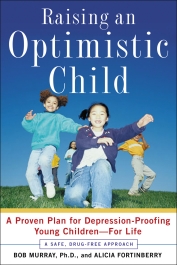
I located a book online today that presents information both about what happened to me and about raising a child who does NOT end up living a life of depression.

Raising an Optimistic Child: A Proven Plan for Depression-Proofing Young Children–For Life

By Dr. Bob Murray and Dr. Alicia Fortinberry

If you click on this title’s active link it will take you to a page that talks about the skyrocketing rates of increasing childhood depression in both the United States and in Australia.  This is part of the information you will read:

Childhood Depression Statistics

The rate of childhood depression is increasing by 23% a year according to a Harvard Medical Center study.

The rate of depression is doubling every 20 years.

1 in 3 American children suffers from depression, 4% of children under 6, according to 2001 National Institute of Mental Health (NIMH) statistics.  Depressions are on average e similar in Australia.

Preschoolers are the fastest growing market for antidepressants.

There is absolutely no evidence that antidepressants work for young children….

++++

We need to be VERY WORRIED about the conditions in our nation that are creating these kinds of stress-anxiety responses in our offspring!  These reactions are being built into little people’s bodies directly in response to the caregiver environment that they are being raised in and by.

TIME online:  Genes and Posttraumatic Stress by Claudia Wallis

++

Can Early Abuse Change Our Genes? It’s Possible

++

Effect of Childhood Trauma on Adult Depression and Neuroendocrine Function: Sex-Specific Moderation by CRH Receptor 1 Gene

++

The Link between Childhood Trauma and Depression

++

January 4, 2011

Controversial Gene-Depression Link Confirmed in New Study

++

Gene Protects From Depression After Childhood Abuse

++

HOMELAND INSECURITY

++++++++++++++++++++++++++++++

+THE UNITED NATION’S REPORT CARD ON AMERICA’S CHILD WELL-BEING – THE WIDE GULF BETWEEN THE HAVES AND THE HAVE-NOTS: AM I IMPASSIONED OR EMBITTERED?

++++++++++++++++++++++++++

Where does the calm voice of reason lie when it comes to hotbed topics that ignite American political passions or give the passive pawns (those of us who are now some scaled-down version of consumers) plenty of opportunity to turn away?

When it comes to the conditions created within our society that directly affect the lack of well-being of our nation’s children might it be best to listen to the trained voices of those who study societies as a whole – the sociologists?

I post here the informal email correspondence that took place this past hour between myself and my sociologist daughter concerning

The United Nations — The Innocenti Report Card 9 (2010)

THE CHILDREN LEFT BEHIND:  A league table of inequality in child well-being in the world’s rich countries

It appears that this report concerns the gap between the haves and the have-nots in our nation regarding the well-being of our children.  As my daughter clarified for me, the variable being measured in this 2010 9th report card is different than the overall well-being measured in the 2007 7th report card: +21 RICH NATIONS COMPARED ON CHILD WELL-BEING – U.S. AND U.K. AT THE BOTTOM.  I did not initially understand the difference between what was specifically being measured in these two reports until my daughter clarified this point for me.

If you would like to see the September 2009 8th United Nation’s Report Card 8:  Progress for Children:  A Report Card on Child Protection it is available by clicking on this title.

++++

I sent my daughter the link to The Innocenti Report Card 9THE CHILDREN LEFT BEHIND:  A league table of inequality in child well-being in the world’s rich countries (December 2010) and this is the discourse that followed:

She:  Definitely not good.  I don’t think we can even call it cognitive dissonance — most Americans just flat out don’t realize we aren’t best at everything!  So, therefore, what is there to fix?

Me:  I sense it even in your comment here, honey — nobody gets the real issue

like it’s destiny that we DON’T?  Is our nation MEANT to fail in the grand scheme of things?

NOBODY CARES!

This isn’t the issue of “most Americans just flat out don’t realize we aren’t best at everything!”

It’s an issue of suffering children, suffering families — social problems that CREATE this discrepancy — and long term extremely destructive consequences!

She:  I do get what you are clarifying here.  Cognitive dissonance would require that we have an awareness of facts that contradict each other.  Many Americans simply operate in ignorance of the reality/facts around them.  The collective national psyche is that “America is the shining example” — which I think contributes to ignorance of the severity of problems in the first place and to the lack of making changes.  I think that is a very important part of the picture.

Many people do care — but it is an uphill struggle much of the time.  Yes, it is incredibly serious.  I don’t know if we will turn things around, but I don’t think it is “destined” either way.  There are solutions out there and there have been times when we’ve made decisions in a relatively quick timeframe that changed the course of the country (for the better) — the implementation of Social Security/Medicare and civil rights, being more recent examples.  Those things didn’t occur without resistance!

Just for some perspective — in terms of inequality — conservatives argue that the overall quality of life in the United States has risen dramatically over the past century — for everyone.  And also that even most of the poorest Americans are far better off than those in third world nations.

This ignores, however, the rapid social changes that have occurred and the consequences on things that aren’t as tangible as food/water/shelter.  The impact on children being raised by stressed mothers/parents and subpar child care environments, the quality of education as a whole, what is going on with our food supply.

More to say, obviously — hopefully I’m articulating at least somewhat coherently.

Me:  This isn’t MINOR though — we are just plain too far down at the bottom to even BE blissfully ignorant – like the canary in the mine shaft, if there’s this much wrong with the well-being of our nation and its children, there is a WHOLE UGLY PICTURE here!

There will not be an America in 50 years at this rate, plain and simple – if we last that long

Me:  If what makes us feel better about our abysmal failure in taking care of the most important, most vulnerable, most helpless and dependent segment of our nation’s population is to compare our suffering children with those in the ‘third world’

I hope we get the hell dropped off of the rich nations’ list entirely!

She:  agreed

Me:  Then the UN should fire its statisticians – obviously they are lying

She:  No, they are looking at disparity — the gap between the middle and the lowest.  Just imagine having moved the whole curve over a bit.  Inequality is a very important measure.  The fact that inequality continues to worsen in the U.S., and reflects a larger (and growing) gap than our other “rich nation” peers — is a BAD thing.

Me:  Wasn’t that what the civil rights movement

and the ‘women’s movement’ were about

inequality?

revolutions?

civil wars?

We could make a separate nation, entirely separate, of the portion of our population – say the top 1/2 of one percent that owns at least 95% of our nation’s wealth

THAT would create a more accurate picture for everyone else remaining American — or would they have the power to take our nation’s name with them?

For every single one of these nationally neglected children some kind of trauma altered development and insecure attachment is building their body-brain

We will end up being a nation, as these children mature, of war mongers

Oxytocin and the human attachment connection calm peaceful potential growth is being thwarted in favor of vasopressin and testosterone — along with such an imbalance in neurochemistry that the reward system will continue to go in the wrong direction

These [have-not] children are being raised in degrees of malevolence, not benign benevolence and their BODY development will show it

from excerpt in last night’s post:  +WHAT REALLY HAPPENED TO US: VIOLENT TRAUMA, MALTREATMENT, ATTACHMENT – BIRTH TO AGE THREE (and beyond)

Recent research has also supported transgenerational transmission of biological response to trauma.  Whether this finding proves ultimately to be a risk or resilience factor remains a question.  An affected mother’s exposure to violent trauma during pregnancy (i.e., the 9/11 terrorist attacks on the World Trade Center in New York City) and her glucocorticoid stress response were linked to the glucocorticoid levels, upregulation of the receptor setpoint, and behavior of her infant by 9 months of life (Yehuda et al., 2005)….  Could this transmission of response to shared stress during pregnancy be one example at the very beginning of the organism’s life of adaptation in the service of evolution?  Is the mother’s biology preparing the offspring for expectation of threat?  If so, can one say that the development of PTSD (and/or other posttraumatic psychopathology) is a form of risk if no further threat actually exists, or resilience in the form of potentially beneficial hypervigilance to actual subsequent threat?” [bold type is mine]

++

There is such a thing as a tipping point – when this all goes TOO far we will not be able to bring our nation back to center or to the positive — That’s where destiny-natural consequence enters the picture.

++++++++++++++++++++++++++

+INSIGHTS ON MY MOTHER FROM HER LONG TIME ‘FRIEND’

From the second telephone interview with Joe Anne Vanover, by Linda Ann Lloyd Danielson, August 7, 2010

++++

“Did you hear about how your mother died?  At the end of Mildred’s life she was living in a miserable, miserable place off of Cordova in Anchorage in one unpleasant room with a bed, a curtain over the window, a little shelving and cabinets to put stuff in, I think a chair, with a shared bathroom and kitchen – cheap room.

I am remembering why I had gone in there.  She wanted something.  I had seen her a month before and had agreed to meet her to go someplace to eat.  She needed to go to the store, and when I got there she was on the floor and couldn’t get up.  I called 911 that time but when they got there they said they could not take her as long as she was coherent and clean even if she couldn’t get up.

So I had seen her on the floor before, and I helped her up and went and got her some stuff.  I went back the day after to check on her and she wasn’t there.  I asked others who lived there where she was and they said she had knocked on her door and asked for someone to help her get up.  When they opened the door and found her another boarder called the paramedics who took her.  Her room was a mess.  She had been using newspaper for toilet paper and there were feces all over.

She had a strangulated bowel so that feces was backing out of her mouth.  I went over to the hospital and found her in one of the emergency room’s cubicles.  She would not agree to surgery.  She WOULD NOT let the hospital call her sons and had kept telling the hospital personnel that Joe Anne would be there to see her.  She was glad to see me.  I left the cubicle and called your brothers anyway and the boys came right over.  They were very kind.  They asked me if I would back them for institutionalizing your mother after surgery and I said yes.

With her boys there she agreed to surgery, but she died under the prep.  The anesthesiologist was devastated.  He had never lost anyone before, but Mildred had so abused her body for so long it was not his fault, and I told him so.  The boys went to collect her stuff.”  Died January 28, 2003

°<>°<>°<>°

I have no idea where Mildred’s money went.  [Bill’s retirement gave her $3000 per month to live on.]

Years before she started starving herself for four days at a time.  Mildred said she needed to practice so she would know if something happened she could live that far, for that long and survive for four days without food.  I would find out and then take her out to eat and she would overeat, gorge herself because she would be starved.

She had no idea – she loved her kids but not you, obviously, but the others until they got old enough they could question her.  She had no idea how to go about being a family or a mother.

[I asked her what she thought about Mildred’s mother.]  My impressions on your grandmother was that she was very businesslike.  One year when she came up to Alaska she did testing on both of my boys [related to their schoolwork].  She was not unfriendly, but not real friendly.  I think she was a very weird lady.  What she did to Mildred was horrid because Mildred did not know how to love.

[During the homesteading years] Mildred would work out these fantasies.  One time she told me she had built a fire down by the creek [where Bill filled our water cans for our drinking water] and pretended she was an Indian princess, washing clothes. [My thoughts are growing about early infant-child damage to my mother as it involved her imagination, ‘pretend play’ that never moved through the Theory of Mind developmental stages required to differentiate ‘true reality’ from ‘pretend reality’.  Remember that I include the operation of DENIAL past the childhood stage of pretend play as being a reversion back to that stage of childhood thinking.]

Mildred had never been loved.  She had been told her dad was dead when he was alive all those years.   Her mother did her such disservice.  All of your family is very smart – but her mother drained out of her everything that would have let her know how to be happy.

Her mother didn’t want her to be happy.

When your father had his stroke, Mildred was extremely concerned he get the best of treatment.  [This was long after their divorce.]  I never heard her say a hateful word about Bill.

Your mother had the most fascinating ability to take any place and fix it up and make it look homey and nice.  That’s why it was such a shocker at the end.  It was terrible!  I knew she was sick, it was terrible, just terrible.  She wouldn’t take help from your brothers, from anyone, I am one of the few people.  [Joe Anne expressed regret repeatedly that she didn’t force someone to intervene on Mildred’s behalf.  I believe Joe Anne did all that was humanly possible considering my mother’s insistent and belligerent refusal to have contact with family, or with anyone else other than Joe Anne at the end of her life.]

I have great compassion for Mildred because I have had wonderful life, loving parents, a great family, a good life.  I have been in the same house since 1951.

The year before she died I knew she hadn’t been anywhere for a long time and I took her to Hatcher Pass.  She loved it and it gave me much pleasure.  Your brothers were so kind as to give us the pictures we took that day.

Underneath she felt really sorry for herself.  She expected more of everything, wanted more of everything, yet had no idea how to achieve it, how to have a family.

Her brother Charles was mean to her.  Underneath I don’t think Mildred was sure about anything .

One time [long after I had left home and after their divorce, when my youngest son was a teenager] Mildred got $20,000 from some relative.  She bought a horse, hired guy to do stuff on homestead, didn’t know how to manage money.

Your mother was probably attracted to Bill because he was kind, quiet and gentle and a heck of a worker – times he worked away from home because it saved his sanity.

I think she was afraid all of her life.  For years she had a set of pearl suitcases, and kept her things in them and took them everywhere with her.

++++

I remember when I first met your mother, when your family first came to Alaska.  I would go over to see her right after you older ones got on the school bus in the morning.  The house would be perfect, too perfect, that always amazed me.  I never understood that.  And when I would go over your little sister [Sharon, just turned two] would always climb up in my lap and just sit there.  I never understood why she did that, either.

Your mother used to tell me that she would have you girls and nightgowns and she’d have your father brush you girls’ hair.  She never said Bill did anything, but I took it she was setting him up to do something.  The way she told the story about having him do it and how much he enjoyed it, she was wanting to see what would happen, what he would do.  Took it, even then, she was trying to provoke something.  [No matter what our mother said about our father molesting his daughters from the time we were very young, even babies, Joe Anne adamantly said, “It was not true.  Your father never, never, never could have done such a thing.  He didn’t.]

I knew your dad had a temper, but I never saw it.

I remember one time when your family was homesteading your mother told me she had taken dirty clothes down by the creek where your father got water.  She said she had built herself a camp fire, and had pretended she was an Indian princess living there in a camp, washing her clothes.  [Joe Anne expressed amazement and puzzlement at this, that she never understood this, but I didn’t write down her exact words.  I will ask her again later.]

Toward the end Bill could hardly stand her.  Their divorce?  She egged him on.  I think she wanted the divorce.  When everything went down in the 80s she had the money. she could have bought a condo.  Back before your brother started his bookstore, when he was selling real estate, your mother had money and he tried to get Mildred to buy something, like a condo.  She would not consider it.  Your brothers used to invite her for holidays, to dinners, but at the last minute she would say she couldn’t go, say it’s too difficult.

But Mildred used to really worry about your brother Steve that he would never make it.  She really enjoyed you brother Dave’s two girls.

Mildred used to tell me that the only time remember happy when she was growing up was when she was walking out in the woods.  She told me how much time she spent walking – that’s where she found her comfort.  [I think that’s why she liked Alaska so much, it reminded her of that.]

She told me she was very uncomfortable in high school, but after, when she went to work in a hospital, she really enjoyed it and had a good time.  [I mentioned to Joe Anne my memories from my mother’s stories that she wanted to study theatre and go on stage, and her Bostonian mother and grandmother told her, “NO!  Only whores and harlots are in the theater.”  Nursing was THEIR choice, not my mother’s though Joe Anne said that Mildred enjoyed the nursing.]

All her life she was thwarted on what she wanted.  She didn’t know how to get it.  She had a terrible, terrible crush on her shrink, such a crush on him, it was pitiful, pitiful.  {I asked Joe Anne if she believed the ‘shrink’ ever responded back to my mother inappropriately and Joe Anne said, “No.”

Much later, when she was living on Government Hill she invited me over.  At first it was empty and she slept on a mat on floor.  I called paramedics but they wouldn’t’ take her.  The she got the bug and fixed it up like a doll house and asked me to come over to meet this Guatemalan she liked.  He wanted to marry her.  I went up there, and met them.  He had worked on a crab fishing boat but he was getting too old.  I couldn’t believe it.  Her actions were wanton –  I don’t know if she was aware of how sitting, posturing, what she was saying.  I talked to her afterward.  I told her he won’t marry you, unless he thinks you have money or he wants to bring a family into the country.  I was totally amazed, aghast, it was so out of character for her.  She was like a teenager trying to entice a boy she wants and would do anything to get.

After the divorce she used to go to dances.

[Now this statement for difficult for Joe Anne to tell me, and I am glad she felt ‘safe’ enough with me to do so.  It is an important one.]  I felt sorry for her.  She was so squirrelly.  I had never met anyone like your mother.  I never knew what to make of her.  She fascinated me, but to me she was like a bug I had on in a pin.  I have felt guilty for feeling this way.  But she was beyond anything you could imagine.  I liked to watch her.  I felt terribly sorry for what she was doing to herself.

[I reminded Joe Anne that if she ever directly confronted Mildred on what she saw and M didn’t like it, M would not only ignore here, but would disappear – sometimes for years.  As far as the ‘bug on a pin’ image, I realized last night as I talked to my daughter that it really was my mother’s mental illness that Joe Anne nailed on the head of a pin — which is what I wish COULD happen to the icky, nasty, invasive, consuming kind of mental illness my mother had!  I think inside herself Joe Anne DID care for the WOMAN, the individual person my mother was.  It is no small testimonial to the importance that Joe Anne played in my mother’s life that it was Joe Anne she knew was coming at the end of her life, was Joe Anne that my mother was glad to see.]

[I noted another comment I will ask her about again:  When Mildred, her mother and grandmother were driving across country from Boston to Los Angeles in 1945 when she was 19, they ran out of money for gas in Nevada and had to sell Mildred’s pink record player which made my mother very sad.  Joe Anne said my mother never got over this.  Considering that the family sold or left behind them many ‘nice’ possessions for this move, this record player (I seem to remember when Joe Anne mentioned this that it was a gramophone) would have been one of only a very few most important and prized possessions that they were able to fit into the car as they traveled.  I suspect even this experience fits into my mother’s ‘psychosis’ and continual moving, and is tied to her losing any sense of a safe and secure attachment connection with her entire childhood life ‘back East’.  I believe as I carefully examine the words that survived about my mother’s story, that this move was just about the worst thing that could have happened to her in her ‘condition’.  In insecure attachment disorder terms, Mildred’s record player was probably a ‘transitional object’ connecting her with her past attachments – not in itself a ‘bad’ thing.  But according to Joe Anne, my mother never got over losing this object.]

°<>°<>°<>°

I didn’t stay glued to my computer during this interview when it seemed to slip into conversation, so much of what Joe Anne said over the span of these two hours did not get recorded.  I am not worried because I know there will more interview-conversations in the future.  Joe Anne (widowed) is about as opposite from my mother as she could be.  She is in her mid-80s, busy, active, involved with family, entertains guests, has lots of friends, has a large and beautifully kept home she cares for herself, lots of lush plants and flowers both inside and out, travels, is close to her children, and is healthy and very, very happy.

She believes that part of what kept my mother in touch with Joe Anne for 45 years was that Mildred believed that Joe Anne the kind of ‘family’ and ‘home’ that Mildred imagined for herself, yet never had any idea how to ‘get’.