
+CONSUMERS BEWARE OF TRAUMA TRIGGERS LURKING IN ‘HOLIDAY SEASON MAGIC’

+++++++++++++++++++++++++++++++

The Holiday Season can be a Trauma Trigger Trap for unsuspecting infant-child abuse and trauma survivors.

+++++++++++++++++++++++++++++++

I am still working on my main post for today about the meaning of the word ‘symptom’, but in the meantime I wanted to present this information from About.Com about Borderline Personality Disorder and the Holidays.  I present this information in memory of my mother, and in memory of her traumatic early infant-child history.

I think difficult emotional states surrounding the Holiday experience can be passed on down the generations just as any other trauma can be.  This is particularly true with holidays that are supposedly child centered.  If trauma surrounds a family’s experience of Christmas in the past, it can be especially true that a child will remember Holiday Season traumas – in their body – without having conscious memory of the facts of the related traumas they endured when they were very young.

I found in my mother’s mother’s own 1930 writings a reference to exactly this kind of Holiday Season trauma when she wrote the following:

As I remember, the late fall [1929?] everything was normal and happy at home.  Christmas is always an unhappy strain of feelings to me. Constantly I made conscious effort of not throwing arousing antagonistic attitudes in my husband [sic].

And where did my grandmother’s difficulties with the Holidays come from?  No doubt from her own early experiences in her own childhood that nobody EVER openly talked about.

Adults can try all they want to try to hide family discord from young children, but humans are emotional detection experts from the time we are born.  It is important to remember that the kinds of emotional distress and traumatic family experiences contained within the Holidays has the power to impact infant-children within their BODY memories for the rest of their lives.

The Holidays thus provide an excellent opportunity to practice changing intergenerational patterns of stress, distress and trauma!  Never that I know of was my mother ever able to admit the truth that the Christmas Holidays were NOT always happy, charming, or pleasant during her childhood.  Why are we so willing in America to practice denial about the truth about Holiday Season trauma?

As I have said before, denial is itself a form of childhood wishful magical thinking.  Because the Holidays are supposed to be these perfect childhood blessed magical times, it is probably exactly HERE that we are most likely to find massive denial present.  Childhood magical thinking (that turns into denial in adulthood) is a perfect fit for Holiday Season emotional set-ups for disaster.

The Holiday Season can be difficult for a lot of people.  From my point of view, it will always be those who did not experience infant-childhood safe and secure attachments, and therefore themselves as adults now have some version of an insecure attachment disorder that will probably be the most high risk people for having emotional complications around this season.

++++

Just as the Holidays provide a perfect match between the practice of adult denial and fantasy because, after all, Christmas is SUPPOSED to be a magical season, it also provides a perfect stage for trauma dramas to continue their repetition on down the generations.  No matter how much effort caregivers of young children might exert toward disguising their own emotions and internal traumatic dilemmas about the season, their sensitive – and often already trauma sensitized offspring – will be able to detect the underlying truths.  The Holidays thus continue to be fertile ground for the transmission of ongoing adult unresolved traumas.

Any adult who did not experience safe and secure attachments within a benevolent infant-child environment had some form of emotional dysregulation built into their forming early developing right social limbic emotional brain.  This emotional dysregulation came from their caregivers who also experienced the same patterns in their own childhood.  These patterns are formed not only into the early brain, but also into the early forming nervous system on all its levels.

For those who are trying very hard NOT to pass down their own traumas to their own children, this Holiday Season can provide a perfect opportunity for deep, profound and fundamental learning about how insecure versus secure attachments operate.  Insecure attachments happen when adult early caregivers are so consumed and overwhelmed on their own insides by unresolved trauma experiences that they lack the ability to be present for their children.

Children are supposed to be front and center in their caregiver’s life.  Caregivers are supposed to be able to have their own attachment need system turned OFF so that they can care give to their young ones.  When adults cannot experience their own internal state of safety and security in the world, they cannot provide this experience to their offspring.  We can start our efforts to be present for our children by becoming honest and very clear about the truth of how the Holiday Seasons felt to us when we were young.  Trash the fantasy.  We are fooling no one, not ourselves and certainly not our children.

++++

If you follow the links provided by About.Com concerning helpful information for those suffering with Borderline Personality Disorder and their loved ones, you will find specific ideas about handling the emotional dysregulation that the Holiday Season can so easily present and amplify.  Remember that we are experiencing all of our life with the tools (our brain and nervous system) that were formed in our own early infant-childhood.

Emotional regulatory abilities are not automatically built into an early traumatized little one’s body in an ordinary way.  But it is here that we can begin to practice our growing consciousness about how our changed body-brain-mind-self actually FEELS and how we can consciously change our experience.

We can understand that every difficulty we experience around the Holiday Season is connected to our own early experiences of trauma in unsafe and insecure attachment environments.  Our own unresolved trauma is NOT what we wish to pass down to our children.  How willing and able are we to actually not only KNOW the truth about our own early trauma – and if we had early trauma at all it certainly did not magically skip over the Holiday Seasons of our childhood?  How willing and able are we to actually TALK to our families about the truth of how we feel?

Attachment experts use the presence, absence and quality of child storytelling as a gauge of secure or insecure attachment in children who are old enough to talk.  Adults need to encourage children from the earliest ages to TALK about themselves having the experiences of having the experience of being a person alive in a body in the world.  This is a continuation of the face-to-face emotional-self mirroring processes between an infant and its early caregivers (primarily the mother) that directly build the right brain in the first place.

It is NEVER too late to add safe and secure mirroring processes between people into our lives.  These interactions not only form the early right brain and form the foundation for all future body-brain-mind-self growth and development – but they help to HEAL the same for those of us who did not experience these interactions in the beginning.

++++

Another extremely important point to remember is that for people like me, the Holiday Season can trigger all kinds of dissociated experiences.  My mother’s chronic and severe abuse of me, that started when I was born and happened for the next 18 years of my childhood, was very likely to be suspended during ‘certain’ kinds of experiences:  Picture taking events.  These included birthdays, any kind of holiday in which a pretend safe and secure attachment HAPPY time was created by my mother inside of bubbles that had nothing whatsoever to do with my ongoing REAL experience of being tormented, tortured and abused by my mother.

Because the abuse seemed to be suspended during these events, and because I was more or less allowed to join with the family during them, and because during these events I was given permission by my mother to be ‘happy’, I COULD tend to continue to pretend that these events were truly special, safe, secure and happy.

They were not.  They simply created more dissociational bubbles of experience that I could not remember in any coherent, ongoing story of my life.  Remember, the inability to tell a coherent life story is one of the MAJOR hallmarks-symptoms of adult insecure attachment patterns and of dissociation.  All kinds of pictures still exist of ‘happy Linda’ during these ‘happy events’.  All dressed up, curls in my hair, opening presents, holding an Easter basket – well, come to think of it I don’t know of one picture of me on a birthday being the center of attention.  But, anyway, you get the picture and my point.

See:  *Age 8 – The Reindeer Envelope – My Own Art Work Analyzed By Me – The Art Therapist

My mother’s ‘nicey nicey’ treatment of me on ‘special occasions’ such as holidays fed into, strengthened and perpetuated the trauma bond that I had with her as my caregiver.  You bet my body has the truth about all these memories!

It has taken me a lot of time and effort as an adult to get to the point NOW where I can clearly see that my mother’s creation of ‘happiness bubbles’ around holidays, that supposedly let Linda out of her miserable captivity of trauma and abuse, simply gave me new dissociational experiences that could not be fit into my ongoing experience of myself in my life.  I never even tried.  I was already a refined, expert dissociator by the time these experiences filtered into my reality.

So think about these types of patterns in your own life, and think about how your experiences of them might be impacting your own children’s experiences.  Why perpetuate the hype?  Are we safely and securely attached today in any of our relationships that we can let ourselves know our own internal truth about how trauma has infiltrated all of our experiences, including the supposed ‘happy times’ of our traumatic infant-childhoods?  Are we continuing to try to create dissociated ‘happy bubbles’ out of the Holidays that have nothing to do with the ongoing nature of our reality?

Because current statistics show that about half of our population had safe and secure attachments in their infant-childhoods, we already know, then, that the other half of us suffered from some deprivation related to attachment.  This other half of us ALL experience (my bet is) some form of infant-childhood trauma memory, deep within our body memory if not consciously, related to insecure attachment experiences around the Holiday Season.  This is a REALITY that does not feed into FANTASY.

It is helpful to make this distinction particularly because the Holiday Season is based in fantasy in all but its most direct Christian historical ties.  It is, perhaps more than any other time of the year, a season when unsafe and insecure attachment trauma histories will appear – one way or the other – to give us emotional (from our body’s memory) big trouble if we are not as conscious as possible about the reality of our infant-childhood life. We can take appropriate care not only of ourselves, but of all those around us who depend upon us not to transmit our trauma drama histories on to them.  (HINT:  Think of this as a Trauma Altered Development allergy to all the fantasy perpetuated about the Holiday Season.)

This is so true that we could actually benefit from attaching a huge consumer warning sign to the Holiday Season:  “BEWARE!  This season is most likely to trigger your early traumatic infant-child memories if you have them!”  It is from this point of awareness that many of us need to prepare for the holidays.  What can we learn from — and how can we change and heal from — our own history of early traumas – no matter where they may be lurking?

+++++++++++++++++++++++++++++++

About Borderline Personality Disorder: Distress Tolerance for the Holiday Season

In the Spotlight | More Topics |
from Kristalyn Salters-Pedneault, PhD
The holiday season is a really hard time for so many people. There are expectations that we will be joyful, or surrounded by friends and family. But for many this is not the reality, and the holiday season can bring extra stressors on top of the expectations. This week, start preparing by practicing some new skills to help with distress tolerance.

What are Distress Tolerance Skills?

In the Spotlight
The distress tolerance skills are a set of tools that will help you manage intense emotional states without doing anything destructive. These skills will not necessarily wash away the emotional pain you are feeling or even make you feel less distressed. Instead, the goal of these skills is to prevent you from doing something that will make the situation worse.

Not-So-Happy Holidays?
As the holidays approach, lots of people with BPD (and people with BPD in their families) struggle. Holidays are complicated!

“Go-To” Coping Skills
When you are having an intense emotion, it can be hard to know what to do. Unfortunately, many people with BPD turn to unhealthy behaviors in an attempt to cope with emotional pain (e.g., self-harm, substance use, or aggression).

More Topics

+++++++++++++++++++++++++++++++

Please feel free to comment directly at the end of this post or on

+++++++

Your Page – Readers’ Responses

++++++++++++++++++++++++++++++++
+THOUGHTS ON THE TRIGGER POINT OF SHAME

++++

I have the advantage of trying to work my way through trauma related information using my own experience as a basis for what I know, rather than being locked into any established patterns of thinking about either trauma or the so-called ‘mental illnesses’ that are directly connected to Trauma Altered Development (TAD).   I am writing a ‘forensic autobiography’.  That means I write from the perspective of being a ‘confessional’ rather than from being a ‘professional’.  I am free to think any way I want to about the topic of trauma as it concerns me and others like me.

I try to understand what the developmental, attachment, and neuroscience experts say about the topic of TAD, but I am certain that if I line up my conclusions on the topic against these expert findings we will not always match point by point.

I want to talk today – again – about how trauma influences our core development as infant-child abuse survivors.  If our earliest caregiver interactions were not safe and secure, our development was altered from the start.

The experience of shame, as I have written before, is a very real physiological Autonomic Nervous System response to explorations within our early environment that caused us to experience conflict – rupture either with or without repair – with our early caregivers.  If there was no serious rupture (we were in agreement with our caregivers about our self in our environment), or there were ruptures that were met with repair through the appropriate actions of our early caregivers, the “GO” and “STOP” balance within our growing Autonomic Nervous System (sympathetic arm = GO, parasympathetic arm = STOP (pair a brakes)) developed optimally and well in a balanced, ‘ordinary’ way.

These ‘shame’ interactions are always based on the experiences prior to the age of one either in a benevolent or malevolent early caregiver environment that has already by this age built our growing brain, nervous system, body and earliest experience of self in a particular direction.  If these interactions were benevolent, a different body-brain-growing mind and self is forming than would be one that is forming under malevolent conditions.

We have to begin to REALLY understand how profoundly our experiences within our earliest caregiver environment affect us – permanently.  Once we are one year old, our development has already been profoundly directed by the kinds of experiences we have had with our caregivers, primarily with our mother.  It is on this earliest foundation that all other experiences will be processed within our little growing body.

By the time we grow a body-brain that is physically developed enough to be able to experience SHAME at one year of age, the course of our development has already been determined – either within and for a safe, secure, trauma-free benevolent world, or for the opposite.

++++

I mention this today in following my post of yesterday where I described my opinion of our nation as not being completely pro the human rights of children.  The ability to optimally experience shame in a growing body already by the age of one, I believe, is directly tied to how we experience any later event that involves conflict, consciousness, conscience and choice.

I believe the earliest caregiver interactions we have, mostly benevolent or malevolent, color the development of our personality.  Experts still suspect that personality is primarily influenced by our genetics.  However, developmental, attachment and neuroscientists are rapidly uncovering the facts about how our earliest experiences actually tell our genes what to do.  Given these new and extremely important findings, we can no longer ever assume that anyone’s personality follows the same developmental pathways if everyone is not raised with the same Universal Human Rights guaranteed.  Any violation of basic human needs for development, as conveyed through our understandings about basic human rights, causes Trauma Altered Development (TAD) to occur.

Our national personality is built upon the personalities of all the individuals that are a part of the whole.  Because we are a democracy, the most obvious personality we show to the world becomes the personality of the majority of our members.  Each of our own individual personalities, in turn, were built upon a combination of our personal genetics as they manifested themselves within either a primarily safe and secure early environment or within a traumatic one.

If early attachment is not safe and secure, some degree of trauma is present because fundamental universal human rights were not guaranteed.  We are talking humans here.  Humans have basic PHYSIOLOGICAL needs for our optimal development that create us – in an interaction between our genes and the quality of our early environment – to end up being a certain way in the world.

++++

America prides itself on being a nation of individualists, choosing to consider that within the perhaps one percent of our genes that make us different from one another there is enough individual potential for differences that it outweighs the 99% of our genes that we share in common as members of our social human species.  I suspect, however, that it is only when early developmental needs are met through the application of human universal rights that the development of the foundational 99% of our shared genetic material can manifest itself optimally that the remaining 1% that provides us the buffet of individual differences can grow, develop and shine among us.

If basic human needs are not met in a safe and secure early environment primarily free of trauma (without ruptures for which there are not adequate and appropriate repair) as described within the recognition of basic human rights, the 99% of us has to take a course through Trauma Altered Development that means we have been forced to adjust to the trauma in a way that limits our ability to be far more of our unique, different self as adults.

Early traumatic, unsafe, insecure and malevolent environments seem to me to narrow the ‘channel’ through which we can pass through our early body-brain-mind-self developmental stages – and still survive.  One by one, I can think about everyone I have ever met who suffered from a malevolent early childhood and begin to see how the patterns among them-us-me become more alike in fundamental ways than they are different.

If I simply look at the so-called ‘personality disorders’ that researchers are now finding are nearly ALWAYS tied in their origins to early infant-child abuse and trauma, the end result makes these people enough alike that they can be grouped into ‘functioning categories’ according to the ‘symptoms’ that they demonstrate in their continued lives.

If I look just at three particular people, I see how Histrionic Personality Disorder, Narcissistic Personality Disorder, and Borderline Personality Disorder lie on a continuum of personality alteration that created these people to be different than I believe they would have been had their Child Rights been guaranteed so that they would have been able to grow up without Trauma Altered Development.

The very best scenario for human growth and development occurs because of development that happens without the mediating and CHANGING affects of trauma.  Only when Children’s Rights are guaranteed within safe and secure environments can a body-brain-mind-self grow up to be free – and by that I mean, free to be MOST flexible and creative throughout their lives in their actions and responses to every life experience (change) that they encounter.

Trauma Altered Development means that we have been forced to sacrifice aspects of our own autonomous development.  We are forced to be more alike than different because SURVIVAL itself has specific requirements that need to be met.  If we are exposed to overwhelming danger, threat and trauma during our early development, our specie’s resiliency factors from within our bodies will be forced into activation.  If the threat to our infant-child well-being endangers our body-brain-mind-self on the most basic levels, the Trauma Altered Development we experience will simply turn us primarily into SURVIVORS    rather into the most unique, flexible, creative original beings that we had the capacity to become.

To the degree that trauma changes a developing infant-child so that they can survive, to that degree will conscious choice and aware decision making be removed from them – unless and until these survivors can learn what the physiological trauma-changes were, how they affect us, and how we can now FORCE ourselves to become increasingly more conscious in our lives.

Non-trauma-altered people who were not forced to physiologically adapt to early traumas naturally end up with a fuller buffet of consciousness – including the ability to empathize, use a broadly built Theory of Mind to understand themselves in relationship to others in the world, and filter their experience through an aware conscience.  They simply have more choices about how to be in the world.

Of course, these non-trauma developed people can choose to be total jerks if they want to be.  Yet we know that a staggeringly high percentage of our nation’s criminal population suffered from Trauma Altered Development in malevolent childhoods.  Compared to people with Trauma Altered Development, the range of potential choices for non-trauma altered people appears to be almost infinite.

The feedback-feedforward information gathering and response loops within the body-brain-mind-self of a non-traumatized infant-child compared to a traumatized one form differently.  When I think about optimal development using the image of the infinity sign, non-trauma development creates an ever expanding, fully operational flow of life force along that “8” pathway.

The more an individual is forced to apply survival-based physiological changes during their infant-child development in the midst of trauma, the smaller the “8” pathway becomes.  In cases such as my mother’s was, the “8” simply broke so that she was left with the repetitive patterns of “0” only, living her life without the ability to allow incoming information to come in without it having to be processed entirely through the filer of the damage she suffered in her development through trauma.  My mother was not allowed to become the fully unique, thriving, creative, flexible person she COULD have become had she not been forced to physiologically adapt in order to survive during her developmental stages as an infant-child.

++++

The physiological crisis point within our human body-brain-mind-self as we interact with others of our species is at the SHAME point.  No matter how we choose to recognize this point, no matter what word we choose to apply to this very real physiological point in the operation of our Autonomic Nervous System (ANS), it is at this SHAME point that we are notified that there has been a rupture in need of repair between ourselves and others around us.  The SHAME point is where the “GO” and the “STOP” within our body-brain-mind-self happens.  It is at this point that negotiation can happen successfully – or not.

It seems entirely possible to me that this SHAME point is where the two circles of the “8” infinity sign meet one another.  In cases such as my mother’s, it is at this point that she broke and was left with “0”, unable to negotiate herself as a being in relationship not only to others, but also in relationship to her own self.  She lost the ability to consciously identify herself in a complex world of shifting realities.

My mother operated from the extremely limited survival-based point of automatic pilot only.  She could not flexibly and creatively, openly or consciously consider options to solving conflicts because everything about her centered on NOT feeling shame because she could not tolerate it.  When an infant-child’s environment is so unstable, when their basic human needs-rights are not met, when survival becomes the ONLY option, it means that the patterns of rupture without either repair or HOPE of repair have so signaled the developing little person of danger in a malevolent world that all but the most very basic, primitive options have been allowed.

++++

The problem with overwhelming trauma is that it disturbs the rupture-repair pattern of checks and balances that allows life to continue going on in anything like a normal or ordinary way.  The problem with overwhelming trauma during our infant-child developmental stages is that we are forced to find a way to survive at the same time we have the most limited resources we will have in our lifetime.  Our only option was, in effect, to steal from our own inner bank of resources in order to survive.  This causes the problem to be built right into our developing body-brain-mind-self because we are then depleted from the inside out.

The point of surviving trauma is to eliminate its effects on us.  If we have no power to eliminate its effects (think here, little tiny person) then the next best thing we can do is eliminate our awareness of the experience of being in a state of ongoing trauma that we cannot escape from.  We have no option except to escape on the inside.

Recovery from trauma post-infant-childhood means that we ‘return’ to a normal or near normal state which happens when the rupture that trauma created becomes repaired.  There must be adequate resources available to allow repair to take place so that life can “GO” on, one way or the other.  In the case of Trauma Altered Development during infant-childhood, the resources had to be found within the child itself because they were not available from the outside.

I do not believe it will be much longer before we understand completely that nearly all of what we call ‘dysfunctional behavior’ including ‘mental illness’ is a result of overwhelming trauma during infant-childhood developmental stages that causes survivors to steal from their own inner storehouse of resources at a time when having to do so – in order to stay alive – robs them of the capacity to later experience a full, healthy, flexibly adaptive, creative best-developed-self.

It is for this reason, if for no other, that a guarantee of Child Rights becomes such a critically important factor.  When a child has its fundamental human rights provided, it will not be forced to use up its own internal resources in order to survive.  Those resources HAVE TO COME from the outside of the child.  That is what human childhood is – a developmental period of growing and expanding ability to sustain oneself in the world.  In order for an infant-child to develop optimally, its needs must be attended to and met during these stages of dependency.  If those needs are not met from the outside, Trauma Altered Development will occur, or the infant-child will die.

It is the responsibility of all adults to ensure that all of a child’s rights are guaranteed and protected.  Nature has designed humans so that appropriate and adequate adult caregiving of infants and children is our specie’s primary, number one resiliency factor.  We must lift the yoke of stigma off of the survivors of infant-child neglect, abuse and trauma and place it instead on all the adults in the society surrounding our little ones that allowed this malevolent treatment and trauma to happen to them in the first place.

It is on this level that I place responsibility and accountability on our nation when I say “SHAME on you!”  Either we intend to STOP neglecting our responsibility to our nation’s children or we don’t.  Either we intend to repair the rupture in the fabric of our society that allows the basic rights of children to be violated, or we do not.

If we choose to GO on letting traumas happen to our little ones that is within our society’s power to STOP, then we must realize that the Trauma Altered Development that will happen to these maltreated and traumatized infant-children will change them on their most primary, physiological level — as they are forced to take from inside of themselves what they need in order to survive — because the adults in their world were not there to help them.  Having to do so will change the degree of well-being for these survivors for the rest of their lives.

When the trigger point of shame is touched, it is time to examine conscience and to choose a course of action.  This is true for individuals and for the societies they are a part of.  In cases such as my mother’s, these abilities were removed from her through trauma that caused her Trauma Altered Development.  Is this same kind of pattern also contained within our nation?

++++++++++++++++++++++++++++++++

Please feel free to comment directly at the end of this post or on

+++++++

Your Page – Readers’ Responses

++++++++++++++++++++++++++++++++
+AMERICANS MUST NOT BELIEVE THAT CHILDREN ARE HUMAN BEINGS — THUS, NO HUMAN RIGHTS

++++++++++++++++++++++++++

Any violation of an infant-child’s rights constitutes abuse in my book.  Our nation can march itself, fly itself, bomb itself, invade itself all around this globe proclaiming to be the great protector of human rights, while within the boundaries of our own nation we refuse to even accept that children are human beings.  If we DID accept this fact, that children are not possessions and are, indeed human, then we would have to recognize EVERY SINGLE ONE OF THEIR UNIVERSAL HUMAN RIGHTS.  SHAME ON US!  SHAME!  SHAME!  SHAME!

++++++++++++++++++++++++++

First, let me say this:  It is an honor to have Pat reading and posting on my blog.  I was concerned that her post today would be lost in the comment tailing pile from the mine of information accumulating on Stop the Storm.  So I copied it over here!!

COMMENT MADE TO +ALIGNING OUR NATION WITH UNITED NATIONS CHILD RIGHTS IS AGAINST OUR OWN LAWS

BY:  Pat Gordon-Smith
on December 6, 2009 at 6:11 AM

There’s an excellent accessible version of the UN Convention on the Rights of the Child at http://www.savethechildren.org.uk/en/docs/Know_Your_Rights_poster.pdf

It’s a poster intended to inform children of their rights and, as such, is great for anyone. The language it uses is important, too. It shows the extent to which the world of children’s rights has moved on since the Universal Declaration on Children’s Rights. Then, the version written for children has them as passive dependants. In this version children are active agents, following the spirit of the CRC itself.

Here is the text from the poster. The numbered points correspond to the articles in the convention:

1)  Everyone under the age of 18 has ALL of these rights. You have the right to…
2)  Be treated fairly no matter who you are, where you are from, what language you speak, what you believe or where you live.
3)  Have adults always do what is best for you.
4)  Have all of these rights protected by your government.
5)  Be given support and advice from your parents and family.
6)  Life.
7)  Have a name and a nationality.
8 )  An official identity.
9)  Not be separated from your parent(s), unless it is for your own good.
10)  Be reunited with your parent(s) if they have to move to another country.
11) Not be taken out of your country illegally.
12)  Have your own opinion, which is listened to and taken seriously.
13)  Find out information and express what you think through speaking, writing and art, unless this denies other people their rights.
14)  Think and believe whatever you want to and practice any religion, with guidance from your parent(s).
15)  Be with friends and join or set up clubs, unless this denies other people their rights.
16)  Have your privacy and family respected.
17)  Get reliable information from newspapers, books, radio, television and the Internet, as long as it is not harmful to you.
18)  Be brought up by your parents, if possible.
19)  Be protected from being hurt or badly treated in any way.
20)  Special protection and help if you can’t live with your parents.
21)  The best care possible if you are adopted or in foster care.
22)  Special protection and help if you are a refugee.
23)  Access to education and any support you may need if you have a disability.
24)  The best health and medical care possible, and information to help you stay healthy.
25)  Have your living situation checked regularly if you are looked after away from your family.
26)  Help from the government if you are poor or in need.
27)  A basic standard of living: food, clothing and a safe place to live.
28)  An education.
29)  An education that develops your personality and abilities, and encourages you to respect other people, cultures and the environment.
30)  Enjoy your own culture, religion and language, even if these are not the same as most people in your country.
31)  Rest, play and relax.
32)  Be protected from work that harms your health or education.
33)  Be protected from dangerous drugs and their trade.
34)  Be protected from sexual abuse.
35)  Not be kidnapped or sold.
36)  Be protected from being taken advantage of or exploited in any way.
37)  Not to be punished in a cruel or hurtful way.
38)  Protection and care in times of war. If you are under 15 you should never be forced to join an army.
39)  Special help if you have been hurt, neglected or badly treated.
40)  Be helped and treated fairly if you are accused of breaking the law.
41)  Be protected by national or international laws which provide better rights than the ones in this list.
42) ALL children and adults should know and learn about these rights.

I’ve just written a blog entry about this on my blog, ‘Children’s rights and other things’ (http://patsky.blogspot.com) that includes some further explanation of certain articles.

+++++++++++++++++++++++++++++

Please refer to the December 12, 1989 United Nations General Assembly document from the Convention on the Rights of the Child from which this above 42-Article List of the Rights of the Child have been condensed for ease of understanding and clarity for our globe’s children and youth.

++++

I remember years ago when I saw a plaque hanging on the wall of someone’s home I was visiting that simply read, “Clarity Begins At Home.”  Today I found this same phrase incorporated into the thinking represented on the website for ERIC – Education Resources Information CenterED201555 – Clarity Begins at Home:  An Analysis of Key Ideas of Invitational Education.

ERIC is America’s Education Resources Information Center – an online digital library of education research and information. ERIC is sponsored by the Institute of Education Sciences (IES) of the U.S. Department of Education. ERIC provides ready access to education literature to support the use of educational research and information to improve practice in learning, teaching, educational decision-making, and research.

++++

My search today for ‘United Nations Child Rights’ yielded 257 documents in the ERIC database that represent global action and thought on the topic.

When I added United States of America into the search, 3 documents appeared.  Only one 1991 document “is a curriculum that serves as an introduction to the United Nations Convention on the Rights of the Child. Designed for the upper elementary and middle grades 5-10.”

I took out ‘America’ and received information on 32 documents, all of which are not specifically about our nation.

Our nation will never begin to bring a discussion of child rights into mainstream educational classrooms as long as we continue to allow corporeal punishment to exist within our schools.  Physical assault, violence and ‘hitting’ by public school staff is still legal in 22 of our 50 states:

Where the states stand on corporal punishment:

Alabama–Legal
Alaska–Illegal
Arizona–Legal
Arkansas–Legal
California–Illegal
Colorado–Legal
Connecticut–Illegal
Delaware–Illegal
District of Columbia–Illegal
Florida–Legal
Georgia–Legal
Hawaii–Illegal
Idaho–Legal
Illinois–Illegal
Indiana–Legal
Iowa–Illegal
Kansas–Legal
Kentucky–Legal
Louisiana–Legal
Maine–Illegal
Maryland–Illegal
Massachusetts–Illegal
Michigan–Illegal
Minnesota–Illegal
Mississippi–Legal
Missouri–Legal
Montana–Illegal
Nebraska–Illegal
Nevada–Illegal
New Hampshire–Illegal
New Jersey–Illegal
New Mexico–Legal
New York–Illegal
North Carolina–Legal
North Dakota–Illegal
Ohio–Legal
Oklahoma–Legal
Oregon–Illegal
Pennsylvania–Illegal
Rhode Island–Illegal
South Carolina–Legal
South Dakota–Illegal
Tennessee–Legal
Texas–Legal
Utah–Illegal
Vermont–Illegal
Virginia–Illegal
Washington–Illegal
West Virginia–Illegal
Wisconsin–Illegal
Wyoming–Legal

We Must Stop Corporal Punishment Now!

+++++++++++++++++++++++++++++

The focus of my blog is on the intergenerational transmission of unresolved trauma that happens because the Rights of Children are not protected.  Our problem is much larger than corporeal punishment in our schools.  I understand that the sinking Titanic of Dark Age thinking within the current medical model field of mental health services and research remains connected to our public consideration of Child Rights on all levels within our nation, including in our laws, in our homes, and in our public educational system.

The following is included in the Preamble to the United Nations Convention on the Rights of the Child:

Recalling that, in the Universal Declaration of Human Rights, the United Nations has proclaimed that childhood is entitled to special care and assistance,

Convinced that the family, as the fundamental group of society and the natural environment for the growth and well-being of all its members and particularly children, should be afforded the necessary protection and assistance so that it can fully assume its responsibilities within the community,

Recognizing that the child, for the full and harmonious development of his or her personality, should grow up in a family environment, in an atmosphere of happiness, love and understanding,

Considering that the child should be fully prepared to live an individual life in society, and brought up in the spirit of the ideals proclaimed in the Charter of the United Nations, and in particular in the spirit of peace, dignity, tolerance, freedom, equality and solidarity…

In the spirit of the aims of this blog, I am particularly concerned that children within our nation experience every possible assistance toward “the full and harmonious development of his or her personality” which can only happen through safe and secure attachment experiences that an infant-child has provided for it “in an atmosphere of happiness, love and understanding” that happens ONLY when Child Rights are recognized, allowed and protected.

We are not clear as a nation or as individuals about what Child Rights are.  CRIN’s Factsheet on Children’s Rights clearly describes the ONLY way to look at the Universal Rights of Children.  The USA is a nation of materialists.  We must still believe that children are possessions, and therefore believe that children are not HUMAN, they are OBJECTS to be arbitrarily treated in any way we want to – within the boundaries of our laws, which are obviously themselves seriously lacking in regard to the Universal HUMAN Rights of Children.

Is our nation acceptably divided about whether or not children are human beings or not?  I think that is the issue here.  If we believe in the Dark Age thinking that children are possessions and are therefore objects rather than human beings, anything we might assign to them in terms of a ‘right’ or not can remain arbitrary.  I have no illusions about this point, personally.

When my mother and my grandmother engaged in a rage-filled argument over little not quite two-year-old me, it was because they believed I was an object possession, not that I was a human child.

When my mother violently shoved my three-year-old head repeatedly into the toilet bowl and beat me mercilessly, I was not being treated as a human being with rights.  I was being treated more aggressively than if I was a baby’s dirty diaper.

When I was battered and terrorized and forced to spend the night sitting perched on a stool alone in the dark because I got the white cuffs of my parka dirty, I was treated as having LESS VALUE and less rights than the coat did!

When I was made to ride long hours in the car curled in a fetal position on the floor of the back seat ‘like a dog’ when I was seven, I was treated as having less value and rights than a badly abused dog!

When I was 13 and knocked down by my mother over and over again into a giant mud puddle until I crawled around and said over and over again, “I am a pig, I am a pig,” which I refused to do, I was being treated with less value and as having no more rights than would a badly abused livestock animal.

++++

I realize that I am taking a controversial stand, but believe me, the suffering of the 18 years of my infant-childhood — and the resulting suffering during my entire adult life as a consequence of the violation of my Rights as a Child – backs me up when I say to everyone in our nation:  You either stand on the side of knowing absolutely that children are human beings with Universal Human Rights that must be guaranteed and protected, or you do not and believe instead that children are not human and are objects that are possessions with no HUMAN rights at all.

It is this latter position held by the majority of our citizens that prevents every one of our 50 states, and therefore prevents our entire nation, the United States of America, from ratifying the United Nations Convention on the Rights of the Child and from guaranteeing these rights be protected for every American child.

I am sorry, but I cannot find any ‘gray area of the Law’ here.  “Clarity Begins At Home.”  Our ignorance belongs to us.  As long as we deny our beliefs that children are objects, possessions and livestock, we will remain a nation of child abusers on our most fundamental level, because we do not REALLY believe that children are human beings at all, and therefore have no Universal Human Rights to be either guaranteed or protected.

How else can I understand how I could go to public 8th grade PE class wearing one of those little blue gym suits with the entire back of my body covered solid with bruises of every imaginable color and shape all the way down to my heels — black, blue, green, purple, yellow, brown — from the base of my neck, across both of my shoulders and arms, down my back, over my buttocks, down my thighs, my calves — all perfectly visible to those around me on the gymnasium floor and/or in the community girls’ showers?  Nobody blinked an eye or EVER said a WORD!

That was in 1964.  How much progress have we REALLY made since then in recognizing and protecting the Universal Human Rights of our nation’s children?  Where are our laws that tell our children and the world we mean exactly what we say?

++++++++++++++++++++++++

Please feel free to comment directly at the end of this post or on

+++++++

Your Page – Readers’ Responses

++++++++++++++++++++++++++++++++
+WHEN OUR TEARS TAKE AWAY OUR WORDS – WHAT IS THE TRUTH ABOUT OUR TRAUMAS?

+++++++++++++++++++++++++++++++++++

By the end of this post I cannot write my way through my tears…..

+++++++++++++++++++++++++++++++++++

I decided to take a look today at this book, hoping to find within it some new information that will give me some new insights about how to ‘recover’ from the effects of the 18 years of chronic trauma I experienced from birth and throughout the survivorhood that was supposed to be my childhood.

The Trauma Spectrum: Hidden Wounds and Human Resiliency by Robert C. Scaer (Hardcover – Jul 17, 2005)

Yet, here again, in spite of Scaer’s many years of experience in treating trauma survivors, in spite of his careful writing based on meticulous research, this book does not truly address my condition.  He misses the fundamental fact that those of us who suffered overwhelming trauma while our body-brain-mind-self was passing through our early critical-window growth and developmental stages have been deprived of the most basic human right possible – the right to live our lives in a body that has not been permanently changed by having trauma built right in to it.

Because I live in a trauma formed body, I have NEVER had a body that did not include these trauma adaptation responses in it.  I do not have the luxury, therefore, to return to any pretrauma state.  Well, I do have to make an important distinction here.  Because the full development of my mother’s mental psychosis did not originate until the time she was actually birthing me, the conditions my body formed in while she was pregnant with me were benign and adequate.  Without at least having had those nine months of untraumatized development, I most certainly would not be alive today.

++++

Except for the critical 9-month reprieve from developmental trauma that I had the luxury of experiencing within my mother’s womb, all the rest of my development occurred in a malevolent environment of trauma.  I now know enough about myself and those like me to understand that everything in Scaer’s book is missing the mark about how trauma ‘facts’ apply to me.

Very few researchers are ready yet to look our situation square in the face.  They treat our reality as if they were trying to consider what a full eclipse of the sun looks like.  We cannot look unaided at an eclipse without suffering permanent visual damage.  Researchers are evidently unprepared to look at our situation without suffering damage to their own vision of what life is SUPPOSED to be like in regard to the impact that trauma truly has on the most powerless and helpless humans on earth – infants and very young children.

++++

I am sorry, but I just cannot find it within me to get too excited about or to feel too hopeful because Scaer starts his book by paying passing lip service to the reality of Trauma Altered Development (TSD) when he writes on page 12:

The nature versus nurture, genes versus experience dilemma is especially important in the field of development of the brain and behavior.  Many mental illnesses and behavioral and personality traits are considered to be primarily genetic in nature.  In fact, genes are routinely activated or “switched on” by experience, often only during a window of opportunity in early infancy.  The long-term effects of early life experience on behavior throughout the lifespan must be considered when diagnosing and treating behavioral disorders, especially when considering the perplexing tendency for victims of trauma to repeat behavior closely associated with prior life trauma.”

HOGWASH!   This is just another example of ‘sinking Titanic’ Dark Age thinking.  Yes, “genes are routinely activated or “switched on” by experience” but there’s nothing ‘often’ about this process.  It occurs on the most fundamental level in a continual process during our early infant-child growth and development – it is HOW we get made!  The experiences we have with our early caregivers, either in a safe and secure attachment relationship or not, set in motion all the physiological, biological adaptations to our benevolent or malevolent environment that determine the creation of the body we will live in and with for the rest of our lives.

Those of us forced to endure overwhelming trauma during these ‘windows of opportunity’ in early infancy (and early childhood) that Scaer mentions in passing so change us that we do not belong to the ‘ordinary’ group the rest of his book is designed to help.  I am left, again, with a mind full of ‘yes, but…..’ – WHAT ABOUT THE REST OF US?

If overwhelming traumatic experiences build us in the first place, we absolutely have no chance to EVER ‘return’ to a pretrauma state.  Very few researchers and clinicians seem to get this critical point.

(see an example of an exception: The Boy Who Was Raised as a Dog: And Other Stories from a Child Psychiatrist’s Notebook Child Psychiatrist’s Notebook–What Traumatized Children Can Teach Us About Loss, Love, and Healing by Bruce Perry and Maia Szalavitz (Paperback – Dec 24, 2007) )

How do I begin to pick my way through the rubble of thinking that is contained in books like Scaer’s so that I can learn SOMETHING useful about the impact of trauma and hoped-for so-called ‘recovery’ from its effects when I know from the start that this author has no clue about how Trauma Altered Development has changed me?  Filtering what Scaer is saying about trauma through my own body-brain-mind-self that was built through my own experiences of overwhelming trauma from the moment I was born and for the next 18 years of my life is a daunting task.  I have to translate and transform his thinking one word, one concept, one ‘lesson’ at a time.

Scaer’s book would be dense and difficult to read even if I knew ahead of time that he knew what he was talking about as his information applies to me.  Knowing ahead of time that he doesn’t have the remotest clue about who and how I am in the world leaves me ONLY with my own desire to better understand the fundamental nature of trauma as it impacts human beings.  I cannot hope or trust that this author has prepared a pathway for me to travel through this information he considers himself enough of an expert to present.

I have to rely upon my own desire for knowledge and understanding about how the trauma that happened to me changed me from the first breath I took on this earth if I am ever going to be able to achieve any healing.  I refuse to accept my assigned status of being a casualty of a war I was born into as I was forced to fight to stay alive and continue my development with every possible human resiliency factor I had in my little, tiny body.

I find myself at this moment up against my own tears that spring from the deepest levels of who I am as I seek to help all of us who were forced to change on our cellular levels in order to remain alive against all odds.  We were terribly, terribly hurt and we remained alive.  Where are the words that we can use to begin to understand what these hurts did to us?  If the trauma experts cannot even find and use these words accurately, how can I?  How can we begin to articulate what our body knows on its most profound levels about the reality of the power trauma has to impact human beings and to forever change us?

How do we begin to translate our experience and transform our tears directly into words?  I have to get back to you on that.  Right now my tears are taking my words away.  I doubt that’s a problem trauma experts like Scaer ever have to face.

++++++++++++++++++++++++++++++++++++++++

Please feel free to comment directly at the end of this post or on

+++++++

Your Page – Readers’ Responses

++++++++++++++++++++++++++++++++

+PTSD AND SEVERE ABUSE SURVIVORSHIP – PART THREE

+++++++++++++++++++++++++++++++++

I find that the only standard I can consistently depend upon in my considerations about what constitutes malevolent treatment versus adequate, benevolent treatment lies within the context of the United Nations Universal Declaration of the Human Rights of Children.  Safe, secure, appropriate and adequate early care that leads to an infant-child’s optimal development lies on a continuum at the opposite end from early malevolent conditions that present nearly a constant challenge and threat to survival itself.

The basic needs of children are defined in this Declaration.  In looking at my own history of survivorhood (I was never allowed to be a child, and therefore I no longer consider that I had a childhood at all) it is clear to me that every one of my rights as an infant-child were violated.  It was in that malevolent environment of deprivation that I was exposed to the degrees of trauma that were severe enough to create within the physiology of my body Trauma Altered Development (TAD).

From my earliest beginnings as a being physically separate from my mother was suffered from a lack of safe and secure attachment.  Deprived of that most fundamental resiliency factor, my body-brain-mind-self had to do the best that I could do to continue to grow and develop within that terrible environment that threatened my very existence.

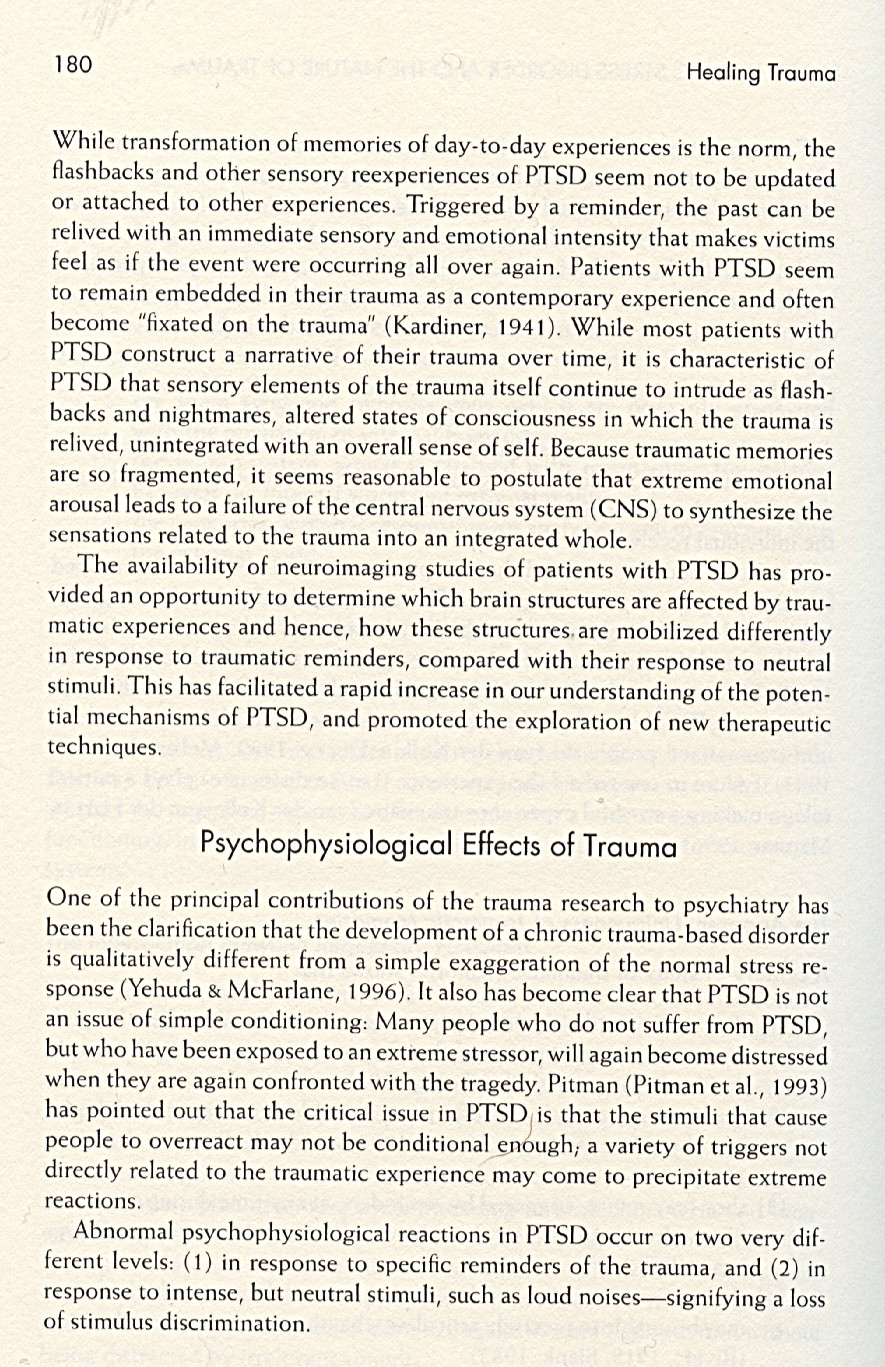
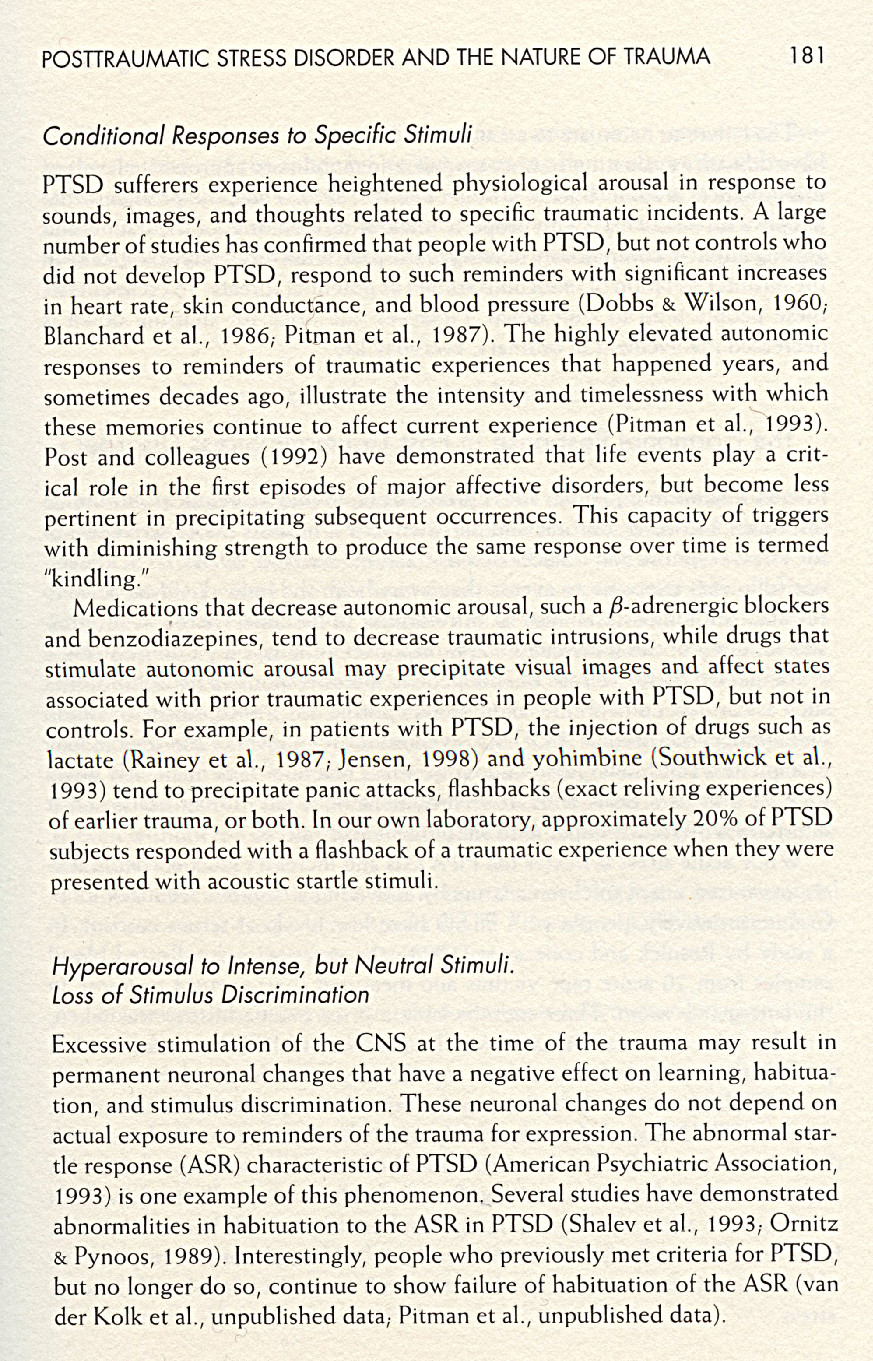
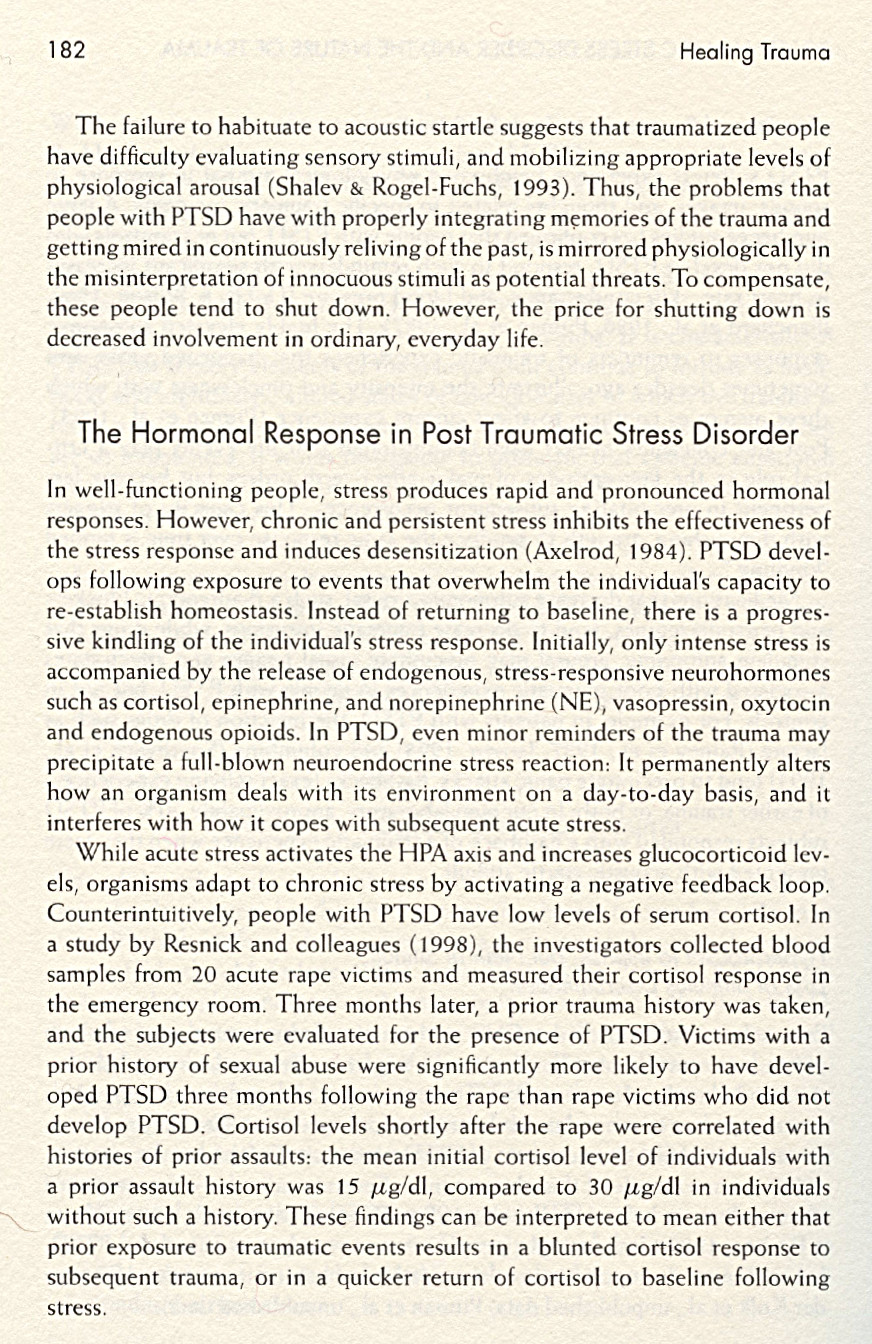
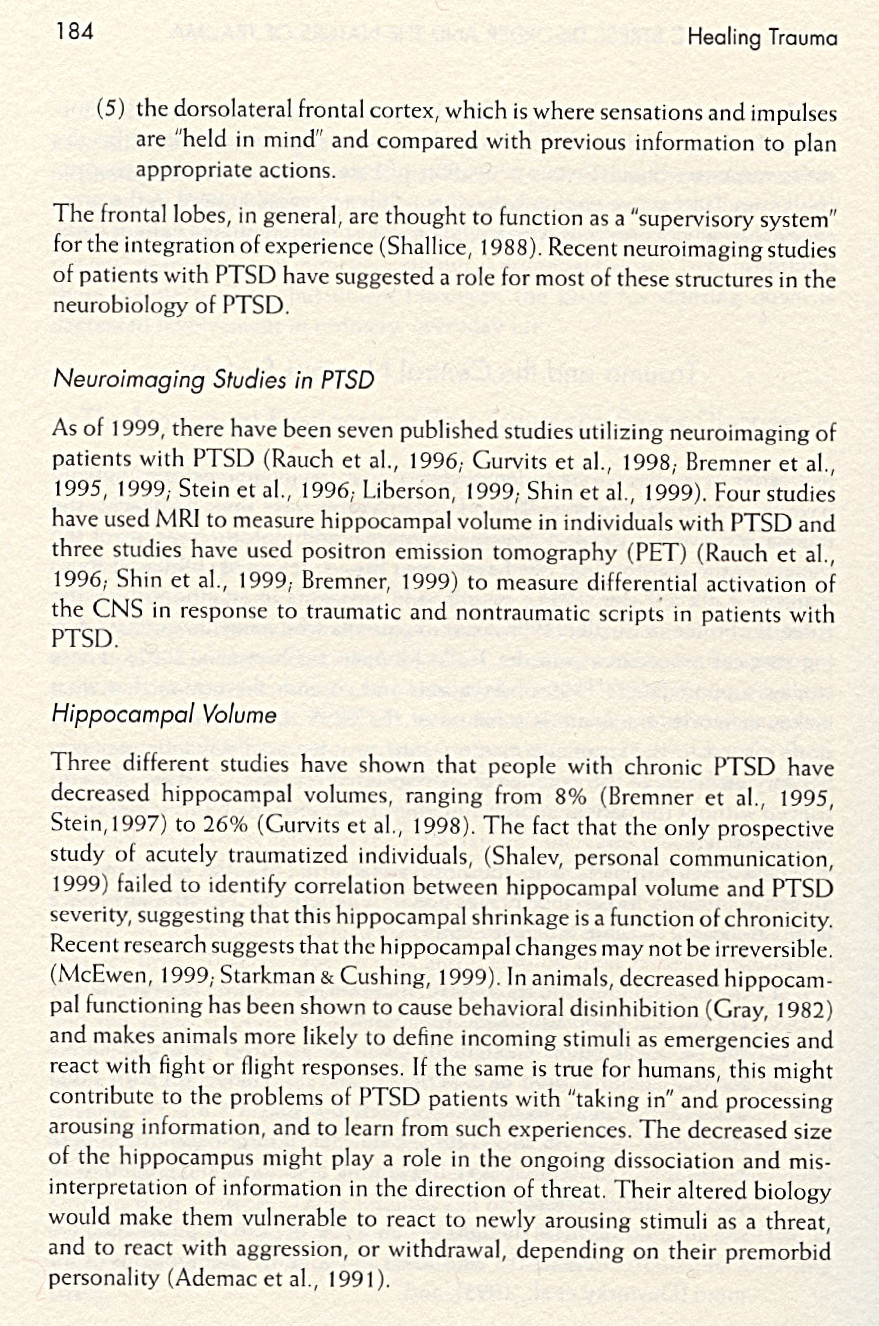
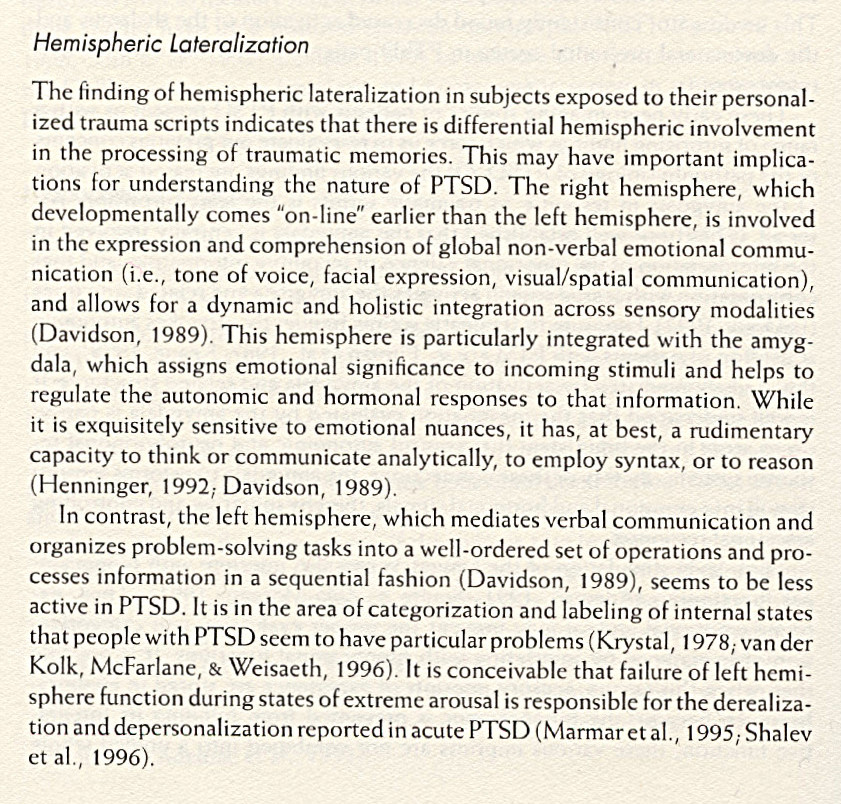
This third post on the topic again continues an exploration of how TAD changes an infant-child abuse survivor’s reaction to ALL trauma.   Van der Kolk writes about posttraumatic stress disorder (PTSD) in the book, Healing Trauma: Attachment, Mind, Body, and Brain – Hardcover (Jan 2003, W.W. Norton and Co.) by Daniel J. Siegel, Marion F. Solomon, and Marion Solomon, chapter 4 (pages 168-195) written by Bessel A. van der Kolk:  “Posttraumatic Stress Disorder and The Nature of Trauma.”

++++

I begin writing today by considering the last sentence of the scanned book pages that were posted on November 30, 2009:

“….progress in understanding the function of attachment in shaping the individual and rapid developments in the neurosciences gave a new shape to these old insights [about the importance of trauma].”  (page 177)

++++

Van der Kolk next considers “The Psychobiology of Trauma” in his writing:

Modern research has come to elucidate the degree to which PTSD is, indeed, a “physioneurosis,” a mental disorder based on the persistence of biological emergency responses.”  (page 177)

In my thinking, naming PTSD ‘a mental disorder’ ignores the overwhelming evidence that the entire human body is included in the ‘persistence of biological emergency responses’ that the author is talking about.  From my point of view, it is the consideration of how severe infant-child maltreatment and abuse changes the development of the ENTIRE BODY of the little one that matters to those of us who survived this degree of early trauma.

‘Biological emergency responses’ BUILT our bodies.  These responses signaled our DNA how to express itself.  These responses signaled our developing nervous system and brain on all levels about how to adapt to trauma.  Our developing nervous system was also intimately involved in these responses as it formed, also.  It is at this most basic, profound level of our physiological development from our beginnings that we have to understand how our development changed in ways that a non-TAD ‘ordinary’ body did not.

The adaptive changes that happened to us took place on far, far deeper levels than just the level of mind.  Mind is simply the topmost layer of our existence that I see as being related to our body as smoke is to fire.  I do not have a ‘mental disorder’.  My entire being is ordered in a very particular way in accordance with what surviving my infant-child trauma required.

It is this Trauma Altered Development that created my survival based, trauma centered ordering of my entire being that I seek to understand.  I am not convinced that van der Kolk has anything more than a passing surface notion of what these TAD changes actually ARE, how they affect us, or even if they legitimately belong to anything like a PTSD diagnostic category.

++++

Van der Kolk continues by saying:

To understand how trauma affects psychobiological activity, it is useful to briefly revisit some basic tenets of neurobiology.”

I do not like the term ‘psychobiological activity’ because it implies that anyone on the outside can ever have any accurate information about what another person’s ‘psyche’ is like.  That is why researchers try to more completely understand the human ability to form a Theory of Mind.  MIND belongs to each of us as individuals, and everyone has their own.  Nobody can ever come to understand what the subjective experience of MIND is like for another person.

‘Neurobiology’ is a different thing.  This is a realistic descriptive word that refers to a part of a person that can, within the current limitations of science, be understood and described because it is physically real on the molecular level.  But neurobiology is not the same thing as MIND.

Van der Kolk continues:

McLean (1990) defined the brain [my note:  The brain is a biological reality as part of our nervous system, from which an individual’s MIND originates.  Brain and MIND are not the same thing.] as a detecting, amplifying, and analyzing device for maintaining us in our internal and external environment.  These functions range from the visceral regulation of oxygen intake and temperature balance to the categorization of incoming information necessary for making complex, long-term decisions affecting both individual and social systems.  In the course of evolution, the human brain has developed three interdependent subanalyzers, each with different anatomical and neurochemical substrates:

(1)  the brain stem and hypothalamus, which are primarily associated with the regulation of internal homeostasis,

(2) the limbic system, which is charged with maintaining the balance between the internal world and external reality, and

(3) the neocortex, which is responsible for analyzing and interacting with the external world.

It is generally thought that the circuitry of the brain stem and hypothalamus is most innate and stable, that the limbic system contains both innate circuitry and circuitry modifiable by experience [my note:  This emotional area of the brain forms through early caregiver attachment interactions birth to age one, forming MUCH earlier than the neocortex], and that the structure of the neocortex is most affected by environmental input (Damasio, 1995).  If that is true, trauma would be expected to leave its most profound changes on neocortical functions, and least affect basic regulatory functions.  However, while this may be true for the ordinary stress response, trauma – stress that overwhelms the organism – seems to affect people over a wide range of biological functioning, involving a large variety of brain structures and neurotransmitter systems.”  (pages 177-178)

++++

I am going to scan in the book pages that follow in van der Kolk’s description of how trauma affects people.  I believe his statement on the bottom half of page 190 is extremely important:

“…the development of a chronic trauma-based disorder is qualitatively different from a simple exaggeration of the normal stress response….”

We need to stretch that concept as far as we possibly can if we are going to understand how severe trauma from malevolent infant-child abuse and neglect changes our entire development – nothing about us is excluded.  Any possible aspect of our development that can adapt its development in order to help us endure and survive early trauma – does so.

Our problem comes when the reality of our early trauma is denied along with the depth, breadth and width of its impact on our development.  What may be true for a non trauma altered development person cannot be assumed to be true for us.  Yes, we know what the following descriptions of consequences FEELS like – but we also know that we never knew any other, different way of being in the world.

Due to the changed development we experienced as we survived our early severe traumas, anything that we might begin to understand now as being more like  ‘ordinary’ in our physical – and correspondingly in our mental — ability to experience our self in our body in our lifetime, will happen as we begin to understand how deeply trauma formed us in the first place so that we will NEVER experience trauma (or life) in the same way as will a person who did not experience Trauma Altered Development when they were little.

++++

The scanned pages below (from the book mentioned above!) is complicated information, but it is a place for us to truly begin to understand ourselves – the way were MADE in the severely abusive and trauma-filled environments we were formed in.

On page 184 van der Kolk notes that “PTSD patients” have problems

“…with “taking in” and processing arousing information, and to learn from such experiences.”

Sorry, but I am not a ‘PTSD patient’.  I am a 58-year-old woman who has suffered from an extra-ordinary body, altered in all its developmental stages in adaptation to trauma, that has never been able to ‘take in’ even ordinary information, let alone ‘arousing information’, or to ‘learn from’ the experiences of my life in an ordinary way.

What on earth do we expect to happen to little people who must continue to develop and survive even while they have little or no access to even their most basic Universal Human Rights?  Infant-child development IS ALTERED under these conditions.  It is time that we realize this is the most truly horrific consequence of early abuse and trauma.  We don’t get to experience ANYTHING the same way as non-early-traumatized people do – not even later traumas.

(note:  I believe in ‘degrees of damage’ – the 75% of our sub-par young adults in this country have suffered some degree of damage that has changed the course of their development away from optimal and BEST!  We cannot afford to ignore that fact – deprivation and violation of the Universal Human Rights of Children causes changes in the way their body and brain develop.  There is a very real, physiological process through which trauma and deprivation get passed on down the generations.  We know it is happening when we see the consequences in degrees of lack of well-being –- which are detectable no matter what our age.)

++++

(The following is from page 186 on left or right handedness and trauma)

++++++++++++++++++++++++++++++

This post follows:

from November 30, 2009 +PTSD AND SEVERE ABUSE SURVIVORSHIP – PART TWO

from November 28, 2009 +PTSD AND SEVERE CHILD ABUSE SURVIVORSHIP – PART ONE

+++++++++++++++++++++++

PLEASE NOTE:  Do not take anything I say as a reason to alter any ongoing treatment, therapy or medication you are receiving.  Consult with your provider if you find something in my writing that brings questions to your mind regarding your health and well-being.

++++++++++++++++++++++++++++++++

Please feel free to comment directly at the end of this post or on

+++++++

Your Page – Readers’ Responses

++++++++++++++++++++++++++++++++
+VIOLATING THE UNIVERSAL HUMAN RIGHTS OF CHILDREN

++++++++++++++++++++++++++++++

When any of the Universal Human Rights of Children are violated, those who violate and those who allow the violation to occur are equally accountable for the criminality of their actions.

Today I am reminded of the biggest picture not only about the condition of the youth, children, infants and their parents within our nation.  This picture is about Human Rights – not only as they apply to adults, but also as they apply to the offspring we are raising among us.

What do these words mean?

Equal Justice, Equal Opportunity, Equal Dignity

I found a wonderful video about Human Rights presented at this above link presented by our friends on their website, Treasures of Wonderment.

I then went to the United Nations website where I found the full text of the Universal Declaration of Human Rights:

On December 10, 1948 the General Assembly of the United Nations adopted and proclaimed the Universal Declaration of Human Rights….Following this historic act the Assembly called upon all Member countries to publicize the text of the Declaration and “to cause it to be disseminated, displayed, read and expounded principally in schools and other educational institutions, without distinction based on the political status of countries or territories.””

++++

Considering my concerns about the current poor condition of the youth of our nation, and thinking about how every passing present moment of our lives are passing continually into the past as we step into the future, I wonder about the decline in well-being that our nation is obviously experiencing as demonstrated not only by this lack of well-being of our youth but also of the parents who raise them.

Do we in America today deny that we have these Universal Human Rights and that our children also have Universal Human Rights?  What are we lacking as a nation that is creating these conditions of distress within our population?  What elements are missing that the required environment of safe and secure attachment to ourselves, to our children, to one another and to the world we live in seems to be increasingly missing within our own nation?

What standards can we use in order to take a clearer look at ourselves?  Why NOT consider the Universal Declaration of Human Rights as the most complete set of guidelines existing on our planet about our concerns?

++++

Every one of the 30 Articles contained within the Universal Declaration of Human Rights are vital to ensure human well-being.  All these Rights fit together into a whole.  It is my particular concern today about the well-being of our nation’s infants, children, youth and their parents that most concerns me, so I paid particular attention to Articles 25 and 26 as I read this Declaration:

Article 25.

  • (1) Everyone has the right to a standard of living adequate for the health and well-being of himself and of his family, including food, clothing, housing and medical care and necessary social services, and the right to security in the event of unemployment, sickness, disability, widowhood, old age or other lack of livelihood in circumstances beyond his control.
  • (2) Motherhood and childhood are entitled to special care and assistance. All children, whether born in or out of wedlock, shall enjoy the same social protection.

Article 26.

  • (1) Everyone has the right to education. Education shall be free, at least in the elementary and fundamental stages. Elementary education shall be compulsory. Technical and professional education shall be made generally available and higher education shall be equally accessible to all on the basis of merit.
  • (2) Education shall be directed to the full development of the human personality and to the strengthening of respect for human rights and fundamental freedoms. It shall promote understanding, tolerance and friendship among all nations, racial or religious groups, and shall further the activities of the United Nations for the maintenance of peace.
  • (3) Parents have a prior right to choose the kind of education that shall be given to their children.

++++

Do the rights of children solely lie with their parents?  What happens if parents do not and cannot ensure the rights of their children?  What happens if and when parents directly violate ANY of the United Nations Human Rights as they apply to children?  What ARE the Universal Human Rights of children?  Do they have any?

On November 20, 1959 the United Nations adopted the Universal Declaration of Children’s Rights.  I found a United Nations page with links on the rights of children, and also found the official version of the Universal Declaration of Children’s Rights.

I also found the following on the United Nations website.  It is in these few words that the picture becomes clear not only about what children need, but what their Universal Human Rights are in plain and simple language:

Declaration of the Rights of the Child – Plain Language Version

1.  All children have the right to what follows, no matter what their race, colour, sex, language, religion, political or other opinion, or where they were born or who they were born to.

2.  You have the special right to grow up and to develop physically and spiritually in a healthy and normal way, free and with dignity.

3.  You have a right to a name and to be a member of a country.

4.  You have a right to special care and protection and to good food, housing and medical services.

5.  You have the right to special care if handicapped in any way.

6.  You have the right to love and understanding, preferably from parents and family, but from the government where these cannot help.

7.  You have the right to go to school for free, to play, and to have an equal chance to develop yourself and to learn to be responsible and useful.

Your parents have special responsibilities for your education and guidance.

8.  You have the right always to be among the first to get help.

9.  You have the right to be protected against cruel acts or exploitation, e.g. you shall not be obliged to do work which hinders your development both physically and mentally.

You should not work before a minimum age and never when that would hinder your health, and your moral and physical development.

10.  You should be taught peace, understanding, tolerance and friendship among all people.

++++

Those who are survivors of any degree of deprivation of any of these rights anywhere on our planet – including within our own nation — are caused suffering through criminal actions.  When any of these Universal Human Rights of children are violated, it is to this that we must pay the closest attention:

6.  You have the right to love and understanding, preferably from parents and family, but from the government where these cannot help.

I do not believe that in our nation the Universal Human Rights of Children should be left to the care of the governments of our separate states.  I believe that the guarantee of these Rights needs to be protected by our federal government.  I believe we need to develop a federal standardization in regards to children’s Rights that is applied equally across all 50 states on every level that impacts the well-being of our nation’s children – from conception forward.

This would include all child protection services, including all services designed to identify maltreatment, all services designed to remedy critical issues within a child’s home of origin in a speedy and competent manner, and all services that are designed to place children in living environments where ALL their Universal Human Rights will be guaranteed.

I also believe that our children’s public education needs to be standardized on a national level and should NO LONGER be left, in any way or on any level, up to the incompetent design and administration of individual states.

It seems obvious to me that considering the findings that 75% of our youth are suffering from serious lack of well-being that even finding ways to shore up inadequate parenting will not resolve the profound problems our nation is facing in regard to Universal Human Rights of our children.  We need an across-the-board revision of our educational system by the federal government, and this need has reached critical proportions.

++++

Either we are a nation that is willing to stand behind these Rights as defined by the United Nations or we are not.  It seems obvious to me where the great grey area of “maybe yes, maybe no” has gotten us.  We have approached a ‘crisis management needed’ stage within our nation.  We need to move up the hierarchy of who is going to take care of our nation’s children – and how.

If parents are not equipped to guarantee the Universal Human Rights of their children, and if our individual states are not equipped to do it, then it is our federal government’s responsibility to step up to its job of guaranteeing these rights through every possible means at its disposal.

Violating the Universal Human Rights of Children is a criminal act.  Allowing anyone to violate these rights is a criminal act.  These Rights are not arbitrary.  They are absolute, fundamental and necessary.  There is no room for grey.  Either we are a nation of criminals or we are not.

+++++++++++++++++++++++

Please feel free to comment directly at the end of this post or on

+++++++

Your Page – Readers’ Responses

++++++++++++++++++++++++++++++++
PBS Documentary – The Mind’s Big Bang – evolution of our mind – There’s a free toolbar you can download that open’s up a universe!!

+PTSD AND SEVERE ABUSE SURVIVORSHIP – PART TWO

+++++++++++++++++++

This second post about Posttraumatic Stress Disorder (PTSD) refers again to a book called Healing Trauma: Attachment, Mind, Body, and Brain – Hardcover (Jan 2003, W.W. Norton and Co.) by Daniel J. Siegel, Marion F. Solomon, and Marion Solomon, chapter 4 (pages 168-195) written by Bessel A. van der Kolk:  “Posttraumatic Stress Disorder and The Nature of Trauma.”

Today’s post follows the November 28, 2009 post

+PTSD AND SEVERE CHILD ABUSE SURVIVORSHIP – PART ONE

PLEASE NOTE:  Do not take anything I say as a reason to alter any ongoing treatment, therapy or medication you are receiving.  Consult with your provider if you find something in my writing that brings questions to your mind regarding your health and well-being.

+++++++++++++++++++

The following is taken from pages 172 of the above text.  I will consider this information in my writing below:

+++++++++++++++++++

It is now easier for me to work with this information because I have described my own version of an alternative way of thinking about the ongoing complications severe infant-child abuse and malevolent treatment survivors face as a direct result not only of the specifics of the actual horrific traumas they lived through, but also because of the very real physiological changes that surviving these traumas created in their infant-child growing and developing body.

(see yesterday’s November 29, 2009 post

+TRAUMA ALTERED DEVELOPMENT (TAD) – A NEW DESCRIPTIVE CONCEPT)

++++

An accurate primary and initial assessment of TAD for those of us who are Infant-Child Severe Maltreatment Survivors would allow us to know immediately how the changes our body-brain had to make created us to be different from ‘ordinary’ people who do not have the history of trauma that we do.

In this TAD assessment two critical resiliency factors would also need to be assessed because these two resiliency factors (one primary, the other secondary) are known to have the ability to nearly completely modify and modulate the power that early trauma has to change our developing body-brain.

The presence of safe and secure attachment to some early primary caregiver is the most basic and important resource an Infant-Child Severe Maltreatment Survivor had.  The current assessment tools available to assess adult secure and insecure attachment need to be simplified, refined and made accessible to the public.

Stemming from the degree of safety and security available through early caregiver attachment, the ability to play is a secondary but critical resiliency factor that impacts an Infant-Child Severe Maltreatment Survivor’s body-brain development.  I believe that assessment criteria and tools to measure this critical factor consistently and accurately can be developed and also made available to the public.

++++

NOTE:  In our new age of technology, the public has the right to be able to access critically important information about themselves and how their early infant and childhood experiences impacted their development.  At present this information remains ONLY available within ‘clinical’ settings, if even there.

++++

As far as I am concerned, anything and everything that is currently lumped under so-called ‘psychological’ categories belongs to the sinking Titanic of dark age medical model thinking that I referred to in yesterday’s post.

Until Trauma Altered Development (TAD) is assessed at the bedrock level of how Infant-Child Severe Maltreatment Survivors changed at their own bedrock (molecular) level, any attempt to moderate so-called ‘symptoms’ remains a crap shoot in the dark.

TAD assessment can connect the consequences of early trauma to altered physiological changes that an Infant-Child Severe Maltreatment Survivor’s body was forced to make to best ensure continued survival in early malevolent environments,

++++

Early caregiver attachment experiences from birth build the body-brain we will live with for the rest of our lives.

Van der Kolk (scanned text above) writes that it is not usually the symptoms of PTSD itself that brings those seeking help to a clinical setting.  Rather, he says that it is “depression, outbursts of anger, self-destructive behaviors, and feelings of shame, self-blame and distrust that distinguished a treatment-seeking sample from a nontreatment-seeking community sample with PTSD.”

Through an accurate TAD assessment, any ongoing difficulty an Infant-Child Severe Maltreatment Survivor has with emotions and social interactions can be traced to inadequate early caregiver interactions in a malevolent environment that built for the survivor an entirely different early-forming right-limbic-emotional-social brain.

When the foundation of the early forming right brain is altered because of maltreatment, the Infant-Child Severe Maltreatment Survivor’s later developmental stages involving shame, guilt and embarrassment will also be off course from ‘ordinary and optimal’ and will cause altered patterns of development in the body-brain.

++++

Van der Kolk states:

The majority of people who seek treatment for trauma-related problems have histories of multiple traumas.”

OK, I can certainly understand this, but here again, as I mentioned above, I do not agree with applying so-called ‘psychological’ and ‘symptom based’ medical model diagnostic thinking used in the author’s next statements.  I absolutely disagree with ever using terms such as ‘character pathology’ in reference to Infant-Child Severe Maltreatment Survivors!

One recent treatment-seeking sample…suffered from a variety of other psychological problems which in most cases were the chief presenting complaints, in addition to their PTSD symptoms:  77% suffered from behavioral impulsivity, affect lability, and aggression against self and others; 84% suffered from depersonalization and other dissociative symptoms; 75% were plagued by chronic feelings of shame, self-blame and being permanently damaged and 93% complained of being unable to negotiate satisfactory relationships with others.  These problems contribute significantly to impairment and disability above and beyond the PTSD symptoms….Focusing exclusively either on PTSD or on the depression, dissociation and character pathology prevents adequate assessment and treatment of traumatized populations.”

TAD assessments will clearly show that ‘impulsivity’, ‘affect liability’, most aggression, and dissociation are directly connected to changes in how an Infant-Child Severe Maltreatment Survivor’s nervous system, including their brain – and here, particularly their right brain – formed differently from ‘ordinary’ due to growth and development in trauma.

Chronic feelings of shame, self-blame and being permanently damaged” are also directly connected to trauma through developmental changes an Infant-Child Severe Maltreatment Survivor’s nervous system, including their brain – and here, particularly their later forming (after age one) left brain – had to make while developing in an early malevolent, trauma-filled environment.

Rather than referring to these changes as ‘character pathologies’, which in my thinking is the maltreatment, abusive stance taken by the medical model toward Infant-Child Severe Maltreatment Survivors, a TAD assessment can accurately and specifically pinpoint the origin of these changes in the body-brain and describe the consequences of them.

Receiving an accurate TAD assessment will show us exactly how our body was forced to adapt during our development through trauma so that we could survive it.   Yes, I do believe we KNOW we are different from ‘ordinary,’ but we are not ‘permanently damaged’.   We ARE permanently changed.

The changes Infant-Child Severe Maltreatment Survivors experience are fundamental and profound!  Everything about us was subject to adjustment for our trauma survival – our body, our nervous system and brain, our immune system, our mind, and our connection between our self and our self and between our self and the entire world around us.  NOT facing the truth and discovering the facts through TAD assessment will NOT resolve the difficulties we face with our continued survival into adulthood.

The only long term solution societies have is to STOP Infant-Child Severe Maltreatment!!!  Part of that solution is to provide the kind of TAD assessment Infant-Child Severe Maltreatment Survivors need, and to make available to us the resources necessary for us to live the best life we can in spite of the changes we had to make in order to stay alive because nobody STOPPED the Infant-Child Severe Maltreatment that happened to us.

It is the pathological character of the society we were born into that allowed what happened to us to happen at all, let alone allowed it to continue to the degree that trauma changed our physiological development.  If there is any self blame to be had, it is on the level far beyond OURS as the Infant-Child Severe Maltreatment Survivors.

++++

That the grand sinking Titanic of the archaic dark age’s medical model about Infant-Child Severe Maltreatment Survivors has at least THOUGHT about throwing us a life boat becomes apparent in van der Kolk’s next words:

As part of the DSM IV field trial, members of the PTSD taskforce delineated a syndrome of psychological problems which have been shown to be frequently associated with histories of prolonged and severe personal abuse.  They call this Complex PTSD, or Disorders of Extreme Stress Not Otherwise Specified (DESNOS).”

Great!  A life boat full of holes!  Gee, why are we NOT thankful for that?

A syndrome of psychological problems” be damned!  Infant-Child Severe Maltreatment Survivors do not suffer from a ‘syndrome’, and ours are not ‘psychological problems’!  For all the reasons I have repeatedly described, we simply need a TAD assessment that will tell us HOW our little body adapted down to our molecular level during our development in the midst of, and in spite of, toxic malevolent trauma.  Then we need resources that inform us how to live NOW with these profound trauma-caused changes that happened to us THEN.

The author continues:

DESNOS delineated a complex of symptoms associated with early interpersonal trauma.”

Again, we don’t have ‘symptoms’.  We have a different body-brain-mind-self that adapted to survival in a malevolent world and caused us to have Trauma Altered Development (TAD).

We don’t have symptoms, we have consequences.  Every single item in the list of so-called ‘complex symptoms’ (see them in the page scan below) that van der Kolk describes are directly connected to our TAD.  EVERY SINGLE ONE OF THESE ITEMS exist within us because of changes our body-brain was forced to make.  They are consequences of the changes our body had to make through our TAD.

The only real progress in the right direction I can see – given to us like faulty patches to a sinking life boat thrown to us from a sinking ship – is that at least an association ‘with early interpersonal trauma’ is finally being considered in the current medical model thinking.

But this tiny droplet of hoped for healing balm offered by the creation of a construct named “Complex PTSD, or Disorders of Extreme Stress Not Otherwise Specified (DESNOS)” is not what we Infant-Child Severe Maltreatment Survivors need in my book.

We need our entire society to understand and accept the truth that the Infant-Child Severe Maltreatment that happened to me and others – and continues to happen to children around us today – is nothing short of a form of parental-selected genocide that did not fulfill its intent to completely destroy us.  We are Infant-Child Severe Maltreatment Survivors because we are still alive, and we ONLY SURVIVED because we were able to adapt our body throughout our Trauma Altered Development to and within the malevolent environments that formed us.

++++

The rest of van der Kolk’s words (below) simply bring into my mind the image of the author being like a modern day Paul Revere, whose horse’s hooves pound along the streets of our nation as he screams a warning.  I am certainly not convinced, however, that even this author knows which message it is that most needs to be delivered.

The Trauma Altered Development that Infant-Child Severe Maltreatment Survivors experienced had no choice but to build itself into every part of who we are BECAUSE we live in a body, and our body had no choice but to change so that we could stay alive.

To describe any aspect of what happened to us in terms of a ‘diagnosis’ or a ‘symptom’, ‘complex’ or not, to call us ‘maladjusted’ or to tell us we suffer from any form of a ‘character pathology’ or ‘psychological problem’ is to continue to condemn us with stigmas and stereotyped prejudice which makes as much sense as applying all of the above labels to someone who is tall versus short, or who has red hair rather than blond.

If we wish as a society to remain in the dark ages about the consequences of Trauma Altered Development for Infant-Child Severe Maltreatment Survivors then at least we should have enough honor and common sense to admit it.  If we are appalled by the ignorance that is still applied to our circumstances, today is the day we can enlighten ourselves and get on with the legitimate task of figuring out how to accurately assess Trauma Altered Development so that we can begin to live well as the changed, extraordinary Infant-Child Severe Maltreatment Survivors that we are.

Our Trauma Altered Development did not affect WHO we are in the world, but it absolutely changed HOW we are in the world.  It is up to all of us to learn what that means.

+++++++++++++++++++

The following is taken from pages 173 of the above text:

Again, it is not a picture of ‘long-term psychiatric impact’ nor a ‘diagnosis’ that Trauma Altered Development affected Infant-Child Severe Maltreatment Survivors need.  We need to understand the changes our body had to make to guarantee our survival and specifically how those changes affect us, and specifically how to improve our quality of life and well-being in the world in spite of our TAD.

+++++++++++++++++++++++++++++++++++++++++

Please feel free to comment directly at the end of this post or on

+++++++

Your Page – Readers’ Responses

++++++++++++++++++++++++++++++++
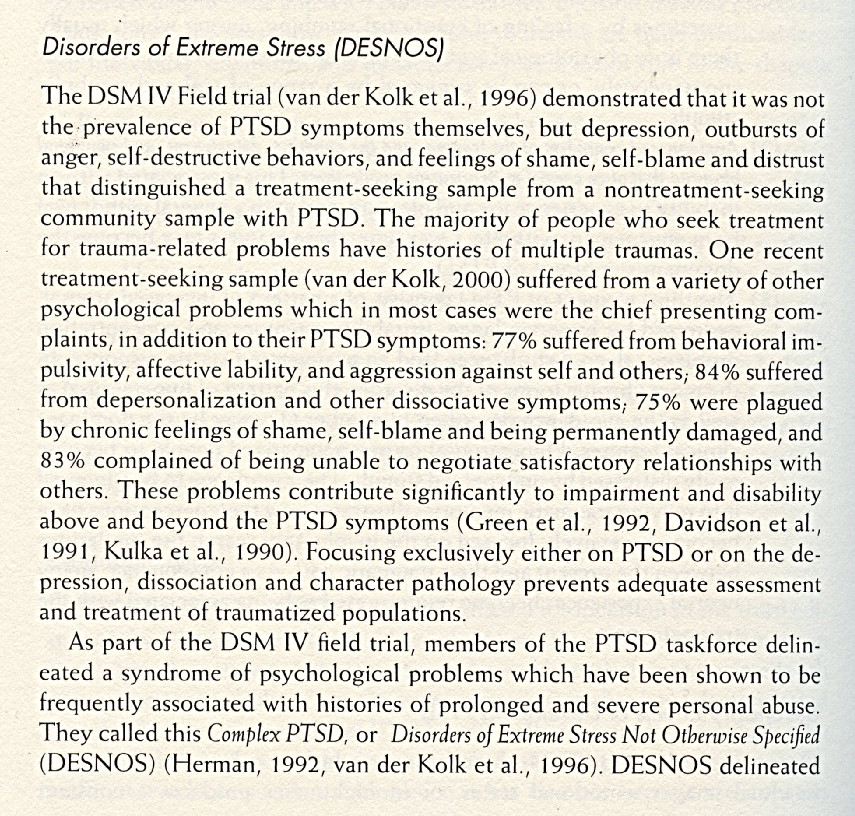
+TRAUMA ALTERED DEVELOPMENT (TAD) – A NEW DESCRIPTIVE CONCEPT

+++++++++++++++++++++++++

Presenting a new descriptive concept that applies specifically to severe infant-child abuse and serious neglect survivors of all ages:

Trauma Altered Development (TAD)

++++++++++++++++++++++++++

Those of us who suffered enough severe traumas through malevolent treatment including abuse during our growth and developmental stages of our infant-child ‘survivorhood’ to alter how our body developed do not need a diagnosis.

— We need an assessment of the changes that happened to us because of the abuse.

— We need information about how these changes affect us in our lives today.

— We need resources that tell us how to improve our well-being in the world in spite of the changes our body had to make in order for us to survive the traumatic environment that formed us.

++++

Thinking in terms of changes that happened to me as a result of my development in a severe abuse environment in my infant-child survivorhood, I am beginning to understand that my body developed to manage all resources available to me in my environment – both inner and outer – to maximize my opportunity for successful survivorship.

I am preparing to stand in opposition to the current ‘mental health’ and ‘behavioral health’ models that obviously are not capable of meeting my true needs as stated above.

I want to see the creation of new thinking about the changes that happened to me and to others whose altered early development allowed them to continue living in spite of insurmountable traumatic obstacles.

I have a new name for what happened to me:  Trauma Altered Development (TAD)

TAD is an accurate, factual description of a physiological process that allows individuals to survive in early malevolent environments.  TAD is not a diagnosis.  It is not a label, and it carries with it no stigma toward a person whatsoever.  It is not naming a ‘disorder’, a ‘pathology’ or a ‘maladjustment.’  Trauma Altered Development (TAD) is an accurate descriptive concept that needs to be the starting point for all positive changes we hope to make for ourselves in this world.

Trauma Altered Development (TAD) can be assessed.  In today’s world, it might take a think tank of dedicated people to put together tools to get this job done, but the information DOES exist and an accurate assessment of trauma-forced change can be described for every one of us that went through this process in our early development because of infant-child trauma and abuse.

I would like to see a systematic effort applied to establish national, regional and local Trauma Altered Development Resource and Referral Centers.  These centers would be connected to a global clearinghouse that gathers research, assessment tools, informational and educational curricula about how trauma alters development for the duration of an individual’s lifespan and how well-being for a lifetime can specifically be improved in spite of these trauma altered developmental changes.

Trauma Altered Development (TAD) assessment would consider not only the changes that happened to us in our development and how those changes affect our well-being and our personal resource management systems in our adulthood, but would also increasingly assist in the recognition of how these changes are directly tied to the resiliency abilities that lie within our species.

Trauma Altered Development (TAD) assessment cannot possibly separate any part of an individual from the whole of who they are.  Trying to consider physical health and well-being as being separate from our ‘mental’ or ‘behavioral’ well-being is just plain goofy!  TAD affected our entire being in the world from our beginning and it affects us now.

++++

I don’t want to save a sinking Titanic of dark-age thinking about so-called ‘mental illness’ or ‘behavioral health’.  I want a whole new boat!  Trauma Altered Development (TAD) is a descriptive concept that appears to me to be that new boat.  I know it sits on the bedrock foundation of what happened to me as a result of my mother’s severe abuse of me.  I believe that TAD must be accurately assessed at this bedrock level for every infant-child trauma and abuse survivor because it affects every aspect of our being in the world for the rest of our lives.

Once an accurate TAD assessment has been completed, all other services designed to address our degrees of lack of well-being will make sense to us because they will be based on the truth of the facts about how we developed through trauma to be the way we are in the world — every step of our lives.

++++++++++++++++++++++++++++++++++

Please feel free to comment directly at the end of this post or on

+++++++

Your Page – Readers’ Responses

++++++++++++++++++++++++++++++++
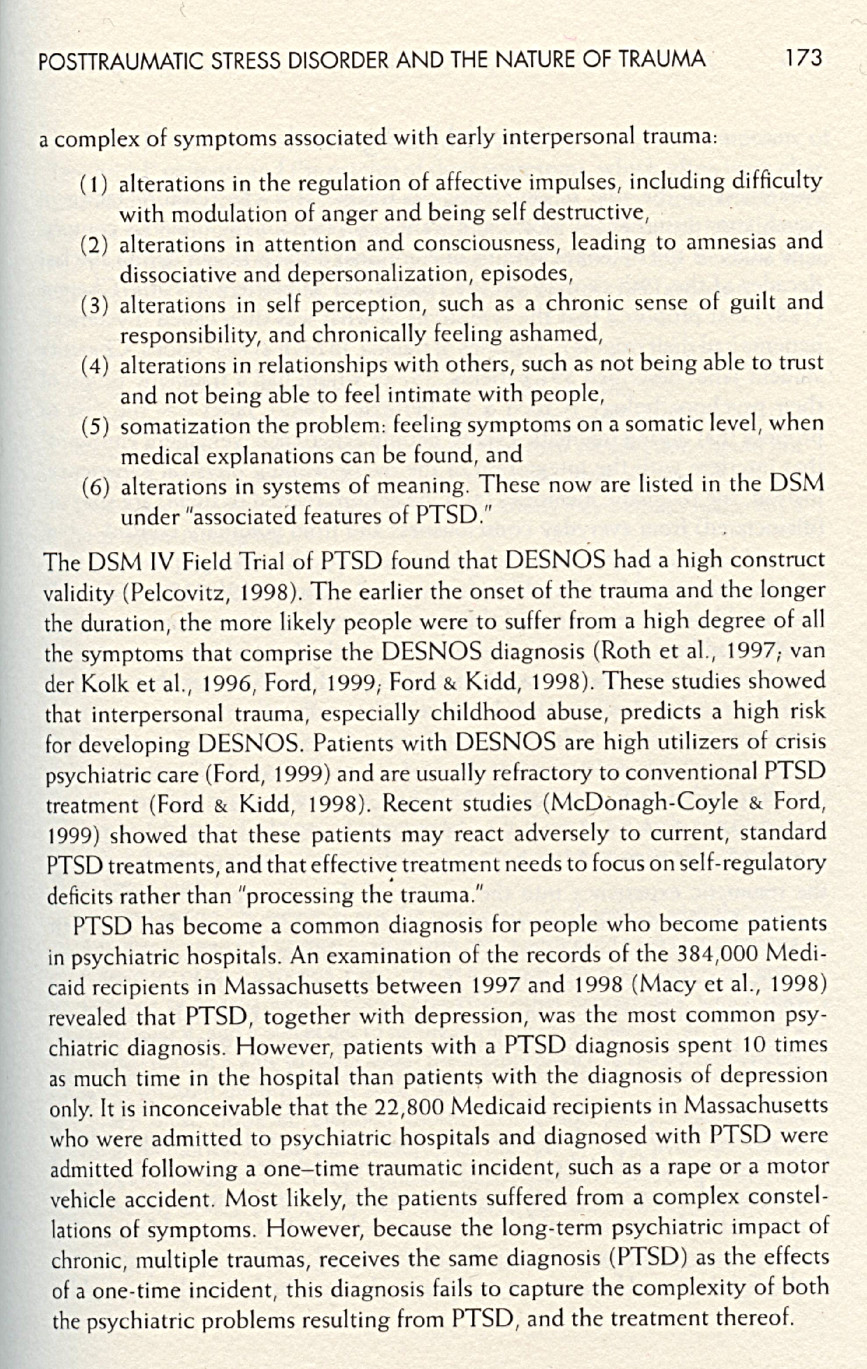
+RETHINKING THE CONSEQUENCES OF EARLY (DEVELOPMENTAL) TRAUMA

++++++++++

Most of us are familiar with the sideways “8” symbol for infinity.   It’s a simple image, but is designed to represent a continuation of something that flows smoothly without having an end in itself.

I was thinking about the symbol this morning in terms of how we use resources in our life from the time we are conceived.  When we came into this world as a fertilized egg we could live off of our own inner resources just long enough to receive signals from our mother’s body that told us it was ‘safe’ to attach to her uterine wall.  Signals from her body told us where to attach, and the ability to receive those signals and act on them allowed us to accomplish this required attachment.

During the length of time we remained attached to the world through our attachment inside our mother we grew an increasingly more complex body by using resources we received from our mother.  From the time we were born as a breathing being into this world outside our mother’s body we were still completely dependent on outside others to provide all our resources for us.  We needed our early caregivers to allow us to breath, to keep us warm, to feed us, to protect us from harm.

During our most dependent stages of growth and development outside our mother’s body we were using the resources given to us by our early caregivers to continue our growth and development which included our nervous system-brain, immune system, and our entire body.  Nature has designed this process to work very well!

If safe and secure attachments continue to exist as they operate through our early caregivers’ attention to us, we continue to grow along an ‘ordinary’ and optimal pathway.  If trauma is introduced into our growing environment, and if it is allowed to overwhelm what is needed for our ‘ordinary’ and optimal growth, changes in our development HAVE to happen so that we can continue to remain alive.

I was thinking about our early growth and development in terms of the infinity sign because in a benevolent world our increasing ability to find and use resources can be represented by an expanding infinity sign.  In a safe and secure attachment environment we have a need, resources are provided to us, we take those resources into our bodies, can use them to our best advantage and we continue to grow.

If trauma in an unsafe and insecure early attachment world that threatens our ‘ordinary’, optimal development by directly interrupting our ability to access and use the resources we need to grow up in a benevolent world, what is changing in our developing body-brains as a consequence is our ability to get the resources we need in order to continue to grow to fulfill our potential for living in a safe and secure world.

As I have said many times in the past, the changes our body has to make due to interruptions through trauma during our early development are not maladaptive or ‘pathological’.  They are necessary and required for continuation of our life.

When we grow up and find ourselves living in a far more benevolent world than the one was that we formed in, we simply (!!) do not have a body-brain-mind-self that is prepared to access and use resources in the same way that an ‘ordinary’ non-traumatized (in early childhood) person can.  Something about our infinity sign has been changed.  Something about how we detect, access and use resources changed as a result of growing a body-brain in an early environment filled not with safety and security but rather with a lack of safety and security = trauma.

++++

When I think about this sideways “8” sign as it passes resources back and forth between the world outside of the body and the world inside a person, I have to think about boundaries.  Where do I stop and where does the outside world begin?

As I continue to explore the existing information about posttraumatic stress disorder (PTSD), I will have to consider one of the fundamental and primary concerns that this diagnostic category of ‘mental illness’ is attempting to address – how we detect, access and use the resource of information from our environment.  This information comes to us in the form of stimuli – both from within our own body and from the world outside of us.  Severe early trauma has changed us in ways that make our stimuli information resource systems work differently from ‘ordinary’.

If there is some degree of lack of well-being exiting within either a fertilized egg or in its mother, the step of attaching safely and securely to the uterine wall is interfered with, the infinity sign of resource transactions required for continued life ceases, and that is the end of life for the new little person.  This kind of risk continues for us every step of our life.  Given enough trauma and given enough inability to overcome the trauma, life stops.

The resource transaction process continues because information passes freely between the world and a life form.  We might think of air and water and food and heat ranges as resources, but do we think of their presence, availability and quality as providing basic information about the condition of the world we live in?  Do we think of early caregiver interactions with offspring as directly providing information (a vital resource about vital resources) concerning the quality of the environment the little one is growing up in – and for?

++++

If a person was built from conception in a safe and secure world, they will have a resource management system designed in, by and for a benevolent world.  If that person later experiences severe trauma, they will process it according to the resource management system they received very early in their lives – because that system has built itself into their body.  This ‘ordinary’ person will still have to access and use plenty of resources to overcome the experience of later traumas – but they will do so differently than someone will who has resource management systems (i.e. body-brain) designed in, by and for a malevolent, traumatic world.

Most plainly put, the following stems from my on-paper doodling as it relates to this critical topic or resource management and the changes our developing body-brain had to make in an unsafe, insecure and traumatic early environment:

S surviving

T – trauma

O – orients

P – personality

The

S – surviving

T – trauma

O – orients

R – resource

M – management

If a newborn finds itself in a malevolent environment all its ongoing experiences will send it signals about the trauma-filled world it lives in so that it can alter its ongoing resource management systems as they develop to maximize its ability to survive in this malevolent world.

If a newborn finds itself in a benevolent environment all its ongoing experiences will send it signals about a safe and secure world so that it can continue our species’ best-case development pathway using information it has received about adequate resources in the world.

Our particular personality is one of our primary resource management assets – but its development is influenced by the information an infant-child receives from its environment.  (More on this later regarding how early trauma creates ‘personality disorder’ developmental conditions.)

++++

Information communicated through the ability to send and receive signals on the molecular level continues throughout our entire life span.  Not only is the information itself a vital resource, but so also is the ability to send and receive these signals.  Beginning from conception information is transmitted between the environment and the organism living in the environment.

As a result of the information we receive and through our potential to adjust to the world we live in, we end up with an orientation either to a safe and secure or a trauma filled world.  Child abuse during critical developmental stages communicates on the molecular level what the conditions of our early world are like.  Our body has the miraculous ability to receive these signals of information and to adjust our development accordingly.

On the most basic level, when we are considering the effects that severe and early trauma has on a developing infant-child, this is what we are talking about – orientation in the world that determines how our resource management systems develop and operate to maximize our chances of survival.

Those of us who had to develop in a malevolent world have a body that is designed through flexible adaptive abilities during early development to be oriented to survival in a malevolent world.  Everything our body-brain knows about being in the world was set by this initial orientation-in-the-world process.

Current clinical thinking about trauma uses a model that looks like this:

Pre-trauma > trauma > post-trauma

That model DOES NOT apply to me.

Because I was born into a world filled with trauma, and because my tiny body-brain had to adapt its development in response to surviving that trauma, trauma built itself into me.  My most fundamental physiological orientation is based on surviving trauma.  I never had a ‘pre-trauma’ state.  Without having one, I cannot have a ‘post-trauma’ state, either.

So what might a severe infant-child abuse survivor’s trauma model look like?

Trauma < > trauma < > trauma

This model represents to me the development of a body-brain on all levels that has trauma at its origins because trauma was present at ground zero when development occurred.  (I am saying ground zero, but in my case that point happened at the moment I was born.  Variations of trauma can exist in utero.  In my case it did not.)

++++

What do we do with such a infant-child abuse trauma model?  My suggestion:  Go back to the drawing board.  The existing model about trauma and PTSD simply do not make sense as it is currently being used to describe what happened to and continues to happen for early severe infant-child abuse survivors.

The operation of our infinity sign resource management system simply developed differently from ‘ordinary’.  We are optimally designed to survive in a malevolent world.  No amount of magical, wishful childhood thinking (termed denial) is going to make us into ‘ordinary’ people.  We were not built in an ordinary world nor designed for living in a benevolent one.

By rethinking what is known about the affects of severe early abuse during infant-child development I have no doubt that we can and will become clear about what our changed body-brain resource management systems are designed to do for us and how they operate.  Once we have this information, we can THEN realistically and most effectively begin to find ways to alter our present experience of being alive in a more benevolent world while having to do so in/with a body physiologically designed in, by and for a malevolent world.

To continue to ignore and deny that we do not fit existing clinical models of ‘mental health’ and that we need to come up with new and appropriate ones, means that the storm of trauma that created us differently in the first place has no real possibility of ending.  The consequences to all of us for not being willing to consider the truth about how a trauma-changed body affects our ability to live well in a more benevolent world means that the wake trauma creates in our beginnings will follow us on through the rest of our lives.

We can do better than this!

++++++++++++++++++++++++++++++++++++++++++++

Please feel free to comment directly at the end of this post or on

+++++++

Your Page – Readers’ Responses

++++++++++++++++++++++++++++++++

+FORCED THROUGH ABUSE IN INFANT-CHILDHOOD TO GROW A DISSOCIATING SELF

+++++++++++++++++++++++++++++++++

Growing a self (with matter) in a body in the world is an infant-child’s sole job in childhood.  Our early caregivers either help us or they harm us in our efforts.

For someone as abused as I was from birth and throughout their childhood, with without a safe and a secure attachment to any early caregiver that would allow them to develop their self in connection to their body in the world, feeling as if one MATTERS or even is a self WITH MATTER is extremely hard to do.

Everyone is born with a spark of life that is uniquely theirs and nobody else’s.  Parents are not supposed to work to destroy that spark.  They are supposed to recognize it in the body (and as the body) of the little one under their care.  They are supposed to recognize the growing self of their infant-child as being separate from their own self, so they can fan the spark and feed it fuel to grow on.

Parents who have serious unresolved trauma complications of their own often cannot do their job.  In my mother’s case, she never recognized ME as a separate being from herself at all.  She overwhelmed me, threatened my spark of life, and my growing and developing body-SELF from the moment I was born and for the next 18 years of my childhood.

Only no matter how hard she tried she could never destroy the spark of life that was-is me.  She heaped every possible obstacle in the way of ME growing my SELF in my body in the world that she could.

I see in my mind the terrible image of an un-jolly giant wielding a gargantuan sledge hammer (like in a tragic cartoon), smashing it down on top of me every chance she got.  In this image I am no bigger than a tiny ant.  As much as it was possible for me to do, my growing self had to stay hiding in order to stay alive at all.

++++

When early caregivers are not available to recognize and nurture and reflect an infant-child’s spark of life self back to it, that little self can seem to all but disappear over time.

I was never allowed to have happy genuine time to grow my self or to even be my self from birth (except in hiding).  The ugly giant with her weapons of destruction was always present or near5 by.  Any time she caught me out in the open being my self in play, exploration or in a state of mistaken safety, she would attack me again.

I see another image in my mind that reminds me of the Phantom of the Opera, because this image is of a stage.  I was only allowed to be like a shadow on the stage of my family’s play.  My mother completely controlled and directed the show.  Mostly I was ‘in trouble’ and being punished somewhere off stage.  I was banished and forbidden to be a part of the ongoing play.

I was left alone in misery because that’s where my mother wanted me (short of dead, which she dared not accomplish).  I could only appear in some version of her dramas such as “It’s a fun family holiday” or “This is Linda in the classroom.”

Mostly I remained either hidden, or under attack.

The REAL me was able to remain hidden back stage and could only sneak around like a phantom where she couldn’t detect me.  Over time, as I aged, I learned to appear on stage in different roles, both as an older child and later as an adult.  But my self-in-hiding could not become integrated within the body that appeared in all of its roles.

Only I didn’t know this was happening.  I have seen in my adult journals how lost I was to myself.  As I’ve mentioned before, my being lost in the world appeared in an unending sequence of patterns of questions that I could never find the answers for no matter how hard I searched or tried.

I have only been able to see the parts of myself that are reflected in my actions performed either around other people, or in my actions I perform when I am alone.  I so rarely have any sense that my WHOLE SELF exists at all that doubt I even have one.  I’ve always had a sense that most of who I am remains somewhere in hiding.

++++

Some would say that loving my ‘inner child’ would give her permission to come out of hiding.  I do not attach an age to the self.  A self moves forward in time just as a body does.  Neither exist ‘back there’ somewhere, suspended in the past.

From my perspective as I write this, I would think that the WHOLE of me simply knows things, as do its ‘parts’.  This self of me was forced to make decisions about how to remain alive in a dangerous world every step forward through my childhood from birth.

Every time my growing and developing self was attacked, my body-self was forced at the same time to make a decision about how best to adapt its growth and development so I could survive in a malevolent world.  Those decisions were made automatically in my body on the cellular, molecular level – including the epigenetic processes that used all the available options possible to tell my DNA how to ensure my survival in a chaotic and dangerous world.

++++

As   strange as it might seem as I write this, I believe by body-brain continued to develop throughout my entire childhood without the ‘usual’ connections to the ongoing presence of a continuous self within it.  Any time I was attacked by my mother and a survival-based decision had to be made in my tiny body about how to stay alive, my growing body went one way and my spark-of-life-self went a different way.

I was supposed to be growing an intimate, inseparable connection between my self and my body.  My mother’s attacks on me were so threatening and continual that this connection could not be formed – physiologically – in any ordinary way.

My ongoing responses to attacks during my early growth and developmental stages changed not only how my body-brain developed, and changed this connection between my self and my body, it also changed how I experienced my self in a body in the world.  Both my growing body and self had to include these changes on a structural and operational level.  There was no magic.  There was no possible alternative.

++++

These patterns of interruption between my growing self and body happened so many times that they cannot be counted.  Two examples that I’ve written earlier come immediately to mind.

One happened when I was two:  *AGE 2 – CINDY BORN – 1953

The other happened when I was three:  *Age 3 – THE TOILET BOWL

I already suffered from an extremely disorganized, disoriented insecure attachment to my ‘caregiving’ mother, to the world around me, and most importantly to my developing body-self connection well before these experiences happened to me.  I believe my mother had already overwhelmed my ability to have any ongoing self experience of having an experience an uncountable number of times well before I reached the age of two.  Without safe, secure and stable early caregiving interactions a safe, secure and stable connection between a growing self and a growing body cannot possibly be made.

After my mother dragged me out of the safety of my grandmother’s bed on the day a month and a half before my second birthday, my mother’s version of this incident was added to her abuse litany of me as proof that I wanted to be an only child, that I loved my grandmother more than I loved her, that I was able to deceive my grandmother by hiding my true, terrible self from her, and that I wanted my grandmother to be my mother and not her.

I first remembered this incident from my vantage point of being a very small toddler floating above my body which I could see in lying at the head in the middle of the expanse of my grandmother’s bed.  I can also remember this experience from within my body on the bed and see the ‘other me’ up there above me looking down.  Only by closing my eyes in my remembering process or by not looking up at all can I make ‘that one’ go away.

I can float around my grandmother’s entire house in that little body.  I can float over the heads of the two screaming women.  I can float over to the window and touch the lace of the curtains.  I can float through the open walk-in closet door, out the bedroom door, down the long curving hallway, into the massive kitchen, into the dusky living room.  I can experience the whole nasty, terrifying event from within the little physical body on the bed, but I cannot bring these two states of experiencing the experience together into one.

++++

When it comes to the toilet bowl incident that happened a month and a half before my fourth birthday, I cannot experience both sides of my memory’s experience.  This ‘event’ was added to my mother’s ongoing abuse litany as proof that I was a murderer who wanted my little sister dead, and that I tried to kill her.

I can remember being in my small battered body as it crumpled against the cold hard surface of the side of the bathtub where my mother threw me after she had exhausted herself in beating me.  What I experienced next I cannot put back together.

As my mother turned to storm out of the bathroom I turned my eyes upward to the window high on the wall across from my sobbing, shaking body.  I can return to this memory in my body.  I remember feeling some part of me rise out of my body and float up toward that window and out of it into the radiant blue sky.  In this memory my awareness remains in my tortured body as the other part of me left my body-self behind.

++++

These are remembered patterns of who-what separates from who-what.  I believe that because I was older and further down the body-brain-self developmental pathway when the toilet bowl attack happened that the separation between my body and self that happened then has continued as a pattern of my being in the world ever since.  What happened that day was an inner rupture without repair.

++++

As I sit here writing at this moment, thinking about what I might be willing or able to say about the part of my self that drifted up out of my body, aimed itself at the window, found its way to escape and floated away, I am having a rather ‘Disney Moment.’

Those of you who watched the movie, ‘Who Framed Roger Rabbit’, can probably remember the final scenes as the wall disappears and a magical world of animation opens up into motion, light, music and color.  At this moment I can sense a similar scene going on behind my shoulders as I write these words.  Thousands of brilliantly colored butterflies dance in the sunlight behind me, each one being a fragment of my experience of myself in my life.

Yet I also know that if I could enter that scene, and travel more deeply within it, that the light would dim, the sounds would change, the butterflies would not be dancing………there I will not go.

This sense I am having of this other world is eerie and makes the hairs on the back of my neck begin to crawl.  I turn around and look behind my back.  There is nothing there but my kitchen wall.  It helps to see a framed picture of Johnny Depp in his pirate guise hanging there.  Seeing it there, I smile.

++++++++++++++++++++++++++++++++++++++++++

For those of you who might be curious, this is the link to the latest ‘counseling’ report I asked for from astrologer Zane:

*Age 58 – Astrology reading about life and death

++++++++++++++++++++++++++++++++++++

Please feel free to comment directly at the end of this post or on

+++++++

Your Page – Readers’ Responses

++++++++++++++++++++++++++++++++