The most important work we can do, individually and globally, is the healing and prevention of traumas so that we don't pass them down to future generations. This blog is a working tool to contribute to this good work.
I guess in a way it’s time for me to celebrate my ‘graduation’ from the job I assigned to myself to transcribe the complete and utter chaotic mess of my mother’s letters and papers that somehow found their way to me when my mother died in 2002. I am done. After working most of this past weekend on two more of her homesteading journals that I found at the very, very bottom of the papers piled here by my computer, I cannot find one more single scrap of paper left to do.
The surprises are over. Now I am working to fine-tune, tweak, correct spelling and edit format in completion of the process that will finally lead to some form of publication of my mother’s words. While this is still no simple task, it feels to me to be an entirely different step that could NOT happen until I finally finished sorting, organizing and transcribing her work.
I realized yesterday as I transcribed the last pages that never once in all these thousands and thousands of words does my mother ever write about ME in the same way that she does for her other ‘darling’ children. That left me knowing that the dichotomy that existed in my mother’s mind between ‘good’ and ‘bad’ let her make the distinction between her DARLINGS and her DEMON child, Me.
What exactly will happen with all this information next I do not know. Time will tell. But I look forward to experiencing an every-growing sense both of pride in the accomplishment of the goal I set for myself and a kind of relief in my freedom from this task during these next days ahead. The work I have to do now is something that ANYONE could do. It doesn’t even require that I be any more ‘present’ for the task than I would be if I were editing writing that I am completely remote from.
This is unlike what happened to me last night as I worked with the very last of my mother’s letters. She was describing where we were on the Jeep road of my childhood when we saw our first black bear. I was actually following that story as I mentally following the startled scared bear as it crashed away from us through the woods when my daughter called me. The ring of my telephone literally caused me to jump right off of my chair.
No more surprises. I am glad for that. I have worn out the plastic carpet protector under my computer chair until it has cracked and broken into little pieces under the wheels of my computer chair. I have worn the lettering off of many keys on my keyboard. But I still have work to do here if you should wonder where I am!
I am here working on my mother’s chronicle of living her Alaskan homesteading dream:
CHRONICLE
Etymology: Middle English cronicle, from Anglo-French, alteration of chronike, from Latin chronica, from Greek chronika, from neuter plural of chronikosDate: 14th century
1: an historical account of events arranged in order of time usually without analysis or interpretation <a chronicle of the Civil War> 2:narrative
+++++++++++++++++++++++++++++++
Planting beside the Eagle River log house, spring 1958 (I was 6, still wearing the infamous turquoise parka with the white fake fur cuffs)
+++++++++++++++++++++++++++
Main Entry: 1chron·i·cle
Pronunciation: \ˈkrä-ni-kəl\
Function: noun
Etymology: Middle English cronicle, from Anglo-French, alteration of chronike, from Latin chronica, from Greek chronika, from neuter plural of chronikos
Date: 14th century
1: an historical account of events arranged in order of time usually without analysis or interpretation <a chronicle of the Civil War> 2:narrative 1
If we are going to survive we have to have the light from within us met by the light from without. Abused children DO find that light – somehow, somewhere – or they could not possibly survive. Looking back, where did we find that light?
++++++++++++++++++++++++++
I was wide awake around 4 o’clock this morning and started my day as the first light began to flood the world even though the sun itself was nowhere to be seen. Filling the outdoor animal’s water dish, sweeping lose dirt from my adobe walkway, watering and turning my ever-growing compost pile, until finally, just now right before 6:30 in the morning the first rays of the sun reach over my eastern neighbor’s trailer, and then just over my tall old corrugated steel fence where the rays begin the day by caressing the ferny tips of the tiny little carrot plants my neighbor children brought me to plant a little over a week ago.
Before long these sun rays will be blazing. They will challenge with their parching heat every green leaf within my yard at the same time that they feed them.
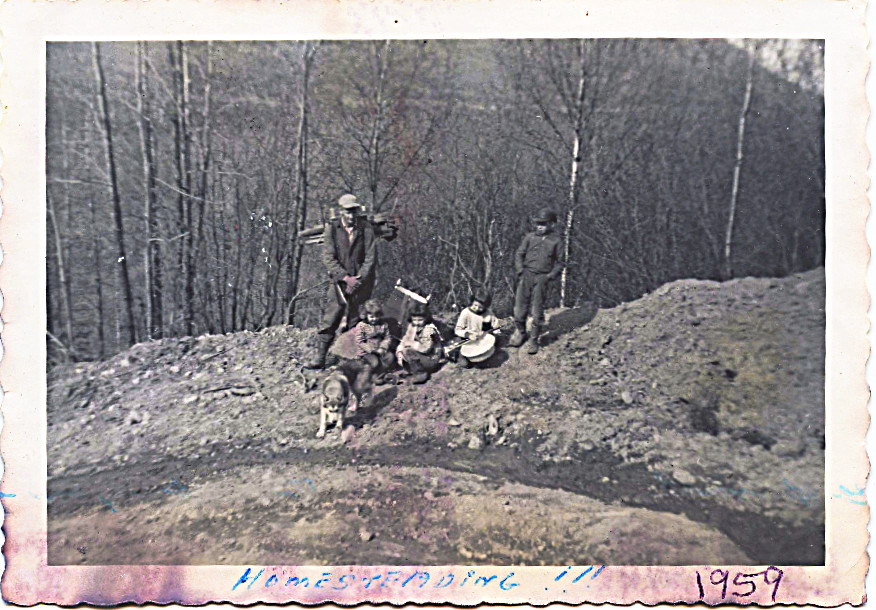
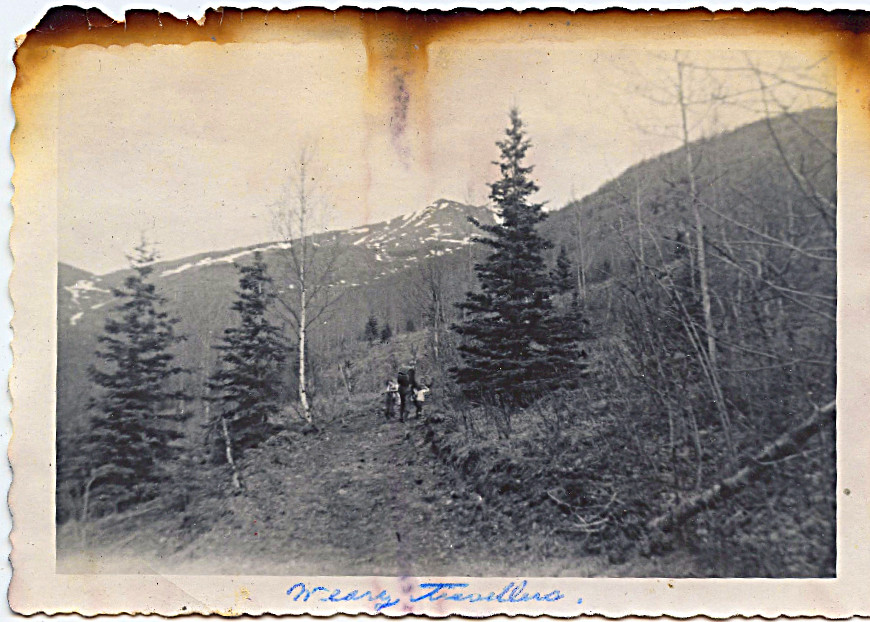
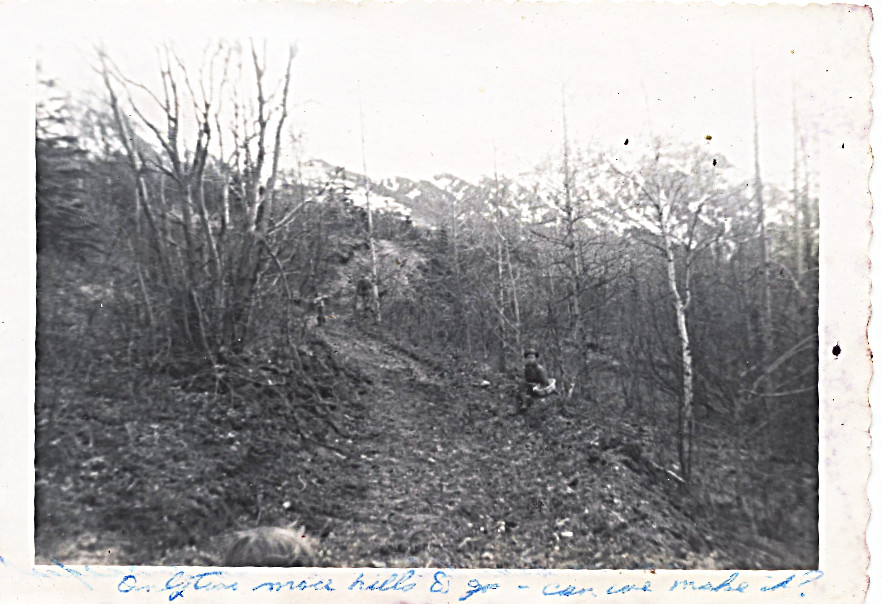
I am thinking about the amazing experience I had as I transcribed that long letter yesterday that my mother wrote down over fifty years ago: +A ROAD IS A LIVING ‘THING’ – 1959 HOMESTEADING ‘STORY’. The more I watched the story contained in her words unfold before my eyes, the more I scanned in the photographs and trimmed them up to add in along with her words, the more my body remembered those days on that mountain road when I was seven years old.
As I remembered I felt something happening inside me that I could not name until just now as I watched these sun rays appearing out of the darkness of the night, bringing a new morning to the world on THIS day, THIS day that cannot possibly ever be exactly like any day that has ever passed over this earth in all of its very long history.
What I now can name is that especially because I was a hated, shunned, usually-frightened and terribly abused child, any time that darkness went away even for a little while the light from without that met and touched my light from within helped me to grow by ‘leaps’ and by ‘bounds’. As I walked my little, growing feet over the virgin land of that Alaskan mountainside something new and different happened to me.
I felt fine. Absolutely fine.
I see in my mother’s homesteading letters that she often turns her scathing tone to my slowness as I trudged along with my family up that mountain. “There’s Linda, so slow as always, lagging far behind the rest of us.” As if I was some foreign albatross, some anchor around everyone else’s neck that dragged down the rest of them no matter what they were doing and no matter what I did.
But as the light from without touched me yesterday as I transcribed that story and remembered every smell, every sight, every tone of the mountainside itself along with what glorious shows of life that lay along the road that led back to OUR mountain along the valley’s floor, I could feel those same sun rays from fifty years ago lighting up my skin on the outside as my soul and spirit lit me up on the inside as clearly as today’s morning sun rays are out there at this instant nourishing those tiny carrot sprouts that rise above the soil’s darkness into their new life.
++++
At this same moment I know inside of myself that I walked that mountain as slowly as my mother would allow because I was eating it up. I noticed every step I took, every sound I heard, every wafting sweet-smelling breath of air that swirled around me. I noticed every twig and branch, every sight of water seeping from the cut earth banks and flowing, the edges of every patch of mud, every freshly cut root from every tree that had been hacked apart by some big caterpillar tractor that had TRIED to make that mountain road.
I heard every bird. I saw every cloud pass above me. And for all the meeting of light from without with my seven-year-old and growing light from within that happened to me upon that mountainside I remembered. I dreamt about those old mountain road switchbacks and the steep walk well into my 40s. I would travel there in my dreams on a road I knew only I could still find. And, oh how I grieved for most of my adult life for those days, for those nights.
I grieved for the mountains as the tractors came to strip away the trees and plants to add in the power poles. I grieved for every freshly cleared strip of land designed to reach someone’s newly built house rising among the trees. I grieved for that light I felt then, and I didn’t even know it. Today as I realize how naturally I responded to that Alaskan sanctity of land only newly touched by people, I also grieve for the eagles and bears and moose and beaver that fifty years ago belonged back in that valley and on that mountain before so many people came and scared them all away.
When I returned to that valley and to the place of my childhood last summer I found that the road all the way up that mountain is paved now. How nice for those who live there, content as they must be with their money, their good vehicles, with the plows that come and clear away all snow trouble before it bothers them. Nestled in all their houses built on subdivided land they are to me nothing more than signposts of change, of the passing of years, of the continued traveling of people who will go as far as they can around this world until there is barely a single thing left over from long ago and no more far away.
At the same time I am grateful that I was allowed as a small child to be a part of history there in that valley, on that mountain, in that time. Because there was so very little light allowed to shine for me in my terrified, suffering and very dark childhood, what light came to me in that place, on that land was essential for my very survival. And here I am today, writing these words, because of my part not only in the horror of my mother’s story that she never truly tells in her written words, but because of the beauty that she also knew — and wrote about.
++++++++++++++++++++++++++
Our own life force is as much our light within as it would be for a plant – or for any other creation. We are designed biologically to respond to light from without. No matter how abused we have been, as I mentioned at the start of this post, we DID receive light from without that met our own life force light from within.
Because we are members of a social species we are designed first and foremost to respond to the light in other PEOPLE as our emotional-social brain and our entire nervous system-body grows and develops from birth (and before). Yet for some of us the human environment was far more toxic than light-enhancing. That could not possibly stop us from responding to nourishing, life promoting influences in our environment no matter what our age.
Perhaps we could see the love and devotion in a pet’s eyes. Perhaps a stranger offered us a compliment. Perhaps we became aware of a miracle of nature around us. Perhaps we loved to run, or to draw, or to cook, or to hit a ball, or to feel damp grass under the soles of our feet or squish wet sand between our toes.
As long as we are alive in a body supportive and nurturing influences surround and encompass us. They feed and sustain us every bit as much as air, water, food and sleep. And in that world we were born into SOMETHING and/or SOMEONE DID delight us – or we would not have survived.
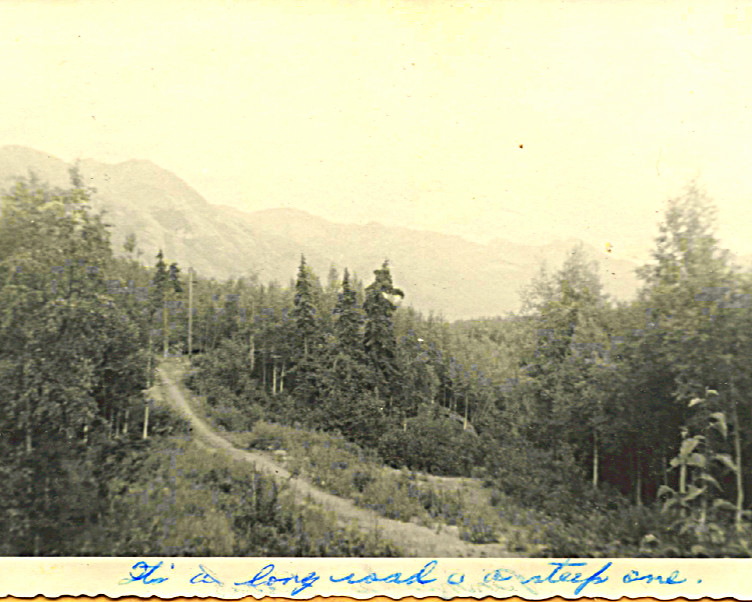
We don’t usually think of roads as being living things. Yet without nearly constant human attention a road will simply return to the life it had BEFORE someone tried to change it into something it isn’t. This is a delightfully descriptive early homesteading letter my mother wrote – enjoy!
+++++++++++++++++++++++
May 9, 1959 Monday [Mildred’s mother recopied Mother’s writings onto pages – much harder for me to read!]
Dear, Dear Mother,
I hope you had a happy Mother’s Day. I would have called you but we were “back in” all weekend, so of course I couldn’t, but I thought of you all day!
We sure had a peculiar time for Mother’s Day – I must say! So much to tell you – how much I wish I could keep you informed day by day! First I’ll tell you about today, then go back.
Before even telling you about today, though, I’m writing real tiny so I can get more on the paper since I’m low on paper. I’ll first put you at ease by telling you I’m better. Oh, Mom how sick I was. The doctor said it might be two or three months, and Mom he wouldn’t let us pay for two office calls and it was only 25.00. Now isn’t that a bright note in Alaska of all places? I know I must watch it and always wear a kerchief in chilly weather, but I feel so much better. I still am a tiny bit weak but that is to be expected.
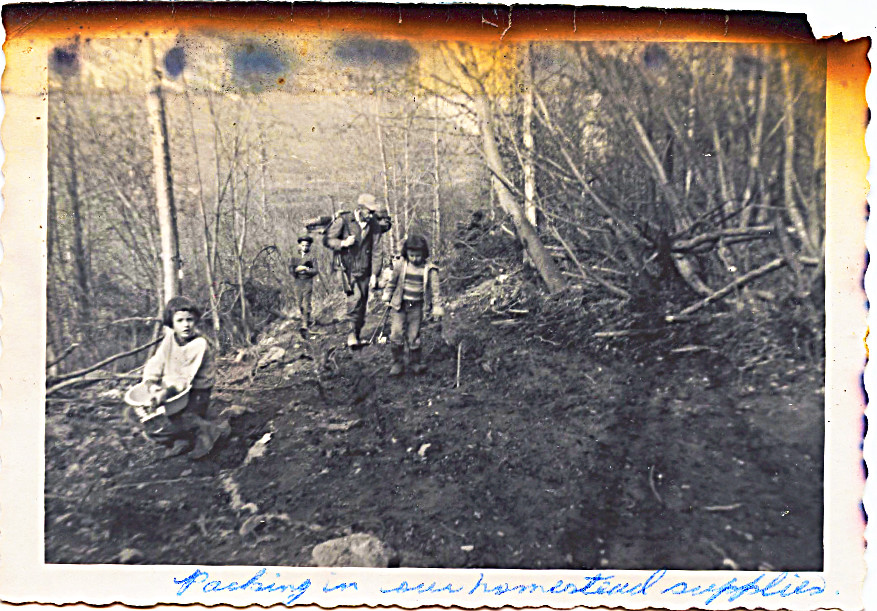
I saw today what a pokey-poke I am. We climbed to the homestead and it took me three hours from here [trailer at bottom of mountain?] to get up! I had to rest every few steps and sometimes just collapsed on the sleeping bag I was lugging up. Bill had a bag too and our camp dishes and Sharon. Even Linda beat me by far.
+++++++++++++++++++++++++++
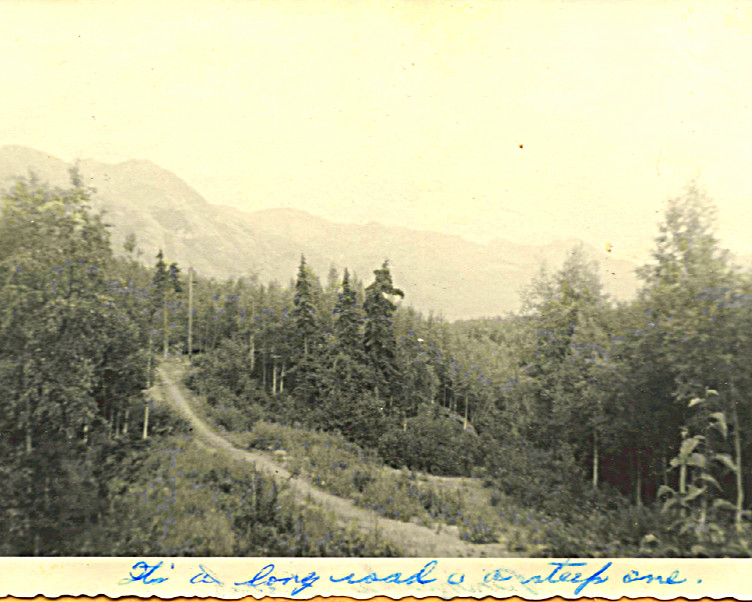
Oh Mom for words to describe our so-called “road” – (ha-ha.)
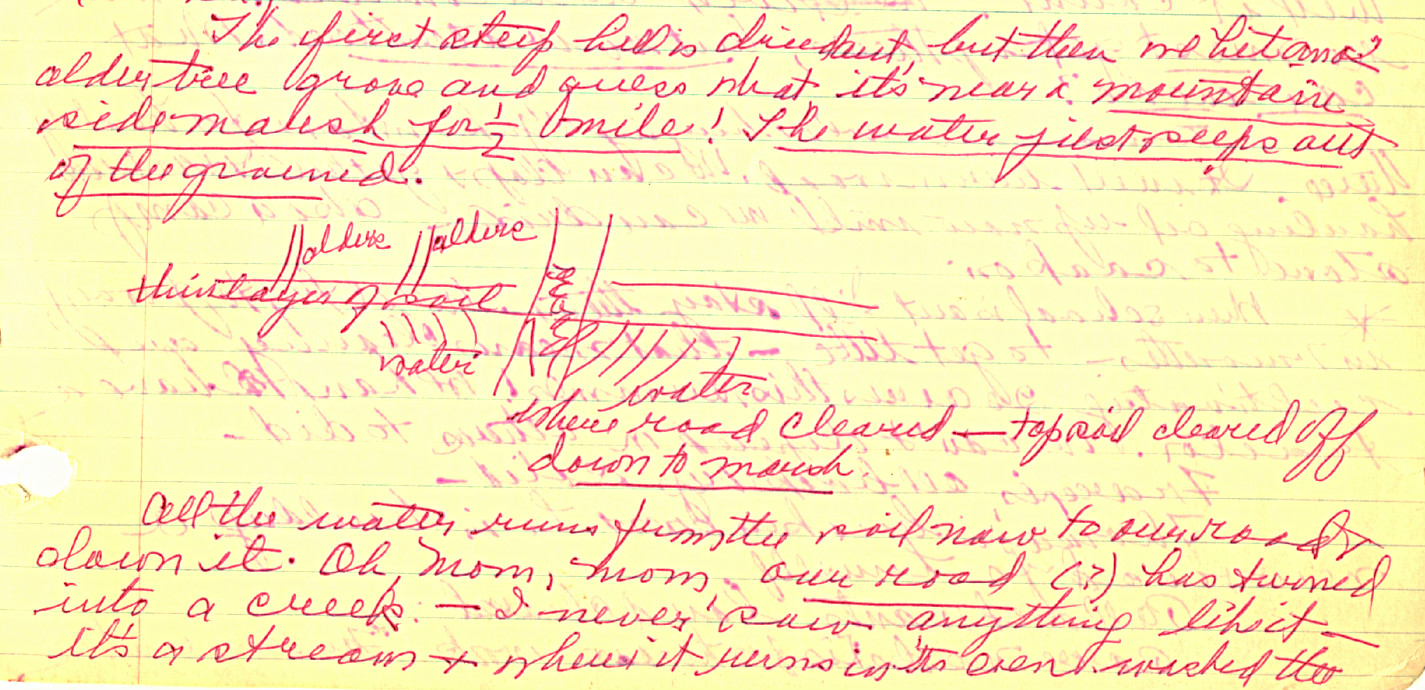
The first steep hill is dried out but then we hit one alder tree grove and guess what? It’s near a mountainside marsh for half a mile! The water just seeps out of the ground.
++++++++++++++++++++++++
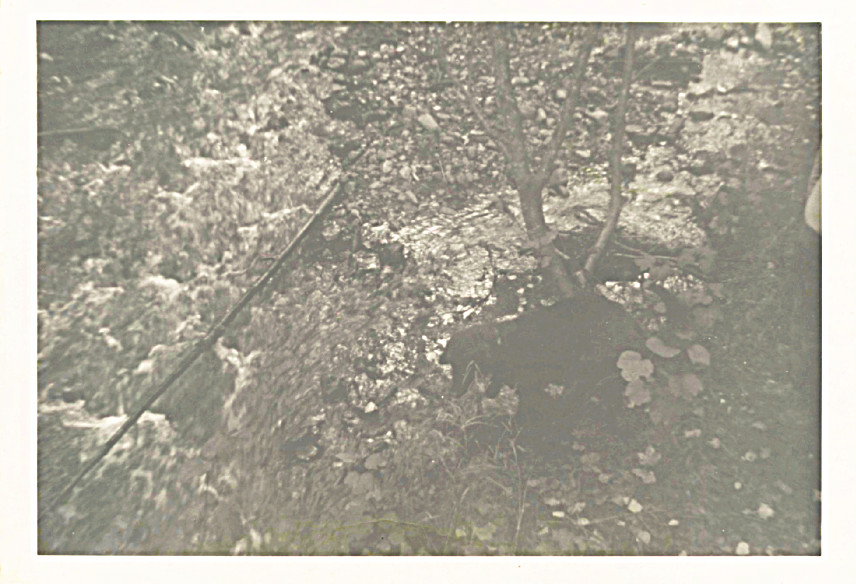
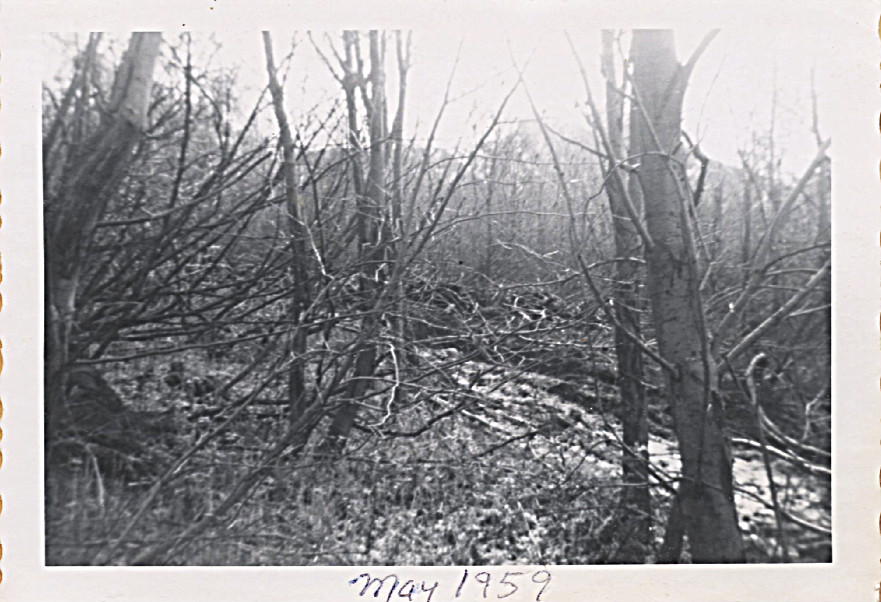
All the water runs from the soil now to our road and down it. Oh Mom, Mom, our road (?) has turned into a creek. I never saw anything like it – it’s a stream and where it runs in [to the road] it has even washed the mud off and it’s a stone bottom like a creek and then in between is oozy–deep mud. You sink way down and your boot sticks in and you can hardly pull it out. If you don’t move quickly you’d never get out. For all that distance one has to walk on the upper side through alders and brush; or try to walk in to “creek” or sink into the oozy mud.
Mildred’s caption on the back of this photograph: This is where we always had to duck through the alders – no other place to walk. ‘Your pack’ would catch on the trees and it would be a job – nasty alders. Oh, what days those were.
++++++++++++++
Even the sides are muddy with deep gully ridges. The upper part is now dried out and is O.K. but so steep.
Bill told me that since the snow and ice had melted it was like that, but I had to see for myself! We just don’t know how long before it will dry out. Bill has diverted the water in as many places as he can but it really doesn’t help much.
It took us three hours to get there and another two hours to cook a simple meal over an open fire because the wind was blowing so hard.
Oh Mom I didn’t want to come back to the trailer – Pollard’s know the seventh [the day we told Land Office we were moving to the land to begin the seven month proving-up residency requirement] has passed. Bill put in residence the night he set up the Quonset [Jamesway, April 4, 1959] – will it count? Will we be contested? Oh Mom he must get up there, but no water there. What canwe do?
Tomorrow we’re buying a Yukon stove for heat up there. It will burn wood. We can chop and gather and save us hauling oil up now until we can drive – also a camp stove to cook on.
* When school is out I’ll stay there. We’ll try to prove up in seven months – to get title – that means clearing and cultivating twenty acres this summer! We have to have a tractor. We can’t depend on others to do it — Frary’s all booked up solid. Thomas’ broke down and he is building a new road for himself. Pollard wants land cleared. Carr needs his for his own work. You remember how busy everyone is here in the summer – the precious summer days.
I won’t rest until we get title to our place. We need at tractor to rebuild this road, clear our own land, haul up supplies now and in the future and to build a new road. When we get the $ we’ll turn the Ford and Truck in on a Tractor plus 800 down. 2,500 for a second hand one!
* Oh how the children loved it up there. Oh to be young, Mom. They scamper up the mountain shouting and laughing. They think it is great fun indeed! I’m glad we’re doing all this now while they are young!
How Bill ever managed to erect that enormous building single-handed I’ll never know. It would be simple enough to build a house alone, but those enormous big pieces! He did, though, and he slept there, and even we are dragging our possessions up – so as far as we are concerned we’ve set up residency. We gave up our apartment and certainly this trailer [still down at the foot of the mountain] is a camp along the way.
How I yearn to sleep there now and wish you could be up there too for the summer. I’m sorry I can’t come to California – my work is laid out here and every day is precious – so much to be done before winter sets in!
(I am finally selling out plastics – decided last week – so far still booking parties but sold out for 10% off; 20 – 30%, depending. Samples are going fast and I have very little left. Have two this week, hope that will do it! It’s been too much and can’t make profit when must travel so far etc. It’s made us all tired and irritable and been hard on everyone.)
School is over one week from Friday and I hope to be all done with it by then. I’ll hibernate to my mountain top even if I walk.
Bill thinks as soon as ground thaws he can dig out a spring in the valley for water. There are only a few remaining patches of snow up there and not a sign on low lands now. The berrybushes are all there as last year and the wildIris are now coming out.
Oh, Mom, I want to be done with town except for occasional trips and make my home here – all year round. Oh for a decent road, but as I tell Bill, I’d rather wait until we have title for sure or someone else will want our place and contest us. True?
I would give my eye teeth to have this trailer up there. It’s home now – elegant next to the Jamesway. It’s all a matter of comparison, isn’t it?
Saved your recent letters. Keep them rolling.
Now I’ll go back to the Tuesday two weeks from tomorrow [would have been April 26, 1959] when we got our jeep out. Remember? Oh that was a busy day. I had plastics to deliver, packing to be done. Bill planned to take Wednesday off and we were to move to the Mountain Top. I’d even seen the Principal about teaching the children the remainder of the year.
I sold the Motel owner 14.00 worth of plastics so paid for day but still owned $14. OUCH!
Finally headed home and oh it seemed good to leave the city behind. Stopped off at Frary’s to see about having him come up next day to do some road building. He’d been had last several days clearing land for Barclee and was boiling because Barclee’s land was steep — road in. He is so awful. Tried to talk us out of homesteading in here and in next breath told us how awful it was when he first homesteaded.
Well, as I said, he’s busy for some time to come and we left. As we drew out of his driveway Pollard’sdrove by – headed back to town. Oh No!! Said two jeeps were stuck in mud and couldn’t get by and those were being dug out – much too far to walk – at least five miles and already 8:00 P.M. and me still weak from being sick. There’s been the real bad marshy place where Pollard and Thomas had just worked over – now barely passable. Evidently when Frary’s tractor went over it, it ruined it – too heavy – and road collapsed.
We went sadly to Fire Lake Lodge for a decent meal – first decent meal in ages – 10 P.M. before we were done — full and satisfied. Asked Bockstahlers (she thinks all this if funny – ha-ha!).
I haven’t seen one person other than her since returning to Eagle River and don’t intend to until hold title to our own land!! It means the world to me – to both of us – if we could leave jeep there over night.
Stayed over night in town at Far North Motel – double room and private bath and adjoining restaurant — $17.00 for one night and well worth it in comparison with other places we’ve seen.
Wednesday night back to town again, but couldn’tpass mud hole. Pollards right behind us. So we walked across and left everything in car. I had gotten a tiny black kitten that day – three weeks old from one of my Haliday plastic women – and carried it to Barclee’s and he rode us to next mud hole. We all waked rest of the way. Next morning, Thursday, I had to go back to town so we all got up at 4:45 so we wouldn’t keep the Pollards waiting. They had their old pick-up truck waiting one mile down the road. We all walked to it and rode it to bad mud hole. We all got across it [left the pickup on the other side] and then in our own jeeps and then to town. What an expedition!
Thursday woman said she wanted plastic party Friday, so we left plastics at her house so we wouldn’t have to bother with them. Friday night stayed over at Far North Motel again and home Saturday.
When we got to mud hole all the homesteaders were working on the road. I wish I’d had a camera with me. Where the road went completely out when Frary went over it, they were scooping all the mud out of that spot to fill it in with gravel and then so pretty birch trees over this to make a bridge over the mud which is so oozy and deep you sink in it.
What a busy place. Our jeep was loaded with everything we had bought in town plus groceries plus clean laundry, but we couldn’t drive it over. We all put our high boots on which look freakish in town where everything is all dried up. We got out.
Ecklund offered to ride us home and Bill would stay and help the men. They carried the children over the mud. It would have gone to their knees and maybe over them. I barely got over – what gooey, gooey stuff.
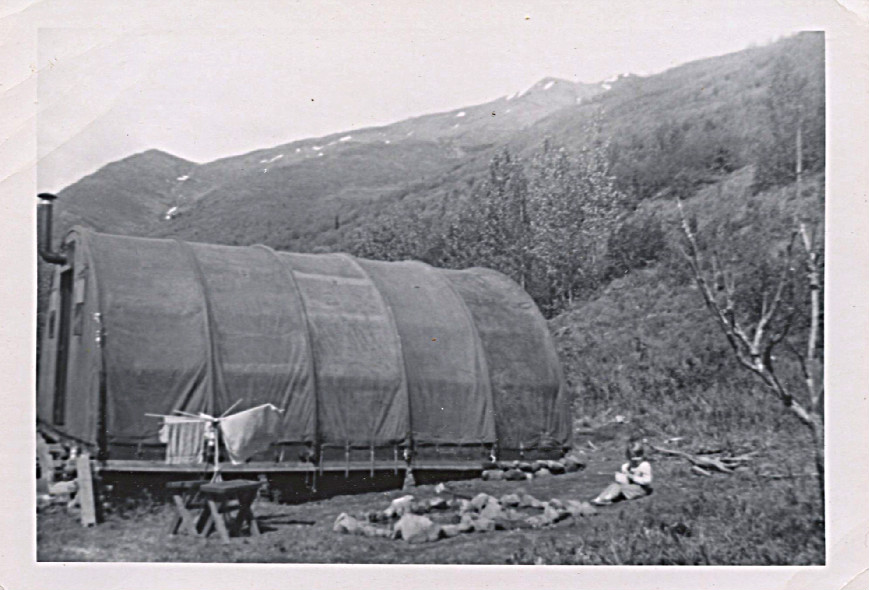
A view of our trailer stuck at the bottom of our mountain on Pollard’s land – could not get it up “Horror Hill” to the homestead – and that’s slippery, gooey mud! Mildred’s comment on back of photo: This is where the trailer stayed for almost six months! Where we lived in April 1959. Taken from top of first hill.
+++++++++++
Home to messy trailer Haven’t really lived in it for some time due to sickness and jeep breaking down. No water though. Was in back of jeep so carried some from Pollard’s stream. Washed dishes, floor, some clothes. Made cake and Bill got home. He drove home – amazing to see the jeep get through after all this time and over those hundreds of birth limbs. Now isn’t that something? It’s called “corduroying” the road. Learn something new every day.
For all the trouble homesteading certainly is exciting to say the least.
Sunday [May 1st] morning Bill had a sales manager from Chan [sp?] Motors coming out to demonstrate a German jeep that he guaranteed (ha ha) could get up “Horror Hill.” Pollard, Carr and sons were all here to see. Well, it got up the hill and stuck in first mud hole. Got it out and he was determined to get through the next, but he couldn’t. Turned it around and he rammed it into a tree. Broke front windshield and top!
Boy, I bet he was mad. Men said Bill should have taken picture for the news of this $4,000 snazzy jeep before and after our road!
Oh I could write pages on all this, but not time. When I am up there for good there will be more time and peace.
I did write you about mosquitoes. We were eaten alive first night here after my being sick. Then got “Off,” a repellant that really works, comes in a spray bottle – no more trouble now! Thank goodness!
Bill doesn’t get home until quarter of seven.
He’s fine. We all feel fine, close again and happy. I felt mean and horrible before I was sick. Then Bill was so good and kind when I was sick and I’m so thankful to be better now that nothing else matters.
I did have time to think and know I’ll give up anything for our homestead. It’s ALL to our way of life now.
We’ll live in Jamesway and walk if I have to.
Sharon just came in. We have a strong glacier wind today. She feels like ice. Otherwise day is heavenly – blue skies and sunny. We’ve had some gorgeous weather recently.
Oh how I love to see you all. After we get title to our land – we’ll come there – should get title November 1959! Hooray!
My secret worry is that you and Pollards and others know that we are not on our land – Oh Mother I worry. Pray for us. We’ve worked so hard and there’s so much ahead yet.
+++++++++++++++++++++++
This is probably from March 1960, but it gives an idea on what 'stuck' looks like
Well, in the final throes of digging up ‘stuff in words’ I have (unexpectedly) unearthed the last of my mother’s homesteading journals. Today, if I was going to name her book I would title it something like this:
Moving Mildred’s Mountain — The Road to a Good Dream is Seldom Easy
An Alaskan Family’s Homesteading Tale
Oh - the road - 1959
“Of the deep wilderness of the wood where you and I shall walk free”
– words evidently written by Mildred around 1933 when she was 8-years-old
There were nearly more obstacles in my family’s story than a person could count – and moving the mountain to make a passable ROAD was certainly one of the main ones.
But even above all others the Number One Obstacle our family carried along with us throughout all time and over all distance and to and from every place we lived was NEVER identified, recognized, named, accepted or dealt with:
My Mother’s Borderline Personality Disorder
In the end this WAS what doomed The Dream. The demise of the homesteading dream happened not because of her mental illness itself but because it WAS never recognized, named or healed in any way. The family was left ‘playing parts’ on my mother’s dream-stage in a continuing downward spiral no matter how hard our family participated in Mother’s ‘drive’ to move up that Mountain and to find a way to stay there.
Yes, I am working my way to the bottom of my mother’s papers and just found something that strikes me as being SO STRANGE!
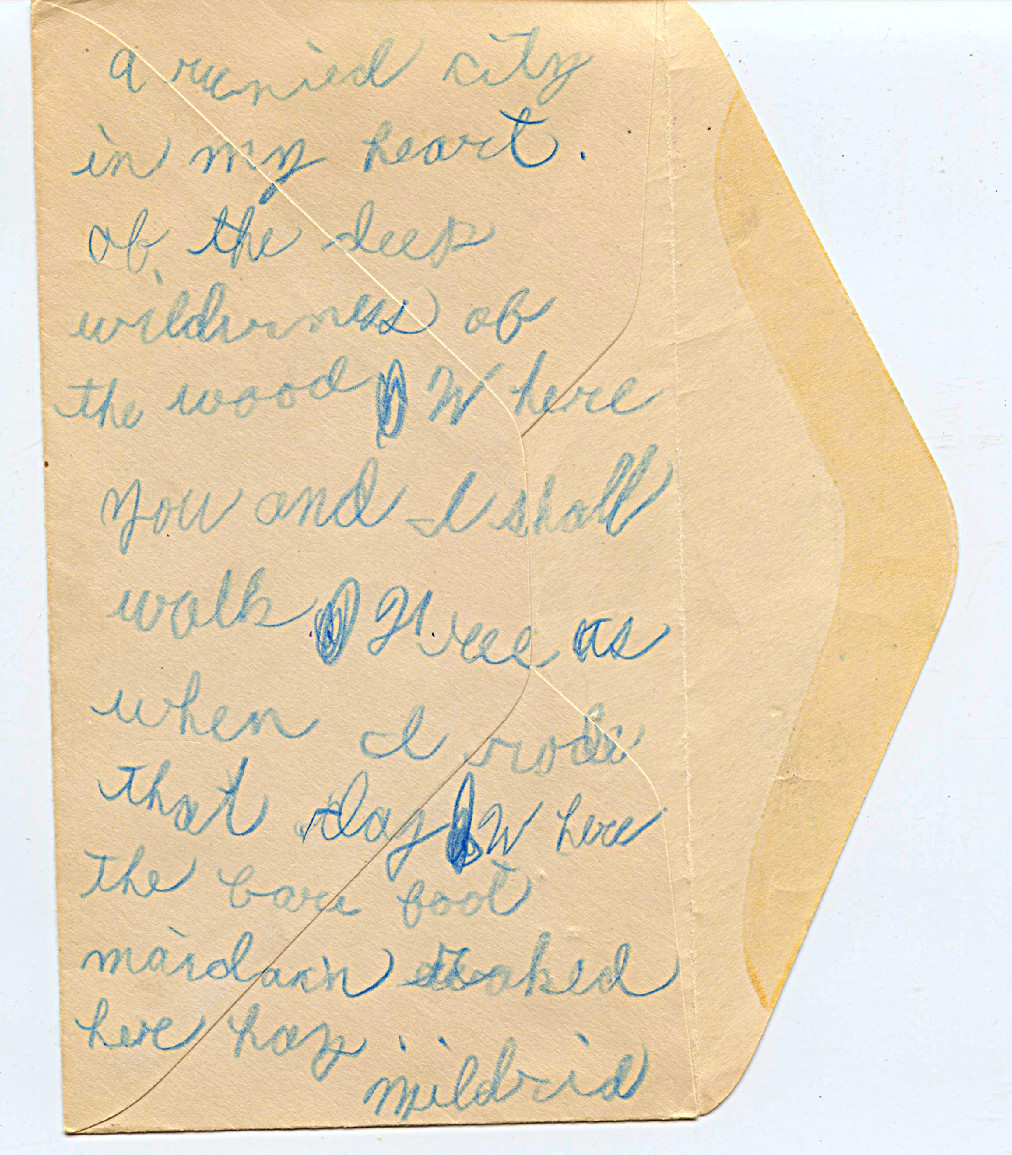
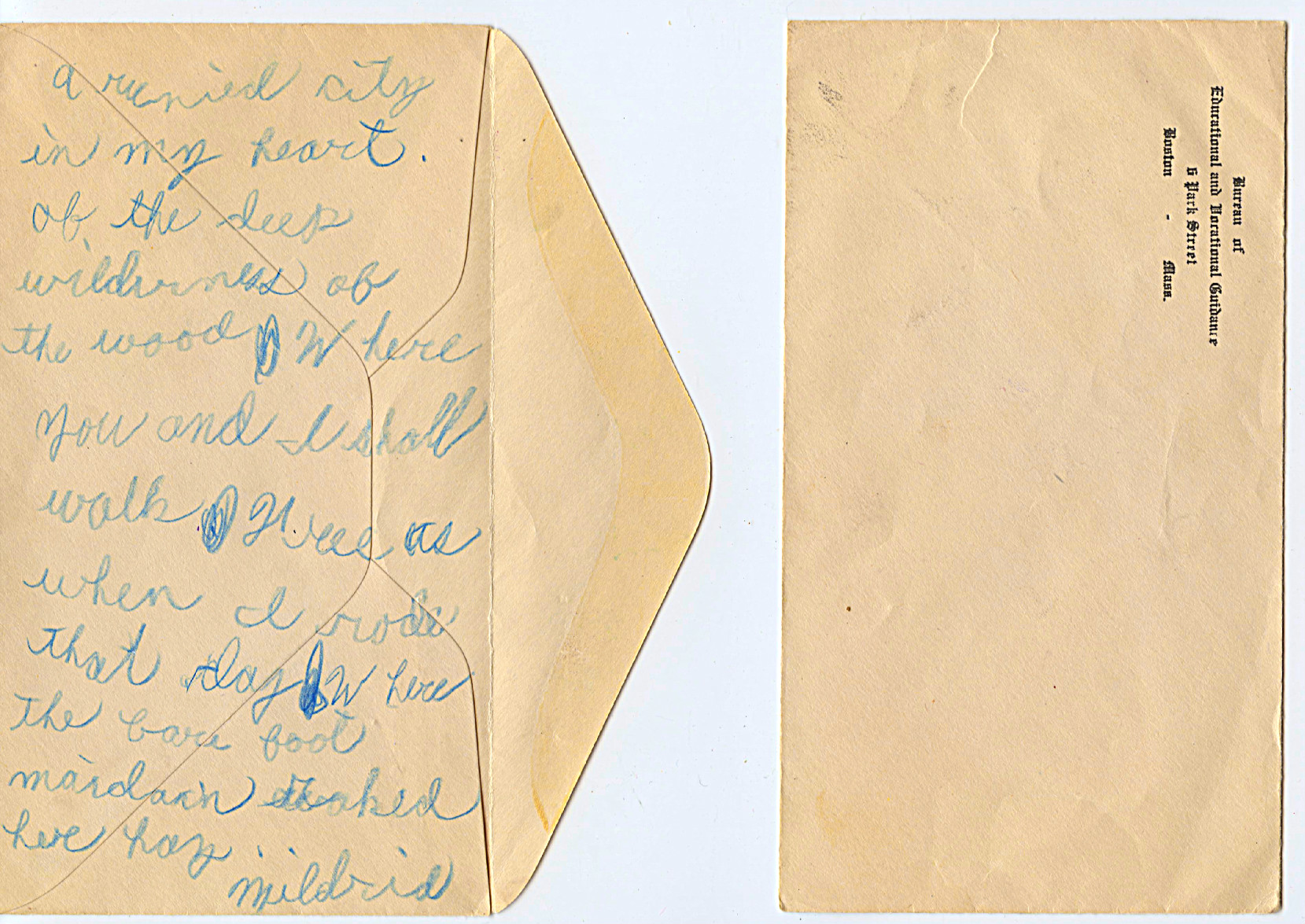
In with my mother’s mother’s college graduation information from Boston University 1917 and masters graduation transcript and information for the University of Minnesota in 1918 I found two very old regular size envelopes with ‘Bureau of Educational and Vocational Guidance, 6 Park Street, Boston, Mass. printed on them. Neither envelope was ever mailed or addressed – but here is what is written in my mother’s child handwriting – evidently before she even knew how to spell her own name (I am going to correct the spelling here in this text):
On the first one:
and presently upon her breast a baby raised and cried aloud. Her mother was so surprised she wept upon her golden hair which was upon her breast. She wept and wept until a bride arrived and swept
On the second one:
a ruined city in my heart. Of the deep wilderness of the wood where you and I shall walk free as when I rode that day where the bare foot maiden raked the hay.
Mildrid
[actual spelling of her name is Mildred] – ah, my youngest sister solved the puzzle – partly:
“As you point out, very precocious of her to understand the meaning of the poetry.”
The strangeness of these two pieces – archetypal image of the mother and baby – but why with the sorrow and the weeping? – prophetic?THIS is what I believe took my mother to Alaska. THIS is what called her to homestead.Archetypal – prophetic of the HUNGER FOR THE LAND, of the ruined city in the heart – reminds me of her dark rainbow storm dream – healed upon the land?
I would think because of the misspelled words that my mother did not copy these words from some other text, which does not mean that she didn’t know the words from some other place. Of course the context for these writings will never be known, but they definitely have been saved for a very long time – probably since around 1935 (when my mother was 10 or even from an earlier time).
This looks about like an age eight handwriting – even then the seeds of how my mother’s life turned out had certainly already been planted within her beginning with not having her needs met from infancy forward. The loss of her grandfather, of her father, and the loss of her mother when her mother went to work to support her family once she had divorced when my mother was five.
Whatever all the combined influences were in her very early years, I can’t help but wonder about these images contained upon these envelopes that have probably traveled 25,000 miles and are 75 years old today, June 16, 2010 when I found them: The a troubled mother with her infant daughter and the yearning for the healing of the land.
How would it happen that a child this young would understand the meaning of these phrases, “a ruined city in my heart” and “the deep wilderness of the wood where you and I shall walk free?” I wonder. I have to deeply wonder.
(And if these are archetypal images with their archetypal figures, whom might the ‘bride’ and ‘the barefoot maiden’ be?)
++++
This reminds me of something I wrote August 21, 2007 on a little piece of paper that I dropped into the ‘mess’ of my mother’s papers and also found today:
Did Mother have to pay the price for “going on being” by leaving the biggest part of who she was and who she could have been and was meant to be — behind?
(Informed compassion) – Understanding frees me to love my Mother — and then to love myself better — as an extension of her (and Dad). If we “hate” a parent we cannot help but have that hatred carry over to how we feel about our self.
I just finishing transcribing another version Mother wrote about the decision they made to move to leave Los Angeles and move to Alaska. I like this one better. There is no indication of when it was written, but I think it was written before the one I posted last night.
It leaves me thinking that no matter how genuine and authentic their ‘dream’ was, my mother’s undiagnosed and untreated severe mental illness did actually destroy any chance our family had to ACTUALLY ‘live happily ever after’, which is something I believe my parents both hoped for when they made this HUGE move. That tragedy is real, even if I cannot find even a glimmer of it in this piece she wrote:
Sometimes I wish I could talk to some ‘mental health professional’ just about the moving around that my mother did. As she mentions in her piece of writing that I transcribed yesterday and posted the link to in *October 1958 – DREAMS CAN COME TRUE, my mother believed that my father provided a kind of stabilizing counterweight to her impetuousness. But I wonder what would have happened to her in her life if my parents had not yoked themselves to one another?
I still have not completely delineated and visibly lined up the number of moves that my mother arranged and that mostly my father accomplished during their married years prior to my leaving their home when I was 18. Some part of me this morning wants to stop and take account of the moves that had already happened before my mother had written her October 1958 description of their Alaskan ‘venture’, as she called it.
My parents married June 11, 1949 and as far as I know they lived on/at Almont in Los Angeles at least until their first child was born on June 15, 1950. Then comes a move. I don’t believe I was born while they were living there, so probably by August 31, 1951 they were living in a rented house on Calavaras (wherever in LA that was).
So, from Almont to Calavaras to a rented apartment by July 10, 1953 when my sister was born, then probably to a house my parents bought in Altadena that they did not sell until they were moving to Alaska even though my spring of 1956 they were in another new house they purchased in Glendora (still in LA area).
We must not have lived in this location of the 4th move for much more than a year, but that would have been four moves in the first seven years of their marriage. The move to Alaska, which involved my father leaving first and being gone from us for two months in June and July of 1957. According to mother’s writing, they sold the Glendora house (and the Altadena one) before my father went to Alaska and moved into a ‘court apartment’.
From this apartment, after my father had left, my mother then moved us into a motel, out of the motel into a rented house, out of the house into her mother’s, up to the mountains for a week, back to her mothers, and then probably into another motel before she left for Anchorage.
So, adding up these longer and shorter term moves and locations, let’s see – that’s around 11 moves that were made with children in tow before mother reached Alaska and the infamous Log House in Eagle River on August 1, 1957. The log house was probably move number 12.
We stayed ‘all cozy’ in the log house until June 1958, by which time my father had already located the 160 acres spot of our homestead and had staked claim, or filed on the land. We moved out of the log house into Bockstahler’s ‘shack’ or ‘cabin’ (its title depended on mothers move moment to moment) where we stayed until October 1958.
At that point the six of us moved into an apartment on Government Hill in Anchorage area where we stayed until about the following March, and by April 1, 1959 we were off on our homesteading adventure.
So by the time my mother wrote her *October 1958 – DREAMS CAN COME TRUE piece she (I’m quite certain it wasn’t my father) had orchestrated, staged and managed to accomplish 14 moves. I was 7 when this piece was written, and already by then I had been dragged around through probably 13 moves with my parents, and that was only the beginning.
So, talking about ‘life’ and ‘childhood’ in attachment-related terms, right along with the incredible vacillation and instability of my mother’s moment-to-moment mental-mood states and the insecurity they caused in the lives of all around her came the physical moving from place to place that even further guaranteed a complete environment of lack of safety and security for my parents children.
My mother wrote *October 1958 – DREAMS CAN COME TRUE from within the small enclosure of a massive, ugly apartment complex. True, the move ‘to town’ was no doubt simply seen as ‘as step in the right direction’ toward accomplishing fulfillment of their Alaskan homesteading dreams, but I still find the contrast in location and place interesting as I read her written piece.
By the time my mother was actually on the homestead, and had her ‘dark rainbow dream’ about the horrific wind storm contrasted to how it stopped in her dream when she met the right ‘person’, she had already in her lifetime experienced probably close to 30 moves.
If I could talk to this ‘mental health professional’ I would like to ask what this kind of moving is seen to represent in a person’s life. That the moving, at least in our family, seemed to be connected to and integrated with this ‘pioneering’ drive makes me suspect that it was then connected to the genetic undercurrent that MANY immigrating ‘pioneers’ had within them as they traveled to America in the first place.
But it is hard to feel a part of the mainstream American current with this kind of ‘traveling’ background – and I have certainly done my share of moving around in my adult life, as well. I still haven’t counted my own moves, but I do know that right now being here and staying here in this little house I live in now is the single most important aspect to my own current life.
So when I work in my yard on my adobe projects it is in part the grounding I experience as I work with the physical DIRT that helps me right now. As I looked around me out in my yard this morning I just had this thought: I wish I had thought beforehand that I could have actually encased my mother’s individual letters I have completed transcribing right into those bricks – where they also would have finally met their final grounded end — because they probably would have remained within those bricks for a very, very, very, very LONG time without GOING anywhere.
I have spent too many hours to count on the job of transcribing my mother’s writings today. No adobe work. Just this work. I am nearing the end stretch but not done yet.
This is a link to my mother’s words written about why they decided to move to Alaska and what that process was like. I am glad I found it – it will certainly be near the front of one of the books of her letters. I really hoped she didn’t spiral out into orbit as she wrote this piece – and thankfully she didn’t. She actually seemed to stay on target, which surprised me! You might be interested in taking a look:
The comments that have grown at the end of yesterday’s post, +WHAT MY MOTHER FORGOT TO WRITE IN HER NOVEMBER 1957 LETTERS, are about a kind of ‘borderline’ that I believe exists within the mind of most members of ‘the public’. If the kind of abuse parents like my mother was cannot be imagined, conceived of, or even BELIEVED by ‘the public’ there will not be much hope of true recovery for survivors of this kind of abuse or protection for its current victims.
Although I posted an allusion yesterday to this type of parental abuse as being more closely related to War Crimes (see +THE GENEVA CONVENTION – WE NEED WORDS TO PROTECT ABUSED CHILDREN) than it being related to the ‘species’ of child abuse most members of ‘the public’ might imagine, abuse (which is in itself far to minor a descriptive word) perpetrated against infants and children by parents like my mother was is, in my thinking, even so far PAST war crimes that if it hadn’t happened to me I probably wouldn’t be able to imagine, conceive of or believe it even could be possible myself.
Members of ‘the public’ are, by and large, reasonable (reason-able) people. They exist on one side of this ‘borderline’ I mention in regard to coming to terms with the possible ranges of infant-child abuse (as well as with the far ranges of ANY kinds of abuse humans can perpetrate). On the other side of this ‘borderline’ are people like my mother was who have what Dr. Martin Teicher’s Harvard research group names ‘an evolutionarily altered brain’.
But it certainly isn’t JUST their brain that is altered. It is their ENTIRE physiology. Once this kind of abusing adult has been created within the malevolent environments of their own early developmental caregiver relationships, the degree of change that might be possible down the road of their lives (much past the age of three, I believe) is minimal — and WILL NEVER make these people magically into SAFE infant-child caregivers.
The kinds of crimes they are capable of committing against their offspring are so far past what ‘the public’ could even begin to imagine as being even ‘war crimes’ that reason-able people cannot usually conceive of them.
No matter how despicable, how devoid of ordinary human conscience any ‘war crime’ might be, if the crimes are committed against adults they are of a different nature than the kinds of infant-child ‘abuse’ that I am talking about. The kind of trauma altered evolutionarily altered brain that Teicher refers to IS one adapted (along with all the rest of a survivor’s physiology) to continued existence in the worst kind of malevolent world possible. When this adapted-to malevolent environment does not contain within it even the most essential resources to ensure continued survival – elimination of offspring can very easily be the end result FOR MOTHERS.
This is, of course, not a consciously recognized aspect of the kind of ‘mind’ my mother had, but this obliviousness to FACT does not make the FACT any less real.
On this level I would say that we are not talking about ‘ordinary ranges’ of infant-child abuse. We are not even talking about ‘ordinary ranges’ of war crimes.
The only closest collection of information that ‘the public’ might be able to reach for, accept and rely upon in their consideration of the kinds of parents I am talking about and the ‘outside-the-range of ordinary’ treatment of their offspring would be to include in their consideration all information currently available about both GENOCIDE and INFANTICIDE.
Such a ‘trauma changed mother’ operates with a physiologically-based biological imperative to eliminate offspring (one or all) in the same way an animal in the wild would (or our ancient ancestors) should life within a hostile, malevolent environment be just about as hard as possible. The BODY that took this evolutionary detour in its earliest development CANNOT BE CHANGED BACK AGAIN to become at some later date a benevolent-environment body-brain-mind.
(It seems entirely possible to me that the genetics behind suicide and well as perhaps genetic combinations (not yet identified) behind self-harm and eating disorders might also be connected to the permanent ‘evolutionary alternative developmental changes’ related to the influencing physiological (epigentic?) factors that are involved in adaptation to early malevolent environments.)
(Another critically important factor to consider is what Tomkins describes when he says that a human infant’s adrenal gland ‘system’ is 2 1/2 times ‘more powerful’ during the earliest developmental stages in proportion to its body size than it is in our adulthood, making sure that stress-related responses to malevolence within the early environment that require adaptations-changes to best ensure survival happen as FAST, as early in development and as permanently as possible.)
That human infant-children do somehow OFTEN manage to in fact physically stay alive and survive the malevolent treatment that was done to them does NOT exclude the range of ‘abuse’ from the arena of considerations related to GENOCIDE and INFANTICIDE. In cases such as my mother’s was, the ONLY reason she did not actually eliminate my body from the world of the living is because of her narcissistic desire to avoid reprisal for her actions.
When an infant-child is NOT actually physically killed, this means that the level of suffering from torture, terrorism, ‘abuse’ and malevolent treatment continues on and on and on and on…….. The fact that these survivors did indeed survive in NO WAY lessens the reality of the acts toward GENOCIDE and INFANTICIDE that these ‘super abusing parents’ commit.
Perhaps, I mentioned in one of my replies connected to yesterday’s post about what my mother ‘forgot’ to tell my grandmother, ‘the public’ is perfectly fine with allowing for a range of ‘acceptable losses’ related to allowing the worst of the worst possible infant-child abuse to continue – in effect, right under our noses.
When thinking about Universal Human Rights of Children we must at the same time consider that when these rights are massively denied and the reverse of human rights is what is actually happening to infant-children, we need to begin to understand that we need the equivalent of a Geneva Convention’s rules for what is to be done on behalf of these ‘super survivors’ of ‘super abusive’ parents — and what is to be done to, with and about these parents, as well.
NOTE: I nearly always add to my posts over time once they are published – best to come directly to this site to read the up-to-the-minute versions!
Having just posted +WHAT MY MOTHER FORGOT TO WRITE IN HER NOVEMBER 1957 LETTERS, which follows the series of selections from my mother’s letters last week about me, ‘my clothes’ and my grandmother has led me in one direction, and one direction only. While NO child should EVER have to experience abuse of any kind – no PERSON – abuse does continue to happen.
As I work toward the publication of my books I am realizing that some child abuse (and other domestic abuse situations) lie closer in their reality to conditions surrounding being held as a Prisoner of War than they do to any other situation we could think of.
I am including in this post the wording at the beginning of the Geneva Convention relative to the Treatment of Prisoners of War. Victims of severe infant-child abuse and other domestic violence victims are attacked by armed force. While I don’t know if anyone has come up with a version of the Convention’s wording as it might relate to civilian attack, even reading these words as they were designed to address circumstances of adult armed conflict gives me a lot to think about as a survivor of my mother’s nearly unimaginable attacks of abuse against me over the 18 years of my infant-childhood.
Geneva Convention relative to the Treatment of Prisoners of War, 75 U.N.T.S. 135, entered into force Oct. 21, 1950.
PART I
GENERAL PROVISIONS
Article 1
The High Contracting Parties undertake to respect and to ensure respect for the present Convention in all circumstances.
Article 2
In addition to the provisions which shall be implemented in peace time, the present Convention shall apply to all cases of declared war or of any other armed conflict which may arise between two or more of the High Contracting Parties, even if the state of war is not recognized by one of them.
The Convention shall also apply to all cases of partial or total occupation of the territory of a High Contracting Party, even if the said occupation meets with no armed resistance.
Although one of the Powers in conflict may not be a party to the present Convention, the Powers who are parties thereto shall remain bound by it in their mutual relations. They shall furthermore be bound by the Convention in relation to the said Power, if the latter accepts and applies the provisions thereof.
Article 3
In the case of armed conflict not of an international character occurring in the territory of one of the High Contracting Parties, each party to the conflict shall be bound to apply, as a minimum, the following provisions:
1. Persons taking no active part in the hostilities, including members of armed forces who have laid down their arms and those placed hors de combat by sickness, wounds, detention, or any other cause, shall in all circumstances be treated humanely, without any adverse distinction founded on race, colour, religion or faith, sex, birth or wealth, or any other similar criteria.
To this end the following acts are and shall remain prohibited at any time and in any place whatsoever with respect to the above-mentioned persons:
(a) Violence to life and person, in particular murder of all kinds, mutilation, cruel treatment and torture;
(b) Taking of hostages;
(c) Outrages upon personal dignity, in particular, humiliating and degrading treatment;
(d) The passing of sentences and the carrying out of executions without previous judgment pronounced by a regularly constituted court affording all the judicial guarantees which are recognized as indispensable by civilized peoples.
2. The wounded and sick shall be collected and cared for.
An impartial humanitarian body, such as the International Committee of the Red Cross, may offer its services to the Parties to the conflict.
The Parties to the conflict should further endeavour to bring into force, by means of special agreements, all or part of the other provisions of the present Convention.
The application of the preceding provisions shall not affect the legal status of the Parties to the conflict.
Article 4
A. Prisoners of war, in the sense of the present Convention, are persons belonging to one of the following categories, who have fallen into the power of the enemy:
1. Members of the armed forces of a Party to the conflict as well as members of militias or volunteer corps forming part of such armed forces.
2. Members of other militias and members of other volunteer corps, including those of organized resistance movements, belonging to a Party to the conflict and operating in or outside their own territory, even if this territory is occupied, provided that such militias or volunteer corps, including such organized resistance movements, fulfil the following conditions:
(a) That of being commanded by a person responsible for his subordinates;
(b) That of having a fixed distinctive sign recognizable at a distance;
(c) That of carrying arms openly;
(d) That of conducting their operations in accordance with the laws and customs of war.
3. Members of regular armed forces who profess allegiance to a government or an authority not recognized by the Detaining Power.
4. Persons who accompany the armed forces without actually being members thereof, such as civilian members of military aircraft crews, war correspondents, supply contractors, members of labour units or of services responsible for the welfare of the armed forces, provided that they have received authorization from the armed forces which they accompany, who shall provide them for that purpose with an identity card similar to the annexed model.
5. Members of crews, including masters, pilots and apprentices, of the merchant marine and the crews of civil aircraft of the Parties to the conflict, who do not benefit by more favourable treatment under any other provisions of international law.
6. Inhabitants of a non-occupied territory, who on the approach of the enemy spontaneously take up arms to resist the invading forces, without having had time to form themselves into regular armed units, provided they carry arms openly and respect the laws and customs of war.
B. The following shall likewise be treated as prisoners of war under the present Convention:
1. Persons belonging, or having belonged, to the armed forces of the occupied country, if the occupying Power considers it necessary by reason of such allegiance to intern them, even though it has originally liberated them while hostilities were going on outside the territory it occupies, in particular where such persons have made an unsuccessful attempt to rejoin the armed forces to which they belong and which are engaged in combat, or where they fail to comply with a summons made to them with a view to internment.
2. The persons belonging to one of the categories enumerated in the present Article, who have been received by neutral or non-belligerent Powers on their territory and whom these Powers are required to intern under international law, without prejudice to any more favourable treatment which these Powers may choose to give and with the exception of Articles 8, 10, 15, 30, fifth paragraph, 58-67, 92, 126 and, where diplomatic relations exist between the Parties to the conflict and the neutral or non-belligerent Power concerned, those Articles concerning the Protecting Power. Where such diplomatic relations exist, the Parties to a conflict on whom these persons depend shall be allowed to perform towards them the functions of a Protecting Power as provided in the present Convention, without prejudice to the functions which these Parties normally exercise in conformity with diplomatic and consular usage and treaties.
C. This Article shall in no way affect the status of medical personnel and chaplains as provided for in Article 33 of the present Convention.
Article 5
The present Convention shall apply to the persons referred to in Article 4 from the time they fall into the power of the enemy and until their final release and repatriation.
Should any doubt arise as to whether persons, having committed a belligerent act and having fallen into the hands of the enemy, belong to any of the categories enumerated in Article 4, such persons shall enjoy the protection of the present Convention until such time as their status has been determined by a competent tribunal.


 >
>



 Stop the Storm
You must be logged in to post a comment.