
+HEALING TRAUMA AT OUR BODY-BRAIN CENTER

+++++++++++

I didn’t realize it when I wrote my post last Sunday, +TRAUMA TELLS THE BODY WHAT TO DO, that I was preparing my own way for the study of Dr. Kerstin Moberg’s book, The Oxytocin Factor: Tapping the Hormone of Calm, Love, and Healing.  But then I don’t imagine that Dr. Moberg knew exactly as she was writing her book how much its information can help severe infant-child abuse survivors and other traumatized people.

When I take a look at this next image that I scanned here from her book, I think about how it is for a tiny growing body-brain when it has to develop in adaptation to the environment it was born into when the stress scale has bottomed out and the calm and connection scale (of safe and secure attachment) has completely inadequate weight to it – or is nearly completely empty.
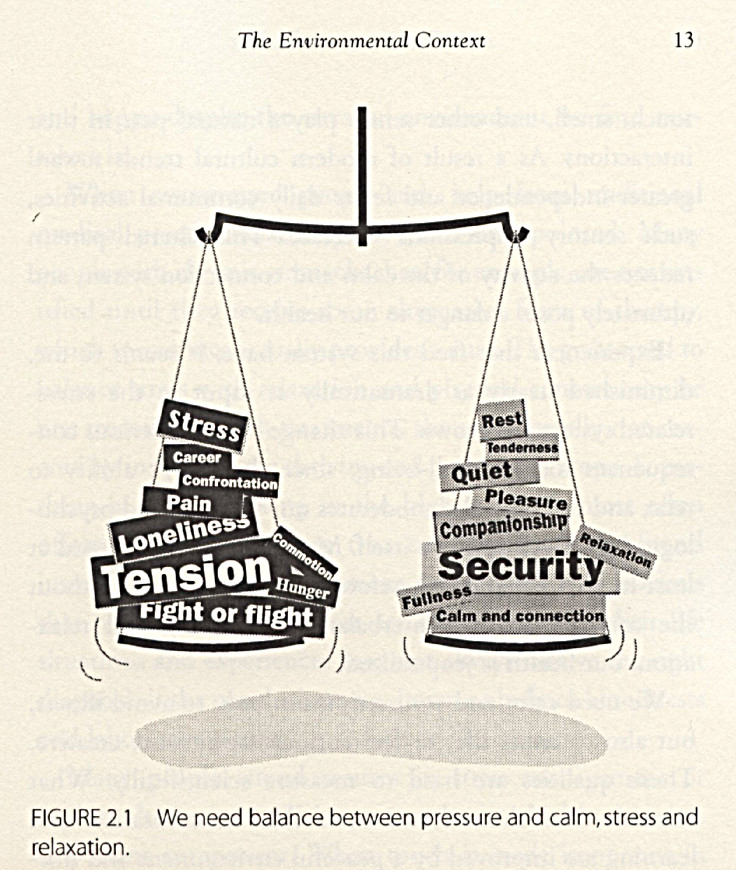
It is important to realize that what this image is showing is a required balance between stress and calmness.  Adequate early body-brain forming environments must include this balance for a body-brain to form and operate correctly.  Obviously too much stress and the wrong kind of stress for anyone is not a good thing.  But too much calmness isn’t good, either. Infant-child neglect often causes such a lack of stimulation during early developmental stages that critical regions of the brain do not receive the stimulation they need to grow hardly at all!

Another point I want to make is that if grave imbalance exists in an infant-child’s developmental environment the set point of the nervous system is NOT set at this central balance point where calm is even possible.  For people who survived terrible trauma in their early lives such as I did, the set point for our nervous system is AT the stress reaction point.

As odd as it might seem, looking back at my own infant-childhood with my new neuroscientific and physiological development insights, I can see that the long, long periods of forced isolation that were part of my mother’s patterns of severe abuse of me where probably – and actually – a very good thing.  During these periods when she had me ‘out of her sight’, even though during these times I was also out of any kind of loop that would have offered me normal infant-child opportunities to interact with others and with my environment in play and discovery, overall these times offered my developing body-brain opportunities for NOTHING TO HAPPEN.

These periods were actually rest and restoration times when my overwhelmed and over stimulated senses, forced into overload from the beginning of my life through the terrorizing and terrifying actions and presence of my Mean Mother, during which my body could actually calm itself down so that internally the effects of her nearly continual earthquake-tsunami abuse of me could somewhat dissipate before the next attack came.

Of course these patterns of wild, severe, over stimulating and overwhelming abuse paired with long periods of my being forced to endure the silence of remote, isolated aloneness harmed me greatly.  This pattern became a most fertile ground for patterns of dissociation to build themselves into my body-brain because nothing but the deprivation of being left completely alone to physiologically try to end my suffering alone (unconsciously, of course), offered me to possible way to connect my ongoing experiences to one another on any level other than the physiological one.  Nothing ever made sense, and nobody or nothing ever helped me to make sense of my malevolent experiences, either.

++++

So leading back to the topic at hand, oxytocin and Dr. Moberg’s book, I want to say that importantly I completely TRUST everything this researcher says.  Because I have continual problems with trust that happens in relationship to a sense of my feeling safe and secure in the world (and NOT), I hold this trust in high value.

At the time Moberg published this book she had already published over 400 scientific articles.  She is considered the world’s leading expert on oxytocin and on the calm-connection half of our autonomic nervous system (ANS) and all the processes that are connected to it.  She is talking about what severe infant-child abuse survivors missed most during our earliest growth and developmental stages:  The opportunity to experience safe and secure attachments that would have allowed us to experience peaceful calmness and connection to others so that our body-brain could build into us a body-brain-nervous system with the balance depicted in the above image included.

Because my infant-childhood was filled with extreme, chronic, ongoing and severe abuse and trauma, I read Moberg’s book from a perspective that means I want to know how things SHOULD have been so that I can better know what I am MISSING at the same time I hope to find information that can help me to consciously CHANGE this set point within my body-nervous system-brain for the BETTER.

As I read Moberg’s account of current research patterns being weighted at 90% study of the stress response compared to 10% of study on the other half of the system, I understand why I am still searching for help, healing and answers.  There is no hope for truly understanding what was so damaging during our early physiological development about being immersed in continual overwhelming trauma if we don’t have the information we need about how things were truly SUPPOSED to be different.  I believe the best hope for healing ourselves on every level does not lie in the drugs we might take to override systems in our body.  We need to get the true picture of what is REALLY GOING ON.

No matter what we read, no matter what anyone tells us, we cannot fool our body.  Our body, the Earth Suit we live in, absolutely knows the truth.  When we encounter the truth in research it will resonate inside of us.  Our body knows the truth when it-we hear it.  Moberg’s book, her work and dedication to research about the calm connection system in the human body as it is designed to operate in counter-weight with our stress response system holds truth that I believe is imperative for us to understand.  As we gain these understandings, we will FEEL them in our body and know them in our brain-mind.  Once I have completed my reading of this book, I will enter the universe of the internet to look for research related to this topic that has occurred in the 6-7 years since the book was written.  I can only hope that the scientific world has taken Moberg’s work seriously enough to pick up this critical study of what contributes to the other half of our well-being as a species:  The ability to calm ourselves down and connect to others.  This is absolutely the study, in my mind, of safe and secure attachment of ourselves in our body in the world we live in.  Again, I will keep you posted.

+++++++++++++++++++++++++++

I wanted to make a little note here today at my sister’s suggestion about my present experiences as I teach myself to read music and play this amazing piano keyboard that I was blessed with being able to bring into my life.  As my sister pointed out, as I continue applying myself to this study and practice and as I gradually improve, I will probably not remember the process of learning itself.

I don’t remember learning to tie my shoes, but I do have faint memories of being at the age of trying to learn my right hand from my left.  I invented a learning strategy that involved remembering a pattern of freckles on my right wrist where I would have worn a watch if I had one (like the one my father wore).  All I had to do was connect the freckles with ‘watch’ with how right in my mind a watch would have looked on my wrist to learn which side of me was right and not left!

I know this music learning experience is similar also to when I learned to ride a bicycle.  Once the motor learning has taken place, I expect that I will never have to consciously think about it again.  In the meantime, my actual process of learning is fascinating.  There’s nobody here to judge my process or progress but myself, and in the clear, plain and good spirit of PLAY I am able to leave all self judgment out of the picture.

What I am left with is the process of literally and consciously experiencing what it is like for ME, in this body, with this brain, to learn something this new and strange.  I also know that because of the severe trauma I was immersed in as my brain developed, neither my left nor might right brain hemisphere formed themselves ‘normally’.  I also know that the corpus callosum that transfers information between my brain hemispheres did not form correctly, either.

As I teach myself this new language of music and gain the motor skills required that will let me actually PLAY music, I am experiencing what I believe is a true healing in these regions of my brain.  Last night I began to practice playing scales with both hands at the same time.  I figured there is no way I am going to get my hands to be able to each first play different notes in different ways in different timings if I can’t get them to cooperate and first play the same notes in the same patterns at the same time.

Well, I am here to tell you I can’t remember the last time I experienced such a giggle session!  Part of me was directly the physical process complete with the intention of desired result – while another part of me fell into giggling bursts of delight to watch what my hands were ACTUALLY doing!  Instead of tangoing they were tangling, each finger with a mind of its own tumbling and fumbling over the keys.

Yet I believe that learning good things is healing.  All the healing I have ever done has been about learning.  Learning how to let myself learn is a learning itself both about what learning is like AND what healing is like.  That process is delightful in itself as I gently and kindly, slowly, patiently and firmly open my own channels for change within myself so that I can let something good and new grow itself into my body-brain-mind-self.

I have hopes, a goal, a direction.  I want to play music.  I know I can do this.  I give myself permission to move forward, to make the mistake-errors, to correct them, to learn-heal at my own pace. As I experience such delight even in this process of learning itself I realize this is just a bonus gift I could not anticipate and did not expect to love and enjoy.

So, needless to say, I have a long long way to go to begin to even get the two hemispheres of my brain to operate harmoniously, cooperatively and well together.  But what I look forward to and DO EXPECT TO HAPPEN is that eventually the two hemispheres of my brain will dance on that keyboard in relationship to one another.  Sometimes they will follow the same patterns together.  Sometimes they will be able to ‘say’ something musically that will be very different, one from the other.

I nearly absolutely and entirely and completely missed the opportunity as an infant-child to be safe, secure, and to play.  And I certainly did not get to giggle.  So, if at 58 I am finally able to giggle myself into this amazing new skill of reading and playing music, that’s a very good thing indeed!  No doubt I am helping myself heal at the center of who I am in this trauma-changed body.  I’ll keep you posted on this process, as well!

++++++++++++++++++++++++++++++++++++++++++
+HOPE FOR HEALING TRAUMA IN THE BODY

+++++++++++++++++++++++

Where can severe trauma survivors look for our best-guess for healing?  In a way this next direction I am going with my study, reading and writing surprises me.  Yet at the same time I am grateful for both this inner guidance system I seem to have that tells me what I most need for healing and for the fact that again and again, I trust and follow this guidance.

Not long ago I wrote a post about an article I had found sometime in the past, printed, and added to the ever expanding pile of papers that grows here on my desk in front of my computer.  By the time I picked it up and read it through and wrote my post about it, I had no memory of how, where or when I had found it online.  The information I will be working with next for as long as it takes me to understand it as thoroughly as I possibly can comes from a book that was referenced in that article.

I ordered this book, written by this Swedish doctor:

The Oxytocin Factor: Tapping the Hormone of Calm, Love, and Healing by Kerstin Uvnas Moberg, Roberta Francis, Kerstin Uvnäs Moberg, and Translated by Roberta Francis (Hardcover – Sept. 16, 2003)

The book is lovely, solid and comforting even in its design and construction.  It is well made and well written, and as I hold it in my hands and begin to explore its message and teaching, it gives me great hope of healing for any trauma survivor, especially for those of us whose body-brain was designed and built by, for and within early infant-childhood environments of malevolent treatment.

++++++++++++++++++++++

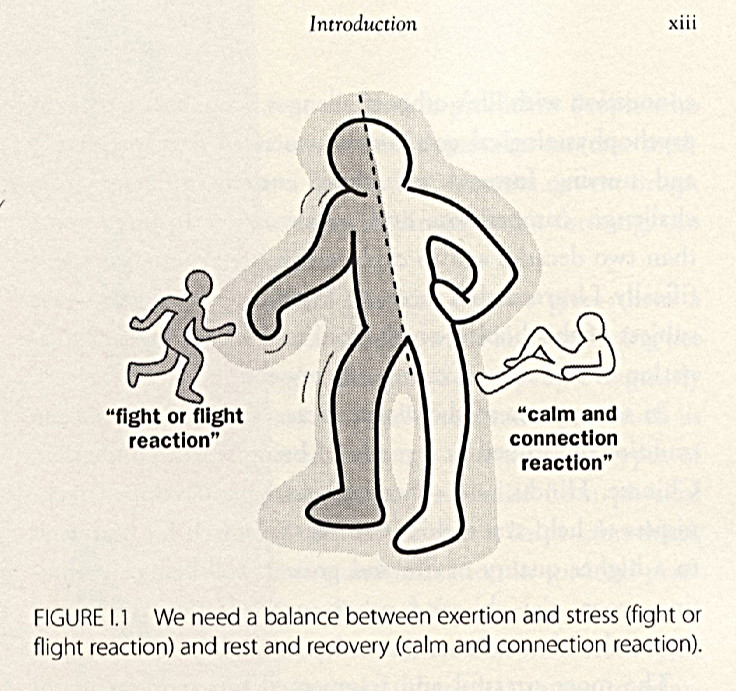
I first want to share with you a copy of an image that appears within the introduction to this book.  It is a simple graphic illustration about what everyone needs, especially trauma survivors who will have to work extra, extra hard to reach this desired balance in our body, nervous system, brain, mind and self between states of alarm and states of calmness:

Infant-child abuse and other survivors of severe trauma DO NOT get to experience what this balanced harmony feels like -- if at all possible, it's time that we DID!

++++++++++++++++++++++

As we look at this picture we are really looking at a visual depiction of what safe and secure attachment gives to us.  If this balance had existed in our parents, especially our within our mother from the time we were conceived and born, our physiological systems including our brain would have been able to develop within us to match this desired state for ourselves.

In early environments of threat, danger and trauma, this picture was missing within our universe because it was missing within our earliest caregivers whose job it was to MAKE an equally safe and secure environment for us so that we could have safe and secure attachment relationships that would have built our body-brain into an entirely different one that the one we ended up with.

I believe that the more we can learn about the information presented in this book the better we will be able to begin to recreate safe and secure patterns within our body-brain-mind-self NOW, no matter what our early forming environment was like.

In fact, we might be able to think about our condition in these most simple terms.  A trauma-built body-brain, formed through unsafe and insecure attachment conditions, continues to run on the fuel of cortisol and the stress hormones creating patterns of freeze, flight and fight response that translates into ‘anxiety problems’.

On the other hand, early safe and secure attachments design and build a body-brain that can run on the fuel of oxytocin or the ‘feel good’ chemical of peaceful calmness and positive connection to self, others and the world.  It is the body-in-balance as the above picture describes that is our goal for our healing.  Oxytocin is a critical neurotransmitter of peace and cooperation.  Cortisol is a critical neurotransmitter of stress, threat and danger.

++++++++++++++++

I find a powerful confirmation of my intuition that I am moving in the right, good and healing direction in my studies when I read in Dr. Moberg’s introduction that she immediately mentions the biases that exist in MOST mainstream medical research.  Those readers who followed the difficult time I had in my struggles with Dr. Dacher Keltner’s book will understand how affirming, comforting and freeing it is for me to find an authority on the subject of human ill- and well-being who recognizes the biases up front that Dr. Keltner seemed to be oblivious to yet relies upon and utilizes heavily in his work.

Moberg notes that fully 90% of published research focuses on the stress response, or sympathetic GO branch of our nervous system while only 10% is devoted to the parasympathetic STOP branch (remember:  pair-a-brakes) branch.  She states about this bias:

“…an interest in the physiology of performance, exertion, and defense has dominated existing scientific knowledge and current research to an extent that we do not always recognize.  This way of looking at things, or shall I say those blinders, has until now kept those of us who work in the medical sciences from seeing the calm and connection response as a separate and valuable physiological system.  Thus, for me, studying this system has involved an element of swimming against the tide with respect to the political mainstream in my profession.”  (pages xii-xii of her introduction)

This imbalance in research focus HIGHLY impacts infant-child abuse and maltreatment survivors, as it does anyone experiencing difficulties with so-called anxiety (including dissociation, PTSD, depression, personality disorders, etc.)  We are in desperate need not only of healing, but of accurate information that can help us DO SO.

As Moberg writes:

“The neglected physiological pattern I will describe in this book is the opposite pole to the fight or flight reaction.  Like most other mammals, we humans are able not only to mobilize when danger threatens but also to enjoy the good things in life, to relax, to bond, to heal.  The fight or flight pattern has an opposite [effect] not only in the events of our lives but also in our biochemical system.  This book deals with the other end of the seesaw, the body’s own system for calm and connection.

“This calm and connection system is associated with trust and curiosity instead of fear, and with friendliness instead of anger.  The heart and circulatory system slow down as the digestion fires up.  When peace and calm prevail, we let our defenses down and instead become sensitive, open, and interested in others around us.  Instead of tapping the internal “power drink,” [of stress-related neurotransmitters] our bodies offer a ready-made healing nectar.  Under its influence, we see the world and our fellow humans in a positive light; we grow, we heal.  This response is also the effect of hormones and signaling substances, but until now, the connections among these vital physiological effects have not been fully recognized and studied.

“The neglect of this system tells us much about the values that underlie scientific research.  The calm and connection system is certainly as important for survival as the system for defense and exertion, and it is equally as complex.  Nevertheless, the stress system is explored much for frequently….

“One reason why research has been so slanted may be that goal-directed activity is emphasized so strongly in our culture.  We are used to defining activity as something moving, something we can see.  But many of the calm and connection system’s processes and effects are not visible to the naked eye.  They also occur slowly and gradually, and they are not as easy to isolate or define as are the more dramatic actions involving attack and defense….physiologists have studied the clearly visible fight or flight mechanism but have been less able to perceive the more hidden and subtle calm and connection system.

“The calm and connection system is most often at work when the body is at rest.  In this apparent stillness, an enormous amount of activity is taking place, but it is not directed to movement or bursts of effort.  This system instead helps the body to heal and grow.  It changes nourishment to energy, storing it up for later use.  Body and mind become calm.  In this state, we have greater access to our internal resources and creativity.  The ability to learn and to solve problems increases when we are not under stress.

“I believe that it is extremely important to increase our understanding of the physical and psychological workings of this antithesis to the fight or flight system.  We need both, since for each individual in each situation there is an optimal way to react.  But it is now well known that long-term stress can produce a variety of psychological and physical problems.  If we are to be healthy in the long run, the two systems must be kept in balance.”  (pages x-xiii of her introduction)

Moberg states very clearly that her interest in the connection system is rooted in her experience of mothering her four children.  Her description of mothering would be the antithesis of my mother’s experience with mothering me.  As I have already noted, it is very clear that the vagus nerve and autonomic nervous system of Borderline’s works with a distortion of the stress-caregiving response systems.  Moberg’s writings are about how things are SUPPOSED to work:

“In pregnancy, nursing, and close contact with my children, I experienced a state diametrically opposed to the stress I was familiar with in connection with life’s other challenges.  I was aware that the psychophysiological conditions associated with pregnancy and nursing fostered something entirely different from challenge, competition, and performance.  Inspired more than two decades ago to explore this life experience scientifically, I learned that there is a key biological marker – the subject of this book – on the trail to a physiological explanation of this state of calm and connection.”  (pages xiii-xiv of her introduction)

++++

It does not surprise me one bit that it would be not only a female researcher, but also one that has her roots on interested grounded in her experience of mothering that I would now turn to for answers about how the terrible imbalance that survivors of severe infant-child trauma have in their body-brain as a consequence of being formed by trauma can be healed.  In profoundly critical ways early abuse survivors were deprived of the safe and secure early attachments – especially with our mothers – that we desperately needed to grow a healthy balance of peace and calmness into our body-brain from the start.

For all the millions and millions of American children and adults that suffer from obesity, depression and other anxiety-related problems, from addictions, from relationships dis-orders, I believe that it will be in gaining factual information about how our body-brain can be rewired for safety, security, connection, and peaceful calmness that our best chance will come for healing.  I am most hopeful that Dr. Moberg’s writings will give me many important answers that I seek.  I will literally keep you posted on what I discover!

++++++++++++++++++++++++++++++++++++++
+TRAUMA TELLS THE BODY WHAT TO DO

+++++++++++++++++++++

Being able to feel safe and secure in the world is a major lifetime occupation for survivors of childhood trauma.  I am writing this post in connection with the following:

Comment February 26, 2010 to this post:  +PTSD AND SEVERE ABUSE SURVIVORSHIP – CONCLUSION

I absolutely agree! My 7 year old suffers from PTSD and it has started rearing it’s ugly head when he was 3 1/2. It is a nightmare we live everyday and it effects every aspect of our lives. I am so tired of hearing people say children are resilient even doctors will tell me this. You have expressed every point I have believed for myself but have not had the words to quite articulate or the extensive background in knowledge. I do feel I am very intuitive with my children and people or doctors cannot tell me where they are at, because I know exactly what is going on with them. My son has been diagnosed as having PTSD and High Anxiety, but there is so much related to this diagnosis that they do not take seriously. My son is on medication to help, but I still do not know who he is because all I see is the effects of the trauma that has been caused to him. I do not know his personality, he is on a constant fight or flight response.

Thank you for bringing so many reasons for people to understand that children are not resilient and we need to be more sensitive to their needs and get them help as soon as we suspect anything. I think if we miss those opportunities can only inset the damage deeper and longer.

+++++++++++++++++++++++++++++++++++++++++++++++

There is a universe of concerns contained in this comment.  At the moment, I want to respond regarding the connection as I see it between insecure attachment and anxiety disorders including Posttraumatic Stress Disorder (PTSD).

Even as I think about my severely abusive Borderline mother I understand that it was her response to the anxiety of being in the world, as it operated in relation to her vagus nerve system, that kept her stuck in a high-alert state of “The world is a dangerous, unsafe and insecure place to be.”

My mother never knew this.  She never knew that all of the anxiety that she experienced was abusively focused on me from the time I was born.  At the same time I think about all the problems that I have within my own body-brain as a direct result of the terrible abuse my mother did to me.  How might my adult life have been different if I had known a long time ago HOW her abuse affected by developing body-brain-mind-self?

What if someone had told me when I first sought therapy-help in 1973 that the number one priority for my body-brain was to be safe?  What would it have meant to me to have been told that more than anything else in my lifetime my physiology would be constantly and continually reacting at my core AS IF all the trauma of the 18 years of my childhood was STILL HAPPENING or COULD HAPPEN at any given second of my life?

I think about the massive amount of life force energy a traumatized person’s body consumes in this continual, constant process of having to be on high alert, always scanning every ‘input’, every stimulus to that comes in to the senses, always always always knowing for a FACT that the world is malevolent and dangerous, and that the storms of trauma are very very real.

A traumatized child’s busily growing and developing body-brain builds all this trauma response into itself.  Nobody ever told me that I became a trauma-survivor ‘machine’, that everything about me is connected in its foundations to the process of surviving.

I think about all the growth and developmental stages infants, children and young adults are doing, and I think about how the life force energy being consumed by this trauma-monitoring robs these young ones also of the ability to go through ANY of their later developmental stages normally or easily.  Problems can compound and compound and compound.

Not only is our body-brain constantly scanning and assessing degrees of threat and danger in our environment all of the time, but our body-brain is also constantly preparing itself to freeze, flee or fight.  I am making a point here that I, at 58, do not have a physiology much different than the one this mother is describing for her 7-year-old traumatized son.  So when I think about what learning about the developmental consequences of trauma actually DO TO US, I realize that the process of learning how to live a better life applies equally to both of us.

That makes the most important information we can learn to consciously give to our body-brain is that WE ARE SAFE IN EACH ONGOING MOMENT.  True, there are many complex prescription drugs that offer some help, but in the end we are complex living beings who need far more than drugs to improve our well-being in our body in the world.

By becoming increasingly aware of how our trauma-formed body-brain is continually involved in assessing whether we are safe and secure in the world or not, means that we are changing the dynamics of the energy being continually consumed within us.  We can learn what safety and security ACTUALLY is.  We can learn how to assess our degrees of safety and security in the present moment at the same time we can become increasingly aware of what our body-brain is physiologically telling us through how we FEEL.

If I just limit my thinking at this moment to PTSD, I can say that our body-brain does not know that the traumas that affected us are IN THE PAST and not in our present moment.  If there IS trauma in our present, then we better know what to do about it to MAKE ourselves more safe and secure.  Because early trauma survivors have a different body-brain formed with the trauma as a part of it, this assessment and response process will never be the same for us as I believe it is for non-early traumatized people.

We need to understand this fact and accept it, and then find ways to regulate our threat-response systems in better (and conscious) ways.  Our body has ONLY one goal:  To keep us alive.  We are still here.  Our body did a darn good job at its job!  We can thank it for that.  But what about quality of LIFE for us as we continue down our pathway of life?

I continually have to work on my ‘YES, BUT….!”  “Yes,” I can tell my body-brain consciously, “you have kept me alive.  Yes, you are very good at your job!  BUT, we need to work this out a bit better now.  You need to learn how to understand when and where threat ACTUALLY exists in the present and when it does not so that you can feel safe and secure in the world as much as possible.”

This might sound simple, but it is the number one occupation of my lifetime.  Yes, that’s a terrible SHAME and it SUCKS, but it’s very, very real.  Constantly that question has to be asked, “Am I safe and secure AT THIS MOMENT?”  Even if/when I can negotiate this question and its answer with my body-brain, being able to FEEL something other than anxiety, sadness, fear, or even anger becomes a whole other problem.  (It’s important to remember, too, that depression is a ‘hypo’ anxiety response rather than a ‘hyper’ one – but an anxiety response it still is.)

But it is a possible process!  And anything that is POSSIBLE gives me hope – for myself and for others including children.  I think the more we can learn about how our body is very, very busy keeping us alive ALL OF THE TIME the more we can begin to find even the tiniest of niches where we can KNOW and FEEL when we are safe and secure.  Our ability to maneuver confidently in our life, to explore the opportunities of our lifetime, our ability to feel safely and securely connected to others, to truly empathize and care about them is dependent upon the extent we can help ourselves to realize how critically important this feeling of being safe and secure is on a continual ongoing basis.

Early trauma survivors (and even later onset trauma survivors) face anxiety negotiation for the rest of their lives.  I thought about this tonight in relation to this commenter’s son because any efforts that caregivers can put toward helping traumatized children learn to do the process I am describing the more proficient they will become.  It’s like learning anything new:  Possible, and practice practice practice helps any skill grow in strength.

Anything we can ever do to help ourselves to actually BE and to recognize WHEN we are safe and secure in the world is a step in the best direction we can take for ourselves as early trauma survivors working to live a better life in the present.

++++++++++++++++++++++++++++++++++

+NIGHTMARE OF BREAST CANCER – MY HUMBLE WRITINGS

++++++++++++++++++++++++++++++++

I have no idea why today, at 3:35 AM it is evidently time for me to post my writings from right after my chemotherapy treatment for my breast cancer, begun very shortly after my double mastectomy, and during the time of my application process for Social Security Disability that followed this trauma that I could not emotionally find the resiliency to surpass in any way as I had seemed to manage at prior times in my life.

These pages were written long before my sister ever brought up her suggestion that I begin a blog.  They are candid and transparent, and I am not editing them as I post them now.  I believe that somehow these words, written humbly and to myself, must be meant to help someone – somehow – somewhere – NOW.  Whoever you are, blessings upon you!!

++++++++++++++++++++++++++++++++

PLEASE FOLLOW THIS LINK:

*Age 57 – Dec. 2007 – July 2008 – (A Shaman Daughter Pages)

++++++++++++++++++++++++++++++++

+SOME MORE WORDS SENT BY MY FRIEND

+++++++++++++++++++++++++++++++++++

Here is another collection of wisdom saved in words now passed to me by my family’s Alaskan homesteading neighbor from my childhood, Dorothy (now 83), who I have mentioned came back into my life after 40 years to be my dear friend.  These words have given me opportunity to ponder:

1.  GOD IS LOVE.  I am an extension of God; therefore I am love, just as I am.

2.  GOD IS LOVE.  Love is light.  The lighted candle cannot NOT shine on, illuminate, and radiate everywhere, touching everyone and everything.

3.  THE EGO IS A TOOL FOR LEARNING.  On this plane, egos relate to egos for learning and teaching.

4.  ROMANTIC LOVE IS A GLIMPSE OF HOLY LOVE — unconditional — heavenly.  Every person needs to experience that.

5.  SPECIAL RELATIONSHIPS ARE A NECESSARY PART OF OUR LEARNING ABOUT OURSELVES.  Also a path to understanding forgiveness and therefore, healing.  From the painful moments comes opportunity to think our deepest thoughts.

6.  I HAVE SEARCHED FOR MY IDENTITY, TRYING TO FIND ME.  Who are we?  We move from one thing to another looking, looking.  We fall in love, and expect to find our identity through the beloved.  We look to money, baubles and trinkets, prestige and power for validity.  Then one day it becomes clear:  THERE IS NO SOLUTION OUTSIDE OF MYSELF.  I heard that in dozens of ways, but it took “suffering” to make it real, and it has taken many years.

7.  CONFLICT WEAKENS ONE to being nearly non-functional.  EACH SIDE OF THE ISSUE HAS ITS OWN ENERGY.  These energies do battle with one another.  We have no peace; not enough energy “left over” for pursuing constructive thinking or activity.  Need to move from division to atonement.

8.  …JUDGMENT BECOMES THE UNKINDEST CUT OF ALL

+++++++++++++++++++++++++++++++++++

IN MEMORY OF MY BORDERLINE MOTHER, HERE’S SOME HOPEFULLY HELPFUL INFORMATION LINKS:

From Kristalyn Salters-Pedneault, PhD, your Guide to Borderline Personality Disorder Many of you are probably familiar with the standard treatment options for BPD, but there are some alternative treatments that you may not have considered. The treatments discussed this week haven’t been tested extensively, but may be considered as adjuncts to your treatment regimen.

Family Therapy – Can it Reduce BPD Symptoms?
Rather than just one person (such as the person with BPD) and their therapist, family therapy involves the whole family, working together, with one or two therapists.
BPD Couples Therapy
There has been no systematic research on couples counseling for borderline personality disorder, but experts are becoming more and more aware of how helpful a stable support network is for people with BPD.
Does Electroconvulsive Therapy Work?
Electroconvulsive therapy (ECT) is a psychiatric treatment with a long and controversial history. Is electroconvulsive therapy effective for borderline personality disorder (BPD)?
Get the Most Out of Your Treatment
Wondering how you can get the most out of therapy? There are times when the success of therapy is related — completely, or in part — to factors that are in your control.

Must Reads

What is BPD?
Symptoms of BPD
Diagnosis of BPD
Treatment of BPD
Living with BPD

+++++++++++++++++++++++++++++++++++

I am loving my new pursuit, learning the language of music with my piano keyboard!!

+++++++++++++++++++++++++++++++++++

+GIFTED WITH A POEM TODAY: “STAYING ALIVE”

++++++++++++++++++++++++++++++++++++

My family’s Alaskan homesteading neighbor from my childhood, who came back into my life after 40 years to be my dear friend, just sent to me some pages with words written on them of things she has collected and saved over the long years of her lifetime that have meaning for her — and now for me.  I feel like I’ve been handed jewels today.  I first wish to share this poem that Dorothy sent.  I see at the bottom is written “N.Y. 12-4-1965”  (NOTE:  Formatting on this blog puts the space between the lines here I cannot remove – )

++++++++++++++++++++++++++++++++++++

STAYING ALIVE

Staying alive in the woods is a matter of calming down

At first and deciding whether to wait for rescue,

Trusting to others,

Or simply to start walking and walking in one direction

Till you come out — or something happens to stop you.

By far the safer choice

Is to settle down where you are, and try to make a living

Off the land, camping near water, away from shadows.

Eat no white berries;

Spit out all bitterness.  Shooting at anything

Means hiking further and further every day

To hunt survivors;

It may be best to learn what you have to learn without a gun,

Not killing but watching birds and animals go

In and out of shelter

At will.  Following their example, build for a whole season:

Facing across the wind in your lean-to,

You may feel wilder,

And nothing, not even you, will have to stay in hiding.

If you have no matches, a stick and a fire-bow

Will keep you warmer,

Or the crystal of your watch, filled with water, held up to the

sun

Will do the same, in time.  In case of snow,

Drifting toward witner,

Don’t try to stay awake through the night, afraid of

freezing —

The bottom of your mind knows all about zero;

It will turn you over

And shake you till you waken.  If you have trouble sleeping

Even in the best of weather, jumping to follow

With eyes strained to their corners

The unidentifiable noises of the night and feeling

Bears and packs of wolves nuzzling your elbow,

Remember the trappers

Who treated them indifferently and were left alone.

If you hurt yourself, no one will comfort you

Or take your temperature,

So stumbling, wading, and climbing are as dangerous as

flying.

But if you decide, at last, you must break through

In spite of all danger,

Think of yourself by time and not by distance, counting

Wherever you’re going by how long it takes you;

No other measure

Will bring you safe to nightfall.  Follow no streams:  they run

Underground or fall into wilder country.

Remember the stars

And moss when your mind runs into circles.  If it should rain,

Or the fog should roll the horizon in around you,

Hold still for hours

Or days, if you must, or weeks, for seeing is believing

In the wilderness.  And if you find a pathway,

Wheel rut, or fence wire,

Retrace it left or right — someone knew where he was going

Once upon a time, and you can follow

Hopefully, somewhere,

Just in case.  There may even come, on some uncanny

evening,

A time when You’re warm and dry, well fed, not thirsty,

Uninjured, without fear,

When nothing, either good or bad, is happening.

This is called staying alive.  It’s temporary.

What occurs after

Is doubtful.  You must always be ready for something to

come bursting

Throught the far edge of a clearing, running toward you,

Grinning from ear to ear

And hoarse with welcome.  Or something crossing and

hovering

Overhead, as light as air, like a break in the sky,

Wondering what you are.

Here you are face to face with the problem of recognition.

Having no time to make smoke, too much to say,

You should have a mirror

With a tiny hole in the back for better aiming, for reflecting

Whatever disaster you can think of, to show

The way you suffer.

These body signals have universal meaning:  If you are lying

Flat on your back with arms outstretched behind you,

You say you require

Emergency treatment; if you are standing erect and holding

Arms horizontal, you mean you are not ready;

If you hold them over

Your head, you want to be picked up.  Three of anything

Is a sign of distress.  Afterward, if you see

No ropes, no ladders,

No maps or messages falling, no searchlights or trails blazing,

Then, chances are, you should be prepared to burrow

Deep for a deep winter.

David Wagoner

+++++++++++++++++++++++++++++++++++++++++++

Here at the bottom of this piece of paper it says:

“What are we, that we are moved at a touch between serenity and desolation?”

+++++++++++++++++++++++++++++++++++++++++++

+WATCHING WHOLENESS AND HAPPINESS HAPPEN

++++++++++++++++++++++++++++++++++

I discovered a portrayal of happiness when I found online the videos of these 40 piano lessons.  It’s a great place to go for a brush-up on music reading and keyboard playing if you have already had some experience in your past with playing music and might – for great benefit and healing – wish to pick up this pastime again.  For those, like me, who have never experienced the joys of playing music, these lessons are a great place to start!

However, my bigger purpose in posting these links today is to present to you the visual of the teacher, an obviously talented and well-skilled young man, who appears to be quite genuinely happy!

I simply wanted to point out today that I think it’s highly doubtful that someone who appears to possess such an ability for humor, for spontaneous laughter and for genuine smiles lives within a body that was formed in a malevolent environment of infant-childhood abuse, maltreatment and trauma.

When I watch the face and body movements of someone like this young man, I can see that I am actually watching a body-nervous system, including a brain that was allowed to form within a safe and secure attachment environment.  Nowhere in these videos do I see the flash of a stress response in the eyes and face.  Nowhere do I hear the millisecond pause in his speech that would let me know the body itself has detected threat to safety and security in its ongoing appraisal of itself in the world.

Not only is the ‘presence of happiness’ well, present in this young man, but just as importantly the ‘absence of anxiety and sadness’ is, well, also equally present.  As a result, he can probably move through his life unimpeded in his intentions and actions by the interrupting ongoing inner experience of having to be hypervigilant about either himself or others in the world.

Along with the happiness apparent in this young man is the competent confidence that comes with being a self in the world that can be fully present in the moment.  This includes having the ability to be a present self in the presence of others.

This young man seems obviously capable of enjoying himself (in-joying himself) in his life.  Nobody seems to have communicated to him that he doesn’t have that right.  It is important to realize that the invisible physiological nervous system-brain underlying circuits and pathways of competence and joy were built into the body of this young man from the time he was born (and before).  What others SEE when they witness this young man in his body in his life is the physical manifestation of well he has been treated throughout his life.

He has been allowed and encouraged on all the important levels that matter to be himself because he was allowed to be safe and secure.  As I have said so many times before, this IS a matter of availability of resources.  Certainly there may well me economic stability in his family that enabled him to have access to instruments and training (not to mention all the other vital requirements for sustaining life).  Yet while these advantages are obviously important to tutor and train inborn talent, it is the social-emotional environment of safe and secure attachment to caregivers from birth (and before) that were vital to the ongoing experience of confidence and joy that this young man seems so able to demonstrate.

While watching these piano lesson videos gives me a visual related to what this young man was given in his life compared to what I was not given, at the same time it gives me a visual of the goal I suggest all survivors can work for.  Even though our long ago formed body (with its nervous system including our brain and our connection to self) may have been altered in our earliest developmental stages due to trauma and abuse, being THIS happy and confident while experiencing safety and security in our body within our environment, with our self present in our experience, is what we need, desire and work for.

Check out How to play piano: Lesson #2 and How to play piano: Lesson #3 Piano Lounge: Andrew Furmanczyk to see for yourself this young man who offers an example of happiness.

+++++++++++++++++++++++++++++++

The next example I encountered in my musical searches online yesterday offers yet another example of what I am talking about here today.  For all the amazing talent visible in the video attached to this link, six-year old girl mastering piano, it is the joy and happiness visible not only in the little girl’s body-face that captured my attention, but MORE SO the joy and happiness visible in her MOTHER’S face.

Here again we are presented with a visual of advantage.  This little girl is not homeless or going to bed hungry at night.  But most importantly this little girl is obviously fully loved.  Look at her face.  Watch her.  You can see that her SELF is fully present in that little body.  You can see that she is safely and securely attached to her own self BECAUSE she has been offered the opportunity to safely and securely attach to her caregivers.

Certainly this little girl was born with an amazing talent.  But the most important talent I want to emphasize, the one that we are all conceived with and hopefully born with, is this ability to thrive and blossom as our body-brain-mind-self grows and develops in interaction with its earliest caregiver environment.

Neither of these young people presented in these videos would LOOK the same, ACT the same, FEEL the same or BE the same if they had been raised within a malevolent rather than a benevolent environment.  They would NOT HAVE THE SAME PHYSIOLOGICAL BODY.  If they had been raised within an early unsafe and insecure attachment environment, they would not think the same, feel the same, act the same, or be the same people they turned out to be.  No way, no how.

So for all the obvious musical virtuosity present in these video samples, what I end up being most aware of is that what these videos are showing most clearly IS THE ABSENCE OF TRAUMA.  While we know that much talent still arises within people who did suffer early trauma and live a life within a trauma-changed body, it is also equally true that talent does not need to be automatically paired with angst and suffering.

++++

What I believe is most empowering for infant-child abuse survivors to know is that not only does early trauma change our physiological development, but also that these consequences follow us for the rest of our lives.  For all the well-wishers that tell us to simply “get over it” or “leave your childhood behind you” or “You could be happy if you really wanted to,” it is vital for us to realize that these statements are not actually grounded in the truth of our trauma-changed physiological reality.

At the same time I believe it is important for we survivors who have been ‘diagnosed’ with so-called ‘mental illnesses’ to realize that most often the best creative and expressive gifts of our species are directly tied genetically to the highest risks for the experience of difficult consequences from trauma-changed bodies during our earliest development.  I suspect that it is equally true that the kinds of changes our genes allow us to make include not only high risk for later complications from these changes, but also gave us immense resiliency factors that allowed us to survive at all.

In essence, if my thinking is correct, I would suggest that both of these piano wizards presented in these videos would have been at extremely high risk for developing serious ‘mental disorders’ had their infant-childhoods been malevolent and traumatic rather than benign and benevolent.  At the same time, their sensitivities and vulnerabilities to trauma-related consequences WOULD STILL HAVE ALLOWED THEM TO ENDURE AND SURVIVE.  But they each would probably have suffered greatly in a trauma-changed body.  Neither would have been the same people we see in these videos.

++++

All of this brings to my mind the question, “Who is the self?”  When I say these musical children would be different, I am not saying that the essence of who they are as individual people could even possibly be altered under any circumstances.  That is equally true for all of us, infant-child abuse survivors or not.

The consequences of enduring within malevolent early-body-brain-forming developmental stages means that the expression of the self, the inner relationship with the self, the outward manifestation of the exact nature of the individual self will be changed and altered, not the actual self itself!  What all of us are working toward is the discovery of who our own individual self IS so that we can learn how to give this self as many opportunities to experience safety and security in the body in the world as is humanly possible to do.

No matter what our age, the process of being a self in a body in the world is essentially the same.  Severe early abuse survivors, however, have to experience, face and deal with all the trauma-related physiological changes that mean for us that an ongoing assessment of potential threat and danger to our SELF (and to our body) is likely to be at the forefront for us the rest of our lives.  Our ability to simply BE a self, with full free interactions and expression, becomes far more difficult for us to obtain.

Coupled with these difficulties is the fact that within our trauma changed body-brain we were robbed of the fullest development of a genuine happy center and the neural development of all the corresponding ‘be safe in the world’ pathways and circuitry.  We have to train and retrain our physiology as we seek to improve our presence in our own body in our own life in the world.

Yes, our experience and the resulting body-brain we would have developed COULD have been different for us as it obviously was for these two musical wizards.  Yes, we do have a lot to mourn for in our loss not only of the actual experiences of a safe and secure infant-childhood, but most importantly for the different body-brain we would have developed under benevolent rather than malevolent conditions.

Yet for severe infant-childhood trauma survivors I believe it is ultimately and importantly empowering for us to realize what we are REALLY dealing with.  As we try to ‘change’ our self to be a ‘better’ person to life a ‘better’ life we need to understand that we are participating in acts of creation as we heal.  We are ‘recreating’ the very molecular structure and operation of our trauma-adjusted, trauma changed body.

Yes, resiliency is possible as long as we breathe.  At the same time, the healing changes we make affect our entire being in the world on every level.  Just as a benevolent safe and secure world created the physiology of these video children, changing our own physiology as survivors means that we need as much of what these children were given as we can possibly get.

++++

In the same way that how these musical children are in the world is a result of the sum total of their genetics in interaction with their environment, our own healing happens in the same way.  I don’t believe it’s possible or even realistic to ‘just’ treat a so-called ‘mental illness’ with drugs, or ‘just’ treat harmful parenting or anger or sadness or anxiety or relationship difficulties with classes or education, or to ‘just’ treat addictions of any kind.

We can become consciously aware that any single ‘part’ of us that heals is providing a healing for our whole self on every level of who we are.  Just as growing a body-brain in the beginning was a ‘whole’ process, healing happens in the same way.  Watching these delightfully whole children in their experiences portrayed on these videos tells me that once the camera lens is taken off of them, their whole self is equally occupied with living their whole life just as happily as their fingers play their music.

++++++++++++++++++++++++++++++

This information today ties into the posts I presented earlier on the genuine, authentic D-smile and true happiness:

+HOOKED ON ‘D’ SMILES – THE HAPPINESS CENTER

+RESEARCHER BIAS ON THE ‘D’ SMILE = SICKENING

+MISSING LAUGHTER IN MY MOTHER’S MONKEY HOUSE

+IT WASN’T FUNNY: THE BUZZARD THAT ATE MY MOTHER

++++++++++++++++++++++++++++++++++

+WHAT I HAVE TO SAY TODAY ABOUT DISSOCIATION

++++++++++++++++++++++++++++++

I wonder if there will be a day that we will understand what dissociation really is.  It seems that people talk about it and write about ‘as if’ at least someone has actually defined it.  Coming from my severe infant-childhood abuse background, I don’t believe anyone is much past the dark ages in terms of actually knowing what dissociation is.

In looking at the abstract for this 2007 article by Dr. Matthias Michal and colleagues, Depersonalization, Mindfulness, and Childhood Trauma, I can’t even get the first sentence before I find myself in disagreement with one of the main premises of this ‘expert opinion’ of an experience related to dissociation:

Depersonalization (DP), i.e., feelings of being detached from one’s own mental processes or body, can be considered as a form of mental escape from the full experience of reality. This mental escape is thought to be etiologically linked with maltreatment during childhood. The detached state of consciousness in DP contrasts with certain aspects of mindfulness, a state of consciousness characterized by being in touch with the present moment.”

Here again I see yet another example of what I call ‘sloppy science’.  Researchers seem to build their hypothesis into their studies in such a way that they are nearly guaranteed to supposedly prove their own point.  Nobody wants to publish failure research.

The gulf that exists between infant-child abuse survivors and those who study us like we are some malformed off shoots of what is considered normal continues to widen because the basic premises researchers use to discover facts about so-called ‘reality’ come from their own ‘mental processes’ that they never question within themselves.

I know what depersonalization feels like because I live with it.  My body-brain formed through trauma that did not allow me as a person to exist from the time I was born.  So, NO, this cannot “be considered as a form of mental escape from the full experience of reality.”  Sorry to disappoint you well-funded and supposedly well meaning wise ones.

Mind, itself, along with its relatives ‘mental’ and ‘mindful’ exist as metaphors for physiological, very real molecular operations within the structures of the body-brain.  The operations that are suggested to represent ‘mind’ happen through biochemical interactions.  Early experiences from conception onward during the critical growth windows, or periods of specific development form circuits and pathways that are not the same for infant-childhood severe trauma and abuse survivors.

The experience of dissociation, depersonalization and derealization are connected to the physiological changes our early developing body-brain was forced to make in the midst of trauma.  In my experience, and I suspect for many other people, what I experience as dissociation is NOT any “form of escape from the full experience of reality.

IT IS MY REALITY.

I cannot “escape from the full experience” of my reality as long as I exist in this trauma-changed-during-development body that does not process information in the same way as the (evidently) NOT trauma changed body of the researchers who define the terms and design the research that names something survivors live with that these researchers will never REALLY know a damn thing about.

++++

The detached state of consciousness in DP contrasts with certain aspects of mindfulness, a state of consciousness characterized by being in touch with the present moment.”

I am not going to ever say that there is not a contrast between the way I experience life in the body I live in and the way a non trauma built body person experiences life.  But what the “H” does “being in touch with the present moment” even BEGIN to mean?  What, exactly, does these researchers’ term “detached state of consciousness” even begin to mean?

++++

I will try to describe to you an experience I had yesterday that has brought this subject into my ‘mindful awareness’ tonight.  I recognized the experience because it was so familiar to me.  I know the state, I know the feeling, I know what it WAS with every sense I possess.

The event was a simple one.  Nothing in particular happened at any point yesterday up until the instant I am going to tell you about.  I was out running errands in the morning in the small town I live near, and had just driven over to my favorite spot to meet my friend for a simple lunch at our local laundromat café.

I pulled into the spacious, nearly empty parking lot, reached to turn off the motor of my car and as I was in the act of pulling my key out of the ignition I froze in the instant my eyes passed by the ‘visual’ of my steering wheel.

I’ve owned this particular car for over four years.  I’ve driven it hundreds of times.  There was nothing, absolutely nothing different about my driving it yesterday.  And yet in the split second my visual field passed over my steering wheel I had the most strange, bizarre feeling that this was NOT my steering wheel.  I had never seen it before.  Did someone change my steering wheel and give me a different one?  Not likely.

Not only did it not look right, and was not shaped ‘right’, it wasn’t attached to the steering column at the ‘right’ angle.  Nothing about the steering wheel looked or seemed remotely familiar to me.  I pulled out the key and sat staring at that steering wheel for a full five minutes as my brain scanned for information about both the nature of the wheel itself and the experience I was having in relationship to it.

I searched, just in case, for any kind of button or possible means to shift or tilt the angle of the wheel.  The car is a 1978 model that has no such option.  The only information that I could possibly find in my brain was the familiar realization that who I was at that moment, sitting in that car behind the steering wheel, was in some way not related to any one of me that had ever been in that car before that instant.

Yes, I knew about every other usual familiar aspect of Linda and of my life.  But I was SEEING that steering wheel for the first time in my life.  Am I supposed to believe that only at this single instant I simply became ‘mindfully conscious and aware’ of my steering wheel?  I wish, oh how I wish the explanation could be that simple.

Was I somehow suddenly in a different reality?  Was I somehow (using researcher logic) suddenly in an ATTACHED rather than in a “detached state of consciousness?”  Did something magically happen that snapped me into “being in touch with the present moment?”  Am I (chuckle, chuckle!) supposed to believe that I have, until that instant, needed some form of “mental escape” from the reality of my automobile’s steering wheel?

Hogwash.

I have thousands and thousands and thousands of running-time and space memories from 18 years of extreme trauma and abuse from my infant-childhood that were simply never actually connected to me.  How could they have been when the abuse began at the moment I was born, far before my brain had formed any neurological abilities to process the information of myself in my life beyond the absolute ‘born with’ essentials?

Picture a child’s toy of a spinning top.  Pick one tiny point on the top, and imagine it spinning at full speed.  Imagine a newborn ‘self’ with senses to the world attached to that single spot as the spinning goes on minute after minute, day in and day out, year after year.  Never did the insanity of the abuse of my childhood actually end.  Never was I safe.  Never did anything make any sense.  Never was there any real cause and effect.  There was – continually and always – no opportunity for me to form my own thoughts, to have my own feelings, to find my own self, anywhere in my body-brain forming years as my mother’s traumatized daughter.

Evidently, for some inexplicable reason, as I reached to remove the keys from my car’s ignition yesterday, while I was under no particular stress, about to have a good lunch and a relaxing visit with my friend, a millisecond snapshot was taken by my being of exactly and specifically ONE THING – the steering wheel of my car.  The top stopped spinning, frozen for one instant of time, as the ME that lives inside this body, and processes my life with this chaos-built traumatized brain saw one particular slice of my life – of my reality — perfectly in focus, absolutely clearly:  My steering wheel.

Did I feel remote at that instant?  Yes.  Did I feel like a stranger in my body, in my car, in that parking lot, at that instant of time?  Yes.  Do I remember this feeling from my childhood?  Yes.  Any memory I have of my childhood is a snapshot, or what is called a flashbulb trauma memory.

My brain did not form itself to process information so-called normally.  I live in what I call a ‘parallel’ life where time and space are related to one another, and to me through combinations of associations that shift like specks of sand in the wind.  If I become ‘mindfully aware’ of this fact, I find myself marveling that there is some core cognizant centralized self of Linda that is aware of itself in this lifetime as being anything other than a figment of a passing (and passed) dream.

So if any Ivory Tower researcher wants to devise a study that might provide any really useful or accurate information about what dissociation, depersonalization and derealization might actually BE, they might want to study the consciousness-invested relationship any severe infant-child abuse survivor might have with their automobile’s steering wheel.

++++++++++++++++++++++++++++++

+RESEARCH ON ISOLATION – ANOTHER STUPID SCIENCE AWARD

+++++++++++++++++++

My opinion?  MORE UNBELIEVABLY STUPID SCIENCE!

++++++++++++++++++++

Written by:  Wray Herbert

Full Frontal Psychology

Why does self-reliance make you sick?

Newspapers used to run occasional human interest stories about very old people dying. These profiles often had a subtext, which went something like this: So-and-so died yesterday at the age of 102, and remained fiercely independent to the end. He never took very good care of himself, smoking two packs a day since he was a teenager. He liked his whiskey.

You don’t see these stories nearly so much anymore. That’s in part because living past 100 isn’t all that uncommon anymore, but it’s more than that. In our hearts, we knew all along that these misbehaving centenarians were aberrations. What’s more, our sensibilities about personal health have shifted dramatically, so that journalists are less likely to romanticize unhealthy habits. The fact is, smoking and excessive drinking don’t prolong life. They shorten life and diminish its quality.

That’s true of the “fiercely independent” part, too. Health psychologists have known for years that isolation is rarely the path to health or longevity. Health comes with a rich and diverse social life, with lots of friends and family, church membership, political engagement. Old people with many relationships of different kinds live longer, stay sharper with age, and suffer less disease.

But why? What is it about being connected to others that makes us healthier and more long-lived. How does a rich social life translate into healthy cells and tissue, and conversely, how does isolation trigger the biological processes of disease and death?

Carnegie Mellon University psychologists Sheldon Cohen and Denise Janiki-Deverts have been studying these important questions, and in the new issue of Perspectives on Psychological Science, they provide a progress report. Here’s the gist:

Most the evidence so far is what scientists call “correlational,” which means that it doesn’t really say anything about cause and effect. It may be indisputable that socially integrated people are far healthier than loners, but that doesn’t mean that a rich social life causes better health. It could very well be that healthier people feel more like being around other people, and that people who feel lousy simply prefer to be alone. This needs to be sorted out.

One way to sort it out is to actually intervene in people’s lives–enrich their lives and see what happens. But this isn’t easy to do. Scientists can’t really tell people to join the Rotary or to reconcile with estranged love ones. As a result, interventions haven’t been done much, and the ones that have been done mostly put people together with others facing the same health challenges, like cancer. These efforts have had mixed results at best.

So the existing studies leave a lot of questions begging for answers. For example, do socially connected people have particular psychological traits that help them cope with disease, or avoid it altogether? Do they have different expectations or world views? Are they more optimistic, trusting, or confident? Do they help others more, and could that selflessness have health benefits?  And how about the social network itself: Is the diversity more important that the sheer numbers, or the other way around?

Most important, what can be done to help? Perhaps there are ways to reunite estranged family members, if that is proven to mitigate loneliness and improve health. Or maybe the elderly can be encouraged to join social and recreational groups. Perhaps some basic social skills training would give people the psychological tools to connect more on their own.

It’s also possible that people’s perceptions of their social networks are more important than the actual details of their lives, so that interventions might target how people think. One study of this type did bolster people’s sense of being supported, but it didn’t have any appreciable effect on health or disease. And that, of course, is what matters in the end: how social connections “get under our skin” to influence disease and mortality.”

MY COMMENT:

In light of the Center for Disease Control’s findings from their Adverse Childhood Experiences study, it is most likely that those who suffer from so-called isolation are survivors of traumatizing childhoods.  Any attempt to change the isolation of later life without considering probable cause is like giving shoes to a person without legs and telling them to get up and run.

Severe early abuse and trauma changes the developing body-brain, including the limbic emotional-social brain, the vagus nerve system, the autonomic nervous system, stress response, immune system, etc., leading to lifetime negative consequences, isolation being just one of them.

Frankly I am appalled at the continued resistance of well-funded researchers to comprehend what is to survivors of severe child abuse a very obvious fact, as per links below:

ACES Implications Slideshow


Relationship of Childhood Abuse and Household Dysfunction to Many of the Leading Causes of Death in Adults: The Adverse Childhood Experiences (ACE) Study


Adverse Childhood Experiences Study Pyramid


+CHILD ABUSE SURVIVORSHIP – info and links


Childhood Trauma May Shorten Life By 20 Years


CDC Research Finds Problems in Childhood Can Be Lifelong


The Adverse Childhood Experiences Study: New York’s Response


ACE Study videos

++++++++++++++++++++++++++++++++++++++

By the way, if severe infant-child abuse and trauma survivors weren’t self reliant from the time we were little tiny people, we would all be D-E-A-D!

++++++++++++++++++++++++++++++++++++++

+POWER OF SOUND FOR HEALING OUR NERVOUS SYSTEM-BRAIN

+++++++++++++++++++

How much of my trauma changed development happened because of the overwhelming traumatic sound of my mother?  How much vicious screaming, yelling and shouting did you hear from before the time you were old enough to begin to know what words were?  How much terrifying noise was directed at YOU?

I know I heard lots of terrible sound as an infant-child, most of it directed at me.  In between, during the extensive periods of forced isolation, I learned to listen in unusual ways as my body-brain developed.  All kinds of sounds are trauma triggers for me, many times even the sound of the human voice.

Music and sound therapy are used in lots of ways to help abused children heal.  We must not lose sight of the power that sound has to heal us as adults, either.  Sound and music therapy is used to help and heal everything from stress relief, the vagal nerve system, diabetes, Parkinson’s disease, epilepsy, the autistic brain, and the immune system.

What might sound and music therapy have to offer each of us in our efforts to heal from abuse and trauma of all kinds?

Here is some information about our ears, our hearing, and about how music and sound offer resonance that can help heal our limbic right emotional-social brain, our nervous system (stress response), the vagus nerve ( the nerve of calmness and compassionate caring) and MORE!!!

+++++++++++++++++

For your listening pleasure!  Does Music therapy belong to India?  “It helps in the quality of neurotransmitters secreted in brain and the behavior of the individual.”

Emusictherapy.com – listen online — Music Therapy Albums

Music to enhance Concentration and Memory
Music to overcome Depression
Music Therapy for Diabetes
Music to overcome Fear and Anxiety
Music for the Heart
Music for Peace of Mind
Music for Pregnancy & Babies
Music for Sleep and Relaxation
Music to overcome Stress and Strain
Music to Enhance Intellect & Creativity
Music to Reduce Pain and for advance Healing
Music to overcome Headache & Migraine

++++++++++++++

How Music Therapy Works

Sound therapists recognize that certain sounds can slow the breathing rate and create a feeling of overall well-being; others can slow a racing heart, even soothe a restless baby. Sound can also alter skin temperature, reduce blood pressure and muscle tension, and influence brain wave frequencies. Although some sounds (like ultrasonic waves) are beyond the range of the ear, they can have a profound effect on the human condition.

How We Respond to Sound

People respond to sound vibrations in two main ways: via rhythm entertainment and resonance. According to Steven Halpern, Ph.D., of San Anselmo, California, “Rhythm entertainment describes the phenomenon whereby, in the presence of any external rhythmic stimulus, the natural rhythm of the heartbeat will be overridden and caused to pulse in sync with the sound source. This may be the rhythm of drums, or the rhythmic pulse of the music, or it may just be your refrigerator’s motor.

“Resonance refers to the physical phenomenon in which different frequencies of sound (different pitches) stimulate the body to vibrate in different areas. Typically, low sound resonates in the lower parts of the body and high sound resonates in the higher parts of the body.”

Sound and the Brain

Sound is linked to the physical body by the eighth and tenth cranial nerves. These carry sound impulses through the ear and skull to the brain. Motor and sensory impulses are then sent along the vagus nerve (which helps regulate breathing, speech, and heart rate) to the throat, larynx, heart, and diaphragm.

Don G. Campbell, B.M.E.D., Director of the Institute for Music, Health, and Education in Boulder, Colorado, explains, “The vagus nerve and the emotional responses to the limbic system (specific areas of the brain responsible for emotion and motivation) are the link between the ear, the brain, and the autonomic nervous system that may account for the effectiveness of Music Therapy in treating physical and emotional disorders.”

Various elements of sound influence separate parts of the brain. Rhythm, for example, engages the reptilian or hindbrain, while its tempo can alter the sense of time. The human body also has its own rhythmic patterns, and there is growing evidence that the rhythms of the heart, the brain, and other organs enjoy a special synchronicity. Illness can arise when these inner rhythms are disturbed.

Tone engages the limbic midbrain, which governs emotion. According to Campbell, “The real power of sound is in the way the tonal or harmonic aspects influence our emotions and midbrain functions.”

Sound can also be used to help the body regulate its corticosteroid hormone levels, helping to control the severity of spastic muscle tremors, reduce cancer-related pain, and reduce stress in heart patients.

Alternative Medicine: The Definitive Guide
Complied by the Burton Group
Future Medicine Publishing, 1997

+++++++++++++++++++++++++

What follows comes from this website:

MUSIC THERAPY LINKS THE UNIVERSAL VOICE OF ACADEMIC SCIENCE IN MUSIC THERAPY

The Special Status of the Ear in the Organism

1.  Our ear is the first organ to develop to its full size and become fully functional – approx. 18 weeks after conception, our ear is ‘ready’.

2.  Our ear is the first sensory organ to begin working – from the 8th week of life. We began to hear whilst we were still in our mother’s womb – and at 18 weeks our hearing capability was fully developed.

3.  In order for our nerves to be fully operational, our organism surrounds them with a layer of myelin – the auditory nerve is the first to receive this layer of myelin.

4.  The ear is not only the first sensory organ to start working – it is generally also the last sensory organ to cease functioning.
For this reason, it also plays an important part in the determination of brain death: when various brain centers have already ceased to react to the relevant stimulation, the brain usually continues to react to stimulation of the auditory nerve.
Therefore, the response to stimulation of the auditory nerve is an important criterion in the determination of brain death.

5.  Our ear is the brain’s greatest supplier of sensory energy and, as such, is probably the greatest changer of our brain’s electrical activity.

Our ears, our skin, our eyes, our mouth, and our nose constantly receive sensory stimulation from our surroundings which they then convert into electrical impulses in their sensory cells and pass on to our brain. Thus, in our brain, no sound, no touch, no pictures, no taste and no smells are encountered, just electrical impulses which only become our sensory experiences through multifarious processing steps taking place in our brain. In this way, our brain receives a constant flow of bioelectrical energy from our sensory organs, without which it is unable to function correctly. As to how much energy each of the five sensory organs supplies, medicine science now provides the following amazing answer: of 100% of the sensory energy which enters the brain, 80-90% is supplied by the ear! As such, our ear is probably the greatest changer of our brain’s electrical activity – the central administration of our entire organism.

6.  Our ear has a definitive role in the construction of our brain.

However, the sensory organs do not only supply our brain with energy, but the electrical impulses produced by them also work themselves in our brain, in that they play a definitive role in deciding in which way our brain cells link up or ‘switch’, so that the necessary circuits required for the exchange of data and the management of the infinite number of processes within our human organism are created.
So what does our ear that has been sending electrical impulses to the brain since our 8th week of life, have a hand in building?
Some medical experts suspect that it controls the entire maturation of our brain.
It is, however, certain that it definitively has a determining influence on how each of those areas of our brain develops which control our feelings, our understanding, our speech and our movements. So our ear plays an active part in the most important areas of our brain.

7.  Our ear controls all of our organism’s muscular activity, and plays a part in the distribution of tension and relaxation.

In the regulating circuit of the movement processes, the brain gives the order to the muscles to move and when they are carrying out these orders, the muscles are controlled by the organ of balance in the ear. In this way our ear also determines our body’s tension profile – that is the distribution of the different states of tension and relaxation in the different parts of our body.

8.  Our ear influences the control of our organism’s thermal balance.

The flow of blood of our tympanic membrane is supplied by a blood circulation which is directly connected to our organism’s thermal regulation center in the brain. Studies with Medical Resonance Therapy Music® have now revealed that certain music structures can decisively change the thermal regulation. Thermal regulation, however, has a significant influence on overcoming illnesses, as is familiar to us with fevers, for example.

9.  Our ear is directly connected via nerve channels with many important organs.

Neural management of our ear concha or flap and our tympanic membrane is largely effected by the 10th cerebral nerve, the so-called vagus nerve. This nerve is also connected, as an important neural manager, with the larynx, the bronchi, the heart, the stomach, the pancreas, the liver, the kidneys, the intestines, and the solar plexus. It also has a definitive role in triggering physiological stress reactions. Thus, via the vagus nerve, our ear has access to transmission lines to important organs in our body, and exerts a direct influence on the regulation of stress.

Traditional Chinese medicine teaches that there are connections within the ear to all areas of the body. Here are just a few of the most important parts of the body which are accessed by ear-acupuncture: the top of the skull, back of the head, forehead, eyes, ears, nose, neck, cervical vertebrae, clavicle, chest, heart, lungs, stomach, kidneys, liver, large intestine, genitals, urinary tracts, hip joints, buttocks, knee joints, joints of the foot and cartilaginous tissue in various parts of the body.
NEWS

“Studies with Medical Resonance Therapy Music® have now revealed that certain music structures can decisively change the thermal regulation.  Thermal regulation, however, has a significant influence on overcoming illnesses, as is familiar to us with fevers, for example.”

+++++++

I find this most fascinating, true I imagine for both physical and emotional pain:

“A positive emotional reaction to music is of course infinitely valuable to cancer patients, but studies have shown that music therapy can also trigger important physical responses.  Alleviation of pain is one such area, says Dr. Delforia Lane, explaining that the brain uses the same neurotransmitter to send the sensations of both pain and music.  If both elements are received at the same time, neither can reach the brain with full intensity.  Hence pain is felt less intensely, so patients may experience a decreased dependence on pain medications.”

From the Music Center page of the Cancer Consultants website

SEE ALSO:  Music strikes chord on coping with pain [and anxiety]

++++++++++++++++++++++++++++++++++++++

Music strikes chord on coping with pain [and anxiety]