+THOUGHTS – INCLUDING DISMISSIVE-AVOIDANT INSECURE ATTACHMENT DISORDER

+++++++++++++++++++

Before I remove myself from my writing again for this upcoming week during which I will again go sit in the office of my friend to cover for her while she is on vacation, I want to say a few more things.

First, as I wrote my previous post I hit the ‘level of truth’ for myself for the first time in my life where I could make the connection inside of myself that allowed me to honestly and truthfully say, “I love my mother.”  That is not an insignificant step for me, and is one I will be able to appreciate as a useful tool when it is time for me to go ‘back there’ to retrieve my childhood abuse story.

The next comment I want to make has to do with my childhood stories as I have already written them (available here with some digging around through the links:  +DEVIL’S CHILD – My Childhood.)  As I just told my daughter in our telephone conversation, my ‘stories’ are nothing more than dissociated, discontinuous vignettes that exist not unlike letters of the alphabet or individual musical notes that have yet to be composed into a cohesive whole.

My mother’s insecure attachment disorder showed up in her incoherent life.  She could not tell a coherent life narrative, and she gave this disability to me.  My main motivation for spending the years that I did transcribing and ordering my mother’s papers was to create a linear time line that I needed to begin to place my own childhood experiences in a linear line, also.

The other comment I wanted to write concerns my father.  At least NOW I know I have hit the point within my own self where I am clear how I love my mother.  I love her as I described in my previous post.  But I have not reached that level with my father.

When it comes to thinking about, describing and feeling emotions, I always have a sideline running in the background concerning my father.  I think about the dismissive-avoidant insecure attachment disorder patterns as researchers are now being able to actually see them operate through visually watching the brains of such people.

Researchers can watch how some brains create in effect a firewall that leaves actual emotions as they ARE triggered in the body completely out of conscious awareness.  Researchers can see the emotion being experienced in the brain AND at the same time be screened from a person so that they do not know they are even there — AT ALL.  The brain is consuming massive amounts of energy during this screening process, and these ‘brain-holders’ never know it.

There are specific early caregiver-to-infant interactions that create these brains from birth to age one.  These changed brains are intimately connected to the changed nervous system and body of their ‘holders’.  Being cared for by unresponsive, unemotional, cold, depressed and ‘blank-faced’ caregivers are some of the ways these dismissive-avoidant brains are created in infants from the beginning.

These same infants, had they been interacted with by securely attached and appropriate-adequate early caregivers would have developed entirely different brains.  My father was an unwanted infant born to an unwilling and depressed mother, raised by his teenage sister primarily who was not caring or nurturing.  In the end, my father’s dismissive-avoidant insecurely attached brain worked very well on his behalf as he could NOT FEEL — did not HAVE to feel — and hence could ignore what he NEEDED to pay attention to and react to appropriately.

I have an important person I care deeply about who I believe also has a dismissive-avoidant insecure attachment disorder, and I can see how easily this pattern fits with Narcissistic Personality Disorder.  Very nicely indeed.  The fact is that people who fit into this range can most often manage to get along just fine — but have extremely limited (if any) ability to FEEL and therefore to CARE how others feel, either.  It would be easy to call them ‘intimacy disabled’.

Sometimes given the intensity of my emotions and my difficulties with them, I find myself tempted to envy these people for their cool, unemotional detachment.  I then remind myself that to miss out on FEELING is to miss out on the entire color range of being alive.  I also remind myself of the dangers of living without feelings — they have a purpose just as our physical body needs to feel its way through life, and to NOT be able to feel puts a person dangerously close (in my mind) to being ‘sociopathic’ — and therefore dangerous!  It is not a good thing to NEED anything from these people.

And it is a sure thing that any infant born to its earliest caregiver with a dismissive-avoidant insecure attachment is going to have that same brain downloaded into their own forming brain — UNLESS there is another strong influence by another early caregiver who is safely and securely attached and therefore has a brain that operates with feelings included.

*Note:  People with the other insecure attachment disorders of preoccupied and disorganized-disoriented tend to be attracted to those with dismissive-avoidant because they know these people will not overwhelm them emotionally.

+++++++++++++++++++

+WORDS SPOKEN WITH THE POWER TO CHANGE ME

++++++++++++++++++++++++

The first thought I have as I turn around and begin to look back over the span of my adulthood (which covers 40 years now) is, “If I had only known THEN what I know now……”  I don’t say this about anything trivial, ordinary or mundane.  I say this about something I see as being so important that if I HAD somehow had the information I have now, the entire course of my adult life would have gone differently.

There are two brilliantly lit spots in my adult history, and they both appeared within months of each other when I was nearing 30 years old.  The first one happened when my 4-year-younger sister took a bus from Edmonton, Canada to visit me in Minnesota.  She was hugely pregnant, and I can still see her resting on my humble living room couch, her head tipped back a little as I came through the doorway into the room.

“You know, Linda,” she said to me, “if you aren’t very very angry for the things Mother did to you while you were growing up there’s something very very wrong with you.”

Talk about a dead-stopper, that was it.  I’m sure my eyes popped wide open, my mouth too.  I had not one single word to speak back to her.  I just stared.  Yet on the inside something happened to me.  She opened a crack in my carefully crafted adult reality that had never been there before.  I didn’t recognize what happened at the time, but her simple statement itself changed the course of my life.

Those changes have been gradual, but I can name that moment as the one that moved something inside of me I didn’t even know was there.

++++

The second brilliantly lit moment in my adulthood happened about a month after my sister’s comment.  An older Native American friend of our family named Larry had stopped in for dinner with his wife.  After we had eaten, after everyone else had left the table and he and I were sitting there alone together,  Larry looked straight into my eyes across the plate cluttered table and simply said, “Linda, you aren’t the person you want everyone to think you are, are you?”

Again I was absolutely stunned.  To tell you the truth, I had no conscious idea what he was talking about, and nearly 30 years later I STILL don’t!  Did I ask him what he meant?  No.  But here again he stuck some kind of a gigantic crowbar into the crack my sister had opened up inside of me and pried that crack wide open — somehow.

I have never forgotten his words.  I remember them exactly, and I remember myself receiving his words in stunned silence, just as I had received the words my baby sister had spoken to me just as simply.

++++

I would say right now that both of these statements were straight ones, perhaps the most-straight statements I have ever heard in my lifetime.  These were words of truth and accuracy that shot straight into the center of ME, and never in my lifetime will I lose my appreciation and awe for the power these words had to help straighten out the course of ME in my lifetime.

++++

I had one similar experience during the long 18 year course of my severely abusive childhood, only this time the words came from an unknown source and I heard them inside of my own self.  I must have been about 13 or 14 when I heard them spoken.  I had been punished severely, beaten, berated, and banished — for what THAT time I do not remember.

What I do remember was lying in bed in the middle of the day.  Being put to bed was a punishment even worse than being put into a corner, both of which consumed massive segments of my childhood.  I know I had been crying, and looking back I know my pain was so deep it consumed me.  My eyes were open, and I was staring at my mother’s carefully varnished plywood wall.  I remember the wandering, curving grain of the wood and the curved ‘eye’ and ‘lip’ shapes embedded here and there.  (I had no idea as a child what these were for, and only found out as an adult that they were ‘plugs’ put into plywood to repair spots where twigs had grown into the tree.)

All of a sudden I heard a voice like none I had ever heard before.  It spoke clearly, but seemed to come from far, far away as it calmly stated, “Linda, it is not humanly possible for anyone to be as bad as your mother says you are.”

That was it.

++++

Many Indigenous People use a term for The Great Mystery to describe all things deeply spiritual that cannot be talked about in any other way.  I would include all three of these statements in that category, even though I know two of them crossed the lips of real human beings.  But the source of these words, the meaning of these words, the timing of when these words reached me, and what they all touched deep inside of me belongs in my mind to The Great Mystery.

As I consider the words that appeared to me in that tear stained, sorrow-filled bed when I was still a child, I think about my mad, mean mother.  I think about some invisible ‘line’ that divided her from me and me from her, as I ask a question that has no answer in this lifetime.

“Why was I gifted with those words that saved me from becoming like my mother?  Why did it happen that no words were given to my mother anywhere along the span of her lifetime that could have just as equally saved her?”

++++

I feel like I am standing at the edge of a great, horror-filled and very dark abyss as I write now.  I am going to take a step off of firm ground out into thin air, trusting there is something solid I can trust will hold me up even though I can’t see it.  As I take this step, I look down, and I see two people falling into that inky blackness.  One is my mother, the other is myself as a child.

I hear again that voice and those words that came to me that day in my bed of despair, and I see that they caught me and stopped my fall as surely as if they had spun a net to catch me.  I see that there were no words to break my mother’s fall, none that she could possibly have heard anyway, and she continues to fall.  Fall, fall, fall, to the moment of her death.

What I heard in those words as a child is not what I now see as their full meaning.  As a child I needed to be told that I could not possibly be as bad as my mother said I was.  I now see the other part, the ‘humanly possible’ part.  To be told in this way at this particular time that I was HUMAN at all is what MOST saved me, though back then it was having the limit set on how bad I could NOT be that I somehow heard.

Back then I must have instinctively swallowed the whole spoonful of saving elixir contained in the whole statement.  If I had stopped to say to whomever spoke those words, “They are meaningless to me because I am not even human, therefore there is no limit to how bad I am,” I do not believe I would be alive today — and certainly not alive without the madness that consumed my mother.

++++

As strange as it might be to think this way, I believe the hardest part of letting go of my perpetrator, my terrible and terrifying abuser, my mother, is not that I hate her.  It is not that I don’t forgive her.  The hardest part is coming to terms with the fact that I could not then, cannot now, can NEVER save her.  I cannot save her from her falling.  And more than anything else I can possibly think of, this lets me know that in my heart of hearts — if I ever question this, and I do — I loved my mother then — and I still do.

++++++++++++++++++++++++

Now, getting back to firm ground I turn away from the edge of that wicked abyss and walk away, walk away, walk away, walk away.  I do not run because the pull of it, the gravity of it echoes, echoes, echoes.  Which leads me to the point I wanted to make at the beginning of this post.

What I know now that I didn’t know as a child, didn’t know through the first 40 years of my adulthood is that this abyss exists.  It is very real.  It is at the center of my natural life because its existence was at the center of my mother’s life when she brought me into this world, and every interaction I ever had with her, most clearly all of them for the first 18 years of my life, happened as SHE was falling through the horrible blackness of that pit and as she did everything in her power to take me down there with her.

++++

I can come up now from this writing so far and take a gulp of sweet fresh air, gaze out my window at the clear blue sky, listen to my parakeet chirp away at some foreign bird it hears perched on a tree branch.  And as I come back to this present world I bring back three words like they are the plug at the end of a long electric power cord of truth — and insert these three words into the history of my past as I know it.

The three words:  Insecure Attachment Disorder.

Not having some way to anchor ourselves safely and securely in the world our body lives in means that we are falling, falling, falling  into an inner world of terror and darkness without end.  Those are the words I now have to describe what I did not know even existed — as an essence of my life — as a child or as an adult person who heard the three statements I mention here.

As I look back on my entire life, including my adulthood past, I now know that this dark bottomless pit has always been with me.  It’s force, its gravity, its existence?  I have felt it, felt it in my body, and never knew its name.

As I look back on my adulthood I can see the patterns.  Over and over and over again — for every major decision I have made in my life, I was FEELING that great open pit, and I ran from it.  I didn’t walk, I RAN as fast and as hard as I could not knowing I could not escape its pull even though I seemed to be able to avoid it.

I did not.

++++

I met men.  I had sex.  I fell in and out of love.  I did drugs.  I drank heavily.  I had babies and cared for them.  I married and divorced and married and divorced.  I traveled.  I moved from one end of this great country to the other.  I wandered.  I found homes, made homes, took them apart and moved on.  I wandered by the crashing ocean side, I wandered by the lakes and through the forests and over fields.  I planted, I reaped, I preserved food.  I bought things and sold them and gave them away.  I tried studies, read books, went through treatments.  I tried jobs, a career, did art, made things — and gave them away as well.

Now?  I mostly sit still, and I write, and I learn to read and play music.  And now?  I am naming that hole, that inky dark pit that I live with — right here, right now.

I am beginning to comprehend that the more I struggle the more powerful the pull that black pit has upon me — because it has its tendrils built right into every cell in my body.  I can’t change that, but I can change what I know and what I do.

I no longer wish to fly off in one direction or another every time some dissociated fragment of myself is triggered by some event in life that blindsides me and makes me lose my poise and balance as I have during the days of my past.

I am intent on learning what this black pit is and how it operates.  I will run from it no more, nor will I let its influence determine my reactions within my own life.  At present I believe I am making some progress.  I can hear its tone — its single roaring tone.  I believe when all is said and done it only has ONE TONE, one main feeling that it sets to resonating within my body.

That tone?  I call it inconsolable despair.

There.  That’s not so hard!  I can learn to recognize that tone when it starts resonating within all the cells of my body, and begins to crawl around within the neurons of my brain.  Inconsolable despair.

Sure, it would be nice if I didn’t know what that tone was, and didn’t know what it feels like.  But I believe every mammal is born with it, and perhaps other kinds of species as well.  It is this, the existence of this inconsolable despair that motivates life to seek all that it needs to continue its existence.

I can thank my daughter who is such a fantastic mother for describing to me how her newly born (now five months old) son wakes from deep and peaceful slumber EXPRESSING this feeling.  There is nothing that has happened to him in his present lifetime that would explain where this feeling state comes from for him — except that he was born with it.

Most appropriately, everyone around that new little person rushes to his rescue when he wakes up crying, sobbing his sounds for his feeling of inconsolable despair.  That is as nature intends.  His needs are always met through safe and secure attachment patterns and my hope is that over time as his body grows, his nervous system and brain grows, his mind and his self that maybe he can gain so many good ways to solve that eternal problem that he will never have to feel it again.

But for those of us who DO still feel it, I think it’s helpful, no, downright empowering to know what this feeling is and where it comes from so that we can find the best ways possible to offer our own self healthy consolation that can dim — even though it might never be able to extinguish — our deeply felt feelings of inconsolable despair when they threaten to overwhelm us.

++++

So in response to my old friend Larry’s comment about the person I am, if I can keep from running off into some dissociated life pattern, if I can remain here true to my present task of learning not only WHO I am but most importantly HOW I am in my body in this lifetime, perhaps someday I will understand what he was telling me that day because I still have to say his words simply still remain a part of The Great Mystery.

Larry left this world a long time ago, and perhaps at this moment he is looking at me and smiling — or — shaking his head in puzzlement that I still don’t know what he meant.

++++++++++++++++++++++++
+OH WHAT A NEW FOUND JOY!

+++++++++++++++

Since I began my break (perhaps strike) from writing a few days ago, I have been spending lots of time learning to read music and to play ‘piano’ on my amazing 88-key keyboard I bought a few months ago.  What an education!  My admiration for piano players is increasing with every moment I spend engrossed in my pleasurable task!

What joy there must be in actually being able to PLAY this instrument!  I can only begin to imagine what that would be like.  I learned the ditty for naming the lines on the treble clef when I was in third grade – and that was IT for my musical education.  So I am at the beginning.

What I was thinking about today as I begin to combine notes for some of the pieces of music I am trying to understand and play is how hard it is for me to decipher the individual sound of notes once two keys are played simultaneously.  I imagine people with trained ears can pick the two separate notes out easily, but I sure can’t.  What I hear is a brand new THIRD NOTE!

It made me think about feelings, and about how hard it is to decipher them when we are actually experiencing more than one of them at the same time!  Then we have the equivalent of the THIRD NOTE — something new and different that vibrates our body in a way we might not be able to describe.  How can we  pick the feelings apart when they happen this way?

I don’t have an answer to my own question.  I am having way too much fun healing my body-brain with sound at this point.  I love the waltzes and the lullabies!  Oh, how wonderful and amazing this is!  And learning to play these notes off the page, I feel like I am touching the fingertips, the hearts and the minds of the people who had these songs come to them and who wrote them down — a direct communication like nothing I have ever experienced before.

So as I went back to the blog here to look for the verbal abuse and music related posts I found what follows here – lots!  Perhaps there’s something useful among all these words — but for now, I’d rather do the music!!!

+++++++++++++++

+VERBAL ABUSE – CAN I HEAL MY INFANT MUSICAL BRAIN?

+POWER OF SOUND FOR HEALING OUR NERVOUS SYSTEM-BRAIN

+SOME MORE INFO ON MUSIC, VOICE AND THE BRAIN

+THE ‘TERROR-ABLE’ CONSEQUENCES OF INFANT-CHILDHOOD VERBAL ABUSE

+THE TOPIC OF TEASING: TOO HARD TO CONSIDER?

+A LONG, THOUGHTFUL LOOK AT VERBAL ABUSE AS MALIGNANT TEASING

+SECURE AND INSECURE ATTACHMENT AND THE CHILDHOOD NARRATIVE

+CHILD ABUSE: IN THE ABSENCE OF THE PRESENCE OF GOODNESS

+LINKS TO TODAY’S PAGES ON DISSOCIATION AND DISCLOSURE

+++++++++++++++

+MY JOURNEY BACKWARD IN TIME (WITH SNACKS)

+++++++++++++++++++

As long as I am rolling along through the topic of roads today, I might as well write about another experience with ‘road problems’.  Because I seem to be rapidly getting older, I have to say “many years ago” I was working as an art therapist with a caseload of severely traumatized children.  On this winter’s day I had to travel a long way to reach a home-based session with a foster child.  Getting there on time was my greatest concern.

At that time I was driving a monster 3/4 ton Chevy van.  Not a lot of weight for traction in that beast.  I headed across a flat land wide dirt road, and I must add, a wash-boarded one.  Any readers with experience in country living will know what that means.  Somehow very mysterious physics comes into play when enough round tires travel down certain dirt roads so that entire long series of patterns appear on the surface that look exactly like what they are named after — a wash board.

“Oh, great,” I was thinking to myself as I looked at my watch and realized that the time I had taken just to FIND this road had bitten a considerable chunk out of the remaining time I had to get to my appointment on time.  The wind had swept all the snow off of the road and into the ditches, hence providing me with a dry straight-of-way — and I took off down it flying.

Well, ALMOST flying.  Before I felt myself heading into a full blown spin off the road I noticed the cut-off trunks of some poor dead trees sticking their weathered tips out of the vast snowbanks I was now going to meet up with up close and personal.  Off we went (van and I), landing with a serious tilt in deep snow with the passenger side wheels nearly in the air.  Stopped with the van’s underside gas tank directly poised to land squarely on top of those tree tips.

Not a comely position for professional-lady me in my stockings and nicely pleated wool skirt.  “How exactly am I supposed to climb out of this beast?”  I didn’t have time to answer my own question when I felt the van beginning to move.  Gravity was having its pull, and down on top of those sharpened stakes my poor gas tank was headed.

Of course I pulled a “Linda.”  Nobody there to hear me but the van I was speaking to, I didn’t empty my verbal arsenal politely.  “Don’t you F—– DARE!” I commanded of that van firmly.  The tilting stopped.  “Good van!  Very good van!”

I managed to push the driver’s door nearly straight into the air to open it, climbed out stocking legs akimbo, plowed my way out of the snowbanked ditch onto the dry dirt road, and took off marching in the direction of my client’s house my heels clapping along with each stride as if I had planned my arrival to go like that.

Yes, a wisely slow driving farmer stopped and picked me up, delivering me to his neighbor’s house where my appointment waited.  I must have looked a riotous sight, me and my blaze red half sunk van.

Beside the obvious moral of this story, the hidden one for me today is that there are times when we are intent on ‘learning’ from our abusive past that it is not wise to barrel our way through our journey along that road as if there is no possible danger.  I had thought on that day if I just drove fast enough I could skip right over all the millions of tiny ruts, taking the high road over the washboard safely.  Not so.

What all of this means to me in real terms today, at this moment, is that I am approaching a return to my traumatic infant-childhood to retrieve my story very slowly and cautiously.  I find that to move in that direction means that I have to first traverse backward through my adulthood.  Along that road I can already see patterns that I never noticed before.

That is what growing means, I guess.  As I continue to grow in my own way, my perspective is continually changing with new added insights.  Things are not looking the same on my backward journey as I thought they might.  This is like I am playing my life backward toward the moment I will walk back into my home of origin in reverse of when I walked out of it at age 18.

What amazes me most about my adult life is that I have stayed as safe as I have.  That doesn’t mean my journey has been easy, but I did not fall for abusive men — at least I never saw that side of them.  I did not fall for anyone who abused my children, either.  I am extremely grateful for this miracle!

Beyond that, I have a little brightly colored kerchief filled with yummy snacks tied to a stick balanced upon my shoulder as I whistle some version of ‘Dixie’ as I pace myself for my long journey of return back to my childhood so I can see what I can see and learn what I can learn — and feel what I can feel — and. . . . . .

+++++++++++++++++++

+EARLY ABUSE BUILT US A BODY DESIGNED FOR THE LONG, HARD HAUL THROUGH LIFE

+++++++++++++++++++

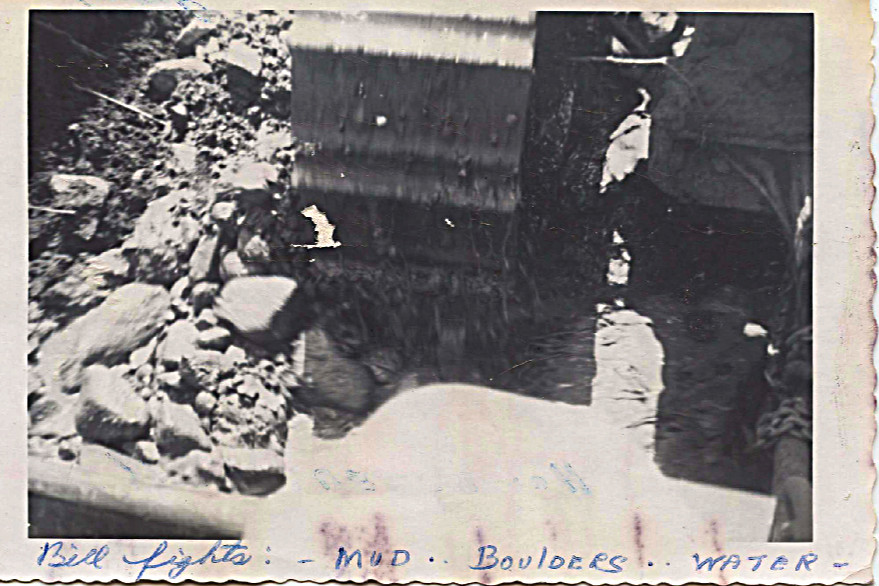
Having just mentioned metaphors as being useful ways the brain (particularly the right brain) has to consider and process information, I remembered this picture I just discovered yesterday.

My mother took this picture around 1960 during our family’s early Alaskan homesteading years.

Written on the back of the photograph: “See the mud spattering up — it is dark here in the woods and picture doesn’t show up the MUCK [underlined]”

Most of these photographs survived a major fire in the 1980s so the white area in the lower picture is a result of that damage.  I never knew this picture existed until yesterday, and I found it a useful addition to my metaphor thinking about how early trauma changes the development of an infant-child’s body-nervous system-brain.

What those of us with serious insecure attachment ‘disorders’ experience — as related to the physiological changes that complex post-traumatic stress disorder (PTSD) causes, is a body that cannot turn off it’s fight-flight-flee-freeze stress response.

When I think of this, I ‘hear’ the low growl of a hard-working machine trying to get us through life in a world that our body was designed to believe would ALWAYS be a dangerous one to our survival.

I know this growl because I heard it growing up on the side of an Alaskan mountain after I was seven as tractors often were heard working hard to either build roads or to repair them.

What our mountainside had was a ‘mountain marsh’ caused by water that ran underground but near to the soil surface.  Once the intricate network of tree and shrub roots that held the soil in place were cut through for road building, the mountainside continually oozed its water — creating in winter massive living glaciers that filled the roads and crawled down the mountain.

In break-up the glaciers melted and created deep ruts that were actually mountain creeks as the water ran down the easiest pathways it could find headed toward the valley below.  Except in the dead of winter, the common denominator for the entire road nightmare was MUD — what my mother is calling here MUCK.

Horrific infant-childhoods tell a little one’s growing and developing body to prepare for a lifetime of the worst.  We only have this one time in our life to grow some of the most profoundly important parts of our body.  Once our adaptations to an early malevolent environment take place, they cannot be undone ‘down the road’ or ‘later on’.  We live with them.

So, in effect I have a body-nervous system built in and designed for a very hard road through life — for one not unlike the road my father was trying to crawl over with his tractor in this picture.

++++

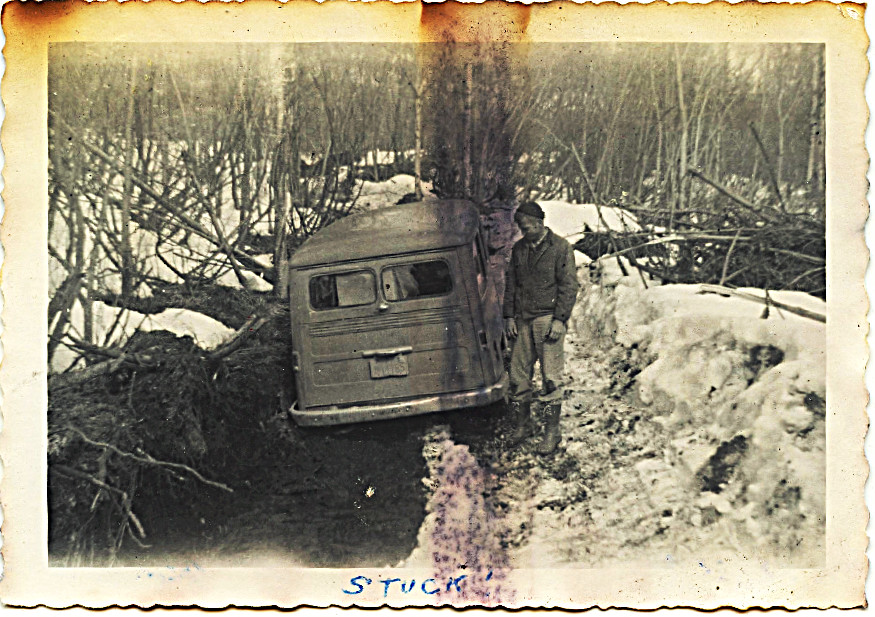
Another picture I have scanned from this era of my childhood comes to mind, and it represents another metaphor of high risk for severe child abuse survivors — that of BEING STUCK along the way.

I really have the advantage of knowing first hand what stuck looks like!

Always running in low working gear, always trying to negotiate a tough, rough road through life, always prepared for the worst, always at risk for danger, frequently getting stuck and needing to find our way out again — all these experiences are part of severe infant-child abuse survivorship.

All these ways of being in the world are built into our body, and all of it consumes vast amount of our inner resources and life force throughout our lifespan.  If we wonder as adults why we can’t reach some pie-in-the-sky level of so-called ‘recovery’ so that we can be more like other people who had entirely different, benevolent early years that gave them a different body entirely, think about all of this.

I’m not saying that improvements can’t be made for us in our lives toward increased well-being — but first, we need to KNOW what happened to us where it matters most.

+++++++++++++++++++

+WE HAVE ALWAYS BEEN GROWING – OR WE WOULDN’T BE HERE NOW

++++++++++++++++++

It stuck me this morning that maybe what I have always thought of as ‘healing’ really is something else, and that something else is growth.  Maybe it doesn’t even matter what I call it, just so I continue to experience it!  But if I think in terms of growth rather than healing, an entirely different set of images comes to mind — and a whole different set of metaphors, as well.

I have a little plant growing in a Styrofoam cup that my sister started from its seed and brought over to me a few months ago.  I have it right by my kitchen sink so I can keep my eye on it and notice when it is too dry and begins to wilt so that I can take good care of it.

This is a Mexican Bird of Paradise plant, but we won’t know which variety it is until it lives long enough to bloom.  Is it the hardier (for my altitude and climate) yellow one, or is it the more warmth-oriented red one?  I hope for red, but either way I admire that my sister was able to get this seed to sprout in the first place because doing so requires some special treatment.

I don’t know what actions my sister actually took, but I have heard that the seed must be pounded to crack its shell.  It is a desert native, so on its own the species has provided its offspring with some way to make it forward in the world.  I am just glad to have this little plant, and today I am going to move it into a bigger container, but I will still keep it where I won’t be likely to ignore its needs.

As I watch the little stems bud and lengthen I think about this healing vs growth idea of mine.  That plant isn’t healing, at least I wouldn’t name its process that.  I would say it is growing.  And as it grows I certainly cannot predict the shape it takes.  It’s growing in its own way although of course it depends on me to give it what it needs to do so.

Perhaps every single thing I have done in my life, and certainly as I try to ‘heal’ from the terrible trauma of 18 years of severe abuse from my mother as I grew a body-brain, was not and is not about healing.  Maybe it was simply about growing — then and now.

Somehow as I think about this growing angle rather than a healing one I feel less pressure to do ‘it’ right!  Certainly this little plant I am watching doesn’t care if it grows right or not.  It just does what it naturally does — and grows!  If it didn’t grow, it would die.  That’s a simplicity I can understand.

I have intuitively always found today’s emphasis on ‘recovery’ impossible to swallow.  Now I know that due to the circumstances of my early abusive environment that changed how my body-brain-mind-self developed I have nothing to go back and get — nothing to ‘recover’ unless I go all the way back to my body as it grew within my mother’s womb and try to find something back THERE that wasn’t permanently altered by my trauma-influenced development during all the stages after my birth.

I’m not going to be able to ever ‘go back there’ and recover any sense of being a safe and securely attached person in the world.  I didn’t get to grow and develop any safe and secure attachment patterns or circuitry into my body from the start.  As I recognize how my experiences changed my very body forever, I am also recognizing the patterns of my life that happened to the largest extent because my development WAS so changed in a malevolent environment of trauma.

Yes, I survived.  And yes, I have looked at what I do now as ‘healing’.  But I am beginning to think that I might just want to throw that word out completely as ‘not relevant’.  What I am doing is what everyone does who is breathing their way from one past moment, through a present one, and hopefully into a future.  I am growing.  Simply growing.

As I begin to think in this new way I understand that my growth is not always predictable.  I am often surprised by what ‘comes up’.  My new little leaf here, my new little root tip there, my branches extending off in this direction or that one.  Learning how to not only watch my own growth happen, but to begin to understand that I ONLY have to be willing to let it happen frees me to appreciate all the interesting twists and turns I have always taken along the way — throughout my life — from the moment I was born.

Looking at my life in terms of growth rather than healing might also change how I look at ‘surviving’.  Perhaps all that my survival really has been from the beginning is my growth.  I just continued to grow from the time I was born through horrific experiences in a very nasty environment.  Somehow I had and found what I needed to do my growing in spite of all of it!

I am free to anticipate all the interesting and clever ways my growth takes place each day.  And because I am my own little plant, I don’t have to compare myself to anyone else’s growth process, either.  If I can see and appreciate that what I needed for my continued growth was there for me from the start of my life, I can more easily appreciate that whatever I need to continue my growing is also right here, right now for me today.

Some good soil, a little water, just the right amount of sunlight, a little darkness at night, no weeds to crowd me out and nobody to trample on my little sprouting branches and I am all set to go.  If healing happens while I am busy growing, that’s OK with me.

++++

I suspect I need to pause to notice all this because I am preparing to go back into the past of my horrible childhood to retrieve my own story — so that I can write it.  I need to remember that I am never actually going backwards.  Growth is a forward affair.  No matter what crap I may encounter as I remember myself in my childhood, I know that all it can do is act as good fertilizer for the growth I am doing today.

++++++++++++++++++

+ALWAYS LEARNING HOW TO LIVE WITH ‘THIS FEELING’

++++++++++++++++++++++

Sometimes when severe infant-child abuse survivors feel crappy, the reason why we feel the way we do — along with what we are actually feeling — might surprise us.  I have ‘this feeling’ often, and now that I better know where it comes from, why I have it, and what it actually IS I find living my life a little easier.  Sometimes.  The trick for me is to recognize ‘this feeling’ when I am having it — so that I can name it specifically for what it is and not for what it is not.

Humans have potential to experience a wide array of feelings, and MOST of them are actually not entirely pleasant.  Why might this be so?  I figure it’s because our actual survival far more depends on our ability to find ways to take care of ourselves so that these unpleasant feelings either shrink or disappear — at least temporarily — than it does on our being outright giddy with glee (my term of choice at the moment for all we might call our feel-good feelings).

If we happen to get caught with our hand in the flames, our jerking it out doesn’t so much make us immediately giddy with glee as it does STOP the pain.  That’s a good thing.  Much of what I suspect we humans do is geared toward stopping pain (thus enhancing our survival).  Nothing wrong with that, and nothing to surprise us here.  Not really.

If life on this planet had always been a giddy party-for-all free-for-all, full of plenty, full of safety and security, a NICE place to survive in we would no doubt be sharing our current breathing space with members of at least SOME of the other 18-plus other hominid species that vanished trying to do what our species did:  Remain flexible and adaptable enough to stay alive.

So while it must sure be nice to have a big fat left-brain happy center, all full of early-formed happy neurons that can be relied on to add humor and a more pleasant focus on life than severe infant-child abuse survivors managed to hold onto in the midst of the tragedy and terror of their body-brain formative years, it’s not anybody’s happy left-brain neuron center that most guarantees they are going to survive if the time ever comes to put their survival to the absolute test.

I have to remember all of this on days that often come to me when I feel far from giddily gleeful.  It’s not ONLY that my early forming left-brain happy center had only sporadic Kodak Moment opportunities for happiness that contributes to my difficulties in staying buoyant today.  It’s not ONLY that fear and sorrow, terror and confusion — and all the rest of my survival-connected emotions got an Olympic sized workout from the time I was born that increases my difficulties in experiencing joy.

What did the most damage was the fact that the malevolent, dangerous, abusive, unsafe and insecure world that I spent the first 18 years of my life trying to grow up in was the fact that all the abuse I experienced happened because both my mother and my father ALSO grew up in unsafe and insecure worlds.  This gave them — and in turn gave me — an ‘insecure attachment disorder’.

What that means to me now is that severe abuse, tied into severe attachment disorders (for both the perpetrators and then for their offspring), left me with an attachment system that CANNOT TURN ITSELF OFF!

THAT is what I am actually feeling on most days that I might otherwise be tempted to describe what I feel in some other survival-based emotional terms.  It isn’t anger or resentment or bitterness or despair or hopelessness or helplessness or fear of the future that gets to those of us who suffered in and survived the kinds of infant-childhoods this blog is dedicated to.  It isn’t boredom or loneliness or even often hunger or thirst or some other physical depletion that we feel.  It isn’t grief or sorrow or depression.  It isn’t isolation or confusion or longing we feel.

What we most often feel does not even have any more of a name in our culture than what I call it here.  What we feel when we do not feel ‘happy’ and can’t seem to find our way even to peaceful calmness (which as I have said is SUPPOSED to be the middle set point for our nervous system and for severe early abuse survivors is NOT) — is the very real physiological body-based FEELING of having an active insecure attachment system THAT CAN’T BE TURNED OFF.

Certainly sometimes we know what it feels like not to have this feeling.  Some use addictions or chemicals from the drug store or addictions to everything from gambling to work to sex to over spending or over eating or relationships (or even as my mother did by abusing someone else and by her constant moving).  What I am describing ACTUALLY is that LOST feeling I mentioned several posts back.  It is the feeling we are born with that motivates us to express our needs in such a way that someone comes and takes care of us (or does not).

Our feel-good and feel-bad chemicals in our body are all tied into this attachment system we have been either fortunate enough to have had built right in safe enough infant-childhoods — or unfortunate enough not to.  It is those of us in the latter group — way way way way over in this latter group — who are left with the same insecure attachment patterns that built our entire body-nervous system-brain-immune system-mind-self from the start back in those truly malevolent earliest years.

Early abuse survivors are left with circuitry in our body that operates differently than does the attachment circuitry built into people who had safe and secure-enough infant-childhoods.  There’s no way around this fact.  What nobody ever told me, what nobody ever tells ANY of us is that THEY have a secure attachment system that can be turned off.  Our insecure attachment system was built to KNOW we will never be safe — and ON is (to our trauma-formed body) BEST.

There are times as a severe abuse survivor that I have been distracted from the experience of having to FEEL my forever turned on insecure attachment system.  Fortunately.  Those distractions include the 35 years I spent mothering children in my home before they reached their own adulthood.  Those distractions really are the story of my adult life.  But the older I have gotten the more difficult it has become for me to find ways to distract myself from feeling WHAT I FEEL LIKE — really feel like — feels like!!  This is all a direct consequence not only of the hell of abuse I was formed in and by throughout my infant-childhood — but is also a direct consequence of the fact that I survived it so that I am still alive to have feelings today (and to write about them).

Typing into the search box on this blog ‘insecure attachment’ will bring up many, many pages on the topic.  I am mentioning it again today because I periodically have to remind myself of how real my insecure attachment ‘disorder’ is — because there are days when I feel it in my body so strongly it is difficult to feel anything else.  Then I have to remind myself it isn’t because I am a flawed person, that there’s something wrong with me, that I ‘should’ be doing something better or differently than I already am.

On days like today I am just face-to-face with myself as a trauma-formed person with a body who will feel that reality for the rest of my life.  At the same time I know that has to be just fine with me because the only escape from it will be my death — that’s a reality.  But I have survived this far and will keep on keepin’ on because that, after all, is what every living member of our species does best.

But I am always in the market to find new tricks for backing off this unpleasant survival-based feeling so that it doesn’t overwhelm me.  Some days that becomes my nearly full-time job.  At the same time I wonder if it isn’t those of us who survived intolerable infant-childhoods of abuse and deprivation — and pay the price for our survival every day that we have to live with ‘this feeling’ that our insecure attachment ‘disorder’ creates in our body — who really have the greatest right to celebrate that we are — in fact — that we are still here and we are AMAZING!

*NOTE:  In dismissive-avoidant insecure attachment disorders (which I believe was the kind my father had) the brain actually creates its own distractions against emotions so that the brain keeps the person from even being aware that they are having a feeling in the first place.

++++++++++++++++++++++

+MAKING FACES IN THE MIRROR (WITH SOUND EFFECTS)

+++++++++++++++++++++++

I am not convinced that by their nature either resentment or bitterness are ‘bad’ things.  They are simply parts of the natural human experience.  I do, however, think that being STUCK in any state is a problem.  Life itself is a constantly changing event, and if we can’t change in flexible ways along with the changes life brings us — well — THAT can mean trouble.

So perhaps if whining bitterness was to become seasoned with a little growling resentment — or growling resentment could become mixed with a little whining bitterness — a person stuck at either end of this ‘stop-go’ nervous system continuum could budge enough to get a start toward healing change.

If bitterness is too close to the despairing giving up end of the stress response, and if resentment is too close to the forever-in-the-wanting-to-fight state, then a move off of dead-center STUCK would be a positive one no matter which way the move took place!

So to get the bowling ball of mood states rolling again, I suspect that if growling resenters took a little time in front of a mirror and practiced turning their scowl into a pout, and whining bitter people took a little time in front of a mirror to practice turning their pout into a grimace — and both need to add the sound effects along the way — and throw in a heaping spoonful of good humor — well — what can I say?

A bowling ball stuck half way down the lane isn’t much fun to play with, and when we get ourselves stuck in these fighting or despairing places and can’t get ourselves out of them — trying SOMETHING is better than doing nothing at all.  Otherwise we can eat up our lifespan either waiting to fight our invisible foes so we can beat them and win — or waiting for some magical event to change the past for us into something better than what it was.

Making faces at ourselves in the mirror while we growl or whine ourselves off of an unhappy dead-center might just free us up enough to find something more pleasant to do with our time!  Never know until you try it!

+++++++++++++++++++++++

+BEEN ABUSED? PATTERNS OF RUPTURE WITH OR WITHOUT REPAIR

+++++++++++++++++

Another important piece of information about resentment and bitterness!  Safe and secure, appropriate, adequate (does NOT need to be perfect) parenting and early infant-child caregiving IS SUPPOSED TO include LOTS of practice with what is called RUPTURE AND REPAIR.

Parents who were not parented correctly are most likely to not recognize the opportunities life gives us through its patterns of RUPTURE to ‘learn’ how to REPAIR them.  All these patterns — adequate or not — build out nervous systems-brain-body-mind-self from the beginning of our life.

Done well, CALM and CONNECTION is the middle set point for our nervous system-brain-mind.  This happens when every rupture is met with an opportunity for repair.  The entire feel good-feel bad chemical system in our body is tied into these systems and is built by these patterns.

When an infant cries and has its needs met appropriately in a safe and secure environment, calm connection builds the center point.  Crying represents a rupture, having needs met is the repair.

We never leave these patterns behind.  All our lives we negotiate what we want and need with the environment, most often with other human beings.  We bump into one another in all sorts of ways, but a well built nervous system-brain-mind-self has all sorts of feedback loops built into it including REMORSE and EMPATHY to let us know what works and what doesn’t — to increase calm and connection for everyone.

Severe child abusers like my mother did not have the right kind of patterns built into them from early on, and as their developing body-brain adjusted – like in my mother’s case, the vagus nerve system was also affected and the ability for empathy and remorse was removed from her.

In our adult years when resentment and bitterness begin to solidify and ‘control’ our ability to respond – decreasing our calm and connection and our sense of well-being — we can bet our body-brain-nervous system-mind-self was built with LOTS OF RUPTURES that did not have adequate or appropriate repair.

My mother could beat me and beat me, etc. and NEVER, not one single time, feel remorse.  She offered NOTHING toward helping me build patterns of repair into my body.  These ruptures without repair ARE what dissociation is all about – plus!

A short post here — but important!  Healing means we recognize the patterns of rupture without repair from the time of our birth and name them for what they are.  Then, if resentment and bitterness are present – and again, they are IN OUR BODY, in our stress-calm response system — we can learn NOW how to live well with these patterns and to find ways to improve and change them!

+++++++++++++++++

+STEPPING TOWARD HEALING – WHAT OUR BODY KNOWS

+++++++++++++++

I believe that child abusing parents ALWAYS have an insecure attachment disorder.  I also believe that it is most likely that either in the parent/s, in their parents, or in their grandparents alcoholism and/or drug addiction almost always exists.

I also believe that if adults struggle with either/or resentful bitterness or bitter resentment there is a very good reason why — and that reason nearly always rests firmly on an unsafe and insecure attachment platform in childhood that very likely contained abuse.

In light of the comment and reply included yesterday on the subject of hurt and bitterness, I simply wanted to make these points because I believe at least in the beginning of healing work from an abusive childhood that Al-Anon’s 12-step program (or any other relevant 12-step support group) has a LOT of solid help and information to offer.  I recommend it highly and suggest a weekly meeting and connection with a good sponsor.  If you go, attend at least six meetings before making a decision about your continued commitment — and before you try another meeting to adjust your ‘fit’.

I also know that healing is certainly possible for many people without these ‘meetings’, and that attendance does not have to be a lifetime affair (no matter what any meeting person might tell you).  But or those of us from abusive and nutty families, with and without the chemical (and other) addictions, we have a lot to learn about life that we didn’t learn when we needed it growing up.

I also know that nobody has all the answers!

++++

I also wanted to mention that I couldn’t continue thinking about bitterness and resentment today without beginning to get mingled ‘sense’ information for myself about what my BODY knows about them.  I therefore speak ONLY for myself – and encourage others to listen to their own body-talk to get their own information.

To me, resentment has a nasty oily kind of smell to it, while bitterness has a metallic sulfuric kind of smell.  Resentment has a sound like a low sustained growl, while bitterness has a sound (to me) that is high pitched, obnoxious and a whole lot like whining.

To me, resentment has a dark, dried blood red-brown-maroon color to it, while bitterness is a sick yellow-green tinged with black.

Resentment (to me) is tied to the fight stress response — and involves a continual sustained state of WANTING to find a way to fight back.  This is a nervous system response tied NOT to resignation, but to a search for competence and confidence to right a wrong.  (The nature of the wrong needs to be examined as does one’s reaction to it.)

Bitterness (to me) is tied also to the stress response system in the body, but it lies more toward the ‘giving up’ end or resignation and lost hopelessness.  It lies very close to despair — and will stay exactly STUCK there until a person can identify all the complicating feelings and factors that contribute to the LOSS and grieving, the sadness and despair that has sapped away rather than restored or built up one’s will to FIGHT.

What child abuse survivors with insecure attachment disorders DO NOT HAVE is (as I have said so many times) a balanced calm and connected, safe and securely attached MIDDLE SET point for their brain and nervous system.  From very early, early in life this middle point — set by abuse to be somewhere OTHER than where nature would best want it — that lies too far either toward aggression-fight or toward giving up.

We are human.  We live in a body.  Resentment and bitterness are anchored in our body as is everything else about us as long as we are alive.  I believe it is helpful to think in terms of color, smells, sounds — all the information our body knows about whatever concerns us.  We can explore this information and learn a LOT about our self, our woundedness, our reactions to our hurts, as well as begin to find our own clues about what to do next to improve our well-being.

+++++++++++++++