
+ATTACHMENT – HOW WE ARE WHO WE ARE

++++

Trying to understand the research and literature on secure and insecure attachment patterns seems to me to be a bit like this image:

Picture a cold winter day.  Someone comes out of their house, shuffles through the snow to a wood pile, brushes a pile of snow off of a corner of the tarp that covers it, pulls the cover back and begins to pile stove size logs into their arm.  They pull the tarp back over the pile, return to their house, and go through the process of adding the wood into a fire.  All is well, warmth is achieved, and life goes on.

When attachment specialists write about attachment styles and patterns they divide their thinking in half.  Half talk about how attachment can be ‘measured’ for infants at about a year of age.  The other half talk about attachment styles and patterns in parents as they relate to their infants that created the attachment styles and patterns one can measure in the infants.

I have found no clear description about how the birth to age one experience an infant has with its earliest caregivers BUILDS its age-one attachment pattern that continues through to create the attachment patterns it has in adulthood.  The topic of attachment is chopped into pieces just like a tree needs to be if its pieces are going to fit into a stove.

Going back to the image I just presented of the woodpile as it might relate to the study of attachment.  To get the WHOLE picture we would have to include a lot more information.  Where did the seed come from that grew into the tree that eventually found itself in pieces heading into a wood stove or a fireplace?  What were all the steps that had to happen for the seed to find itself into the ground, for it to crack open into life, grow into a sapling, into a tree big enough to use for firewood?  What was the process that went on as someone found the tree, cut it down, hauled it home, chopped it up, and made a covered pile of firewood?

Where do we turn for the whole story about human attachment from conception to death?

++++

Dr. Daniel J. Siegel has written what is, I believe, the only book that approaches parenting from an attachment point of view:  Parenting From the Inside Out by Daniel Siegel and Mary Hartzell.  Please read this book for a fuller understanding of what I am going to write about today.

Today I scanned in 13 pages for your study taken from another of Siegel’s books, The Developing Mind: How Relationships and the Brain Interact to Shape Who We Are (The Guilford Press, 1999)) — available for purchase by clicking on the title link –

These pages can be seen at this link:

**Siegel – Attachment Measurement (kid and adult)

++++++++++++++

As critically important as this attachment information is, I still think it is dense, complicated, hard to read, hard to understand, and hard to relate to anyone’s ongoing experience of their life with others and with their own self.

Because these early attachment experiences actually build the foundation of the human social-emotional brain (and direct the development of the body), it is critical to understand that the attachment patterns that can be ‘measured’ at age one happened one tiny step after another from birth.  The same patterns that can be seen in a one year old continue to operate for a life time – because they built the body-brain-mind-self of the person from the start.

++++

All the specialized fields of research are themselves each like a single piece of firewood cut from a whole tree.  The fields of study examine and report on their little piece of the tree, but nobody seems willing or able to put the whole picture together and look at the whole.

Attachment, in my thinking is the whole tree from which all other aspects of being human connect to and originate from.  Every single other facet of study concerning ‘the human condition’ stems from this tree.

Nowhere along the line of a lifetime, from conception to death, can attachment be ‘simply’ considered to be like the pile of firewood under the tarp.  Human attachment is about the entire process of the journey of each of us – like the firewood — from seed to ashes.  And just as the entire journey of our proverbial tree was influenced by the conditions within its environment from start to finish, so too are we.

++++

In yesterday’s post I laid out which of all the horses related to the betterment of the human condition I would lay my money on.  Coming to understand the attachment continuum of our lifetime – what it is, how it operates, how it determines the manifestation of our genetic potential, how it directs the building of our body-brain-mind-self’s foundation, how it affects our relationship with our own self, with others of our species, and with the entire environment we live and die within – is, in my belief, the most important conscious learning we can ever pursue and accomplish.

Improving our ability to experience safe and secure attachment will improve the quality of our life.  Finding ways to overcome whatever our degrees of unsafe and insecure attachment will be the most effective tool we can have to improve our degree of well-being within our own self and within the world we live in.

Yet where in the fragmented, disjointed, cut-into-tiny-pieces world of academic information can we look for the attachment-related facts we need to improve our lives?

Sadly I would have to say – nowhere.

Siegel’s book on parenting (link above) is probably the most complete effort anyone has accomplished to help us understand how our adult attachment patterns affect us as parents.  His work cannot possibly be comprehensive in my thinking (give us a picture of the whole of the living tree) for several reasons.

First of all, as you will notice if you follow the link to the 13 scanned pages, the terms used to describe attachment patterns seen in infants does not match the terms used to describe attachment patterns in adults.  This fact has made it difficult for me to think about the life continuum of attachment.

Pneumonia is pneumonia, diarrhea is diarrhea, and cancer is cancer no matter what age is of the body that might be suffering from these conditions.  Attachment patterns ARE physiological patterns within the body-brain.  They are not imaginary events that can be arbitrarily called one thing for an infant and something else for an adult.

In addition, as you read the 13 scanned pages you will be learning about the two accepted measurement tools available to measure attachment accurately – one for infants at about a year of age and the other for adults.  Both of these measurement tools are designed for use in a professional research setting.  To my knowledge, no one has ever yet designed accurate assessment (rather than measurement) tools that can be used in public settings to either assess infant or adult attachment patterns.

++++

Most people can read the information about how attachment is measured in infants and think about what we know in our real life about infants and their caregivers.  We can imagine the clinical experience as it happens around us in our lives.  We can begin to use our common sense to make the connection between the information about early mother-infant brain building interactions that Schore describes and the year-old patterns of interactions an infant has with its mother as presented in these 13 scanned pages.

This still does not leave us with any clear idea about how we could translate the clinical measurement tool so anyone could assess infant attachment in the ‘real world’.

Nor does the presentation of information about adult attachment measurement presented in the 13 scanned pages give us any everyday working idea about how we could assess our own adult attachment patterns.  It does not present a means to assessing adult attachment ‘on the streets’ or ‘in the trenches’ so that ordinary people could better come to understand how attachment patterns are affecting all our relationships – everywhere – every day and every night of our lives.

We are left reading the 13 scanned pages and trying to imagine an ordinary context in the same way we might be able to imagine the whole story about how a seed was planted that eventually ended up in firewood pieces giving warmth within someone’s home.

++++++++++++++
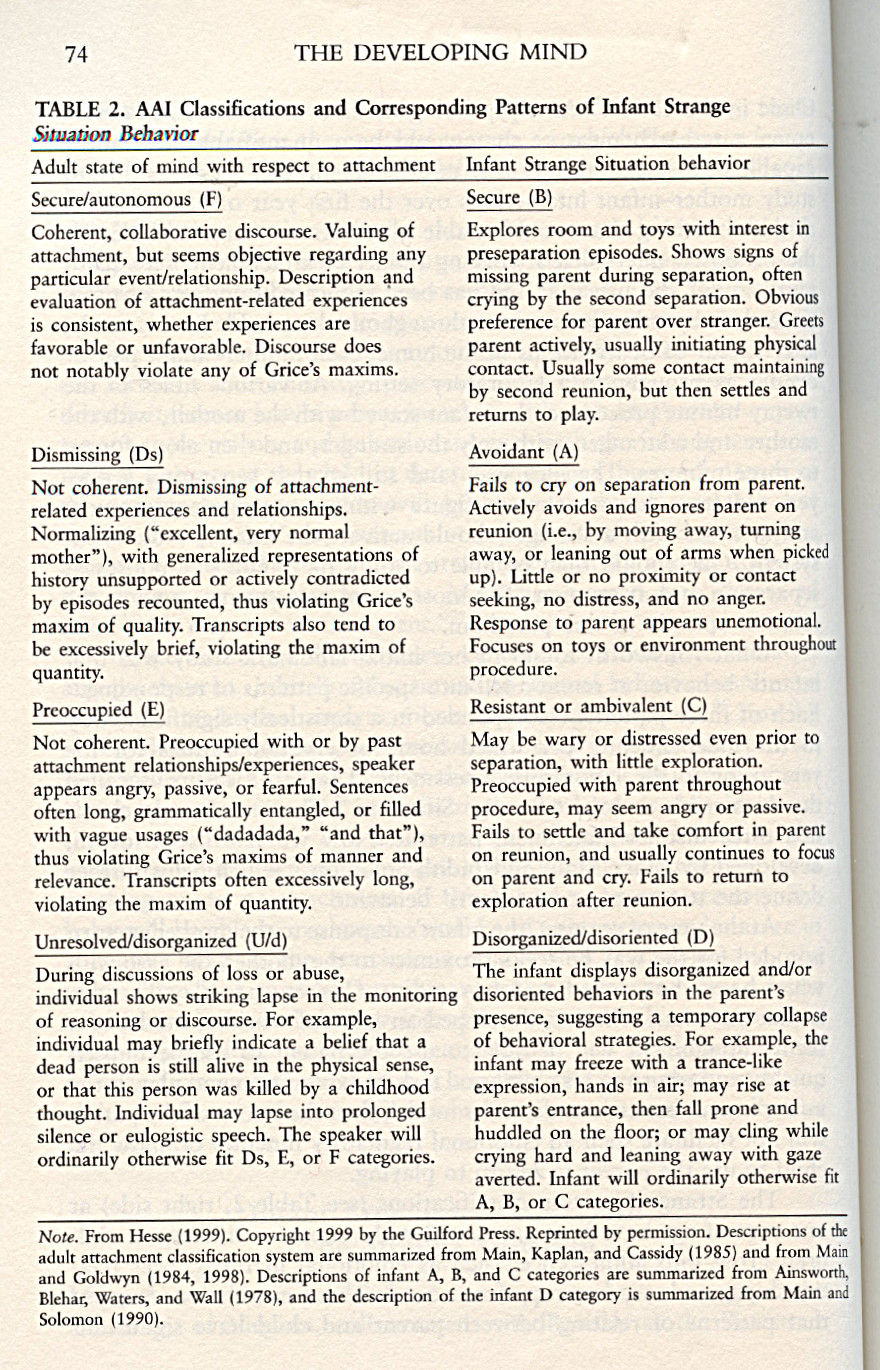
This scanned table about adult attachment refers to something called Grice’s maxims.  Here is the clearest description of these maxims, which originated historically in Kant’s philosophy, that I can find:

Grice’s Conversational Maxims

Maxim of Quantity:

1. Make your contribution to the conversation as informative as necessary.
2. Do not make your contribution to the conversation more informative than necessary.
Maxim of Quality:

1. Do not say what you believe to be false.
2. Do not say that for which you lack adequate evidence.
Maxim of Relevance:

Be relevant (i.e., say things related to the current topic of the conversation).
Maxim of Manner:

1. Avoid obscurity of expression.
2. Avoid ambiguity.
3. Be brief (avoid unnecessary wordiness).
4. Be orderly.

These maxims are considered to be reflected within rational ‘cooperative discourse’, and have been incorporated into the rating structure of the Adult Attachment Interview (AAI) used clinically and in research to assess adult attachment.

The AAI is a research tool.  People who administer the interview and rate it must go through specialized training.  This tool’s usefulness even in research is complicated because there are many factors about it that cannot be easily controlled, such as how the environment where the interview is given influences responses, how the person of the interviewer interacts with the ‘subject’, how interviewer’s biases might influence ratings, etc.

If I go back to my wood pile analogy and change the ‘end result’ of a tree’s lifetime into a toothpick or a piece of toilet paper instead of a log of firewood, and then expect us to be able to exactly imagine the entire process accurately that the seed went through to get to its end, we have a more accurate picture of how hard it would be to connect the results of an Adult Attachment Interview back through all the experiences of a person’s life back to their beginnings.  That would be if we even believed that the results of an AAI accurately described an adult’s attachment pattern in the first place.

++++

In the end, the simplest description of what an adult’s insecure attachment pattern might look like ‘on the streets’ or ‘in the trenches’ has to do with having some ability to tell a coherent life story – or not.

If I look at the piece of toilet paper version of how an AAI result might look, I would consider the ‘lowest’ grade of adult attachment that is not even mentioned in the 13 scanned pages.  It is called the ‘Cannot Classify Category’ and looks something like what 1998 research article describes:

Discourse, memory, and the adult attachment interview: A note with emphasis on the emerging cannot classify category

This brief report focuses on the emergence of a new Adult Attachment Interview (AAI) category, Cannot Classify. The Adult Attachment Interview classification system is discussed with emphasis upon differences in AAI categories as they relate to strategies or lapses in strategy for the integration and focus of attention and memory. The Cannot Classify category is understood to differ from the other AAI categories in that it appears to represent a global breakdown in the organization and maintenance of a singular strategy for adhering to the discourse tasks of the AAI.”

++

strategies or lapses in strategy for the integration and focus of attention and memory

This is what the researchers are looking for when they try to pin down what varying styles of adult attachment patterns look like.  That doesn’t give the rest of us much to go by in terms of learning about our adult attachment patterns, does it?

The fascinating point is that right within the few words of that sentence lies the heart of our concerns – TRAUMA.  What happened, when it happened, how it happened, what strategies either did or did not exist to integrate the experience of trauma, how these trauma experiences influenced and were influenced by attention and memory processes are all connected to attachment patterns.

++++

Attachment patterns are patterns of dealing with trauma.  If trauma built the early brain in the first place, these patterns show up in infant insecure attachment patterns such as the 13 scanned pages describe.  If trauma built the early brain, the same trauma-formed patterns continue into adulthood and manifest themselves in the disruptions of conversation about one’s self in one’s life that the AAI is designed to define.

Because our concern is with ‘trauma dramas’ that repeat themselves throughout a person’s lifetime, it is essential that we recognize what we are looking FOR as we find it in what we are looking AT.  We are looking for early infant-caregiver traumatic interactions (or their absence in safe and secure attachment) that built social-emotional brain in the first place because that is where the seed of who we are as a body-brain-mind-self originated.  We can tell the trauma was there at the beginning and that it influenced all later development if an insecure attachment pattern exists – in infant-children and in adults.

++++

So, if I disappoint my readers my not being able to clearly describe what adult attachment IS, let alone how it operates, how we identify the patterns, or how we change them, I hope you will be patient.  I might as well take what I have on hand and go into my back yard thinking I can build myself a space shuttle that actually works.

Humans had the capacity to figure out how to fly to the moon long before we did so.  We have the capacity to find a way to clearly assess human attachment, but we haven’t done so yet.  Because most of what goes wrong in human lives can be traced to the quality of attachment that formed the brain foundation and lies at the root of all of our social interactions – including the one we have with our own self – I believe this field of study should become the single most important one we pursue.

I have faith in US.  WE can figure this out – if and when we want to.  After all, as members of a social species our attachment patterns determine WHO we are in the world because they determine HOW we are in the world.

+++++++++++++++++++++++++++++++++++++++++++++++++++++

+WHAT DO WE KNOW ABOUT TRAUMA?

+++++++++++++++++++++++++++

I would think that in their own way everyone in our great nation recognizes today as the 8th anniversary of one of the most terrible crisis that ever occurred within the boundaries of our country.  Our hearts continue to go out to all those who suffered terror and unimaginable trauma as a result of the destruction brought upon them by the acts of terrorists whose own agendas allowed them to kill and destroy wantonly.  At the same time we remember each person and their loved ones whose lives have been touched in the aftermath of war, destruction and bloodshed that has followed 9-11 and the World Trade Center attacks.

+++++++++++++++++++++++++++

The most devastating consequences of trauma to humans can never be measured in financial terms.  Neither do we yet know the true reality of the way humans respond to extraordinary traumatic stressors.  Continued research into the ongoing, intergenerational consequence of the Holocaust’s traumatic effects shows that trauma can be CLEARLY passed down to offspring.

Researchers will be working to uncover the long range consequences of trauma caused by 9-11 for a long time to come.  They know that babies of women pregnant during the 9-11 terrorist attacks have been found to be born with the ‘markers’ for Posttraumatic Stress Disorder (PTSD) as a result of their mother’s exposure to the attacks.

We are learning more and more both about how resilient humans are and about our fragility.  Every-day people do not usually pay attention to the results of millions and millions of dollars spent on research about the consequences of trauma to humans, and yet this research can inform our thinking in new and more enlightened ways.

The Atlanta study looked at genetic potential as it interacts with children’s responses to trauma.  It found, among other things, that a child’s safe and secure attachment to ANY adult in its life influences to the positive that child’s ability to overcome traumatic experiences.  In another corner of the world researchers have discovered the same thing.  Although exposed equally to unimaginable terrors and traumas, the children of South Africa end up with severe longterm traumatic responses while the children of Kenya do not.

The more damaged South African children live in a country long torn apart, in fact all but dismantled by generations of influences that have destroyed the secure social attachment fabric of their culture.  Kenya has not suffered this intergenerational destruction of its ongoing cultural strengths so that their children have the benefit – in spite of current terrible traumas and tragedies – of being ‘held’ within a culture that still has its social supports and secure attachment systems somewhat in place.

+++++++++++++++++++++++++++

We cannot realistically consider the long range consequences of traumatic experience without considering the attachment contexts that form and support (or don’t) the members of any human society.  These attachments begin before birth, as the responses of infants still very much physiologically attached to their mothers during 9-11 demonstrated.

Children are held and supported by the fabric of the attachment support net that their parents either do or do not have in their lives.  Without firmly safe and secure human attachments from the beginning of our lives, we are at astronomically increased risk of suffering long term devastation in our adult lives from any traumatic experience that we might later have.  It is time that all of us realize that attachment is the single most important aspect of our lives because we are a social species.

What this means to me is that all of us, including and perhaps most importantly any mental health expert that works with troubled people of all ages, must begin to include attachment disorder understanding, concepts and vocabulary into our cultural base of knowledge about what makes our lives ‘good’ and what makes them ‘bad’.  I doubt that more than a small handful of mental health experts EVER talk with their adult clients about insecure attachment disorders.

We reserve any discussion or awareness of secure and insecure attachment disorders ONLY as it might relate to ‘troubled’ children.  Where do we think child attachment disorders disappear to once someone magically crosses some invisible line into adulthood?  They go nowhere.  Our attachment orders or disorders are as much ingrained into us as any other physiological response system our brain, body, nervous and immune system has.

We HAVE to begin talking about our attachment system as it operates in our adulthood because it formed who we are and affects how we respond both to the good and to the bad in our lives – at all times!  Those who might be having the most difficult time recovering from the devastating trauma of 9-11 are no exception.  But has ANYONE ever talked to them about their attachment system?

I am willing to bet that any adult who was formed in an extremely malevolent childhood environment and who did not have the benefit of having a safe and secure adult attachment person in their childhood life, is among those who lack the necessary resiliency to recuperate fully from any traumas that they experience.  We are doing nobody any favors by ignoring the absolute, fundamental reality of how our secure or insecure attachment system governs our ability to cope with trauma.

I therefore encourage readers to spend some time investigating some of the information connected to the live-links provided in this post.  You might help yourself beyond belief, or be able to assist someone you know in their efforts to deal with any ongoing traumatic consequences in their lives – including their ability to parent effectively.

Trauma is not bliss, and neither is ignorance.  It is the response-ability of all of us to arm ourselves with any and all information that can help us understand what we can better do to improve secure attachments in the world – no matter who we are, what age we are, or what we have experienced.

Thank you for reading this post.  Comments are welcome and appreciated.

+ATTACHMENT: SMART AND STUPID RESEARCH

+++++++++++++++++++++++++++

+DON’T MISS THESE 3 COMPLETED PAGES

These three pages are now complete:

*COLLINS ON RESPONDING TO NEED – Part Five

*COLLINS ON RESPONDING TO NEED – Part Six

**Attachment Styles and Caregiving from Collins Article

+Links to new pages on attachment patterns

The only way not to have an operating attachment system is to be dead.  Our attachment system is supposed to be able to be deactivated appropriately so that our other systems of exploration and caregiving can be activated in their own turn.  When we have an insecure attachment rather than secure attachment system, this ‘shut off’ ability may be lost to us.  As a result, all of our behavioral systems are negatively affected.

Our attachment patterns are formed into our brains during our experiences with our mother and other important early care givers mostly before we are a year old.  They operate behind the scenes of our life much as a computer’s operating system is hidden from our view.

Whether we look at an infant’s developing attachment system, or look at an adult attachment system as it operates in romantic and other relationships including parenthood, the more we understand these systems the more conscious power we can have over our own lives.

*COLLINS ON RESPONDING TO NEED – Part One

**Attachment Styles from Collin’s Article

*COLLINS ON RESPONDING TO NEED – Part Two

*COLLINS ON RESPONDING TO NEED – Part Three

*COLLINS ON RESPONDING TO NEED – Part Four

*COLLINS ON RESPONDING TO NEED – Part Five

*COLLINS ON RESPONDING TO NEED – Part Six

**Attachment Styles and Caregiving from Collins Article

+LINK to *THE DANGERS OF MEMORY RETRIEVAL

The following link will take you to the page I wrote today about my experiences related to re-membering traumas within my own life:

*THE DANGERS OF MEMORY RETRIEVAL

+MOTHERING: WHEN IT’S RIGHT, WHEN IT’S WRONG

I feel at this instant like a dancer might who is poised behind a curtain of a stage, breathing those last breaths before the music starts, before the curtain rises, about to dance a dance before an unseen but present audience.  This dancer would have performed the dance before, would have practiced it step by step, part by part, before this evening’s performance.  Not I.  I have no idea what I am going to write here before you.  I know not one word before I begin.  All I can do is take that last breath and step on out, hoping.

Hoping that I know what I want to say, what needs to be said.  Hoping that I can say it right, leaving nothing out but adding nothing in that does not belong within this dance of words.  What is it that I will say first?

++

Do we, as a species, want to replace the kind of mothering that built our species from the beginning with medications that alter our brain chemicals and that might mimic what we used to be able to accomplish within our own brains without any other assistance? After all, we used to be prepared for the task of living as members of a social species in such an exact way that all the programming needed to accomplish this mothering was biologically given to mothers, and given to infants, so that in the end infants grew up to be balanced children and adults who knew the possibility of well being.

What happens to infants when the ability to mother adequately is removed from the people-growing equation?  What happens to the adults that these infants grow up to be?  How far back in my own family can I look in order to discover where the diversion of mothering abilities began and where mothering began to be altered and removed from the ongoing patterns particularly of how mothers raised their daughters?  I can’t see back there very far, but far enough to know something passed down to me was very, very harmful.

++

I must tread carefully here, if treading across a public stage can be considered dancing at all?  I wish I could say what needs to be said exactly, specifically so, as if the dance has already been danced before and I can follow in some earlier, preexisting invisible footsteps.  If I knew ahead of time what the dance was and how to perform it, this writing would be so much easier to do.

++

I do not wish to alienate mothers.  I do not wish to harshly condemn any mother’s efforts to raise her own children.  Those of you who have been reading my posts already know that something was so wrong with the way my mother raised me that it could hardly be called mothering at all.

But she was my mother and she did mother me.  Inadequately, but she did mother me.  Taken from that far extreme of mothering like my mother gave me, across an entire range of possibilities of mothering, all the way over to the most perfect mother we could even collectively imagine — somewhere along this line every mother could place her own.

It is not that I am deliberately eliminating men from my writing here due to some inner bias of my own.  I very specifically consider that mothering is something only women can do.  Men father.  They cannot mother, no matter how nurturing they may be toward their infants and children.  Everything we know and can imagine about the biological, physiological differences between women and men apply here.  How men father is not the topic of this post.  How women mother is.

++

With that clarifying step taken, I will turn in another direction and take yet another step.  What we might consciously know about mothering will always be only a tiny part of the story unless we today begin to think very clearly and carefully about ourselves as a species, and particularly about being American members of our species at this point in time.  We cannot leave the context of culture and society out of our discussion about mothering.

I can report facts to you about my own experiences of mothering as I consciously understand them, but I also must state I know really nothing of substance about the generations of women in my family that preceded me as mothers.  I make guesses based on guesses.  My guess is that my mother’s grandmother — who came into my mother’s home when her own husband died, and very closely in time to when my mother’s mother divorced her own husband — was as important to my mother as she grew up after the age of 5 or 6 as her actual mother was.  I do not believe that my mother was healthily mothered by either one of these women.

It is here that my dance must take another step, a sort of flying leap into the air with a shift of the body above the stage floor, so that some distance is covered and the dancer lands in a surprising spot — of sorts.  This step includes what any of us women might know or imagine about all the grand mothering in our families.  What is grand mothering compared and/or contrasted to mothering?  We cannot leave the grandmothers out of our mothering equation.

How my mother’s grandmother mothered my mother’s mother had to have had — my definite guess here — a major influence upon how my mother developed not only as a person, not only as a mother, but specifically as my mother.  How my mother mothered me had a powerful impact on my ability to mother my own children, and backward and forward throughout the generations we see that mothers never do their own mothering in a vacuum.

++

Now I, as the dancer within my own mind, must take yet another step.  This time the step moves into a spin, both feet close together twirling above the floor, ending with me landing into a forward fold, down on one knee, both arms stretched in front of me, palms together toward the sky.  It is here I must talk about our evolution, how if we move far enough away from the kind of mothering that nature intended us to practice within our species we are running the risk of endangering ourselves — and I use this word ‘ourselves’ in both the most singular and most collective way.

I, singularly, suffered the consequences of my mother’s psychosis that was focused specifically on me.  I know that all of my siblings suffered from growing up with my mother as their mother.  Yet we all know that I was forced from birth to be the one chosen to grow up in the center of her storm.

I have said and I will continue to say it again, that my mother’s psychotic break and her overriding mental illness was influenced by conditions of her childhood that damaged her developing brain-mind.  This next step I am taking is more like a jumping up and down firmly in one place.  It is not a step of grace, it is a step of emphasis.  No matter what the men may be doing in the early lives of children, it is ALWAYS to the mothers that I will look for ultimate accountability.

I take another step here away from center and follow with another and another and another until I have traveled in a wide full circle.  At the center of this circle I place the young children.  For every step from that center in any direction I would want another woman to be standing there.  This wide movement I am taking in my dance is meant to point out that for the millions of years our species spent evolving itself, never until recent times and under the guise and the burden of so-called ‘civilization’ did we women EVER mother alone.

We can all talk until we run out of breath about the rights of women.  I am not opposed to women pursuing what they may think is best for them in their lives.  But I am NOT talking about women here.  I am talking about mothers.  I am talking about women’s fitness to mother in the first place.  And ultimately, I am talking about the children we bear and bring into this world.  These children not only need mothers (and fathers, not the topic of this post), they need adequate MOTHERING.

I have to let other dancers onto the stage now.  This is no longer a dance I choose to dance alone.  With the flurry of movement of multiple dancers I see in the patterns they create in their dancing that when women who are mothering are cut off from one another all manor of ill being replaces the well being that we always knew before.

++

The color I remember from stories my mother told of both her grandmother and her mother were that they were brilliant women.  Each in their own way were educated career women.  I hold no false belief that either of these two women were adequate as mothers.  My mother paid a price for this.  I and my siblings paid a price for this.  My own children paid a price for this, even though I was a stay-at-home mother.

Just in looking at the influences in five generations, from my great grandmother to my own children, I see that it wasn’t the mothers themselves that were missing.  No, not us.  It was the necessary QUALITY of mothering that was missing, and that lack and loss is what has created the ongoing pattern of disaster.

If you read my June 1972 writing in +LEAVING NO CHAOS BEHIND – PART ONE, you will be able to instantly know what I am talking about.  That writing reflected the state of dysregulation within my brain-mind that was a direct result of the trauma and terror that formed by brain from the beginning of my life.  How could I, or anyone else, ever expect me to be able to adequately mother children with that brain?

True, except for the incident I described in THE DAY I ABUSED MY OWN LITTLE SON, I did not blatantly or overtly abuse my own children.  But I did harm them.  There was no possible way that I could not have done so, no matter how much I tried not to.  That is the nature of trauma when it is not resolved.  One way or the other, it passes itself on down the generations.  We can whine and moan, curse and spit, but there is little we can do about it — unless and until we find the right information and the resources we need AT THE RIGHT TIME.

Dance over.  I’m deadly serious now.  I do not have any grandchildren.  This may change in the future.  What matters to me most is that my children have broken the pattern to the best of their ability.

If I could magically go back and offer to my own self when I was 18 what I know now, I have no doubt my children would be the beneficiary of radical positive changes that I would have been able to make in myself as a result of the knowledge I now have.  True, there is a probable chance that they would never have been born in the first place.  I cannot find it in myself to wish for that.

All I can do is what we all can do — move forward.  We can learn.  We can change.  We can heal, each according to our abilities.

Before our species so changed our world, back before the coming of ‘civilization’ began to disconnect mothers from mothers, we did not mother alone.  Grandmothers were also part of the cycle of mothering.  Not isolated grandmothers, but connected grandmothers.  Women breast fed one another’s children.  They held them and cared for them as if they were their own.

The birth mother was not left with the full burden of caring for her child alone.  She was always accessible in times when her infant could not be solaced by other women.  The infant could always be returned to its birth mother (if she were alive) when necessary.  But in between these times the birth mother had the ability to ‘get away’ and to work at her other tasks, but the infants never suffered for lack of mothering.

++

I take the stand that in today’s world of American culture we are hurting our mothers by isolating them from other mothers and we are hurting our offspring.  We have gone so far away from what nature gave us in the beginning I am not at all convinced that we can ever find our way back.  But I also know that if we never identify problems that exist we have absolutely NO HOPE of repairing the rupture we have created within our culture — and in increasingly wider circles within other ‘advancing’ cultures — as we interfere with mothers’ ability to adequately mother their young.

I will describe in future posts that the damage we are causing directly affects our brain’s ability to regulate itself.  Adequate mothering is designed to build a regulated human brain that can experience well being as its center point of balanced equilibrium.  The more mothers don’t and can’t mother their young the way nature intended us to, the more dysregulated our brains become.

Is it a good thing that we now have, as the end result of very expensive and extensive research, all kinds of prescription drugs to regulate more and more and more brain and nervous system dysregulations than ever before?  Or do we look at the bigger picture and accept as fact that inadequate mothering of infants and young children is creating these dysregulations in the first place?  Are we more afraid to ask the questions or to find out the true answers?

We are becoming dependent as a society on the powerful drugs we take — as adults and feed to our children — to regulate brain chemistry because we are creating the problems by building these brains that cannot regulate themselves in the first place.

++

I could ask, “What are we willing to know about this problem?”  Or I could ask the much harder and more helpful question, “What are we NOT willing to know about this problem?”  Maybe we are so acceptant of the fact that ‘everyone’ takes brain-regulating medications that we don’t even think it’s a problem in the first place.

Are we so absolutely stupid and foolish that we ‘thank our lucky stars’ that we have all these wonder drugs available to us in our super advanced civilization to fix us?  Does it ever occur to us that we are creating these same problems that need these medications and that the conditions are PREVENTABLE?

Do we refuse to see harm in anything we are doing or have done to our own children that meant they had no choice but to develop brains that could not adequately regulate themselves for the task of being humans who are healthy and have well being — naturally?  Just as women birth the children, they are designed to be the builders of infant brains.  That job is not done at birth.  If mothers cannot adequately build brains within their infants that can healthily regulate themselves, the job will not get done.

++

I do not ask any question that I am not willing to ask myself, no matter how difficult it might be to look at the truth.  We might not need to use the word abuse in reference to how we parent our own children.  But if we have our own histories of trauma we cannot help but pass this trauma down to our children, no matter how much we try not to.

There is a wealth of new information available to us about the brain development of infants and young children.  Until we access this information at the ground level where we all live and struggle, we cannot make the kinds of changes within ourselves that will truly allow our children to escape what we never meant to do to them in the first place.  There is no bliss in ignorance.

We HAVE to know what happened to us.  We have to become crystal clear about the changes in HOW mothers mother because we are damaging our children and the future of our society.  This isn’t about feeling badly.  I give the example as clearly as I can that how my mother mothered me does NOT need to be an emotional issue on any level other than in my memories of the actual abuse experiences themselves.

What we need MOST are the facts.  The simple clear facts.  We can change nothing for the better without them.  I do not believe that we can continue to bear and raise children in our present and advancing technological world without knowing the facts we need to know about how to build a healthy human brain from birth.

Interactions within inadequate daycare environments, infant isolation from lengthy quality time with healthy mothers, ongoing lengths of time interacting with electronic media, lack of exercise, lack of time outdoors, lack of quality play, are all contributing to a demise of the human brain resulting in an increased need to consume medications to regulate the brain — whether we want to admit it or not.  We are social beings designed to build a social brain through powerful positive human attachments that begin most importantly with our mothers.

If we continue to choose not to pay attention to the reality of our human condition within our ‘new world’, our proverbial dance will be done.  We are a specific species with specific needs during our infant brain developmental stages.  How well we are mothered determines how well our brains work for the rest of our lives.  There are no exceptions.

+IS THIS NORMAL?

I have to ask the question, “Do we any longer even know what normal is for our species?”  I have the advantage when looking backward over my life in knowing that there obviously was nothing normal about the way I was raised, nothing normal about the formation of my brain except as its growth and development reflected the human ability to adapt to dire conditions.

In the three generations that have come into being upon this planet since the time of my birth so many changes have happened in our culture and upon our planet that I am not sure we even know who we are as a species any more.

The simplest way to look at this is to consider that over 90% of veterans returning home from our current wars are consuming some version of a psychotrophic medication (prescription medications that alter brain chemistry).  At the same time a huge percentage of our at home population is doing the same thing.  These medications, to me, represent a need within us to supplement our own body and brain operations through the addition of powerful brain modulating chemicals that we are not evidently able to produce within our own bodies.

In the bigger picture I see that we are not only consuming our own technologies, but they are now consuming us and we don’t even see this happening.  If we do, do we consider this to be normal?

++

I don’t have the time to write anything else at the moment, but I do believe we need to explore our own thinking about how technologies are not only changing the way humans are living on this planet, but are also changing our bodies at the same time.  What do we really understand about these changes?

+DEPERSONALIZATION LINKS

My previous two posts were difficult to write and ‘took a lot out of me’.  They reminded me of myself.

I am only going to give a little information on depersonalization today, which is one aspect of dissociation, in case some readers are not familiar with it.

++

Depersonalization (or depersonalisation) can be referred as a malfunction or anomaly of the mechanism in which an individual has awareness or perception of his or her own self. It is a feeling of watching oneself act, while having no control over a situation.[1] It can be considered desirable, such as in the use of recreational drugs, but it usually refers to the severe form found in anxiety and, in the most intense cases, panic attacks. A sufferer feels that he or she has changed and the world has become less real, vague, dreamlike, or lacking in significance. It can sometimes be a rather disturbing experience, since many feel that, indeed, they are living in a “dream”.

More at http://en.wikipedia.org/wiki/Depersonalization

DEPERSONALIZATION SUPPORT COMMUNITY

http://www.dpselfhelp.com/forum/

“STRANGER TO OURSELVES”

http://www.depersonalization.info/overview.html

++++

See also link below on veterans and suicide

http://www.cbsnews.com/stories/2007/11/13/cbsnews_investigates/main3496471.shtml