
+A LONG, THOUGHTFUL LOOK AT VERBAL ABUSE AS MALIGNANT TEASING

+++++++++++++++++++++++++

I was born into a sinister world that is the opposite of the one Dr. Dacher Keltner seems to be considering as the REAL world in his book, Born to Be Good: The Science of a Meaningful Life.  I was born into one of those infant-child abusing homes that forced me to grow and develop in a universe that was “upside-down, backwards and inside-out from safe, secure and normal.”

As I explained in yesterday’s post, I don’t believe Keltner.  If people are “born to be good” as Keltner suggests, how is it possible that so many people can turn out to be so bad, including my mother and all severely abusive infant-child caregivers?

I suggest in contrary to Keltner’s beliefs that humans are born with all their human abilities to choose between “being good” and “being bad” intact.  I then still further believe that even when infant-childhood is ‘good enough’ some people still prefer to choose to do bad.  I also believe that some people, like my mother, suffer from enough deprivation, trauma and harm during their earliest brain growth and developmental stages that the ability to consciously choose between doing bad and doing good is removed from them.

In a very literal sense I can agree with Keltner that my mother was BORN to BE good.  She had that capacity within her at the moment she was born.  But it’s a far cry and a very long shot to believe that she KEPT this ability.  I do not believe that she did.

So next I have to consider that I believe DOING good and BEING good are two entirely different things.  Can a person still be innately GOOD even though they actual DO very bad things?  Was Hitler innately good?  Was my mother?

I am not equipped to consider what are probably spiritual questions like the innate goodness or badness of people.  I believe enough in the supremacy of God to say that this level of judgment does not belong to human beings.  I do not believe that humans can ever have enough of the right kind of information to assess the innate worthiness of anyone.

And because this is true, I cannot judge Hitler any more than I can judge my mother or anyone else.  I can, however, keep my eyes and my mind completely open in my thinking about the goodness or the badness of human activities.  Keltner’s premise that humans are “born to be good” tells me nothing useful about the real world we all have to live in.  It is either a philosophical assertion or a spiritual topic to consider the innate ‘beingness’ of humans.

I therefore have to revise my own thinking as I read the words Keltner wrote in the second half of his chapter on teasing because I see this fundamental difference between “born to be good” versus “born with the capacity to choose to do good or bad.”  If something happens during infant-child development that changes this ‘capacity to choose to do good or bad’, the stage is set for all hell to break loose.  I know this as a FACT, as do all severe infant-child abuse survivors.  There is nothing in Keltner’s book that would suggest to me that he is one of these survivors.

It seems to me that his not being a severe infant-child abuse survivor lets him think about the good actions of humans as if they are a given.  I know the opposite to be true.  Anything good my mother accomplished in her life seemed to be as much of an unconscious accident as was all the bad she seemed able to do without conscience.

The true value of Keltner’s writings to me is that here I am for the first time beginning to define the goodness that was missing in my mother’s life, and therefore was also missing in the childhood she provided for her children.  I am beginning to see, as I have written in my previous posts about Keltner’s book, that the goodness that was missing in my childhood was equally as harmful to me as was the presence of the badness.

I will also say here that I have an additional piece of important information about Keltner’s book that my blog readers don’t.  I see that his chapter after the topic of teasing is about touch.  Oh, I can assure you, knowing that touch is the next topic Keltner presents has given me pause in my reading.  If I don’t let myself become completely clear now in this current topic of teasing, as it relates to my own version of reality from 18 long, long years of all kinds of severe abuse from my mother, I am in for big trouble when it is time for me to think about what I know about the perils of touch.

At the same time I expect to uncover all kinds of information about the goodness of human touch in Keltner’s next chapter, I have no confidence that my own reality is going to be discussed in his words.  Now that I see that Keltner is describing a fairy tale world where only human goodness is possible, I can see that he is simply ignoring the perils that exist right along side of the goodness he is presenting as the ONLY reality.

If Keltner cannot begin to think about how terribly BAD what he calls ‘teasing’ can actually become, if he cannot even mention how the aspects of teasing that involve words can actually HURT people, how can I have any confidence that he will be even the least bit sensitive to the realities of people who have survived not only the horrors of severe verbal abuse as well as the horrors of the physical abuses related to touch?

As I presented through links in my post +THE ‘TERROR-ABLE’ CONSEQUENCES OF INFANT-CHILDHOOD VERBAL ABUSE, spoken words along with all the sounds that accompany them, can reach out and touch even the fundamental construction and operation of the human brain (and body) and change it –permanently.  The people who have to live for the rest of their lives with one of these changed brains will know things about the bad side of humans that Keltner does not seem able to even begin to imagine.

I have found that reading his words at face value would only be possible if I deny my own reality.  I had to wait until the force of my own doubt within me became so powerful, loud and obvious that I could no longer pretend that I agreed wholeheartedly with Keltner that humans are “born to be good.”  I have a second filter in place as I read his words on teasing that Keltner does not have.  He filters teasing through what is good about humans.  I also add the filter of reading his words knowing what is bad about humans.

Whether or not everyone takes their first newborn breath in a state of ‘being good’ or not is outside the range of my concern here.  I believe newborns are born with the capacities of doing good and of doing bad, both extremes existing on a continuum of human’s possible behaviors.  If, as Keltner asserts the capacity to smile, laugh and tease is hardwired into our human body as a part of our species’ genetic makeup, his logic falls short by the time he gets to his description of teasing.

++++

Research has confirmed that both genuine smiles and genuine laughter involve brain regions in specific ways so that these actions cannot be faked.  If they cannot be faked, they are therefore immune from being tampered with.  Teasing appears to be a much more advanced activity; one that Keltner mentions is not fully operational in humans until we reach about ten-and-a-half years of age.

So many body-brain-mind-self critical developmental stages of been reached and passed through already by the time we reach this ‘age of teasing’ that we cannot possibly exempt teasing abilities from the influence that all the experiences a child has already had prior to this age from the end result – how this pre-formed child operates in the social environment.

As I have already written, by the time my mother reached this age of ten-and-a-half, I believe something was already so changed about her that there was no hope that the full-blown expression of her brain-mind-self changes was not going to erupt in terrible tragedy down the road of her life.  I can see and sense these changes being present in the stories I have that she wrote at this age.

By the time my mother was ten years old she was already an accident waiting to happen.  The fuse of her explosive potential had already been lit.  As I read what Keltner next says about the topic of teasing, I can see all the places within this context where the potential of humans to harm others resides.  Teasing is at best a risky business, even though Keltner seems intent on ignoring this fact.

++++

The entire framework that Keltner uses to describe teasing rests on the assumption that the ability to participate in sincere, coherent verbal thinking and communication has developed within a normally-formed brain-mind.  Keltner states:  “What gives the tease the playful genius of the jester’s satire are systematic violations of Grice’s maxims.”  (page 153)

GRICE'S MAXIMS OF COMMUNICATION, page 152 of Keltner's "Born to Be Good" book
(remember these are the same maxims used to assess secure and insecure adult attachment) -- page 152 from Keltner's "Born to Be Good" book


What Keltner does not say is that having the ability to ‘systematically violate’ these rules of speech rests on a person’s ability to use them systematically in the first place.  There will be corresponding changes in a person’s ability to even think ‘systematically’, let alone communicate with others systematically in accordance with the degrees of developmental brain changes that have happened in a person’s early infant-child traumatic environment.

Keltner does not address how traumas in the early brain developmental stages can plant the seeds of badness within some infant-child abuse survivors.  He does not talk about how these seeds can sprout and turn into twisted, distorted patterns of social interaction.  I can see the fertile soil in the field of teasing behaviors and motivations that create the dangerous conditions that can lead to abuse.

Keltner is using two powerful examples of human interactions in his description of teasing:  play and war.  He writes about “the art of the tease” without considering the harmful extremes that are the opposite of what he chooses to describe here.

The art of the tease lies on the spectrum Keltner refers to as ‘playful genius’ that operates according to identifiable principles that are systematic violations of Grice’s maxims – exaggeration, repetition, and rule of manner (directness and clarity).

Keltner:  “A first principle is exaggeration, which marks the playfulness of the tease by deviating from Grice’s maxim of quality.  Teasing can involve copious detail, excessive profanity, or an exaggerated characterization….  We tease with dramatic and exaggerated shifts in our pitch – we mock the plaintiveness of another with high-pitched imitations, and the momentary obtuseness of another with slow-moving, low-pitched utterances….  We tease by imitating, in exaggerated form, the mannerisms of others….”  (pages 153-154

I read in this paragraph a description of the potential for harm contained in verbal abuse.  What words would we use to describe the opposite of ‘the art of the tease’?  What is the opposite of ‘playful genius’?  I know what the opposite sounds like.  I know what it feels like.  The opposite end of this artful, playful genius of ‘good’ teasing is the use of these characteristics of exaggeration in verbal abuse.

I think of my mother’s abuse litany, of the verbal record of her distorted remembrances of the so-called crimes I had committed from the time I was born that she wielded against me while she beat me over the years of my childhood.  Her verbalizations about me were always extremely distorted exaggerations.  To say my mother was dramatic would be a terrible understatement.  To say that she mocked me would also be a massive understatement.

Keltner continues about the first deviation of Grice’s maxims used in teasing:  “Repetition is a classic element of the tease, and violates the rule of quanitity.  If a friend says you are a really good neck rubber, you blush with pride.  If she says you are a really, really, really, really outrageously fantastic neck rubber, you are likely to bristle a bit, recall questionable massage techniques – the use of your elbows and your nose – you’ve experimented with, wonder what her point is, and rise to defend yourself.”  (pages 154-155)

Here, in his own words, Keltner is making reference to the potential for danger and harm that exists on the teasing spectrum.  It doesn’t take much effort to imagine what turning up the volume on making someone “bristle a bit” or “recall questionable” or “wonder what her point is” or “rise and defend yourself” would feel like to a victim of verbal abuse.

Those of us who have been victimized by verbal abuse know what this repetitive distortion of Grice’s maxim on quantity sounds like.  If the verbal abuse was coupled with physical attacks, which it most frequently is, we know what it sounds and feels like when the rhythm of the words is matched to blows.  “I HATE you, I HATE you, I HATE YOU, you horrible, HORRIBLE, HORRIBLE child!”   Up goes the volume, up goes the pitch – or down into a threatening animal growl as every word resounds with a violent blow of attack.

Keltner continues about the second deviation of Grice’s maxims used in teasing:  “Repetitive formulaic expressions rhythmically placed within social routines signal teasing.  These linguistic acts are a reliable part of the quotidian [occurring] life of healthy families. Parents have been known to short-circuit their children’s mutinous reactions to their dinner with repetitive, formulaic expressions (“here’s your dog food”) to make light of, and preempt, their prickly objections.”  (page 155)

OK, And I would ask Keltner, “And how do these “repetitive formulaic expressions rhythmically placed within social routines” operate in unhealthy families?”  What happens when ‘making light’ turns into a distorted, sinister ‘making dark’?  Do we still call this teasing?  Those of us with verbal abuse experience know these devious patterns do actually exist.  Does Keltner know this fact?

Keltner continues about the third deviation of Grice’s maxims used in teasing:  “We violate the rule of manner, or directness and clarity, in innumerable ways to tease.  Idiomatic expressions – quirky nicknames and relationship-specific phrases – are a common element of teasing, zeroing in on idiosyncrasies and potentially problematic characteristics of the target.  We violate the rules of manner with several vocal cues, including sing-song voice, loud, rapid delivery, dramatized sighs, and utterances that are either louder or quieter than preceding utterances.  And of course there is the wink, the very emblem of off-record indirectness.  The wink violates the sincere and truthful orientation of direct, straightforward gaze, and recognizes an audience to the side, thus signaling that all is not what it appears to be.”  (page 155)

My mother had ‘an audience to the side’, a whole family of terrorized witnesses to her terrible attacks of rage against me.  But I can assure you, I don’t believe my mother had the capacity to wink.  ‘Quirky nicknames’ used in verbal abuse attacks might replicate the patterns of benign teasing techniques, but there is nothing ‘quirky’ about them.  They are devastating indictments against the very core of the self of the victim.  Again, read the above paragraph with verbal abuse in mind, and there will be no possible way to doubt that verbal abuse does not make use of these exact patterns of teasing activity that Keltner is describing here.

Keltner next puts these three characteristics of teasing together:  “With exaggeration, repetition, and idiomatic phrases, with elongated vowels and shifts in the speed and pitch of our delivery, with tongue protrusions, well-timed laughs, and expressive caricature of others, we violate the maxims of sincere communication, all in the service of teasing.  We provoke, on the one had, but artfully signal that nonliteral interpretations of the provocation are possible.  We signal that we do not necessarily mean what we say, that our actions are to be taken in the spirit of play.”  (page 155)

My, oh my, whose version of play is Keltner describing here?  The first image that comes into my mind is of a cat at ‘play’ with its prey.  What is the experience of this so-called play from the mouse’s point of view?

This again brings to my mind the absurdity of Keltner’s proposal that humans are ‘born to be good’.  He is denying one of the fundamental aspects of our species:  We are predatory mammals!  Under what circumstances might a cat’s ‘play’ with a mouse not end with the mouse being D-E-A-D?  One, if the cat is a completely inept hunter, or two, if the cat is not one single bit hungry.

My mother operated fully from her predatory nature.  She was an adept hunter of powerless me, and insatiably hungry.  She violated these ‘maxims of sincere communication’ all right, but she was absolutely sincere in her violations.  To any objective bystander, my mother must have looked all the world like an ‘expressive caricature’ of a rage-o-maniac (a very convincing one!).  She provoked the powerless, and was an extremely skilled signaler of ‘nonliteral interpretations’ that she unfortunately literally believed herself.  And she expertly signaled that she DID mean what she said, and that her actions were to be taken in the ‘spirit of play’ that any predatory animal would demonstrate with its soon-to-be-shredded into unrecognizable dinner and devoured prey.

Keltner ignores this entire destructive end of the teasing behavior spectrum as if it does not exist.  I am left stepping out into thin air when I read his next paragraph.  Nowhere does he present any platform to stand on for those of us who personally know how terror-able the ‘bad’ end of the ‘good’ teasing continuum can be.

Keltner continues:  “When we tease…we frame the interaction as one that occurs in a playful, nonserious realm of social exchange.  When done with a light touch and style, teasing is a game, a dramatic performance, one filled with shared laughter that transforms conflicts – between rivals in a hierarchy, romantic partners, siblings finding separate spaces – into playful negotiations.  It is in artful teasing that we lightheartedly provoke, to discern one another’s commitments.  It is with artful teasing that we convert many problems in social living to opportunities for higher jen ratios.”  (page 155)

If I had not already carefully constructed my own platform from which to read this paragraph of Keltner’s, I would at this point be completely lost in my attempt to connect what he is saying to my own experience.  At the same time I can intellectually understand what he is saying, I also know that there is nothing about his description of teasing in this paragraph that was remotely a part of the 18 years’ experience I had living with my mother.

Keltner has set up the stage in this paragraph upon which only dramatic performances of GOOD teasing, as he defines it, can be enacted.  In Keltner’s pretend fairy tale Disney World vision of what good teasing is, he has completely obliterated from his view the reality that bad teasing exits.  Because he is ‘the expert’, am I supposed to believe him?

As Chi Chi Rodriguez, played by John Leguizamo so eloquently put it in the movie, To Wong Foo Thanks for Everything, Julie Newmar (1995),  “I don’t THEENK so!”  What am I REALLY supposed to understand about Keltner’s description of teasing?  He is not making the distinction here between ‘good’ and ‘bad’ teasing.  Is he saying ‘bad’ teasing does not exist?  What can I make of this?

When we tease…we frame the interaction as one that occurs in a playful, nonserious realm of social exchange.  When done with a light touch and style, teasing is a game, a dramatic performance, one filled with shared laughter that transforms conflicts – between rivals in a hierarchy, romantic partners, siblings finding separate spaces – into playful negotiations.  It is in artful teasing that we lightheartedly provoke, to discern one another’s commitments.  It is with artful teasing that we convert many problems in social living to opportunities…

My interactions with my mother occurred in an extremely hurtful, deadly serious ‘social realm’ that did not include exchange – unless my terror and pain in response to her can be considered what I ‘gave back’ to her.  Hers was the opposite of ‘a light touch’.  Her actions were the opposite of ‘style’.  Hers was a predator-caught-the-prey ‘game’, and it was certainly a trauma-drama performance.  There was never shared laughter and correspondingly, no transformation of conflicts into playful negotiations.  Nobody ever had any opportunity to negotiate anything with my mother.  There was no lightheartedness in my mother’s home.  Lightheartedness happens in safe and secure attachment relationships.  My mother provoked responses of terror.  Her entire being enacted her unconscious commitment to resolve her inner torment she did not even know she had.

Therefore, according to Keltner’s definition of teasing, my mother was not teasing.  This could seem confusing to me because what she did to me followed a distorted pathway through the same Grice’s maxims alterations that Keltner states allow teasing to happen in the first place.  If Keltner could at least admit that BAD teasing is as real as GOOD teasing is, I could make better sense out of his chapter.  As it is, I feel I have to read his words backwards in a mirror as I seek to understand what I KNOW is true:  Bad teasing in the form of verbal abuse uses the same processes that benevolent, benign good teasing does – only uses these patterns in malevolent ways.  I have suffered too much to pretend this fact is not true.

++++++++++++++++++

I assure you I would not be putting this much time and effort into trying to understand Keltner’s writings if I didn’t believe there is some important information here that can help those of us who have suffered greatly from severe verbal abuse understand something we need to know about this crime.  I am determined to get through the remainder of Keltner’s chapter on teasing in this post, no matter how long it takes me to do it.

I have progressed to the point where I understand that the real truth is that all the human brain-mind processes that go into making the tease happen are the same for both good teasing as they are for bad teasing (verbal abuse).  I think of this now as a teasing factory.  Teasing comes out of the same factory: The different versions of teasing are the different versions of the product this factory produces most clearly related to connection between people and community.  What Keltner says next is about this factory.

Keltner continues:  “The philosopher Bertrand Russell argued, “The fundamental concept in social science is power, in the same sense that Energy is the fundamental concept in physics.”  Power is a basic force in human relationships.

“Power hierarchies have many benefits.  Hierarchies help organize the collective actions necessary to gathering resources, raising offspring, defense, and mating.  They provide heuristic [educational], quick-decision rules about the allocation of resources and the division of labor (often favoring those in power).  They provide protection for those involved (and peril to those outside the hierarchy).

“Alongside their benefits, hierarchies are costly to negotiate.  Conflicts over rank and status are very often a deadly affair….  Given the enormous costs of negotiating rank, many species have shifted to ritualized battles.  Displays of strength are exchanged in symbolic, dramatized form, and rank is negotiated through signaling rather than costly physical engagement…..which is a much better alternative than direct combat, injury, and an increased probability of death.”  (pages 156-157)

These words are important enough that the deserve a second reading.  My mother’s self was disorganized as a direct consequence of having been mis-formed in an unsafe and insecure early attachment environment.  Her disorganized self was then not organized adequately within the larger social context.  Her Theory of Mind did not form normally, meaning that her ability to understand these ‘rules about the allocation of resources’ that Keltner is describing did not operate normally.

My mother could not take a normal place in the human power and resource hierarchy from the time she was a very tiny child.  Her ability to mentalize and to think in representational, symbolic terms was not formed correctly.

Keltner continues:  “In humans, teasing can be thought of as…a ritualized, symbolic means by which group members negotiate rank.  Teasing is a dramatized performance clearly preferable to the obvious alternative – violent confrontations over rank and honor….  Teasing [is] a ritualized status contest.”  (pages 157-158)

Artful teasing is, according to Keltner, “a battle plan for the merry war.”  (page 166)  My mother never knew a ‘merry war’.  Hers was a literal one.

Keltner returns again to the difference as he sees it between teasing and bullying:  “…the heart of bullying has nothing to do with teasing.  What bullies largely do is act violently – they torment, hit, pin down, steal, and vandalize.  This has little to do with teasing.”  (page 167)

Keltner is contradicting himself here.  There’s a big difference between his statement “the heart of bullying has nothing to do with teasing” and “This has little to do with teasing.”  “Nothing” is not the same thing as “little.”  Keltner next writes – finally — that indeed there are ‘lighter’ and ‘darker’ versions of teasing as he talks about “artful teasing” versus “teasing that goes awry” (all bolding in type below is mine):

The more subtle matter we confronted is the paradox of the playground.  Scan a playground of any grammar school for fifteen minutes and you’ll see the full spectrum of teasing, its lighter, playful side as well as its darker versions.  Children have an instinct for teasing.  It emerges early (one British psychologist observed a cheeky nine-month-old mocking her grandmother’s snoring with a delightful imitation).  As with adults, teasing can instigate and mark deep friendship.  At the same time, teasing can go horribly awry.  The teasing of children with obesity problems, for example, has been found to have lasting pernicious [exceedingly harmful] effects upon the target’s self-esteem.

What separates the productive tease from the damaging one?  Data from our studies yielded four lessons about when teasing goes awry, lessons that can be put to use on the playground or in the office.  A first is the nature of the provocation in the tease.  Harmful teasing is physically painful and zeroes in on vulnerable [sic] aspects of the individual’s identity….  Playful teasing is less hurtful physically, and thoughtfully targets less critical facets of the target’s identity….  The literature on bullies bears this out:  Their pokes in the ribs, noogies, and skin twisters hurt, and they tease others about taboo subjects.  Not so for the artful teaser, whose teasing is lighter and less hurtful, and can even find ways to flatter in the provocation.

A second lesson pertains to the presence of the off-record markers – the exaggeration, repetition, shifts in vocalization patterns, funny facial displays.  In studies of teasing we have found that the same provocation delivered with the wonderful arabesques of our nonliteral language, the off-record markers, produced little anger, and elevated love, amusement, and mirth.  The same provocation delivered without these markers mainly produced anger and affront.  To sort out the effective tease for the hostile act, look and listen for off-record markers, those tickets to the realm of pretense and play.

A third lesson is one of social context.  The same action – a personal joke, a critical comment, an unusually long gaze, a touch to the space between the shoulder and neck – can take on radically different meanings when coming from foe or friend, whether they occur in a formal or informal setting, alone in a room or surrounded by friends.  Critical to the meaning of the tease is power.  Power asymmetries [lack of proportion] – and in particular, when targets are unable through coercion or context to respond in kind – produce pernicious [destructive] teasing.  When I coded the facial displays of the twenty-second bursts of teasing in the fraternity study, amid the laughter and hilarity I found that over 50 percent of low-power members showed fleeting facial signs of fear, consistent with the tendency for low power to trigger a threat system – anxiety, amygdala hyperreactivity, the stress hormone cortisol – which can lead to health problems, disease, and shortened lives when chronically activated.  Bullies are known for teasing in domineering ways that prevent the target from reciprocating.  Teasing in romantic bonds defined by power asymmetries takes the shape of bullying.  The art of the tease is to enable reciprocity and back-and-forth exchange.  An effective teaser invites being teased.  [my note:  This paragraph has obvious implications in regard to the context between parent and infant-child where abuse takes place, as well.]

Finally, we must remember that teasing, like so many things, gets better with age.  Starting at around age ten or eleven, children become much more sophisticated in their abilities to endorse contradictory propositions about objects in the world – they move from Manichean, either/or, black-or-white reasoning to a more ironic, complex understanding of the world.  [my note:  remember the Borderline difficulties with dichotomous thinking and with ambiguity]  As a result…they add irony and sarcasm to their social repertoire.  One sees, at this age, a precipitous twofold drop in the reported incidences of bullying.  And this shift in the ability to understand and communicate irony and sarcasm should shift the tenor of teasing in reliable fashion.  [my note:  Or not, as in the case of my mother.]”  (pages 167-168)

+++++++++++++++++++

Interestingly, Keltner concludes his chapter on teasing with a reference to the lack of teasing abilities among children with the autism-spectrum disorder of Asperger’s Syndrome.  I saw myself more clearly described in this part of the chapter than I did in any other part of it.  While I don’t have Asperger’s, I do seem to share some of the typical emotional-social brain characteristics of this ‘disorder’ thanks to the brain changes I experienced as a direct consequence of my mother’s abuse of me during my early developmental stages.

Keltner refers to “the disinterested disregard for others” that is part of the “unusual social style” of Asperger’s:

What proves to be difficult for Asperger’s children are the tools of social connection….eye contact, gentle touch, the understanding of others’ minds, embarrassment or love, imaginative play with others, greeting smiles with smiles, antiphonal laughter.  And teasing, as revealed in a study I conducted with my friend and colleague Lisa Capps.  If teasing is a dramatic performance, one that requires nonliteral language, where affections, conflicts, commitments, and identities are playfully negotiated, this should be particularly difficult for Asperger’s children.  They have difficulties in imaginative play, pretense, taking others’ perspectives, and the elements of the tease, in particular nonliteral communication.

In our study we visited the homes of Asperger’s children and their mothers, as well as the homes of comparison children and their mothers.  We then had them tease each other with the nickname paradigm.  Our children were 10.8 years old, on average – the very age that children’s capacities for multiple representations and irony come on line and teasing transforms into a pleasurable social drama.  Our comparison children described experiences of teasing that had many positive flavors, in which they navigated the connections and moral notions of preteen life.  The Asperger’s children, in contrast, recounted experiences that were largely negative, and made little reference to connection and community.  When we coded the brief teasing exchanges between parents and child, we found out why.  Asperger’s children were just as hostile in their teasing of their mothers as comparison children, but they showed none of the nonliteral gems of an artful tease – exaggeration, repetition, prosodic [rhythm and tone] shifts, funny facial expressions, imitations, iconic [symbolic] gestures, metaphor.  These difficulties with the tease, we also found, could be attributed to the child’s difficulties with taking others’ perspectives.”  (pages 171-172)

Right here, from my point of view, is an intergenerational consequence of trauma passed through infant-child neglect, abuse and maltreatment to children that do not have Asperger’s but who still end up without an adequate Theory of Mind:  We have “difficulties with taking others’ perspectives” that Keltner describes here.  These abilities originate in the foundational emotional-social limbic brain that is formed differently in both autism and in severe infant-child abuse survivors.

As a result, both my brain and my mother’s share in common some of the experience of this Asperger’s child that Keltner refers to in the last sentences of his chapter on teasing:

“As one of our young Asperger’s children said:  “There are some things I don’t know so much about….  Teasing is one of them.”  Absent teasing, the Asperger’s child misses out on a layer of social life, of dramatic performances where affections are realized, rules are defined, conflicts are hashed out, all in the lighthearted rhetoric of nonliteral language.  They miss out on what teasing gives us:  shared laughter, playful touch, ritualized reconciliation, the perspective of others – a life beyond parallel play.”  (page 172)

++++

It is this stage of parallel play that I don’t believe my mother ever passed out of as a young child.  My mother never learned the difference between her world of pretend and the bigger world of reality that included real other people.  Parallel play is the developmental stage between ages 2 – 6 that happens before cooperation and negotiation with others can take place.  My mother missed this empathic developmental stage because something went terribly wrong in her development through abuse and neglect well before the age of two.

The end results of my mother’s changed brain-mind development included her inability to participate in the prosocial realm of productive, artful teasing that Keltner describes.  My mother grew in the opposite direction.  The months and years of my mother’s childhood that she spent in solitary play in a room full of dolls did not prepare her brain-mind for human social interactions.  I don’t believe she had been given what she needed before she ever entered that room, and as a result, she could never really leave it.  Everything she ever did to me, including her verbal abuse of me, was a consequence of this fact.

++++++++++++++++++++++++++

This post should give rise to some very serious thought for those who seek to alter the course of abusive parenting practices.  For the truly early-childhood-damaged parent, simply applying ‘rules of good parenting’ in the form of helpful parenting techniques and related information probably amounts to adding a cute band-aid to the wound created when a limb is amputed.  Parents who came out of their infant-childhoods being as wounded as my mother was are nearly without hope of ever being adequate parents.  We have to know there are circumstances where this fact has to be accepted.

See also:  +I FOUND ANOTHER ‘BROKEN’ DOLL PIECE MY MOTHER WROTE IN 1955

++++++++++++++++++++++++++
+CHILD ABUSE SURVIVORSHIP – info and links

+++++++++++++++++++++++++

CHILD ABUSE SURVIVORSHIP IN THE NEWS:

Childhood Trauma May Shorten Life By 20 Years

CDC Research Finds Problems in Childhood Can Be Lifelong

By JOSEPH BROWNSTEIN
ABC News Medical Unit

Oct. 6, 2009

+++++++++++++++++++++++++

I want to pause for a moment from the ongoing themes of my present writing to mention again the important work being done by the Center for Disease Control (CDC) in regard to tracking the longterm consequences of Adverse Childhood Experiences (ACE) including child maltreatment, traumas and abuse.

But first I want to let you know about an interesting website I found while pursuing a Google search on the ACE study called The Survivor Archives Project.  This is a trauma hope and healing site that invites readers to personally submit to their archives, journal and library.

++++

The CDC-ACE study is not without limitations.  All 17,421 participants were insurance members which means that information from the many other uninsured levels of our society were not included.   If they had been (or are in the future) how much more child abuse connected lifelong adult devastation would be seen?

I would like to see the model of this study expanded through the use of the ACE questionnaires in a far wider variety of settings, preferably included in every human well-being study our nation produces.  At the moment, I want to simply highlight the important work the CDC has been doing over the past 14 years with its studies of the consequences of child abuse for survivors for your thought and consideration by presenting some information from their website on Adverse Childhood Experiences as follows:

The Adverse Childhood Experiences (ACE) Study is one of the largest investigations ever conducted on the links between childhood maltreatment and later-life health and well-being. As a collaboration between the Centers for Disease Control and Prevention and Kaiser Permanente’s Health Appraisal Clinic in San Diego, Health Maintenance Organization (HMO) members undergoing a comprehensive physical examination provided detailed information about their childhood experience of abuse, neglect, and family dysfunction. Over 17,000 members chose to participate. To date, over 50 scientific articles have been published and over 100 conference and workshop presentations have been made.

The ACE Study findings suggest that these experiences are major risk factors for the leading causes of illness and death as well as poor quality of life in the United States. Progress in preventing and recovering from the nation’s worst health and social problems is likely to benefit from the understanding that many of these problems arise as a consequence of adverse childhood experiences.

Here is one website about the study:

The Adverse Childhood Experiences (ACE) Study:  Bridging the gap between childhood trauma and negative consequences later in life.

++++

About the study:

The ACE Study was initiated at Kaiser Permanente from 1995 to 1997, and its participants are over 17,000 members who were undergoing a standardized physical examination. No further participants will be enrolled, but we are tracking the medical status of the baseline participants.

Each study participant completed a confidential survey that contained questions about childhood maltreatment and family dysfunction, as well as items detailing their current health status and behaviors. This information was combined with the results of their physical examination to form the baseline data for the study.

The prospective phase of the ACE Study is currently underway, and will assess the relationship between adverse childhood experiences, health care use, and causes of death.

More detailed scientific information about the study design can be found in “The relationship of adult health status to childhood abuse and household dysfunction,”* published in the American Journal of Preventive Medicine in 1998, Volume 14, pages 245-258.

++++++++++++++++++++++++++++++

The ACE Pyramid represents the conceptual framework for the Study. During the time period of the 1980s and early 1990s information about risk factors for disease had been widely researched and merged into public education and prevention programs. However, it was also clear that risk factors, such as smoking, alcohol abuse, and sexual behaviors for many common diseases were not randomly distributed in the population. In fact, it was known that risk factors for many chronic diseases tended to cluster, that is, persons who had one risk factor tended to have one or more others.

Because of this knowledge, the ACE Study was designed to assess what we considered to be “scientific gaps” about the origins of risk factors. These gaps are depicted as the two arrows linking Adverse Childhood Experiences to risk factors that lead to the health and social consequences higher up the pyramid. Specifically, the study was designed to provide data that would help answer the question: “If risk factors for disease, disability, and early mortality are not randomly distributed, what influences precede the adoption or development of them?” By providing information to answer this question, we hoped to provide scientific information that would be useful for the development of new and more effective prevention programs.

The ACE Study takes a whole life perspective, as indicated on the orange arrow leading from conception to death. By working within this framework, the ACE Study began to progressively uncover how childhood stressors (ACE) are strongly related to development and prevalence of risk factors for disease and health and social well-being throughout the lifespan.

++++++++++++++++++++++++++++++

Major Findings

Childhood abuse, neglect, and exposure to other traumatic stressors which we term adverse childhood experiences (ACE) are common. Almost two-thirds of our study participants reported at least one ACE, and more than one in five reported three or more ACE. The short- and long-term outcomes of these childhood exposures include a multitude of health and social problems. The ACE Study uses the ACE Score, which is a count of the total number of ACE respondents reported. The ACE Score is used to assess the total amount of stress during childhood and has demonstrated that as the number of ACE increase, the risk for the following health problems increases in a strong and graded fashion:

  • alcoholism and alcohol abuse
  • chronic obstructive pulmonary disease (COPD)
  • depression
  • fetal death
  • health-related quality of life
  • illicit drug use
  • ischemic heart disease (IHD)
  • liver disease
  • risk for intimate partner violence
  • multiple sexual partners
  • sexually transmitted diseases (STDs)
  • smoking
  • suicide attempts
  • unintended pregnancies

In addition, the ACE Study has also demonstrated that the ACE Score has a strong and graded relationship to health-related behaviors and outcomes during childhood and adolescence including early initiation of smoking, sexual activity, and illicit drug use, adolescent pregnancies, and suicide attempts. Finally, as the number of ACE increases the number of co-occurring or “co-morbid” conditions increases.

Content source: Division of Adult and Community Health, National Center for Chronic Disease Prevention and Health Promotion

+++++++++++++++++++++++++++

Adverse Childhood Experiences Study Questionnaires – AVAILABLE TO EVERYONE

This is the simplest version of the ACE questionnaire I have seen that consists of ten questions:  What’s YOUR ACE Score?  Help me calculate my ACE Score.

+++++++++++++++++++++++++++

THE ACE SCORE:

The ACE Study used a simple scoring method to determine the extent of each study participant’s exposure to childhood trauma.  Exposure to one category (not incident) of ACE, qualifies as one point.  When the points are added up, the ACE Score is achieved.  An ACE Score of 0 (zero) would mean that the person reported no exposure to any of the categories of trauma listed as ACEs above.  An ACE Score of 10 would mean that the person reported exposure to all of the categories of trauma listed above.  The ACE Score is referred to throughout all of the peer-reviewed publications about the ACE Study findings

Below are the links to the actual forms used (and to be used) for research purposes.

The Family Health History and Health Appraisal questionnaires were used to collect information on childhood maltreatment, household dysfunction, and other socio-behavioral factors examined in the ACE Study. The questionnaires are not copyrighted and there are no fees for their use. As a courtesy, a copy of articles on any research conducted using items from the questionnaires is requested.

Family Health History Questionnaire

Male Version (PDF–190K)

Female Version (PDF–180K)

Health Appraisal Questionnaire

Male Version (PDF–85K)

Female Version (PDF–89K)

+++++++++++++++++++++++++++

Adverse Childhood Experiences Definitions

+++++++++++++++++++++++++++

Future Directions

The ACE study is now in its 10th year and the prospective phase is currently underway. In this ongoing stage of the study, data are being gathered from various sources including outpatient medical records, pharmacy utilization records, and hospital discharge records to track the subsequent health outcomes and health care use of ACE Study participants. In addition, an examination of National Death Index records will be conducted to establish the relationship between ACE and mortality among the ACE Study population.

International interest in replications of the ACE Study is growing. At present there is knowledge of efforts to replicate the ACE Study or use its questionnaire in Canada, China, Jordan, Norway, the Philippines and the United Kingdom. In Puerto Rico, the link between women’s cardiovascular health risks and ACE are under study. In addition, the World Health Organization has included the ACE Study questionnaires as an addendum to the document Preventing Child Maltreatment: A Guide to Taking Action and Generating Evidence. (October 2006*) (PDF)

+++++++++++++++++++++++++++

Related Links

CDC Resources

CDC’s National Center on Birth Defects and Developmental Disabilities

CDC’s National Center for Injury Prevention and Control

Other Government Resources

The Department of Health and Human Services Administration for Children and Families

Research Institutes

American Professional Society on the Abuse of Children*

International Society for the Prevention of Child Abuse and Neglect*

Family Research Laboratory*

Voluntary Organizations

Prevent Child Abuse America*

Childhelp USA*

Victim Assistance

National Children’s Advocacy Center*

Chadwick Center*

+++++++++++++++++++++++++++

Overview Article:

Felitti VJ, Anda RF, Nordenberg D, Williamson DF, Spitz AM, Edwards V, Koss MP, Marks JS. Relationship of Childhood Abuse and Household Dysfunction to Many of the Leading Causes of Death in Adults: The adverse childhood experiences (ACE) study.
American Journal of Preventive Medicine. 1998;14:245-258.

+++++++++++++++++++++++++++

New Publication: Childhood Stress and Autoimmune Disease in Adults

++++++++++++++++++++++++++++++++++

PUBLICATIONS ON MAJOR FINDINGS BY:

Health Outcomes

Publication Year

A Video Series on:  THE ACE STUDY

The ACE PyramidACE Study Links Childhood Trauma—  These results, appearing in the November 2009 issue of the American Journal of Preventive Medicine, are the latest from the ACE Study (Adverse Childhood Experiences). The research project, now in its 14th year,  is one of the largest investigations ever conducted on the links between childhood maltreatment and health and well-being later in life. The ongoing study looks at how both positive and negative experiences and childhood stressors are strongly related to development and affect risk factors for disease, health and social well-being throughout the lifespan.

The ACE Study — The Good Works in TraumaFrom the Institute for Educational Research and Service and the National Native Children’s Trauma Center

++++++++++++++++++++++++++++++++++

+A CRITICAL FACT I JUST LEARNED ABOUT MY ABUSIVE BORDERLINE MOTHER

++++++++++++++++++++++++

Never did I know about my psychotically abusive Borderline mother what I learned today.  My mother could do what she did to me because she lacked the normal human capacity to experience authentic embarrassment.

Evidently my own forensic autobiographical writing had to wait for very specific research to be done that could give me what I need to complete my journey.  And, yes, I am finding extremely important —  and surprising — clues in the book I mentioned in yesterday’s post, Born to Be Good: The Science of a Meaningful Life (2009) by Dr. Dacher Keltner.

++++

Keltner has carved himself a memorable niche in research on human emotion with his landmark discovery of the 2 to 3 second biologically hard wired human emotional display of embarrassment.  I had to read to page 74 of his book before I came to his description of what embarrassment is all about.

What Keltner has found in his continued study of this biological display of human emotion is directly connected to how my mother could treat me the way that she did from birth until I left home at 18.  Something was wrong with how the orbitofrontal region of her brain formed and operated.  My mother could not feel appropriate embarrassment, and did not have an appropriate social conscience.

++++

In the first pages of his book Keltner describes the history of the study of emotion from Charles Darwin forward.  He explains how researchers meticulously and accurately created a map of how all the muscles of the human face move and interact to express emotion.  Some of the combinations can be faked.  The most important expressions of prosocial human emotions, including embarrassment, cannot.  (Exceptions can occur with gifted actors.)

I am going to present to you here today excerpts from Keltner’s writing on embarrassment because I believe his thoughts are of central importance to those of us who suffered from severe infant-child abuse.  At the same time that I see how his work applies to my mother, I can also see how they apply to me.

Embarrassment takes place in the orbitofrontal cortex that has not matured enough before the age of 18 months to allow a human to experience it.  When I think about my mother and myself, I consider that the earliest forming right, limbic, emotional brain, built from birth to age one (at which point an infant CAN experience shame), I understand that when early caregiver interactions did not form this emotional brain foundation well, the future development of the orbitofrontal cortex will also be changed.

Unlike subjects in research studies who have damage done to JUST the orbitofrontal cortex region of their brain, severe infant-child abuse survivors are likely to have an entire combination of a series of ‘cascading’ brain changes that began at birth (or before).

Keltner is not talking about how infant-child abuse affects the developing foundation of the early brain.  Yet the more I read what he says about embarrassment the more I realized that he is talking about something that went fundamentally wrong with my mother.  He is also talking about something that went fundamentally wrong with me because my mother’s abuse of me formed my brain, though fortunately I did not end up with the exact same problems that she had.

For those of you who suffered from severe infant-child abuse, keep your abuser in mind as you consider the excerpts from Keltner’s book I present here below (I encourage you to read his book for the fuller, important context for all that follows).

++++++++++++++++++++++++

“What does embarrassment have to do with incivility, remoteness, and murder?  I trained my eye in the frame-by-frame view of human social life….  I slowed down the blur of two-second snippets of embarrassment and studied its fleeting elements – gaze shifts, head movements down, coy, compressed smiles, neck exposures, and glancing touches of the face.  At the time I began my research, the display of embarrassment was thought to be a sign of confusion and thwarted intention.  My research told a different story, about how these elements of embarrassment are the visible signals of an evolved force that brings people together during conflict and after breeches of the social contract, when relations are adrift, and aggressive inclinations perilously on the rise.  This subtle display is a sign of our respect for others, our appreciation of their view of things, and our commitment to the moral and social order.  I found that facial displays of embarrassment are evolved signals whose rudiments are observed in other species, and that the study of this seemingly inconsequential emotion offers a porthole onto the ethical brain….”  (page 76)

++++

I did not understand when I first read these words the full implications of what Keltner was saying.  Looking back on them now I can see here a description of what was so wrong with my mother.  My bet is if you read the second half of this paragraph again you will clearly see your abuser.  My mother had no “evolved force that brings people together during conflict and after breeches of the social contract.”  She had no ability to perceive when relations were adrift and “and aggressive inclinations [were] perilously on the rise.”  She certainly did not seem to have the ability to care that she continually and perpetually caused them.

She had no “respect for others” and had no “appreciation of their view of things.”  And she sure didn’t have any “commitment to the moral and social order.”  She lacked “this subtle display” of embarrassment, which was both the cause of her problems and a sign of their existence.  Something was terribly wrong with my mother’s “ethical brain.”

In my situation, it would be the study of the LACK “of this seemingly inconsequential emotion” in my mother that can show me “a porthole onto the ethical brain” whose development can go so terribly, terribly wrong through harmful and insufficient early brain-forming caregiver experiences.

++++

Keltner was doing research on the magnitude of subject’s 250-millisecond (a quarter of a second) startle response when he made his amazing discovery of the patterned embarrassment response.  He found something that no other researcher had ever paid attention to before and had completely ignored.

People who participated in his research were left alone to relax in an observation room.  Their startle response to an unanticipated loud “BAM!” was filmed.  Keltner describes what he found as he later examined the films frame-by-frame.

“And then I noticed something unexpected.  In the first frame after the startle response, people look purified, cleansed, as if their body and mind had been shut down for a second and then turned on – the orienting function of the startle.  And then in the next frame their gaze shifted to the side.  A knowing, abashed look washed over their faces.  People looked as if they had been goosed, or whispered to of something lewd.  And then a flicker of a nonverbal display that Darwin had actually missed.  Participants averted their gaze downwards, they turned their head and body away, they showed an awkward, self-conscious smile.  Some blushed.  Some touched their cheeks or noses with a finger or two.”  (page 80)

He was able to accurately show that young children under the age of 18 months did not show the embarrassment response.  Keltner then went on to devise experiments that were increasingly designed to embarrass people in settings where their facial reactions could be specifically filmed.  Subjects went through a regiment of having to make a specific (and difficult to accomplish) ‘weird’ face that had to be held for 10 long seconds.  At the end of this time, subjects were filmed in their ensuing embarrassment response.  Keltner then charted his frame-by-frame filmed observations in 20-millisecond (rate of 50 per second) segments that allowed him to map the patterns of the embarrassment response.

Keltner states:

“What I charted in the elements of the embarrassment display was a fleeting but highly coordinated two- to three-second signal.  First the participant’s eyes shot down within .75 seconds after finishing the pose of the awkward face.  Then the individual turned his head to the side, typically leftward, and down with the next .5 seconds, exposing the neck.  Contained within this head motion down and to the left was a smile, which typically lasted about two seconds.  At the onset and offset of this smile, like bookends, were other facial actions in the mouth, smile controls:  lip sucks, lip presses, lip puckers.  And while the person’s head was down and to the left a few curious actions:  the person looked up two to three times with furtive glances, and the person often touched his or her face.  This three-second snippet of behavior was not some bedlam of confused actions; it had the timing, patterning, and contour of an evolved signal, coordinated, brief, and smooth in its onset and offset.”  (pages 83-84)

+++++++++++++++++++++++++++++

I want to mention here a profound connection between the findings of research on human emotion and the permanent, long-term consequences of severe early relational infant-child deprivation and trauma.  As you can see by Keltner’s research, this entire embarrassment display happens very fast.  From start to finish it takes two to three seconds.

Researchers have to use sophisticated photographic techniques in order to break this display down into its visual components.  The human emotional-social brain has built into it the capacity to send, receive, respond and act according to these nonverbal signals of communication.  Or it is SUPPOSED to.  If early deprivation and trauma interrupts the optimal formation of the brain circuitry and regions that accomplish these amazing feats of communication, all hell can literally break lose.

Most severe early abuse survivors, my mother and me included, did not have what we needed during our early brain developmental critical windows of growth so that these patterns of signaling could happen ‘normally’.  While my mother’s brain development and operation went off into a different direction than mine did, I still suffer very disturbing consequences from her abusive treatment of me from birth.

Here is a connection to aspects of the social difficulties autistic spectrum people face with their different emotional-social brain.  We do not and cannot ‘run the race’ of ‘normal’ human nonverbal communication equally with those whose early brains formed in the usual fashion.  While we CAN hopefully train ourselves to recognize what we are lacking so that we can compensate somewhat, we will always be at an emotional-social disadvantage in emotional-social interactions.  We do not read these cues or respond to them ‘normally’.

While Keltner does not address this fact, what he says about emotional display-cue expressions applies to what severe early abuse survivors need to consciously learn.  Keltner says about his work with embarrassment observation:

“…with careful frame-by-frame analysis a different picture emerged, and one in line with Darwin-inspired analysis of emotional displays as involuntary, truthful signs of our commitments to particular courses of actions.  Our facial expression of anger, for example, signals to others likely aggressive actions, and prompts actions in others that prevent costly aggressive encounters.  Within this school of thought, emotional displays are highly coordinated, stereotyped patterns of behavior, honed by thousands of generations of evolution and the beneficial effects displays have on social interactions.  Evolved displays unfold briefly, typically between two and three seconds.  The brevity of emotional displays is, in part, due to limits on the time that certain facial muscles can fire.  Emotional displays are brief, as well, because of the pressing needs facial expressions are attuned to – the approaching predator, the child catapulting toward danger, the flickering signs of interest shown by a potential mate amid many suitors.”  (pages 82-83)

Those of us who did not get to develop optimal early-forming (through interactions with our mothering caregiver) emotional-social brains will always be at a disadvantage in regard to the normal signaling Keltner is describing.  They WORK for humans because they are not voluntary.  They are automatic, very fast, authentic and cannot be mimicked.  They work because they are honest and truthful expressions of our intent to take action – one way or the other.  They are evolutionarily designed patterns of instantaneous communication that make twittering look like something out of the stone age.

My mother’s violence and abuse of me from birth stole these abilities from me, just as someone stole them from her.  This is NOT a minor or insignificant loss!

++++++++++++++

Keltner continues:

“When I reviewed forty studies of appeasement and reconciliation processes across species, from blue-footed boobies to 4,500-pound elephant seals, the evolutionary origins of embarrassment became apparent:  It is a display that reconciles, that brings people together in contexts of distance and likely aggression.”  (page 86)

Keltner breaks down the individual segments of the embarrassment display according to what the behaviors are signaling:

“Gaze aversion is a cut-off behavior.  Extended eye contact signals continue what you’re doing; gaze aversion acts like a red light, terminating what has been happening.  Our embarrassed participants, by quickly averting their gaze, were exiting the previous situation.  They were signaling an end to the situation for obvious reasons:  embarrassment follows actions…that sully our reputations and jeopardize our social standing.

“What about those head turns and head movements down?  Various species, including pits, rabbits, pigeons, doves, Japanese quail, loons, and salamanders, resort to head movements down, head turns, head bobs, and constricted posture to appease.  These actions shrink the size of the organism, and expose areas of vulnerability (the neck and jugular vein, in the case of human embarrassment).  These actions signal weakness….  At the heart of the embarrassment display, as in other species’ appeasement behaviors, is weakness, humility and modesty.

“The embarrassed smile has a simple story with a subtle twist.  The smile originates in the fear grimace of bared-teeth grin of nonhuman primates….the embarrassed smile is more than just a smile; it has accompanying muscle actions in the mouth that alter the appearance of the smile.  The most frequent one is the lip press, a sign of inhibition….  Just as common are lip puckers, a faint kiss gracing the embarrassed smile as it unfolds during its two- to three-second attempt to make peace….

“The face touch may be the most mysterious element of embarrassment.  Several primates cover their faces when appeasing.  Even the rabbit rubs its nose with its paws when appeasing.  Face touching in humans has many functions….  Certain face touches seem to act like the curtains on a stage, closing up one act of the social drama and ushering in the next.  A psychoanalyst has even argued that we face-touch to remind ourselves that we exist, in the midst of social exchanges where our sense of self feels to be drifting away….

“In turning to other species’ appeasement displays, the social forces that have shaped this display during the tens of millions of years of primate evolution were there to see.  This simple display brought together signals of inhibition, weakness, modesty, sexual allure, and defense all woven together in a two- or three-second display.  The mission of the display is to make peace, to prevent conflict and costly aggression, and to bring people closer together, to reestablish cooperative bonds.  We may feel alienated, flawed, alone, and exposed when embarrassed, but our experience and display of this complex emotion is a wellspring of forgiveness and reconciliation.  The complement would also prove to be true.  The absence of embarrassment is a sign of abandoning the social contract.”  (pages 86-88)

+++++++++++++++++++++

Now, HERE I begin to see the direct connection between Keltner’s work and my mother:  “The absence of embarrassment is a sign of abandoning the social contract.”  Someone ignored and abandoned any appropriate ‘social contract’ in the early treatment of my mother.  The ‘social contract’ was formed into my mother’s early brain in some strange and distorted manner that did not include what she needed to mother her own children – or even to allow her to interact appropriately with any other human in her lifetime.

Most fortunately, even though my brain formed differently from normal, I CAN feel embarrassment.  I do have a ‘social contract’.  My ability to experience how it operates is not ‘normal’, but I do have one.  My mother had one, too, in some ways – but when it came to her repeated explosions of violence and her chronic malicious intent toward me, she had none.  There was nothing prosocial about her relationship with me.

Infant-child abuse happens outside of “the social contract.”

++++

Keltner’s next description of his continued research brought my mother’s condition into even more clear focus.  He introduced a test, “designed to produce some failure in all children,” to groups of well-adjusted boys and compared their responses to groups of boys known to be prone to violence.  He states about his findings:

“I chose to study the other end of the continuum – people prone to violence.  My thesis was simple:  To the extent that embarrassment displays reflect respect for others and a commitment to the moral order, the relative absence of embarrassment should be accompanied by the tendency to act in antisocial ways, the most extreme being violence…..  Consistent with my moral commitment hypothesis, the well-adjusted boys showed the most embarrassment, and in fact this was their dominant response to the test.  They in effect were displaying concern over their performance, and perhaps a deeper respect for the institution of education.  The externalizing [violent, acting out] boys, in contrast, showed little or no embarrassment.  Instead, these boys erupted with occasional facial displays of anger (one boy gave the finger to the camera when the experimenter momentarily had to leave the testing room).  The fleeting, subtle embarrassment display is a strong index of our commitment to the social-moral order and the greater good.

“Neuroscientist James Blair has followed up on this work on embarrassment and violence by studying “acquired sociopathy,” that is, antisocial tendencies brought on by brain trauma….”  (pages 89-90)

++++

That is exactly what early relational deprivation and trauma does to an infant-child’s growing brain.  If ‘brings on’ changes in the developing emotional-social brain that end up creating very similar patterns – like in my mother – that is demonstrated in this “acquired sociopathy” research.  (Keltner describes some of this research in his writing here).

This research shows that damage to the orbitofrontal cortex brain region can lead to complete incompetence in experiencing embarrassment or in attributing the experience to others.  These people also show great difficulty in identifying anger and disgust expressions, “the kinds of expressions that often signal disapproval and trigger our embarrassment.”  Keltner observes about the findings related to deficits of orbitofrontal cortex damage that these people “are not wired to respond to the judgments of others.”  (page 91)

OK, Mommy – gotcha!  “Not wired to respond to the judgments of others.”  I can see in the hundreds of my mother’s letters that I have transcribed that my mother DID certainly respond by judging others herself, which certainly brutally and fundamentally included her judgment of me (which always triggered rage-attack)!!  But she seemed to be strangely and distortedly immune to others’ judgments of her.  As I can see in her letters, if she ever detected what she perceived as a judgment against her, she reacted with rage-attack.  Something was wrong with my mother’s orbitofrontal cortex.  (See search results for Borderline and orbitofrontal cortex HERE – lots to read)

Keltner’s descriptions of people who have suffered damage to the orbitofrontal cortex region of their brain from falls, blows, etc. can be summarized in this assessment of such a man:

“This damage had left J.S.’s reasoning processes intact, but it had short-circuited his capacity for embarrassment.  In actuality, he had lost something much larger:  his ability to appease, reconcile, forgive, and participate in the social-moral-order.”  (pages 91-91)

I would also make a note here that when brain developmental changes happen through the consequences of deprivation, trauma and child abuse, not even the “reasoning processes” develop normally, either.  When someone ends up like my mother did, MANY changes have happened in the developing early brain.  But this clear-cut link between my mother’s inabilities and Keltner’s research are irrefutable.

Keltner continues with this chilling observation about the findings from research on survivors of orbitofrontal cortex damage.  My mother eerily fit the profile these findings present:

“They have lost the ability to appease, to reconcile, and signal their concern for others…..  in judging the emotions of others, our orbitofrontal patients were inept at identifying embarrassment from photos, although they were quite skilled at judging other facial expressions, for example those of happiness, amusement, or surprise.  They resembled psychopaths, who prove to be unresponsive to the signs of suffering in others.

“Embarrassment warns us of immoral acts and prevents us from mistakes that unsettle social harmony.  It signals our sense of wrong-doing and our respect for the judgments of others.  It provokes ordinary acts of forgiveness and reconciliation, without which it would be a dog-eat-dog world.  Orbitofrontal patients, fully capable in the realm of reason, have lost this art of embarrassment.  They have lost the subtle ethic of modesty.”  (pages 93-94)

[my note:  again, not my mother’s brain did not develop normal reasoning abilities, either – See:  child abuse, brain development, reasoning ]

++++

Keltner completes his chapter on embarrassment by saying:

“Embarrassment is like an ocean wave:  It throws you and those near you into the earth, but you come up embracing and laughing.

The simple elements of the embarrassment display I have documented and traced back to other species’ appeasement and reconciliation processes – the gaze aversion, head movements down, awkward smiles, and face touches – are a language of cooperation; they are the unspoken ethic of modesty.  With these fleeting displays of deference, we preempt conflicts.  We navigate conflict-laden situations (watch how regularly people display embarrassment when in close physical spaces, when negotiating the turn-taking of everyday conversations, or when sharing good).  We express gratitude and appreciation.  We quickly extricate embarrassed souls from their momentary predicaments with deflections of attention or face-saving parodies of the mishap.

“Embarrassment is the foundation of an ethic of modesty….”  (page 95)

+++++++++++++++++++++++++++++

Keltner is not talking about Victorian displays of prudish concerns.  My Boston-raised mother was an expert at these.  He is talking about ancient and authentic, automatic and essential patterns of negotiating ourselves as members of a socially-bonded species.  My mother could mimic ‘voluntary’ displays that parodied embarrassment, but she lacked the authentic, supposed-to-be hard wired neurological ability to respond normally regarding embarrassment.

It intrigues me that nowhere in Keltner’s writing have I seen the world ‘conscience’ appear.  He is not describing some philosophical, abstract process.  He is talking about a body-based, evolutionarily programmed, physiological response that my mother seemed to be entirely missing.

Keltner included small pictures in his text of a carved face of the Buddha, a picture of Gandhi and one of the Dalai Lama (page 90) that clearly show the embarrassment-spectrum facial expressions that I find so beautiful to look at.  Now that I have found this new information that lets me think about my abusive mother in a new way, I can realize that I NEVER saw my mother’s face take on any semblance of the expression of authentic, genuine embarrassment.  My mother was tragically missing this key component to being human.  She could never make this statement that Keltner describes:

“….the elements of the embarrassment are fleeting statements the individual makes about his or her respect for the judgment of others.  Embarrassment reveals how much the individual cares about the rules that bind us to one another.  Gaze aversion, head turns to the side and down, the coy smile, and the occasional face touch are perhaps the most potent nonverbal clues we have to an individual’s commitment to the moral order.  These nonverbal cues, in the words of sociologist Erving Goffman, are “acts of devotion…in which an actor celebrates and confirms his relation to a recipient.””  (page 89)

Keltner concludes that embarrassment offers transformation through reconciliation and forgiveness.  “It is in these in-the-moment acts of deference that we honor others, and in so doing, become strong.  It is often when tender and weak that we are alive….” and most closely connected to the fullest experience of living a meaningful life.

++++

Did something change inside of my mother when she was little that disallowed her from ever being able to tolerate the feeling of weakness — and thus vulnerability — that Keltner is describing?

++++++++++++++++++++++++++++++++

+ATTACHMENT – HOW WE ARE WHO WE ARE

++++

Trying to understand the research and literature on secure and insecure attachment patterns seems to me to be a bit like this image:

Picture a cold winter day.  Someone comes out of their house, shuffles through the snow to a wood pile, brushes a pile of snow off of a corner of the tarp that covers it, pulls the cover back and begins to pile stove size logs into their arm.  They pull the tarp back over the pile, return to their house, and go through the process of adding the wood into a fire.  All is well, warmth is achieved, and life goes on.

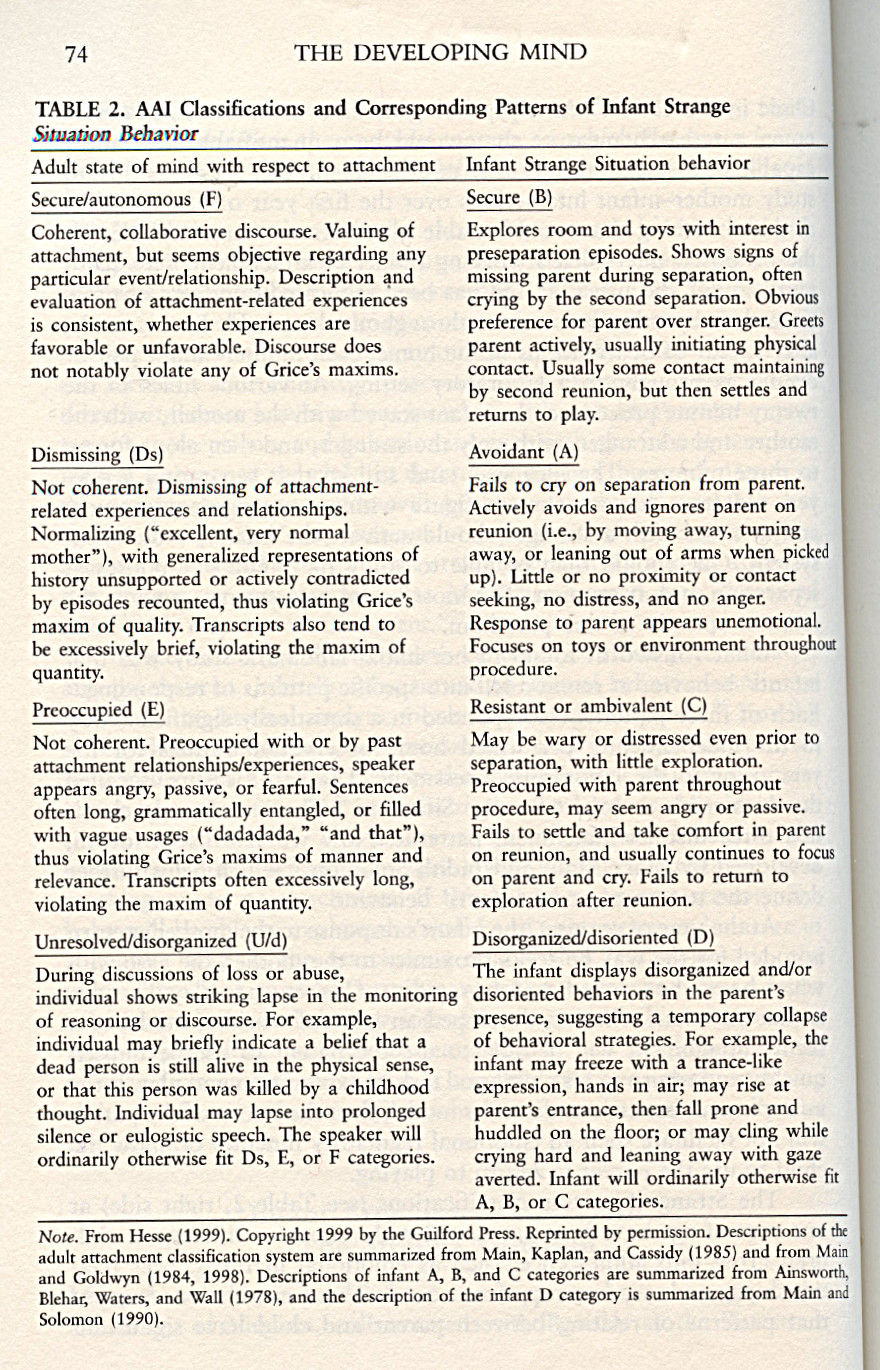
When attachment specialists write about attachment styles and patterns they divide their thinking in half.  Half talk about how attachment can be ‘measured’ for infants at about a year of age.  The other half talk about attachment styles and patterns in parents as they relate to their infants that created the attachment styles and patterns one can measure in the infants.

I have found no clear description about how the birth to age one experience an infant has with its earliest caregivers BUILDS its age-one attachment pattern that continues through to create the attachment patterns it has in adulthood.  The topic of attachment is chopped into pieces just like a tree needs to be if its pieces are going to fit into a stove.

Going back to the image I just presented of the woodpile as it might relate to the study of attachment.  To get the WHOLE picture we would have to include a lot more information.  Where did the seed come from that grew into the tree that eventually found itself in pieces heading into a wood stove or a fireplace?  What were all the steps that had to happen for the seed to find itself into the ground, for it to crack open into life, grow into a sapling, into a tree big enough to use for firewood?  What was the process that went on as someone found the tree, cut it down, hauled it home, chopped it up, and made a covered pile of firewood?

Where do we turn for the whole story about human attachment from conception to death?

++++

Dr. Daniel J. Siegel has written what is, I believe, the only book that approaches parenting from an attachment point of view:  Parenting From the Inside Out by Daniel Siegel and Mary Hartzell.  Please read this book for a fuller understanding of what I am going to write about today.

Today I scanned in 13 pages for your study taken from another of Siegel’s books, The Developing Mind: How Relationships and the Brain Interact to Shape Who We Are (The Guilford Press, 1999)) — available for purchase by clicking on the title link –

These pages can be seen at this link:

**Siegel – Attachment Measurement (kid and adult)

++++++++++++++

As critically important as this attachment information is, I still think it is dense, complicated, hard to read, hard to understand, and hard to relate to anyone’s ongoing experience of their life with others and with their own self.

Because these early attachment experiences actually build the foundation of the human social-emotional brain (and direct the development of the body), it is critical to understand that the attachment patterns that can be ‘measured’ at age one happened one tiny step after another from birth.  The same patterns that can be seen in a one year old continue to operate for a life time – because they built the body-brain-mind-self of the person from the start.

++++

All the specialized fields of research are themselves each like a single piece of firewood cut from a whole tree.  The fields of study examine and report on their little piece of the tree, but nobody seems willing or able to put the whole picture together and look at the whole.

Attachment, in my thinking is the whole tree from which all other aspects of being human connect to and originate from.  Every single other facet of study concerning ‘the human condition’ stems from this tree.

Nowhere along the line of a lifetime, from conception to death, can attachment be ‘simply’ considered to be like the pile of firewood under the tarp.  Human attachment is about the entire process of the journey of each of us – like the firewood — from seed to ashes.  And just as the entire journey of our proverbial tree was influenced by the conditions within its environment from start to finish, so too are we.

++++

In yesterday’s post I laid out which of all the horses related to the betterment of the human condition I would lay my money on.  Coming to understand the attachment continuum of our lifetime – what it is, how it operates, how it determines the manifestation of our genetic potential, how it directs the building of our body-brain-mind-self’s foundation, how it affects our relationship with our own self, with others of our species, and with the entire environment we live and die within – is, in my belief, the most important conscious learning we can ever pursue and accomplish.

Improving our ability to experience safe and secure attachment will improve the quality of our life.  Finding ways to overcome whatever our degrees of unsafe and insecure attachment will be the most effective tool we can have to improve our degree of well-being within our own self and within the world we live in.

Yet where in the fragmented, disjointed, cut-into-tiny-pieces world of academic information can we look for the attachment-related facts we need to improve our lives?

Sadly I would have to say – nowhere.

Siegel’s book on parenting (link above) is probably the most complete effort anyone has accomplished to help us understand how our adult attachment patterns affect us as parents.  His work cannot possibly be comprehensive in my thinking (give us a picture of the whole of the living tree) for several reasons.

First of all, as you will notice if you follow the link to the 13 scanned pages, the terms used to describe attachment patterns seen in infants does not match the terms used to describe attachment patterns in adults.  This fact has made it difficult for me to think about the life continuum of attachment.

Pneumonia is pneumonia, diarrhea is diarrhea, and cancer is cancer no matter what age is of the body that might be suffering from these conditions.  Attachment patterns ARE physiological patterns within the body-brain.  They are not imaginary events that can be arbitrarily called one thing for an infant and something else for an adult.

In addition, as you read the 13 scanned pages you will be learning about the two accepted measurement tools available to measure attachment accurately – one for infants at about a year of age and the other for adults.  Both of these measurement tools are designed for use in a professional research setting.  To my knowledge, no one has ever yet designed accurate assessment (rather than measurement) tools that can be used in public settings to either assess infant or adult attachment patterns.

++++

Most people can read the information about how attachment is measured in infants and think about what we know in our real life about infants and their caregivers.  We can imagine the clinical experience as it happens around us in our lives.  We can begin to use our common sense to make the connection between the information about early mother-infant brain building interactions that Schore describes and the year-old patterns of interactions an infant has with its mother as presented in these 13 scanned pages.

This still does not leave us with any clear idea about how we could translate the clinical measurement tool so anyone could assess infant attachment in the ‘real world’.

Nor does the presentation of information about adult attachment measurement presented in the 13 scanned pages give us any everyday working idea about how we could assess our own adult attachment patterns.  It does not present a means to assessing adult attachment ‘on the streets’ or ‘in the trenches’ so that ordinary people could better come to understand how attachment patterns are affecting all our relationships – everywhere – every day and every night of our lives.

We are left reading the 13 scanned pages and trying to imagine an ordinary context in the same way we might be able to imagine the whole story about how a seed was planted that eventually ended up in firewood pieces giving warmth within someone’s home.

++++++++++++++

This scanned table about adult attachment refers to something called Grice’s maxims.  Here is the clearest description of these maxims, which originated historically in Kant’s philosophy, that I can find:

Grice’s Conversational Maxims

Maxim of Quantity:

1. Make your contribution to the conversation as informative as necessary.
2. Do not make your contribution to the conversation more informative than necessary.
Maxim of Quality:

1. Do not say what you believe to be false.
2. Do not say that for which you lack adequate evidence.
Maxim of Relevance:

Be relevant (i.e., say things related to the current topic of the conversation).
Maxim of Manner:

1. Avoid obscurity of expression.
2. Avoid ambiguity.
3. Be brief (avoid unnecessary wordiness).
4. Be orderly.

These maxims are considered to be reflected within rational ‘cooperative discourse’, and have been incorporated into the rating structure of the Adult Attachment Interview (AAI) used clinically and in research to assess adult attachment.

The AAI is a research tool.  People who administer the interview and rate it must go through specialized training.  This tool’s usefulness even in research is complicated because there are many factors about it that cannot be easily controlled, such as how the environment where the interview is given influences responses, how the person of the interviewer interacts with the ‘subject’, how interviewer’s biases might influence ratings, etc.

If I go back to my wood pile analogy and change the ‘end result’ of a tree’s lifetime into a toothpick or a piece of toilet paper instead of a log of firewood, and then expect us to be able to exactly imagine the entire process accurately that the seed went through to get to its end, we have a more accurate picture of how hard it would be to connect the results of an Adult Attachment Interview back through all the experiences of a person’s life back to their beginnings.  That would be if we even believed that the results of an AAI accurately described an adult’s attachment pattern in the first place.

++++

In the end, the simplest description of what an adult’s insecure attachment pattern might look like ‘on the streets’ or ‘in the trenches’ has to do with having some ability to tell a coherent life story – or not.

If I look at the piece of toilet paper version of how an AAI result might look, I would consider the ‘lowest’ grade of adult attachment that is not even mentioned in the 13 scanned pages.  It is called the ‘Cannot Classify Category’ and looks something like what 1998 research article describes:

Discourse, memory, and the adult attachment interview: A note with emphasis on the emerging cannot classify category

This brief report focuses on the emergence of a new Adult Attachment Interview (AAI) category, Cannot Classify. The Adult Attachment Interview classification system is discussed with emphasis upon differences in AAI categories as they relate to strategies or lapses in strategy for the integration and focus of attention and memory. The Cannot Classify category is understood to differ from the other AAI categories in that it appears to represent a global breakdown in the organization and maintenance of a singular strategy for adhering to the discourse tasks of the AAI.”

++

strategies or lapses in strategy for the integration and focus of attention and memory

This is what the researchers are looking for when they try to pin down what varying styles of adult attachment patterns look like.  That doesn’t give the rest of us much to go by in terms of learning about our adult attachment patterns, does it?

The fascinating point is that right within the few words of that sentence lies the heart of our concerns – TRAUMA.  What happened, when it happened, how it happened, what strategies either did or did not exist to integrate the experience of trauma, how these trauma experiences influenced and were influenced by attention and memory processes are all connected to attachment patterns.

++++

Attachment patterns are patterns of dealing with trauma.  If trauma built the early brain in the first place, these patterns show up in infant insecure attachment patterns such as the 13 scanned pages describe.  If trauma built the early brain, the same trauma-formed patterns continue into adulthood and manifest themselves in the disruptions of conversation about one’s self in one’s life that the AAI is designed to define.

Because our concern is with ‘trauma dramas’ that repeat themselves throughout a person’s lifetime, it is essential that we recognize what we are looking FOR as we find it in what we are looking AT.  We are looking for early infant-caregiver traumatic interactions (or their absence in safe and secure attachment) that built social-emotional brain in the first place because that is where the seed of who we are as a body-brain-mind-self originated.  We can tell the trauma was there at the beginning and that it influenced all later development if an insecure attachment pattern exists – in infant-children and in adults.

++++

So, if I disappoint my readers my not being able to clearly describe what adult attachment IS, let alone how it operates, how we identify the patterns, or how we change them, I hope you will be patient.  I might as well take what I have on hand and go into my back yard thinking I can build myself a space shuttle that actually works.

Humans had the capacity to figure out how to fly to the moon long before we did so.  We have the capacity to find a way to clearly assess human attachment, but we haven’t done so yet.  Because most of what goes wrong in human lives can be traced to the quality of attachment that formed the brain foundation and lies at the root of all of our social interactions – including the one we have with our own self – I believe this field of study should become the single most important one we pursue.

I have faith in US.  WE can figure this out – if and when we want to.  After all, as members of a social species our attachment patterns determine WHO we are in the world because they determine HOW we are in the world.

+++++++++++++++++++++++++++++++++++++++++++++++++++++

+WHAT DO WE KNOW ABOUT TRAUMA?

+++++++++++++++++++++++++++

I would think that in their own way everyone in our great nation recognizes today as the 8th anniversary of one of the most terrible crisis that ever occurred within the boundaries of our country.  Our hearts continue to go out to all those who suffered terror and unimaginable trauma as a result of the destruction brought upon them by the acts of terrorists whose own agendas allowed them to kill and destroy wantonly.  At the same time we remember each person and their loved ones whose lives have been touched in the aftermath of war, destruction and bloodshed that has followed 9-11 and the World Trade Center attacks.

+++++++++++++++++++++++++++

The most devastating consequences of trauma to humans can never be measured in financial terms.  Neither do we yet know the true reality of the way humans respond to extraordinary traumatic stressors.  Continued research into the ongoing, intergenerational consequence of the Holocaust’s traumatic effects shows that trauma can be CLEARLY passed down to offspring.

Researchers will be working to uncover the long range consequences of trauma caused by 9-11 for a long time to come.  They know that babies of women pregnant during the 9-11 terrorist attacks have been found to be born with the ‘markers’ for Posttraumatic Stress Disorder (PTSD) as a result of their mother’s exposure to the attacks.

We are learning more and more both about how resilient humans are and about our fragility.  Every-day people do not usually pay attention to the results of millions and millions of dollars spent on research about the consequences of trauma to humans, and yet this research can inform our thinking in new and more enlightened ways.

The Atlanta study looked at genetic potential as it interacts with children’s responses to trauma.  It found, among other things, that a child’s safe and secure attachment to ANY adult in its life influences to the positive that child’s ability to overcome traumatic experiences.  In another corner of the world researchers have discovered the same thing.  Although exposed equally to unimaginable terrors and traumas, the children of South Africa end up with severe longterm traumatic responses while the children of Kenya do not.

The more damaged South African children live in a country long torn apart, in fact all but dismantled by generations of influences that have destroyed the secure social attachment fabric of their culture.  Kenya has not suffered this intergenerational destruction of its ongoing cultural strengths so that their children have the benefit – in spite of current terrible traumas and tragedies – of being ‘held’ within a culture that still has its social supports and secure attachment systems somewhat in place.

+++++++++++++++++++++++++++

We cannot realistically consider the long range consequences of traumatic experience without considering the attachment contexts that form and support (or don’t) the members of any human society.  These attachments begin before birth, as the responses of infants still very much physiologically attached to their mothers during 9-11 demonstrated.

Children are held and supported by the fabric of the attachment support net that their parents either do or do not have in their lives.  Without firmly safe and secure human attachments from the beginning of our lives, we are at astronomically increased risk of suffering long term devastation in our adult lives from any traumatic experience that we might later have.  It is time that all of us realize that attachment is the single most important aspect of our lives because we are a social species.

What this means to me is that all of us, including and perhaps most importantly any mental health expert that works with troubled people of all ages, must begin to include attachment disorder understanding, concepts and vocabulary into our cultural base of knowledge about what makes our lives ‘good’ and what makes them ‘bad’.  I doubt that more than a small handful of mental health experts EVER talk with their adult clients about insecure attachment disorders.

We reserve any discussion or awareness of secure and insecure attachment disorders ONLY as it might relate to ‘troubled’ children.  Where do we think child attachment disorders disappear to once someone magically crosses some invisible line into adulthood?  They go nowhere.  Our attachment orders or disorders are as much ingrained into us as any other physiological response system our brain, body, nervous and immune system has.

We HAVE to begin talking about our attachment system as it operates in our adulthood because it formed who we are and affects how we respond both to the good and to the bad in our lives – at all times!  Those who might be having the most difficult time recovering from the devastating trauma of 9-11 are no exception.  But has ANYONE ever talked to them about their attachment system?

I am willing to bet that any adult who was formed in an extremely malevolent childhood environment and who did not have the benefit of having a safe and secure adult attachment person in their childhood life, is among those who lack the necessary resiliency to recuperate fully from any traumas that they experience.  We are doing nobody any favors by ignoring the absolute, fundamental reality of how our secure or insecure attachment system governs our ability to cope with trauma.

I therefore encourage readers to spend some time investigating some of the information connected to the live-links provided in this post.  You might help yourself beyond belief, or be able to assist someone you know in their efforts to deal with any ongoing traumatic consequences in their lives – including their ability to parent effectively.

Trauma is not bliss, and neither is ignorance.  It is the response-ability of all of us to arm ourselves with any and all information that can help us understand what we can better do to improve secure attachments in the world – no matter who we are, what age we are, or what we have experienced.

Thank you for reading this post.  Comments are welcome and appreciated.

+ATTACHMENT: SMART AND STUPID RESEARCH

+++++++++++++++++++++++++++

+DON’T MISS THESE 3 COMPLETED PAGES

These three pages are now complete:

*COLLINS ON RESPONDING TO NEED – Part Five

*COLLINS ON RESPONDING TO NEED – Part Six

**Attachment Styles and Caregiving from Collins Article

+Links to new pages on attachment patterns

The only way not to have an operating attachment system is to be dead.  Our attachment system is supposed to be able to be deactivated appropriately so that our other systems of exploration and caregiving can be activated in their own turn.  When we have an insecure attachment rather than secure attachment system, this ‘shut off’ ability may be lost to us.  As a result, all of our behavioral systems are negatively affected.

Our attachment patterns are formed into our brains during our experiences with our mother and other important early care givers mostly before we are a year old.  They operate behind the scenes of our life much as a computer’s operating system is hidden from our view.

Whether we look at an infant’s developing attachment system, or look at an adult attachment system as it operates in romantic and other relationships including parenthood, the more we understand these systems the more conscious power we can have over our own lives.

*COLLINS ON RESPONDING TO NEED – Part One

**Attachment Styles from Collin’s Article

*COLLINS ON RESPONDING TO NEED – Part Two

*COLLINS ON RESPONDING TO NEED – Part Three

*COLLINS ON RESPONDING TO NEED – Part Four

*COLLINS ON RESPONDING TO NEED – Part Five

*COLLINS ON RESPONDING TO NEED – Part Six

**Attachment Styles and Caregiving from Collins Article

+LINK to *THE DANGERS OF MEMORY RETRIEVAL

The following link will take you to the page I wrote today about my experiences related to re-membering traumas within my own life:

*THE DANGERS OF MEMORY RETRIEVAL