
+A CRITICAL FACT I JUST LEARNED ABOUT MY ABUSIVE BORDERLINE MOTHER

++++++++++++++++++++++++

Never did I know about my psychotically abusive Borderline mother what I learned today.  My mother could do what she did to me because she lacked the normal human capacity to experience authentic embarrassment.

Evidently my own forensic autobiographical writing had to wait for very specific research to be done that could give me what I need to complete my journey.  And, yes, I am finding extremely important —  and surprising — clues in the book I mentioned in yesterday’s post, Born to Be Good: The Science of a Meaningful Life (2009) by Dr. Dacher Keltner.

++++

Keltner has carved himself a memorable niche in research on human emotion with his landmark discovery of the 2 to 3 second biologically hard wired human emotional display of embarrassment.  I had to read to page 74 of his book before I came to his description of what embarrassment is all about.

What Keltner has found in his continued study of this biological display of human emotion is directly connected to how my mother could treat me the way that she did from birth until I left home at 18.  Something was wrong with how the orbitofrontal region of her brain formed and operated.  My mother could not feel appropriate embarrassment, and did not have an appropriate social conscience.

++++

In the first pages of his book Keltner describes the history of the study of emotion from Charles Darwin forward.  He explains how researchers meticulously and accurately created a map of how all the muscles of the human face move and interact to express emotion.  Some of the combinations can be faked.  The most important expressions of prosocial human emotions, including embarrassment, cannot.  (Exceptions can occur with gifted actors.)

I am going to present to you here today excerpts from Keltner’s writing on embarrassment because I believe his thoughts are of central importance to those of us who suffered from severe infant-child abuse.  At the same time that I see how his work applies to my mother, I can also see how they apply to me.

Embarrassment takes place in the orbitofrontal cortex that has not matured enough before the age of 18 months to allow a human to experience it.  When I think about my mother and myself, I consider that the earliest forming right, limbic, emotional brain, built from birth to age one (at which point an infant CAN experience shame), I understand that when early caregiver interactions did not form this emotional brain foundation well, the future development of the orbitofrontal cortex will also be changed.

Unlike subjects in research studies who have damage done to JUST the orbitofrontal cortex region of their brain, severe infant-child abuse survivors are likely to have an entire combination of a series of ‘cascading’ brain changes that began at birth (or before).

Keltner is not talking about how infant-child abuse affects the developing foundation of the early brain.  Yet the more I read what he says about embarrassment the more I realized that he is talking about something that went fundamentally wrong with my mother.  He is also talking about something that went fundamentally wrong with me because my mother’s abuse of me formed my brain, though fortunately I did not end up with the exact same problems that she had.

For those of you who suffered from severe infant-child abuse, keep your abuser in mind as you consider the excerpts from Keltner’s book I present here below (I encourage you to read his book for the fuller, important context for all that follows).

++++++++++++++++++++++++

“What does embarrassment have to do with incivility, remoteness, and murder?  I trained my eye in the frame-by-frame view of human social life….  I slowed down the blur of two-second snippets of embarrassment and studied its fleeting elements – gaze shifts, head movements down, coy, compressed smiles, neck exposures, and glancing touches of the face.  At the time I began my research, the display of embarrassment was thought to be a sign of confusion and thwarted intention.  My research told a different story, about how these elements of embarrassment are the visible signals of an evolved force that brings people together during conflict and after breeches of the social contract, when relations are adrift, and aggressive inclinations perilously on the rise.  This subtle display is a sign of our respect for others, our appreciation of their view of things, and our commitment to the moral and social order.  I found that facial displays of embarrassment are evolved signals whose rudiments are observed in other species, and that the study of this seemingly inconsequential emotion offers a porthole onto the ethical brain….”  (page 76)

++++

I did not understand when I first read these words the full implications of what Keltner was saying.  Looking back on them now I can see here a description of what was so wrong with my mother.  My bet is if you read the second half of this paragraph again you will clearly see your abuser.  My mother had no “evolved force that brings people together during conflict and after breeches of the social contract.”  She had no ability to perceive when relations were adrift and “and aggressive inclinations [were] perilously on the rise.”  She certainly did not seem to have the ability to care that she continually and perpetually caused them.

She had no “respect for others” and had no “appreciation of their view of things.”  And she sure didn’t have any “commitment to the moral and social order.”  She lacked “this subtle display” of embarrassment, which was both the cause of her problems and a sign of their existence.  Something was terribly wrong with my mother’s “ethical brain.”

In my situation, it would be the study of the LACK “of this seemingly inconsequential emotion” in my mother that can show me “a porthole onto the ethical brain” whose development can go so terribly, terribly wrong through harmful and insufficient early brain-forming caregiver experiences.

++++

Keltner was doing research on the magnitude of subject’s 250-millisecond (a quarter of a second) startle response when he made his amazing discovery of the patterned embarrassment response.  He found something that no other researcher had ever paid attention to before and had completely ignored.

People who participated in his research were left alone to relax in an observation room.  Their startle response to an unanticipated loud “BAM!” was filmed.  Keltner describes what he found as he later examined the films frame-by-frame.

“And then I noticed something unexpected.  In the first frame after the startle response, people look purified, cleansed, as if their body and mind had been shut down for a second and then turned on – the orienting function of the startle.  And then in the next frame their gaze shifted to the side.  A knowing, abashed look washed over their faces.  People looked as if they had been goosed, or whispered to of something lewd.  And then a flicker of a nonverbal display that Darwin had actually missed.  Participants averted their gaze downwards, they turned their head and body away, they showed an awkward, self-conscious smile.  Some blushed.  Some touched their cheeks or noses with a finger or two.”  (page 80)

He was able to accurately show that young children under the age of 18 months did not show the embarrassment response.  Keltner then went on to devise experiments that were increasingly designed to embarrass people in settings where their facial reactions could be specifically filmed.  Subjects went through a regiment of having to make a specific (and difficult to accomplish) ‘weird’ face that had to be held for 10 long seconds.  At the end of this time, subjects were filmed in their ensuing embarrassment response.  Keltner then charted his frame-by-frame filmed observations in 20-millisecond (rate of 50 per second) segments that allowed him to map the patterns of the embarrassment response.

Keltner states:

“What I charted in the elements of the embarrassment display was a fleeting but highly coordinated two- to three-second signal.  First the participant’s eyes shot down within .75 seconds after finishing the pose of the awkward face.  Then the individual turned his head to the side, typically leftward, and down with the next .5 seconds, exposing the neck.  Contained within this head motion down and to the left was a smile, which typically lasted about two seconds.  At the onset and offset of this smile, like bookends, were other facial actions in the mouth, smile controls:  lip sucks, lip presses, lip puckers.  And while the person’s head was down and to the left a few curious actions:  the person looked up two to three times with furtive glances, and the person often touched his or her face.  This three-second snippet of behavior was not some bedlam of confused actions; it had the timing, patterning, and contour of an evolved signal, coordinated, brief, and smooth in its onset and offset.”  (pages 83-84)

+++++++++++++++++++++++++++++

I want to mention here a profound connection between the findings of research on human emotion and the permanent, long-term consequences of severe early relational infant-child deprivation and trauma.  As you can see by Keltner’s research, this entire embarrassment display happens very fast.  From start to finish it takes two to three seconds.

Researchers have to use sophisticated photographic techniques in order to break this display down into its visual components.  The human emotional-social brain has built into it the capacity to send, receive, respond and act according to these nonverbal signals of communication.  Or it is SUPPOSED to.  If early deprivation and trauma interrupts the optimal formation of the brain circuitry and regions that accomplish these amazing feats of communication, all hell can literally break lose.

Most severe early abuse survivors, my mother and me included, did not have what we needed during our early brain developmental critical windows of growth so that these patterns of signaling could happen ‘normally’.  While my mother’s brain development and operation went off into a different direction than mine did, I still suffer very disturbing consequences from her abusive treatment of me from birth.

Here is a connection to aspects of the social difficulties autistic spectrum people face with their different emotional-social brain.  We do not and cannot ‘run the race’ of ‘normal’ human nonverbal communication equally with those whose early brains formed in the usual fashion.  While we CAN hopefully train ourselves to recognize what we are lacking so that we can compensate somewhat, we will always be at an emotional-social disadvantage in emotional-social interactions.  We do not read these cues or respond to them ‘normally’.

While Keltner does not address this fact, what he says about emotional display-cue expressions applies to what severe early abuse survivors need to consciously learn.  Keltner says about his work with embarrassment observation:

“…with careful frame-by-frame analysis a different picture emerged, and one in line with Darwin-inspired analysis of emotional displays as involuntary, truthful signs of our commitments to particular courses of actions.  Our facial expression of anger, for example, signals to others likely aggressive actions, and prompts actions in others that prevent costly aggressive encounters.  Within this school of thought, emotional displays are highly coordinated, stereotyped patterns of behavior, honed by thousands of generations of evolution and the beneficial effects displays have on social interactions.  Evolved displays unfold briefly, typically between two and three seconds.  The brevity of emotional displays is, in part, due to limits on the time that certain facial muscles can fire.  Emotional displays are brief, as well, because of the pressing needs facial expressions are attuned to – the approaching predator, the child catapulting toward danger, the flickering signs of interest shown by a potential mate amid many suitors.”  (pages 82-83)

Those of us who did not get to develop optimal early-forming (through interactions with our mothering caregiver) emotional-social brains will always be at a disadvantage in regard to the normal signaling Keltner is describing.  They WORK for humans because they are not voluntary.  They are automatic, very fast, authentic and cannot be mimicked.  They work because they are honest and truthful expressions of our intent to take action – one way or the other.  They are evolutionarily designed patterns of instantaneous communication that make twittering look like something out of the stone age.

My mother’s violence and abuse of me from birth stole these abilities from me, just as someone stole them from her.  This is NOT a minor or insignificant loss!

++++++++++++++

Keltner continues:

“When I reviewed forty studies of appeasement and reconciliation processes across species, from blue-footed boobies to 4,500-pound elephant seals, the evolutionary origins of embarrassment became apparent:  It is a display that reconciles, that brings people together in contexts of distance and likely aggression.”  (page 86)

Keltner breaks down the individual segments of the embarrassment display according to what the behaviors are signaling:

“Gaze aversion is a cut-off behavior.  Extended eye contact signals continue what you’re doing; gaze aversion acts like a red light, terminating what has been happening.  Our embarrassed participants, by quickly averting their gaze, were exiting the previous situation.  They were signaling an end to the situation for obvious reasons:  embarrassment follows actions…that sully our reputations and jeopardize our social standing.

“What about those head turns and head movements down?  Various species, including pits, rabbits, pigeons, doves, Japanese quail, loons, and salamanders, resort to head movements down, head turns, head bobs, and constricted posture to appease.  These actions shrink the size of the organism, and expose areas of vulnerability (the neck and jugular vein, in the case of human embarrassment).  These actions signal weakness….  At the heart of the embarrassment display, as in other species’ appeasement behaviors, is weakness, humility and modesty.

“The embarrassed smile has a simple story with a subtle twist.  The smile originates in the fear grimace of bared-teeth grin of nonhuman primates….the embarrassed smile is more than just a smile; it has accompanying muscle actions in the mouth that alter the appearance of the smile.  The most frequent one is the lip press, a sign of inhibition….  Just as common are lip puckers, a faint kiss gracing the embarrassed smile as it unfolds during its two- to three-second attempt to make peace….

“The face touch may be the most mysterious element of embarrassment.  Several primates cover their faces when appeasing.  Even the rabbit rubs its nose with its paws when appeasing.  Face touching in humans has many functions….  Certain face touches seem to act like the curtains on a stage, closing up one act of the social drama and ushering in the next.  A psychoanalyst has even argued that we face-touch to remind ourselves that we exist, in the midst of social exchanges where our sense of self feels to be drifting away….

“In turning to other species’ appeasement displays, the social forces that have shaped this display during the tens of millions of years of primate evolution were there to see.  This simple display brought together signals of inhibition, weakness, modesty, sexual allure, and defense all woven together in a two- or three-second display.  The mission of the display is to make peace, to prevent conflict and costly aggression, and to bring people closer together, to reestablish cooperative bonds.  We may feel alienated, flawed, alone, and exposed when embarrassed, but our experience and display of this complex emotion is a wellspring of forgiveness and reconciliation.  The complement would also prove to be true.  The absence of embarrassment is a sign of abandoning the social contract.”  (pages 86-88)

+++++++++++++++++++++

Now, HERE I begin to see the direct connection between Keltner’s work and my mother:  “The absence of embarrassment is a sign of abandoning the social contract.”  Someone ignored and abandoned any appropriate ‘social contract’ in the early treatment of my mother.  The ‘social contract’ was formed into my mother’s early brain in some strange and distorted manner that did not include what she needed to mother her own children – or even to allow her to interact appropriately with any other human in her lifetime.

Most fortunately, even though my brain formed differently from normal, I CAN feel embarrassment.  I do have a ‘social contract’.  My ability to experience how it operates is not ‘normal’, but I do have one.  My mother had one, too, in some ways – but when it came to her repeated explosions of violence and her chronic malicious intent toward me, she had none.  There was nothing prosocial about her relationship with me.

Infant-child abuse happens outside of “the social contract.”

++++

Keltner’s next description of his continued research brought my mother’s condition into even more clear focus.  He introduced a test, “designed to produce some failure in all children,” to groups of well-adjusted boys and compared their responses to groups of boys known to be prone to violence.  He states about his findings:

“I chose to study the other end of the continuum – people prone to violence.  My thesis was simple:  To the extent that embarrassment displays reflect respect for others and a commitment to the moral order, the relative absence of embarrassment should be accompanied by the tendency to act in antisocial ways, the most extreme being violence…..  Consistent with my moral commitment hypothesis, the well-adjusted boys showed the most embarrassment, and in fact this was their dominant response to the test.  They in effect were displaying concern over their performance, and perhaps a deeper respect for the institution of education.  The externalizing [violent, acting out] boys, in contrast, showed little or no embarrassment.  Instead, these boys erupted with occasional facial displays of anger (one boy gave the finger to the camera when the experimenter momentarily had to leave the testing room).  The fleeting, subtle embarrassment display is a strong index of our commitment to the social-moral order and the greater good.

“Neuroscientist James Blair has followed up on this work on embarrassment and violence by studying “acquired sociopathy,” that is, antisocial tendencies brought on by brain trauma….”  (pages 89-90)

++++

That is exactly what early relational deprivation and trauma does to an infant-child’s growing brain.  If ‘brings on’ changes in the developing emotional-social brain that end up creating very similar patterns – like in my mother – that is demonstrated in this “acquired sociopathy” research.  (Keltner describes some of this research in his writing here).

This research shows that damage to the orbitofrontal cortex brain region can lead to complete incompetence in experiencing embarrassment or in attributing the experience to others.  These people also show great difficulty in identifying anger and disgust expressions, “the kinds of expressions that often signal disapproval and trigger our embarrassment.”  Keltner observes about the findings related to deficits of orbitofrontal cortex damage that these people “are not wired to respond to the judgments of others.”  (page 91)

OK, Mommy – gotcha!  “Not wired to respond to the judgments of others.”  I can see in the hundreds of my mother’s letters that I have transcribed that my mother DID certainly respond by judging others herself, which certainly brutally and fundamentally included her judgment of me (which always triggered rage-attack)!!  But she seemed to be strangely and distortedly immune to others’ judgments of her.  As I can see in her letters, if she ever detected what she perceived as a judgment against her, she reacted with rage-attack.  Something was wrong with my mother’s orbitofrontal cortex.  (See search results for Borderline and orbitofrontal cortex HERE – lots to read)

Keltner’s descriptions of people who have suffered damage to the orbitofrontal cortex region of their brain from falls, blows, etc. can be summarized in this assessment of such a man:

“This damage had left J.S.’s reasoning processes intact, but it had short-circuited his capacity for embarrassment.  In actuality, he had lost something much larger:  his ability to appease, reconcile, forgive, and participate in the social-moral-order.”  (pages 91-91)

I would also make a note here that when brain developmental changes happen through the consequences of deprivation, trauma and child abuse, not even the “reasoning processes” develop normally, either.  When someone ends up like my mother did, MANY changes have happened in the developing early brain.  But this clear-cut link between my mother’s inabilities and Keltner’s research are irrefutable.

Keltner continues with this chilling observation about the findings from research on survivors of orbitofrontal cortex damage.  My mother eerily fit the profile these findings present:

“They have lost the ability to appease, to reconcile, and signal their concern for others…..  in judging the emotions of others, our orbitofrontal patients were inept at identifying embarrassment from photos, although they were quite skilled at judging other facial expressions, for example those of happiness, amusement, or surprise.  They resembled psychopaths, who prove to be unresponsive to the signs of suffering in others.

“Embarrassment warns us of immoral acts and prevents us from mistakes that unsettle social harmony.  It signals our sense of wrong-doing and our respect for the judgments of others.  It provokes ordinary acts of forgiveness and reconciliation, without which it would be a dog-eat-dog world.  Orbitofrontal patients, fully capable in the realm of reason, have lost this art of embarrassment.  They have lost the subtle ethic of modesty.”  (pages 93-94)

[my note:  again, not my mother’s brain did not develop normal reasoning abilities, either – See:  child abuse, brain development, reasoning ]

++++

Keltner completes his chapter on embarrassment by saying:

“Embarrassment is like an ocean wave:  It throws you and those near you into the earth, but you come up embracing and laughing.

The simple elements of the embarrassment display I have documented and traced back to other species’ appeasement and reconciliation processes – the gaze aversion, head movements down, awkward smiles, and face touches – are a language of cooperation; they are the unspoken ethic of modesty.  With these fleeting displays of deference, we preempt conflicts.  We navigate conflict-laden situations (watch how regularly people display embarrassment when in close physical spaces, when negotiating the turn-taking of everyday conversations, or when sharing good).  We express gratitude and appreciation.  We quickly extricate embarrassed souls from their momentary predicaments with deflections of attention or face-saving parodies of the mishap.

“Embarrassment is the foundation of an ethic of modesty….”  (page 95)

+++++++++++++++++++++++++++++

Keltner is not talking about Victorian displays of prudish concerns.  My Boston-raised mother was an expert at these.  He is talking about ancient and authentic, automatic and essential patterns of negotiating ourselves as members of a socially-bonded species.  My mother could mimic ‘voluntary’ displays that parodied embarrassment, but she lacked the authentic, supposed-to-be hard wired neurological ability to respond normally regarding embarrassment.

It intrigues me that nowhere in Keltner’s writing have I seen the world ‘conscience’ appear.  He is not describing some philosophical, abstract process.  He is talking about a body-based, evolutionarily programmed, physiological response that my mother seemed to be entirely missing.

Keltner included small pictures in his text of a carved face of the Buddha, a picture of Gandhi and one of the Dalai Lama (page 90) that clearly show the embarrassment-spectrum facial expressions that I find so beautiful to look at.  Now that I have found this new information that lets me think about my abusive mother in a new way, I can realize that I NEVER saw my mother’s face take on any semblance of the expression of authentic, genuine embarrassment.  My mother was tragically missing this key component to being human.  She could never make this statement that Keltner describes:

“….the elements of the embarrassment are fleeting statements the individual makes about his or her respect for the judgment of others.  Embarrassment reveals how much the individual cares about the rules that bind us to one another.  Gaze aversion, head turns to the side and down, the coy smile, and the occasional face touch are perhaps the most potent nonverbal clues we have to an individual’s commitment to the moral order.  These nonverbal cues, in the words of sociologist Erving Goffman, are “acts of devotion…in which an actor celebrates and confirms his relation to a recipient.””  (page 89)

Keltner concludes that embarrassment offers transformation through reconciliation and forgiveness.  “It is in these in-the-moment acts of deference that we honor others, and in so doing, become strong.  It is often when tender and weak that we are alive….” and most closely connected to the fullest experience of living a meaningful life.

++++

Did something change inside of my mother when she was little that disallowed her from ever being able to tolerate the feeling of weakness — and thus vulnerability — that Keltner is describing?

++++++++++++++++++++++++++++++++
+ATTACHMENT – HOW WE ARE WHO WE ARE

++++

Trying to understand the research and literature on secure and insecure attachment patterns seems to me to be a bit like this image:

Picture a cold winter day.  Someone comes out of their house, shuffles through the snow to a wood pile, brushes a pile of snow off of a corner of the tarp that covers it, pulls the cover back and begins to pile stove size logs into their arm.  They pull the tarp back over the pile, return to their house, and go through the process of adding the wood into a fire.  All is well, warmth is achieved, and life goes on.

When attachment specialists write about attachment styles and patterns they divide their thinking in half.  Half talk about how attachment can be ‘measured’ for infants at about a year of age.  The other half talk about attachment styles and patterns in parents as they relate to their infants that created the attachment styles and patterns one can measure in the infants.

I have found no clear description about how the birth to age one experience an infant has with its earliest caregivers BUILDS its age-one attachment pattern that continues through to create the attachment patterns it has in adulthood.  The topic of attachment is chopped into pieces just like a tree needs to be if its pieces are going to fit into a stove.

Going back to the image I just presented of the woodpile as it might relate to the study of attachment.  To get the WHOLE picture we would have to include a lot more information.  Where did the seed come from that grew into the tree that eventually found itself in pieces heading into a wood stove or a fireplace?  What were all the steps that had to happen for the seed to find itself into the ground, for it to crack open into life, grow into a sapling, into a tree big enough to use for firewood?  What was the process that went on as someone found the tree, cut it down, hauled it home, chopped it up, and made a covered pile of firewood?

Where do we turn for the whole story about human attachment from conception to death?

++++

Dr. Daniel J. Siegel has written what is, I believe, the only book that approaches parenting from an attachment point of view:  Parenting From the Inside Out by Daniel Siegel and Mary Hartzell.  Please read this book for a fuller understanding of what I am going to write about today.

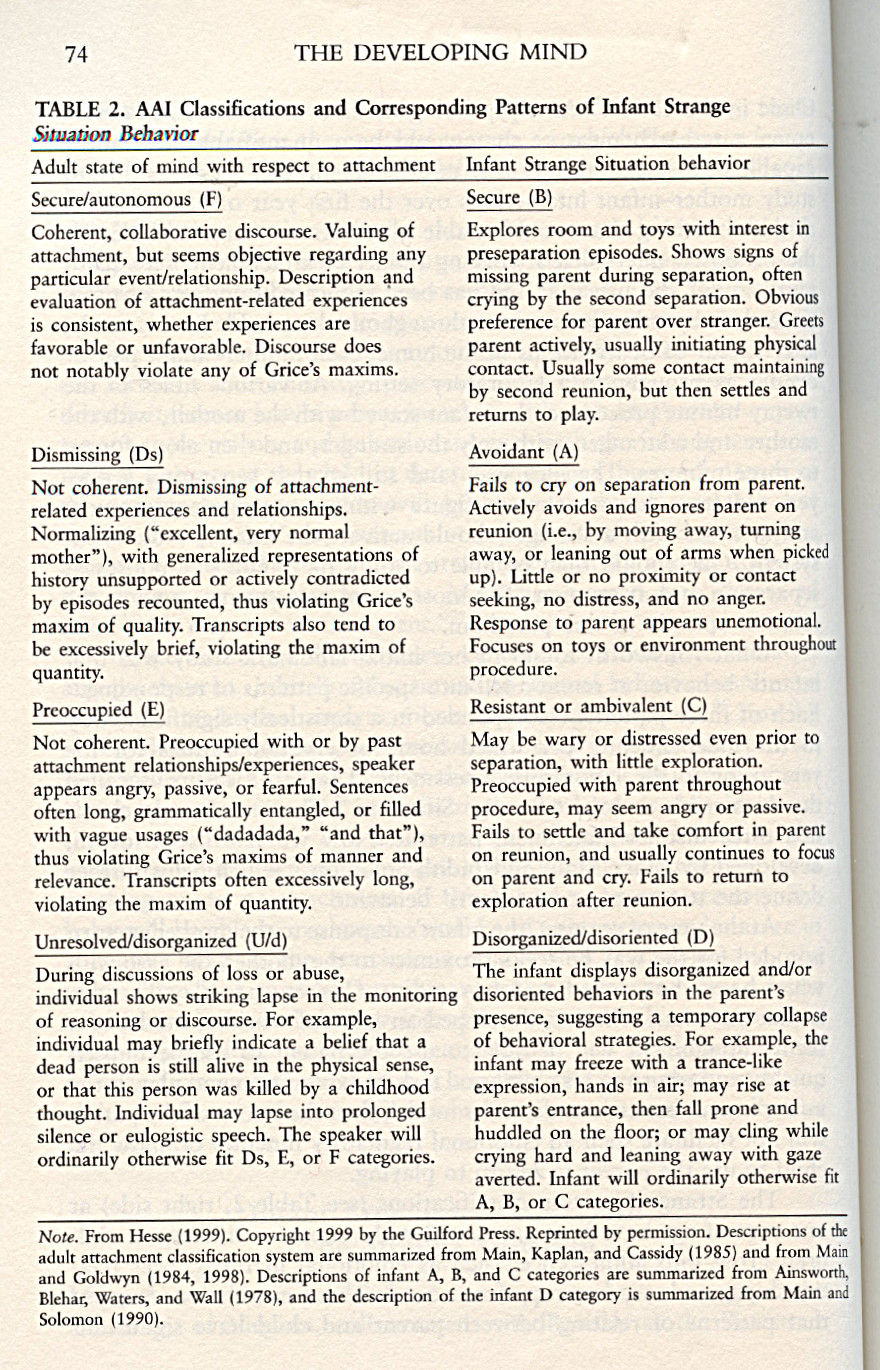
Today I scanned in 13 pages for your study taken from another of Siegel’s books, The Developing Mind: How Relationships and the Brain Interact to Shape Who We Are (The Guilford Press, 1999)) — available for purchase by clicking on the title link –

These pages can be seen at this link:

**Siegel – Attachment Measurement (kid and adult)

++++++++++++++

As critically important as this attachment information is, I still think it is dense, complicated, hard to read, hard to understand, and hard to relate to anyone’s ongoing experience of their life with others and with their own self.

Because these early attachment experiences actually build the foundation of the human social-emotional brain (and direct the development of the body), it is critical to understand that the attachment patterns that can be ‘measured’ at age one happened one tiny step after another from birth.  The same patterns that can be seen in a one year old continue to operate for a life time – because they built the body-brain-mind-self of the person from the start.

++++

All the specialized fields of research are themselves each like a single piece of firewood cut from a whole tree.  The fields of study examine and report on their little piece of the tree, but nobody seems willing or able to put the whole picture together and look at the whole.

Attachment, in my thinking is the whole tree from which all other aspects of being human connect to and originate from.  Every single other facet of study concerning ‘the human condition’ stems from this tree.

Nowhere along the line of a lifetime, from conception to death, can attachment be ‘simply’ considered to be like the pile of firewood under the tarp.  Human attachment is about the entire process of the journey of each of us – like the firewood — from seed to ashes.  And just as the entire journey of our proverbial tree was influenced by the conditions within its environment from start to finish, so too are we.

++++

In yesterday’s post I laid out which of all the horses related to the betterment of the human condition I would lay my money on.  Coming to understand the attachment continuum of our lifetime – what it is, how it operates, how it determines the manifestation of our genetic potential, how it directs the building of our body-brain-mind-self’s foundation, how it affects our relationship with our own self, with others of our species, and with the entire environment we live and die within – is, in my belief, the most important conscious learning we can ever pursue and accomplish.

Improving our ability to experience safe and secure attachment will improve the quality of our life.  Finding ways to overcome whatever our degrees of unsafe and insecure attachment will be the most effective tool we can have to improve our degree of well-being within our own self and within the world we live in.

Yet where in the fragmented, disjointed, cut-into-tiny-pieces world of academic information can we look for the attachment-related facts we need to improve our lives?

Sadly I would have to say – nowhere.

Siegel’s book on parenting (link above) is probably the most complete effort anyone has accomplished to help us understand how our adult attachment patterns affect us as parents.  His work cannot possibly be comprehensive in my thinking (give us a picture of the whole of the living tree) for several reasons.

First of all, as you will notice if you follow the link to the 13 scanned pages, the terms used to describe attachment patterns seen in infants does not match the terms used to describe attachment patterns in adults.  This fact has made it difficult for me to think about the life continuum of attachment.

Pneumonia is pneumonia, diarrhea is diarrhea, and cancer is cancer no matter what age is of the body that might be suffering from these conditions.  Attachment patterns ARE physiological patterns within the body-brain.  They are not imaginary events that can be arbitrarily called one thing for an infant and something else for an adult.

In addition, as you read the 13 scanned pages you will be learning about the two accepted measurement tools available to measure attachment accurately – one for infants at about a year of age and the other for adults.  Both of these measurement tools are designed for use in a professional research setting.  To my knowledge, no one has ever yet designed accurate assessment (rather than measurement) tools that can be used in public settings to either assess infant or adult attachment patterns.

++++

Most people can read the information about how attachment is measured in infants and think about what we know in our real life about infants and their caregivers.  We can imagine the clinical experience as it happens around us in our lives.  We can begin to use our common sense to make the connection between the information about early mother-infant brain building interactions that Schore describes and the year-old patterns of interactions an infant has with its mother as presented in these 13 scanned pages.

This still does not leave us with any clear idea about how we could translate the clinical measurement tool so anyone could assess infant attachment in the ‘real world’.

Nor does the presentation of information about adult attachment measurement presented in the 13 scanned pages give us any everyday working idea about how we could assess our own adult attachment patterns.  It does not present a means to assessing adult attachment ‘on the streets’ or ‘in the trenches’ so that ordinary people could better come to understand how attachment patterns are affecting all our relationships – everywhere – every day and every night of our lives.

We are left reading the 13 scanned pages and trying to imagine an ordinary context in the same way we might be able to imagine the whole story about how a seed was planted that eventually ended up in firewood pieces giving warmth within someone’s home.

++++++++++++++

This scanned table about adult attachment refers to something called Grice’s maxims.  Here is the clearest description of these maxims, which originated historically in Kant’s philosophy, that I can find:

Grice’s Conversational Maxims

Maxim of Quantity:

1. Make your contribution to the conversation as informative as necessary.
2. Do not make your contribution to the conversation more informative than necessary.
Maxim of Quality:

1. Do not say what you believe to be false.
2. Do not say that for which you lack adequate evidence.
Maxim of Relevance:

Be relevant (i.e., say things related to the current topic of the conversation).
Maxim of Manner:

1. Avoid obscurity of expression.
2. Avoid ambiguity.
3. Be brief (avoid unnecessary wordiness).
4. Be orderly.

These maxims are considered to be reflected within rational ‘cooperative discourse’, and have been incorporated into the rating structure of the Adult Attachment Interview (AAI) used clinically and in research to assess adult attachment.

The AAI is a research tool.  People who administer the interview and rate it must go through specialized training.  This tool’s usefulness even in research is complicated because there are many factors about it that cannot be easily controlled, such as how the environment where the interview is given influences responses, how the person of the interviewer interacts with the ‘subject’, how interviewer’s biases might influence ratings, etc.

If I go back to my wood pile analogy and change the ‘end result’ of a tree’s lifetime into a toothpick or a piece of toilet paper instead of a log of firewood, and then expect us to be able to exactly imagine the entire process accurately that the seed went through to get to its end, we have a more accurate picture of how hard it would be to connect the results of an Adult Attachment Interview back through all the experiences of a person’s life back to their beginnings.  That would be if we even believed that the results of an AAI accurately described an adult’s attachment pattern in the first place.

++++

In the end, the simplest description of what an adult’s insecure attachment pattern might look like ‘on the streets’ or ‘in the trenches’ has to do with having some ability to tell a coherent life story – or not.

If I look at the piece of toilet paper version of how an AAI result might look, I would consider the ‘lowest’ grade of adult attachment that is not even mentioned in the 13 scanned pages.  It is called the ‘Cannot Classify Category’ and looks something like what 1998 research article describes:

Discourse, memory, and the adult attachment interview: A note with emphasis on the emerging cannot classify category

This brief report focuses on the emergence of a new Adult Attachment Interview (AAI) category, Cannot Classify. The Adult Attachment Interview classification system is discussed with emphasis upon differences in AAI categories as they relate to strategies or lapses in strategy for the integration and focus of attention and memory. The Cannot Classify category is understood to differ from the other AAI categories in that it appears to represent a global breakdown in the organization and maintenance of a singular strategy for adhering to the discourse tasks of the AAI.”

++

strategies or lapses in strategy for the integration and focus of attention and memory

This is what the researchers are looking for when they try to pin down what varying styles of adult attachment patterns look like.  That doesn’t give the rest of us much to go by in terms of learning about our adult attachment patterns, does it?

The fascinating point is that right within the few words of that sentence lies the heart of our concerns – TRAUMA.  What happened, when it happened, how it happened, what strategies either did or did not exist to integrate the experience of trauma, how these trauma experiences influenced and were influenced by attention and memory processes are all connected to attachment patterns.

++++

Attachment patterns are patterns of dealing with trauma.  If trauma built the early brain in the first place, these patterns show up in infant insecure attachment patterns such as the 13 scanned pages describe.  If trauma built the early brain, the same trauma-formed patterns continue into adulthood and manifest themselves in the disruptions of conversation about one’s self in one’s life that the AAI is designed to define.

Because our concern is with ‘trauma dramas’ that repeat themselves throughout a person’s lifetime, it is essential that we recognize what we are looking FOR as we find it in what we are looking AT.  We are looking for early infant-caregiver traumatic interactions (or their absence in safe and secure attachment) that built social-emotional brain in the first place because that is where the seed of who we are as a body-brain-mind-self originated.  We can tell the trauma was there at the beginning and that it influenced all later development if an insecure attachment pattern exists – in infant-children and in adults.

++++

So, if I disappoint my readers my not being able to clearly describe what adult attachment IS, let alone how it operates, how we identify the patterns, or how we change them, I hope you will be patient.  I might as well take what I have on hand and go into my back yard thinking I can build myself a space shuttle that actually works.

Humans had the capacity to figure out how to fly to the moon long before we did so.  We have the capacity to find a way to clearly assess human attachment, but we haven’t done so yet.  Because most of what goes wrong in human lives can be traced to the quality of attachment that formed the brain foundation and lies at the root of all of our social interactions – including the one we have with our own self – I believe this field of study should become the single most important one we pursue.

I have faith in US.  WE can figure this out – if and when we want to.  After all, as members of a social species our attachment patterns determine WHO we are in the world because they determine HOW we are in the world.

+++++++++++++++++++++++++++++++++++++++++++++++++++++

+WHAT DO WE KNOW ABOUT TRAUMA?

+++++++++++++++++++++++++++

I would think that in their own way everyone in our great nation recognizes today as the 8th anniversary of one of the most terrible crisis that ever occurred within the boundaries of our country.  Our hearts continue to go out to all those who suffered terror and unimaginable trauma as a result of the destruction brought upon them by the acts of terrorists whose own agendas allowed them to kill and destroy wantonly.  At the same time we remember each person and their loved ones whose lives have been touched in the aftermath of war, destruction and bloodshed that has followed 9-11 and the World Trade Center attacks.

+++++++++++++++++++++++++++

The most devastating consequences of trauma to humans can never be measured in financial terms.  Neither do we yet know the true reality of the way humans respond to extraordinary traumatic stressors.  Continued research into the ongoing, intergenerational consequence of the Holocaust’s traumatic effects shows that trauma can be CLEARLY passed down to offspring.

Researchers will be working to uncover the long range consequences of trauma caused by 9-11 for a long time to come.  They know that babies of women pregnant during the 9-11 terrorist attacks have been found to be born with the ‘markers’ for Posttraumatic Stress Disorder (PTSD) as a result of their mother’s exposure to the attacks.

We are learning more and more both about how resilient humans are and about our fragility.  Every-day people do not usually pay attention to the results of millions and millions of dollars spent on research about the consequences of trauma to humans, and yet this research can inform our thinking in new and more enlightened ways.

The Atlanta study looked at genetic potential as it interacts with children’s responses to trauma.  It found, among other things, that a child’s safe and secure attachment to ANY adult in its life influences to the positive that child’s ability to overcome traumatic experiences.  In another corner of the world researchers have discovered the same thing.  Although exposed equally to unimaginable terrors and traumas, the children of South Africa end up with severe longterm traumatic responses while the children of Kenya do not.

The more damaged South African children live in a country long torn apart, in fact all but dismantled by generations of influences that have destroyed the secure social attachment fabric of their culture.  Kenya has not suffered this intergenerational destruction of its ongoing cultural strengths so that their children have the benefit – in spite of current terrible traumas and tragedies – of being ‘held’ within a culture that still has its social supports and secure attachment systems somewhat in place.

+++++++++++++++++++++++++++

We cannot realistically consider the long range consequences of traumatic experience without considering the attachment contexts that form and support (or don’t) the members of any human society.  These attachments begin before birth, as the responses of infants still very much physiologically attached to their mothers during 9-11 demonstrated.

Children are held and supported by the fabric of the attachment support net that their parents either do or do not have in their lives.  Without firmly safe and secure human attachments from the beginning of our lives, we are at astronomically increased risk of suffering long term devastation in our adult lives from any traumatic experience that we might later have.  It is time that all of us realize that attachment is the single most important aspect of our lives because we are a social species.

What this means to me is that all of us, including and perhaps most importantly any mental health expert that works with troubled people of all ages, must begin to include attachment disorder understanding, concepts and vocabulary into our cultural base of knowledge about what makes our lives ‘good’ and what makes them ‘bad’.  I doubt that more than a small handful of mental health experts EVER talk with their adult clients about insecure attachment disorders.

We reserve any discussion or awareness of secure and insecure attachment disorders ONLY as it might relate to ‘troubled’ children.  Where do we think child attachment disorders disappear to once someone magically crosses some invisible line into adulthood?  They go nowhere.  Our attachment orders or disorders are as much ingrained into us as any other physiological response system our brain, body, nervous and immune system has.

We HAVE to begin talking about our attachment system as it operates in our adulthood because it formed who we are and affects how we respond both to the good and to the bad in our lives – at all times!  Those who might be having the most difficult time recovering from the devastating trauma of 9-11 are no exception.  But has ANYONE ever talked to them about their attachment system?

I am willing to bet that any adult who was formed in an extremely malevolent childhood environment and who did not have the benefit of having a safe and secure adult attachment person in their childhood life, is among those who lack the necessary resiliency to recuperate fully from any traumas that they experience.  We are doing nobody any favors by ignoring the absolute, fundamental reality of how our secure or insecure attachment system governs our ability to cope with trauma.

I therefore encourage readers to spend some time investigating some of the information connected to the live-links provided in this post.  You might help yourself beyond belief, or be able to assist someone you know in their efforts to deal with any ongoing traumatic consequences in their lives – including their ability to parent effectively.

Trauma is not bliss, and neither is ignorance.  It is the response-ability of all of us to arm ourselves with any and all information that can help us understand what we can better do to improve secure attachments in the world – no matter who we are, what age we are, or what we have experienced.

Thank you for reading this post.  Comments are welcome and appreciated.

+ATTACHMENT: SMART AND STUPID RESEARCH

+++++++++++++++++++++++++++

+DON’T MISS THESE 3 COMPLETED PAGES

These three pages are now complete:

*COLLINS ON RESPONDING TO NEED – Part Five

*COLLINS ON RESPONDING TO NEED – Part Six

**Attachment Styles and Caregiving from Collins Article

+Links to new pages on attachment patterns

The only way not to have an operating attachment system is to be dead.  Our attachment system is supposed to be able to be deactivated appropriately so that our other systems of exploration and caregiving can be activated in their own turn.  When we have an insecure attachment rather than secure attachment system, this ‘shut off’ ability may be lost to us.  As a result, all of our behavioral systems are negatively affected.

Our attachment patterns are formed into our brains during our experiences with our mother and other important early care givers mostly before we are a year old.  They operate behind the scenes of our life much as a computer’s operating system is hidden from our view.

Whether we look at an infant’s developing attachment system, or look at an adult attachment system as it operates in romantic and other relationships including parenthood, the more we understand these systems the more conscious power we can have over our own lives.

*COLLINS ON RESPONDING TO NEED – Part One

**Attachment Styles from Collin’s Article

*COLLINS ON RESPONDING TO NEED – Part Two

*COLLINS ON RESPONDING TO NEED – Part Three

*COLLINS ON RESPONDING TO NEED – Part Four

*COLLINS ON RESPONDING TO NEED – Part Five

*COLLINS ON RESPONDING TO NEED – Part Six

**Attachment Styles and Caregiving from Collins Article

+LINK to *THE DANGERS OF MEMORY RETRIEVAL

The following link will take you to the page I wrote today about my experiences related to re-membering traumas within my own life:

*THE DANGERS OF MEMORY RETRIEVAL

+MOTHERING: WHEN IT’S RIGHT, WHEN IT’S WRONG

I feel at this instant like a dancer might who is poised behind a curtain of a stage, breathing those last breaths before the music starts, before the curtain rises, about to dance a dance before an unseen but present audience.  This dancer would have performed the dance before, would have practiced it step by step, part by part, before this evening’s performance.  Not I.  I have no idea what I am going to write here before you.  I know not one word before I begin.  All I can do is take that last breath and step on out, hoping.

Hoping that I know what I want to say, what needs to be said.  Hoping that I can say it right, leaving nothing out but adding nothing in that does not belong within this dance of words.  What is it that I will say first?

++

Do we, as a species, want to replace the kind of mothering that built our species from the beginning with medications that alter our brain chemicals and that might mimic what we used to be able to accomplish within our own brains without any other assistance? After all, we used to be prepared for the task of living as members of a social species in such an exact way that all the programming needed to accomplish this mothering was biologically given to mothers, and given to infants, so that in the end infants grew up to be balanced children and adults who knew the possibility of well being.

What happens to infants when the ability to mother adequately is removed from the people-growing equation?  What happens to the adults that these infants grow up to be?  How far back in my own family can I look in order to discover where the diversion of mothering abilities began and where mothering began to be altered and removed from the ongoing patterns particularly of how mothers raised their daughters?  I can’t see back there very far, but far enough to know something passed down to me was very, very harmful.

++

I must tread carefully here, if treading across a public stage can be considered dancing at all?  I wish I could say what needs to be said exactly, specifically so, as if the dance has already been danced before and I can follow in some earlier, preexisting invisible footsteps.  If I knew ahead of time what the dance was and how to perform it, this writing would be so much easier to do.

++

I do not wish to alienate mothers.  I do not wish to harshly condemn any mother’s efforts to raise her own children.  Those of you who have been reading my posts already know that something was so wrong with the way my mother raised me that it could hardly be called mothering at all.

But she was my mother and she did mother me.  Inadequately, but she did mother me.  Taken from that far extreme of mothering like my mother gave me, across an entire range of possibilities of mothering, all the way over to the most perfect mother we could even collectively imagine — somewhere along this line every mother could place her own.

It is not that I am deliberately eliminating men from my writing here due to some inner bias of my own.  I very specifically consider that mothering is something only women can do.  Men father.  They cannot mother, no matter how nurturing they may be toward their infants and children.  Everything we know and can imagine about the biological, physiological differences between women and men apply here.  How men father is not the topic of this post.  How women mother is.

++

With that clarifying step taken, I will turn in another direction and take yet another step.  What we might consciously know about mothering will always be only a tiny part of the story unless we today begin to think very clearly and carefully about ourselves as a species, and particularly about being American members of our species at this point in time.  We cannot leave the context of culture and society out of our discussion about mothering.

I can report facts to you about my own experiences of mothering as I consciously understand them, but I also must state I know really nothing of substance about the generations of women in my family that preceded me as mothers.  I make guesses based on guesses.  My guess is that my mother’s grandmother — who came into my mother’s home when her own husband died, and very closely in time to when my mother’s mother divorced her own husband — was as important to my mother as she grew up after the age of 5 or 6 as her actual mother was.  I do not believe that my mother was healthily mothered by either one of these women.

It is here that my dance must take another step, a sort of flying leap into the air with a shift of the body above the stage floor, so that some distance is covered and the dancer lands in a surprising spot — of sorts.  This step includes what any of us women might know or imagine about all the grand mothering in our families.  What is grand mothering compared and/or contrasted to mothering?  We cannot leave the grandmothers out of our mothering equation.

How my mother’s grandmother mothered my mother’s mother had to have had — my definite guess here — a major influence upon how my mother developed not only as a person, not only as a mother, but specifically as my mother.  How my mother mothered me had a powerful impact on my ability to mother my own children, and backward and forward throughout the generations we see that mothers never do their own mothering in a vacuum.

++

Now I, as the dancer within my own mind, must take yet another step.  This time the step moves into a spin, both feet close together twirling above the floor, ending with me landing into a forward fold, down on one knee, both arms stretched in front of me, palms together toward the sky.  It is here I must talk about our evolution, how if we move far enough away from the kind of mothering that nature intended us to practice within our species we are running the risk of endangering ourselves — and I use this word ‘ourselves’ in both the most singular and most collective way.

I, singularly, suffered the consequences of my mother’s psychosis that was focused specifically on me.  I know that all of my siblings suffered from growing up with my mother as their mother.  Yet we all know that I was forced from birth to be the one chosen to grow up in the center of her storm.

I have said and I will continue to say it again, that my mother’s psychotic break and her overriding mental illness was influenced by conditions of her childhood that damaged her developing brain-mind.  This next step I am taking is more like a jumping up and down firmly in one place.  It is not a step of grace, it is a step of emphasis.  No matter what the men may be doing in the early lives of children, it is ALWAYS to the mothers that I will look for ultimate accountability.

I take another step here away from center and follow with another and another and another until I have traveled in a wide full circle.  At the center of this circle I place the young children.  For every step from that center in any direction I would want another woman to be standing there.  This wide movement I am taking in my dance is meant to point out that for the millions of years our species spent evolving itself, never until recent times and under the guise and the burden of so-called ‘civilization’ did we women EVER mother alone.

We can all talk until we run out of breath about the rights of women.  I am not opposed to women pursuing what they may think is best for them in their lives.  But I am NOT talking about women here.  I am talking about mothers.  I am talking about women’s fitness to mother in the first place.  And ultimately, I am talking about the children we bear and bring into this world.  These children not only need mothers (and fathers, not the topic of this post), they need adequate MOTHERING.

I have to let other dancers onto the stage now.  This is no longer a dance I choose to dance alone.  With the flurry of movement of multiple dancers I see in the patterns they create in their dancing that when women who are mothering are cut off from one another all manor of ill being replaces the well being that we always knew before.

++

The color I remember from stories my mother told of both her grandmother and her mother were that they were brilliant women.  Each in their own way were educated career women.  I hold no false belief that either of these two women were adequate as mothers.  My mother paid a price for this.  I and my siblings paid a price for this.  My own children paid a price for this, even though I was a stay-at-home mother.

Just in looking at the influences in five generations, from my great grandmother to my own children, I see that it wasn’t the mothers themselves that were missing.  No, not us.  It was the necessary QUALITY of mothering that was missing, and that lack and loss is what has created the ongoing pattern of disaster.

If you read my June 1972 writing in +LEAVING NO CHAOS BEHIND – PART ONE, you will be able to instantly know what I am talking about.  That writing reflected the state of dysregulation within my brain-mind that was a direct result of the trauma and terror that formed by brain from the beginning of my life.  How could I, or anyone else, ever expect me to be able to adequately mother children with that brain?

True, except for the incident I described in THE DAY I ABUSED MY OWN LITTLE SON, I did not blatantly or overtly abuse my own children.  But I did harm them.  There was no possible way that I could not have done so, no matter how much I tried not to.  That is the nature of trauma when it is not resolved.  One way or the other, it passes itself on down the generations.  We can whine and moan, curse and spit, but there is little we can do about it — unless and until we find the right information and the resources we need AT THE RIGHT TIME.

Dance over.  I’m deadly serious now.  I do not have any grandchildren.  This may change in the future.  What matters to me most is that my children have broken the pattern to the best of their ability.

If I could magically go back and offer to my own self when I was 18 what I know now, I have no doubt my children would be the beneficiary of radical positive changes that I would have been able to make in myself as a result of the knowledge I now have.  True, there is a probable chance that they would never have been born in the first place.  I cannot find it in myself to wish for that.

All I can do is what we all can do — move forward.  We can learn.  We can change.  We can heal, each according to our abilities.

Before our species so changed our world, back before the coming of ‘civilization’ began to disconnect mothers from mothers, we did not mother alone.  Grandmothers were also part of the cycle of mothering.  Not isolated grandmothers, but connected grandmothers.  Women breast fed one another’s children.  They held them and cared for them as if they were their own.

The birth mother was not left with the full burden of caring for her child alone.  She was always accessible in times when her infant could not be solaced by other women.  The infant could always be returned to its birth mother (if she were alive) when necessary.  But in between these times the birth mother had the ability to ‘get away’ and to work at her other tasks, but the infants never suffered for lack of mothering.

++

I take the stand that in today’s world of American culture we are hurting our mothers by isolating them from other mothers and we are hurting our offspring.  We have gone so far away from what nature gave us in the beginning I am not at all convinced that we can ever find our way back.  But I also know that if we never identify problems that exist we have absolutely NO HOPE of repairing the rupture we have created within our culture — and in increasingly wider circles within other ‘advancing’ cultures — as we interfere with mothers’ ability to adequately mother their young.

I will describe in future posts that the damage we are causing directly affects our brain’s ability to regulate itself.  Adequate mothering is designed to build a regulated human brain that can experience well being as its center point of balanced equilibrium.  The more mothers don’t and can’t mother their young the way nature intended us to, the more dysregulated our brains become.

Is it a good thing that we now have, as the end result of very expensive and extensive research, all kinds of prescription drugs to regulate more and more and more brain and nervous system dysregulations than ever before?  Or do we look at the bigger picture and accept as fact that inadequate mothering of infants and young children is creating these dysregulations in the first place?  Are we more afraid to ask the questions or to find out the true answers?

We are becoming dependent as a society on the powerful drugs we take — as adults and feed to our children — to regulate brain chemistry because we are creating the problems by building these brains that cannot regulate themselves in the first place.

++

I could ask, “What are we willing to know about this problem?”  Or I could ask the much harder and more helpful question, “What are we NOT willing to know about this problem?”  Maybe we are so acceptant of the fact that ‘everyone’ takes brain-regulating medications that we don’t even think it’s a problem in the first place.

Are we so absolutely stupid and foolish that we ‘thank our lucky stars’ that we have all these wonder drugs available to us in our super advanced civilization to fix us?  Does it ever occur to us that we are creating these same problems that need these medications and that the conditions are PREVENTABLE?

Do we refuse to see harm in anything we are doing or have done to our own children that meant they had no choice but to develop brains that could not adequately regulate themselves for the task of being humans who are healthy and have well being — naturally?  Just as women birth the children, they are designed to be the builders of infant brains.  That job is not done at birth.  If mothers cannot adequately build brains within their infants that can healthily regulate themselves, the job will not get done.

++

I do not ask any question that I am not willing to ask myself, no matter how difficult it might be to look at the truth.  We might not need to use the word abuse in reference to how we parent our own children.  But if we have our own histories of trauma we cannot help but pass this trauma down to our children, no matter how much we try not to.

There is a wealth of new information available to us about the brain development of infants and young children.  Until we access this information at the ground level where we all live and struggle, we cannot make the kinds of changes within ourselves that will truly allow our children to escape what we never meant to do to them in the first place.  There is no bliss in ignorance.

We HAVE to know what happened to us.  We have to become crystal clear about the changes in HOW mothers mother because we are damaging our children and the future of our society.  This isn’t about feeling badly.  I give the example as clearly as I can that how my mother mothered me does NOT need to be an emotional issue on any level other than in my memories of the actual abuse experiences themselves.

What we need MOST are the facts.  The simple clear facts.  We can change nothing for the better without them.  I do not believe that we can continue to bear and raise children in our present and advancing technological world without knowing the facts we need to know about how to build a healthy human brain from birth.

Interactions within inadequate daycare environments, infant isolation from lengthy quality time with healthy mothers, ongoing lengths of time interacting with electronic media, lack of exercise, lack of time outdoors, lack of quality play, are all contributing to a demise of the human brain resulting in an increased need to consume medications to regulate the brain — whether we want to admit it or not.  We are social beings designed to build a social brain through powerful positive human attachments that begin most importantly with our mothers.

If we continue to choose not to pay attention to the reality of our human condition within our ‘new world’, our proverbial dance will be done.  We are a specific species with specific needs during our infant brain developmental stages.  How well we are mothered determines how well our brains work for the rest of our lives.  There are no exceptions.

+IS THIS NORMAL?

I have to ask the question, “Do we any longer even know what normal is for our species?”  I have the advantage when looking backward over my life in knowing that there obviously was nothing normal about the way I was raised, nothing normal about the formation of my brain except as its growth and development reflected the human ability to adapt to dire conditions.

In the three generations that have come into being upon this planet since the time of my birth so many changes have happened in our culture and upon our planet that I am not sure we even know who we are as a species any more.

The simplest way to look at this is to consider that over 90% of veterans returning home from our current wars are consuming some version of a psychotrophic medication (prescription medications that alter brain chemistry).  At the same time a huge percentage of our at home population is doing the same thing.  These medications, to me, represent a need within us to supplement our own body and brain operations through the addition of powerful brain modulating chemicals that we are not evidently able to produce within our own bodies.

In the bigger picture I see that we are not only consuming our own technologies, but they are now consuming us and we don’t even see this happening.  If we do, do we consider this to be normal?

++

I don’t have the time to write anything else at the moment, but I do believe we need to explore our own thinking about how technologies are not only changing the way humans are living on this planet, but are also changing our bodies at the same time.  What do we really understand about these changes?