
+ATTACHMENT – HOW WE ARE WHO WE ARE

++++

Trying to understand the research and literature on secure and insecure attachment patterns seems to me to be a bit like this image:

Picture a cold winter day.  Someone comes out of their house, shuffles through the snow to a wood pile, brushes a pile of snow off of a corner of the tarp that covers it, pulls the cover back and begins to pile stove size logs into their arm.  They pull the tarp back over the pile, return to their house, and go through the process of adding the wood into a fire.  All is well, warmth is achieved, and life goes on.

When attachment specialists write about attachment styles and patterns they divide their thinking in half.  Half talk about how attachment can be ‘measured’ for infants at about a year of age.  The other half talk about attachment styles and patterns in parents as they relate to their infants that created the attachment styles and patterns one can measure in the infants.

I have found no clear description about how the birth to age one experience an infant has with its earliest caregivers BUILDS its age-one attachment pattern that continues through to create the attachment patterns it has in adulthood.  The topic of attachment is chopped into pieces just like a tree needs to be if its pieces are going to fit into a stove.

Going back to the image I just presented of the woodpile as it might relate to the study of attachment.  To get the WHOLE picture we would have to include a lot more information.  Where did the seed come from that grew into the tree that eventually found itself in pieces heading into a wood stove or a fireplace?  What were all the steps that had to happen for the seed to find itself into the ground, for it to crack open into life, grow into a sapling, into a tree big enough to use for firewood?  What was the process that went on as someone found the tree, cut it down, hauled it home, chopped it up, and made a covered pile of firewood?

Where do we turn for the whole story about human attachment from conception to death?

++++

Dr. Daniel J. Siegel has written what is, I believe, the only book that approaches parenting from an attachment point of view:  Parenting From the Inside Out by Daniel Siegel and Mary Hartzell.  Please read this book for a fuller understanding of what I am going to write about today.

Today I scanned in 13 pages for your study taken from another of Siegel’s books, The Developing Mind: How Relationships and the Brain Interact to Shape Who We Are (The Guilford Press, 1999)) — available for purchase by clicking on the title link –

These pages can be seen at this link:

**Siegel – Attachment Measurement (kid and adult)

++++++++++++++

As critically important as this attachment information is, I still think it is dense, complicated, hard to read, hard to understand, and hard to relate to anyone’s ongoing experience of their life with others and with their own self.

Because these early attachment experiences actually build the foundation of the human social-emotional brain (and direct the development of the body), it is critical to understand that the attachment patterns that can be ‘measured’ at age one happened one tiny step after another from birth.  The same patterns that can be seen in a one year old continue to operate for a life time – because they built the body-brain-mind-self of the person from the start.

++++

All the specialized fields of research are themselves each like a single piece of firewood cut from a whole tree.  The fields of study examine and report on their little piece of the tree, but nobody seems willing or able to put the whole picture together and look at the whole.

Attachment, in my thinking is the whole tree from which all other aspects of being human connect to and originate from.  Every single other facet of study concerning ‘the human condition’ stems from this tree.

Nowhere along the line of a lifetime, from conception to death, can attachment be ‘simply’ considered to be like the pile of firewood under the tarp.  Human attachment is about the entire process of the journey of each of us – like the firewood — from seed to ashes.  And just as the entire journey of our proverbial tree was influenced by the conditions within its environment from start to finish, so too are we.

++++

In yesterday’s post I laid out which of all the horses related to the betterment of the human condition I would lay my money on.  Coming to understand the attachment continuum of our lifetime – what it is, how it operates, how it determines the manifestation of our genetic potential, how it directs the building of our body-brain-mind-self’s foundation, how it affects our relationship with our own self, with others of our species, and with the entire environment we live and die within – is, in my belief, the most important conscious learning we can ever pursue and accomplish.

Improving our ability to experience safe and secure attachment will improve the quality of our life.  Finding ways to overcome whatever our degrees of unsafe and insecure attachment will be the most effective tool we can have to improve our degree of well-being within our own self and within the world we live in.

Yet where in the fragmented, disjointed, cut-into-tiny-pieces world of academic information can we look for the attachment-related facts we need to improve our lives?

Sadly I would have to say – nowhere.

Siegel’s book on parenting (link above) is probably the most complete effort anyone has accomplished to help us understand how our adult attachment patterns affect us as parents.  His work cannot possibly be comprehensive in my thinking (give us a picture of the whole of the living tree) for several reasons.

First of all, as you will notice if you follow the link to the 13 scanned pages, the terms used to describe attachment patterns seen in infants does not match the terms used to describe attachment patterns in adults.  This fact has made it difficult for me to think about the life continuum of attachment.

Pneumonia is pneumonia, diarrhea is diarrhea, and cancer is cancer no matter what age is of the body that might be suffering from these conditions.  Attachment patterns ARE physiological patterns within the body-brain.  They are not imaginary events that can be arbitrarily called one thing for an infant and something else for an adult.

In addition, as you read the 13 scanned pages you will be learning about the two accepted measurement tools available to measure attachment accurately – one for infants at about a year of age and the other for adults.  Both of these measurement tools are designed for use in a professional research setting.  To my knowledge, no one has ever yet designed accurate assessment (rather than measurement) tools that can be used in public settings to either assess infant or adult attachment patterns.

++++

Most people can read the information about how attachment is measured in infants and think about what we know in our real life about infants and their caregivers.  We can imagine the clinical experience as it happens around us in our lives.  We can begin to use our common sense to make the connection between the information about early mother-infant brain building interactions that Schore describes and the year-old patterns of interactions an infant has with its mother as presented in these 13 scanned pages.

This still does not leave us with any clear idea about how we could translate the clinical measurement tool so anyone could assess infant attachment in the ‘real world’.

Nor does the presentation of information about adult attachment measurement presented in the 13 scanned pages give us any everyday working idea about how we could assess our own adult attachment patterns.  It does not present a means to assessing adult attachment ‘on the streets’ or ‘in the trenches’ so that ordinary people could better come to understand how attachment patterns are affecting all our relationships – everywhere – every day and every night of our lives.

We are left reading the 13 scanned pages and trying to imagine an ordinary context in the same way we might be able to imagine the whole story about how a seed was planted that eventually ended up in firewood pieces giving warmth within someone’s home.

++++++++++++++
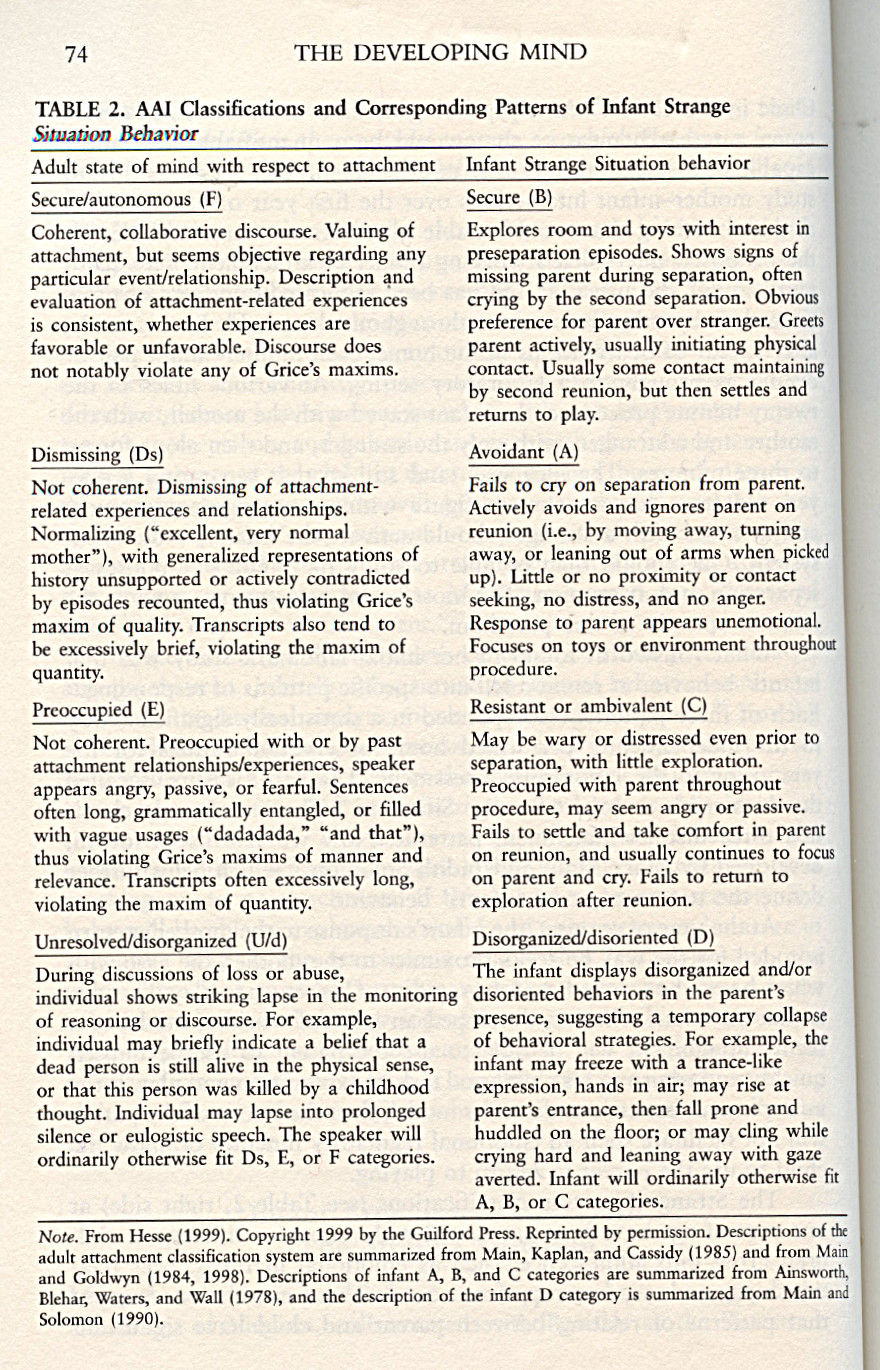
This scanned table about adult attachment refers to something called Grice’s maxims.  Here is the clearest description of these maxims, which originated historically in Kant’s philosophy, that I can find:

Grice’s Conversational Maxims

Maxim of Quantity:

1. Make your contribution to the conversation as informative as necessary.
2. Do not make your contribution to the conversation more informative than necessary.
Maxim of Quality:

1. Do not say what you believe to be false.
2. Do not say that for which you lack adequate evidence.
Maxim of Relevance:

Be relevant (i.e., say things related to the current topic of the conversation).
Maxim of Manner:

1. Avoid obscurity of expression.
2. Avoid ambiguity.
3. Be brief (avoid unnecessary wordiness).
4. Be orderly.

These maxims are considered to be reflected within rational ‘cooperative discourse’, and have been incorporated into the rating structure of the Adult Attachment Interview (AAI) used clinically and in research to assess adult attachment.

The AAI is a research tool.  People who administer the interview and rate it must go through specialized training.  This tool’s usefulness even in research is complicated because there are many factors about it that cannot be easily controlled, such as how the environment where the interview is given influences responses, how the person of the interviewer interacts with the ‘subject’, how interviewer’s biases might influence ratings, etc.

If I go back to my wood pile analogy and change the ‘end result’ of a tree’s lifetime into a toothpick or a piece of toilet paper instead of a log of firewood, and then expect us to be able to exactly imagine the entire process accurately that the seed went through to get to its end, we have a more accurate picture of how hard it would be to connect the results of an Adult Attachment Interview back through all the experiences of a person’s life back to their beginnings.  That would be if we even believed that the results of an AAI accurately described an adult’s attachment pattern in the first place.

++++

In the end, the simplest description of what an adult’s insecure attachment pattern might look like ‘on the streets’ or ‘in the trenches’ has to do with having some ability to tell a coherent life story – or not.

If I look at the piece of toilet paper version of how an AAI result might look, I would consider the ‘lowest’ grade of adult attachment that is not even mentioned in the 13 scanned pages.  It is called the ‘Cannot Classify Category’ and looks something like what 1998 research article describes:

Discourse, memory, and the adult attachment interview: A note with emphasis on the emerging cannot classify category

This brief report focuses on the emergence of a new Adult Attachment Interview (AAI) category, Cannot Classify. The Adult Attachment Interview classification system is discussed with emphasis upon differences in AAI categories as they relate to strategies or lapses in strategy for the integration and focus of attention and memory. The Cannot Classify category is understood to differ from the other AAI categories in that it appears to represent a global breakdown in the organization and maintenance of a singular strategy for adhering to the discourse tasks of the AAI.”

++

strategies or lapses in strategy for the integration and focus of attention and memory

This is what the researchers are looking for when they try to pin down what varying styles of adult attachment patterns look like.  That doesn’t give the rest of us much to go by in terms of learning about our adult attachment patterns, does it?

The fascinating point is that right within the few words of that sentence lies the heart of our concerns – TRAUMA.  What happened, when it happened, how it happened, what strategies either did or did not exist to integrate the experience of trauma, how these trauma experiences influenced and were influenced by attention and memory processes are all connected to attachment patterns.

++++

Attachment patterns are patterns of dealing with trauma.  If trauma built the early brain in the first place, these patterns show up in infant insecure attachment patterns such as the 13 scanned pages describe.  If trauma built the early brain, the same trauma-formed patterns continue into adulthood and manifest themselves in the disruptions of conversation about one’s self in one’s life that the AAI is designed to define.

Because our concern is with ‘trauma dramas’ that repeat themselves throughout a person’s lifetime, it is essential that we recognize what we are looking FOR as we find it in what we are looking AT.  We are looking for early infant-caregiver traumatic interactions (or their absence in safe and secure attachment) that built social-emotional brain in the first place because that is where the seed of who we are as a body-brain-mind-self originated.  We can tell the trauma was there at the beginning and that it influenced all later development if an insecure attachment pattern exists – in infant-children and in adults.

++++

So, if I disappoint my readers my not being able to clearly describe what adult attachment IS, let alone how it operates, how we identify the patterns, or how we change them, I hope you will be patient.  I might as well take what I have on hand and go into my back yard thinking I can build myself a space shuttle that actually works.

Humans had the capacity to figure out how to fly to the moon long before we did so.  We have the capacity to find a way to clearly assess human attachment, but we haven’t done so yet.  Because most of what goes wrong in human lives can be traced to the quality of attachment that formed the brain foundation and lies at the root of all of our social interactions – including the one we have with our own self – I believe this field of study should become the single most important one we pursue.

I have faith in US.  WE can figure this out – if and when we want to.  After all, as members of a social species our attachment patterns determine WHO we are in the world because they determine HOW we are in the world.

+++++++++++++++++++++++++++++++++++++++++++++++++++++

+INSECURE ATTACHMENT BREEDS CHILD ABUSE

+++++++++++++++++++++++

I did not intend to write myself around in a big circle about attachment today, but I did.  I guess that is what my ‘global’ thinking just naturally does.  In the end my conclusion is that child abuse continues to happen quite simply because we let it.

+++++++++++++++++++++++++

As usual I have a collection of thoughts that I can’t make sense out of until I write them down.  Once I open a Word page and begin to place all these letters together, one after the other, in rows I begin to see a THING, a post, as it forms itself on my computer screen.

Hum.  What is it I want to say?  I think about myself at age 18, having been sent away from my parents’ home out into the world some thousands of miles away from Alaska and into Navy boot camp.  What did I know of the world outside the doors of my childhood home(s)?  Nothing.

What did I know about interacting with other humans on the level playing field of so-called adulthood?  Nothing.  What did I know about what had been done to me, all the violence and hatred, fear and sadness my childhood had built up inside of me?  Nothing.

Who could I talk to about what had been done to me?  Nobody.  Who cared?  No one.  Did any of this matter to the bigger world outside of my own skin?  No, it didn’t.

++++

Sometimes I find myself thinking about what good I could do with the profits of a bestseller if I actually could write one and it sold well.  How could one book, or even two or three generate enough capitol to do anything that could make much of a difference toward improving the quality of life – either for survivors of child abuse or for the offspring of those trauma-changed people?

Whenever I think about efforts that might be designed to prevent child abuse my thoughts return to my mother like a compass needle pointing North.  I can’t say that women like me, who become pregnant in their teens and face the world alone are at highest risk for abusing their children.  I didn’t abuse mine.  My mother wasn’t married until she was 23.  She and my father wanted children, planned them, brought them into the world as if they were part of some perfectly orchestrated drama with the stage set and all the necessary actors trained, present and accounted for.

Would it have made a difference in my case if someone had given my parents an infant-child growth and development chart that described the needs of a human social-emotional brain in some up-beat, attractive, catchy format that would have told them clearly what safe and secure human attachment LOOKS like and FEELS like especially between a mother and her offspring?

Well, gee.  Any kind of a cutesy, informative infant-child brain growth and early development chart presented to MY MOTHER in a little pamphlet would have had to say inside as soon as she opened it up:

1)  DO NOT HATE YOUR BABY

2)  YOUR BABY IS NOT SATAN’S CHILD

3)  YOUR UNBORN INFANT DID NOT TRY TO KILL YOU AS SHE WAS BEING BORN

4)  YOUR INFANT-CHILD IS NOT A CURSE UPON YOUR LIFE

5)  YOUR BABY WAS BORN PERFECT AND IF YOU CANNOT LOVE HER, GIVE HER AWAY TO SOMEONE WHO WILL

OK.  So what if I don’t think about my mother and about other mothers and fathers who obviously have something seriously wrong with the way their own early social-emotional brain-body-mind-self developed.  Do I aim at simply trying to heighten the overall public mindset about the critical impact that all early interactions with an infant have on its growing brain?

Would anyone who had been so specifically enlightened have EVER recognized what my mother was doing to me even if they had learned this infant-brain building information.

Nope.

++++

I reached a dead end in my thinking.  Don’t you hate it when that happens?  Where do I go next?  Toward educating the mates of mothers such as mine was?

When I turn my thinking in the direction of my father the first thing that comes to mind is adult attachment disorders.  In order to begin to think about what kind of information could have reached my father, I think about how I could perhaps put proceeds from a bestseller into an effort to enlighten the public about what human attachment is, about how our attachment patterns are formed through our earliest brain-building experiences with our mothering caregiver, and about how those attachment patterns form how we relate to others – including our mates and offspring – for the rest of our lives.

My mother was a gregarious, charming, extremely attractive woman.  She LOOKED like quite the catch.  She ACTED like quite the catch.  My father was quiet, reserved, gentle, handsome, smart and educated.  He also appeared at quite the catch.  Mildred meets Bill, Bill marries Mildred.  End of story for the next almost 40 years until my father gave up and divorced my mother.

How to have reached my father so that he could possibly have understood that something was terribly, terribly wrong in my home of origin?

OK.  So my father did not abuse me.  So my father never once intervened to protect me.  Nobody would have spotted what was happening to me through studying my father.

UNLESS……What?

++++

Let me talk for a moment about how infant-childhood formed insecure attachment patterns operate in adult relationships.  First of all, if we still believe that about 50% of infant-children grow up in ‘normal’ families with good enough safe and secure attachment so that their social-emotional brain foundation operates in safe and secure patterned ways, we would pretty well know just from a description of how safe and secure adult attachment operates that even if a securely attached person should choose a mate who is insecurely attached, chances are that relationship will not last.

In fact, given that the securely attached person has a much better formed social-emotional brain from the start, they are likely to recognize the insecurely attached pattern from the beginning and then will smartly avoid any involvement in the first place.

Think about the groups of brain-changed primates I wrote about in yesterday’s post.  Those primates expertly found one another according to the patterns of signaling that each transmitted, received and understood.  If we understood ourselves better as humans, our changed-brain detection systems are every bit as capable of knowing the truth about one another as any ‘lower’ primate does.

Humans ignore the signals of secure and insecure social-emotional brain patterns.  We ignore the signs of insecure attachment.

++++

This brings to mind a strange collection of images.  First I think about the Ray Bradbury story that was made into a movie, Something Wicked This Way Comes.  Bradbury wrote the signs of Wicked into the story.  Signs of Wicked exist in humans.  Do we know what they are?  That depends.

In a social-emotional brain-body that has had trauma built into it and then responds to the world with insecurely attached patterns, changes in the Wicked, or Danger detection systems have been changed.  Although primates would still evidently be able to detect signals and signs from one another clearly enough to act on these differences, humans have reached a social evolution point where they can choose to ignore them and still survive.

Another image that comes to my mind is about how all kinds of living creatures can detect and ‘predict’ earthquakes.  They can sense the coming of a Tsunami.  That happens because they have no interference with their ability to remember signs and signals and to act on them the best way that they can.

Living creatures have amazing abilities to know when threat and danger is coming so that they can avoid the consequences of related potential harm whenever possible.  While humans might not have senses refined enough to be able to sense and predict earthquakes and Tsunamis that other living creatures do, we are certainly supposed to be able to do so in regard to human relationships.  If we LACK the ability to sense and detect danger that lies ahead if we chose to become ‘involved’ with another person, that only happens if we have an insecure attachment-formed early social-emotional brain.  Unfortunately, in a best-case scenario, this group includes – on some level – at least half of our adult population.

++++

If suddenly we gained our ability (I can’t say regained because we never got to build a securely attached social-emotional brain in the first place) to detect ‘Something Wicked This Way Comes’ both in ourselves and in those around us, we would still have to be able to ACT appropriately (better) in response to this information.  Very few of us with insecure attachment patterns are going to be able to do this.

We would need to be able to recognize the signs of insecure attachment patterns BOTH within our own self and within other people.  It is the nature of insecure attachment patterns that we are lacking in the ability to recognize the signs within EITHER others or within our self.  This does not mean that the signs do not exist and it does not mean that we cannot learn to understand what they are.  Once we do this, we empower ourselves to make different choices every single step of the way.

Those of us trained to drive a vehicle on public roads are trained to know what a green, yellow and red light mean when we encounter one at an intersection.  This brings to my mind one of my very favorite ideas:  BIFURCATION POINT.  A bifurcation point is a decision point where a choice is made.

Some people describe chaos as a state where all possibilities exist.  As we move forward through space and time in our life, we make billions and billions of choices we don’t think about.  For every choice we make we are ordering chaos into patterns.  One of my favorite books, Eskimo Realities, by Edmund Snow Carpenter, describes an ancient cultural approach to bringing life into existence through the ordering of chaos.

++++

My mother and father reached a significant bifurcation point when they met one another in the winter of 1948-1949.  Both of them ignored (for whatever reasons) the warning signs and signals about the Something Wicked that would come if they continued their relationship on down wedding lane.  What happened to me was obviously a result of their choices – or I would not exist.  The rest of what happened to me, the 18 years of severe abuse I suffered from my mother with my father’s full support of my mother, also happened to be because of the choices they made at their significant bifurcation points.

Trauma Altered Development that changes the way an infant-child’s body-brain-mind-self forms itself in a malevolent environment happens every infitesimally small bifurcation point at a time.  Every single brain neuron that responds to the conditions of an infant-child’s early environment does so at the molecular bifurcation point of early brain development.  The resiliency factors that we have as humans within our DNA operate in response – continually – to and within our environment.  This is how our attachment patterns come into being within us.

++++

At this point in my writing today as some inner force nudges each letter into existence on this page boils down to one single word.  INFLUENCE.

Our early environment, as it communicated its condition to us during our earliest development through our attachment experiences with our earliest mothering caregiver, influenced the molecular decisions our body-brain chose to make as it built itself.  Every time a bifurcation point was reached our body-brain physiologically, automatically and without our conscious informed consent made a decision and a choice for us.

What we need to understand is that ALL of these influences and the corresponding choices that were made within our body-brain are essentially and fundamentally ABOUT attachment in the world.  Because we are a social species (not something we have a choice over), which means that social attachment patterns are at the core of our existence, and because being a social species means that we have a prescribed range of possible responses to an influence when it occurs, ALL OF OUR RESPONSES at every bifurcation point we encounter and pass through in our lifetime means that we are having a social attachment-related experience.

We have no choice but to be influenced by all the containing parameters of the species to which we belong – our social one – in whose image we are created.

This means to me that if there is one thing that would most benefit us from learning about so that we can empower ourselves to make the best and wisest conscious choices at every bifurcation point we reach, it would be about how our human attachment systems operate.

++++

I could duck briefly under the umbrella of ‘ongoing life’ here and simply state that as long as we remain attached to this world we remain alive.  When we are no longer attached to this world we die.  We need basics, like air, water and food to remain attached and alive.  We have ongoing attachment systems within us that let us utilize this air, water and food.  All of our attachment systems are connected and operate together throughout every instant of our ongoing life.  Our connections to one another as members of a social species are, most simply put, a part of the same ongoing attachment-to-life system.  Our environment influences us, and our attachment systems respond.

Consciousness cannot be in any way disconnected in our thinking from attachment.  The same brain that formed itself within us during our critical windows of early infant-child development allows or disallows consciousness to manifest according to how our early attachment experiences influenced our growth.  This was no less true for my father as it was for my mother or for my self, or for any of the rest of us.

Our brain-building human attachment experiences influenced what we are conscious of and how.  There is only one other point that comes to mind as I write these words:  CARING.  Although what we care about and how is obviously tied to the body-brain we were built with from the start of our life here, I believe that it is at the level of CARING that we can most influence not only one another, but our own ongoing experience in the world.

The saying “You can lead a horse to water but you cannot make it drink” comes to mind.  Interestingly, some say that this might be the oldest proverb in the English language.  If a horse doesn’t care to drink, it won’t.

What might influence human caring?  A donkey or a chicken could detect the signs and signals from the environment that an earthquake or a Tsunami is coming until it was ‘blue in the face’, but if nobody pays attention, if nobody gives a damn, if nobody cares, what is the point?

So, again, what might influence human caring?  One thing and one thing only comes to mind:  PAIN.  Yet the word ‘pain’, as it came into modern English in the 14th century, has roots to both ‘punishment’ and through Sanskrit roots to ‘he revenges’.  These ideas are connected in our language to ‘vengeance’, ‘payment’, and ‘penalty’.  In order to find the oldest 9before the 12th century) connecting concept in the roots of our language, I had to go back to the word ‘bear’ as in ‘to bear’.

It all goes back to what influences we tolerate, either through choice or because we have to.  The word ‘tolerate’ in our language goes directly back in its roots to ‘to bear’, which of course goes back to ‘carry’.

As severe infant-child abuse survivors, we had no choice but to tolerate, bear and carry within our body-brains the malevolent treatment we received.  Our deprivation-traumas changed how we developed.  That means our attachment patterns within our self to the world changed.  These changes happened according to the degree of safe and secure or unsafe and insecure attachments we had with our earliest caregivers.

How much we continue to bear remains up to us.  When and if it ever comes down to how I choose to spend any future book sale proceeds, I will allocate them exactly and specifically to public education efforts about the human attachment continuum because attachment is how our life originates and how it continues.

++++

What each of us had to bear when we were little is exactly what we continue to bear unless and until we care enough to change.  Caring enough will happen as people come to understand exactly what IT is that they are bearing in the first place, and that different options DO exist so they don’t have to bear IT any more.  Neither do they have to pass what they are bearing down to future generations.

IT is made up of the unsafe and insecure attachment patterns that were built into our body-brain when we were tiny while our body-brain was being built.  Conditions of our early life influenced our entire existence in the direction of survival in either a benevolent or a malevolent world.

While everyone after the age of consciousness can be influenced to be informed enough to care enough to learn to make better attachment-related choices, it is only each individual person who can actually make their own choices.  As a social species we have the power collectively to care enough to prevent – what?

I have come around full circle to the concept of free will, free choice, freedom.  Our word ‘free’ (before the 12th century word) ties back to Sanskrit ‘own, dear’.  ‘Own’ goes back to roots before the 12th century to ‘owe’.  ‘Owe’ goes back before the 12th century to Sanskrit ‘he possesses’.  The word ‘dear’ also goes back in our language to before the 12th century as it connects to ‘costly’.  Not surprisingly, by following the connections through the concept of ‘cost’ back through ‘constant’ to before the 12th century we end up here:  ‘to stand’.

What are we able to bear?  What are we able to stand?

What are we willing to bear?  What are we willing to stand?

Are we as a society willing and able to bear that little tiny infants and children are being maltreated?  Are we as a society willing and able to stand for infant-child abuse to continue along with its cost to individual and collective well-being?

Or are we willing and able to care enough to stand up and stop it?

Think about the nature and quality of your own human attachment system.  Who do you include and who do you exclude?  If other people do not care about other people’s children enough to take a stand against all maltreatment of all children, the tragedy of child abuse will remain a reality quite simply because we choose to bear it.

++++++++++++++++++++++++++++++++

Don’t forget to check out — Brain Facts – A primer on the brain and nervous system

++++

— NEW:  CLICK ON POST, PAGE AND/OR COMMENT TITLE

AND LOOK FOR ‘YOU RATE IT’ STARS AT BOTTOM OF PAGE —

Please feel free to comment directly at the end of this post or on

+++++++

Your Page – Readers’ Responses

+++++++++++++++++++++++++

+LEARNING STYLES AND LONELINESS

+++++++++++++++++++++++++++

People have differing styles of learning about themselves in the world which are no doubt influenced by our earliest experiences.  I present a link today to a very simple ‘test’ that will show you clearly what your own individual preferences for processing yourself in the world are.  This information comes to us ‘free and easy’ from the engineering department of North Carolina State University.  I found their website today that presents extremely clear and concise information about the four main styles of learning:

INDEX OF LEARNING STYLES (ILS)

It contains a link to the  ILS questionnaire.   Click on this link and complete the 44-item questionnaire that can be submitted and automatically — and instantly — scored on the Web.  This is an ‘older person’s’ version for determining learning styles – just right for us!

Many people believe (myself included) that if our public educational system bothered to do a version of this simple assessment for students, and then bothered to tailor instruction for students according to the learning styles that are most a part of their individual nature, the current miserable state of education among our youth would not exist as it does.  Our learning styles continue to influence how we process ourselves in the world for the rest of our lives.

I hope you will take a few moments to take this test for yourself before you read the rest of this post because I think our first response to the questions will be more on target if we don’t think too much about them ahead of time.  I would recommend going through this experience from your ‘gut’ (body) rather than from your ‘head’ (second-guessing) so that you can better ALLOW your responses to come naturally rather than force them.

After you complete the 44-item questionnaire, your results will appear immediately as soon as you submit them.  You will see a continuum between the extreme ends of all four main learning styles.  Your result will show an ‘X’ above some point on each of these four lines.  THEN click on LEARNING STYLES AND STRATEGIES for the description of what each of these four styles are.  (This link is also at the bottom of your ‘results’ page.)

If you are the type of learner who wants as much information as possible BEFORE you attempt any unfamiliar task, this link (above) will give you an explanation related to the results as it describes the ‘playing field’!

+++++++++++++++

How did your scores come out on the continuums between these four dimensions of learning styles?

These are my scores::

—  ‘1’ toward the ‘reflective’ end on ‘active-reflective

— ‘11’ toward the ‘intuitive’ end on ‘sensing-intuitive

— ‘9’ toward the ‘visual’ end on ‘visual-verbal

— ‘9’ toward the ‘global’ end on ‘sequential-global

++++++++++++++

I believe that where we find ourselves on this MAP shows us how we are in the world, period.  Our learning style shows us how we pay attention, how we perceive, how we process, how we order and orient ourselves in the world.

Here, as with everything else about how I am in the world, I have to consider the impact that severe ongoing early trauma and abuse had on me as my body-brain-mind-self developed in the world through Trauma Altered Development.

How did the trauma of my childhood affect and influence the development of my learning style for me?  I see that I am very nearly at the extreme ends on three of the four continuums.  Only on the ‘active-reflective’ scale do I lie within a middle, more balanced range.

I can more clearly NAME and understand my own writing process when I think in terms of my position on these four scales.  I intuit my writing, I visualize from within myself (really by a sort of sensing and feeling from within my body) what ‘wants’ to be said, and the whole process operates in a globalized fashion where the end result becomes a ‘whole’ rather than a collection of parts that can be rearranged, reordered or restructured.

+++++++++++++++++++++++

For example, my thinking about how things end up being connected to one another makes more sense when I can simply allow my own individual style to shine.

As I have been thinking about my Christmas Eve post +TRAGEDIES OF CHILD ABUSE REFLECTED IN STORIES, I realize that my ‘cup runneth over’ with thoughts than seem disconnected (dissociated)  from the theme of the post.  Yet I know they are related and are connected (associated) in some way or I wouldn’t have them all tumbling around inside of me.

So, what is my inner logic?  What is the pattern and what are the connections?  I won’t begin to know until I write them down!

First of all, to own for myself the truth of what I wrote in this December 24th post I have to accept that my brain did not form in an optimal way through safe and secure attachment – obviously – or I would not have had the experience as a child in relation to the story-movie I wrote about.

In-tune reflection, empathy and mirroring between an infant as it grows its brain and its earliest mothering caregiver are meant to build a social-emotional brain that is built with patterns of human familiarity and connectedness.  The infant is supposed to see its own emotion-states-self mirrored back to it by its mothering caregiver.  As this happens, the infant is learning about patterns of harmonious similarity between itself and the human world it has been born into as these patterns both build the brain and build themselves into it.

At the same time patterns of how the infant is a separate DIFFERENT individual get harmoniously built into the early forming foundation of the infant’s social-emotional brain at the same time it is learning about similarities.  Ideally patterns of ASSOCIATION (similarities – “WE are socially human.”) form the foundation of the social-emotional brain rather than patterns of DISSOCIATION (“Gee, I have no idea what’s going on, or who is who, or what in the UNIVERSE is happening here!”)

++++

The first scenario happens through safe and secure attachment in a benevolent world.  The infant has repeated experiences of being shown that there is a WE that is made up of two separate people.  The self of the infant is growing in relationship to the self of the caregiver.

The second scenario happens in a malevolent environment where trauma is present.  Trauma is trauma because it is not ordinary or normal, and because it interrupts the ongoing experience of being safely and securely attached in the world.  If trauma is not resolved, and continues to place itself at the center of infant-mothering caregiver interactions (in all kinds of miserable ways), the infant will not be able to either clearly see the OTHER or be able to form its own self in relationship to this scrambled and scrambling messed up maybe-other.

The main relationship then ends up being to the ongoing TRAUMA rather than being a relationship between two benevolent entities in a benevolent world.

Voila!  Enter here a connection to my December 24th post.  What amazes me most is that I survived my severely traumatic childhood being able to function in anything like a human way!!  Making point one:  My version of being human is NOT normal!

If my first truly social-human experience of feeling myself mirrored back to myself happened the way I describe in my December 24th post, there is no possible way that I can feel – and here comes point number two – connected within myself to other people in anything like a normal way.

Oh – I am going to pause here and say something about use of the word NORMAL.  I have avoided this word, but my professional statistician daughter assures me that it is a fallacy to ever think that normal is not real.  Take a look at any Bell Curve.  Think about these images.  NORMAL is there in the middle, and pretending it isn’t is a childhood magical thinking stage illusion!  Normal exists, and it IS measurable once we define what we are talking about.

So, normal.  Oh, yes.  I experienced Trauma Altered Development and I am not normal.  Normal for members of a social species like ours has to do with comfort level that is connected to our experience of well-being – being well as a safely and securely attached member of our species.

What is my own experience of being an evolutionarily changed, adapted to trauma since my early social-emotional brain formed human?

++++

I am alone.  That is what happens within a traumatized infant-child’s brain in an unsafe and insecure, violent, chaotic, unstable, unpredictable malevolent early brain forming world.  Patterns of overwhelming isolation and DISSOCIATIONS built my brain.  My brain did not form within itself patterns of associations and similarities between myself and others.

If we go back to the foundational brain-building facts of Dr. Allen Schore’s most important 60-page article about infant early development, we can see how things are normally supposed to work between an infant and its mothering caregiver as its social-emotional brain is being built – from the beginning.  My brain did not get built normally.  I am a trauma altered person.

My growing brain could invent nothing outside of the experiences I had that built it.  I had very limited exposure from my birth to anyone besides my mother.  She designed my environment.  She controlled it.  In the beginning, most fortunately, she did not ban my 14-month-older brother from having contact with me.  It was those experiences that my earliest forming infant brain had with a human being – my little brother who loved me as much as it is possible for a human being to love another person – that I believe most saved my life.

Without those early human interactional face-to-face mirroring interactions with my baby brother, my growing brain would not have formed hardly ANY human connection circuits, pathways and patterns into my brain.  As I continued to grow from being an infant into a toddler, my mother began to interfere with and prevent contact even between me and my brother in the same ways she prevented my contact with my father, grandmother and other children.

But while the early interactions I had with my brother probably saved my life, they were NOT enough to save me from Trauma Altered Development.  My brain formed itself with human beings on one side of an impenetrable wall, and what self I could manage to form on the other side.

That means I was formed ALONE, disconnected and dissociated from the experience of being WITH other humans in the world.  That fundamental fact is what my December 24th post is ultimately about.

++++

My brain formed in isolation.  Isolation is NOT a GOOD condition for humans or any other mammal to form within.  I believe my Trauma Altered Development contributed to the fact that how my self is in the world lies on the extreme ends of three of the four learning style spectrums presented at the beginning of the post.  In my intuitive, visual, global way of knowing things, I KNOW that how my social-emotional early-formed brain developed itself is so far outside the Bell Curve range of normal that it is far closer to one shared on a continuum with autistic people.

I do not anticipate ever being able to find a so-called ‘mental health’ professional who would agree with me.  But I KNOW what I KNOW, and I am right.  I am my own living proof that I know what I am talking about.

It enrages me that I was forced to form a social-emotional brain that does not contain within it normal patterns of being a social human being.  I was BORN with full potential to have a normal brain.  I was FORCED through abuse and trauma to grow a different one.

Another thing that enrages me is that nobody ever told me – ever HAS told me about the facts regarding how my social-emotional brain formed differently from normal.  Luckily ‘they’ did the research, I found it, and now I DO understand what happened to me to give me this unending inner feeling of being not just lonely in any normal sense of the word – but fundamentally isolated and alone – within the very fabric of my body-brain-mind-self’s molecular construction.

++++

I write this post today for all readers who suffered extreme early trauma and abuse and who suffered from Trauma Altered Development as a consequence.

If you picture Michelangelo’s image of God giving life to Adam painted on the Sistine Chapel ceiling, and imagine the space between the finger tips as a visual presentation of a gap that cannot ever be bridged between an individual self and the world of other people, others of you without Trauma Altered Development might begin to get a sense of what our kind of isolation, aloneness and loneliness is like.

I believe that a person with a social-emotional brain built through mostly safe and secure early attachment experiences can FEEL connected to others which bridges this gap.  The gap that is supposed to exist between people is supposed to be closed through this ‘feeling felt’ experience.  This gap is only supposed to exist between human beings on the most central levels of selfhood where the boundaries that allow for selfhood itself to exist are not meant to be crossed.

On all other levels people are supposed to have early brains formed that can so communicate with one another between selves through empathic reflective mirroring — that happens in their normally formed social-emotional brain — that they have a choice about being connected to others of their species that the rest of us will never have (including people on the Autistic spectrum).

I am no longer remotely concerned with couching the reality of my state of being in any kind of terms that might make other normally developed social-emotional brained people feel comfortable.  I am different from most human beings, and now I know it – along with the why, how and what of it.  I am not ‘disordered, dysfunctional, blah, blah, blah’ either.  I am different.

I was left isolated and alone with a brutal monster of a mother who did not want me to be alive.  How she treated me – along with the absence of anyone else in my life who gave a damn – gave me a nonsocial emotionally altered body-brain-mind-self.  None of these changes happened as a result of my choice.

++++

I attended a community Christmas dinner yesterday.  Now that I know HOW I feel being a human in relationship to other humans, I can understand and accept that at no time in my life have I EVER, nor do I hope to in the future to EVER, feel connected to or with them.

I now know I am specifically skilled at pretending to be ‘one of them’.  I can watch them and interpret their actions.  I can mimic these communications in return.  I have a human body, so I look like other people.  But I know the differences between us now, and because I do I also know more and more about how my own feelings inside of myself stem from this fundamental disconnection (dissociation) between myself and other people that exists at the foundation of my long ago formed right social-emotional brain.

I might as well be on the other side of a glass wall forming a barrier between myself and others that can never be removed.

I cannot imagine a greater loss in life than is the loss of any ability to truly FEEL connected – through the circuitry of our brain – to others of our species.

When I write about child abuse, when I speak about the abridgment of fundamental universal human rights of children, when I talk about the consequences of maltreatment in infant-childhood that CAUSES Trauma Altered Development, I am talking about the crime of allowing human beings to be formed in the world so absolutely, fundamentally, essentially ALONE in a dangerous world that their brains are prevented from forming the beginning circuitry that would allow human connection to take place.

++++

About three years ago I accidentally discovered information that came about through an offshoot of primate brain research that was accomplished through surgical alteration of the victim brains.  I cannot locate my source, and will be very happy when I can.

The gist of it is that at some primate brain study facility that had a very large and ‘nice’ compound for the subject-victims to live in, a discovery was made in a surprising way.  All the primates in the compound had enough space and enough food, etc. so that their social patterns happened most certainly according to the following:

Researchers discovered that the primates bonded to one another and formed their social groups exactly and specifically according to which area of their brain had been tampered with, damaged and changed.  The victims of brain region alteration found one another based only on the similarity of changes caused by what had been done to them.  Each group was self sustaining and had no interaction with any other group who had suffered from damage to any different part of their brain.

++++

When I talk about having a changed social-emotional brain due to Trauma Altered Development, I am talking about every one of us who survived our terrible childhoods because of these changes knowing on an intuitive, global and visual level – which includes ALL of the information we KNOW from within our entire body-brain-self – that we are lost in a world where we cannot find one another in the way that these (really) trauma-changed-brain primates could.

When we feel lonely, when we feel isolated and alone, when we feel ‘alien’ and ‘different’ from mainstream normal others – it’s because we are.  If nonhuman primates can figure this out, it’s certainly time that the humans did.

I am tempted to say that we DO find one another – in prisons, on the streets, in battered spouse centers, in poverty, ‘mental health’ centers, etc.  While I DO believe this is true, there’s far more to the story.  Most of us find ourselves among people who did not suffer developmental early social-emotional brain changes.  We then additionally suffer from all kinds of mismatches between our experience of being alive and theirs.

We need to validate what we KNOW and how we KNOW it so that we can fully celebrate who we are.  We need to understand HOW and WHAT happened to us – on our most basic, fundamental, essential levels.  We need to know how to live better lives in spite of the changes that happened to us, and I will never be able to say this enough:  We need to HONOR who we are and how we are in the world.  (And we must remember that changes to our early growing social-emotional brain happened according to degrees of early deprivation-trauma we experienced.)

So — THIS is what I wanted to write about today.  Now that I wrote it – I know it – and so do you.  Those brain-changed primates evidently can easily tell how they are different – so they can be different together.  As members of another social species, it is time humans understand this same fact.

If we don’t like the fact that some people end up with a trauma-changed social-emotional brain, we need to  – STOP CHILD ABUSE NOW!  STOP TRANSMITTING UNRESOLVED TRAUMA DOWN THE GENERATIONS NOW!  STOP THE STORM NOW!

++++++++++++++++++++++++++++++++

Don’t forget to check out — Brain Facts – A primer on the brain and nervous system

++++

— NEW:  CLICK ON POST, PAGE AND/OR COMMENT TITLE

AND LOOK FOR ‘YOU RATE IT’ STARS AT BOTTOM OF PAGE —

Please feel free to comment directly at the end of this post or on

+++++++

Your Page – Readers’ Responses

+++++++++++++++++++++++++

+PTSD AND SEVERE ABUSE SURVIVORSHIP – CONCLUSION

++++++++

This is the concluding post (PART 4 – see links below to 1st 3 posts) about how Trauma Altered Development (TAD) changes an infant-child abuse survivor’s reaction to ALL trauma.   Van der Kolk writes about posttraumatic stress disorder (PTSD) in the book, Healing Trauma: Attachment, Mind, Body, and Brain – Hardcover (Jan 2003, W.W. Norton and Co.) by Daniel J. Siegel, Marion F. Solomon, and Marion Solomon, chapter 4 (pages 168-195) written by Bessel A. van der Kolk:  “Posttraumatic Stress Disorder and The Nature of Trauma.”

In his concluding statement of his chapter, van der Kolk writes:

“The rediscovery of trauma as an etiological [causing] factor in mental disorders is only about 20 years old.  During this time there has been an explosion of knowledge about how experience shapes the CNS [Central Nervous System, including the brain] and the formation of the self.  Developments in the neurosciences have started to make significant contributions to our understanding of how the brain is shaped by experience, and how life itself continues to transform the ways biology is organized.”

Again, in talking about infant-child abuse survivors, I would throw the term ‘mental disorders’ out the window.  (Yet how did my mother’s TAD lead her to be HOW she was in the world?]  Trauma Altered Development (TAD) happens at birth (and before) as these trauma experiences shape the CNS and brain’s formation and ‘the formation of the self’.

We cannot minimize, ignore, deny or under estimate the power early trauma has to affect an infant-child’s development.  Van der Kolk is writing in 2003.  Many advances in research and discovery about the impact early experience has on forming an individual have been made in these intervening seven years.  Evidence of early trauma’s power to change people is piling up around us.

“How life itself continues to transform the ways biology is organized” has to be considered in the light that certain of our developmental stages, once passed through in our early life, cannot later be redone under better conditions.  Science has to sort out which is which – which changes are permanent and which changes can be altered at a later age.

++

Van der Kolk continues:

“The study of trauma has probably been the single most fertile area within the disciplines of psychiatry and psychology in helping to develop a deeper understanding of the interrelationships among emotional, cognitive, social and biological forces that shape human development.  Starting with PTSD in adults, but expanding into early attachment and coping with overwhelming experiences in childhood, our field has discovered how certain experiences can “set” psychological expectations and biological selectivity.  Research in these areas has opened up entirely new insights into how extreme experiences throughout the lifecycle can have profound effects on memory, affect regulation, biological stress modulation, and interpersonal relatedions [sic].  These findings, in the context of the development of a range of new therapy approaches, are beginning to open up entirely new perspectives on how traumatized individuals can be helped to overcome their past.”

OK, I will first take issue with the last statement van der Kolk makes in his conclusion.  We have to sort out those with Trauma Altered Development (TAD) due to adaptation to extreme traumatic stress during the critical windows of their development from those who did not suffer from trauma that changed them in their development.  I belong to the first group.  Now that I know that fact, I can understand that I will NEVER be able to “overcome” my “past” in any fashion such as this author is suggesting here.

This is a critically important point for TAD survivors to understand.  Our traumatic infant-child experiences changed how we formed so that both the trauma experiences and our physiological responses to them are built into our body!  We cannot, obviously, leave our trauma changed body in our ‘past’, and any suggestion that we should or can do is worse than ludicrous.

I do not believe that any ‘help’ for me can start with PTSD in my adulthood.  For reasons pointed out in my previous posts on this topic (see below) I am no longer convinced that I even have PTSD.  I never had a pretrauma state from which to measure a posttraumatic state against – nor do I have a pretrauma state (or condition of my body) to return to.

Maybe it would help me understand myself better if I rework van der Kolk’s words so they make more sense to me as a TAD survivor:

“The study of trauma …[can help us] to develop a deeper understanding of the interrelationships among emotional, cognitive, social and biological forces that shape human development.  Starting with … early attachment and coping with overwhelming [malevolent, traumatic] experiences in childhood, our field has discovered how certain experiences …[form a developing infant-child body so that] psychological expectations and biological selectivity [are profoundly affected and permanently altered as a result].  Research in these areas has opened up entirely new insights into how extreme [traumatic] experiences throughout the lifecycle can have profound effects on memory, affect regulation, biological stress modulation, and interpersonal …[relations – but most definitely and profoundly when these experiences happen during development and change it so that all life experiences, including any later trauma experience, is processed in a different way]  These findings… are beginning to open up entirely new perspectives on how traumatized individuals [changed from birth cannot] …be helped to overcome their past.”

We cannot overcome our past.  We can begin to learn about the changes that happened to us so that we can begin to learn how to live well in spite of them.

++++

Interesting website my sister sent me the link to – am exploring it – has really COOL TRAUMA CHARTS!  Take a look at them, especially the third one which about describes how I feel all the time — and the way I felt for the entire first 18 years of my life — minus the hostility and rage because I did not have the luxury of that experience.  It is important to remember that depression is considered ‘an anxiety disorder’.

The experience of all these experiences related to trauma built themselves into our body through early infant-child maltreatment from our beginning.  The top right cluster of experiences on that bottom chart are ‘hyper’  or ‘GO’ sympathetic arm responses of our Autonomic Nervous System (ANS) and the lower left ones are the ‘hypo’ or ‘STOP’ parasympathetic ones (remember, like a ‘pair a brakes’).  Fundamental changes in how our ANS formed happened to us through our Trauma Altered Development (TAD).

Again, I have to consider this information through my Trauma Altered Development (TAD) severe infant-child abuse survivorhood filter – I do not have an ‘ordinary’ non-trauma built body – my nervous system does not have a safe, secure calm set point……I am different…..so how does this information apply to me/us?  We have to figure this out…..
Somatic Experiencing Foundation for Human EnrichmentMission Statement

The Foundation for Human Enrichment – FHE is a non-profit, educational and research organization dedicated to the worldwide healing and prevention of trauma. We provide professional training in Somatic Experiencing and outreach to under served populations and victims of violence, war and natural disasters.

What is Somatic Experiencing® (SE)?

”Somatic Experiencing® is a body-awareness approach to trauma being taught throughout the world. It is the result of over forty years of observation, research, and hands-on development by Dr. Levine. Based upon the realization that human beings have an innate ability to overcome the effects of trauma, Somatic Experiencing has touched the lives of many thousands. SE® restores self-regulation, and returns a sense of aliveness, relaxation and wholeness to traumatized individuals who have had these precious gifts taken away. Peter has applied his work to combat veterans, rape survivors, Holocaust survivors, auto accident and post surgical trauma, chronic pain sufferers, and even to infants after suffering traumatic births.

This is the primary website for the SE training, support of health professionals in Somatic Experiencing® and connecting trauma victims to the approximately 5,000 SE® Practitioners across the globe.”

++

FROM MY POINT OF VIEW — considered from the above:

SE® restores self-regulation, and returns a sense of aliveness, relaxation and wholeness to traumatized individuals who have had these precious gifts taken away

TAD survivors cannot be restored or returned to anything like what these presenters are describing.  “These precious gifts” were taken away from us from the time of our birth — or even before!!  We have to understand what this means to us — nobody is going to do it for us!!  I never had a ‘sense of aliveness, relaxation or wholeness’ ever formed into my body in the first place — or any ‘ordinary’ ability to self-regulate (formed into our body-nervous system-brain fundamentally through our caregiver attachment experiences before the age of one).  Nobody can give me back what I never had.

So, how do I FIND these ‘precious gifts’ for myself NOW?  My Trauma Altered Development is a consequence I have suffered from my entire life as a result of having had my Human Rights as a Child stripped from me and violated through 18 years of abuse, torment and trauma.

++++++++++++++++++++++++++++++

This post follows:

From December 2, 2009 +PTSD AND SEVERE ABUSE SURVIVORSHIP – PART THREE

from November 30, 2009 +PTSD AND SEVERE ABUSE SURVIVORSHIP – PART TWO

from November 28, 2009 +PTSD AND SEVERE CHILD ABUSE SURVIVORSHIP – PART ONE

+++++++++++++++++++++++

PLEASE NOTE:  Do not take anything I say as a reason to alter any ongoing treatment, therapy or medication you are receiving.  Consult with your provider if you find something in my writing that brings questions to your mind regarding your health and well-being.

++++++++++++++++++++++++++++++++

Please feel free to comment directly at the end of this post or on

+++++++

Your Page – Readers’ Responses

++++++++++++++++++++++++++++++++

OK, and this for FUN?

President Obama and ET?  “The Vatican Astrobiology conference from November 6-8 , for the first time legitimized discussion of extraterrestrial life and its implications for the Catholic Church.”

++++++++++++++++++++++++++++++++

+VIOLATING THE UNIVERSAL HUMAN RIGHTS OF CHILDREN

++++++++++++++++++++++++++++++

When any of the Universal Human Rights of Children are violated, those who violate and those who allow the violation to occur are equally accountable for the criminality of their actions.

Today I am reminded of the biggest picture not only about the condition of the youth, children, infants and their parents within our nation.  This picture is about Human Rights – not only as they apply to adults, but also as they apply to the offspring we are raising among us.

What do these words mean?

Equal Justice, Equal Opportunity, Equal Dignity

I found a wonderful video about Human Rights presented at this above link presented by our friends on their website, Treasures of Wonderment.

I then went to the United Nations website where I found the full text of the Universal Declaration of Human Rights:

On December 10, 1948 the General Assembly of the United Nations adopted and proclaimed the Universal Declaration of Human Rights….Following this historic act the Assembly called upon all Member countries to publicize the text of the Declaration and “to cause it to be disseminated, displayed, read and expounded principally in schools and other educational institutions, without distinction based on the political status of countries or territories.””

++++

Considering my concerns about the current poor condition of the youth of our nation, and thinking about how every passing present moment of our lives are passing continually into the past as we step into the future, I wonder about the decline in well-being that our nation is obviously experiencing as demonstrated not only by this lack of well-being of our youth but also of the parents who raise them.

Do we in America today deny that we have these Universal Human Rights and that our children also have Universal Human Rights?  What are we lacking as a nation that is creating these conditions of distress within our population?  What elements are missing that the required environment of safe and secure attachment to ourselves, to our children, to one another and to the world we live in seems to be increasingly missing within our own nation?

What standards can we use in order to take a clearer look at ourselves?  Why NOT consider the Universal Declaration of Human Rights as the most complete set of guidelines existing on our planet about our concerns?

++++

Every one of the 30 Articles contained within the Universal Declaration of Human Rights are vital to ensure human well-being.  All these Rights fit together into a whole.  It is my particular concern today about the well-being of our nation’s infants, children, youth and their parents that most concerns me, so I paid particular attention to Articles 25 and 26 as I read this Declaration:

Article 25.

  • (1) Everyone has the right to a standard of living adequate for the health and well-being of himself and of his family, including food, clothing, housing and medical care and necessary social services, and the right to security in the event of unemployment, sickness, disability, widowhood, old age or other lack of livelihood in circumstances beyond his control.
  • (2) Motherhood and childhood are entitled to special care and assistance. All children, whether born in or out of wedlock, shall enjoy the same social protection.

Article 26.

  • (1) Everyone has the right to education. Education shall be free, at least in the elementary and fundamental stages. Elementary education shall be compulsory. Technical and professional education shall be made generally available and higher education shall be equally accessible to all on the basis of merit.
  • (2) Education shall be directed to the full development of the human personality and to the strengthening of respect for human rights and fundamental freedoms. It shall promote understanding, tolerance and friendship among all nations, racial or religious groups, and shall further the activities of the United Nations for the maintenance of peace.
  • (3) Parents have a prior right to choose the kind of education that shall be given to their children.

++++

Do the rights of children solely lie with their parents?  What happens if parents do not and cannot ensure the rights of their children?  What happens if and when parents directly violate ANY of the United Nations Human Rights as they apply to children?  What ARE the Universal Human Rights of children?  Do they have any?

On November 20, 1959 the United Nations adopted the Universal Declaration of Children’s Rights.  I found a United Nations page with links on the rights of children, and also found the official version of the Universal Declaration of Children’s Rights.

I also found the following on the United Nations website.  It is in these few words that the picture becomes clear not only about what children need, but what their Universal Human Rights are in plain and simple language:

Declaration of the Rights of the Child – Plain Language Version

1.  All children have the right to what follows, no matter what their race, colour, sex, language, religion, political or other opinion, or where they were born or who they were born to.

2.  You have the special right to grow up and to develop physically and spiritually in a healthy and normal way, free and with dignity.

3.  You have a right to a name and to be a member of a country.

4.  You have a right to special care and protection and to good food, housing and medical services.

5.  You have the right to special care if handicapped in any way.

6.  You have the right to love and understanding, preferably from parents and family, but from the government where these cannot help.

7.  You have the right to go to school for free, to play, and to have an equal chance to develop yourself and to learn to be responsible and useful.

Your parents have special responsibilities for your education and guidance.

8.  You have the right always to be among the first to get help.

9.  You have the right to be protected against cruel acts or exploitation, e.g. you shall not be obliged to do work which hinders your development both physically and mentally.

You should not work before a minimum age and never when that would hinder your health, and your moral and physical development.

10.  You should be taught peace, understanding, tolerance and friendship among all people.

++++

Those who are survivors of any degree of deprivation of any of these rights anywhere on our planet – including within our own nation — are caused suffering through criminal actions.  When any of these Universal Human Rights of children are violated, it is to this that we must pay the closest attention:

6.  You have the right to love and understanding, preferably from parents and family, but from the government where these cannot help.

I do not believe that in our nation the Universal Human Rights of Children should be left to the care of the governments of our separate states.  I believe that the guarantee of these Rights needs to be protected by our federal government.  I believe we need to develop a federal standardization in regards to children’s Rights that is applied equally across all 50 states on every level that impacts the well-being of our nation’s children – from conception forward.

This would include all child protection services, including all services designed to identify maltreatment, all services designed to remedy critical issues within a child’s home of origin in a speedy and competent manner, and all services that are designed to place children in living environments where ALL their Universal Human Rights will be guaranteed.

I also believe that our children’s public education needs to be standardized on a national level and should NO LONGER be left, in any way or on any level, up to the incompetent design and administration of individual states.

It seems obvious to me that considering the findings that 75% of our youth are suffering from serious lack of well-being that even finding ways to shore up inadequate parenting will not resolve the profound problems our nation is facing in regard to Universal Human Rights of our children.  We need an across-the-board revision of our educational system by the federal government, and this need has reached critical proportions.

++++

Either we are a nation that is willing to stand behind these Rights as defined by the United Nations or we are not.  It seems obvious to me where the great grey area of “maybe yes, maybe no” has gotten us.  We have approached a ‘crisis management needed’ stage within our nation.  We need to move up the hierarchy of who is going to take care of our nation’s children – and how.

If parents are not equipped to guarantee the Universal Human Rights of their children, and if our individual states are not equipped to do it, then it is our federal government’s responsibility to step up to its job of guaranteeing these rights through every possible means at its disposal.

Violating the Universal Human Rights of Children is a criminal act.  Allowing anyone to violate these rights is a criminal act.  These Rights are not arbitrary.  They are absolute, fundamental and necessary.  There is no room for grey.  Either we are a nation of criminals or we are not.

+++++++++++++++++++++++

Please feel free to comment directly at the end of this post or on

+++++++

Your Page – Readers’ Responses

++++++++++++++++++++++++++++++++

PBS Documentary – The Mind’s Big Bang – evolution of our mind – There’s a free toolbar you can download that open’s up a universe!!

+WHAT DO WE KNOW ABOUT TRAUMA?

+++++++++++++++++++++++++++

I would think that in their own way everyone in our great nation recognizes today as the 8th anniversary of one of the most terrible crisis that ever occurred within the boundaries of our country.  Our hearts continue to go out to all those who suffered terror and unimaginable trauma as a result of the destruction brought upon them by the acts of terrorists whose own agendas allowed them to kill and destroy wantonly.  At the same time we remember each person and their loved ones whose lives have been touched in the aftermath of war, destruction and bloodshed that has followed 9-11 and the World Trade Center attacks.

+++++++++++++++++++++++++++

The most devastating consequences of trauma to humans can never be measured in financial terms.  Neither do we yet know the true reality of the way humans respond to extraordinary traumatic stressors.  Continued research into the ongoing, intergenerational consequence of the Holocaust’s traumatic effects shows that trauma can be CLEARLY passed down to offspring.

Researchers will be working to uncover the long range consequences of trauma caused by 9-11 for a long time to come.  They know that babies of women pregnant during the 9-11 terrorist attacks have been found to be born with the ‘markers’ for Posttraumatic Stress Disorder (PTSD) as a result of their mother’s exposure to the attacks.

We are learning more and more both about how resilient humans are and about our fragility.  Every-day people do not usually pay attention to the results of millions and millions of dollars spent on research about the consequences of trauma to humans, and yet this research can inform our thinking in new and more enlightened ways.

The Atlanta study looked at genetic potential as it interacts with children’s responses to trauma.  It found, among other things, that a child’s safe and secure attachment to ANY adult in its life influences to the positive that child’s ability to overcome traumatic experiences.  In another corner of the world researchers have discovered the same thing.  Although exposed equally to unimaginable terrors and traumas, the children of South Africa end up with severe longterm traumatic responses while the children of Kenya do not.

The more damaged South African children live in a country long torn apart, in fact all but dismantled by generations of influences that have destroyed the secure social attachment fabric of their culture.  Kenya has not suffered this intergenerational destruction of its ongoing cultural strengths so that their children have the benefit – in spite of current terrible traumas and tragedies – of being ‘held’ within a culture that still has its social supports and secure attachment systems somewhat in place.

+++++++++++++++++++++++++++

We cannot realistically consider the long range consequences of traumatic experience without considering the attachment contexts that form and support (or don’t) the members of any human society.  These attachments begin before birth, as the responses of infants still very much physiologically attached to their mothers during 9-11 demonstrated.

Children are held and supported by the fabric of the attachment support net that their parents either do or do not have in their lives.  Without firmly safe and secure human attachments from the beginning of our lives, we are at astronomically increased risk of suffering long term devastation in our adult lives from any traumatic experience that we might later have.  It is time that all of us realize that attachment is the single most important aspect of our lives because we are a social species.

What this means to me is that all of us, including and perhaps most importantly any mental health expert that works with troubled people of all ages, must begin to include attachment disorder understanding, concepts and vocabulary into our cultural base of knowledge about what makes our lives ‘good’ and what makes them ‘bad’.  I doubt that more than a small handful of mental health experts EVER talk with their adult clients about insecure attachment disorders.

We reserve any discussion or awareness of secure and insecure attachment disorders ONLY as it might relate to ‘troubled’ children.  Where do we think child attachment disorders disappear to once someone magically crosses some invisible line into adulthood?  They go nowhere.  Our attachment orders or disorders are as much ingrained into us as any other physiological response system our brain, body, nervous and immune system has.

We HAVE to begin talking about our attachment system as it operates in our adulthood because it formed who we are and affects how we respond both to the good and to the bad in our lives – at all times!  Those who might be having the most difficult time recovering from the devastating trauma of 9-11 are no exception.  But has ANYONE ever talked to them about their attachment system?

I am willing to bet that any adult who was formed in an extremely malevolent childhood environment and who did not have the benefit of having a safe and secure adult attachment person in their childhood life, is among those who lack the necessary resiliency to recuperate fully from any traumas that they experience.  We are doing nobody any favors by ignoring the absolute, fundamental reality of how our secure or insecure attachment system governs our ability to cope with trauma.

I therefore encourage readers to spend some time investigating some of the information connected to the live-links provided in this post.  You might help yourself beyond belief, or be able to assist someone you know in their efforts to deal with any ongoing traumatic consequences in their lives – including their ability to parent effectively.

Trauma is not bliss, and neither is ignorance.  It is the response-ability of all of us to arm ourselves with any and all information that can help us understand what we can better do to improve secure attachments in the world – no matter who we are, what age we are, or what we have experienced.

Thank you for reading this post.  Comments are welcome and appreciated.

+ATTACHMENT: SMART AND STUPID RESEARCH

+++++++++++++++++++++++++++

+DON’T MISS THESE 3 COMPLETED PAGES

These three pages are now complete:

*COLLINS ON RESPONDING TO NEED – Part Five

*COLLINS ON RESPONDING TO NEED – Part Six

**Attachment Styles and Caregiving from Collins Article

+Links to new pages on attachment patterns

The only way not to have an operating attachment system is to be dead.  Our attachment system is supposed to be able to be deactivated appropriately so that our other systems of exploration and caregiving can be activated in their own turn.  When we have an insecure attachment rather than secure attachment system, this ‘shut off’ ability may be lost to us.  As a result, all of our behavioral systems are negatively affected.

Our attachment patterns are formed into our brains during our experiences with our mother and other important early care givers mostly before we are a year old.  They operate behind the scenes of our life much as a computer’s operating system is hidden from our view.

Whether we look at an infant’s developing attachment system, or look at an adult attachment system as it operates in romantic and other relationships including parenthood, the more we understand these systems the more conscious power we can have over our own lives.

*COLLINS ON RESPONDING TO NEED – Part One

**Attachment Styles from Collin’s Article

*COLLINS ON RESPONDING TO NEED – Part Two

*COLLINS ON RESPONDING TO NEED – Part Three

*COLLINS ON RESPONDING TO NEED – Part Four

*COLLINS ON RESPONDING TO NEED – Part Five

*COLLINS ON RESPONDING TO NEED – Part Six

**Attachment Styles and Caregiving from Collins Article

+LINK to *THE DANGERS OF MEMORY RETRIEVAL

The following link will take you to the page I wrote today about my experiences related to re-membering traumas within my own life:

*THE DANGERS OF MEMORY RETRIEVAL