
++++++++++++++++++++++
Members of our culture are familiar with information that streams down to the general public from the TOP. Unless our current view of society is suddenly flipped over completely, I certainly hold a position as a human being close to the bottom, not the top.
Here is an image for something known as The Bell Curve.
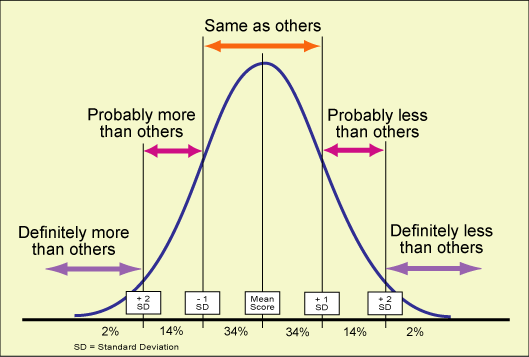
Whether we are talking in general about the ‘haves’ versus the ‘have nots’, or talking in terms of diagnosed ‘mental illness’, or talking about degrees on a continuum of insecure versus secure human attachment acquired during the first year of life as it designs and builds the human nervous system-brain, etc., we can consider the degrees of human well-being as they can be expressed using a Bell Curve image.
The healthier, happier, and more safely and securely attached an infant’s mother is, the same will correspondingly be true for her offspring — for a lifetime. These are the people who will suffer and struggle less and enjoy more over their life span.
The opposite direction happens when the opposite conditions exist. These are the people who will suffer and struggle more and enjoy less over their life span.
Intervention and education can directly improve the odds that well-being for an infant will improve for its lifetime when the quality of earliest caregiver interactions is improved. The degrees I am describing become physiologically wired and built into an infant’s body. I fully believe that increases to the positive will travel on down the generations just as the negative ones do. Which do we desire as individual parents and as a society?
We are not helpless victims. If we truly desire the best well-being possible for all (and this always starts with the quality of care to our infants), we have the power to accomplish what we want.
++++
To be very clear, I write as a survivor of the kind of infant-child abuse that probably ONLY exists in the ‘lowest’ (on the left end of this image) severe maltreatment, trauma and abuse. I was a despised and hated baby from my first breath. My advantage now is that I know this at the same time I know a great deal about how this malevolent treatment changed my physiological development.
Having been born to a severely ‘mentally ill’ (no doubt Borderline) mother who, herself, existed on the devastating neglect and abuse end of the infant attachment spectrum, puts me in what I consider either the LOWEST 5% or the HIGHEST 5% depending upon how one looks at the Bell Curve of infant-child treatment.
I ‘definitely’ received a megasized dose of maltreatment at the same time I was mega-deprived of the RIGHT kind of treatment.
So I write from society’s bottom 5% while most so-called ‘experts’ write from the TOP 5%. This means that much of what I say is as equally challenging for the TOP group of humans to comprehend and believe as THEIR information is to those of us in the bottom 5%.
++++
I am completely comfortable in expanding the size of the group I write to and about from 5% to 15% of our population. While the ‘a little bit higher’ additional 10% above me did not perhaps experience outright hatred from their earliest caregivers, they did NOT receive the quality of tender, loving, adequate care they needed. Their entire physiological development was, I believe, altered in adjustment to their malevolent, insecure and unsafe earliest caregiving (!) environment.
At the same time, even though most attachment experts suggest that fully 50% of our population’s infants DO experience ‘good enough’ early caregiving to end up with a body-nervous system(NS)-brain-mind-self to carry on with the rest of their lives having a primary safe and secure attachment system, I believe that it is ONLY the top 15% who REALLY experience the blessing of ‘optimal’. Those beneficiaries, as a result, can suffer from a kind of blindness that they DO NOT ADMIT. This ignorance stems from their position of privilege.
I believe nearly ALL of our top high-powered ‘professional experts’ came from this top 15%, which means to me that if I am going to wholeheartedly accept as TRUE everything that they tell me, I am accepting their reality as REAL at the same time I discount and deny my own reality.
++++
While I cannot argue with the generalized view point that approximately 50% of our population had a first year of life that has given them a safe and secure attachment system (matched by a properly operating nervous system/brain-stress response system-vagus nerve system-immune system), I ask myself the question, “Why is such a large percentage of our population reliant upon antidepressants to get through their life?”
Developmental neuroscientists know that mothers as an infant’s earliest primary caregiver — and it remains mothers due to biological heritage of our species that has not changed — quite literally download their brain and nervous system patterning into their offspring’s rapidly growing and developing body-brain at the same time they are passing along their own attachment system patterning. This means that in spite of our best intentions NOT to pass trauma patterns on to our offspring — we do.
Yes, while it can be said that much depression is ‘genetic’, it is also true that many genetic combinations that lead not only to depression to also to a wide array of physiological ‘problems’ are directly triggered into operation during the earliest months and years of our human development because of the influence our earliest caregivers have upon us.
++++
So what I would hope could be a ‘clarion whisper’ to others in my writings is this: In today’s complex and hectic mothering environment we need to understand and make very clear that what a mother has experienced in HER life directly impacts the body-brain that her baby will grow.
Perhaps the ‘top 50%’ of our society do not need to directly THINK about this fact. They can go on passing down to their offspring the goodness they have received in their benevolent infant-childhoods. The OTHER 50% needs to understand as much as they can — hopefully PRIOR to creating their children — something we do not talk about in our culture: How their body-NS-brain-immune system-mind-self was formed at the beginning of their life.
This is not so much about thinking, “WHO am I in the world?” This is about thinking about, “HOW am I in the world and HOW did I get to be this way?”
It is very common to see an infant growth and development chart or list of what to look for in regard to visible external signs of advancement. I want to see either a separate chart-list that talks about the INNER invisible critical growth and development of an infant’s attachment system as it affects development of its entire nervous system-brain AND body, or see this information included along with the mention of when to expect rolling over, sitting up, the first tooth and crawling.
Only in rare situations does an infant NOT develop its outward signs of health in a normal-ordinary fashion. And yet we accept that at least 50% of these same infants are NOT being given what they need to develop their INNER responses in a normal-ordinary way.
This means to me that we are willing to accept that less-than-best for half our population’s infants, which will directly influence their lifelong well-being on the down turn, is perfectly OK with us.
It is NOT OK! We CAN influence how the Bell Curve of human safe and secure attachment and BEST physiological development ON THE INSIDE turns out. We can ‘raise the bar’ for everyone and we can at the same time ‘raise the bottom’.
My own terrible infant-childhood maltreatment harmed my development greatly. I did not even begin to understand that what happened to me growing up for 18 years under extremely traumatic conditions was not only NOT NORMAL, but was NOT OK and was extremely harmful. It has only been in the last 6-7 years that I have learned what that ‘harmful’ means in terms of my trauma altered development.
It so happens that so much new information has become available about the needs of infants for optimal development due to advances in scientific technologies paralleled my own need and desire to find out the truth about what happened to me where it mattered most. That information is out there for all of us to find, but it needs to be made accessible and understandable to everyone, especially to new parents.
Even though I came a long, long way in not passing the trauma my mother, and through her that I experienced to my own children — I did so anyway on some significant levels. A very sad and traumatized mother who does NOT know this about herself, and who does NOT know how she is going to pass these patterns down to her infant through her innocent (and best) interactions with it during its first year of life — is going to pass those patterns down to her infant. That is nature’s design.
The very best and most accurate measure of the state of a human society’s well-being is to look directly — and with an informed eye — at its infants prior to the age of one.
What we want to see are infants who are well fed and physically cared for — yes. But what we ALSO and at the same time need to see are infants who are being attended to in safe and secure attachment interactions. These interactions are very real actually PHYSIOLOGICAL ways. Yes, they involve caregiver-mother touch, smell, voice, words, tone — but they also happen through face-to-face expressions that are designed to download particularly a mother’s experience of being in the world to her infant so that her infant can, in turn, adjust its physiological development ON ALL LEVELS to the condition of the world it has been born into.
A baby needs to be attended to and comforted in such a way that its entire nervous system will develop with a state of peaceful calm (safety and security) as its middle set point. Some excitement. Not too much. The right kind of stimulation. Modulation of excitement (both positive and negative) ALWAYS BACK TO THIS CENTER POINT OF PEACEFUL CALM.
The baby needs interactions that stimulate its happiness and joy center’s development in its brain. This happens FROM THE CENTER SETPOINT OF PEACE AND CALM. The baby needs to gradually and eventually begin to tolerate the survival experiences of discomfort, anger, fear and sadness — but always within the best possible parameters set by its caregivers so that the infant is NEVER IN ANY WAY OVERWHELMED BY ANYTHING — EVER!
An infant from birth to one is building its brain neuron and nervous system directly based on the kinds of early caregiver interactions it is receiving. The information it gets from these caregiver interactions are telling its genetic material exactly how safe and secure (benevolent) or how unsafe and insecure (malevolent) the entire universe is — and will be — for the rest of its life. The infant’s physiological INNER development will adjust itself accordingly — and in most ways, permanently.
An infant from birth is at the same time building within itself the platform foundation for its thoughts, beginning with the underlying images that are directly connected to its experiences with its earliest caregivers — primarily its mother. “Can I absolutely trust that someone loves me, knows that I AM HERE, and will come to take care of me?”
From this knowledge — either with a “YES” answer or a “NO” answer (or a “MAYBE?” one) comes not only the foundation of trust, but also the foundation of hope. Eventually an infant around the age of one will be able to HOPE for that wonderful caregiver to come take care of it when the infant experiences a need. With this foundation of trust and hope — or its absence — an infant advances into its stages of being able to move out into the world and explore it on its own knowing on its most basic physiological levels that it can count on being safely and securely attached to and in the world — or not.
AND the infant begins to add into its growing body-brain the ability to THINK in more than senses and images. Every single interaction an infant has with a human being before the age of one is directly influencing where its neurons are going to land in the regions of its brains, whether these neurons will live or die, and how these brain regions will process information — including information the infant needs to build its SELF and its relationship with this SELF.
++++
All of these interactions a billions more directly affect where a maturing human being will end up on this Bell Curve of well-being. Although I was born down there at the lowest 5% point within an extremely malevolent, traumatizing and abusive environment, I can now look upwards and SEE the whole range of possibilities. I can do this because I found a way to learn about how degrees of safe and secure attachment — and its opposite — directly influence the development of ALL OF US.
True, all of us can learn throughout our lifespan, but reality is reality. There are early infant-child critical windows of development during which certain aspects of our physiological development are finalized — and cannot be changed. We need to know as much as we can about what human developmental stages are ON THE INSIDE. We need to know the best we can what happened to us that changed us. Readers of this blog will already know exactly what I am talking about.
As a society we can make up our minds that LESS THAN BEST is not acceptable when it comes to infant care. While we mouth the words ‘everyone is created equal’ we are NOT making sure that everyone is given the same BEST chance to grow and develop the BEST body-brain-mind-self possible. Shame on us.
+++++++++++++++++++++++++
Based on what happens in the womb and during the first year of life, additional critical brain development takes place in the second year of life — and onwards. But ALL future development will be directed by and adapted to the information the infant receives from its earliest caregiving environment before the age of one.
++++++++++++++++++++++++++
Number of Americans taking antidepressants doubles – USATODAY.com
Aug 3, 2009 … The number of Americans using antidepressants doubled in only a decade, while the number seeing psychiatrists continued to fall, …
CDC: Antidepressants most prescribed drugs in U.S. – CNN.com
Jul 9, 2007 … CDC: Antidepressants most prescribed drugs in U.S. … She added that 25 percent of adults will have a major depressive episode sometime in …
Answers.com – What percentage of the US takes anti-depressants
Depression and Bipolar Disorder question: What percentage of the US takes anti-depressants? Answer More people than you think!!! Could not find it but this …
10 Percent of Americans Use Antidepressants, Study Finds
Aug 4, 2009 … New research finds that 27 million Americans — more than 10 percent of the population — took antidepressant medications in 2005, …
Antidepressants in America – TIME
Aug 5, 2009 … Antidepressants in America. By Alex Altman Wednesday, Aug. … which data were available — the percentage of Americans using antidepressants …
http://www.time.com/time/health/article/0,8599,1914604,00.html …
Antidepressant Use in U.S. Has Almost Doubled – US News and World …
Aug 3, 2009 … Antidepressant Use in U.S. Has Almost Doubled … The study found that 5.84 percent of U.S. residents aged 6 and over were using …
++++++++++++++++++++++
 Stop the Storm
