
++++++++++++++++
Is it possible to be very nearly a species of one? That’s how I feel today as I realize that nowhere in the ‘professional’ literature can I find much of a match for my infant-childhood experiences and how I became a changed being as a consequence.
It seems very rare that researchers ever talk realistically (from my point of view) about the ‘freeze’ response when they talk about the ‘fight or flight’ response. I think about it as an infant-child abuse survivor because I suspect, more than anything else, it was the freeze response that I most often used in response to my mother’s abuse.
Because I never knew anything OTHER than my mother’s abuse from the time I was born, there was never a time when the flight response came to me. There was one occasion I know of when I was a preteen that I actually ran from her. If I hadn’t done so that time, she would probably have killed me.
The rest of the time, beginning in my infancy, I suffered, endured and persisted to live on in spite of my mother’s abuse. But what was going on inside of me during all these experiences of trauma? If I could not fight, and I could not escape her, was I forced to use this freeze response that nobody seems to want to talk about?
++++
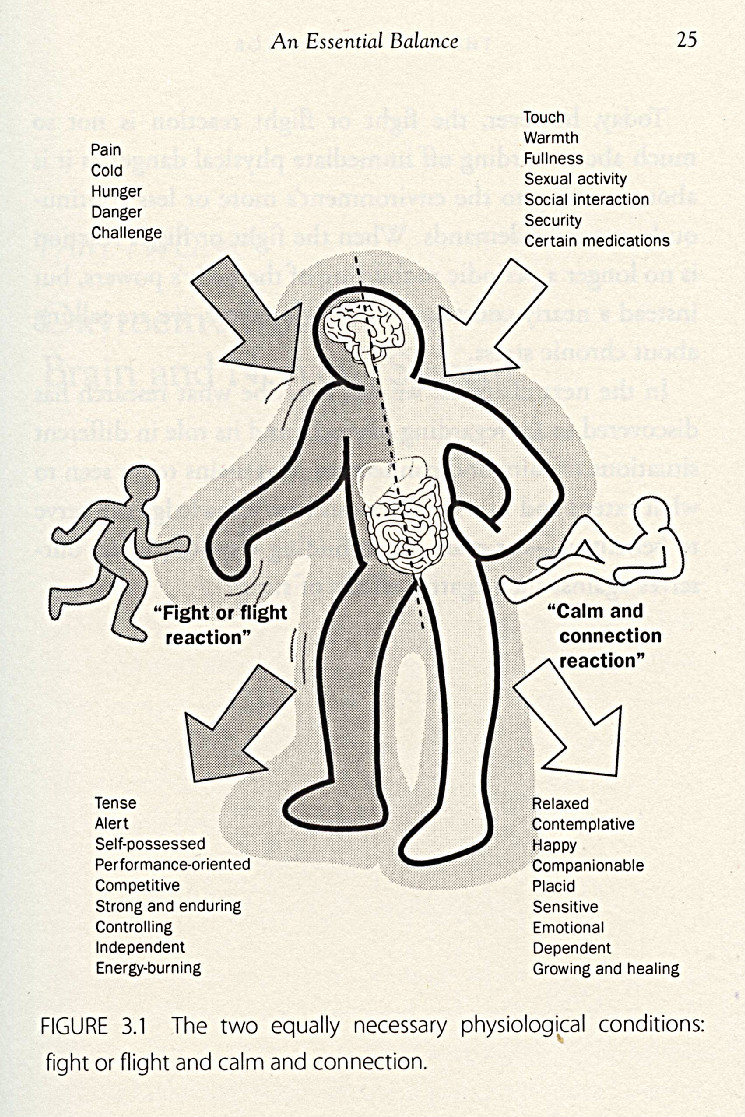
I wonder about this today in regard to this image presented in the book by Dr. Kerstin Uvnas Moberg, The Oxytocin Factor: Tapping the Hormone of Calm, Love, and Healing.
++++
I located this excellent online source of articles on trauma, although I wish the page were more up-to-date!
– David Baldwin’s Trauma Information Pages –
Contained among these pages is this:
Introduction to Survival Strategies
Paul Valent
This is a modification of a key chapter (chapter 7 by the same name, pp. 115-123) in From Survival to Fulfillment: a framework for the life-trauma dialectic, by Paul Valent (1998). Philadelphia: Brunner/Mazel. Copyright© by Paul Valent.
Valent presents a chart (about half way down his pages) that includes many aspects of the trauma response in detail: Table 2 – Survival Strategy Components. This article and table are useful, and worth reading, but Valent does not mention the freeze response, either.
Something is missing. I don’t find what resonates with me in trauma-response writings because the authors of these writings are missing the point I need in their own thinking about trauma as it applies to many severe infant-early childhood abuse and trauma survivors.
++++
I found this article:
Inducing traumatic attachment in adults with a history of child abuse: Forensic applications
By Felicity De Zulueta published in The British Journal of Forensic Practice * VOLUME 8 * ISSUE 3 * SEPTEMBER 2006
It presents typical theory and understanding about how particularly disorganized-disoriented insecure attachment is created and how it manifests in infants as well as in adults. This author, as do others, suggests that the biggest problem with insecure attachment happens when the early caregiver is the source of fear to an infant. The infant has no one to turn to for safety and security, and is left in a state of ‘fear without resolution’.
Researchers and theorists assume that an infant will do everything in its power to try to get its earliest attachment figure to respond to it appropriately (according to the infant’s needs). What happens when absolutely nothing the infant can do – within its very limited natural abilities – works? What happens when the efforts of the infant to generate an appropriate response from its caregiver results in unpredictable, painful, terrifying and completely inappropriate responses to its efforts?
From my point of view, I believe infants and very young children are forced to deal with this state of ‘fear without resolution’ — so that they can ‘go on being’ while in situations that present what other developmental experts call, ‘the unsolvable paradox’ – in ways that all but the most thorough-thinking and astute researchers miss completely.
The infant is left in a frozen state of helplessness that is like suspended animation. This response shares some of the typical patterns of response assigned to the fight-flight response, but is inherently different. I do not agree with professionals that assign the term ‘coping mechanism’ to the processes that these severely abused infants and young children are forced to develop within their growing body-brain.
Some discussion of the child response to trauma can be found here:
Childhood Responses to Threat/Coping Strategies
++++
Because my history of severe infant-child abuse happened on the far-far-from-normal range of parenting practices, I personally know that there is a whole other level to early trauma survival that even this information (above) does not address.
“A child experiencing abuse develops strategies, which become coping mechanisms which enable day-to-day functioning, but yet help the child detach from the emotional and physical pain of events, especially when abuse continues over a long period of time….”
In my thinking a CHILD is a far different entity than an INFANT is. Most all research statements, like this one, make the assumption that the two stages of being human are the same.
When severe abuse occurs during fundamental, critical window-of-development stages, these so-called ‘coping mechanisms’ do NOT exist as such. What I experience is a life lived within a body-brain that was changed in its development as a direct consequence of the trauma I was forced to endure. I know that very real epigenetic changes occur. I know that nervous system-brain circuitry changes.
SOMETHING ELSE results from early severe abuse. I even believe it is more than so-called dissociation. I believe it is more than the fight-flight response. It is more and different even from the freeze response as presented in these writings.
++++
I am left to explore from within what I can detect about how my body-brain operates in the world – and to try to determine the nature of my experience. I often return in my thoughts to the presentation of the unique child-woman in the movie “Nell.” I will never forget my response to this movie the first time I watched it.
For the first time in my life I was presented with an image of a person who was more like me than anyone else I had ever imagined. And yet even this imagined character was far different than I was. This character had a bonded attachment at least at one point in her life to her twin sister. She had a bizarre mother, but not a mother that hated, tormented and abused her. Unlike me, this character did not seem bonded to the life of the natural world around her as I was growing up in Alaska.
Yet the difference between this character and other people was portrayed adequately enough to let viewers know that there was something so different about Nell that she would never in ten million years ‘be like other people’.
Thoughts of this movie comfort me now. If you’ve never watched it, please consider doing so. There are many realms of human experience that can only be presented through forms of art, and the state of being I am more familiar with than not is at least alluded to in this story. But the film presents no suggestion that Nell was remotely concerned with whether or not she was like other people or if others could understand her. How freeing that would be to me, if I could ever attain that state!
Nell did not wish to be any other way than how she was in the world. My problems probably stem mostly from the fact that I do.
++++++++++++++++
 Stop the Storm
That episode or attack lasted for more than an hour and
once it subsided and I could think clearly I was determined to find a way to stop whatever was triggering the attacks and eliminate these episodes from my life.
You always live in that fear that you will get the panic
attack. A good understanding of what causes a panic attack is
imperative. Menopause and panic attack may be tough to go through, but with the full support
of your loving family and dear friends, you will be able to pull through it successfully.
You wrote: “SOMETHING ELSE results from early severe abuse. I even believe it is more than so-called dissociation. I believe it is more than the fight-flight response. It is more and different even from the freeze response as presented in this writings.”
Dissociation encompasses far broader experiences than is usually recognized by experts or laymen. I found out what happened to me in the first days of my life (and possibly some pre-birth) through marbled images in 1-inch by 1-inch bathroom tiles. I SAW what happened in those tiles and I understood that each image was a dissociated memory of my being in that moment. Each image, each tile, was of an infant, child, or fetus. Some were of body parts.
These images didn’t describe in expert’s terms what happened in my brain. Better than that, they gave my own history, my life, the hundreds of parts of ME, back to me. Each contained one moment in time, all moments of physical torture and near death.
Neither running nor freezing could ever have been an option at those points. I was a newborn, at most. Dissociation doesn’t adequately describe it, perhaps, either. What could I dissociate of myself at such a time when I didn’t even know I existed, didn’t know where I was, or what anything meant? But my mind took each moment that contained too much pain to bear and it placed each one in a little box with a picture of me, as if I could see myself from outside of myself. An amazing thing, when you think of it. A newborn without any awareness of what she looked like, picturing herself as a physical being. Or was it just the “out of body” experience in fact?
Nothing I have ever read anywhere or heard from anyone has ever described anything like what happened to me. My mind, my self, was shattered, exploded into a million pieces and scattered to the wide winds, but my mind somehow retained those events and gave them all back to me. How can I expect anyone to explain that who hasn’t been through it? And considering it took me 50 years to recover this “memory,” even if someone has experienced this, how can I expect them to be able to explain it well enough for anyone else to understand?
I appreciate your comment! Thank you for it. Sometimes I feel very alone. Your words help me to feel connected knowing that there ARE people out there who know.
Over and over again it keeps coming to me that what I might understand of my own experience is that something was (and still is) very different for me in relation to the passage of time.
I cannot explain this in words, not even so I can really even ‘think’ about what I know I know from the time of my beginnings (being born into my mother’s madness) – not even ‘yet’.
I appreciate your own image with the tiles — I have thought of my own experience in terms of ‘bubbles’ of instants of encapsulated awareness – but they remain separated from one another (and remain objective as if separate from me) as if passing time between the experiences is real, physical, tangible — even more real than the experiences themselves – as if the bubbles float in ‘it’ and are surrounded by ‘it’ and kept apart by ‘it’.
I could not see ‘me’, I don’t think, even up until 18 when I left home. I have no memory of ever thinking about myself in terms of ‘I’.
I think a great deal of what is expected to be the way people are put together is only one option, one alternative, though by far the most common one. I believe there are other ways of being in one’s own life in the world that are not described unless those of us who experienced these greatly altered infant-toddlerhoods attempt to describe our experience as it felt-feels to us. This is all much complicated by the fact these experiences happened to us way before we had language. That does NOT mean we don’t remember what happened.