
++++++++++++++++++++++++++
If we cannot ever stop wincing from our own internal, unconscious pain we will never be able to truly sign from another’s.
++++++++++++++++++++++++++
I had a dream last night that I cannot remember. All I know is that it had something to do with improvement in well-being that can happen in more than one way and involves the vagus nerve system. Some of those ways of positive change could happen consciously and some of them could happen automatically and unconsciously. In my dream these changes seemed to be linked like spokes of a bicycle wheel to a center hub – which was the vagus nerve.
Feeling a little puzzled this morning about what this dream was telling me, I returned yet again to Dr. Dacher Keltner’s chapter on compassion (from his book Born to Be Good: The Science of a Meaningful Life) where he writes about the methods developed about fifteen years ago that measure the activity of the wandering vagus nerve bundle that have shown:
“When we inhale, the vagus nerve is inhibited, and heart rate speeds up. When we exhale, the vagus nerve is activated, and heart rate slows down…. The vagus nerve controls how breathing influences fluctuations in heart rate. We measure the strength of the vagus nerve response, therefore, by capturing how heart rate variability is linked to cyclical changes in respiration.” (page 233 – also included with yesterday’s post).
At the same time that I was having this dream last night, I was also having the sense that for all the work I’ve put into trying to ‘technically’ understand the dynamics of my mother’s abusive relationship with me, this single vagus nerve-hub-image is the most important one I have discovered thus far. As I think about it all this morning in the light of this cloudy, gray day, I also realize that yesterday’s post directly about the hub of the vagus nerve and my mother’s self-weakness brought the fewest numbers of readers to my post of any in many, many months.
As I to suppose that I have ended up at a dead end in the labyrinth of my thinking about the causes, consequences and hope for ‘cure’ for those of us who suffer from severe early abuse histories reflected in the dearth of interest shown by readers to my yesterday’s post?
My dreams have never, in the six years I have been studying the case history of my mother’s severe abuse of me, been wrong. They have never led me astray. Many times my dreams have opened a new direction in my search and thinking that have allowed my past thinking to gel so that some new thinking can emerge. Last night, I know, was no different and the images that I remember upon waking are no doubt correct. My dream is pointing me toward something important.
++++
I find that Keltner next directly ties the physical measurement of vagus nerve activity not only to the experience of compassion versus pride, but also to altruistic acts. Nobody except those concerned with infant and child abuse would probably ever have a need to think about appropriate and adequate parenting of offspring in terms of altruism. Isn’t loving one’s babies and children something humans simply do automatically and instinctively?
Obviously, from the point of view of severe infant-childhood abuse, neglect, and malevolent abuse survivors, NO it is not!
Although the research that Keltner describes was not designed to target the vagus nerve bundle as the being the seat of abuse, as soon as he described it as the probable seat of compassion he is suggesting to me that it is. Keltner cites research in his chapter on compassion that documents “that this selfless state of compassion produces altruism.” (page 237), and that when faced with a situation that can trigger either “pure self-interest” or “the swell of compassion” in the chest (page 238) the reaction of the vagus nerve system will show corresponding activity as one of the branches of the Autonomic Nervous System (ANS) responds: either the GO fight/flight arm related to pride and self-interest or the STOP arm related to compassion.
The research findings about the vagus nerve and compassion have shown in these studies that (as mentioned in yesterday’s post):
“Participants’ reports of their feelings of compassion increased as their vagus nerve activity increased. With increasing vagus nerve response, participants’ orientation shifted toward one of care rather than attention to what is strong about the self.
“Then our participants, feeling surges of either compassion or pride, indicated how similar they themselves were to twenty other groups…. Our participants made to feel compassion by viewing images of harm reported a broader circle of care – they reported a greater sense of similarity to the 20 groups – than people feeling pride. This feeling of similarity to others increased as individuals’ vagus nerve fired more intensely.
“And when we looked more closely at whom people feeling compassion and pride felt most similar to…we found that pride made people feel more similar to the strong, resource-rich groups in the set of twenty that they rated…. Compassion, on the other hand, made people feel more similar to the vulnerable groups – the homeless, the ill, the elderly…. Compassion is anything but blind or biased by subjective concerns; it is exquisitely attuned to those in need.” (pages 234-235)
++++
Why am I bothering to again repeat Keltner’s words here? My dream last night showed me that while these findings lie very close to the heart of the infant-child abuse perpetrator’s problem, they are not what is actually at the very center of the hub.
These words are talking about an inner alignment that is supposed to happen in our body as it corresponds to the activity of the vagus nerve in response to either stimulus that appropriately creates a pride reaction or appropriately stimulates a caring reaction. Infant-child abusers, in my thinking, cannot possibly be experiencing appropriate responses along this continuum.
Keltner is describing here that these pride versus caring reactions are associated with how the self aligns itself on a continuum of power and resources. Pride corresponds to an alignment with ‘power-full’ others while caring corresponds to an alignment with ‘power-less’ others. The resource being considered here is POWER.
I cannot see a way that anyone’s self can consider power as it relates to others without at the same time considering power as it relates to their own self. If a person’s own self was formed in a malevolent, unsafe and insecurely attached environment that self will not automatically have a sense of itself as being ‘power-full’. Such a self, because it suffered from degrees of powerlessness in the face of overwhelming traumas as it was growing, will have formed itself with depletion rather than with plenty at its center. Such a self will continue to negotiate itself in power-related situations in different ways than will a self that was formed in a benevolent, safe and secure attachment environment.
++++
I believe that we are close to the hub of what is wrong with infant-child abuse perpetrators when we read these few words in Keltner’s statement: “With increasing vagus nerve response, participants’ orientation shifted toward one of care rather than attention to what is strong about the self.” (page 234) The three key words here are ORIENTATION and ATTENTION and the action of SHIFTING.
A strongly formed self can choose – consciously or unconsciously — to accomplish this shifting of orientation and attention away from self and toward others smoothly and appropriately in ways that a weakly formed self cannot. The activity of this shifting can be measured with the vagus nerve response. This measured vagus nerve response shows the degree of orientation and attention to the self versus orientation and attention to the other.
Three key and fundamental factors of being an ‘evolutionarily advanced’ member of the human species are altered in these early malevolent self-forming environments: (1) the nature and recognition of the individual self, (2) the nature and recognition of the ‘other’s self’, and (3) the nature and recognition of the boundary that separates ‘self’ from ‘other’.
A weak self, formed in an early environment of malevolent, overwhelming trauma, will NOT be strong enough to shift its orientation or attention away from its own self-preservation. In addition, because a weak self is formed in unsafe and insecure early attachment relationships, it has no clear idea about its own self in relationship with any other self. To miss or to ignore these facts is to entirely miss and ignore the very heart of infant-child abuse cause and consequence.
I believe this very heart can be measured if not actually SEEN in the response of an infant-child abuse perpetrator’s vagus nerve.
++++
I am not going to try to shorten what Keltner says next. Within his words is a clear example of the vagus nerve response already operates when we are very young along with what Keltner refers to the “clarifying point” that determines what a person is actually likely to DO in response to another person’s weakness/vulnerability/need:
“Stronger evidence still would link selfless, altruistic action to activation in the vagus nerve. Nancy Eisenberg has gathered just this kind of data. In one illustrative study, young children (second-graders and fifth-graders) and college students watched a videotape of a young mother and her children who had recently been injured in a violent accident. Her children were forced to miss school while they recuperated from their injuries in the hospital. After watching the videotape, the children were given the opportunity to take homework to the recovering children during their recess (thus sacrificing precious playground time). Those children who reported feeling compassion and who shoed heart rate deceleration – a sign of vagus nerve activity – as well as oblique, concerned eyebrows while watching the video (see figure below) were much more likely to help out the kids in the hospital. In contrast, those children who winced, who reported distress, and who showed heart rate acceleration – that is, those children who winced, who reported distress, and who showed heart rate acceleration – that is, those children who reacted with their own personal distress – were less likely to help. These findings make a clarifying point: It is an active concern for others, and not a simple mirroring of others’ suffering, that is the fount of compassion, and that leads to altruistic ends.” (pages 239-240 – bolding is mine)
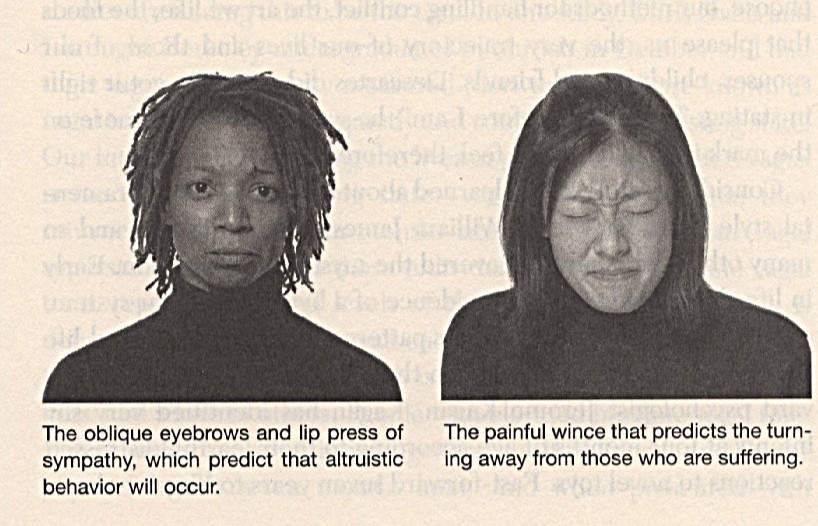
What is fascinating about this “clarifying point” that Keltner is making is the fact that it is when early infant-child mirroring activities between early caregiver and the little one in the attachment environment, while its self is forming well before the age of two, that these response patterns between self and other form the nervous system and brain. In traumatic early environments, a different nervous system, brain and self are formed that will operate differently throughout the lifespan.
What Keltner is describing here is the HUB OF THE WHEEL of the caring-compassion response that was changed in my mother, and I would say within all infant-child abusing caregivers. Because their self formed with the distress being a part of the self, because the self did not form with the power to make the distress STOP, wincing will always be the vagus nerve response rather than the sigh.
But a self formed like my mother’s was seals off from consciousness any awareness of the self’s distress, pain or ‘wince’. Such a self also seals off from conscious awareness its own inherent power-less state.
When the self contains its own perpetual pain, distress and powerlessness, when it cannot clearly identify who its own self in or who the self of any other is clearly, when it cannot define clearly where the boundary lies between its own self and another self, it will never be able to respond appropriately to pain – its own or anyone else’s.
The center point of the hub of the wheel where humans negotiate self and other seems to lie in the vagus nerve response, where orientation and attention to the self can shift toward others – or not. That the entire array of responses can be narrowed down to the difference between a wince or a sigh makes perfect sense to me.
My mother did not know where her own self started and stopped. She did not know where I started and stopped. My mother never stopped wincing from her own (unconscious) pain. My mother could never appropriately sigh for anyone else, certainly not for me.
(Post subject to be continued…..)
++++++++++++++++++++++++++++++++++++++
 Stop the Storm