
+++++++++++++++++++++++++++++++++
I find that the only standard I can consistently depend upon in my considerations about what constitutes malevolent treatment versus adequate, benevolent treatment lies within the context of the United Nations Universal Declaration of the Human Rights of Children. Safe, secure, appropriate and adequate early care that leads to an infant-child’s optimal development lies on a continuum at the opposite end from early malevolent conditions that present nearly a constant challenge and threat to survival itself.
The basic needs of children are defined in this Declaration. In looking at my own history of survivorhood (I was never allowed to be a child, and therefore I no longer consider that I had a childhood at all) it is clear to me that every one of my rights as an infant-child were violated. It was in that malevolent environment of deprivation that I was exposed to the degrees of trauma that were severe enough to create within the physiology of my body Trauma Altered Development (TAD).
From my earliest beginnings as a being physically separate from my mother was suffered from a lack of safe and secure attachment. Deprived of that most fundamental resiliency factor, my body-brain-mind-self had to do the best that I could do to continue to grow and develop within that terrible environment that threatened my very existence.
This third post on the topic again continues an exploration of how TAD changes an infant-child abuse survivor’s reaction to ALL trauma. Van der Kolk writes about posttraumatic stress disorder (PTSD) in the book, Healing Trauma: Attachment, Mind, Body, and Brain – Hardcover (Jan 2003, W.W. Norton and Co.) by Daniel J. Siegel, Marion F. Solomon, and Marion Solomon, chapter 4 (pages 168-195) written by Bessel A. van der Kolk: “Posttraumatic Stress Disorder and The Nature of Trauma.”
++++
I begin writing today by considering the last sentence of the scanned book pages that were posted on November 30, 2009:
“….progress in understanding the function of attachment in shaping the individual and rapid developments in the neurosciences gave a new shape to these old insights [about the importance of trauma].” (page 177)
++++
Van der Kolk next considers “The Psychobiology of Trauma” in his writing:
“Modern research has come to elucidate the degree to which PTSD is, indeed, a “physioneurosis,” a mental disorder based on the persistence of biological emergency responses.” (page 177)
In my thinking, naming PTSD ‘a mental disorder’ ignores the overwhelming evidence that the entire human body is included in the ‘persistence of biological emergency responses’ that the author is talking about. From my point of view, it is the consideration of how severe infant-child maltreatment and abuse changes the development of the ENTIRE BODY of the little one that matters to those of us who survived this degree of early trauma.
‘Biological emergency responses’ BUILT our bodies. These responses signaled our DNA how to express itself. These responses signaled our developing nervous system and brain on all levels about how to adapt to trauma. Our developing nervous system was also intimately involved in these responses as it formed, also. It is at this most basic, profound level of our physiological development from our beginnings that we have to understand how our development changed in ways that a non-TAD ‘ordinary’ body did not.
The adaptive changes that happened to us took place on far, far deeper levels than just the level of mind. Mind is simply the topmost layer of our existence that I see as being related to our body as smoke is to fire. I do not have a ‘mental disorder’. My entire being is ordered in a very particular way in accordance with what surviving my infant-child trauma required.
It is this Trauma Altered Development that created my survival based, trauma centered ordering of my entire being that I seek to understand. I am not convinced that van der Kolk has anything more than a passing surface notion of what these TAD changes actually ARE, how they affect us, or even if they legitimately belong to anything like a PTSD diagnostic category.
++++
Van der Kolk continues by saying:
“To understand how trauma affects psychobiological activity, it is useful to briefly revisit some basic tenets of neurobiology.”
I do not like the term ‘psychobiological activity’ because it implies that anyone on the outside can ever have any accurate information about what another person’s ‘psyche’ is like. That is why researchers try to more completely understand the human ability to form a Theory of Mind. MIND belongs to each of us as individuals, and everyone has their own. Nobody can ever come to understand what the subjective experience of MIND is like for another person.
‘Neurobiology’ is a different thing. This is a realistic descriptive word that refers to a part of a person that can, within the current limitations of science, be understood and described because it is physically real on the molecular level. But neurobiology is not the same thing as MIND.
Van der Kolk continues:
“McLean (1990) defined the brain [my note: The brain is a biological reality as part of our nervous system, from which an individual’s MIND originates. Brain and MIND are not the same thing.] as a detecting, amplifying, and analyzing device for maintaining us in our internal and external environment. These functions range from the visceral regulation of oxygen intake and temperature balance to the categorization of incoming information necessary for making complex, long-term decisions affecting both individual and social systems. In the course of evolution, the human brain has developed three interdependent subanalyzers, each with different anatomical and neurochemical substrates:
(1) the brain stem and hypothalamus, which are primarily associated with the regulation of internal homeostasis,
(2) the limbic system, which is charged with maintaining the balance between the internal world and external reality, and
(3) the neocortex, which is responsible for analyzing and interacting with the external world.
”It is generally thought that the circuitry of the brain stem and hypothalamus is most innate and stable, that the limbic system contains both innate circuitry and circuitry modifiable by experience [my note: This emotional area of the brain forms through early caregiver attachment interactions birth to age one, forming MUCH earlier than the neocortex], and that the structure of the neocortex is most affected by environmental input (Damasio, 1995). If that is true, trauma would be expected to leave its most profound changes on neocortical functions, and least affect basic regulatory functions. However, while this may be true for the ordinary stress response, trauma – stress that overwhelms the organism – seems to affect people over a wide range of biological functioning, involving a large variety of brain structures and neurotransmitter systems.” (pages 177-178)
++++
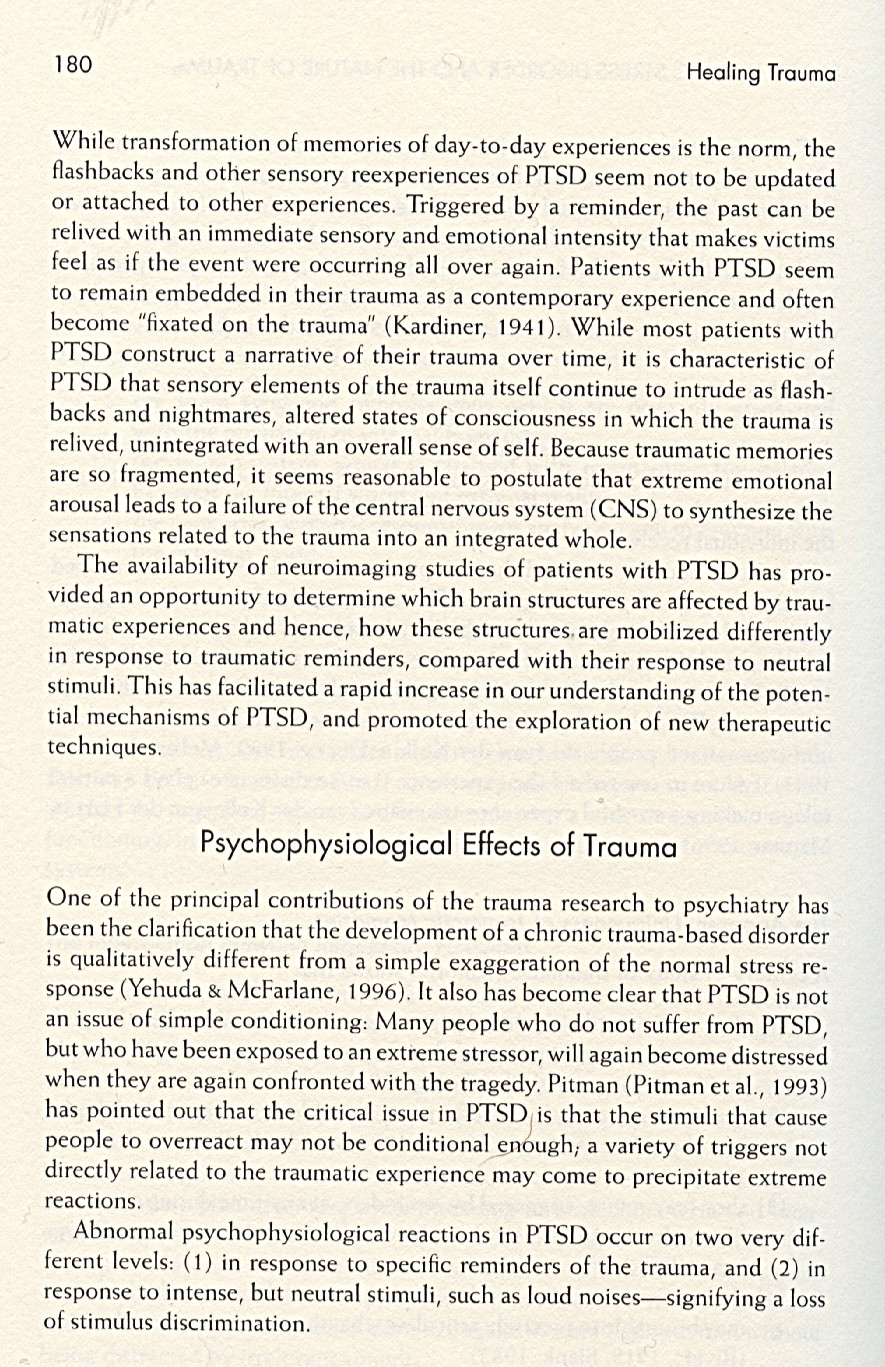
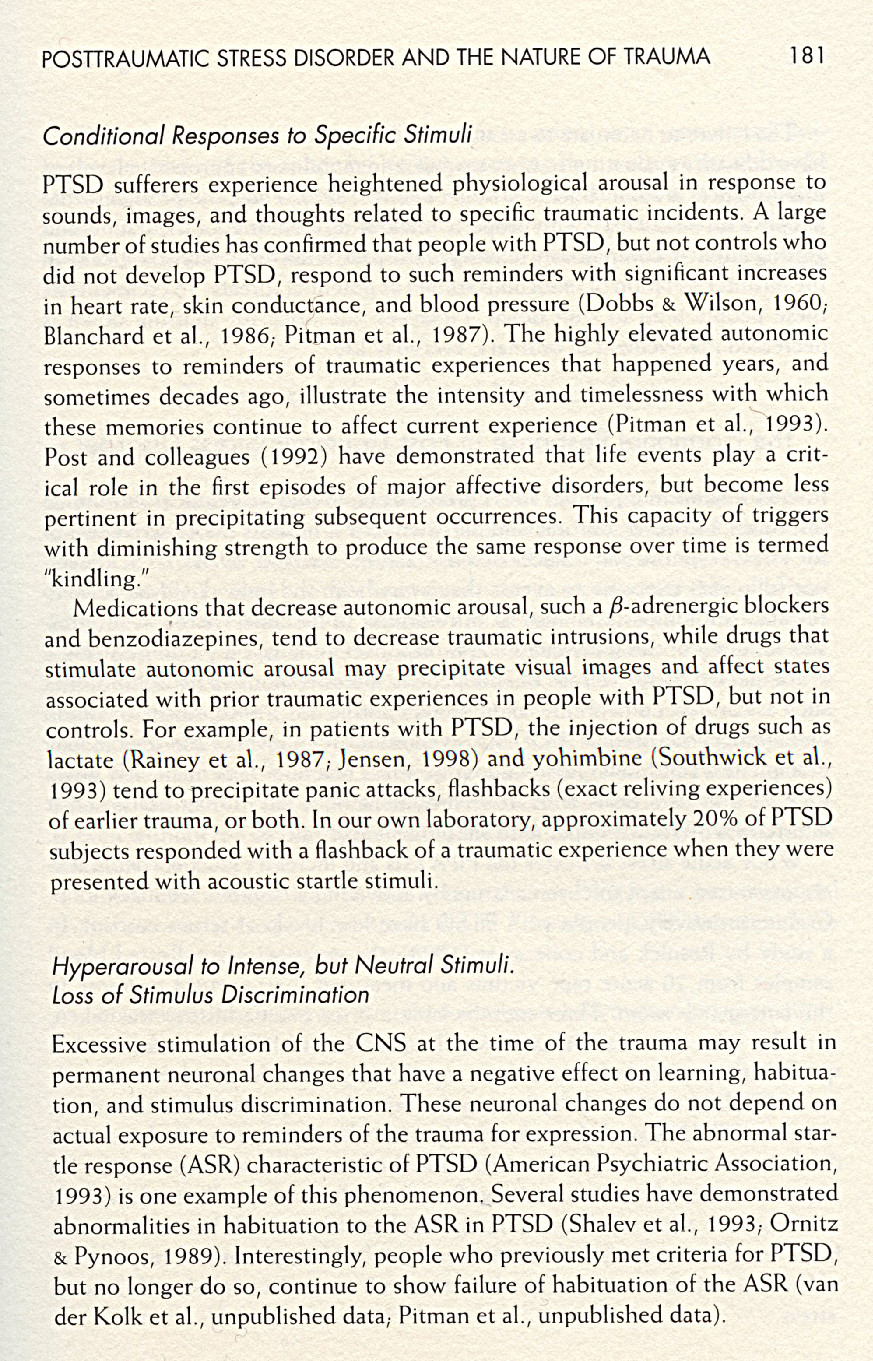
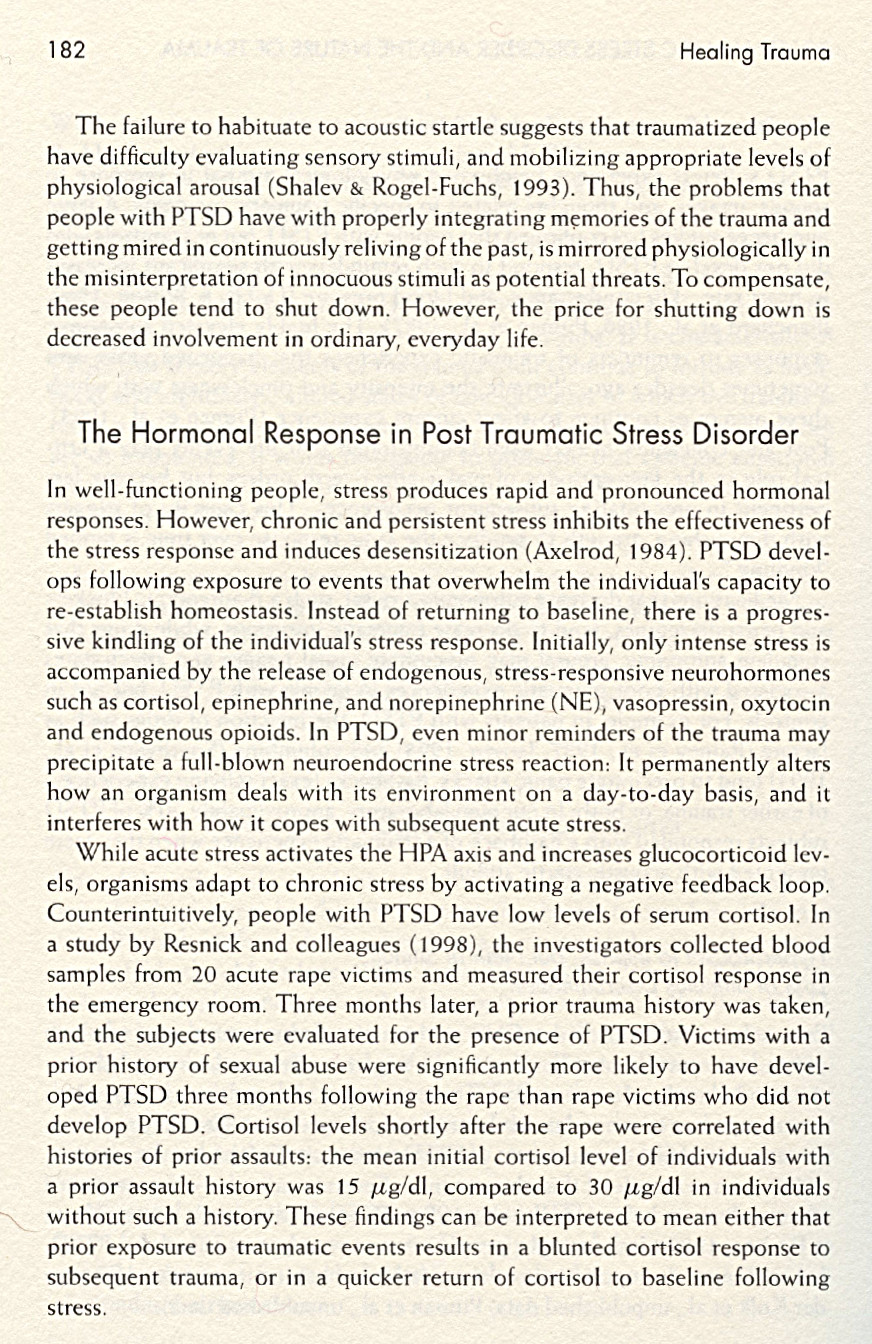
I am going to scan in the book pages that follow in van der Kolk’s description of how trauma affects people. I believe his statement on the bottom half of page 190 is extremely important:
“…the development of a chronic trauma-based disorder is qualitatively different from a simple exaggeration of the normal stress response….”
We need to stretch that concept as far as we possibly can if we are going to understand how severe trauma from malevolent infant-child abuse and neglect changes our entire development – nothing about us is excluded. Any possible aspect of our development that can adapt its development in order to help us endure and survive early trauma – does so.
Our problem comes when the reality of our early trauma is denied along with the depth, breadth and width of its impact on our development. What may be true for a non trauma altered development person cannot be assumed to be true for us. Yes, we know what the following descriptions of consequences FEELS like – but we also know that we never knew any other, different way of being in the world.
Due to the changed development we experienced as we survived our early severe traumas, anything that we might begin to understand now as being more like ‘ordinary’ in our physical – and correspondingly in our mental — ability to experience our self in our body in our lifetime, will happen as we begin to understand how deeply trauma formed us in the first place so that we will NEVER experience trauma (or life) in the same way as will a person who did not experience Trauma Altered Development when they were little.
++++
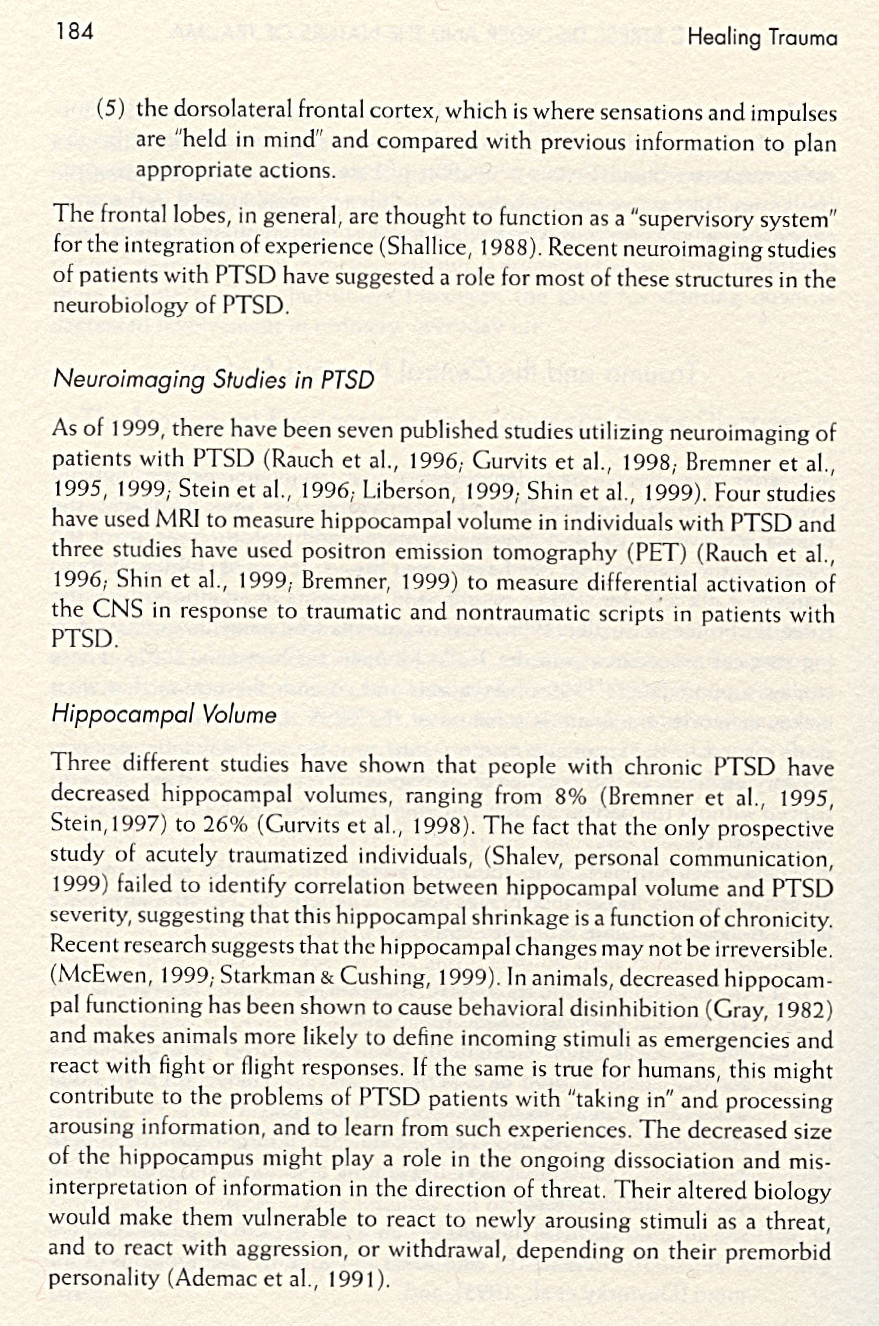
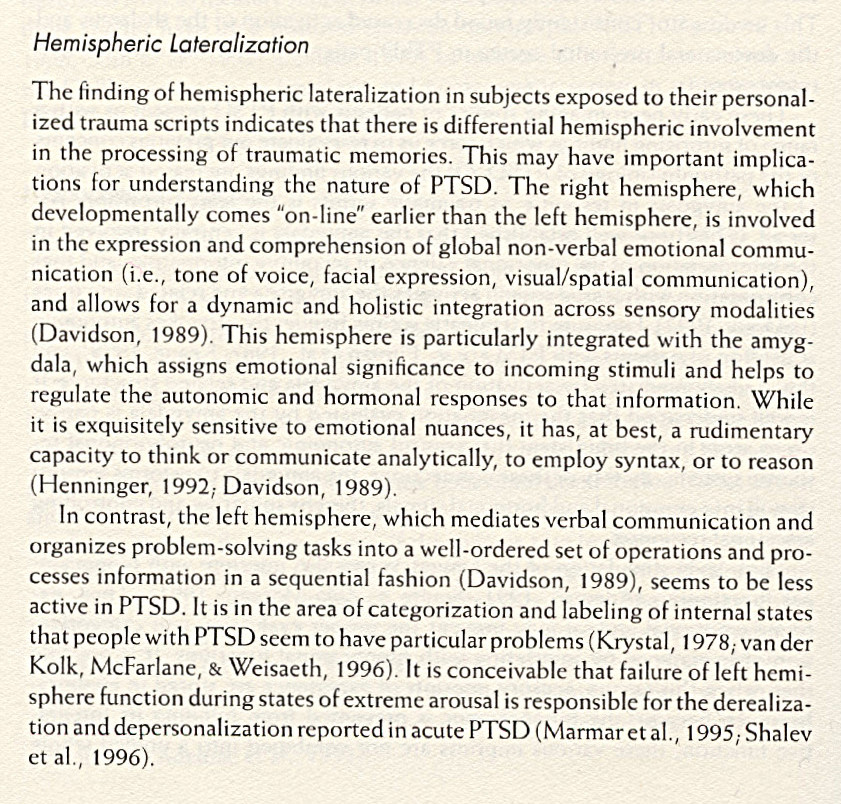
The scanned pages below (from the book mentioned above!) is complicated information, but it is a place for us to truly begin to understand ourselves – the way were MADE in the severely abusive and trauma-filled environments we were formed in.
On page 184 van der Kolk notes that “PTSD patients” have problems
“…with “taking in” and processing arousing information, and to learn from such experiences.”
Sorry, but I am not a ‘PTSD patient’. I am a 58-year-old woman who has suffered from an extra-ordinary body, altered in all its developmental stages in adaptation to trauma, that has never been able to ‘take in’ even ordinary information, let alone ‘arousing information’, or to ‘learn from’ the experiences of my life in an ordinary way.
What on earth do we expect to happen to little people who must continue to develop and survive even while they have little or no access to even their most basic Universal Human Rights? Infant-child development IS ALTERED under these conditions. It is time that we realize this is the most truly horrific consequence of early abuse and trauma. We don’t get to experience ANYTHING the same way as non-early-traumatized people do – not even later traumas.
(note: I believe in ‘degrees of damage’ – the 75% of our sub-par young adults in this country have suffered some degree of damage that has changed the course of their development away from optimal and BEST! We cannot afford to ignore that fact – deprivation and violation of the Universal Human Rights of Children causes changes in the way their body and brain develop. There is a very real, physiological process through which trauma and deprivation get passed on down the generations. We know it is happening when we see the consequences in degrees of lack of well-being –- which are detectable no matter what our age.)
++++

++++++++++++++++++++++++++++++
This post follows:
from November 30, 2009 +PTSD AND SEVERE ABUSE SURVIVORSHIP – PART TWO
from November 28, 2009 +PTSD AND SEVERE CHILD ABUSE SURVIVORSHIP – PART ONE
+++++++++++++++++++++++
PLEASE NOTE: Do not take anything I say as a reason to alter any ongoing treatment, therapy or medication you are receiving. Consult with your provider if you find something in my writing that brings questions to your mind regarding your health and well-being.
++++++++++++++++++++++++++++++++
Please feel free to comment directly at the end of this post or on
+++++++
Your Page – Readers’ Responses
++++++++++++++++++++++++++++++++
 Stop the Storm