+HEALING TRAUMA WITH THE TIME ASSET

+++++++++++++++++

I have a few other thoughts related to my encounters with people-families-children at the Saturday children art festival where I did the spinning demonstration.

One collection of thoughts has to do, again, with small and big people and how humans relate to one another in ‘tearing down’ or ‘building up’ ways.  A young man about 12 years old stopped by my demonstration and immediately showed not only rapt interest but quite a bit of knowledge about spinning, weaving and the fiber arts.  His mother was with him, and in talking with these two I was given a picture I’ll try to relay to you here.

Last year this boy enrolled in a beginning weaving class held by Bisbee’s local Fiber Arts Guild.  He was fascinated, learned quickly, warped his own loom at the Guild studio and made his mother a scarf along with a baby blanket for his newborn cousin.  In the middle of the weekend class schedule his mother became ill.  The Guild was notified, and the boy missed three of the 10 week class sessions.  When he was able to return he found not only that the Guild members had passed off his loom with his next project on it to someone else, but they had not bothered to call and ask or tell him this was being done.  The adults participating in these activities were evidently quite demeaning, rude, disrespectful and hurtful to this child.  They let him know they did not want him around.

I have been given a solid and working handmade table top loom that I told this boy I will bring into town and leave off at his home for him.  I will collect all of the related items I can find here that go with the loom, look for a book or two I might have here at home that can help him, and also see what I have in the way of extra yarn I can give him.  Once I have all of this collected, I will pile it all into my trusty 1978 rather worn El Camino and drop it off at his house.

With all the troubles our nation is having in engaging our youth in their own lives, let alone in the life of their community and nation, it is beyond my comprehension how ANYONE could be rude to any child, period!  Let alone to a child like this boy is who is obviously motivated with passion to learn the fiber arts and is committed to doing so!

++++

The next collection of thoughts I have is related to an 8-year-old boy and his parents who stopped by my demonstration.  This child is obviously brilliant, as are his parents.  His father is a professional musician, a drummer.  His mother is a computer programmer web designer.  The child is fortunately home schooled and very much loved.

From the first instant this child spotted the very simple and basic, actually rudimentary gizmos and gadgets that are used in the process of preparing wool and spinning it, I could see that his brain did not work like an ordinary child’s.  His parents sat most patiently for over two hours on a stone bench in the middle of the Central School hallway while their son explored every avenue not only of the wool preparation process, but most noticeably of the equipment – how it was constructed, how it worked, why it worked.

Not knowing anything by fact here, I can still think that this child’s tool region of this brain is forming major connections.  The child certainly wasn’t intimidated by people.  In fact, he hawked the process from his newly found and claimed station at the drum carder.  He instantly memorized every step of the process when I first told him, and continued to instruct every passerby he could rope in about how this all worked.

At one point I was vaguely aware of him giving his spiel while I sat at my spinning wheel visiting with his parents.  All of a sudden I hear the boy say in a rather loud, commanding voice, “Hey!  What’s wrong over there!  Why aren’t’ you working?”  I had to laugh.  There I sat like a broken machine.  He had educated his audience completely up to the point where they needed to see the final stage in process, and there I was having dropped my end of the bargain.

The boy was not being rude, though certainly his attitude could have been interpreted that way.  This boy, I could tell from watching him, treated human beings exactly as if they had gears and mechanisms and programming that made them tick.  He is a brilliant, absolutely brilliant child, but I would not expect him to ever have an ordinarily developed right social-emotional limbic brain.  His brain is special, as he is.

This brings me to mentioning the Asperger autistic spectrum giant, Temple Grandin.  A made-for-television movie about her life has just been released:  “The HBO movie “Temple Grandin” honors its heroine’s priorities, stressing deeds over tearful setbacks and joyous breakthroughs.”  If you haven’t heard about Grandin and her work before now, please spend a little time checking her out.  In the meantime, I will specifically mention that Grandin has a LOT to say about so-called GEEK children who have brains that are gifts to the world.  This little boy might well fit into the schemata of the children Grandin is talking about.

++++

This brings me to my third thought collection for today which is related to yesterday’s post, +SO MANY NEEDY PEOPLE IN DENIAL OF THEIR NEEDINESS.  Due to the insane and terrible abuse I suffered during my childhood from birth, complete with extended manipulation of any opportunities I might have had from tiny on to interact with people, my right limbic emotional-social brain did not have the chance to build itself in an ordinary fashion (as this blog’s readers have heard me write about repeatedly).

As a part of the spectrum of consequences to the adaptive brain changes my body made, I do not read, understand, process, or respond to the emotional-social signals other people send out easily or well.  In some ways, I am realizing that I have a rather unique ability to not automatically buy into the send-receive-respond social signal-cue communications cycles that people with ordinarily built early brains (through safe and secure early caregiver attachment exchanges) are designed for.  I can notice, attend to and translate actions that ordinary-brained people probably miss — because they CAN.

(Similarly, I suspect, to how the 8-year-old boy’s brain gains and processes information about machines that few other brains would, or can, notice.  Temple Grandin’s brain gets this altered information about animals.  These are abilities that do not come primarily from choice.  They reflect in manifestation different body-brain constructions — changed in part or wholly by combinations of genetics interacting with the environment.  Our abilities give us resources that more ordinarily-brained people probably do not have.  These differences and changes are part of what makes us exceptional and extra-ordinary people.)

Lest any of my readers suspect that I am exaggerating the differences I experience in my emotional-social interactional abilities with people, let me again mention that these transactions normally occur in the hundredths of a millisecond response signaling range.  They are happening physiologically about at the speed of light, or however quickly electrical signals are sent and received between neurons and other bodily cells.

These extremely fast, and supposed-to-be automatic electrical signals are operating according to how a person’s body-brain was constructed primarily from conception through age one.  Connections between pathways, circuits, brain regions and the body are constructed very early on and all growth and development past these early critical window stages of development follow along accordingly as we finish our early (and later) development.

This matters in many, many ways.  When, as a commenter to yesterday’s post mentioned (See: +SO MANY NEEDY PEOPLE IN DENIAL OF THEIR NEEDINESS) those of us with these changed brains are faced with awkward, uncomfortable, disquieting if not down right mean interactions with other people, we have an extremely difficult time doing what this commenter suggested when she noted:  Eleanor Roosevelt said “no one can make you feel inferior without your permission.”

Our body-brain does not read social-emotional cues and signals in the same way as Ms. Roosevelt’s no doubt did.  As a result, our attempts to decipher all of the signals other people are sending out in the hundredth of millisecond range do not mean the same thing to us as they do to ordinary brains.  If we are even going to get a clue about what is actually happening in our interactions with others, we need the one thing to happen that SO RARELY DOES HAPPEN that we could consider it impossible.

We need time to slow way, way down.  Because these communication signals are designed (normally) to occur near the speed of light, because they are outward manifestations of electrical impulses traveling invisibly within a person yet STILL manifesting themselves in visual and auditory signals that we are supposed to automatically read, understand and be able to respond back to in kind, we are at a serious disadvantage when it comes to doing what dear Ms. Roosevelt (and this commenter) suggest.

There is a universe, and I MEAN A UNIVERSE of information necessary to process information between people according to this maxim:  “no one can make you feel inferior without your permission.”  The brain has to know who-what the self is completely, it has to know who-what the other is completely, it has to process what-where the boundaries are between them, it has to be able to process the “feel” emotional information appropriately (and FAST), it has to make determinations as to what the emotion means, what the value is connected to the emotion, whether it is an ‘approach’ signal or an ‘avoid’ signal, it has to assess what’s at stake, what the degree of risk of threat to self and/or life is, what is being asked or demanded by this nebulous ‘other’, who has the power, what are the control stakes, where free will and choice (higher cortical functions) can fit into the picture……..  In other words, there is NOTHING simple about humans interacting with humans!  NOTHING!

This brings me to my last critical point.  When infant-children do not enjoy body-brain development in interaction with SOMEONE in the earliest caregiver department that allows for a safe and secure attachment to others, to the self, and to the world as a whole, none of the emotional-social processes the early brain is building itself upon will include the same information as will the body-brain of those who DID have the benefit of these more optimal developmental experiences.

We would be better off to NEVER automatically assume that the person we are engaging with in any way has a NORMALLY built optimal body-brain.  I would never expect that the woman I mentioned who needed to put me down regarding my spinning had an optimal emotional-social brain any more than I would ever expect that the rage filled passive-aggressive (in complete denial) worker at the laundromat I mentioned has one either.  They are operating in survival mode just as I do, just as my mother did.

True, individual personality blends with individual experience to create individually unique selves (by ratio with conscious awareness).  I recognize more and more my own inability to negotiate complex human transactions and interactions BECAUSE I no longer opt out by assuming that my automatic responses are the ones that are best for me.  At the same time – quite literally – TIME is RARELY my friend.

In a culture of hit-and-miss, hit-and-run, of brushing past one another at near breakneck speeds, very few of us are allowed or given the kind of TIME we would need to slow these interactional processes down far enough that we could manage to HONESTLY, with integrity, and ACTUALLY do the kind of processing Ms. Roosevelt must have assumed could happen automatically for everyone always – IF ONLY a person chose to do so.

When the emotional-social brain has not been built optimally, and the corresponding wiring in the body is not either (i.e. vagus nerve, autonomic nervous system, stress versus connection system, etc.), the only hope we have of processing information in any other way than the automatic trauma-built way we are designed for is to have TIME to include conscious processing.  Our social milieu is too invested on shallow and speedy interactions to let this happen.

We end up operating without enough information relevant for the present instant of time we find ourselves in with other people.  Our version of automatic creates ripples upon ripples of inward discomfort that we don’t even usually know about.  As we DO begin to become aware of the changed way other people and ourselves process emotional-social information, we begin to notice details of information – in our feelings, emotions, grounded in our body – that time does not let us process within usual fast moving social interactions.  That does NOT mean we are WRONG if we claim that many of our interactions with others leave us feeling sour inside as if we swallowed a toxic poison.

To no longer deny the truth behind many of the intentions, needs, demands, assessments and assumptions humans in our culture are wont to dish out back and forth – often in disguise so as to appear socially appropriate – means that we are returning back to the very beginning of our emotional-social brain’s formation so that we can do things differently than was done to us.  We are learning to no longer deny what we know on our insides to be true for us.

I believe this is healing, no matter how uncomfortable the process might be to our self or to anyone else.  We must take the TIME we need to figure out these uncomfortable interactions with others and our responses to them.  This, to me, is where the hope for change truly lies – not in therapy chambers, not in pills and drugs.

Hope and healing lies

in our being willing and patient enough

to find our own questions

so that we can find our own way

to answering them.

+++++++++++++++++
+SO MANY NEEDY PEOPLE IN DENIAL OF THEIR NEEDINESS

++++++++++++++++++++

I have a whole collection of thoughts from my experiences of this last week, but I don’t know which thought – like a star in a constellation – actually belongs in what pattern with other thoughts.  There seem to be three main areas of my observations that are probably divided so:  (1) denial, (2) what empathy isn’t, and (3) many people must feel small.

To begin with, I want to say that being around people I do not know exhausts me.  Of course if I leave my house and go out there into the public domain, that’s who I encounter:  people I do not know.

The tip of the iceberg regarding my observations from last week is that people seem to me to be constantly jockeying for a one-up position when they interact with others.  I see nothing that would lead me to suspect people are conscious of how small they must feel that they need to find ways to make themselves feel bigger than other people.

These patterns would be tiring enough to negotiate even without the fact that people seem most skilled at making themselves feel bigger by finding subtle, ongoing ways to make other people feel smaller.

OK, so I see I am beginning with my third point, though I don’t yet know why.  How do these three topics connect to one another?  If I think about each one of them in terms of being like nets that filter aspects of our human experience, which one of the three has the biggest holes in it?

I am thinking in terms, again, of the vagal nerve system and its connection to the flight-flight response or the calm, connecting, caregiving, compassionate response.  What I sense around most people when I have to interact with them is that it doesn’t take very long at all before what is supposedly communication disintegrates into some strange kind of invisible power negotiation.  In that power negotiation one person works to feel bigger and more power-full by in some way denigrating, devaluing, and disrespecting someone else.  In other words, the OTHER must be made to feel smaller.

Language experts have found that fully two-thirds of human language interactions concern some form of gossip.  Taking those patterns as a given, what does it actually FEEL like to be in interactive communication with people?  How much of what goes on are we supposed to automatically IGNORE – and surprise!  Surprise!  Here is a direct connection to my first point above:  DENIAL.

Is denial actually the main tender that we use to negotiate most human-to-human interactions?  When people are not consciously aware of their own needs, or their wants, and instead constantly denigrate others to get these needs and wants met, aren’t they expertly practicing denial?

And then, on the other hand, the recipient of the denigrative comments is NOT supposed to consciously be aware of the true nature of the interactions.  We are supposed to unconsciously, automatically and in a state of denial of our own perceptions ACT our part in return.

Let me give you just one simple example from an interaction I had with a woman who is evidently a spinner.  This woman passed by my spot in the hallway yesterday at the public art carnival for children where I was demonstrating and stopped to have what is probably a typical kind of accepted human interaction with me.  I had never seen her before.

One of the facts that this woman evidently was oblivious to is that when a spinner is showing anyone, especially a child, how the wheel is sending a twist into the collection of wool fibers being held in one hand so that the twist creates yarn, one has to keep this section of the process clearly visible to the child.  This means that when I spin on my own I hold the fibers differently in my hands, usually meaning much farther away from the wheel.

So this woman found no reason at all not to just tell me with a snicker and a snide look on her face, “You are obviously doing that wrong.”  And then she proceeded to instruct me on what I was doing wrong – exactly – and to tell me how to do it better.  During this whole verbalized judgment and criticism process, during this denigrating, shaming, down-putting ICKY experience, did I tell her to shut the hell up!

I am proud of myself that I didn’t fall into the trap of explaining to her why I was holding my hands in a position other than the supposedly correct one she was asserting.  I did not defend myself.  But I did not tell her my truth in any other way, either.  I just suffered along with her in this transaction.

I have been spinning off and on for 35 years.  I know what I am doing.  I spin what I want the way I want.  My spinning is a part of me.  Nobody, and I mean nobody has the right to criticize this process that is a part of who and how I am in the world in my lifetime.  I mean that.  Literally.  Nobody has that right.  If they do it, I know without denial that this person is throwing their ugliness at me and I want NO PART of it or of them, either.

This would be no big deal if I didn’t understand what I do now in my heightened sensitivity state.  What I DO KNOW, if I let go of denial, is that this interaction is exactly typical of most human interactions I witness.  These transactions are meant to victimize someone else.  They are bullying transactions.  I hate them, and as a consequence, I don’t like to have any more to do with other human beings at this point in my life than I absolutely HAVE to.  There is nothing pleasurable or good about constantly having to be on guard against these subtle and no so subtle attacks on one’s selfhood.

++++

My simplest terminology I use for myself is that many people are just simply passive-aggressive.  The truth is, they are geared to fight.  I can sense another person’s denied rage in the isle of a grocery store, when I walk into a laundromat, when I stand in line a bank.  We are all familiar with road rage.  We can spot drivers who are displaying aggression with the way they handle their vehicle.  The way people handle themselves in their body is no different.  The signals are plain.

On my side of the center line, I can say that it’s too bad I don’t have the energy or the motivation to feel either empathy or compassion, barely even tolerance, when I put myself in any position to have to interact with such people.  I do not have the energy for it, the desire to engage, or any hope that anything I can do will sooth these people in any way.  I just plain don’t wish to be around them.

The truth is that I can no longer play this denial game.  It never does any good to stick up for myself, to take a stand on my own behalf.  I find that the only way not to escalate the denied rage in others is to pretend it’s all OK, to remain silent, to let them do their digs and get away with it.

That woman was victimizing me yesterday.  She appeared to need to assert her ‘betterness’ by stabbing me in any way that she could.  I might feel sorry for her, but I am frankly tired of that!  Do I expect that strangers could ever walk up to one another and clearly state, “I am feeling small.  Please, I need you to help me feel bigger” in a culture that has somehow managed to create so many of us that feel so small in the first place?

++++

I happened to meet a young man who came through town for a few months with his wife and children and moved on again last week.  He radiated.  I’ve so rarely seen such perfect joy, happiness and well-being in a grown up that I’d almost forgotten what it looks like.  Never, in one single interaction with this gentlemen (who temporarily took a job working in the local laundromat and cafe) did I ever feel anger.  Not his, not my own.

I went to visit my friend there while she did her laundry the other day, and this young man’s position has been filled by a woman who carries around her denied rage that I find absolutely tangible.  I cannot escape that she is toxic; nor can I pretend that I don’t notice her rage that fills the expanse of that building.  I will never again step into that business as long as she works there.

My thinking travels next to my second point above:  empathy.  I don’t want to empathize with her.  I don’t want to be anywhere around her.  I don’t have the energy to pretend I don’t notice, to dodge all the hatred she sends out with her every word and action.  I will not be her unconscious target.  I spent my 18 years of childhood taking my mother’s rage, and I don’t play that game any more.

For me, these are no-win transactions.  Now, the young shining man I mentioned can move throughout his life and his presence heals.  There is something about him that vanquishes rage from the space he inhabits in ever expanding circles.  I am not strong enough to do that.  I know that.  I admit it.

Another problem I have being out in public is that these transactions I am describing are not isolated or sporadic events.  They happen continually.  They don’t happen only in rapid succession to one another, they happen on top of one another and simultaneously!  People are at battle with one another in this small-big war and they don’t even know it.

Evidently to be social beings we are all supposed to operate in denial about what’s going on between us.  If this is supposed to be a dance, it’s an ugly one.  Perhaps if I hadn’t grown up with so much isolation as a part of the abuse I experienced, I would have gradually received some sort of inoculation that would allow me to go through my entire life being able to comfortably negotiate these sad interactions that so few people seem to even notice.

But I do notice them.  Like I mentioned in my last post, evidently I am geared to live comfortably in a perfect world where people appreciate one another, respect one another, affirm rather than condemn one another, build something positive when they interact rather than tear one another down as they tear them apart.

I see little that is calm, compassionate or connecting about most human-to-human interactions.  Sadly, this makes someone like the gentleman I mentioned appear to me like a rare angel of goodness.  Sure, I’d like to be more like him.  But cutting out denial, the truth is I am not.  Evidently the best I can do right now is sit here alone at my computer and whine about what I see out there without having a single darn thing to offer about how to make things better – except to suggest that honest awareness about our own internal states might let us be more gentle and kind not only with our self, but with other people.

But while the public is out there begging for attention and affirmation by insidiously and unconsciously trying to steal ‘bigness’ from others so they don’t have to feel so small, I would rather just avoid the whole ugly mess.  These emotional pariahs, these unconscious beggars will continue to ply their skills with everyone they meet.  I, quite simply, have absolutely nothing to give them.  I just want to stay out of their way.

I am too worn out to be constantly on guard to defend myself from their attacks.  I don’t want to fight back against them and to even try would only escalate every single situation.  I have to step back and let the safely and securely attached people like this gentleman I mentioned go out there and walk among the people who seem to be so emotionally wounded.  I don’t believe he carries the same kind of woundedness within himself, so he probably doesn’t even have to notice the war that IS going on.  He carries a natural immunity, and as a result he can heal just by his shining.  I thank the universe for the existence of people such as him.  We need to make more people just like him.

++++++++++++++++++++

POSTSCRIPT sent to me by my sister:

I think this is related to the ‘one up, one down’ mentality…

Brooke: Your findings related to crime and imprisonment rates seem to be particularly illustrative of the way inequality can lead to social corrosion.

If you grow up in an unequal society, your actual experience of human relationships is different. Your idea of human nature changes: you think of human beings as self-interested.

Richard: We quote a prison psychiatrist who spent 25 years talking to really violent men, and he says he has yet to see an act of violence which was not caused by people feeling disrespected, humiliated, or like they’ve lost face. Those are the triggers to violence, and they’re more intense in more unequal societies, where status competition is intensified and we’re more sensitive about social judgments.

http://www.yesmagazine.org/happiness/want-the-good-life-your-neighbors-need-it-too

+++++++++++++++++++++

Here are some photos that go with this post!

+THE LIFE ENHANCING NATURE OF SHARED THOUGHTS

++++++++++++++++++++

+HEALING TRAUMA AT OUR BODY-BRAIN CENTER

+++++++++++

I didn’t realize it when I wrote my post last Sunday, +TRAUMA TELLS THE BODY WHAT TO DO, that I was preparing my own way for the study of Dr. Kerstin Moberg’s book, The Oxytocin Factor: Tapping the Hormone of Calm, Love, and Healing.  But then I don’t imagine that Dr. Moberg knew exactly as she was writing her book how much its information can help severe infant-child abuse survivors and other traumatized people.

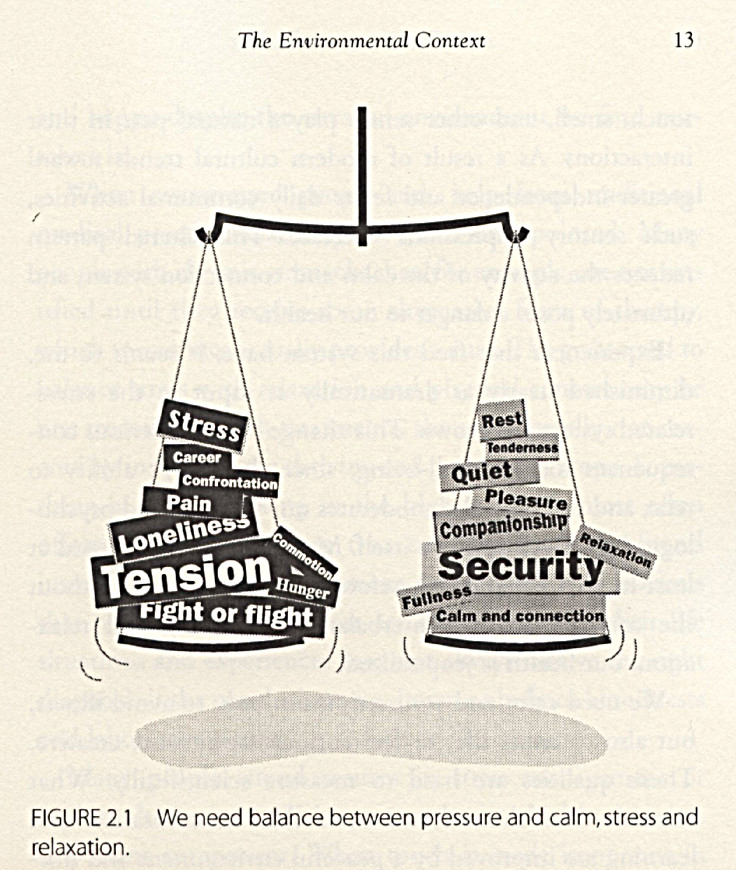
When I take a look at this next image that I scanned here from her book, I think about how it is for a tiny growing body-brain when it has to develop in adaptation to the environment it was born into when the stress scale has bottomed out and the calm and connection scale (of safe and secure attachment) has completely inadequate weight to it – or is nearly completely empty.

It is important to realize that what this image is showing is a required balance between stress and calmness.  Adequate early body-brain forming environments must include this balance for a body-brain to form and operate correctly.  Obviously too much stress and the wrong kind of stress for anyone is not a good thing.  But too much calmness isn’t good, either. Infant-child neglect often causes such a lack of stimulation during early developmental stages that critical regions of the brain do not receive the stimulation they need to grow hardly at all!

Another point I want to make is that if grave imbalance exists in an infant-child’s developmental environment the set point of the nervous system is NOT set at this central balance point where calm is even possible.  For people who survived terrible trauma in their early lives such as I did, the set point for our nervous system is AT the stress reaction point.

As odd as it might seem, looking back at my own infant-childhood with my new neuroscientific and physiological development insights, I can see that the long, long periods of forced isolation that were part of my mother’s patterns of severe abuse of me where probably – and actually – a very good thing.  During these periods when she had me ‘out of her sight’, even though during these times I was also out of any kind of loop that would have offered me normal infant-child opportunities to interact with others and with my environment in play and discovery, overall these times offered my developing body-brain opportunities for NOTHING TO HAPPEN.

These periods were actually rest and restoration times when my overwhelmed and over stimulated senses, forced into overload from the beginning of my life through the terrorizing and terrifying actions and presence of my Mean Mother, during which my body could actually calm itself down so that internally the effects of her nearly continual earthquake-tsunami abuse of me could somewhat dissipate before the next attack came.

Of course these patterns of wild, severe, over stimulating and overwhelming abuse paired with long periods of my being forced to endure the silence of remote, isolated aloneness harmed me greatly.  This pattern became a most fertile ground for patterns of dissociation to build themselves into my body-brain because nothing but the deprivation of being left completely alone to physiologically try to end my suffering alone (unconsciously, of course), offered me to possible way to connect my ongoing experiences to one another on any level other than the physiological one.  Nothing ever made sense, and nobody or nothing ever helped me to make sense of my malevolent experiences, either.

++++

So leading back to the topic at hand, oxytocin and Dr. Moberg’s book, I want to say that importantly I completely TRUST everything this researcher says.  Because I have continual problems with trust that happens in relationship to a sense of my feeling safe and secure in the world (and NOT), I hold this trust in high value.

At the time Moberg published this book she had already published over 400 scientific articles.  She is considered the world’s leading expert on oxytocin and on the calm-connection half of our autonomic nervous system (ANS) and all the processes that are connected to it.  She is talking about what severe infant-child abuse survivors missed most during our earliest growth and developmental stages:  The opportunity to experience safe and secure attachments that would have allowed us to experience peaceful calmness and connection to others so that our body-brain could build into us a body-brain-nervous system with the balance depicted in the above image included.

Because my infant-childhood was filled with extreme, chronic, ongoing and severe abuse and trauma, I read Moberg’s book from a perspective that means I want to know how things SHOULD have been so that I can better know what I am MISSING at the same time I hope to find information that can help me to consciously CHANGE this set point within my body-nervous system-brain for the BETTER.

As I read Moberg’s account of current research patterns being weighted at 90% study of the stress response compared to 10% of study on the other half of the system, I understand why I am still searching for help, healing and answers.  There is no hope for truly understanding what was so damaging during our early physiological development about being immersed in continual overwhelming trauma if we don’t have the information we need about how things were truly SUPPOSED to be different.  I believe the best hope for healing ourselves on every level does not lie in the drugs we might take to override systems in our body.  We need to get the true picture of what is REALLY GOING ON.

No matter what we read, no matter what anyone tells us, we cannot fool our body.  Our body, the Earth Suit we live in, absolutely knows the truth.  When we encounter the truth in research it will resonate inside of us.  Our body knows the truth when it-we hear it.  Moberg’s book, her work and dedication to research about the calm connection system in the human body as it is designed to operate in counter-weight with our stress response system holds truth that I believe is imperative for us to understand.  As we gain these understandings, we will FEEL them in our body and know them in our brain-mind.  Once I have completed my reading of this book, I will enter the universe of the internet to look for research related to this topic that has occurred in the 6-7 years since the book was written.  I can only hope that the scientific world has taken Moberg’s work seriously enough to pick up this critical study of what contributes to the other half of our well-being as a species:  The ability to calm ourselves down and connect to others.  This is absolutely the study, in my mind, of safe and secure attachment of ourselves in our body in the world we live in.  Again, I will keep you posted.

+++++++++++++++++++++++++++

I wanted to make a little note here today at my sister’s suggestion about my present experiences as I teach myself to read music and play this amazing piano keyboard that I was blessed with being able to bring into my life.  As my sister pointed out, as I continue applying myself to this study and practice and as I gradually improve, I will probably not remember the process of learning itself.

I don’t remember learning to tie my shoes, but I do have faint memories of being at the age of trying to learn my right hand from my left.  I invented a learning strategy that involved remembering a pattern of freckles on my right wrist where I would have worn a watch if I had one (like the one my father wore).  All I had to do was connect the freckles with ‘watch’ with how right in my mind a watch would have looked on my wrist to learn which side of me was right and not left!

I know this music learning experience is similar also to when I learned to ride a bicycle.  Once the motor learning has taken place, I expect that I will never have to consciously think about it again.  In the meantime, my actual process of learning is fascinating.  There’s nobody here to judge my process or progress but myself, and in the clear, plain and good spirit of PLAY I am able to leave all self judgment out of the picture.

What I am left with is the process of literally and consciously experiencing what it is like for ME, in this body, with this brain, to learn something this new and strange.  I also know that because of the severe trauma I was immersed in as my brain developed, neither my left nor might right brain hemisphere formed themselves ‘normally’.  I also know that the corpus callosum that transfers information between my brain hemispheres did not form correctly, either.

As I teach myself this new language of music and gain the motor skills required that will let me actually PLAY music, I am experiencing what I believe is a true healing in these regions of my brain.  Last night I began to practice playing scales with both hands at the same time.  I figured there is no way I am going to get my hands to be able to each first play different notes in different ways in different timings if I can’t get them to cooperate and first play the same notes in the same patterns at the same time.

Well, I am here to tell you I can’t remember the last time I experienced such a giggle session!  Part of me was directly the physical process complete with the intention of desired result – while another part of me fell into giggling bursts of delight to watch what my hands were ACTUALLY doing!  Instead of tangoing they were tangling, each finger with a mind of its own tumbling and fumbling over the keys.

Yet I believe that learning good things is healing.  All the healing I have ever done has been about learning.  Learning how to let myself learn is a learning itself both about what learning is like AND what healing is like.  That process is delightful in itself as I gently and kindly, slowly, patiently and firmly open my own channels for change within myself so that I can let something good and new grow itself into my body-brain-mind-self.

I have hopes, a goal, a direction.  I want to play music.  I know I can do this.  I give myself permission to move forward, to make the mistake-errors, to correct them, to learn-heal at my own pace. As I experience such delight even in this process of learning itself I realize this is just a bonus gift I could not anticipate and did not expect to love and enjoy.

So, needless to say, I have a long long way to go to begin to even get the two hemispheres of my brain to operate harmoniously, cooperatively and well together.  But what I look forward to and DO EXPECT TO HAPPEN is that eventually the two hemispheres of my brain will dance on that keyboard in relationship to one another.  Sometimes they will follow the same patterns together.  Sometimes they will be able to ‘say’ something musically that will be very different, one from the other.

I nearly absolutely and entirely and completely missed the opportunity as an infant-child to be safe, secure, and to play.  And I certainly did not get to giggle.  So, if at 58 I am finally able to giggle myself into this amazing new skill of reading and playing music, that’s a very good thing indeed!  No doubt I am helping myself heal at the center of who I am in this trauma-changed body.  I’ll keep you posted on this process, as well!

++++++++++++++++++++++++++++++++++++++++++

+NIGHTMARE OF BREAST CANCER – MY HUMBLE WRITINGS

++++++++++++++++++++++++++++++++

I have no idea why today, at 3:35 AM it is evidently time for me to post my writings from right after my chemotherapy treatment for my breast cancer, begun very shortly after my double mastectomy, and during the time of my application process for Social Security Disability that followed this trauma that I could not emotionally find the resiliency to surpass in any way as I had seemed to manage at prior times in my life.

These pages were written long before my sister ever brought up her suggestion that I begin a blog.  They are candid and transparent, and I am not editing them as I post them now.  I believe that somehow these words, written humbly and to myself, must be meant to help someone – somehow – somewhere – NOW.  Whoever you are, blessings upon you!!

++++++++++++++++++++++++++++++++

PLEASE FOLLOW THIS LINK:

*Age 57 – Dec. 2007 – July 2008 – (A Shaman Daughter Pages)

++++++++++++++++++++++++++++++++

+SOME MORE WORDS SENT BY MY FRIEND

+++++++++++++++++++++++++++++++++++

Here is another collection of wisdom saved in words now passed to me by my family’s Alaskan homesteading neighbor from my childhood, Dorothy (now 83), who I have mentioned came back into my life after 40 years to be my dear friend.  These words have given me opportunity to ponder:

1.  GOD IS LOVE.  I am an extension of God; therefore I am love, just as I am.

2.  GOD IS LOVE.  Love is light.  The lighted candle cannot NOT shine on, illuminate, and radiate everywhere, touching everyone and everything.

3.  THE EGO IS A TOOL FOR LEARNING.  On this plane, egos relate to egos for learning and teaching.

4.  ROMANTIC LOVE IS A GLIMPSE OF HOLY LOVE — unconditional — heavenly.  Every person needs to experience that.

5.  SPECIAL RELATIONSHIPS ARE A NECESSARY PART OF OUR LEARNING ABOUT OURSELVES.  Also a path to understanding forgiveness and therefore, healing.  From the painful moments comes opportunity to think our deepest thoughts.

6.  I HAVE SEARCHED FOR MY IDENTITY, TRYING TO FIND ME.  Who are we?  We move from one thing to another looking, looking.  We fall in love, and expect to find our identity through the beloved.  We look to money, baubles and trinkets, prestige and power for validity.  Then one day it becomes clear:  THERE IS NO SOLUTION OUTSIDE OF MYSELF.  I heard that in dozens of ways, but it took “suffering” to make it real, and it has taken many years.

7.  CONFLICT WEAKENS ONE to being nearly non-functional.  EACH SIDE OF THE ISSUE HAS ITS OWN ENERGY.  These energies do battle with one another.  We have no peace; not enough energy “left over” for pursuing constructive thinking or activity.  Need to move from division to atonement.

8.  …JUDGMENT BECOMES THE UNKINDEST CUT OF ALL

+++++++++++++++++++++++++++++++++++

IN MEMORY OF MY BORDERLINE MOTHER, HERE’S SOME HOPEFULLY HELPFUL INFORMATION LINKS:

From Kristalyn Salters-Pedneault, PhD, your Guide to Borderline Personality Disorder Many of you are probably familiar with the standard treatment options for BPD, but there are some alternative treatments that you may not have considered. The treatments discussed this week haven’t been tested extensively, but may be considered as adjuncts to your treatment regimen.

Family Therapy – Can it Reduce BPD Symptoms?
Rather than just one person (such as the person with BPD) and their therapist, family therapy involves the whole family, working together, with one or two therapists.
BPD Couples Therapy
There has been no systematic research on couples counseling for borderline personality disorder, but experts are becoming more and more aware of how helpful a stable support network is for people with BPD.
Does Electroconvulsive Therapy Work?
Electroconvulsive therapy (ECT) is a psychiatric treatment with a long and controversial history. Is electroconvulsive therapy effective for borderline personality disorder (BPD)?
Get the Most Out of Your Treatment
Wondering how you can get the most out of therapy? There are times when the success of therapy is related — completely, or in part — to factors that are in your control.

Must Reads

What is BPD?
Symptoms of BPD
Diagnosis of BPD
Treatment of BPD
Living with BPD

+++++++++++++++++++++++++++++++++++

I am loving my new pursuit, learning the language of music with my piano keyboard!!

+++++++++++++++++++++++++++++++++++

+GIFTED WITH A POEM TODAY: “STAYING ALIVE”

++++++++++++++++++++++++++++++++++++

My family’s Alaskan homesteading neighbor from my childhood, who came back into my life after 40 years to be my dear friend, just sent to me some pages with words written on them of things she has collected and saved over the long years of her lifetime that have meaning for her — and now for me.  I feel like I’ve been handed jewels today.  I first wish to share this poem that Dorothy sent.  I see at the bottom is written “N.Y. 12-4-1965”  (NOTE:  Formatting on this blog puts the space between the lines here I cannot remove – )

++++++++++++++++++++++++++++++++++++

STAYING ALIVE

Staying alive in the woods is a matter of calming down

At first and deciding whether to wait for rescue,

Trusting to others,

Or simply to start walking and walking in one direction

Till you come out — or something happens to stop you.

By far the safer choice

Is to settle down where you are, and try to make a living

Off the land, camping near water, away from shadows.

Eat no white berries;

Spit out all bitterness.  Shooting at anything

Means hiking further and further every day

To hunt survivors;

It may be best to learn what you have to learn without a gun,

Not killing but watching birds and animals go

In and out of shelter

At will.  Following their example, build for a whole season:

Facing across the wind in your lean-to,

You may feel wilder,

And nothing, not even you, will have to stay in hiding.

If you have no matches, a stick and a fire-bow

Will keep you warmer,

Or the crystal of your watch, filled with water, held up to the

sun

Will do the same, in time.  In case of snow,

Drifting toward witner,

Don’t try to stay awake through the night, afraid of

freezing —

The bottom of your mind knows all about zero;

It will turn you over

And shake you till you waken.  If you have trouble sleeping

Even in the best of weather, jumping to follow

With eyes strained to their corners

The unidentifiable noises of the night and feeling

Bears and packs of wolves nuzzling your elbow,

Remember the trappers

Who treated them indifferently and were left alone.

If you hurt yourself, no one will comfort you

Or take your temperature,

So stumbling, wading, and climbing are as dangerous as

flying.

But if you decide, at last, you must break through

In spite of all danger,

Think of yourself by time and not by distance, counting

Wherever you’re going by how long it takes you;

No other measure

Will bring you safe to nightfall.  Follow no streams:  they run

Underground or fall into wilder country.

Remember the stars

And moss when your mind runs into circles.  If it should rain,

Or the fog should roll the horizon in around you,

Hold still for hours

Or days, if you must, or weeks, for seeing is believing

In the wilderness.  And if you find a pathway,

Wheel rut, or fence wire,

Retrace it left or right — someone knew where he was going

Once upon a time, and you can follow

Hopefully, somewhere,

Just in case.  There may even come, on some uncanny

evening,

A time when You’re warm and dry, well fed, not thirsty,

Uninjured, without fear,

When nothing, either good or bad, is happening.

This is called staying alive.  It’s temporary.

What occurs after

Is doubtful.  You must always be ready for something to

come bursting

Throught the far edge of a clearing, running toward you,

Grinning from ear to ear

And hoarse with welcome.  Or something crossing and

hovering

Overhead, as light as air, like a break in the sky,

Wondering what you are.

Here you are face to face with the problem of recognition.

Having no time to make smoke, too much to say,

You should have a mirror

With a tiny hole in the back for better aiming, for reflecting

Whatever disaster you can think of, to show

The way you suffer.

These body signals have universal meaning:  If you are lying

Flat on your back with arms outstretched behind you,

You say you require

Emergency treatment; if you are standing erect and holding

Arms horizontal, you mean you are not ready;

If you hold them over

Your head, you want to be picked up.  Three of anything

Is a sign of distress.  Afterward, if you see

No ropes, no ladders,

No maps or messages falling, no searchlights or trails blazing,

Then, chances are, you should be prepared to burrow

Deep for a deep winter.

— David Wagoner

+++++++++++++++++++++++++++++++++++++++++++

Here at the bottom of this piece of paper it says:

“What are we, that we are moved at a touch between serenity and desolation?”

+++++++++++++++++++++++++++++++++++++++++++

+WATCHING WHOLENESS AND HAPPINESS HAPPEN

++++++++++++++++++++++++++++++++++

I discovered a portrayal of happiness when I found online the videos of these 40 piano lessons.  It’s a great place to go for a brush-up on music reading and keyboard playing if you have already had some experience in your past with playing music and might – for great benefit and healing – wish to pick up this pastime again.  For those, like me, who have never experienced the joys of playing music, these lessons are a great place to start!

However, my bigger purpose in posting these links today is to present to you the visual of the teacher, an obviously talented and well-skilled young man, who appears to be quite genuinely happy!

I simply wanted to point out today that I think it’s highly doubtful that someone who appears to possess such an ability for humor, for spontaneous laughter and for genuine smiles lives within a body that was formed in a malevolent environment of infant-childhood abuse, maltreatment and trauma.

When I watch the face and body movements of someone like this young man, I can see that I am actually watching a body-nervous system, including a brain that was allowed to form within a safe and secure attachment environment.  Nowhere in these videos do I see the flash of a stress response in the eyes and face.  Nowhere do I hear the millisecond pause in his speech that would let me know the body itself has detected threat to safety and security in its ongoing appraisal of itself in the world.

Not only is the ‘presence of happiness’ well, present in this young man, but just as importantly the ‘absence of anxiety and sadness’ is, well, also equally present.  As a result, he can probably move through his life unimpeded in his intentions and actions by the interrupting ongoing inner experience of having to be hypervigilant about either himself or others in the world.

Along with the happiness apparent in this young man is the competent confidence that comes with being a self in the world that can be fully present in the moment.  This includes having the ability to be a present self in the presence of others.

This young man seems obviously capable of enjoying himself (in-joying himself) in his life.  Nobody seems to have communicated to him that he doesn’t have that right.  It is important to realize that the invisible physiological nervous system-brain underlying circuits and pathways of competence and joy were built into the body of this young man from the time he was born (and before).  What others SEE when they witness this young man in his body in his life is the physical manifestation of well he has been treated throughout his life.

He has been allowed and encouraged on all the important levels that matter to be himself because he was allowed to be safe and secure.  As I have said so many times before, this IS a matter of availability of resources.  Certainly there may well me economic stability in his family that enabled him to have access to instruments and training (not to mention all the other vital requirements for sustaining life).  Yet while these advantages are obviously important to tutor and train inborn talent, it is the social-emotional environment of safe and secure attachment to caregivers from birth (and before) that were vital to the ongoing experience of confidence and joy that this young man seems so able to demonstrate.

While watching these piano lesson videos gives me a visual related to what this young man was given in his life compared to what I was not given, at the same time it gives me a visual of the goal I suggest all survivors can work for.  Even though our long ago formed body (with its nervous system including our brain and our connection to self) may have been altered in our earliest developmental stages due to trauma and abuse, being THIS happy and confident while experiencing safety and security in our body within our environment, with our self present in our experience, is what we need, desire and work for.

Check out How to play piano: Lesson #2 and How to play piano: Lesson #3 Piano Lounge: Andrew Furmanczyk to see for yourself this young man who offers an example of happiness.

+++++++++++++++++++++++++++++++

The next example I encountered in my musical searches online yesterday offers yet another example of what I am talking about here today.  For all the amazing talent visible in the video attached to this link, six-year old girl mastering piano, it is the joy and happiness visible not only in the little girl’s body-face that captured my attention, but MORE SO the joy and happiness visible in her MOTHER’S face.

Here again we are presented with a visual of advantage.  This little girl is not homeless or going to bed hungry at night.  But most importantly this little girl is obviously fully loved.  Look at her face.  Watch her.  You can see that her SELF is fully present in that little body.  You can see that she is safely and securely attached to her own self BECAUSE she has been offered the opportunity to safely and securely attach to her caregivers.

Certainly this little girl was born with an amazing talent.  But the most important talent I want to emphasize, the one that we are all conceived with and hopefully born with, is this ability to thrive and blossom as our body-brain-mind-self grows and develops in interaction with its earliest caregiver environment.

Neither of these young people presented in these videos would LOOK the same, ACT the same, FEEL the same or BE the same if they had been raised within a malevolent rather than a benevolent environment.  They would NOT HAVE THE SAME PHYSIOLOGICAL BODY.  If they had been raised within an early unsafe and insecure attachment environment, they would not think the same, feel the same, act the same, or be the same people they turned out to be.  No way, no how.

So for all the obvious musical virtuosity present in these video samples, what I end up being most aware of is that what these videos are showing most clearly IS THE ABSENCE OF TRAUMA.  While we know that much talent still arises within people who did suffer early trauma and live a life within a trauma-changed body, it is also equally true that talent does not need to be automatically paired with angst and suffering.

++++

What I believe is most empowering for infant-child abuse survivors to know is that not only does early trauma change our physiological development, but also that these consequences follow us for the rest of our lives.  For all the well-wishers that tell us to simply “get over it” or “leave your childhood behind you” or “You could be happy if you really wanted to,” it is vital for us to realize that these statements are not actually grounded in the truth of our trauma-changed physiological reality.

At the same time I believe it is important for we survivors who have been ‘diagnosed’ with so-called ‘mental illnesses’ to realize that most often the best creative and expressive gifts of our species are directly tied genetically to the highest risks for the experience of difficult consequences from trauma-changed bodies during our earliest development.  I suspect that it is equally true that the kinds of changes our genes allow us to make include not only high risk for later complications from these changes, but also gave us immense resiliency factors that allowed us to survive at all.

In essence, if my thinking is correct, I would suggest that both of these piano wizards presented in these videos would have been at extremely high risk for developing serious ‘mental disorders’ had their infant-childhoods been malevolent and traumatic rather than benign and benevolent.  At the same time, their sensitivities and vulnerabilities to trauma-related consequences WOULD STILL HAVE ALLOWED THEM TO ENDURE AND SURVIVE.  But they each would probably have suffered greatly in a trauma-changed body.  Neither would have been the same people we see in these videos.

++++

All of this brings to my mind the question, “Who is the self?”  When I say these musical children would be different, I am not saying that the essence of who they are as individual people could even possibly be altered under any circumstances.  That is equally true for all of us, infant-child abuse survivors or not.

The consequences of enduring within malevolent early-body-brain-forming developmental stages means that the expression of the self, the inner relationship with the self, the outward manifestation of the exact nature of the individual self will be changed and altered, not the actual self itself!  What all of us are working toward is the discovery of who our own individual self IS so that we can learn how to give this self as many opportunities to experience safety and security in the body in the world as is humanly possible to do.

No matter what our age, the process of being a self in a body in the world is essentially the same.  Severe early abuse survivors, however, have to experience, face and deal with all the trauma-related physiological changes that mean for us that an ongoing assessment of potential threat and danger to our SELF (and to our body) is likely to be at the forefront for us the rest of our lives.  Our ability to simply BE a self, with full free interactions and expression, becomes far more difficult for us to obtain.

Coupled with these difficulties is the fact that within our trauma changed body-brain we were robbed of the fullest development of a genuine happy center and the neural development of all the corresponding ‘be safe in the world’ pathways and circuitry.  We have to train and retrain our physiology as we seek to improve our presence in our own body in our own life in the world.

Yes, our experience and the resulting body-brain we would have developed COULD have been different for us as it obviously was for these two musical wizards.  Yes, we do have a lot to mourn for in our loss not only of the actual experiences of a safe and secure infant-childhood, but most importantly for the different body-brain we would have developed under benevolent rather than malevolent conditions.

Yet for severe infant-childhood trauma survivors I believe it is ultimately and importantly empowering for us to realize what we are REALLY dealing with.  As we try to ‘change’ our self to be a ‘better’ person to life a ‘better’ life we need to understand that we are participating in acts of creation as we heal.  We are ‘recreating’ the very molecular structure and operation of our trauma-adjusted, trauma changed body.

Yes, resiliency is possible as long as we breathe.  At the same time, the healing changes we make affect our entire being in the world on every level.  Just as a benevolent safe and secure world created the physiology of these video children, changing our own physiology as survivors means that we need as much of what these children were given as we can possibly get.

++++

In the same way that how these musical children are in the world is a result of the sum total of their genetics in interaction with their environment, our own healing happens in the same way.  I don’t believe it’s possible or even realistic to ‘just’ treat a so-called ‘mental illness’ with drugs, or ‘just’ treat harmful parenting or anger or sadness or anxiety or relationship difficulties with classes or education, or to ‘just’ treat addictions of any kind.

We can become consciously aware that any single ‘part’ of us that heals is providing a healing for our whole self on every level of who we are.  Just as growing a body-brain in the beginning was a ‘whole’ process, healing happens in the same way.  Watching these delightfully whole children in their experiences portrayed on these videos tells me that once the camera lens is taken off of them, their whole self is equally occupied with living their whole life just as happily as their fingers play their music.

++++++++++++++++++++++++++++++

This information today ties into the posts I presented earlier on the genuine, authentic D-smile and true happiness:

+HOOKED ON ‘D’ SMILES – THE HAPPINESS CENTER

+RESEARCHER BIAS ON THE ‘D’ SMILE = SICKENING

+MISSING LAUGHTER IN MY MOTHER’S MONKEY HOUSE

+IT WASN’T FUNNY: THE BUZZARD THAT ATE MY MOTHER

++++++++++++++++++++++++++++++++++

+POWER OF SOUND FOR HEALING OUR NERVOUS SYSTEM-BRAIN

+++++++++++++++++++

How much of my trauma changed development happened because of the overwhelming traumatic sound of my mother?  How much vicious screaming, yelling and shouting did you hear from before the time you were old enough to begin to know what words were?  How much terrifying noise was directed at YOU?

I know I heard lots of terrible sound as an infant-child, most of it directed at me.  In between, during the extensive periods of forced isolation, I learned to listen in unusual ways as my body-brain developed.  All kinds of sounds are trauma triggers for me, many times even the sound of the human voice.

Music and sound therapy are used in lots of ways to help abused children heal.  We must not lose sight of the power that sound has to heal us as adults, either.  Sound and music therapy is used to help and heal everything from stress relief, the vagal nerve system, diabetes, Parkinson’s disease, epilepsy, the autistic brain, and the immune system.

What might sound and music therapy have to offer each of us in our efforts to heal from abuse and trauma of all kinds?

Here is some information about our ears, our hearing, and about how music and sound offer resonance that can help heal our limbic right emotional-social brain, our nervous system (stress response), the vagus nerve ( the nerve of calmness and compassionate caring) and MORE!!!

+++++++++++++++++

For your listening pleasure!  Does Music therapy belong to India?  “It helps in the quality of neurotransmitters secreted in brain and the behavior of the individual.”

Emusictherapy.com – listen online — Music Therapy Albums

Music to enhance Concentration and Memory
Music to overcome Depression
Music Therapy for Diabetes
Music to overcome Fear and Anxiety
Music for the Heart
Music for Peace of Mind
Music for Pregnancy & Babies
Music for Sleep and Relaxation
Music to overcome Stress and Strain
Music to Enhance Intellect & Creativity
Music to Reduce Pain and for advance Healing
Music to overcome Headache & Migraine

++++++++++++++

How Music Therapy Works

Sound therapists recognize that certain sounds can slow the breathing rate and create a feeling of overall well-being; others can slow a racing heart, even soothe a restless baby. Sound can also alter skin temperature, reduce blood pressure and muscle tension, and influence brain wave frequencies. Although some sounds (like ultrasonic waves) are beyond the range of the ear, they can have a profound effect on the human condition.

How We Respond to Sound

People respond to sound vibrations in two main ways: via rhythm entertainment and resonance. According to Steven Halpern, Ph.D., of San Anselmo, California, “Rhythm entertainment describes the phenomenon whereby, in the presence of any external rhythmic stimulus, the natural rhythm of the heartbeat will be overridden and caused to pulse in sync with the sound source. This may be the rhythm of drums, or the rhythmic pulse of the music, or it may just be your refrigerator’s motor.

“Resonance refers to the physical phenomenon in which different frequencies of sound (different pitches) stimulate the body to vibrate in different areas. Typically, low sound resonates in the lower parts of the body and high sound resonates in the higher parts of the body.”

Sound and the Brain

Sound is linked to the physical body by the eighth and tenth cranial nerves. These carry sound impulses through the ear and skull to the brain. Motor and sensory impulses are then sent along the vagus nerve (which helps regulate breathing, speech, and heart rate) to the throat, larynx, heart, and diaphragm.

Don G. Campbell, B.M.E.D., Director of the Institute for Music, Health, and Education in Boulder, Colorado, explains, “The vagus nerve and the emotional responses to the limbic system (specific areas of the brain responsible for emotion and motivation) are the link between the ear, the brain, and the autonomic nervous system that may account for the effectiveness of Music Therapy in treating physical and emotional disorders.”

Various elements of sound influence separate parts of the brain. Rhythm, for example, engages the reptilian or hindbrain, while its tempo can alter the sense of time. The human body also has its own rhythmic patterns, and there is growing evidence that the rhythms of the heart, the brain, and other organs enjoy a special synchronicity. Illness can arise when these inner rhythms are disturbed.

Tone engages the limbic midbrain, which governs emotion. According to Campbell, “The real power of sound is in the way the tonal or harmonic aspects influence our emotions and midbrain functions.”

Sound can also be used to help the body regulate its corticosteroid hormone levels, helping to control the severity of spastic muscle tremors, reduce cancer-related pain, and reduce stress in heart patients.

Alternative Medicine: The Definitive Guide
Complied by the Burton Group
Future Medicine Publishing, 1997

+++++++++++++++++++++++++

What follows comes from this website:

MUSIC THERAPY LINKS THE UNIVERSAL VOICE OF ACADEMIC SCIENCE IN MUSIC THERAPY

The Special Status of the Ear in the Organism

1.  Our ear is the first organ to develop to its full size and become fully functional – approx. 18 weeks after conception, our ear is ‘ready’.

2.  Our ear is the first sensory organ to begin working – from the 8th week of life. We began to hear whilst we were still in our mother’s womb – and at 18 weeks our hearing capability was fully developed.

3.  In order for our nerves to be fully operational, our organism surrounds them with a layer of myelin – the auditory nerve is the first to receive this layer of myelin.

4.  The ear is not only the first sensory organ to start working – it is generally also the last sensory organ to cease functioning.
For this reason, it also plays an important part in the determination of brain death: when various brain centers have already ceased to react to the relevant stimulation, the brain usually continues to react to stimulation of the auditory nerve.
Therefore, the response to stimulation of the auditory nerve is an important criterion in the determination of brain death.

5.  Our ear is the brain’s greatest supplier of sensory energy and, as such, is probably the greatest changer of our brain’s electrical activity.

Our ears, our skin, our eyes, our mouth, and our nose constantly receive sensory stimulation from our surroundings which they then convert into electrical impulses in their sensory cells and pass on to our brain. Thus, in our brain, no sound, no touch, no pictures, no taste and no smells are encountered, just electrical impulses which only become our sensory experiences through multifarious processing steps taking place in our brain. In this way, our brain receives a constant flow of bioelectrical energy from our sensory organs, without which it is unable to function correctly. As to how much energy each of the five sensory organs supplies, medicine science now provides the following amazing answer: of 100% of the sensory energy which enters the brain, 80-90% is supplied by the ear! As such, our ear is probably the greatest changer of our brain’s electrical activity – the central administration of our entire organism.

6.  Our ear has a definitive role in the construction of our brain.

However, the sensory organs do not only supply our brain with energy, but the electrical impulses produced by them also work themselves in our brain, in that they play a definitive role in deciding in which way our brain cells link up or ‘switch’, so that the necessary circuits required for the exchange of data and the management of the infinite number of processes within our human organism are created.
So what does our ear that has been sending electrical impulses to the brain since our 8th week of life, have a hand in building?
Some medical experts suspect that it controls the entire maturation of our brain.
It is, however, certain that it definitively has a determining influence on how each of those areas of our brain develops which control our feelings, our understanding, our speech and our movements. So our ear plays an active part in the most important areas of our brain.

7.  Our ear controls all of our organism’s muscular activity, and plays a part in the distribution of tension and relaxation.

In the regulating circuit of the movement processes, the brain gives the order to the muscles to move and when they are carrying out these orders, the muscles are controlled by the organ of balance in the ear. In this way our ear also determines our body’s tension profile – that is the distribution of the different states of tension and relaxation in the different parts of our body.

8.  Our ear influences the control of our organism’s thermal balance.

The flow of blood of our tympanic membrane is supplied by a blood circulation which is directly connected to our organism’s thermal regulation center in the brain. Studies with Medical Resonance Therapy Music® have now revealed that certain music structures can decisively change the thermal regulation. Thermal regulation, however, has a significant influence on overcoming illnesses, as is familiar to us with fevers, for example.

9.  Our ear is directly connected via nerve channels with many important organs.

Neural management of our ear concha or flap and our tympanic membrane is largely effected by the 10th cerebral nerve, the so-called vagus nerve. This nerve is also connected, as an important neural manager, with the larynx, the bronchi, the heart, the stomach, the pancreas, the liver, the kidneys, the intestines, and the solar plexus. It also has a definitive role in triggering physiological stress reactions. Thus, via the vagus nerve, our ear has access to transmission lines to important organs in our body, and exerts a direct influence on the regulation of stress.

Traditional Chinese medicine teaches that there are connections within the ear to all areas of the body. Here are just a few of the most important parts of the body which are accessed by ear-acupuncture: the top of the skull, back of the head, forehead, eyes, ears, nose, neck, cervical vertebrae, clavicle, chest, heart, lungs, stomach, kidneys, liver, large intestine, genitals, urinary tracts, hip joints, buttocks, knee joints, joints of the foot and cartilaginous tissue in various parts of the body.
NEWS

“Studies with Medical Resonance Therapy Music® have now revealed that certain music structures can decisively change the thermal regulation.  Thermal regulation, however, has a significant influence on overcoming illnesses, as is familiar to us with fevers, for example.”

+++++++

I find this most fascinating, true I imagine for both physical and emotional pain:

“A positive emotional reaction to music is of course infinitely valuable to cancer patients, but studies have shown that music therapy can also trigger important physical responses.  Alleviation of pain is one such area, says Dr. Delforia Lane, explaining that the brain uses the same neurotransmitter to send the sensations of both pain and music.  If both elements are received at the same time, neither can reach the brain with full intensity.  Hence pain is felt less intensely, so patients may experience a decreased dependence on pain medications.”

From the Music Center page of the Cancer Consultants website

SEE ALSO:  Music strikes chord on coping with pain [and anxiety]

++++++++++++++++++++++++++++++++++++++

Music strikes chord on coping with pain [and anxiety]

+CONSCIOUS AWARENESS AND EMOTIONAL AROUSAL REGULATION

+++++++++++++++++++++++++++

Try as I might, I just cannot think of any way that anyone exposed to severe infant-childhood trauma and abuse could NOT change in their body-brain development as a consequence.  The more that is learned about how epigenetic forces creatively alter the pathways of our genetic manifestation the more we are learning about where, how and when these changes can – and do – occur.

I came across a statistic once that suggested that 50% of who we are is in our genes, and 50% of who we are can be changed by the influence of the early environment (and the continued one) that we are developing within.  I think about that now, knowing how severe the infant-abuse was that I endured from birth (and for the next 18 years) and I find that this 50% ‘rule’ gives me a firm place to get my feet under me as I try to understand more and more about who and how I am in the world today.

I will always be 100% me, but as this blog’s commenter stated today, we all “mourn for the who-I-would-have-lived-to-be.”

How on earth could we possibly NOT mourn?

Yet for all the specific variations that exist in the trauma and abuse history of each survivor individually in terms of actual experiences we had, the range of possible changes that our body-brain was able to make in response to the trauma and abuse seem to be contained within increasingly defined (through new research) ways.

From my perspective as a severe early abuse survivor, I find this fact both exciting and extremely hopeful!  The mystery of the unknown is fine if we want to contemplate with wonder the marvels of creation or follow a storyline in some mass market paperback.  But the more mystery we can take out of severe traumatic infant-childhood survivorship, the better!

The 100% of me wants to know and understand how the 50% of me was changed in my development.  I see the wordless image right now in my mind of a complex archeological dig in progress.  Sooner or later all the pieces will be unveiled, one tiny brush sweep at a time, until the whole picture of the civilization of the past becomes revealed.

Severe infant-child trauma survivors are like members of a particular kind of ancient civilization – the civilization of the early attachment world we lived in from conception certainly through age 2 (where our self is clearly established) and on into and through about age 10 when our Theory of Mind is formed (using all the early formed body-brain circuitry established before age 2).

Severe infant-childhood trauma and abuse survivors had to grow their body-brain in a toxic environment.  Nobody gave us one of those fancy suits to wear to protect us from the toxins.  The only protection we had available to us was in the form of the internal changes we could make in our early development so that we could survive.  The newest research is telling us more and more about what these changes were and how they continue to affect us.  We were made in, by and for enduring within a malevolent world in very specific ways.  What we most need to know about how to live a BETTER life while living with these changes will be found in this research that tells us how the ancient civilization of our toxic early environment actually affected us.

+++++++++++++++++++++++++++++++++++++++++++++++++++++++

Because our right limbic emotional-social brain, as it connects into our body through our vagus nerve system, is directly formed through the kinds of attachment experiences we have with our earliest caregivers, it is to this region that we can pay special and care-full attention for clues about how to live a better life NOW.

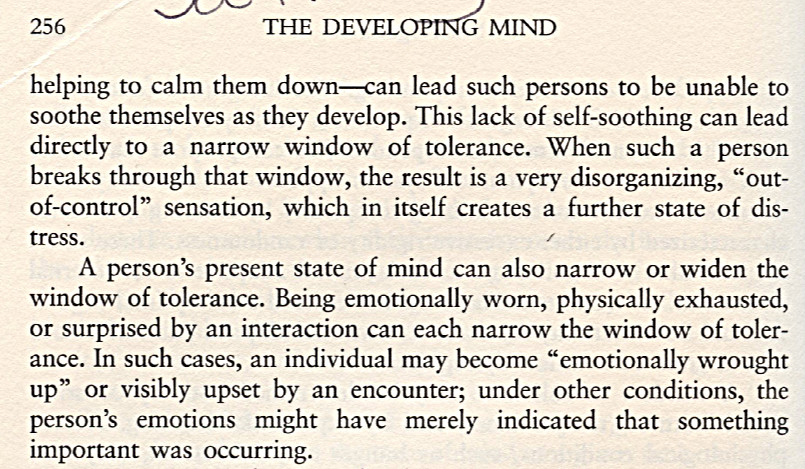
Some of these clues can be found in Dr. Daniel J. Siegel ‘s book, The Developing Mind: How Relationships and the Brain Interact to Shape Who We Are, as I mentioned in yesterday’s post.

Siegel has also written what I consider to be the most up-to-date accurate parenting book available:  Parenting From the Inside Out.  The author describes how our early caregiver attachment experiences formed our own attachment patterns, how those patters are likely to affect our relationships with our offspring, and what we can do to make positive changes.

Please consider purchasing and reading these two books, and also make a visit to Siegel’s Mindsight Institute website, whose theme “Inspire to Rewire” lets us know that no matter what the toxic conditions of our earliest ‘ancient civilization’ were that changed us in our infant-child development, we CAN take control over how we experience our life NOW.

++++

I want to return to Siegel’s writing in The Developing Mind for awhile this morning because we do not exist in our Earth Suit without emotions.

We are born with emotion as we are born with a body.  How our earliest caregivers interact with us forms our emotional brain.

If these early caregiver interactions are neglectful, traumatic and malevolent, our emotional right limbic brain will have to form itself in adaptation to these interactions – as will our immune system, our nervous system, and our body.

One way or the other our Earth Suit has to encompass ways to handle our emotion.  The patterns we are given from our earliest caregivers’ interactions with us (most importantly our mother) will either help us to regulate our emotions smoothly, or will hinder us with emotional dysregulation.

Personally, I have to wonder if what is called ‘emotional dysregulation’ is even possible, because however our body-brain manages to stay alive incorporates SOME VERSION OF EMOTIONAL REGULATION or we would be dead.

However, the very extreme ways our body finds to adapt its regulation of overwhelming, toxic, traumatic and malevolent emotional experiences will not be in ideal ways for living a life of well-being in a benevolent world.  Those ways of regulating our emotions built into our brain in our toxic ancient civilization of our early life do not match the conditions of a more benign, benevolent present day civilization.

Nor will a severe early trauma survivor’s body-brain’s operation match those of people who were not raised in toxic early environments.

I think we have to empower ourselves for positive change by understanding how completely adaptable our body-brain became in early trauma.  That those adaptations appear in our present more benevolent life as ‘dysregulation’ has more to do with the relative safety and security of the world we find ourselves in NOW than it does with there being something WRONG within US!

True, looking at how someone can be so out-of-the-loop between emotion and higher cognitive functions that they can do something like the pilot did yesterday in Austin, blowing up his house with his wife and child inside and then flying himself to death into a building, obviously appears ‘dysfunctional’, dysregulated and WRONG!  At the same time, if I wanted to understand how the adult got to that point, I would need to accomplish a version of an archeological dig to find out what the environmental influences on his body-brain development were from the time he was conceived through at least age 2 before I could begin to understand the pathway and pattern his life took from that point forward.

++++

As humans, we seem tempted to couch our consideration of aberrant actions of others in terms of ‘good and evil’ and ‘right and wrong’.  Probably because I was raised from birth and for the next 18 years by a mother who was obviously capable of beating me thousands of times, or abusing me consistently and chronically for all that time, by a woman who was not capable of knowing I was human and not the devil’s child, I have a unique position when I look at what being human actually means.

My mother was not fundamentally different from anyone else.  Nor was pilot Mr. Joseph Stack.  Because we are all members of the same species, we are always actually doing the same thing only in different ways:  We are all, always, regulating our state of emotional arousal one way or the other.

My mother regulated her emotional arousal by torturing and abusing me.  Mr. Stack regulated his state of emotional arousal by taking the actions that he did.  Any consideration we might have that these people seem emotionally and mentally ‘dysregulated’ can only happen because we have the luxury of taking an outside perspective on them.  What we might understand about being human, about how humans are supposed to regulate their emotional states of arousal, does not match their understanding.

++++

So what are we really looking at when we turn our thinking toward another human being – no matter what they do?  Turning to Siegel’s writing in The Developing Mind I find that he talks about emotion regulation in terms of basic components that operate within our species no matter who we are.

The problems happen when a developing body-brain-mind-self does not achieve what is most vital and needed for successful living in a benign, benevolent world.  Siegel calls this desired “achievement” as having “a flexible and adaptive capacity for the regulation of emotional process.”  (page 244)

Neither my mother nor Mr. Stack had this “flexible and adaptive capacity.”  In all cases where trauma influences development – even if we are to believe that ONLY that the trauma is in a person’s genetics that manifested without malevolent early influences on development – it is always a resulting rigidity rather than flexibility coupled with an absence of the capacity to adapt appropriately to the conditions of a present benevolent environment that causes such terribly harmful actions and their consequences to happen.

The brain is, according to Siegel, SUPPOSED to develop

“…a rich circuitry that helps regulate its states of arousal.  The nature of this process of emotion regulation may vary quite a lot from individual to individual and may be influenced both by constitutional features and by adaptations to experience….

“Attachment studies support the view that the pattern of communication with parents creates a cascade of adaptations that directly shape the development of the child’s nervous system [including the brain]….what parents do with their children makes a difference in the outcome of the children’s development….  It is important to realize that both temperament and attachment history contribute to the marked differences we see between individuals in their ability to regulate their emotions.”  (pages 244-245)

I read Siegel’s words literally.  Everyone has some version of an “ability to regulate their emotions.”  Therefore in my thinking the concept of ‘dysregulation’ really does not apply.  We are all, always, involved in processes of regulating our emotional arousal one way or the other.  What we see are variations, or the “marked differences” between individuals in their capacity to regulate their emotional arousal flexibly and adaptively.  It is the variety of ways, the variation in the ways that different individuals regulate their states of arousal through the “process of emotion regulation” that we can question, not the fact that this process is happening even in the most extremely harmful ways.

If we are going to make any use whatsoever of the concept of ‘emotional dysregulation’ we need to be clear that it only applies when there is a need for change in a person’s capacity to regulate their emotional arousal differently than the way they are doing it.

Once a human being’s body-brain circuitry has been built and established during their early trauma-full or trauma-free development, the patterns of operation for these circuits is automatic.  Trauma-free development enables far more mind-full, free-will dominated, conscious choice to be included in the operation of the feedback and feedforward physiological information-activity loops working in a person’s body-brain.  In this way although consciousness can be applied to override automatic processes, even the presence of the ability to BE conscious has entered the automatic range of options.

Having consciousness is an evolutionary advanced ability.  Trauma-formed early body-brains have had this evolutionary advanced ability interfered with.

I see no way for change to occur in emotional arousal patterns when, where and as needed — no matter how destructive and hurtful they may be to self and others — without there being a corresponding match in increased conscious awareness.  Even though from the outside we can look at my mother, or look at pilot Mr. Stack and consciously know that their patterns of regulating their emotional arousal were not flexible or adaptive within the conditions of the larger environment they lived in.  Yet because it is doubtful that the evolutionary advanced ability to gain conscious control over their emotional arousal regulation was available to these individuals, it is for those on the outside to know they were ‘emotionally dysregulated’.

++++

Learning about the concepts of emotional regulation and dysregulation has given me a new arena to look at my mother, at myself, and at others around me in a new light.  As I begin to understand that everything humans do is about regulating emotional arousal, and that the patterns of regulation we use was built into us through the conditions within our earliest caregiving attachment environment, I can begin to understand more about the experience of being human.

I did not form a right emotional-social brain in a benign, benevolent world.  Therefore my options for processing emotional regulation flexibly and adaptively were changed.  I have to become increasingly conscious of the automatic patterns of emotional arousal regulation that my body-brain uses if I want to change them.  It is helpful for me to know that these patterns I use are the same thing as my attachment patterns.  They have to do with how I am attached within my own body-brain to my own self and to everyone and everything in the world I live in.

Automatic physiologically-based reactions are survival enhancing because they are FAST.  Consciousness happened as an evolutionary advantage only because the environment allowed for enough TIME in enough situations that it was helpful.  Trauma itself has its own time frame reality.  SLOW is not what our survival-based fight/flight/freeze reactions are about.  They have to be FAST, so they have to be automatic.

If we have a body-brain built in, by and for a malevolent world of trauma, and if we want to change how we regulate our emotional states of arousal, we have to realize that we will have to make use of the much SLOWER processes related to consciousness and choice.  BUT, and this is important, as we consciously LEARN to do things differently, the plasticity of our body-brain will eventually move us closer to an automatic capacity to include our NEW learnings in our life.

I am paying attention to the process I am going through as I consciously learn to read music and play the piano keyboard.  I have to be almost painfully conscious of every single step in this process.  Yet my goal HERE is NOT to have to remain conscious of playing.  My goal is to so learn how to read music and to play this instrument that the entire process can move into unconscious, automatic action.

I had a few continuous seconds last evening of what this experience will FEEL like once the conscious learning has moved to unconscious automatic action.  I played five full lines of the music of this song I am learning automatically and without thought – and there it was!!  The feeling of being one with the music.  I WAS the music for those few seconds.  It was an experience I imagine might be like BEING a ray of sunlight or BEING a breath of wind.

At the same time I am extremely aware that when I sit down and put my fingers on those keys, rest my eyes on the first note of the song, I am changing my thoughts and my emotions through my intention, through my focus, and through this process.  No matter what I might be thinking when I sit down at that keyboard, no matter what I might be feeling, the moment I start the playing I can physiologically feel the switch happening in my body-brain.

Because I suffered extreme, ongoing, chronic trauma for my entire infant-childhood, I have no illusion that I will live long enough to be able to consciously change the body-brain patterns of emotional arousal regulation that happen mostly unconsciously and automatically for me.  But at least now I know what I am up against and why.  I live on full disability because of these trauma-changes that are built into me.

At the same time I remain extremely grateful that somehow I retained the capacity to increase my consciousness about how I am in my body-brain in the world.  Knowing that people like my mother and like Mr. Stacker did not seem to gain or retain this ability for consciousness makes me feel humble and contributes to my gratitude for myself as being different from them.  I do not take conscious awareness for granted.

Having degrees of this ability does not make me feel arrogantly superior to those without it.  I too narrowly escaped the traumatic horror of my infant-childhood with my consciousness ability relatively intact not to have a compassionate appreciation for how cherished a gift conscious awareness of ourselves in the world really is.

Leaving infant-childhood bereft of this gift of the ability to have mindful, reflective, conscious awareness of how we regulate our emotional arousal dooms us to a life where the trauma that engulfed us in the beginning will surround us and follow us to our death.

Leaving infant-childhood bereft of this gift of the ability to have mindful, reflective, conscious awareness of how we regulate our emotional arousal dooms us to a life where the trauma that engulfed us in the beginning will surround us and follow us to our death.  At the same time I can mourn for who I could have become if I had not been so traumatized as an infant-child, I can also celebrate that I did not lose the wonderful abilities that I DO have even though I survived such trauma.

++++++++++++++++++++++++++++++++++++++++++++++++

+INFO ON WINDOWS OF EMOTIONAL TOLERANCE

+++++++++++++++++++++++++++++++++++

Sometimes I have to force myself toward the study of information that I KNOW will help me in my life.  The choice is between continuing to live in ignorance while experiencing intensity of emotions I don’t understand and cannot easily regulate (along with repeated dissociation which I believe is one of a survivor’s ‘tools’ for regulating overwhelming emotion), or trying to learn SOMETHING that can help me make sense of the way I experience my life in this trauma-changed body.

The information presented in the article in my post +TRUE HEALING POSSIBLE – MY #1 CHOICE FOR TREATMENT is about the limbic social-emotional right brain as it connects into our body.  It is about how we experience emotion.  It is about how our interactions with other people starting from the beginning of our life form the patterns that either regulate or dysregulate our emotional life.

Our emotions are supposed to be the factors of our existence as human beings that are supposed to guide us toward approach or avoid through a process that lets us know what is good for us and what is harmful for us.  In other words, our limbic brain is intimately connected to our appraisal system, and from there to our reaction-action systems.  Severe infant-abuse survivorship changes the development not only of this limbic region of our brain, but also of our appraisal and our reaction system.

I am going to present some very specific information today about what is termed our Windows of Tolerance as it applies both to our emotional well- or ill-being and to the ways that we get information in the first place through our body.  This information comes from the writings of Dr. Daniel J. Siegel in his book The Developing Mind: How Relationships and the Brain Interact to Shape Who We Are.

The pages that precede the ones I am posting here today talk about how emotions are differentiated early infancy — or not.  These processes all occur within the earliest caregiver attachment interactions we have as our brain and nervous system-body is growing and developing.  All these processes are literally wired into the cells of our body and will determine how we ARE in the world.  The kind of therapy described in my earlier post is recognizing how fundamental these processes are and how they are wired into our body-brain.

Siegel states:

“Creating change within rigid patterns of specific appraisals requires a fundamental change in the organization of information and energy flow….

“Value circuits determine specific appraisal, creating the basic hedonic tone of “this is good” or “this is bad” and the behavioral set of “approach” or “withdraw.”  Value circuits also continue to assess the meaning of these initial activations as they are elaborated into more defined emotional states, including the categorical emotions.  What determines the nature of the appraisal/value process itself?  How does the mind “know” what should be paid attention to, what is good or bad, and how to respond with sadness or anger?

“For human beings to have survived, this complex appraisal process had to be organized by at least two components.  According to the fundamental principles of evolution, the characteristics of those that helped the individuals to survive and pass on their genes are more likely to be present today.  This is one explanation, for example, of why some people are frightened of snakes though they may never have seen one before.  This may also explain why infants have a “hard-wired,” inborn system to appraise attachment experiences as important.

“A second evolutionarily crucial influence on the appraisal mechanism is that it had to be able to learn from an individual’s experience.  Individuals who did not learn, for example, that touching a flame hurts would have been more likely to be repeatedly injured and unable to defend themselves, and therefore less likely to survive and pass on their genes.  Those individuals whose brains could alter their evaluative mechanisms would have been more likely to survive.  Hence, the appraisal system is also responsive to experience; it learns.  Emotional engagement enhances learning.”  (pages 252-253)

As pointed out in the article I posted two days ago on limbic resonance therapy, much of our learning ability happens through epigentic changes.  The healing that severe early abuse survivors need to accomplish happens at these molecular levels through processes that are also described in this article.

Early trauma overwhelms and over-arouses, over stimulates and over amps our nervous system, body and brain.  During our developmental stages that are designed to build emotional regulation into us, we were instead given far, far too much information at the same time we were left to our own physiological adaptations to survive.  As a result our appraisal system changed, a fact that means our Window of Tolerance for emotion and our reaction to emotion was also changed.

++++

While many of us know perfectly well what it FEELS like to have had our emotional, limbic, right brain’s internal guidance system changed because we LIVE with the consequences every day, most of us have never been given the information we need to understand what really happened to us.  We suffer from so-called ‘symptoms’ and ‘mental illnesses’ that are directly a consequence of how our extreme early trauma changed our body-brain in development.

These pages I scanned today from Siegel’s book give us some vital information that lets us begin to think more mindfully and consciously about what we experience in our body.  While change and healing is always possible, I believe that we need to comprehend how pervasive our trauma-related developmental changes in our body-brain’s arousal and reaction systems were so that we can be realistic in our expectations of ourselves as we go forward in our lives practicing gentle kindness.

NOTE:  It is important to realize that what Siegel states here about temperament are factors that are influenced in early development and by any exposure to trauma.  Hence, anxiety disorders, PTSD, depression, dissociation are all related to windows of emotional tolerance and our nervous system’s STOP and/or GO response, influencing how ‘shy’ or ‘bold’ we feel in our body-brain.  (It also might explain why/how things like this can happen:  http://www.kvue.com/news/KVUE-Live-Streaming-Video-81260087.html)

++++

+++++++++++++++++++++++++++++++