+DEAD CHILDREN: LEAVES FALLEN FROM THE FAMILY TREE

++++++++++++++++++++++++++

I do not mean for this post to be a morbid one, only an informative one.  In looking at the power than unresolved trauma has to follow in families on down the generations I want to write about two discoveries I have made regarding important MEN in my family tree that have to do with the ‘missing’ children, the dead ones, whose initial ‘being in the world’ no doubt impacted the entire lives of these MEN, albeit perhaps invisibly.

Perhaps it is simply my own limited range of thinking and vision that alerts me to the possibility that it is NOT so much the stories that are told in a family — as few or as many as there may be or have been — that truly matters most.  It seems more likely to me that it is the stories that are NOT told that are the ones that contain the storms of intergenerational unresolved trauma that can combine to impact future generations in traumatic ways that TRULY MATTER.

Those of us living today receive the benefit of medical advancements that have lessened or eliminated especially the risk of premature death for infants and children.  It was not too many generations past that the continued life of one’s offspring could be counted on.

There are schools of thought that suggest that modern efforts toward the protection of children did not come into play until the survival of children was more likely to happen than it did in the past.  Before medical advancements came along to help protect the life of people from diseases we can now prevent and treat,  so many parents lost their little ones that a sort of emotional (and affectionate) vacuum existed to lessen the profound grief that losing one’s infants and children had on parents in the past.

++

It was not unusual in the past for infants and children to be treated as possession-objects rather than as human beings with needs, feelings and rights of their own.  In order to more fully understand how we, as early infant-child abuse survivors experienced the ongoing trauma that DID come down to us from our family’s past history, we need to gather for ourselves as much information as we can about the possible CONTEXT that is NOT told in the stories that belong to and within our family tree.

++

I contrast to what I am writing here don’t consider myself especially interested in a genealogical search for my ancestral connections.  Yet at the same time I have devoted many, many hundreds of hours to transcribing the writings of my mother, even of her mother, letters of my father as these words filtered down over time into my possession.

I only through accident have come across two streams of information that directly apply to my words here today.

The first piece of information relates to the contextual history of my own father.  The stories told within my family of origin always included the fact that my father was an ‘unwanted’ child that arrived late among his siblings.  We were told that his sister (unwillingly) was given responsibility for his care when he was young and ‘raised him’.

Much later when I was an adult over 30 my father told me that during his childhood his mother ‘never left the house unless she had to go to the store’ and ‘never had company come to her home’.  This information gives me a sense of the context of my grandmother’s depression and/or sadness that I am quite certain PROFOUNDLY affected my father’s infant-child development.

It has only been in the past few months since my daughter began gathering family records to connect herself to my father’s mother who was a member of the Daughters of the American Revolution that an important NEW piece of information arrived about the context of my father’s family.  Included on my father’s birth certificate is the fact that there were FOUR children born living while only THREE were living as my father was born.

A MISSING CHILD among my father’s siblings.

This fact was NEVER mentioned in spoken words at any time that I know of, and yet is SUCH an important one that it has rearranged and changed everything I know about myself, as the daughter of a man who never stood up to his abusive wife, who never ONCE intervened to protect me or any of my siblings from my mother’s insanity and abuse.

I know enough to understand that the grief of losing a child affected my father’s parents — and siblings — and within the bigger picture, the enlarged context of my family of origin — that missing child affected me.

++

This past weekend I had a woman come visit me overnight who has been a friend of mine for 30 years.  She lives in Annapolis but was in Arizona visiting her sick brother and popped on down to visit me.  My friend has been deeply involved in researching her family tree, and generously spent time online showing me information that can be accessed on my own family history.

I chose to have her look into my mother’s father’s ancestral line.  While she couldn’t go back very far, what was found is fascinating.

And NOTHING that we found was EVER mentioned in story by my mother whose parents divorced in 1930 when my mother was five.  My mother’s mother remained angry and embittered, full of hatred for her ex husband until her death.  She forced her hatred into my mother so that my mother ‘disowned’ her father and never saw him again past about the year 1932.

My mother’s father’s side of the family tree was amputated and erased from the spoken history of our family, but the effects of even this bitterness and the family trauma it was connected to DID affect not only my mother, but also impacted me, and through me, my offspring.

++

We could find no information further back than the 1881 Canadian Census, and moving forward to the 1900 United States Census.

Perhaps because my friend is a member of the Unitarian Universalist Church she immediately noted that my mother’s father’s father (my great grandfather) had listed himself as a member of the Universalist Church on the 1881 census.  His father was listed as born in England, his mother as born in France and French speaking.  We could not find the name of either one of these ancestors of mine.

We did find that the first Canadian Universalist (Unitarian) church was started in Halifax, Nova Scotia, Canaca in 1937, and that my great grandfather was born there in 1845.  (His wife was also born there).  These people immigrated to the Boston, MA area in 1882 and by the 1900 census were listing three children:  Ada (23) who I know nothing about, her brothers Howard (11) and Charles (9).  Charles became my mother’s father.

ALSO included in the census information is the fact that there were FIVE dead children probably between Ada and Howard.  No matter what happened to them, that is a LOT OF GRIEF AND TRAUMA that I never heard anyone ever say anything about.

++

What this tells me in simple fact is that my mother’s father was the youngest child in his family as was my father in his.  I know enough to suspect that the silent, invisible grief in BOTH of these families affected these MEN — right on down the line.

++

The other piece of information about my great grandfather’s connection to the Universalist Church in Nova Scotia has provided an avenue for continued ancestral search because according to my friend’s online search that church still has all of its records.  I have emailed them asking for help.  I would like to know if my unknown great great grandparents were involved in the founding of this first church in Canada.

I am also intrigued with the unique religious affiliation that these ancestors of mine had outside of the ‘mainstream’ of Christian culture.  Learning this piece of information rearranged how I think about free-thinking self and my own very free-thinking children.  That all of these ancestors, all the way back to the French ones (I hope to find my great grandmother’s maiden name from the marriage records of the church in Halifax), were NEVER mentioned by my mother is a clear sign to me that just as there are road signs to unresolved trauma within families carried in the death of children, there are also road signs to unresolved trauma carried within other family history that is encased within silence.

++++

I do not believe that severe infant-child abuse EVER EVER simply pops up within a family out of nowhere.  If there is abuse, it came from somewhere and is a part of a much bigger picture of trauma and is part of a much larger context that we MUST find as much information about as we possibly can to further our own healing process.

It might seem like nonsense within our culture to put the emphasis that I do personally on the need for severe infant-child abuse survivors to go back through any safe way they can to gather ANY and ALL POSSIBLE INFORMATION about family history so that our understanding about how unresolved trauma FROM THE PAST directly impacted what happened to us can be broadened.

Trauma does NOT easily resolve itself in silence — not when it happened and not as it passes down through the generations.

I also believe that blaming and shaming the perpetrators of abuse is NOT helpful to gathering the kind of contextual information that we need to know.  If, as I suspect, trauma does not resolve itself until somebody, somewhere at sometime LEARNS what the trauma has to teach, we need to learn as much as we can about what the signals/signs/symptoms of unresolved trauma are.

Finding that there are amputated branches from the family tree, such as there are in mine, and finding that we had ancestors that died as babies and children so that the unresolved trauma of grief passed down the generations and no doubt affected our parents IS NOT MEANINGLESS TIDBITS OF INFORMATION.

Every bit of unresolved trauma from ‘back there’ found its way, sometimes in trickles, sometimes in roaring rivers, into the ocean of sadness, violence, confusion, loss and rage that fed the traumatic abuse that happened to us.  The more we can know about these histories, the more we can find, hear, tell and learn from the stories (especially in the silent ones carried within families), the more coherent our OWN life story and our telling of our own life narrative will become.

Because the inability to tell a coherent life narrative is the number one sign of an adult insecure attachment system-disorder, it is critically important that we find and use anything we can find that helps us make sense out of trauma.  We can make progress this way in smoothing out the pathway that leads through us from the past into the future.

Our individual participation in this ‘smoothing out’ process, gained through knowledge that leads to understanding and compassion, will increasing contribute SOOTHING healing and equally soothing calmness for our own self and for all those we are in contact with as we work to put trauma to rest.

++++++++++++++++++++++++++

+GUEST POSTS ALWAYS WELCOME! AN INVITATION

++++++++++++++++++++++++

If any reader ever wishes to write a guest post for this blog you are more than welcome to do so!  The best way for you to do this is to add your post as a comment at the last tab that appears with the pages at the top of this blog:

Your Page – Readers’ Responses

We can all describe and document our experiences as infant-child abuse survivors.  The growing body of this information, as it is contained in our stories and experiences, is growing online to become a most valuable resource for everyone — no matter what stage of our journey of life we are writing about.

The ‘professional’ community at the ‘top’ has been missing the truth of what we at the ‘bottom’ truly know about living our lifetime in a trauma-changed body that was altered through our experiences of having to adapt our physiological development to an early environment of trauma.  It is time for us to find our words to describe a reality that those at and near the ‘top’ (the Pampered Ones) cannot — on their own — even begin to imagine.

++++++++++++++++++++++++

+CONVERSATIONS CONTINUED: DIFFERENCE BETWEEN NEED AND GREED

++++++++++++++++++++++++

Following my thinking from my previous post, +PATTERNS OF CONVERSATION – SOOTHING OR NOT? I find myself wondering how, even if we do detect subtle or blatant competitive aggression in conversations, how do we know whether or not a person is ACTUALLY experiencing their unsafe and in-unsecure attachment system as ON — which means they have needs that are present in the conversation but are not being recognized or addressed — versus someone who is being greedy rather than needy?

Greed implies to me that a person has their basic needs met through access and utilization of adequate resources but WANTS and intends to guarantee to themselves that they will have MORE THAN THEY NEED.

I suspect the only way anyone knows (about someone else or about their self) whether greed or need is operating ‘below the surface’ and intertwined in conversations that feel unsettling and stressful rather than sustaining and soothing is that an honest degree of awareness of INFANT-CHILDHOOD has been gained so that this history (as if absolutely affected development of body-brain) is KNOWN.

It is probably not ‘good enough’ to note the ‘symptoms’ of need-greed being present in self and/or others.  If the context, the earliest history is NOT known, a wide open space exists within which determination between actual need related to an insecure attachment system versus outright greed cannot be made.

We can watch someone operate who appears competent and confident — perhaps self-righteous and arrogant and selfish — but still appearing as if they have everything ‘all together’ — and not be able to detect whether their aggression-competition in conversation (and action) is due to their UNDERLYING, unknown, unconscious (even implicit-memory based) woundedness or to outright greed.

Either way, what I most often experience is that it is not considered appropriate to ASK someone for clarity regarding these issues.  Humans operate with supposed conscious choice in our culture at the same time most of the platform for conversation is built on ignorance of important factual information.  Even if we know someone a LONG time, and know a LOT about their background — enough to expect that their NEED is at the bottom of their inability to truly express empathy and compassion — it is STILL not appropriate to bring up the truth.

This awareness leads me to feel dissatisfied, empty, and often drained after engaging in conversation with nearly everyone.  If I had NOT been built in a world of trauma, abuse and isolation I strongly believe that I would be able to abide by the ‘rules of social engagement’ along with nearly everyone else on their terms without question.  Most importantly, I would participate in the ignorance and NOT know what I do detect.  How easy that would that be?

Meanwhile, I believe that greed is one of America’s most powerful mainstream cultural ACCEPTED values.  That not even THIS fact can be ‘politely’ addressed and usefully conversed about just further contributes not only to the drain that our society creates for the planet, but also for the individuals within it that choose to remain blinded to and by this fact.

As long as we continue NOT defining personally and culturally the difference between what we NEED from our expressions in word and action of GREED we will never grow into our mature wisdom.  We will continue to toddle along with hoped for impunity until somewhere down the line the consequences of our ignorance catches up to us — because it will.

++

I further think that severe infant-child abuse survivors, once we let the reality of how awful our early years REALLY were, can have a distinct advantage over ordinary people in that we KNOW we didn’t get our basic human rights or needs met.  This means that perhaps we can become more honest, more clear, more conscious — and more responsible for how we interact with others than ordinary people might EVER decide they need to.

++++++++++++++++++++++++

+PATTERNS OF CONVERSATION – SOOTHING OR NOT?

++++++++++++++++++++++

As so often happens I have no idea what I need to say until I write it.  If I don’t write my thoughts just continue to roll around in a jumble like long scarves swirling around in a tumble drier.    I am thinking about how one’s social-emotional early forming right limbic brain develops must appear in action during conversation.  (I almost said human-to-human conversation, but is there other kinds?  Yes, I do think so.)

If patterns of safe and secure or unsafe and insecure attachment revolve around patterns of rupture and repair, then I suspect these same patterns govern our ‘people’ conversations.  (My thoughts are spinning around very quickly so I will have to hope what I pick out of this swirl applies to what I really want to say!)

Resonance and mirroring, sending and receiving signals — along with activated safety and security attachment needs versus the ability to deactivate one’s own attachment system so that caregiving can happen — are a part of human interactions we have with others from the moment we are born.

What about the patterns of rupture and repair in conversations?

I wonder:  If true empathy and compassion are present in conversation MUTUALLY do the patterns of rupture and repair never have to occur?  Is this kind of conversation, then, the kind that leaves us feeling ‘balmed’ – listened to, hear, appreciated, valued, understood and BETTER for the conversation?

I would contrast these soothing, balming kind of conversations to ones where there is a disturbing competition between the speakers.  Who is right?  Who is wrong?  Who is smartest?  Who knows more than the other?  How does the competition for the ‘goodies’ of conversation play itself out?

In patterns either of rupture with repair or rupture without repair.  And we KNOW the difference.  A competitive conversation leaves us feeling disturbed if not distressed like neither participant was able to truly say from the heart what they would have liked to say — and neither truly listened to or heard the other.

++

I believe that some people are by nature, by design, or by trauma-altered early development far more competitive than others.  There is a spectrum of aggression and on this spectrum lies those people who thrive on competition and those who find competition troubling and unnecessary.

I am one of those who see very little need for competition.  When competition appears in conversation it means to me that someone is trying to override (in disrespect) the other.  To me, competition does not happen when there is a mutual acknowledgment of ‘there’s plenty of resources to go around’.

Traumatic backgrounds often leave people feeling desperately unsafe and insecure in the world so that their attachment system never actually turns itself off.  Rupture WITH repair allows for attachment needs to be met so that the system can turn itself OFF.

Rupture WITHOUT repair in relationships and conversations happens, I suspect, when one or both people’s insecure attachment systems remain ON so that one or both peoples CAREGIVING system cannot truly (honestly) be activated.  Our attachment and our caregiving systems are so linked together than diminishing activation of one system allows for increasing activation of the other.  Humans are not designed to operate with these two system dissociated from one another.

I am NOT saying that either attachment or caregiving remain separate from one another.  I AM saying that the way that they are always linked together affects our patterns of human interaction either toward a center point of soothing calm or toward a center point of competition for scarce and needed (depleted) resources.

The fact that we are not educated in any way to usefully recognize these patterns so that we can identify them, name them, own them and then bring under our power of conscious choice our ability to ALTER how these patterns are operating creates (I believe) far more unsatisfying than truly satisfying conversations with others people in our world.

I suspect that the more we are in competition with one another (nearly always on the unconscious level) the LESS able we are to help ourselves and others increase our sense of safety and security in the world.  This means we are then NOT increasing our ability to feel empathy and compassion because degrees of safety and security are what allows true empathy and compassion to operate.

Our body is designed this way.  Our safety and security ‘sense’ system is directly tied to our (anxiety producing) stress versus calm/connection (soothing) response system.  I do not believe that genuine connection between people involves active competition — on any level (I am not talking about ‘friendly games’).  I also suspect that if a person has unacknowledged need competition with others for scarce resources will be present on some level.

++

For the first 18 years of my life I was nearly completely barred from social opportunities to participate in banter, gossip, or any other (more?) meaningful human conversation (some experts suspect that humans acquired verbal language due to our motivation to include more members of a social group in gossip).  I DID witness, listen and watch others any time I was around them.  Nearly all of the time to this day some aspect of who I am is involved with this same process — which contributes to my sense of remoteness and disconnection from others.  I believe I was wired this way from birth.

Being involved in this kind of remote watching even when I am involved in conversations with others often feels awkward — if not just plain ‘wrong’ — like part of me is spying upon and critiquing ongoing patterns of conversations, detecting what others were built-from-birth to know instantaneously and automatically and can simply accept as givens and ignore.

Because solitary confinement and social isolation was such a large part of the patterns of abuse I experienced the first 18 years of my life I do not believe that ordinary human conversation (even in my native English tongue) will ever be natural to me.  I am an ‘outsider’ who can somehow ‘cheat’ in conversation like I am watching a movie and can detect in human conversations what others do not(though I was the one initially who was cheated and deprived of what most people take for granted).

Then after conversations I have participated in I have a whole basket full of information I have gleaned by watching the patterns that I have absolutely NOBODY to share the information with.  So today I share this with you.

++++++++++++++++++++++

+DISSOCIATION AND EXTERNALIZED NONAUTOBIOGRAPHICAL MEMORY

++++++++++++++++++++++++

I was able to sit in my garden this morning to watch the first sun rays touch the delicate leaves of the Ballerina Rose bush I moved yesterday.  “Ah-Ha!”  I thought to the rose.  “I can tell you will be happy there, and I am glad!  No longer will you have to wait too long each morning for that light you so desperately need.  You will grow into a beautiful plant now.  Just wait until next summer.  You will see!”

I hope 'my' rose reaches this fullest expression of beauty -- in its own time.

It was cool last night, though still not quite a hard freeze.  There is no breath of wind, and I was able to hear each leaf collapsing off the branch of the old Mulberry tree I hard-pruned last summer.  Plink!  Click!  Clatter!  Each single leaf marked its falling with a sound hitting the hard adobe walkways.

Does a falling leaf remember its life growing upon the twigs and branches of a tree each year?  Does it remember its falling?  Can a leaf remember itself once its eaten by a worm and becomes new soil that in turn can feed the growth of something else?

++

I thought about how hard my day was for me yesterday.  I realized how critically important my garden is to me — for a reason I have not until now clarified in words.

My garden is a collective storehouse of my memories.

This helped me to understand more clearly that just as a leaf is not likely to remember itself in its life, I cannot really remember myself in my life, either.  My memories are not ‘attached’ to me as I suspect ‘ordinary’ people’s memories are attached.  My memories are attached externally to objects and to people.

Semantic memory is a memory for facts, I think always available in their connection to descriptive words.

Autobiographical memory is SUPPOSED to form so that a self is in the middle of the memory — because they were in the middle of the experience of not ONLY the experience as it happened in time — but most importantly they were in the experience of HAVING the experience as it happened.

This is connected to the critical FEELING FELT process that is supposed to happen for an infant as its body-brain is building through interactions it has with its earliest caregivers.  The nature of the infant-caregiver interactions are SUPPOSED to mirror back to the infant, reflect back to the infant, and resonate with the infant in such a way that the infant begins — through the experience of FEELING FELT — to know that it has a SELF inside of it that is having the experience of feeling its own self in its own life.

I MISSED THIS STAGE OF DEVELOPMENT, and once this stage was missed and the ‘feeling felt’ neurons did not develop in an ordinary way, I have lacked the ability to FEEL FELT in my body in my own life — for ALL of my life.

++

I thought again this morning about the very first time I encountered a literal awareness of the passage of time.  When I was 18, fresh away from home and just out of Naval boot camp, I met a man I fell in love with, had a child by, and eventually married (and soon divorced).

This man had friends with money who lived high on a hill somewhere in the San Francisco Bay area.  We went to visit them one day and I saw my first hammock.  It was pure white, strong and new looking, hanging in the sun from the branches of two trees that overlooked a vineyard.

Nothing should have been especially noteworthy about my seeing the hammock, and there wasn’t until I returned 2 years later on another visit with my partner and encountered the hammock again.

There is STILL something intangible about my experience of having the experience of encountering this hammock a second time.  There it was, the same hammock, but now it was sun rotted, broken and shredded, dirty and in threads half hidden in a growth of weeds.

I remember standing there gazing at the hammock in SHOCK!

It wasn’t the hammock itself that I was responding to so much as it was my very first experience of SEEING the passage of time.

++

As I remember this memory this morning — the hammock as I first saw it, the hammock as I saw it next — and as I remember the stunned sensation that filled me at realizing PHYSICALLY in my body that enough time had passed by since I had first walked upon that spot that the hammock and disintegrated into nothing but a tangled web of broken strings — I realize that this is the clearest example I have in my life of how the passage of the time of me in my life is connected NOT to my own internal experience of myself passing through time but is rather connected to how everything I can notice OUTSIDE of myself passes through time.

++

My memory returns to the second experience I am clearly aware of that again involves a physical object (as if these things have a life of their own — like a leaf) with its own ‘life in and over time’.

When I was 20 and first moved with my little daughter to Fargo, North Dakota I was blessed with the sweetest landlady anyone could every have — Lily.  Over the few months that I lived in Lily’s basement apartment I often sat with her at her kitchen table and shared coffee with her and visited.

After many such encounters one day something came into my awareness — again with a sense of shock.  There on the lowest shelf of her narrow shelves built into the wall next to her kitchen table was the exact same sand-filled, metal-topped, plaid cloth-bottomed ashtray — that had ALWAYS been returned to sit in that same exact spot.

Thinking about my own inner reaction to my realization that the ashtray ‘resided’ in that spot over time reminds me of something my son said when we were eating burgers at a restaurant when he was three.  Well, actually, he was NOT eating his hamburger — a fact that created this specific memory for me.

We were ready to leave and as I looked at my son’s plate with its burger still intact I said to him, “You haven’t even touched your hamburger!”

He replied from his three-year-old’s perception, “Here, momma, I am touching it now,” as he gingerly placed the tip of his right pointer finger on the bun.

“Oh,” I said next.  “I guess we’ll just have take it home.”

My son, in his young thinking-processing stage was NOT being sassy when he responded back.  “But Momma!  We can’t take the hamburger home!  It already is home!  This is where it lives!”

++

I have a sticky note attached to a infant-child growth chart that is lying here beside my computer.  The note is from page 126 of Affect Regulation and the Repair of the Self – Hardcover (Apr. 2003) by Allan N. Schore:

At three years of age and beginning at the end of the second year a child “can construct accurate representations of events that endure and are accessible over time.”  These are imprinted into the right brain hemisphere as AUTOBIOGRAPHICAL MEMORY.

++

My son was very much involved in related growth and developmental processes that happen as ‘Theory of Mind’ develops — as he went through them HIS WAY.  Eventually, of course, he grew to understand that hamburgers don’t ‘live’ anywhere and don’t have a ‘Theory of Mind’.  Hamburgers also don’t have memory — at least not as we usually think of memory.

++

I have a whole collection of sticky notes attached to this growth chart I am looking at.  I have been waiting for years to be ready to address them, in all their simply stated accuracy, in my writing. These statements are about critically important inner growth processes that happen from age one to age four.  These stages of development are built upon the first foundation of body-brain development that happens from birth to one through early attachment relationships an infant has with its caregivers.

So far I cannot look directly at these next stages of development because I personally know that NOTHING went as it should have in my development up until age one — and therefore all of my future development was altered, as well.  I have not wanted to face what all these changes did to me!

Yet I also know that my ability to have ‘ordinary’ experience of having experience with the FEELING FELT in my own body as the experiences happen — and then storing those memories autobiographically — was stolen from me by severe abuse from birth.  I was amputated from my own life, separated from it as surely as each leaf I watch plummet to the earth on a windless morning has been amputated from its tree.

++

Identifying specifically HOW I experience my life is hard enough.  Finding words to describe it is equally as hard.  While I know I am the person who watched those leaves fall this morning, I cannot FEEL it.

As I have worked toward being able to write my own story about my own experience of my severely abusive infant-childhood I have struggled with being able to remember what remembering myself in my first 18 years was REALLY like.

As I do this work I increasingly realize that how I experienced those first 18 years is the same as how I have ALWAYS experienced myself in my life.

Perhaps nature had no better way to assist me in surviving those 18 years of traumatic hell other than to remove from me the ability to truly FEEL myself feeling myself as I went through those experiences.

Instead every experience, as an amputated individual snippet in time, appears to me as if I had remotely WATCHED what happened from a very great distance away (like watching a hammock or an ashtray over time).  Today it is becoming even more clear to me that the process I use — have always used — to remember my life is SEMANTIC recall of the facts as they happened and does not involve what ‘ordinary’ people would use as autobiographical memory building and retrieval.

I have always been left outside rather than inside my own life.  I believe I lack the neurological underpinnings that would have formed the circuits and pathways inside my body-brain so that I could CONNECT and ASSOCIATE and ATTACH my own self in a ‘feeling felt’ way through time as I live in this body in my lifetime.

On this physiologically-trauma-changed level I ALSO lack those same required neurological pathways and circuits that would enable me to truly feel felt WITH and BY anyone else.  I am left wondering what the ‘ordinary’ experience of life is even like for other people — and I truly believe I will never know.  Once these emotional-social patterns are built into the body-brain BEFORE THE AGE OF ONE they cannot be changed.

The earliest foundations of body-brain growth and development happened for me in the midst of terrible trauma in such a way that my pathways and circuits were made in a different-than-ordinary way.

As surely as the body of the little girl me in those two pictures I included in my last post look like they were cutout and pasted into a picture of ongoing life of OTHERS that had nothing to do with the reality of my life, I am STILL a cutout-and-pasted-in person in the midst of a stream of life that I experience very, very differently from others.

Yes, I experience feelings.  Intensely.  But somehow my emotions are disconnected from my memory process in such a way that the literal facts of events are stored (as they are for everyone) separately from the emotions.  In my case the emotional of memory (stored by a different process in the body as it is for everyone) is ALWAYS disconnected, unattached and dissociated permanently from my memory recall.

++

In rewinding the ‘movie’ of my thinking process this morning I need to add in the part about going to visit yesterday’s post commenter’s blog and reading what he says there about Dissociative Identity Disorder from his experience and perspective.  As I read I found myself being envious of people who can experience the experience of having ANY identity — from inside their own self — at all!

I think about looking at my newly moved rose bush shining away in the sunshine this morning.  I can only begin to try to imagine what the rose bush’s experience MIGHT be like.  As I look at my newly planted apple tree, also shining away and gently swaying in the emerging morning breeze I can wonder what it MIGHT be like to be that apple tree.

As I remember myself yesterday I try to IMAGINE what it was actually like to be me, to have my feelings and thoughts as I did yesterday, because I cannot FEEL myself in my memory from yesterday any more than I can feel what it might have been like to be anyone else — yesterday.

I document all of this simply because I know I was formed in an extreme environment — yes, like in a perfect storm.  My mother was so insanely focused on what she did to me from birth that she was able to effectively beat, terrorize and remove from me all of my own ability to know what it was like to actually be me in my own life in any way except in the exact present moment as it was/is happening.  Not only did she cut me off from nearly all human contact other than with her, she also cut me off from my ability to be in contact with my own feeling-felt self in my own life.

I therefore have a version of Dissociative Identity Disorder without any real, stuck-together, feeling felt version of any identity at all.  I exist from one moment to the next because I semantically (factually) KNOW that I do — and because I exist to other people.  No wonder I responded powerfully to the quip about “If a tree falls in a forest and nobody is there to hear it, does it make a sound?” when I first heard it shortly after I left home at 18.

I was built to be that tree falling.

++++++++++++++++++++++++

+WHO WOULD WANT TO LIVE WITH THIS SADNESS?

++++++++++++++++++++++++

This post is for this girl — I am still the same person and feel the same way.

Me left out -- I have felt that all of my life, just a few times less left out - very much feeling this today (me with my father's back turned on me - in a different universe than my siblings were - and I still pay the price for that)
So sad. Sadness beyond 'in my bones' - in all the cells of my body -- and still there

I know I can’t think my sadness away, but I spent the day garden-building and trying to ask ‘God and the angels’ to show me what I can learn from it.

I miss the man I love (who prefers another’s company) and I miss my children and all my siblings more as the holidays arrive than usual.  I HATE ‘the holidays’.

One of the ‘helpful’ insights today was knowing that I am not alone in how I feel, and ‘things could always be worse’.

Far from happy thoughts — either of THOSE two.

Not that I did actually arrive at any happy thoughts today — but I did end up (perhaps mixing up my holidays) thinking about Jesus on the cross and how alone He was there — but for his Father and the angels.

Then I thought about how easy it might be for humans to forget about God when they are happy with one another — well, I don’t fit THAT picture!

Tomorrow on Thanksgiving I am going to a friend’s house to help her in the kitchen — be with people — eat good food.  My friend feeds anyone in the community who wishes to come every Thanksgiving.

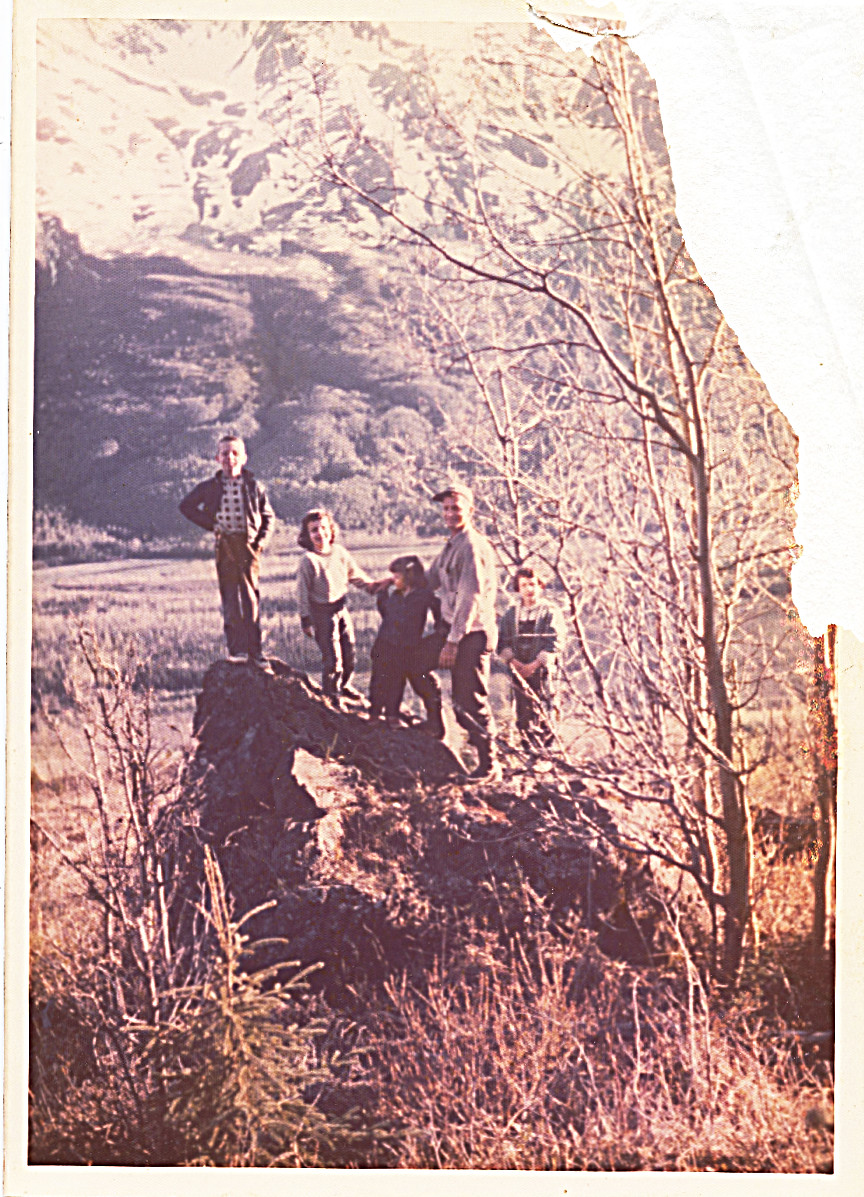
I went last year, and ‘hiding’ in the kitchen suit me.  Serving food to others suit me.  Being quiet suit me.  Watching and listening to others (as if they belonged to a different species than I do) suit me.  I am not sure that I have ever truly felt any more a part of a group than I did in the picture of my father and his three favored children on the big Alaskan rock.

++

At 59 knowing that I can’t CHANGE how I feel pisses me off more than anything else.  I no longer have the false desire to try, either.  I am soul tired.

People say, “Everyone feels alone in a crowd sometimes.”  I believe it takes a special kind of severely traumatic and abusive infant-childhood for anyone to REALLY even begin to have a glimmer of a clue what ‘feeling alone’ really feels like.

Then I thought some more about Christ on the cross.  I thought some more about my horrible, horrible childhood and the ‘special hell’ my mother reserved for me (as my oldest brother put it once).  I thought about how NO INFANT or CHILD ever deserves the treatment that some of us had any more than Jesus deserved what happened to Him during His time on this earth.

This thought cheered me up a TINY bit.

Maybe it is because I feel so sad and soul weary that I cannot find any way at all to fight to ‘get better than this’ any more.  I can’t run around and ‘try this’ and ‘try that’ and ‘run here’ and ‘run there’ like I used to.  I can’t distract myself any more.  I can’t fool myself any more.  I can’t pretend any more.

I was, most importantly, able to be different for the 35 years of my life that I had a child under 18 in my care to raise.  My ‘caregiving system’ was able to combine with my attachment to my children to get me down the road without having to have to FEEL the depths of my sadness.

I know now that the sadness has always been at my center since my insanely abusive mother built it into me from the time I was born.  I am so proud of myself that I was able to let my children GO, to let them fly, to let them create for themselves their OWN life.  I certainly wish they didn’t live — all three of them — in Fargo, North Dakota!

++

Another train of my thoughts today (again) followed the course of my wandering lost life that seemed to most importantly enable all three of the very special people my children are to be born.  Yet I also NEVER felt that the life I lived along the way was mine, meant for me, belonged to me.  Maybe it is ONLY to the future that the meaning of my own life will come true — in my children, in their lives, the people they encounter and affect — and in the next generations.

If my body processed experience and stored my memories in a safe and securely attached fashion (autobiographical memory) I know I would feel different and be different today.  My dissociational patterns means that all of my memories feel remote to me and NOT a part of ME.  That is so WRONG — and so directly connected as a consequence of my having to build a body-brain in the midst of such terrible and continuing trauma.

I don’t believe my memories comfort me in the way that they do more ‘ordinary’ people — and they never have.

++

I think knowing and feeling all of this is directly connected to the most fortunate opportunity I have to work outside with the soil to build a garden.

I laid a big piece of the drip irrigation in the back yard yesterday, and today I planted there.  In went poppy seeds, larkspur seeds, pansy seeds — all waiting now for winter rains to nourish them — and for spring.

I planted a lilac today and I planted an apple tree.  (I moved a rose bush to a happier place for it with morning light so I could better improve the spot for the apple tree.)

I am digging out an area by the back turquoise wood fence as I imagine perhaps — just perhaps — I can tear down the remains of the old shed on my back fence and use that lumber to build a chicken coop.

I use the adobe from that digging to fill in a long planter along the tall yellow metal fence.

I have an adobe bench back there I can sit on in the sun and watch the apple tree grow now.  If I can build a chicken coop I could sit there and watch my chickens.  I would LOVE to be able to do that — though I don’t have transportation to get to a feed store to buy them feed — even if I can afford to buy it — and can find three chickens.

And maybe a little rabbit.  I could sit like I did when I was a child with my warm fuzzy so-gentle rabbit on my lap — pat it and get to know its spirit.

++

Someday I hope somebody comes to visit me.  I find down here in southeastern Arizona that people do not go to one another’s house to be with one another like they do up north.  I couldn’t handle the ‘stimulation-noise’ of too many people — or the ‘wrong’ people.  But SOMEONE?

My daughter will bring my grandson down about the 4th to the 8th of this January.  That will be — well — fantastically wonderful!  Then they will go and then I will miss them…….

Meanwhile……….  Perhaps the angels like it if I talk to them.

(Oh — and yesterday I laid the drip over the large compost pile filled with delicious garbage and the thousand worms my sister sent me from Seattle!  I moved the buried tomb that contained all my mother’s writings into the big compost — and guess what?  For the first time in the four years I’ve lived on this property I saw centipedes — nested within my mother’s papers.  HOW GROSS!  I hate centipedes!  Very unsettling, but somehow didn’t surprise me — certainly not after my recent posts about eliminating the hideous oleanders!  The wonderful composting worms can have those papers now — and I KNOW they will make me wonderful garden soil out of them by spring!)

++++++++++++++++++++++++

+TWO DRAWINGS MY MOTHER DID BEFORE 8TH BIRTHDAY (1933)

++++++++++++++++++++

Link here to two drawings my mother did right before her 8th birthday.

*1933 Nov 5 Mildred’s 2 Indian Drawings (she was almost 8)

++++++++++++++++++++

+THINKING ABOUT ANIMALS, PEOPLE, COMPASSION

++++++++++++++++++++

ON THE DEVELOPMENT OF HUMAN COMPASSION — Neanderthals had feelings too, researchers say

“Spikins and col­leagues have em­barked on what they call the “u­nique chal­lenge” of chart­ing the de­vel­op­ment of hu­man com­pas­sion. They stud­ied ar­chae­o­log­i­cal ev­i­dence for the way emo­tions, as they claim, be­gan to emerge in our early an­ces­tors and then de­vel­oped to more re­cent hu­mans such as Ne­an­der­thals and our­selves. The re­search by Spikins, An­dy Need­ham and Holly Ruth­er­ford is pub­lished in the re­search jour­nal Time and Mind.”

“In mod­ern hu­mans start­ing 120,000 years ago, com­pas­sion was ex­tend­ed to strangers, an­i­mals, ob­jects and ab­stract con­cepts, ac­cord­ing to the Spikins group’s mod­el.

“Compas­sion is per­haps the most fun­da­men­tal hu­man emo­tion. It binds us to­geth­er and can in­spire us but it is al­so frag­ile and elu­sive,” Spikins said. “This ap­par­ent fragil­ity makes ad­dress­ing the ev­i­dence for the de­vel­op­ment of com­pas­sion in our most an­cient an­ces­tors a un­ique chal­lenge, yet the ar­chae­o­log­i­cal rec­ord has an im­por­tant sto­ry to tel­l.”

++

Why Do We Anthropomorphize?

By Rick Nauert PhD Senior News Editor

“Neuroscience research has shown that similar brain regions are involved when we think about the behavior of both humans and of nonhuman entities, suggesting that anthropomorphism may be using similar processes as those used for thinking about other people.

Anthropomorphism carries many important implications. For example, thinking of a nonhuman entity in human ways renders it worthy of moral care and consideration. In addition, anthropomorphized entities become responsible for their own actions — that is, they become deserving of punishment and reward.

Although we like to anthropomorphize, we do not assign human qualities to each and every single object we encounter. What accounts for this selectivity? One factor is similarity. An entity is more likely to be anthropomorphized if it appears to have many traits similar to those of humans (for example, through humanlike movements or physical features such as a face).”

++

How Much Babies Know
Emily Sohn

“Scientists who specialize in brain development do agree on one thing: The ways in which babies sort objects into groups is a key sign of brain development.”

“Infants are learning how things move around in the world by watching their caretakers do actions and then deciding which things are like those objects, based on having the same parts,” Rakison says. “Then, they model the action.”

Young infants will learn nearly anything, Rakison says. As they get older, they become less likely to accept scenarios that don’t make sense—like cows with wheels or cars that hop.

Certain categories, however, may be so important that even very young infants learn them quickly. In his most recent experiments, Rakison showed spidery images to 5- and 9-month-olds.

The babies looked longer at realistic-looking spiders than at squished or scrambled spiderlike shapes. Babies as young as 10 months were also quicker to respond with fear to fake snakes and spiders than they were to cute stuffed rabbits, even when researchers acted as if they themselves feared the fluffy toys.

The results suggest that babies are born with some sense of what spiders and snakes are. “I’m not saying that they know [these animals are] bad or scary or dangerous,” Rakison says. “They’re simply prepared to learn.”

++

Your Brilliant Baby in Week 22: Knowing Which Objects Move Themselves

Baby’s Brain in Week 22

“By now your baby is paying close attention to how people and animals, as compared to objects, move. Baby realizes that animate objects (you, the cat, her big brother) move on their own, and inanimate objects (her binky, chairs, the balls she loves to watch roll) move only when carried, pushed, pulled, or tossed by an external agent. Baby seems driven to understand that animate objects engage in self-motion and that inanimate objects don’t.”

Your Brilliant Baby in Week 33: Discovering Which Objects Bump!

Baby’s Brain in Week 33

“By now, Baby has a firmer grasp on how the world gets around. She understands how people and animals move as compared to balls and toy cars. She’s likely surmised that animate objects don’t necessarily move in straight lines but may change direction without any obvious force acting upon them (although no, she doesn’t get that whole “free will” concept yet). And she seems to understand that a person has the capacity to look like he is going to get a drink or water but then changes course and turns on the computer instead.”

++

Infant Brain Development

(Scroll down past the video for the very nice outline of infant brain development!)

++

People With Autism And Asperger Syndrome Process Faces As Objects, Yale Study Of Brain Abnormalities Finds

ScienceDaily (Apr. 21, 2000)

+++++++++++++

OXYTOCIN

Compassion Cure

A natural hormone boosts social skills for autistic patients

By Michael Rosenwald

++

‘Cuddle chemical’ could treat mental illness

Maia Szalavitz

“Overall, oxytocin’s role in the brain appears to be to link social contact with pleasure. Without it, social species could not function. This, of course, includes humans. Evidence is emerging that oxytocin plays a central role in many aspects of human life, including romantic and social interactions and parenting. “It’s the glue of society, so simple yet so profound,” says Paul Zak, director of the Center for Neuroeconomics Studies in Claremont, California.”

“Eric Hollander of Mount Sinai School of Medicine in New York is studying what happens when you give oxytocin to autistic adults. He has found that it improves their ability to recognise emotions like happiness and anger in people’s tone of voice, something autistic people struggle with. A single intravenous infusion produced improvements that lasted two weeks (Biological Psychiatry, vol 61, p 498).

Hollander has also found that oxytocin increases his volunteers’ ability to recognise faces and interpret emotional expressions. Prior studies have already shown that when autistic people see faces, they activate brain areas normally used to recognise inanimate objects. Hollander says his preliminary results show that when given oxytocin intravenously, autistic people are more able to recruit the normal face-recognition area, the fusiform gyrus. Oxytocin also reduced their repetitive behaviours.”

“One argument for starting oxytocin treatment early in a child’s life is that it appears to play a crucial role in brain development during infancy, helping babies learn to associate social contact with calmness and pleasure. For example, rats that receive more grooming from their mothers are better able to manage social stress. “In rats which get lots of attention from mom, there is a higher level of oxytocin in certain parts of the brain than in those that get less. These are systems shaped by early life experience,” says Young.

Zak adds: “We find in animal studies that if the mother neglects the baby, the number of oxytocin receptors atrophies.” Similarly, studies of monkeys raised without mothers find that they have lower oxytocin levels than monkeys reared normally.

The influence of oxytocin on mother-infant attachment can be seen in humans, too. Children who suffer severe early neglect – for example, raised without individual attention in a bare orphanage – often have symptoms indistinguishable from those of autism. A 2005 study found that children who had spent the first few months or years of their lives in a Romanian orphanage had lower than normal oxytocin responses to contact with their adoptive mothers (Proceedings of the National Academy of Sciences, vol 102, p 17237).

As a result of such work, Hollander is interested to see whether oxytocin can help alleviate disorders associated with early neglect. One of these is borderline personality disorder, which is overwhelmingly associated with childhood trauma. People with this disorder have severe relationship problems, find social stress difficult to cope with and rejection unbearable.

If oxytocin can help treat borderline personality disorder, then it could help rescue abused and neglected children from a lifetime of mental health problems. These children are at higher risk of developing virtually every psychiatric illness, from post-traumatic stress disorder to addiction, depression, anxiety disorders, antisocial personality disorder and schizophrenia.”

+++++++++++++

‘WILD CHILD’

THE CIVILIZING OF GENIE

By Maya Pines

Wild Child Speechless After Tortured Life

+++++++++++++++++++++++++++++++++++++++++++++++++++

Extinct and Endangered Animals

++

Tigers could be extinct in 12 years if unprotected

By IRINA TITOVA, Associated Press Irina Titova, Associated Press – Sun Nov 21, 7:26 pm ET

ST. PETERSBURG, Russia – Wild tigers could become extinct in 12 years if countries where they still roam fail to take quick action to protect their habitats and step up the fight against poaching, global wildlife experts told a “tiger summit” Sunday.

The World Wildlife Fund and other experts say only about 3,200 tigers remain in the wild, a dramatic plunge from an estimated 100,000 a century ago.

++

Published on Thursday, July 15, 2010 by The Independent/UK

Hudson Bay Polar Bears ‘Could Soon Be Extinct’

by Michael McCarthy, Environment Editor

++

World Wildlife Fund – Almost a quarter of the world’s animals are in danger of extinction

++

Should pandas be left to face extinction?

*UPDATE* – Pandas To Go Extinct (Hopefully!)

— (Not my opinion, obviously!)

+++++++++++++++++++++++++++

+AFRAID OF MY ANGER

+++++++++++++++++

Just noting how absolutely uncomfortable I am with being angry — at anyone or anything for any reason.  I have no idea what ‘healthy anger’ might be — no idea if there even is such a thing.  No idea if some of this ‘healthy anger’ might be useful in combating sadness?

I heard a long time ago that ‘depression is anger turned inward’.  No idea if that statement might be remotely true, either.  It’s all a muddle to me — but today?  Angry and afraid of it.

I just know that I NEVER NEVER feel my anger is ‘justified’ or that I have a right to EVER be angry.  Therefore if I do feel angry, I am WRONG to feel it and I have to ‘make it go away’ ASAP.  So how am I going to learn anything useful about or from my anger if I cannot tolerate even feeling it?  Hum…

Anger — all anger — confuses and disorients me.

+++++++++++++++++

+THE POWER OF LEARNING HOW TO SHORTCUT THE TRAUMA CYCLE

+++++++++++++++++++++++

Over the past thirty years since I first encountered the 12-step program’s emphasis on the absolute necessity of ‘letting go’ of resentments, I have until this past week always considered that what made resentments tick is anger.  Buried anger, sideways anger, justified or unjustified anger, recognized or unrecognized anger — any way I have looked at resentments from the viewpoint of my interpretation of what the 12-steppers say about resentments is that they carry within them the seed-kernel of anger.

From my recent experiences of having to re-look at the topic of resentments, it is NOW clear to me — from my own inner knowing place — that what I can tell about other people’s continuing resentments is that they do not carry anger.  They carry hurt from deep, unrecognized, undealt with, unhealed wounds.

Looking again at Grice’s Maxims as several of my recent posts have mentioned, I realize that the misinformation being communicated when a person expresses a resentment — the information that is OVERLY focused on in the expression, the irrelevant information that is expressed, and the truthful, powerful, important information that is NOT being expressed all end up pointing toward a wound that is too big to cope with in any other known way.

++++

Yes, resentments APPEAR most often to be anger focused and anger driven.  Anger holds a very specific (and special) place on the full circle of the stress-not stressed nervous system-brain survival response system.

I see peace and calm as being what we need at the center of this system.  Anger is at the “GO” area of the ‘fight’ stress response.  When anger is connected to good, effective, manageable, known tools for improving the chances of continued survival it is useful.  It is tied to both confidence in known abilities to solve problems and to competence.

In effect, anger says, “I have seen this problem before and kicked its butt.  This is how I did it, and I know if I use these same tools and abilities THIS time it will lead to the same positive results.  The problem will be solved and the ‘threat’ will be beaten.”

++

If the stress-calm response system is operating effectively, when it is seen that the anger-fight response was NOT successful, a person automatically moves into the next quadrant of the response system — FEAR.

Fear, of course, can be tied to continual experience of anxiety.  What matters is that fear lead forward into something effective for solving the threat-conflict-challenge.

Fear is designed to give us the information that what we tried before to solve a similar problem was NOT effective this time around — on this particular problem we face.  The fear is the body’s response to the recognition of lack of competence to overcome and ‘beat’ the challenge, and thus to the feeling state of lack of confidence.

Fear says, “Uh Oh!  THAT sure didn’t work!  Now I am in big trouble!  I better learn something new here, and learn it fast or I am Bye Bye!”

It’s great if a person can jump off of the twirly stress-calm response carousel right here by learning something new from the situations surrounding THIS particular trauma.  They can simply take a shortcut back to the anger quadrant of the circle and get to work — and WIN — whatever that entails — so that they can as quickly as possible return to the center point of peace, calm and well-being.

++

But what if nothing can be discovered to cope in a new effective way with the immediate challenge?  What if one tries their darnedest and comes up with — ZIPPO?  Oh, dear, and you guessed it!  The person moves on to the next quadrant of this response circle into sadness.  And oh this can be just as big a problem as ending up stuck in either of the previous two spots of anger or fear.

BUT — and this is something I thought a lot about about a year ago.  SADNESS is one of the most positive points on this circle a person can reach because if any particular problem that has not responded to all known attempts to apply what is known fail, this is the most productive spot for learning something very new, very different, very creative — and very productive.

At the same time in our current culture sadness can be the most difficult state to move out of.   It is like finding oneself stuck in a giant pothole or trying to get over a giant hill.  When in sadness, our life force, our energy, our confidence, our sense of competence to solve problems in a great way so we can get back to peace and calm are at its lowest.

And it is at THIS point on the stress-calm response system circle that I think resentments lie — not at the anger spot.

Resentments, though they do not usually seem to concern themselves directly with a REAL problem, only some fantasized version of an irrelevant problem, are actually probably about sadness — hopelessness — despair.  What is lacking at this particular point on this system-wheel is most often the ability to access the needed external support and encouragement from other people.

Tossing resentments around at others does not quite motivate them to step in with warmth and compassion to lend a willing helping hand.

Resentments thrown at others is most often (in non-trauma drama conditions) to bring this response.  “I have no idea where you are coming from and I am not remotely interested in finding out.  When YOU figure it out, let me know.  I am NOT going to join you in THAT misery.”

++

I haven’t yet mentioned what I see as the 4th point on this survival wheel.  While it is a response point that is BEST entered FIRST when a challenge appears to ongoing life and/or well-being, it can also very commonly be the LAST point we enter.

But no matter whether we get there first when we receive a challenge, or last if we are faced with something we have no effective first response for, it is the one that benefits us as do no others.

If a challenge does not overwhelm our abilities to respond to it effectively, we simply leave our center point of peace and calm into the quadrant of confident competence — and deal with it.  From there, once the problem has been solved, we can take the very simple and very short step back to our center of peaceful calm.

I used to include joy and happiness in my thinking about this survival response wheel, but I no longer do.  Feeding my suspicions is the physiological fact that our ‘happiness center’ resides in a particular very small area in our later forming LEFT brain, not in our earliest forming, directly-body-connected, more ancient emotional-social RIGHT brain.

All the processes I am describing within the stress-survival wheel happen in connection with perceived threats that are fundamentally challenging our well-being on a deeper level than do those that simply challenge our more peripheral ‘happiness center’.  This state of happy joy is, in my thinking, a more highly evolved condition that relies upon all the other systems in our body to work profitably and effectively.

++

If a person has ‘learned’ adequate responses to solve problems and knows how and when to use these responses, the ‘fight’ or anger quadrant of our survival response never needs to be entered.  Neither does the fear one, or the sadness one.

But few of us are so fortunate to ‘win’ in every situation first time around.  We are left in vulnerable bodies feeling vulnerable and have to WORK and LEARN as we go on through life.  Getting stuck in any place around the wheel means that we are deprived of the benefits of spending the majority of our time in the life-nurturing center of peace and calm.

++

So, when I think about some of the resentments other people who are important to me tossed in my direction lately, I do agree that their resentments do not accurately follow Grice’s Maxims of reasonable conversation or ‘polite speech’.  The resentments are not ‘on topic’ for the situations that stimulated their appearance.  The resentments are NOT providing enough of the right, accurate, truthful information about what the problem that person is facing REALLY is.  Hence, the resentments are not relevant.

Resentments are fantastic.  They are tied into a fantasy that by tossing out these particular ‘words’ nobody will really detect the true state of hopeless sadness that is, in fact, feeding the real problems.  Resentments are a cover-up for missing confidence and actual competence for solving problems that have created wounds that are not healing.

So, yes, it would appear that genuine empathy and compassion would be the most accurate response a resentment-receiver could make.

Not so simple as it might sound.

Because resentments are themselves signals that there is unresolved ongoing trauma in a person’s life, it can be very difficult to negotiate a non-trauma drama response in feeling, thought, word and action.  How to relate to a person who has just thrown the glove of combat while NOT responding in kind — and while avoiding stepping into the quicksand of ongoing trauma drama?

As far as I can tell the first step is for me to recognize that a problem-challenge has presented itself.  The second step is to try to accurately define what the challenge ACTUALLY is.

These two steps must be taken on some level every single time we are challenged with a problem, large trauma or not.

The third step is for me to assess my abilities to respond effectively and appropriately.  That I am having to stop and do this step AT ALL lets me know I lack the confidence in my competence to immediately solve the conflict-problem for myself (1st or is it the 4th point on the survival wheel?)

Well, in my case this won’t be the first step on the wheel.  I have to work through my anger, my fear, my sadness — and arrive hopefully at the fourth position of appropriate and effective response IN TIME.  It is not happening instantaneously.

I could be stuck in anger at the person, at the situation, at myself for not knowing how to actively cope with it effectively.  I could be stuck in fear that I did something wrong, that I am stupid, that I am going to lose this relationship forever.  Then I could be stuck in hopeless sadness.

OR, I can take the benefit from being in movement around this wheel which is — I am presented with the opportunity to LEARN SOMETHING NEW that will be effective THIS time, and possibly in the future as well.

If I CAN learn something new that works and might work in the future, I can possibly spare myself all this trouble next time!

What I do know is that because there is a problem-challenge (rupture) to my abilities that my known responses did not resolve (repair) I am left NOT feeling peaceful and calm.

While I am not responsible for how other people ARE or for what they DO, I am responsible (by choice) for finding new ways to process my way through life that do not involve me jumping into the quicksand of trauma drama — not my own, not anyone else’s.

++

What I suspect is most devastating about not having the RIGHT response to a problem-challenge immediately available (known and tested) is that as we then enter into the stress response wheel we lose our connection to that center place of peaceful calm.  What I want to explore here for myself in this new opportunity for learning that has been presented to me is this:  “Is there a way to allow myself to move around this very natural wheel of what it takes to learn something new to repair a rupture while I STAY CONNECTED to the powers that the/my center of peace and calm provide to me””

Because I have trauma altered development due to growing up from birth in an insanely abusive, traumatizing, malevolent world, I at the same time have two related ‘disabilities’.

(1) I have a disorganized-disoriented (dissociating) insecure attachment pattern built into my physiology — which includes my nervous system-brain-mind-self AND my stress-calm response system.

(2) I have co-occurring emotional regulation difficulties.

So what I want to practice is how to stay in contact with my peace and calm center, which lets me know that I am safe and secure no matter what at the same time I allow myself to feel all the other emotions that exist in my body, as they are processed, and as the information about how I feel is fed to my attention from my right brain.

In other words, how to I peacefully and calmly experience this state along with the other multiple and difficult emotional states at the same time — and ALSO continue to work my way through the stress circle to come out with a non-trauma effective solution?

Good question.  Very good question.  And I don’t yet have the answer but I have confidence at least that my efforts are positive.

I am also aware that I am working on the level of my physiology as I apply myself to this effort.  That alone is great progress for me, to know that I cannot live my life without my body being a part of every experience that I have!  I cannot simply try to THINK my way through this without feeling all of it also.

The other most important point for me to realize is my commitment to working my way through these present conflicts without dissociating.  It seems like a lot to ask of myself — like believing I could pick up 40 gallon milk jugs and begin to juggle them through the air like some imagined pro would.

Nope, wrong information.  Right brain, wrong image.  That’s as silly a thought and as useless and irrelevant as any resentment is.  I cannot resent myself for not knowing how to do everything perfectly.  It is not productive for me to fault myself for not knowing all the answers.

Rather I can encourage myself and think about all the things I have done competently.  And I can know that no matter what the problem-challenge, all of us can always learn something new, useful and effective!  And as we do this learning work we are wearing an ever deepening rut around the stress-trauma-calm response wheel so that every next time we are challenged we can move around it faster (or skip it all together) so that we spend less time in the difficult states and more time in the center state where peace and calmness supply us with our well-being.

+++++++++++++++++++++++